

Literacy Play 30
 |
Description
Book Introduction
The current generation finds it difficult to read even short texts.
We must lay a solid foundation for literacy before it is too late.
To do that, you need to start by building your basic vocabulary.
Vocabulary is not a skill that can be developed in a short period of time.
You need to constantly encounter a variety of words in your daily life to grow, but it's difficult to put this into practice.
Studying vocabulary separately is not only difficult, but if you force it, children will develop psychological resistance.
However, if you deal with a variety of words through fun games, your vocabulary will naturally increase.
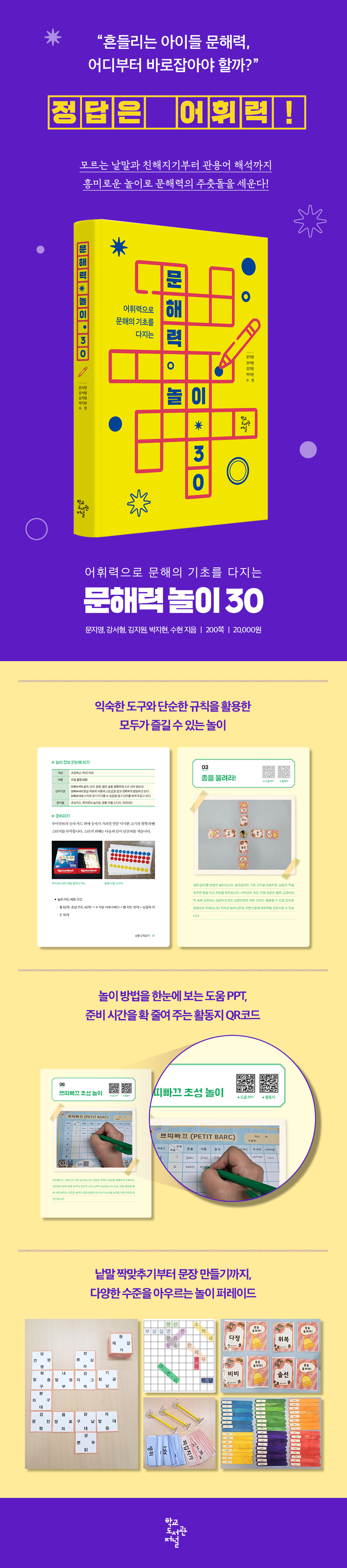
This book contains 30 literacy games carefully selected by five teacher-librarians who have studied children's literacy for a long time based on their actual classroom experiences.
Teachers who are concerned about children who have difficulty reading textbooks due to poor literacy skills will find a way to improve their literacy skills in this book.
We must lay a solid foundation for literacy before it is too late.
To do that, you need to start by building your basic vocabulary.
Vocabulary is not a skill that can be developed in a short period of time.
You need to constantly encounter a variety of words in your daily life to grow, but it's difficult to put this into practice.
Studying vocabulary separately is not only difficult, but if you force it, children will develop psychological resistance.
However, if you deal with a variety of words through fun games, your vocabulary will naturally increase.
This book contains 30 literacy games carefully selected by five teacher-librarians who have studied children's literacy for a long time based on their actual classroom experiences.
Teachers who are concerned about children who have difficulty reading textbooks due to poor literacy skills will find a way to improve their literacy skills in this book.
- You can preview some of the book's contents.
Preview
index
ㆍEntering
Literacy Play Step 1: Learning Words
01 Waggle Waggle Words
02 Puzzle as I like
03 Crossword Map
04 Word Land Grabbing
05 Power Together Word Puzzle
06 Petit Pack Initial Consonant Play
07 Catching Word Thieves
08 jumbled initial letters
09 Master of Initial Consonants
10 123 Initial Consonant Game
Literacy Game Level 2: Word Matching
01 Emoji Book Riddle
02 Perfect Word King
03 Remember the doodle
04 Every single detail of volunteer work
05 Pinocchio, the coach of the eye
06 I can't find it, cuckoo!
07 The Rose of Sharon has bloomed
08 Words Alkagi
09 Find Word Friends
10 word telepathy
Literacy Play Step 3: Expanding the Words
01 Four-character idioms for the four directions: East, West, South, and North
02 Jjajang and Danmuji
03 Ring the bell!
04 Idiom Jewels hanging in clusters
05 Punctuation Running
06 Confused! Korean
07 Ttu Ttu Captain
08 Rainbow Story Stick
09 AI Hide and Seek
10 Word Maze Escape
Appendix: Library Play
01 Book Hunt Operation
02 Book Title Catching
03 Electricity as I wish
04 Patchwork Novelist
05 Book Detective Game
Literacy Play Step 1: Learning Words
01 Waggle Waggle Words
02 Puzzle as I like
03 Crossword Map
04 Word Land Grabbing
05 Power Together Word Puzzle
06 Petit Pack Initial Consonant Play
07 Catching Word Thieves
08 jumbled initial letters
09 Master of Initial Consonants
10 123 Initial Consonant Game
Literacy Game Level 2: Word Matching
01 Emoji Book Riddle
02 Perfect Word King
03 Remember the doodle
04 Every single detail of volunteer work
05 Pinocchio, the coach of the eye
06 I can't find it, cuckoo!
07 The Rose of Sharon has bloomed
08 Words Alkagi
09 Find Word Friends
10 word telepathy
Literacy Play Step 3: Expanding the Words
01 Four-character idioms for the four directions: East, West, South, and North
02 Jjajang and Danmuji
03 Ring the bell!
04 Idiom Jewels hanging in clusters
05 Punctuation Running
06 Confused! Korean
07 Ttu Ttu Captain
08 Rainbow Story Stick
09 AI Hide and Seek
10 Word Maze Escape
Appendix: Library Play
01 Book Hunt Operation
02 Book Title Catching
03 Electricity as I wish
04 Patchwork Novelist
05 Book Detective Game
Detailed image
Into the book
Vocabulary is difficult to develop in a short period of time, so it requires small, consistent efforts, like getting wet in a drizzle. And for today's children who are accustomed to the fast and intense stimulation of the digital world, fun is essential.
--- p.6
Since it was a game that everyone from elementary school to high school could participate in, I made a puzzle board with words that could be found in the library, but since there were no hints, the children had a hard time solving it.
You can make the game more enjoyable by considering the vocabulary of the participants, such as giving a few hints based on the level of the children or revealing the most difficult words in advance.
--- p.33
When ambiguous words like 'kindness' and 'consideration' are listed one after another, children naturally exclaim in admiration.
While playing, children struggle to understand their own doodles, but they can also check which words they know correctly and think about appropriate ways to express them.
--- p.70
Play time took about 15 to 20 minutes based on a 4*4 play board.
By prompting children to explain the meaning of words during play, you can check whether they know the words correctly.
If children do not know the meaning of a word, they should be taught immediately.
--- p.95
Playing with cards that you make yourself will increase your child's concentration and interest.
Since the card maker is also involved, it is easy to check the correct answer and mediation is quick when a conflict arises.
--- p.127
Continuous iterative guidance is needed to avoid using punctuation marks in the wrong places.
For example, the sentence 'I ate rice' requires guidance because it is inappropriate to put a question mark at the end.
--- p.141
This is a board game-style game that helps develop vocabulary, teamwork, and creative thinking.
We aim to develop comprehensive vocabulary usage through various activities such as finding antonyms, finding synonyms, and creating questions.
--- p.6
Since it was a game that everyone from elementary school to high school could participate in, I made a puzzle board with words that could be found in the library, but since there were no hints, the children had a hard time solving it.
You can make the game more enjoyable by considering the vocabulary of the participants, such as giving a few hints based on the level of the children or revealing the most difficult words in advance.
--- p.33
When ambiguous words like 'kindness' and 'consideration' are listed one after another, children naturally exclaim in admiration.
While playing, children struggle to understand their own doodles, but they can also check which words they know correctly and think about appropriate ways to express them.
--- p.70
Play time took about 15 to 20 minutes based on a 4*4 play board.
By prompting children to explain the meaning of words during play, you can check whether they know the words correctly.
If children do not know the meaning of a word, they should be taught immediately.
--- p.95
Playing with cards that you make yourself will increase your child's concentration and interest.
Since the card maker is also involved, it is easy to check the correct answer and mediation is quick when a conflict arises.
--- p.127
Continuous iterative guidance is needed to avoid using punctuation marks in the wrong places.
For example, the sentence 'I ate rice' requires guidance because it is inappropriate to put a question mark at the end.
--- p.141
This is a board game-style game that helps develop vocabulary, teamwork, and creative thinking.
We aim to develop comprehensive vocabulary usage through various activities such as finding antonyms, finding synonyms, and creating questions.
--- p.166
Publisher's Review
Children who struggle to read even textbooks need to start by improving their vocabulary.
The episode of mistaking '중식' for Chinese food and '금일' for Friday has spread like a meme, but it has become something that cannot be laughed off in the classroom.
Due to a lack of basic vocabulary, the number of children who have difficulty reading books has increased, going beyond simply having difficulty reading books to having difficulty even reading textbooks appropriate for their grade level.
A lack of vocabulary creates a vicious cycle in literacy development.
To improve literacy, you need to practice reading frequently, but if there are too many unfamiliar words, it is difficult to read, so the opportunity to develop literacy is blocked.
This is why we introduce literacy play in this book.
The 30 vocabulary-centered literacy games are designed to stimulate children's interest and encourage them to learn words voluntarily. The content of the games is designed to take into account the stage of literacy development so that word learning leads to sentence and text unit learning.
Literacy cannot be developed by reading books alone.
Now is the time to establish vocabulary and lay the foundation for literacy development.
Systematically develop vocabulary through 30 step-by-step games.
The 30 literacy games introduced here are divided into 3 levels of 10 each.
Step 1 is 'Word Mastery', which helps you become familiar with unfamiliar and difficult words.
We introduce a game that allows you to become familiar with words by frequently reading them with your eyes and mouth, even if you don't know their meaning, just like 'find the same picture'.
Step 2 is 'Word Linking', where you connect words whose meanings you have only vaguely guessed or are only familiar with through sight to their correct meanings.
In particular, for abstract words that are difficult to distinguish, such as ‘kindness’ and ‘consideration,’ we introduce one-on-one correspondence games, such as ‘puzzle matching,’ because we need to know the exact meaning.
Step 3 is 'Word Expansion', which looks at words that are difficult to guess the meaning of just by looking at them, such as idioms or proverbs, and expands the play category to the sentence level by utilizing punctuation marks and spacing.
If you go through these three steps one by one, your vocabulary will naturally grow and your basic literacy skills will become firmly established.
Contains the expertise of five librarians who have studied children's literacy.
Literacy is an ability that develops through reading various types of texts, but it is difficult to read consistently when reading comprehension is difficult due to limited vocabulary.
Five school librarians, who understood this situation better than anyone else, developed games that would stimulate children's interest while also helping them develop their vocabulary. They carefully selected 30 games after practicing them directly with their students.
Fun games can be repeated many times without losing focus for children, and through the process of repeating such games, children naturally learn words.
In addition, we introduced flexible forms of play that can be used for learning not only everyday terms but also academic terms, and we introduced various forms of play, from simple to full-fledged, so that students can choose the appropriate play depending on the remaining time during class.
The necessary materials were prepared in a short period of time, and specially designed play boards and activity sheets were included with QR codes so that they could be printed out anywhere.
The episode of mistaking '중식' for Chinese food and '금일' for Friday has spread like a meme, but it has become something that cannot be laughed off in the classroom.
Due to a lack of basic vocabulary, the number of children who have difficulty reading books has increased, going beyond simply having difficulty reading books to having difficulty even reading textbooks appropriate for their grade level.
A lack of vocabulary creates a vicious cycle in literacy development.
To improve literacy, you need to practice reading frequently, but if there are too many unfamiliar words, it is difficult to read, so the opportunity to develop literacy is blocked.
This is why we introduce literacy play in this book.
The 30 vocabulary-centered literacy games are designed to stimulate children's interest and encourage them to learn words voluntarily. The content of the games is designed to take into account the stage of literacy development so that word learning leads to sentence and text unit learning.
Literacy cannot be developed by reading books alone.
Now is the time to establish vocabulary and lay the foundation for literacy development.
Systematically develop vocabulary through 30 step-by-step games.
The 30 literacy games introduced here are divided into 3 levels of 10 each.
Step 1 is 'Word Mastery', which helps you become familiar with unfamiliar and difficult words.
We introduce a game that allows you to become familiar with words by frequently reading them with your eyes and mouth, even if you don't know their meaning, just like 'find the same picture'.
Step 2 is 'Word Linking', where you connect words whose meanings you have only vaguely guessed or are only familiar with through sight to their correct meanings.
In particular, for abstract words that are difficult to distinguish, such as ‘kindness’ and ‘consideration,’ we introduce one-on-one correspondence games, such as ‘puzzle matching,’ because we need to know the exact meaning.
Step 3 is 'Word Expansion', which looks at words that are difficult to guess the meaning of just by looking at them, such as idioms or proverbs, and expands the play category to the sentence level by utilizing punctuation marks and spacing.
If you go through these three steps one by one, your vocabulary will naturally grow and your basic literacy skills will become firmly established.
Contains the expertise of five librarians who have studied children's literacy.
Literacy is an ability that develops through reading various types of texts, but it is difficult to read consistently when reading comprehension is difficult due to limited vocabulary.
Five school librarians, who understood this situation better than anyone else, developed games that would stimulate children's interest while also helping them develop their vocabulary. They carefully selected 30 games after practicing them directly with their students.
Fun games can be repeated many times without losing focus for children, and through the process of repeating such games, children naturally learn words.
In addition, we introduced flexible forms of play that can be used for learning not only everyday terms but also academic terms, and we introduced various forms of play, from simple to full-fledged, so that students can choose the appropriate play depending on the remaining time during class.
The necessary materials were prepared in a short period of time, and specially designed play boards and activity sheets were included with QR codes so that they could be printed out anywhere.
GOODS SPECIFICS
- Date of issue: October 24, 2025
- Page count, weight, size: 200 pages | 148*210*20mm
- ISBN13: 9788969151940
- ISBN10: 896915194X
You may also like
카테고리
korean


korean

![GQ KOREA Mark (Monthly): December [2025]](http://librairie.coreenne.fr/cdn/shop/files/8ef265dbbfbf186523ed75ba7319009d.jpg?v=1765340328&width=3840)


