

The Unbearable Lightness of Being
 |
Description
Book Introduction
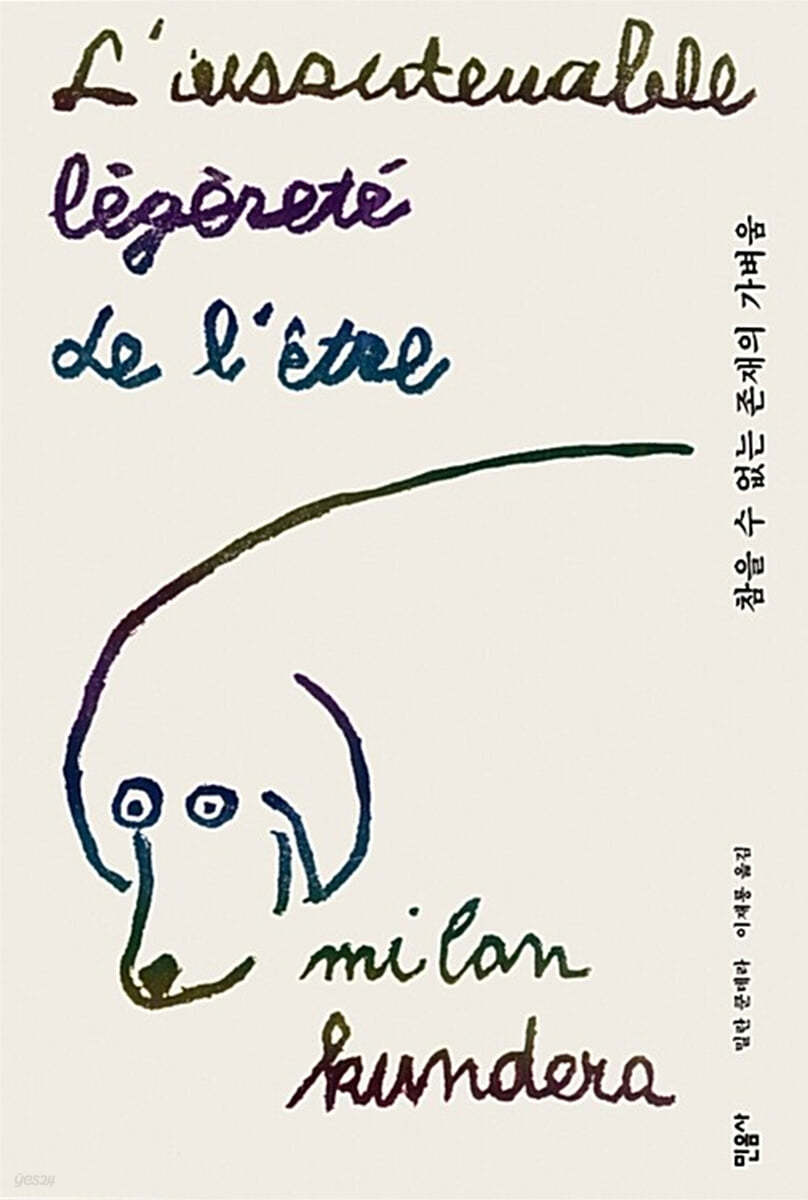
“They loved each other, “You gave the other person a hell of a ride.” Celebrating the 30th anniversary of domestic publication and reaching 1 million copies in domestic sales Renewal volume publication A writer who is nominated for the Nobel Prize in Literature every year, but who also avoids interviews and public activities and calls himself a recluse. A Czech writer who experienced the Prague Spring firsthand and fled to France to escape political persecution, including being banned from writing and selling his works. A writer from the 20th century, not so far from the present, but already a living legend. Koreans have a special love for Milan Kundera. His representative work, The Unbearable Lightness of Being, has sold over 1 million copies in Korea, and Minumsa has also published the complete works of Milan Kundera (15 volumes in total). Readers who love Kundera come from all walks of life, including advertiser Park Woong-hyun, pianist Kim Dae-jin, painter Hwang Ju-ri, and novelists Kim Young-ha and Kim Yeon-su. In particular, in 2016, it was included in the top 10 of ‘Books Loved by Intellectuals of Our Time’ selected by Naver’s ‘Intellectuals’ Library’. The rave reviews of Kundera began among Western intellectuals immediately after his novels were introduced in French. In the preface to the French edition of Kundera's first novel, The Joke, the poet Aragon praised Kundera as "one of the greatest novelists of this century, a writer who proves that the novel is as indispensable to man as bread," adding that he "possesses a technique that no writer of our time can match." Salman Rushdie also called Kundera “undoubtedly the greatest artist the world has ever seen.” As such, Kundera, who is considered one of the greatest contemporary novelists of the 20th century, has received numerous literary awards, including the Prix Médicis of France, the Clement Lucquet Prize, the Premio Letterario Mondello Prize, the Europa Prize, the Czech Writers' Union Prize, the Czech Writers' and Publishers' Prize, the Commonwealth Prize, the LA Times Novel Prize, and the Duka Foundation Prize, for his works, and is nominated for the Nobel Prize in Literature every year. The University of Michigan in the United States awarded him an honorary doctorate in recognition of his literary contributions. Minumsa, which has an exclusive contract to publish Kundera's works, has released a renewed edition of "The Unbearable Lightness of Being" to commemorate the 30th anniversary of Milan Kundera's introduction in Korea. "The Unbearable Lightness of Being" was first introduced to Korea when it was reprinted in the fall 1988 issue of the quarterly [World Literature], and was published as a book on November 20, 1988, shortly after its publication. At the time, Professor Song Dong-jun, a German literature scholar, translated and published the German version, but in February 1999, it was republished with a translation by Professor Lee Jae-ryong, a French literature scholar. This was at the request of the original author, Milan Kundera, who stated that translating the French edition was most faithful to his original work. The newly renewed edition of 『The Unbearable Lightness of Being』 is expected to once again capture the attention of young readers living in the 21st century with its fresh cover and binding designed based on illustrations by Milan Kundera himself, unlike the previously published world literature and author collection versions. |
- You can preview some of the book's contents.
Preview
index
Part 1: Lightness and Heaviness 7
Part 2: Soul and Body 67
Part 3: Words Not Understood 139
Part 4: Soul and Body 213
Part 5: Lightness and Heaviness 287
Part 6, The Great Journey, 393
Part 7: Karenin's Smile 463
Part 2: Soul and Body 67
Part 3: Words Not Understood 139
Part 4: Soul and Body 213
Part 5: Lightness and Heaviness 287
Part 6, The Great Journey, 393
Part 7: Karenin's Smile 463
Into the book
He felt an indescribable love for her, even though he knew almost nothing about her.
She looked like a child who had been thrown into the river in a pine tar-proof basket and then retrieved from his bedside.
--- p.14
At that moment, it occurred to him that she had been inside his body for a long time and was now dying.
Suddenly, it felt like an obvious truth that he wouldn't be able to survive after she died.
He wanted to lie down next to her and die together.
He lay motionless for a long time, his cheek pressed against hers, lost in these thoughts.
Now he remembered that moment.
If what I experienced then wasn't love, then what was it?
--- p.16
Having sex with a woman and sleeping with her are two different, almost conflicting passions.
Love is not expressed in the desire to have sex (which applies to many women), but in the desire to sleep together (which applies to only one woman).
--- p.29
We all believe that love is something light, something that weighs nothing at all.
We imagine that our love must be like this.
I also believe that without love, our lives would no longer be life.
--- pp.64~65
Unlike necessity, chance has this magical power.
For a love to become an unforgettable love, many coincidences must come together from the very first moment, like birds gathering on the shoulders of St. Francis.
--- p.87
She thought their meeting was based on a mistake from the beginning.
The Anna Karenina she had under her armpit that day was a fake ID card she used to deceive Tomas.
They loved each other, yet they gave each other hell.
It is true that they loved.
The evidence is that the error did not stem from themselves, their behavior, or their emotions, but from their inability to coexist.
Because he was strong and she was weak.
--- p.132
His love for this woman, whom he had fallen in love with a few months ago, was so precious that he struggled to create a separate space for her in his life, a pure and untouchable realm.
--- p.142
“Why don’t you use your power on me sometimes?”
“Because to love means to give up power,” Franz said softly.
--- p.187
Her drama was not a drama of heaviness, but a drama of lightness.
It was not the burden that weighed her down, but the unbearable lightness of being.
--- p.203
Love begins with a metaphor.
In other words, love begins the moment a woman is etched into our poetic memory through language.
--- p.343
If excitement is a mechanical device that the Creator uses for amusement, then love is something that belongs solely to our power, and through it we escape from the Creator.
Love, it is our freedom.
--- p.387
He was reminded of the famous myth from Plato's Symposium.
In ancient times, humans possessed both sexes, but God separated them into halves, and from then on, they wandered around trying to find their halves.
Love is the desire for the lost half of ourselves.
--- p.391
What she said was sad, but somehow they were happy.
They were happy not because they had to overcome their sadness, but because of their sadness.
--- p.484
Does he love me? Does he love someone else more than me? Does he love me more than I love him? All these questions—questioning, weighing, exploring, and examining love—could destroy it in its very bud.
If we can't love, it's probably because we want to be loved.
In other words, it may be because they do not approach others without any demands and simply ask for their presence, but rather want something else (love).
--- p.491
Human time does not rotate in a circle, but moves in a straight line.
Since happiness is a desire for repetition, this is also the reason why humans cannot be happy.
--- p.492
Oh my God, did he really have to come all this way to be sure that he loved him?
--- p.511
She felt the same strange happiness, the same strange sadness now as she had then.
This sadness meant that we were at the final destination.
This happiness meant that we were together.
Sadness was the form, happiness was the content.
Happiness filled the space of sadness.
She looked like a child who had been thrown into the river in a pine tar-proof basket and then retrieved from his bedside.
--- p.14
At that moment, it occurred to him that she had been inside his body for a long time and was now dying.
Suddenly, it felt like an obvious truth that he wouldn't be able to survive after she died.
He wanted to lie down next to her and die together.
He lay motionless for a long time, his cheek pressed against hers, lost in these thoughts.
Now he remembered that moment.
If what I experienced then wasn't love, then what was it?
--- p.16
Having sex with a woman and sleeping with her are two different, almost conflicting passions.
Love is not expressed in the desire to have sex (which applies to many women), but in the desire to sleep together (which applies to only one woman).
--- p.29
We all believe that love is something light, something that weighs nothing at all.
We imagine that our love must be like this.
I also believe that without love, our lives would no longer be life.
--- pp.64~65
Unlike necessity, chance has this magical power.
For a love to become an unforgettable love, many coincidences must come together from the very first moment, like birds gathering on the shoulders of St. Francis.
--- p.87
She thought their meeting was based on a mistake from the beginning.
The Anna Karenina she had under her armpit that day was a fake ID card she used to deceive Tomas.
They loved each other, yet they gave each other hell.
It is true that they loved.
The evidence is that the error did not stem from themselves, their behavior, or their emotions, but from their inability to coexist.
Because he was strong and she was weak.
--- p.132
His love for this woman, whom he had fallen in love with a few months ago, was so precious that he struggled to create a separate space for her in his life, a pure and untouchable realm.
--- p.142
“Why don’t you use your power on me sometimes?”
“Because to love means to give up power,” Franz said softly.
--- p.187
Her drama was not a drama of heaviness, but a drama of lightness.
It was not the burden that weighed her down, but the unbearable lightness of being.
--- p.203
Love begins with a metaphor.
In other words, love begins the moment a woman is etched into our poetic memory through language.
--- p.343
If excitement is a mechanical device that the Creator uses for amusement, then love is something that belongs solely to our power, and through it we escape from the Creator.
Love, it is our freedom.
--- p.387
He was reminded of the famous myth from Plato's Symposium.
In ancient times, humans possessed both sexes, but God separated them into halves, and from then on, they wandered around trying to find their halves.
Love is the desire for the lost half of ourselves.
--- p.391
What she said was sad, but somehow they were happy.
They were happy not because they had to overcome their sadness, but because of their sadness.
--- p.484
Does he love me? Does he love someone else more than me? Does he love me more than I love him? All these questions—questioning, weighing, exploring, and examining love—could destroy it in its very bud.
If we can't love, it's probably because we want to be loved.
In other words, it may be because they do not approach others without any demands and simply ask for their presence, but rather want something else (love).
--- p.491
Human time does not rotate in a circle, but moves in a straight line.
Since happiness is a desire for repetition, this is also the reason why humans cannot be happy.
--- p.492
Oh my God, did he really have to come all this way to be sure that he loved him?
--- p.511
She felt the same strange happiness, the same strange sadness now as she had then.
This sadness meant that we were at the final destination.
This happiness meant that we were together.
Sadness was the form, happiness was the content.
Happiness filled the space of sadness.
--- p.516
Publisher's Review
A cruel metaphor for the fleeting love that permeates existence.
Young Tereza, who was barely making a living working in a small bar in her hometown, meets Tomas, a surgeon who is visiting the city on a business trip.
As they both thought that their meeting was so fateful that they would never forget it, Tereza went to see him, carrying only Tolstoy's Anna Karenina and a suitcase.
After divorcing his ex-wife, Tomas, who has been burdened by serious love, cannot let go of Tereza's fragile charm, like a "baby floating down the river," and begins to live with her as if taking in an orphan.
However, Tomas cannot give up the 'light life' he calls 'erotic friendship' and goes from woman to woman.
Tereza, who watches Tomas like that, struggles with the pain of jealousy and resignation.
After the Czech Republic lost its freedom due to the Soviet invasion, the two moved to Switzerland together.
Tereza, who believed that leaving the Czech Republic would also allow her to escape Tomas's lovers, loses faith due to Tomas's constant infidelity and returns to Prague alone across the border.
The lives of two people, mixed with jealousy and hatred, gradually gain weight.
Meanwhile, Sabina, another of Tomas's lovers and a painter, longs to live freely, free from the weight of her homeland and history that persistently follows her.
Even when she eats, draws, or walks down the street, she cannot bear the label of "a woman who lost her country" attached to her.
Sabina goes as far away from the Czech Republic as she can.
Franz, a scholar who loves Sabina and a father who enjoys a stable daily life, is captivated by Sabina's 'lightness'.
The lives and loves of these four men and women, bearing the heavy scars of history and personal trauma, mirror our own, wandering between the "unbearable" heaviness and lightness of life today.
On the meaninglessness of our one and only life, which cannot be returned
“What eternal return asserts is that life is like a mere shadow, because once it is gone it never returns, and so living has no weight, and we are as good as dead from the beginning, so no matter how cruel, beautiful, or brilliant life may be, even that cruelty, beauty, and brilliance are meaningless.” - From the text
In "The Unbearable Lightness of Being," the author tells a love story, a special and unforgettable one.
Teresa and Thomas meet by chance and continue their love for each other in their own ways until they die together in a car accident.
Their fate is not inevitable.
Because in the end, it is nothing more than the product of an accumulation of irreversible decisions, accidental events, and constraints that we have somehow accepted.
Yet, these two are entangled in that bondage and live their entire lives under the weight of existence.
Tomas constantly repeats this in this work.
“It is absolutely impossible to know what a person should desire.
Because people only live once, and they cannot compare their past lives with their present lives, nor can they correct their future lives by comparing them with their present lives.
(…) Something that happens only once is as if it never happened.
“To live only once is to not live at all (Einmal ist Keinmal.)” Based on this idea, which twists Nietzsche’s idea of eternal recurrence, Kundera thoroughly explores the meaninglessness of this life that is both “one time” and “nothing.”
Kundera depicts Tomas wandering between the 'lightness' implied by Nietzsche's idea of eternal recurrence and the 'heaviness' of 'It must be so! (Es muss sein!)', one of the motifs of Beethoven's music.
The motif of the fourth movement of the final quartet of Beethoven's Opus 135, 'It must be so! (Es muss sein!)', signifies restraint, duty, and a transition from light to heavy.
Among the various attitudes toward life, Kundera depicts a wandering crowd, weighing the contradictory weight of life.
A work that contains Milan Kundera's historical and philosophical thoughts.
“History is as light as an individual life, as unbearably light, as light as a feather, as light as dust blown by the wind, as light as something that will disappear tomorrow.”
- From the text
Can a single life be free from history? Whether trivial or profound, should we accept it as fate? This novel, which follows the love stories of four men and women, is set against the backdrop of the trials that shook Czechoslovakia in the 1960s and Europe in the 1970s.
The Czech Republic, which is now far away, is firmly embedded in the center of Kundera's work as if it were the main character.
The author's origins were in the Czech Republic.
Kundera himself experienced the tragedy and personal persecution that took place in his homeland, and these experiences are reflected in many of his works.
But at the same time, Kundera, in his recent essay “Curtain,” stated that history itself—social movements, wars, revolutions and counter-revolutions, national humiliations—is not something that novelists should depict, denounce, or interpret.
The novelist is not a “servant of the historian,” and the history that fascinates the novelist is only “history as a searchlight that illuminates human existence.”
As Kundera said, art as history, or the history of art, is fleeting, and “the chirping of art will be eternal,” this work was born from history, but because it deals with human existence itself that transcends history, it will remain an immortal classic loved forever.
Young Tereza, who was barely making a living working in a small bar in her hometown, meets Tomas, a surgeon who is visiting the city on a business trip.
As they both thought that their meeting was so fateful that they would never forget it, Tereza went to see him, carrying only Tolstoy's Anna Karenina and a suitcase.
After divorcing his ex-wife, Tomas, who has been burdened by serious love, cannot let go of Tereza's fragile charm, like a "baby floating down the river," and begins to live with her as if taking in an orphan.
However, Tomas cannot give up the 'light life' he calls 'erotic friendship' and goes from woman to woman.
Tereza, who watches Tomas like that, struggles with the pain of jealousy and resignation.
After the Czech Republic lost its freedom due to the Soviet invasion, the two moved to Switzerland together.
Tereza, who believed that leaving the Czech Republic would also allow her to escape Tomas's lovers, loses faith due to Tomas's constant infidelity and returns to Prague alone across the border.
The lives of two people, mixed with jealousy and hatred, gradually gain weight.
Meanwhile, Sabina, another of Tomas's lovers and a painter, longs to live freely, free from the weight of her homeland and history that persistently follows her.
Even when she eats, draws, or walks down the street, she cannot bear the label of "a woman who lost her country" attached to her.
Sabina goes as far away from the Czech Republic as she can.
Franz, a scholar who loves Sabina and a father who enjoys a stable daily life, is captivated by Sabina's 'lightness'.
The lives and loves of these four men and women, bearing the heavy scars of history and personal trauma, mirror our own, wandering between the "unbearable" heaviness and lightness of life today.
On the meaninglessness of our one and only life, which cannot be returned
“What eternal return asserts is that life is like a mere shadow, because once it is gone it never returns, and so living has no weight, and we are as good as dead from the beginning, so no matter how cruel, beautiful, or brilliant life may be, even that cruelty, beauty, and brilliance are meaningless.” - From the text
In "The Unbearable Lightness of Being," the author tells a love story, a special and unforgettable one.
Teresa and Thomas meet by chance and continue their love for each other in their own ways until they die together in a car accident.
Their fate is not inevitable.
Because in the end, it is nothing more than the product of an accumulation of irreversible decisions, accidental events, and constraints that we have somehow accepted.
Yet, these two are entangled in that bondage and live their entire lives under the weight of existence.
Tomas constantly repeats this in this work.
“It is absolutely impossible to know what a person should desire.
Because people only live once, and they cannot compare their past lives with their present lives, nor can they correct their future lives by comparing them with their present lives.
(…) Something that happens only once is as if it never happened.
“To live only once is to not live at all (Einmal ist Keinmal.)” Based on this idea, which twists Nietzsche’s idea of eternal recurrence, Kundera thoroughly explores the meaninglessness of this life that is both “one time” and “nothing.”
Kundera depicts Tomas wandering between the 'lightness' implied by Nietzsche's idea of eternal recurrence and the 'heaviness' of 'It must be so! (Es muss sein!)', one of the motifs of Beethoven's music.
The motif of the fourth movement of the final quartet of Beethoven's Opus 135, 'It must be so! (Es muss sein!)', signifies restraint, duty, and a transition from light to heavy.
Among the various attitudes toward life, Kundera depicts a wandering crowd, weighing the contradictory weight of life.
A work that contains Milan Kundera's historical and philosophical thoughts.
“History is as light as an individual life, as unbearably light, as light as a feather, as light as dust blown by the wind, as light as something that will disappear tomorrow.”
- From the text
Can a single life be free from history? Whether trivial or profound, should we accept it as fate? This novel, which follows the love stories of four men and women, is set against the backdrop of the trials that shook Czechoslovakia in the 1960s and Europe in the 1970s.
The Czech Republic, which is now far away, is firmly embedded in the center of Kundera's work as if it were the main character.
The author's origins were in the Czech Republic.
Kundera himself experienced the tragedy and personal persecution that took place in his homeland, and these experiences are reflected in many of his works.
But at the same time, Kundera, in his recent essay “Curtain,” stated that history itself—social movements, wars, revolutions and counter-revolutions, national humiliations—is not something that novelists should depict, denounce, or interpret.
The novelist is not a “servant of the historian,” and the history that fascinates the novelist is only “history as a searchlight that illuminates human existence.”
As Kundera said, art as history, or the history of art, is fleeting, and “the chirping of art will be eternal,” this work was born from history, but because it deals with human existence itself that transcends history, it will remain an immortal classic loved forever.
GOODS SPECIFICS
- Date of publication: June 20, 2018
- Format: Hardcover book binding method guide
- Page count, weight, size: 520 pages | 538g | 125*190*35mm
- ISBN13: 9788937437564
- ISBN10: 8937437562
You may also like
카테고리
korean


korean

![ELLE 엘르 스페셜 에디션 A형 : 12월 [2025]](http://librairie.coreenne.fr/cdn/shop/files/b8e27a3de6c9538896439686c6b0e8fb.jpg?v=1766436872&width=3840)


