

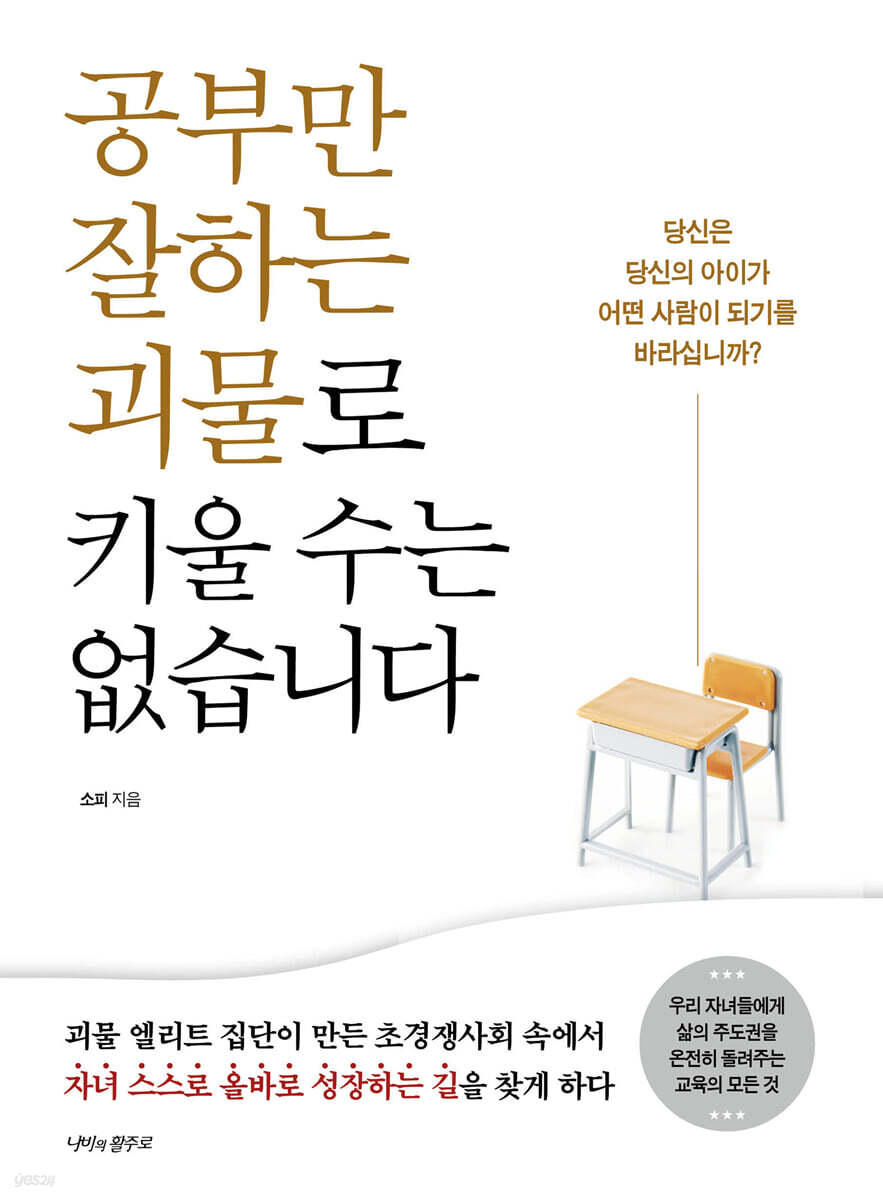
You can't raise a child to be a monster who only studies well.
 |
Description
Book Introduction
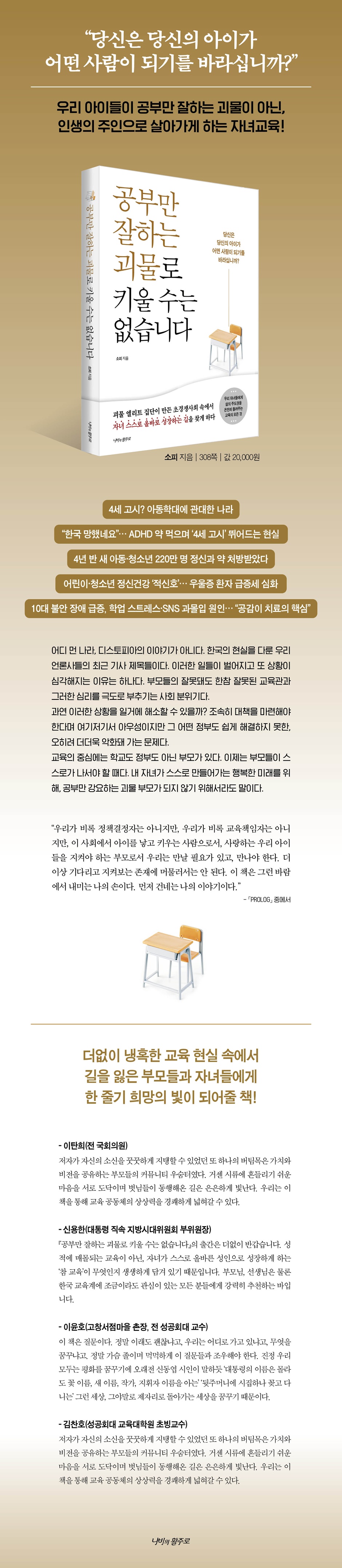
What kind of person do you want your child to become?
Our children are not monsters who only study well,
Educating children to become masters of their own lives!
The '4-year-old exam', which has an unfamiliar name, is causing controversy.
It vividly shows the bleak reality of the Korean education system.
Education that causes suffering to both parents and children.
I know this isn't the right way, but I feel like something bad will happen to my child if I don't do it.
It is true that elite supremacy contributed to our country's growth, but now Korea is facing a great crisis due to the monstrous elite group and the educational environment that only nurtures monstrous elites.
The book, "You Can't Raise Your Child to Be a Monster Who Only Studyes Well," is about "true education" that allows children to grow into upright adults on their own, rather than an education that focuses solely on grades.
This book vividly tells the author's story of how, after realizing that she was turning into a monster because of her children's education, she struggled to find a completely different way of raising them, not only for her children but also for herself.
The educational policy that minimizes parental interference while allowing children to grow up properly and make important choices in their lives, and the resulting positive outcomes, leave a deep impression along with a sense of enlightenment.
We have compiled a comprehensive introduction to education-related books that parents in Korea must read, as discovered while leading the activities of the self-reflective reading movement, ‘Our Breathing Ground.’
Our children are not monsters who only study well,
Educating children to become masters of their own lives!
The '4-year-old exam', which has an unfamiliar name, is causing controversy.
It vividly shows the bleak reality of the Korean education system.
Education that causes suffering to both parents and children.
I know this isn't the right way, but I feel like something bad will happen to my child if I don't do it.
It is true that elite supremacy contributed to our country's growth, but now Korea is facing a great crisis due to the monstrous elite group and the educational environment that only nurtures monstrous elites.
The book, "You Can't Raise Your Child to Be a Monster Who Only Studyes Well," is about "true education" that allows children to grow into upright adults on their own, rather than an education that focuses solely on grades.
This book vividly tells the author's story of how, after realizing that she was turning into a monster because of her children's education, she struggled to find a completely different way of raising them, not only for her children but also for herself.
The educational policy that minimizes parental interference while allowing children to grow up properly and make important choices in their lives, and the resulting positive outcomes, leave a deep impression along with a sense of enlightenment.
We have compiled a comprehensive introduction to education-related books that parents in Korea must read, as discovered while leading the activities of the self-reflective reading movement, ‘Our Breathing Ground.’
- You can preview some of the book's contents.
Preview
index
Recommendation 4
PROLOG 8 Seeing a world ruled by monsters
Chapter 1: Sophie Becomes a Monster
Chapter 2 Who Makes Us Monsters?
Win unconditionally 39
Trust No One 49
You are just 'words' 57
Chapter 3: To avoid becoming a monster
Asking Questions 68
Thinking about the future 75
Chapter 4: Raising People
From 'Well done' to 'Congratulations' 88
What it means to be the master of your own life 94
Between Love and Violence 99
Being Iron 103
How to Overcome Disappointment with Yourself 114
Finding Your Dream 119
Circling the Earth 128
Raising Children Without Comparison 134
Swaying Flower 139
Children Who Grow on Their Own 145
How Internal Order Is Established 150
The Principle of Words Becoming Seeds 154
Order 159, not speed or direction
The World's Best Environment 164
We were all children once 167
What's Not in Our House and What's in Our House 171
Chapter 5: Books We Loved
What Kind of Being Are Children? - Ellen Kay, The Century of Children, p. 183
What Are We Losing? - Erich Fromm, "Why I Repeat Apathy" 190
Why do schools exist? - John Holt, Why Children Fail, 198
How is True Learning Possible? - Ellen Langer, The Mindful Learning Revolution, p. 203
What is the reality of South Korea? - Lee Seung-wook, Shin Hee-kyung, and Kim Eun-san, "Parents of the Republic of Korea" 211
This is not just Seo Yi-cho's case - Kim Hyun-soo, "The Birth of a Monster Parent" 218
Reviving the Broken Continuity - Jean Ridloff, In Search of the Lost Archetypes of Parenting, p. 223
A New Perspective on Parenting - Pamela Druckerman, Like a French Child 229
If you want to know how to truly love children
- Janusz Korczak, How to Love Children 234
How strict and harsh education drives a child to death
- Hermann Hesse, Beneath the Wheel 239
Let's Lead the Korean Education Revolution! - Kim Nu-ri, "Competitive Education is Barbaric" 244
Chapter 6: The Story of Three Children
Y's Story of Silently Going His Own Way, Part 255
Self-Esteem-Boosting P Story 262
Very Happy J Story 266
EPILOGUE You Can't Raise Your Child to Be a Monster Who Only Studyes 270
Appendix: Usumteo Story 280
PROLOG 8 Seeing a world ruled by monsters
Chapter 1: Sophie Becomes a Monster
Chapter 2 Who Makes Us Monsters?
Win unconditionally 39
Trust No One 49
You are just 'words' 57
Chapter 3: To avoid becoming a monster
Asking Questions 68
Thinking about the future 75
Chapter 4: Raising People
From 'Well done' to 'Congratulations' 88
What it means to be the master of your own life 94
Between Love and Violence 99
Being Iron 103
How to Overcome Disappointment with Yourself 114
Finding Your Dream 119
Circling the Earth 128
Raising Children Without Comparison 134
Swaying Flower 139
Children Who Grow on Their Own 145
How Internal Order Is Established 150
The Principle of Words Becoming Seeds 154
Order 159, not speed or direction
The World's Best Environment 164
We were all children once 167
What's Not in Our House and What's in Our House 171
Chapter 5: Books We Loved
What Kind of Being Are Children? - Ellen Kay, The Century of Children, p. 183
What Are We Losing? - Erich Fromm, "Why I Repeat Apathy" 190
Why do schools exist? - John Holt, Why Children Fail, 198
How is True Learning Possible? - Ellen Langer, The Mindful Learning Revolution, p. 203
What is the reality of South Korea? - Lee Seung-wook, Shin Hee-kyung, and Kim Eun-san, "Parents of the Republic of Korea" 211
This is not just Seo Yi-cho's case - Kim Hyun-soo, "The Birth of a Monster Parent" 218
Reviving the Broken Continuity - Jean Ridloff, In Search of the Lost Archetypes of Parenting, p. 223
A New Perspective on Parenting - Pamela Druckerman, Like a French Child 229
If you want to know how to truly love children
- Janusz Korczak, How to Love Children 234
How strict and harsh education drives a child to death
- Hermann Hesse, Beneath the Wheel 239
Let's Lead the Korean Education Revolution! - Kim Nu-ri, "Competitive Education is Barbaric" 244
Chapter 6: The Story of Three Children
Y's Story of Silently Going His Own Way, Part 255
Self-Esteem-Boosting P Story 262
Very Happy J Story 266
EPILOGUE You Can't Raise Your Child to Be a Monster Who Only Studyes 270
Appendix: Usumteo Story 280
Detailed image
Into the book
Life is not a space filled with 'things to do'.
'Things to do' are just one of the many elements that fill the vast space called life, but they are not everything.
But at some point, I was raising my children as if accomplishing those things was my whole life.
Because of this, we have forgotten the other elements, such as love and trust for each other, support and encouragement.
--- p.30
Needless to say, the reason we live a life without a single friend is because the second motto of the Squid Game, “Trust no one,” exists in our society.
In a society where the belief that you cannot survive if you do not win is prevalent, trusting someone is a shortcut to 'elimination'.
This overall social atmosphere naturally affects parents raising children.
How can parents be free from the fact that their children have to survive in the squid game?
The parent community is an invisible battlefield.
The network of parents is a strategic alliance to win the war.
So, although we share information, we cannot honestly discuss the numerous questions that arise while raising children.
There is no one to consult with regarding the numerous problems that people face while raising children.
--- p.53
Saying “congratulations” is fundamentally different from saying “well done.”
The former is used in a situation where you fully acknowledge that all of the results are solely due to you, while the latter is used under the premise that some of the results are also due to the person giving the praise.
Because it is a phrase used when something taught has been done well.
In fact, parents teach their children a lot in their daily lives.
So it is natural to use the word 'well done'.
It's just that at the time, I was so obsessed with giving the initiative back to the children that I decided to change "good job" to "congratulations."
--- p.90
Come to think of it, the kids and I were fundamentally prone to violence.
This means that the balance of power is broken.
Because young children are absolutely weak and have no choice but to depend on me as their mother, and I am the absolute strong one who protects them.
Besides, my relationship with my children is a very private one.
In the public sphere, even if the balance of power is broken, it is not easy for it to escalate into a violent situation, but the power imbalance in the private sphere is different.
Because it is not revealed to the outside.
A secret, private sphere, in a state of disrupted balance of power! It was under such conditions that my violence quietly reared its head.
Like mold that blooms in damp places.
--- p.101
For example, we can tell children what kind of place this world is, what kind of being a human is, what it means to live, and what love is, but in the end, the definition of all these things that are ultimately built in their heads or hearts is up to the children themselves.
This means that each child will be different and that no two children will have the same definition.
What we are saying is that each person will come to their own conclusions by mixing in countless things other than what we teach.
Maybe every moment, without anyone knowing.
'Things to do' are just one of the many elements that fill the vast space called life, but they are not everything.
But at some point, I was raising my children as if accomplishing those things was my whole life.
Because of this, we have forgotten the other elements, such as love and trust for each other, support and encouragement.
--- p.30
Needless to say, the reason we live a life without a single friend is because the second motto of the Squid Game, “Trust no one,” exists in our society.
In a society where the belief that you cannot survive if you do not win is prevalent, trusting someone is a shortcut to 'elimination'.
This overall social atmosphere naturally affects parents raising children.
How can parents be free from the fact that their children have to survive in the squid game?
The parent community is an invisible battlefield.
The network of parents is a strategic alliance to win the war.
So, although we share information, we cannot honestly discuss the numerous questions that arise while raising children.
There is no one to consult with regarding the numerous problems that people face while raising children.
--- p.53
Saying “congratulations” is fundamentally different from saying “well done.”
The former is used in a situation where you fully acknowledge that all of the results are solely due to you, while the latter is used under the premise that some of the results are also due to the person giving the praise.
Because it is a phrase used when something taught has been done well.
In fact, parents teach their children a lot in their daily lives.
So it is natural to use the word 'well done'.
It's just that at the time, I was so obsessed with giving the initiative back to the children that I decided to change "good job" to "congratulations."
--- p.90
Come to think of it, the kids and I were fundamentally prone to violence.
This means that the balance of power is broken.
Because young children are absolutely weak and have no choice but to depend on me as their mother, and I am the absolute strong one who protects them.
Besides, my relationship with my children is a very private one.
In the public sphere, even if the balance of power is broken, it is not easy for it to escalate into a violent situation, but the power imbalance in the private sphere is different.
Because it is not revealed to the outside.
A secret, private sphere, in a state of disrupted balance of power! It was under such conditions that my violence quietly reared its head.
Like mold that blooms in damp places.
--- p.101
For example, we can tell children what kind of place this world is, what kind of being a human is, what it means to live, and what love is, but in the end, the definition of all these things that are ultimately built in their heads or hearts is up to the children themselves.
This means that each child will be different and that no two children will have the same definition.
What we are saying is that each person will come to their own conclusions by mixing in countless things other than what we teach.
Maybe every moment, without anyone knowing.
--- p.151
Publisher's Review
One of the most pressing issues currently affecting Korean society is the 'decline of the elite.'
The practice of forming cartels based on school ties and regionalism and privatizing power and economic interests has already been pointed out countless times.
The emergence of the new term "trash elite," specifically targeting high-ranking officials, journalists, executives of large corporations, and members of the legal profession centered around the prosecution, reflects the nationwide anger and concern over their irresponsible, incompetent, and power-oriented behavior.
The author fundamentally questions what this shocking reality, this deep public concern that "it's not just one president who's weird," means.
And, borrowing the insight of Professor Kim Nu-ri of Chung-Ang University, the answer is found in none other than ‘Korea’s hyper-competitive education.’
It also raises the sharp question of what kind of adults the children who are 'best trained' to be number one in a classroom where competition and the logic of superiority dominate will become.
A series of events, such as the recent Martial Law Incident of December 3, provide a horrifying answer to this question.
The author assesses that this incident had such a shocking effect that it threatened the very existence of the nation that the elites should be thankful that they had been merely hypocritical and irresponsible until now.
The Korean education system, which appeared to be nurturing intelligent and capable leaders on the surface, has in fact been collectively producing "monsters" who are self-centered, blinded by money and power, obsessed with superiority and privilege, and intent on building their own world.
What is even more depressing is the reality that these systems are not stopping and are only getting worse.
The social atmosphere that forces early competition called 'gosi' on 4-year-olds, let alone 7-year-olds, is leading to tragic results such as depression in children as well as adolescents.
The arduous process of raising a child into a fully formed adult is becoming a time of suffering that is several times, even dozens of times more difficult in the hyper-competitive society of South Korea.
So, parents' sighs cannot help but deepen.
"You Can't Raise Your Children to Be Monsters Who Only Study Well" is more than a simple social indictment; it's a stern warning to all parents and educators of this era, and at the same time, a powerful call to action.
As individuals who have experienced the ills of our society's competitive education system throughout their lives, we emphasize that we must no longer allow our children to grow up to be "study-obsessed monsters" and continue this irresponsible lineage of elites.
Hope does not come from external reforms or appointments by an incompetent government.
Rather, we, as victims and subjects of competitive education, must directly reject this flawed system and create a social environment that can nurture the next generation with well-rounded personalities.
The author's vivid experiences in raising children, as well as the true meaning of education discovered through collaboration with like-minded individuals, shine as a clear solution to overcome the crisis facing South Korea.
Although these efforts may not produce immediate, visible results, I am confident they will be sufficient to lay the groundwork for a new era of growth and advancement for the Republic of Korea and to empower our children to become the stars of that stage.
The practice of forming cartels based on school ties and regionalism and privatizing power and economic interests has already been pointed out countless times.
The emergence of the new term "trash elite," specifically targeting high-ranking officials, journalists, executives of large corporations, and members of the legal profession centered around the prosecution, reflects the nationwide anger and concern over their irresponsible, incompetent, and power-oriented behavior.
The author fundamentally questions what this shocking reality, this deep public concern that "it's not just one president who's weird," means.
And, borrowing the insight of Professor Kim Nu-ri of Chung-Ang University, the answer is found in none other than ‘Korea’s hyper-competitive education.’
It also raises the sharp question of what kind of adults the children who are 'best trained' to be number one in a classroom where competition and the logic of superiority dominate will become.
A series of events, such as the recent Martial Law Incident of December 3, provide a horrifying answer to this question.
The author assesses that this incident had such a shocking effect that it threatened the very existence of the nation that the elites should be thankful that they had been merely hypocritical and irresponsible until now.
The Korean education system, which appeared to be nurturing intelligent and capable leaders on the surface, has in fact been collectively producing "monsters" who are self-centered, blinded by money and power, obsessed with superiority and privilege, and intent on building their own world.
What is even more depressing is the reality that these systems are not stopping and are only getting worse.
The social atmosphere that forces early competition called 'gosi' on 4-year-olds, let alone 7-year-olds, is leading to tragic results such as depression in children as well as adolescents.
The arduous process of raising a child into a fully formed adult is becoming a time of suffering that is several times, even dozens of times more difficult in the hyper-competitive society of South Korea.
So, parents' sighs cannot help but deepen.
"You Can't Raise Your Children to Be Monsters Who Only Study Well" is more than a simple social indictment; it's a stern warning to all parents and educators of this era, and at the same time, a powerful call to action.
As individuals who have experienced the ills of our society's competitive education system throughout their lives, we emphasize that we must no longer allow our children to grow up to be "study-obsessed monsters" and continue this irresponsible lineage of elites.
Hope does not come from external reforms or appointments by an incompetent government.
Rather, we, as victims and subjects of competitive education, must directly reject this flawed system and create a social environment that can nurture the next generation with well-rounded personalities.
The author's vivid experiences in raising children, as well as the true meaning of education discovered through collaboration with like-minded individuals, shine as a clear solution to overcome the crisis facing South Korea.
Although these efforts may not produce immediate, visible results, I am confident they will be sufficient to lay the groundwork for a new era of growth and advancement for the Republic of Korea and to empower our children to become the stars of that stage.
GOODS SPECIFICS
- Date of issue: November 5, 2025
- Page count, weight, size: 308 pages | 150*210*18mm
- ISBN13: 9791193110843
- ISBN10: 119311084X
You may also like
카테고리
korean


korean

![GQ KOREA Mark (Monthly): December [2025]](http://librairie.coreenne.fr/cdn/shop/files/8ef265dbbfbf186523ed75ba7319009d.jpg?v=1765340328&width=3840)


