

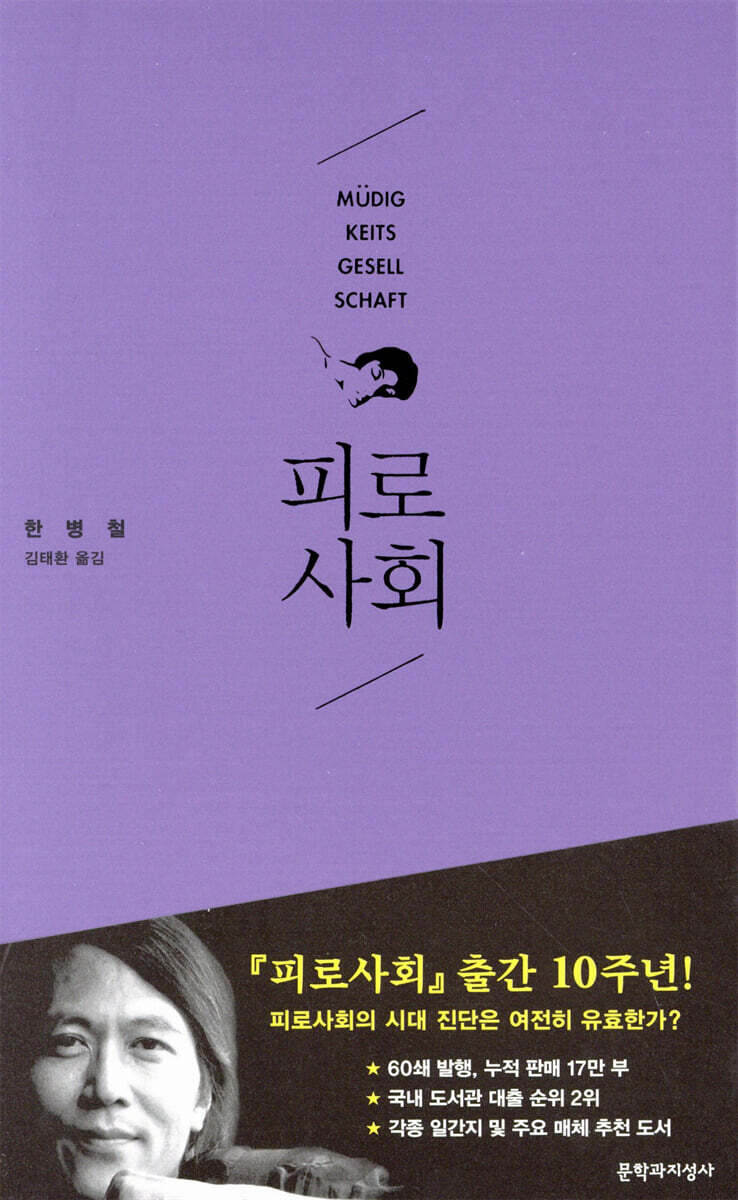
fatigue society
 |
Description
Book Introduction
A philosopher who flew from Korea to Germany criticizes modern society, receiving rave reviews from Germany's most prestigious publications.
An elegant and sharp philosophical diagnosis of our age dominated by depression.
The achievement society born from the evolution of the capitalist system, locking all modern people in labor camps!
As soon as it was published, the book became a hot topic, generating a surprisingly enthusiastic response from readers for a philosophy book, and the author, Byung-Chul Han, is currently the most notable philosopher in Germany.
He was evaluated as a new type of cultural critic who used the language of Western philosophy while incorporating Eastern messages into it, and in this book, he captivated readers by keenly capturing the paradigm shift in modern society.
The author believes that a shift from a society based on hostility and negativity between the self and others to a society where such negativity has been eliminated and positivity dominates instead of negativity has occurred since the latter half of the 20th century. He names this new society a performance society, and the people living in this society a performance subject.
If the society of the past was a society of negativity achieved through prohibition (“you must not do it”), the performance society is a society of positivity where “you can do it” is the highest value.
In this society, success is the only remaining discipline, and the most emphasized thing for success is a positive spirit.
However, positivity unconstrained by negativity results in an excess of positivity and crushes the self in a sense different from the threat or oppression of others.
The ego that seeks to confirm its existence as a subject solely through its own abilities and achievements becomes exhausted, and the frustration of not being able to meet the demands it has set for itself leads to depression.
Seek answers to the questions of why we are still not truly free and why we are not happy.
The author argues that in the face of the hyperactivity and overstimulation of a performance-driven society, we need a life of reflection, inspirational inaction, boredom, and rest.
From this perspective, the concept of 'fatigue' also acquires new meaning.
In a performance-based society, 'fatigue' is a decline in one's ability to do something, and is simply something to be overcome.
But Han Byeong-cheol, who starts from the value of inaction, sees another aspect of fatigue.
Fatigue suppresses the desire for overactivity and alleviates the performance-oriented obsession of a self filled with positive spirit.
The tired ego can break free from the infantile world that whips itself for its own success, restore relationships with others, and find new inspiration.
An elegant and sharp philosophical diagnosis of our age dominated by depression.
The achievement society born from the evolution of the capitalist system, locking all modern people in labor camps!
As soon as it was published, the book became a hot topic, generating a surprisingly enthusiastic response from readers for a philosophy book, and the author, Byung-Chul Han, is currently the most notable philosopher in Germany.
He was evaluated as a new type of cultural critic who used the language of Western philosophy while incorporating Eastern messages into it, and in this book, he captivated readers by keenly capturing the paradigm shift in modern society.
The author believes that a shift from a society based on hostility and negativity between the self and others to a society where such negativity has been eliminated and positivity dominates instead of negativity has occurred since the latter half of the 20th century. He names this new society a performance society, and the people living in this society a performance subject.
If the society of the past was a society of negativity achieved through prohibition (“you must not do it”), the performance society is a society of positivity where “you can do it” is the highest value.
In this society, success is the only remaining discipline, and the most emphasized thing for success is a positive spirit.
However, positivity unconstrained by negativity results in an excess of positivity and crushes the self in a sense different from the threat or oppression of others.
The ego that seeks to confirm its existence as a subject solely through its own abilities and achievements becomes exhausted, and the frustration of not being able to meet the demands it has set for itself leads to depression.
Seek answers to the questions of why we are still not truly free and why we are not happy.
The author argues that in the face of the hyperactivity and overstimulation of a performance-driven society, we need a life of reflection, inspirational inaction, boredom, and rest.
From this perspective, the concept of 'fatigue' also acquires new meaning.
In a performance-based society, 'fatigue' is a decline in one's ability to do something, and is simply something to be overcome.
But Han Byeong-cheol, who starts from the value of inaction, sees another aspect of fatigue.
Fatigue suppresses the desire for overactivity and alleviates the performance-oriented obsession of a self filled with positive spirit.
The tired ego can break free from the infantile world that whips itself for its own success, restore relationships with others, and find new inspiration.
- You can preview some of the book's contents.
Preview
index
Preface to the Korean edition
fatigue society
neurotic violence
In the shadow of a disciplinary society
deep boredom
active life
Education of how to see
In the case of Bartleby
fatigue society
Americas
Depressed society
Americas
Translator's Note
fatigue society
neurotic violence
In the shadow of a disciplinary society
deep boredom
active life
Education of how to see
In the case of Bartleby
fatigue society
Americas
Depressed society
Americas
Translator's Note
Publisher's Review
An elegant and sharp philosophical diagnosis of our age dominated by depression!
“A society of exhaustion is a society of self-exploitation.
“In a fatigued society, modern people are both victims and perpetrators.”
Germany's most prestigious newspaper, Frankfurter Allgemeine Zeitung (FAZ), published a special article on October 2, 2010, highlighting the philosophical achievements of Professor Han Byung-chul of the Karlsruhe University of Fine Arts.
In this article, Professor Han Byung-chul is described as a pioneer of a new kind of cultural criticism.
Cultural criticism is an important tradition in German thought, including Nietzsche, Freud, Adorno, and Benjamin, and therefore it is not surprising that Germany's most prestigious publication has given a Korean philosopher the title of innovator of cultural criticism.
Marc Simons, the author of the above article, points out that while East Asian countries such as China, Japan, and Korea may have demonstrated impressive economic and technological achievements, they have had little ideological influence on the West. He evaluates Han Byung-Chul as breaking this ideological silence and opening up new possibilities for cultural criticism from an East Asian perspective.
This means that Professor Han Byung-chul is the first Asian philosopher to make a big splash in Germany's intellectual world.
After majoring in engineering in his home country, Han Byung-chul, a philosopher living in Germany, began studying philosophy in Germany and has been publishing books consistently with prestigious German publishers. Through “The Fatigued Society,” he has emerged as one of the most notable philosophers in Germany and a new type of cultural critic who uses the language of Western philosophy while incorporating Eastern messages into it.
As soon as it was published, 『The Fatigued Society』 became a hot topic, generating a surprisingly enthusiastic response from readers for a philosophy book.
Almost all major German newspapers and broadcasters covered the book in significant detail, praising it as a sharp examination of the core issues of the times.
In this book, Professor Han Byeong-cheol keenly captures the paradigm shift in modern society.
The change from a society based on hostility or negativity between the self and the other (Cold War, immunology, disciplinary society) to a society where such negativity has been eliminated and positivity dominates instead of negativity has occurred since the latter half of the 20th century.
Professor Han Byeong-cheol calls this new society a performance society, and the people living in this society performance subjects.
If the society of the past was a society of negativity achieved through prohibition (“you must not do it”), the performance society is a society of positivity where “you can do it” is the highest value.
In this society, the only remaining discipline is to succeed, and the most emphasized thing for success is the spirit of positivity (“Yes, we can!”).
However, positivity unconstrained by negativity results in an excess of positivity and crushes the self in a sense different from the threat or oppression of others.
The ego, which seeks to confirm its existence as a subject solely through its own abilities and achievements, becomes exhausted, and the frustration of not being able to meet the demands it has set for itself leads to depression.
Han Byung-chul summarizes these social changes as follows:
“The negativity of a disciplinary society produces madmen and criminals.
On the other hand, a performance-based society creates depressed people and dropouts.”
In this book, the performance society is interpreted as a result of the evolution of the capitalist system.
By encouraging individual desires to achieve greater success through greater achievement, capitalism maximizes overall productivity.
Capitalist exploitation thus takes on the appearance of voluntary exploitation.
The subject of achievement exploits himself.
He is both the perpetrator and the victim.
The performer carries his own labor camp.
When the flood of success books say, “You are your own manager,” Han Byung-chul reads it as, “You are your own exploiter.”
Han Byung-chul advocates the value of a contemplative life, inspiring inaction, boredom, and rest against the hyperactivity and overstimulation of a performance-oriented society.
From this perspective, the concept of 'fatigue' also acquires new meaning.
In a performance-based society, 'fatigue' is a decline in one's ability to do something, and is simply something to be overcome.
But Han Byeong-cheol, who starts from the value of inaction, sees another aspect of fatigue.
Fatigue suppresses the desire for overactivity and alleviates the performance-oriented obsession of a self filled with positive spirit.
The tired ego can break free from the infantile world that whips itself for its own success, restore relationships with others, and find new inspiration.
Han Byung-Chul offers clear answers to the questions people feel in Western society, which has broken down all authority and realized the most complete individual freedom, a society of positivity where negativity seems almost completely eliminated: “Why are we still not truly free?” and “Why are we not happy?”
That may be why the book has had such a huge impact in Germany, the most economically successful country in Europe.
The image of the performance-based society depicted in Han Byung-chul's "Fatigue Society" largely matches the reality of Korean society.
This point is confirmed by the fact that books on life that preach success through the power of positivity are selling well in the Korean book market.
The ideal society that Koreans desire is probably one where ability (achievement) and success coincide.
People also saw this ideal in Huh Gak, who overcame an unfortunate background and became the winner of an audition program with only his singing skills.
However, Han Byung-chul's book makes us realize that the ideal that ability (achievement) = success can never be the goal of an ideal society, as it comes from the paradigm of a performance-based society that makes ability (achievement) the highest value.
When the proposition that "to exist, one must be able to do" becomes an internalized, supreme task in the minds of every individual, society will, as Han Byung-chul said, produce a large number of depressed patients and dropouts.
“A society of exhaustion is a society of self-exploitation.
“In a fatigued society, modern people are both victims and perpetrators.”
Germany's most prestigious newspaper, Frankfurter Allgemeine Zeitung (FAZ), published a special article on October 2, 2010, highlighting the philosophical achievements of Professor Han Byung-chul of the Karlsruhe University of Fine Arts.
In this article, Professor Han Byung-chul is described as a pioneer of a new kind of cultural criticism.
Cultural criticism is an important tradition in German thought, including Nietzsche, Freud, Adorno, and Benjamin, and therefore it is not surprising that Germany's most prestigious publication has given a Korean philosopher the title of innovator of cultural criticism.
Marc Simons, the author of the above article, points out that while East Asian countries such as China, Japan, and Korea may have demonstrated impressive economic and technological achievements, they have had little ideological influence on the West. He evaluates Han Byung-Chul as breaking this ideological silence and opening up new possibilities for cultural criticism from an East Asian perspective.
This means that Professor Han Byung-chul is the first Asian philosopher to make a big splash in Germany's intellectual world.
After majoring in engineering in his home country, Han Byung-chul, a philosopher living in Germany, began studying philosophy in Germany and has been publishing books consistently with prestigious German publishers. Through “The Fatigued Society,” he has emerged as one of the most notable philosophers in Germany and a new type of cultural critic who uses the language of Western philosophy while incorporating Eastern messages into it.
As soon as it was published, 『The Fatigued Society』 became a hot topic, generating a surprisingly enthusiastic response from readers for a philosophy book.
Almost all major German newspapers and broadcasters covered the book in significant detail, praising it as a sharp examination of the core issues of the times.
In this book, Professor Han Byeong-cheol keenly captures the paradigm shift in modern society.
The change from a society based on hostility or negativity between the self and the other (Cold War, immunology, disciplinary society) to a society where such negativity has been eliminated and positivity dominates instead of negativity has occurred since the latter half of the 20th century.
Professor Han Byeong-cheol calls this new society a performance society, and the people living in this society performance subjects.
If the society of the past was a society of negativity achieved through prohibition (“you must not do it”), the performance society is a society of positivity where “you can do it” is the highest value.
In this society, the only remaining discipline is to succeed, and the most emphasized thing for success is the spirit of positivity (“Yes, we can!”).
However, positivity unconstrained by negativity results in an excess of positivity and crushes the self in a sense different from the threat or oppression of others.
The ego, which seeks to confirm its existence as a subject solely through its own abilities and achievements, becomes exhausted, and the frustration of not being able to meet the demands it has set for itself leads to depression.
Han Byung-chul summarizes these social changes as follows:
“The negativity of a disciplinary society produces madmen and criminals.
On the other hand, a performance-based society creates depressed people and dropouts.”
In this book, the performance society is interpreted as a result of the evolution of the capitalist system.
By encouraging individual desires to achieve greater success through greater achievement, capitalism maximizes overall productivity.
Capitalist exploitation thus takes on the appearance of voluntary exploitation.
The subject of achievement exploits himself.
He is both the perpetrator and the victim.
The performer carries his own labor camp.
When the flood of success books say, “You are your own manager,” Han Byung-chul reads it as, “You are your own exploiter.”
Han Byung-chul advocates the value of a contemplative life, inspiring inaction, boredom, and rest against the hyperactivity and overstimulation of a performance-oriented society.
From this perspective, the concept of 'fatigue' also acquires new meaning.
In a performance-based society, 'fatigue' is a decline in one's ability to do something, and is simply something to be overcome.
But Han Byeong-cheol, who starts from the value of inaction, sees another aspect of fatigue.
Fatigue suppresses the desire for overactivity and alleviates the performance-oriented obsession of a self filled with positive spirit.
The tired ego can break free from the infantile world that whips itself for its own success, restore relationships with others, and find new inspiration.
Han Byung-Chul offers clear answers to the questions people feel in Western society, which has broken down all authority and realized the most complete individual freedom, a society of positivity where negativity seems almost completely eliminated: “Why are we still not truly free?” and “Why are we not happy?”
That may be why the book has had such a huge impact in Germany, the most economically successful country in Europe.
The image of the performance-based society depicted in Han Byung-chul's "Fatigue Society" largely matches the reality of Korean society.
This point is confirmed by the fact that books on life that preach success through the power of positivity are selling well in the Korean book market.
The ideal society that Koreans desire is probably one where ability (achievement) and success coincide.
People also saw this ideal in Huh Gak, who overcame an unfortunate background and became the winner of an audition program with only his singing skills.
However, Han Byung-chul's book makes us realize that the ideal that ability (achievement) = success can never be the goal of an ideal society, as it comes from the paradigm of a performance-based society that makes ability (achievement) the highest value.
When the proposition that "to exist, one must be able to do" becomes an internalized, supreme task in the minds of every individual, society will, as Han Byung-chul said, produce a large number of depressed patients and dropouts.
GOODS SPECIFICS
- Date of issue: March 5, 2012
- Page count, weight, size: 128 pages | 160g | 153*224*20mm
- ISBN13: 9788932022888
- ISBN10: 8932022887
You may also like
카테고리
korean


korean

![GQ KOREA Mark (Monthly): December [2025]](http://librairie.coreenne.fr/cdn/shop/files/8ef265dbbfbf186523ed75ba7319009d.jpg?v=1765340328&width=3840)


