

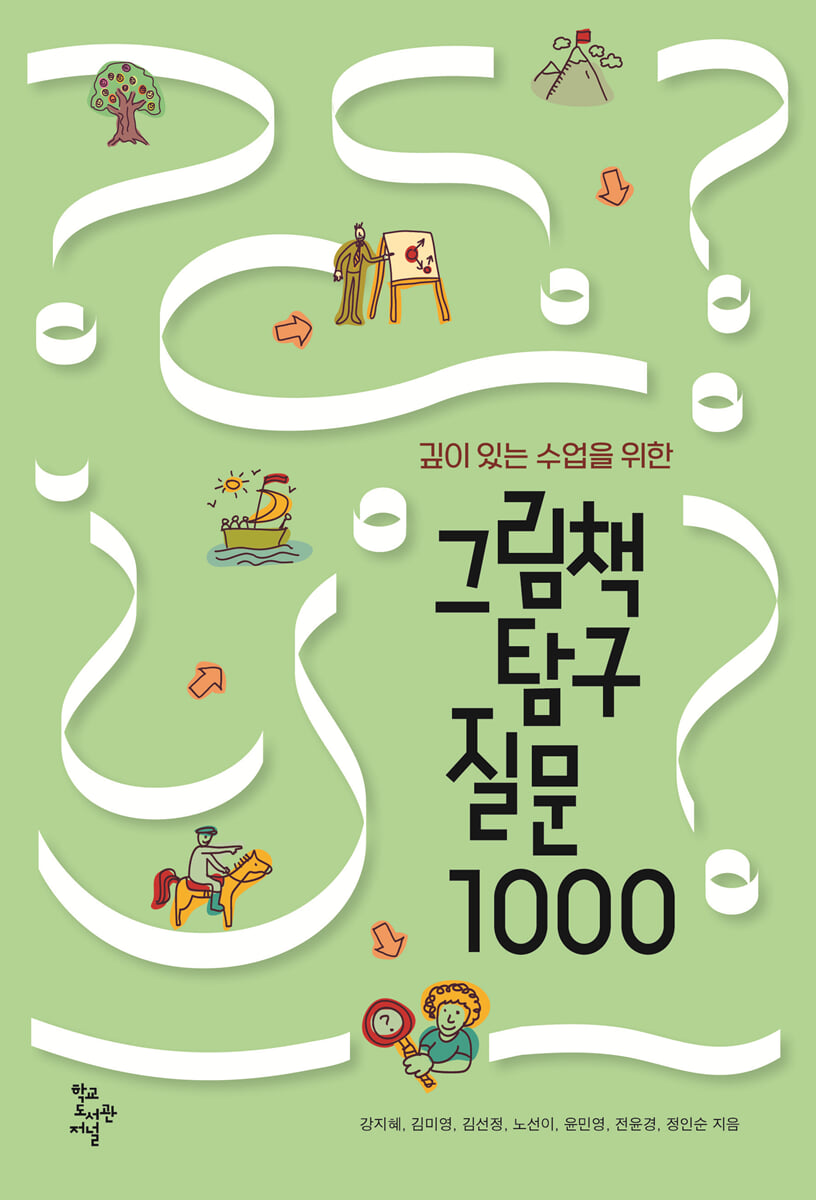
1000 Picture Book Exploration Questions
 |
Description
Book Introduction
A book that presents specific inquiry questions that lead to deeper reading of picture books, broader thinking, and colorful storytelling.
Seven teachers who have been participating in a long-term picture book research group carefully selected 50 excellent picture books tailored to the main areas of social-emotional learning and created approximately 1,800 research questions related to the picture books.
These questions were developed through extensive use by the authors in classes and meetings, as well as through intense discussions and exchange of diverse opinions.
We designed it with deep consideration not only for the appropriateness of individual questions, but also for the flow and continuity between questions.
By using these exploratory questions when reading picture books, children can actively explore the book and become agents who construct their own meaning.
This book will be especially useful for teachers who want to deepen their picture book classes, book club participants who want to engage in rich conversations centered around picture books, and parents and educators who want to expand picture book reading into discussion and reflection.
Seven teachers who have been participating in a long-term picture book research group carefully selected 50 excellent picture books tailored to the main areas of social-emotional learning and created approximately 1,800 research questions related to the picture books.
These questions were developed through extensive use by the authors in classes and meetings, as well as through intense discussions and exchange of diverse opinions.
We designed it with deep consideration not only for the appropriateness of individual questions, but also for the flow and continuity between questions.
By using these exploratory questions when reading picture books, children can actively explore the book and become agents who construct their own meaning.
This book will be especially useful for teachers who want to deepen their picture book classes, book club participants who want to engage in rich conversations centered around picture books, and parents and educators who want to expand picture book reading into discussion and reflection.
- You can preview some of the book's contents.
Preview
index
Entering
Part 1: What are the Picture Book Exploration Questions?
Picture books, why are they exploratory questions?
How to create picture book inquiry questions?
How to conduct a class using picture book inquiry questions?
Part 2: Picture Book Exploration Questions Utilization Class
01 Self-understanding
It's Okay to Be Upside Down 『Upside Down Rabbit Kitty』
The Possibility of Noh's "The Bride with the Oar"
How to Live Simply: "If it's hot, just take it off."
Uniqueness Found Through Flexibility: "Octopus Panties"
A Life Without Regrets? "The Cat Who Lived a Million Times"
Growing Up as a Broccoli: "I Want to Be Loved"
The Challenges and Growth of a Little Snowball 『The Dream of a Little Snowball』
The Whole Me 『Little Piece Pechettino』
Overcoming the Good Child Complex: "Should I Be Good?"
The Preciousness of a Dreaming Life: Kiosk
02 Emotions and Mind
How to Welcome Emotional Guests? "Emotional Hotel"
Want to wash away your worries in a dog bath? "Dog Bath"
Comfort for the little ones: "It'll be okay"
The healing power of tears: "Sea of Tears"
Even a bad day has its moments of goodness. "Oh my goodness, my bad day."
How to escape hatred? "Hatred"
The End of Endless Desire? "The World's Most Delicious Figs"
The Standard of Perfection: Angthong's Perfect Watermelon Field
Growth through Love and Parting: "A Certain Rabbit"
Between Good and Bad Luck: In Pursuit of Good Luck
03 Relationships and Conflicts
What is a boundary-keeping relationship? "Mr. Bear's Chair"
A dazzling friendship that melts winter: "Snow Child"
Together, apart, together 『Tick, tick』
The Joy of the Process: Sam and Dave Digging
The Magic of Positivity: Edward, the Worst Boy in the World
Jealousy and Betrayal 『Fox』
Conflicts Caused by Differences in Opinion: "To the Left Hand"
The Secret of Strange Counting: How We Eat Cake
A special respite for a weary family: "The Kidnapping of Our Family"
A Day It's Okay to Forget 『The Day I Forget』
A Moment of Need for Courage: "The Courage I Forgot"
04 Society and Community
Why the Princess Ate the Poisoned Apple: "Don't Wake the Princess"
Attitudes toward fake news: "Have you heard that rumor?"
What if there's still hope for us? "They Never Made It to Bremen"
Comparison and Discrimination Brought About by Measurement: "We Measure You"
What is true beauty? "Rubinstein is truly beautiful."
How to Coexist with My Pot 『… Anatole's Little Pot』
What if darkness were forbidden? "The King Who Forbidden Darkness"
Seeing the same thing means "Look up!"
To change prejudice into understanding, read 『Iparapanyamunyamu』
The Power of Books That Won War: "The Baron Who Stopped the War with Books"
05 Coexistence and a Sustainable Future
Coexistence and Responsibility in the Climate Crisis: "Snowstorm"
A Voice of Solidarity to Save the Earth: "Water Is Rising in the City"
What if one day you had a companion dragon? "Pet Dragon for Sale"
Things that disappeared due to convenience 『The Vanished Evening』
Warning from the Box 『Box World』
A life worthy of the animal spirit: "Please walk on two feet at the Eden Hotel."
Prescription for the Earth: "Leave it to me!"
The Value of Choice for Life: Perception
To restore the song of nature, 『Panpanpan Popipopi Panpanpan』
Part 1: What are the Picture Book Exploration Questions?
Picture books, why are they exploratory questions?
How to create picture book inquiry questions?
How to conduct a class using picture book inquiry questions?
Part 2: Picture Book Exploration Questions Utilization Class
01 Self-understanding
It's Okay to Be Upside Down 『Upside Down Rabbit Kitty』
The Possibility of Noh's "The Bride with the Oar"
How to Live Simply: "If it's hot, just take it off."
Uniqueness Found Through Flexibility: "Octopus Panties"
A Life Without Regrets? "The Cat Who Lived a Million Times"
Growing Up as a Broccoli: "I Want to Be Loved"
The Challenges and Growth of a Little Snowball 『The Dream of a Little Snowball』
The Whole Me 『Little Piece Pechettino』
Overcoming the Good Child Complex: "Should I Be Good?"
The Preciousness of a Dreaming Life: Kiosk
02 Emotions and Mind
How to Welcome Emotional Guests? "Emotional Hotel"
Want to wash away your worries in a dog bath? "Dog Bath"
Comfort for the little ones: "It'll be okay"
The healing power of tears: "Sea of Tears"
Even a bad day has its moments of goodness. "Oh my goodness, my bad day."
How to escape hatred? "Hatred"
The End of Endless Desire? "The World's Most Delicious Figs"
The Standard of Perfection: Angthong's Perfect Watermelon Field
Growth through Love and Parting: "A Certain Rabbit"
Between Good and Bad Luck: In Pursuit of Good Luck
03 Relationships and Conflicts
What is a boundary-keeping relationship? "Mr. Bear's Chair"
A dazzling friendship that melts winter: "Snow Child"
Together, apart, together 『Tick, tick』
The Joy of the Process: Sam and Dave Digging
The Magic of Positivity: Edward, the Worst Boy in the World
Jealousy and Betrayal 『Fox』
Conflicts Caused by Differences in Opinion: "To the Left Hand"
The Secret of Strange Counting: How We Eat Cake
A special respite for a weary family: "The Kidnapping of Our Family"
A Day It's Okay to Forget 『The Day I Forget』
A Moment of Need for Courage: "The Courage I Forgot"
04 Society and Community
Why the Princess Ate the Poisoned Apple: "Don't Wake the Princess"
Attitudes toward fake news: "Have you heard that rumor?"
What if there's still hope for us? "They Never Made It to Bremen"
Comparison and Discrimination Brought About by Measurement: "We Measure You"
What is true beauty? "Rubinstein is truly beautiful."
How to Coexist with My Pot 『… Anatole's Little Pot』
What if darkness were forbidden? "The King Who Forbidden Darkness"
Seeing the same thing means "Look up!"
To change prejudice into understanding, read 『Iparapanyamunyamu』
The Power of Books That Won War: "The Baron Who Stopped the War with Books"
05 Coexistence and a Sustainable Future
Coexistence and Responsibility in the Climate Crisis: "Snowstorm"
A Voice of Solidarity to Save the Earth: "Water Is Rising in the City"
What if one day you had a companion dragon? "Pet Dragon for Sale"
Things that disappeared due to convenience 『The Vanished Evening』
Warning from the Box 『Box World』
A life worthy of the animal spirit: "Please walk on two feet at the Eden Hotel."
Prescription for the Earth: "Leave it to me!"
The Value of Choice for Life: Perception
To restore the song of nature, 『Panpanpan Popipopi Panpanpan』
Detailed image

Into the book
The power to transform a classroom is not the question that seeks the right answer, but the question that expands students' thinking, prompts them to reexamine the meaning of the story, and prompts them to reflect on their own lives.
--- From "Entering"
To truly understand a picture book, you need to look at the pictures while reading the text, and actively explore how these two elements work together to create the story.
This is the process of exploring and reading picture books.
At this point, the reader constructs meaning based on clues hidden throughout the text.
Classes that construct the meaning of picture books based on questions can also foster other core competencies, such as knowledge information processing skills, creative thinking skills, and aesthetic sensibility skills.
These skills are naturally developed in the classroom, where students read deeply, interpret, and express themselves based on inquiry questions, rather than through the content of the picture book itself.
--- From "Picture Books, Why Exploratory Questions?"
To effectively guide the thought process while reading and exploring picture books, it is important to clearly recognize the direction and depth of thought required by each question and clarify its nature.
Questions are not just tools for verifying information; they can function as cognitive devices that structure and expand students' thinking.
--- From "Entering"
To truly understand a picture book, you need to look at the pictures while reading the text, and actively explore how these two elements work together to create the story.
This is the process of exploring and reading picture books.
At this point, the reader constructs meaning based on clues hidden throughout the text.
Classes that construct the meaning of picture books based on questions can also foster other core competencies, such as knowledge information processing skills, creative thinking skills, and aesthetic sensibility skills.
These skills are naturally developed in the classroom, where students read deeply, interpret, and express themselves based on inquiry questions, rather than through the content of the picture book itself.
--- From "Picture Books, Why Exploratory Questions?"
To effectively guide the thought process while reading and exploring picture books, it is important to clearly recognize the direction and depth of thought required by each question and clarify its nature.
Questions are not just tools for verifying information; they can function as cognitive devices that structure and expand students' thinking.
--- From "How to Create Picture Book Research Questions?"
Publisher's Review
Six Types of Questions That Lead to Deep Reading
Exploratory reading, which involves actively exploring books and delving deeply into topics, enhances students' interpretive abilities as well as their thinking and expressive powers.
To guide students toward this kind of deep reading, the authors decide to use picture books.
This is because picture books create meaning through the interaction of various expressive elements.
The authors created a variety of inquiry questions to encourage students to explore and read the picture books deeply.
The questions are organically connected and structured so that thoughts can naturally expand from before to after reading a book.
Through the process of solving background knowledge questions, fact-checking questions, interpretation and evaluation questions, application questions, choice questions, and core questions, students can move beyond a superficial understanding of the text and construct and express their own thoughts. Furthermore, they can experience the process of collaborative inquiry where they listen to the thoughts of others and create meaning together.
Over 1,800 picture book exploration questions you can use right away in class.
Picture books are very useful in achieving various educational goals and are continuously used in educational settings, but they are often used only as curriculum-linking materials or as tools for activities.
It is not easy for teachers to find books that can be used in class every day, and it is not easy to create questions related to picture books for each class.
To help teachers reduce their workload and transform their classes, we've selected picture books and filled them with questions.
We selected 50 excellent books that fall into five categories reflecting the core competencies of the 2022 revised curriculum and the main areas of social and emotional learning. We created 30 to 40 picture books for each book, containing approximately 1,800 inquiry questions.
After extensive use and intense discussion in classes and meetings by seven teachers, we aimed to present specific and comprehensive questions that can be used directly in class.
The questions are divided into six types, so you can easily select and use the questions that best fit the target and situation.
"Picture Book Activities Plus": Interesting, Experiential, and Exploratory Activity Materials
When using picture book inquiry questions in a class or meeting, students or participants may lose interest or become unengaged as they delve deeply into the picture book to actively answer various questions.
A good tool to use in this situation is ‘Picture Book Activity Plus.’
Each picture book includes activity sheets that anyone who has read the picture book can easily experience and enjoy.
Depending on the situation, it is also possible to reduce the number of exploratory questions and increase the time for picture book activities.
These activities allowed for a natural connection between the core content and questions of the picture book.
The activity sheets are detailed because they were created based on the authors' extensive teaching experience.
It would be useful if you copy and use it or modify it.
Exploratory reading, which involves actively exploring books and delving deeply into topics, enhances students' interpretive abilities as well as their thinking and expressive powers.
To guide students toward this kind of deep reading, the authors decide to use picture books.
This is because picture books create meaning through the interaction of various expressive elements.
The authors created a variety of inquiry questions to encourage students to explore and read the picture books deeply.
The questions are organically connected and structured so that thoughts can naturally expand from before to after reading a book.
Through the process of solving background knowledge questions, fact-checking questions, interpretation and evaluation questions, application questions, choice questions, and core questions, students can move beyond a superficial understanding of the text and construct and express their own thoughts. Furthermore, they can experience the process of collaborative inquiry where they listen to the thoughts of others and create meaning together.
Over 1,800 picture book exploration questions you can use right away in class.
Picture books are very useful in achieving various educational goals and are continuously used in educational settings, but they are often used only as curriculum-linking materials or as tools for activities.
It is not easy for teachers to find books that can be used in class every day, and it is not easy to create questions related to picture books for each class.
To help teachers reduce their workload and transform their classes, we've selected picture books and filled them with questions.
We selected 50 excellent books that fall into five categories reflecting the core competencies of the 2022 revised curriculum and the main areas of social and emotional learning. We created 30 to 40 picture books for each book, containing approximately 1,800 inquiry questions.
After extensive use and intense discussion in classes and meetings by seven teachers, we aimed to present specific and comprehensive questions that can be used directly in class.
The questions are divided into six types, so you can easily select and use the questions that best fit the target and situation.
"Picture Book Activities Plus": Interesting, Experiential, and Exploratory Activity Materials
When using picture book inquiry questions in a class or meeting, students or participants may lose interest or become unengaged as they delve deeply into the picture book to actively answer various questions.
A good tool to use in this situation is ‘Picture Book Activity Plus.’
Each picture book includes activity sheets that anyone who has read the picture book can easily experience and enjoy.
Depending on the situation, it is also possible to reduce the number of exploratory questions and increase the time for picture book activities.
These activities allowed for a natural connection between the core content and questions of the picture book.
The activity sheets are detailed because they were created based on the authors' extensive teaching experience.
It would be useful if you copy and use it or modify it.
GOODS SPECIFICS
- Date of issue: September 15, 2025
- Page count, weight, size: 408 pages | 153*225*30mm
- ISBN13: 9788969151872
- ISBN10: 8969151877
You may also like
카테고리
korean


korean

![GQ KOREA Mark (Monthly): December [2025]](http://librairie.coreenne.fr/cdn/shop/files/8ef265dbbfbf186523ed75ba7319009d.jpg?v=1765340328&width=3840)


