

Drug war
 |
Description
Book Introduction
- A word from MD
-
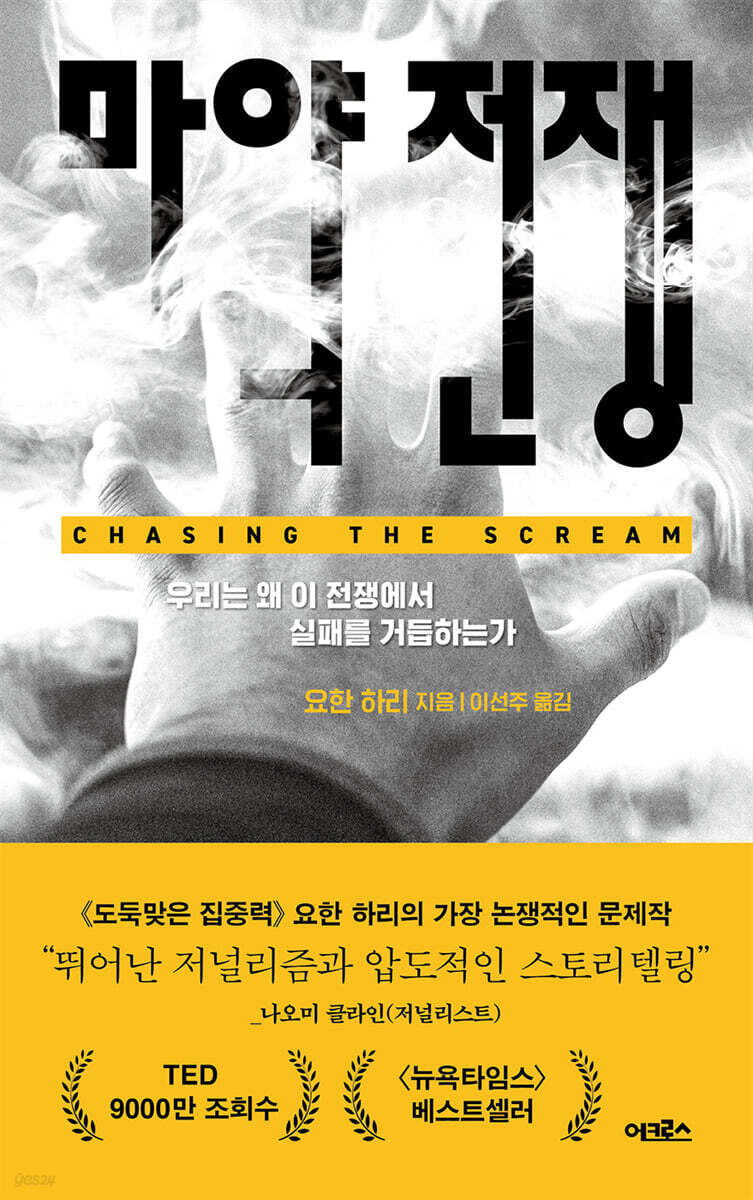
Addiction as told by Johann Hari『Stolen Concentration』 Johann Hari's masterpiece.
In many countries, the response to drugs is still focused on punishment.
However, because drugs are related to the human mind, it is difficult to solve them through punishment.
A record of fighting addiction by listening to the stories of various people surrounding drugs and addiction.
October 14, 2025. Min-gyu Son, Humanities PD
Why We Keep Failing in the War on Drugs
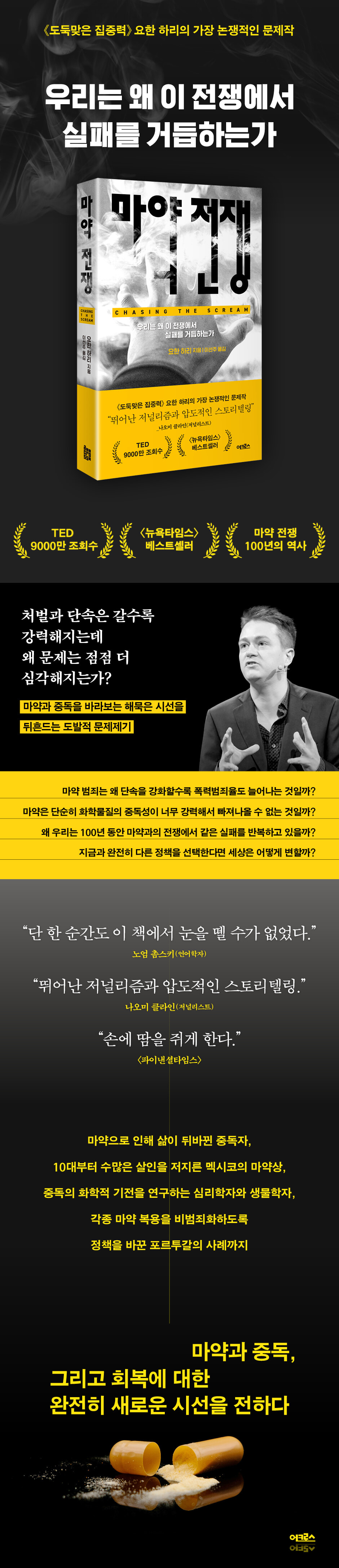
A provocative question that challenges outdated views on drugs and addiction.
People believe that the purpose of the 'war on drugs' is to prevent drug use and reintegrate addicts into society.
But the beginning was completely different.
In the early 20th century, as the United States passed anti-drug laws, the Narcotics Bureau began indiscriminately arresting users, regardless of the severity of the crime or where the drugs were used.
Even doctors who prescribed legal drugs were arrested, and jazz singer Billie Holiday, a famous heroin addict, was targeted and denied treatment and recovery.
This was the prelude to showing that the way a nation responds to individual suffering can become a war called 'punishment'.
Even now, 100 years later, our society is still in the midst of war.
World-renowned journalist Johan Hari speaks to a diverse range of people, from addicts whose lives have been turned upside down by drugs, to Mexican drug dealers who have committed numerous murders, to psychologists and biologists studying the chemical mechanisms of addiction, to a Portuguese doctor who changed the policy of decriminalizing various drug use, and reveals the need to understand the problem of drug addiction from a new perspective.
The old ways of relying on punishment and discipline no longer work, and addiction may be a response to the loneliness of human beings, born of loss, isolation, and social disconnection, rather than the chemical properties of drugs.
This book criticizes the fears, misconceptions, and countless failures surrounding drugs, while also seriously proposing alternatives for a better society, shaking up our outdated ideas about drugs and addiction.
A provocative question that challenges outdated views on drugs and addiction.
People believe that the purpose of the 'war on drugs' is to prevent drug use and reintegrate addicts into society.
But the beginning was completely different.
In the early 20th century, as the United States passed anti-drug laws, the Narcotics Bureau began indiscriminately arresting users, regardless of the severity of the crime or where the drugs were used.
Even doctors who prescribed legal drugs were arrested, and jazz singer Billie Holiday, a famous heroin addict, was targeted and denied treatment and recovery.
This was the prelude to showing that the way a nation responds to individual suffering can become a war called 'punishment'.
Even now, 100 years later, our society is still in the midst of war.
World-renowned journalist Johan Hari speaks to a diverse range of people, from addicts whose lives have been turned upside down by drugs, to Mexican drug dealers who have committed numerous murders, to psychologists and biologists studying the chemical mechanisms of addiction, to a Portuguese doctor who changed the policy of decriminalizing various drug use, and reveals the need to understand the problem of drug addiction from a new perspective.
The old ways of relying on punishment and discipline no longer work, and addiction may be a response to the loneliness of human beings, born of loss, isolation, and social disconnection, rather than the chemical properties of drugs.
This book criticizes the fears, misconceptions, and countless failures surrounding drugs, while also seriously proposing alternatives for a better society, shaking up our outdated ideas about drugs and addiction.
- You can preview some of the book's contents.
Preview
index
Preface to the Korean Edition: A Story Very Different from Our Thoughts
Part 1: The Prelude to War
Chapter 1: Addicts, Criminals, and Lawbreakers: Three Figures at the Heart of the Drug War
Chasing the Scream│What Could Be Found Anywhere│The Black Hand│Victor Licata's Decisive Case│The War on Jazz│“This Song Can't Be Stopped”│Racism and the Drug War
Chapter 2: The Doctor Who Foresaw the Future: What Happened When Drugs Were Banned
Doctors Arrested│Prescriptions for Addicts
Chapter 3: Where Harry's Gun Is Pointed: Even as a Ghost, He Commands This War
The Shadow of the Narcotics Empire Spreading Across the World│The Fall of Ideology
Chapter 4: No One Tried to Stand Against Them: The Drug Dealers Who Tamed the World
The Most Feared Name in New York│The War on Drugs
Part 2: History Repeats Itself
Chapter 5: 'Troublemakers' Raised on a Battlefield: A World Where You're Eaten or Be Eaten
Witnessing the war in real time│Violence for notoriety│Choices made to survive│So he got addicted to drugs│No justice, no peace
Chapter 6: Why Arresting Drug Dealers Increases Murders: The Uniqueness of Drug Crime
The Story of a Police Officer Who Infiltrated the KKK│Why Drug Trafficking Can't Be Reduced
Chapter 7: Victims of the Vortex: They're Called "Mushrooms"
Chapter 8: The Murderer on the Run for His Life: Inside the Drug Cartel
The Man Who Decided to Become an Angel | Slowly Becoming a 'Human Weapon' | The Murderer's Question
Part 3: The Hidden Truth About Addiction
Chapter 9: The Desire to Change Your Mood: Do Animals Get High on Drugs?
The choice of a grieving mongoose│The Fourth Desire
Chapter 10: The Mystery of Addiction: The Addiction Scenario We Used to Know Was Wrong
What Makes Us So Addictive? The Impact of Childhood Trauma | Not Everyone Becomes an Addict
Chapter 11 The Myth of "Chemical Slavery": The Link Between Addiction and Chemicals
Addiction is not a 'disease'│Why do people become addicted│The rise vs.
Deepening Disconnection│The Difference Between Physical Dependence and Addiction
Chapter 12: I'll Prescribe Heroin: The First Step to Breaking Free from Addiction
Prevention Begins with Respect│If You Have to Eat a Hunk of Batter Instead of a Steak│Make a Decision for Yourself, Not the Addicts
Chapter 13: 1974, In the Spirit of Revolution: Decriminalizing Drugs
Portugal's most radical and daring attempt│The core of addiction treatment│After the drug revolution│An answer to contradictions
In conclusion: The opposite of addiction
Part 1: The Prelude to War
Chapter 1: Addicts, Criminals, and Lawbreakers: Three Figures at the Heart of the Drug War
Chasing the Scream│What Could Be Found Anywhere│The Black Hand│Victor Licata's Decisive Case│The War on Jazz│“This Song Can't Be Stopped”│Racism and the Drug War
Chapter 2: The Doctor Who Foresaw the Future: What Happened When Drugs Were Banned
Doctors Arrested│Prescriptions for Addicts
Chapter 3: Where Harry's Gun Is Pointed: Even as a Ghost, He Commands This War
The Shadow of the Narcotics Empire Spreading Across the World│The Fall of Ideology
Chapter 4: No One Tried to Stand Against Them: The Drug Dealers Who Tamed the World
The Most Feared Name in New York│The War on Drugs
Part 2: History Repeats Itself
Chapter 5: 'Troublemakers' Raised on a Battlefield: A World Where You're Eaten or Be Eaten
Witnessing the war in real time│Violence for notoriety│Choices made to survive│So he got addicted to drugs│No justice, no peace
Chapter 6: Why Arresting Drug Dealers Increases Murders: The Uniqueness of Drug Crime
The Story of a Police Officer Who Infiltrated the KKK│Why Drug Trafficking Can't Be Reduced
Chapter 7: Victims of the Vortex: They're Called "Mushrooms"
Chapter 8: The Murderer on the Run for His Life: Inside the Drug Cartel
The Man Who Decided to Become an Angel | Slowly Becoming a 'Human Weapon' | The Murderer's Question
Part 3: The Hidden Truth About Addiction
Chapter 9: The Desire to Change Your Mood: Do Animals Get High on Drugs?
The choice of a grieving mongoose│The Fourth Desire
Chapter 10: The Mystery of Addiction: The Addiction Scenario We Used to Know Was Wrong
What Makes Us So Addictive? The Impact of Childhood Trauma | Not Everyone Becomes an Addict
Chapter 11 The Myth of "Chemical Slavery": The Link Between Addiction and Chemicals
Addiction is not a 'disease'│Why do people become addicted│The rise vs.
Deepening Disconnection│The Difference Between Physical Dependence and Addiction
Chapter 12: I'll Prescribe Heroin: The First Step to Breaking Free from Addiction
Prevention Begins with Respect│If You Have to Eat a Hunk of Batter Instead of a Steak│Make a Decision for Yourself, Not the Addicts
Chapter 13: 1974, In the Spirit of Revolution: Decriminalizing Drugs
Portugal's most radical and daring attempt│The core of addiction treatment│After the drug revolution│An answer to contradictions
In conclusion: The opposite of addiction
Detailed image
Into the book
Harry sent letters to 30 scientific experts asking them various questions about marijuana.
Twenty-nine of them responded that prohibiting marijuana is wrong and that the media is grossly misrepresenting the topic.
Anslinger chose to ignore their comments, citing only one expert who believed that marijuana was so dangerous that it should be eradicated.
--- From "Chapter 1, Addicts, Criminals, and Regulators"
It is a natural human instinct to want to dispel fear by transforming that fear into a symbol and then trying to destroy that symbol.
Such things have been repeated throughout human history, from the Crusades to the witch hunts, and even to this day.
When we ponder something as complex as the human drive to take drugs, it's difficult to accept that this drive will never go away and that it will always cause problems (and pleasures).
I'd much rather hear another story about how we can end this problem.
We want to believe that if we just listen and follow what they say, all of our problems will be solved.
--- From "Chapter 3, Where Harry's Gun Was Pointed"
As Chino described the world he inhabited, I kept thinking about a part of slum culture that, to an outsider, seemed irrational and bizarre: the obsession with one's own turf and the constant demand for "respect."
And I came to think that such behavior was not irrational.
It seemed like a way to protect their most valuable asset: the drug supply.
Since we had no recourse to the law, it seemed necessary to make sure that people were kept from disturbing their own territory out of fear.
I realized that enforcing respect and fear was the only way to make this economy work.
If the local economy runs on these rules, those rules will dominate even the local population, even those who are barely involved in the drug trade.
--- From "Chapter 5, 'Troublemakers' Who Grew Up on the Battlefield"
After listening to the recording of this interview over and over again, I was reminded of a paper by sociologist Philippe Bourgeois that helped me understand Chino's story.
He explained that when drugs are banned, the first to abandon moral constraints will gain a competitive advantage and control more of the drug market.
Drug cartels therefore have no qualms about using these young "expendables" to brutally murder not only rival cartel members but also their relatives.
--- From "Chapter 8, The Murderer Who Ran Away to Live"
I kept thinking back to the UN's promise to create a drug-free world.
One thing stood out in my mind more than anything else about that promise.
It's a fact that seems obvious at first, but then you intuitively feel it's wrong.
Only 10 percent of drug users develop problems due to their use.
The overwhelming majority, about 90 percent, of people who use drugs are not harmed by them.
These are not figures released by groups advocating for the legalization of drugs.
These are figures released by the United Nations Office on Narcotics Control, which leads the global war on drugs.
Even William Bennett, the director of the Office of Drug Control Policy and known as the “drug czar” for implementing the most aggressive drug policy in American history, admitted that “a significant portion of drug users in our country are not addicted to drugs.”
--- From "Chapter 9, The Desire to Change Your Mood"
From a young age I asked myself:
How do you become addicted? What is addiction? I've heard many explanations about addiction over the years.
Addiction is a moral failing.
It's a disease.
I heard that it is a hereditary disease.
I believed that the real cause of addiction was ultimately shrouded in mystery.
Then, when I went to Canada, I discovered that there was a small group of non-mainstream scientists who were trying to find answers to my questions.
Their research has remained largely unknown for decades.
“Our way is to try to treat them as humanely as possible.
Just being there for them.
I don't give them advice on how to fix their messed up lives.
Just live life with them.
I try to be kind and trustworthy.
“Someone who pretends to please them and then leaves, someone who won’t abandon them, someone who won’t leave them, someone who won’t kick them out.” Almost everyone thought this plan was crazy.
If addicts were given a place to live freely, without any judgment or blame, wouldn't they inevitably become addicted to alcohol or drugs and die sooner? A better solution might be to bomb the Portland Hotel, killing everyone there, one doctor told Liz Evans.
--- From "Chapter 10, The Mystery of the Cause of Addiction"
Drug prohibition is based on external methods of preventing people from using drugs through fear and violence.
Portugal's alternative, on the other hand, is based on the belief that drugs will not go away, and that instead of violence, people should be given the internal tools - confidence, knowledge, and support - to make the right decisions for themselves.
Twenty-nine of them responded that prohibiting marijuana is wrong and that the media is grossly misrepresenting the topic.
Anslinger chose to ignore their comments, citing only one expert who believed that marijuana was so dangerous that it should be eradicated.
--- From "Chapter 1, Addicts, Criminals, and Regulators"
It is a natural human instinct to want to dispel fear by transforming that fear into a symbol and then trying to destroy that symbol.
Such things have been repeated throughout human history, from the Crusades to the witch hunts, and even to this day.
When we ponder something as complex as the human drive to take drugs, it's difficult to accept that this drive will never go away and that it will always cause problems (and pleasures).
I'd much rather hear another story about how we can end this problem.
We want to believe that if we just listen and follow what they say, all of our problems will be solved.
--- From "Chapter 3, Where Harry's Gun Was Pointed"
As Chino described the world he inhabited, I kept thinking about a part of slum culture that, to an outsider, seemed irrational and bizarre: the obsession with one's own turf and the constant demand for "respect."
And I came to think that such behavior was not irrational.
It seemed like a way to protect their most valuable asset: the drug supply.
Since we had no recourse to the law, it seemed necessary to make sure that people were kept from disturbing their own territory out of fear.
I realized that enforcing respect and fear was the only way to make this economy work.
If the local economy runs on these rules, those rules will dominate even the local population, even those who are barely involved in the drug trade.
--- From "Chapter 5, 'Troublemakers' Who Grew Up on the Battlefield"
After listening to the recording of this interview over and over again, I was reminded of a paper by sociologist Philippe Bourgeois that helped me understand Chino's story.
He explained that when drugs are banned, the first to abandon moral constraints will gain a competitive advantage and control more of the drug market.
Drug cartels therefore have no qualms about using these young "expendables" to brutally murder not only rival cartel members but also their relatives.
--- From "Chapter 8, The Murderer Who Ran Away to Live"
I kept thinking back to the UN's promise to create a drug-free world.
One thing stood out in my mind more than anything else about that promise.
It's a fact that seems obvious at first, but then you intuitively feel it's wrong.
Only 10 percent of drug users develop problems due to their use.
The overwhelming majority, about 90 percent, of people who use drugs are not harmed by them.
These are not figures released by groups advocating for the legalization of drugs.
These are figures released by the United Nations Office on Narcotics Control, which leads the global war on drugs.
Even William Bennett, the director of the Office of Drug Control Policy and known as the “drug czar” for implementing the most aggressive drug policy in American history, admitted that “a significant portion of drug users in our country are not addicted to drugs.”
--- From "Chapter 9, The Desire to Change Your Mood"
From a young age I asked myself:
How do you become addicted? What is addiction? I've heard many explanations about addiction over the years.
Addiction is a moral failing.
It's a disease.
I heard that it is a hereditary disease.
I believed that the real cause of addiction was ultimately shrouded in mystery.
Then, when I went to Canada, I discovered that there was a small group of non-mainstream scientists who were trying to find answers to my questions.
Their research has remained largely unknown for decades.
“Our way is to try to treat them as humanely as possible.
Just being there for them.
I don't give them advice on how to fix their messed up lives.
Just live life with them.
I try to be kind and trustworthy.
“Someone who pretends to please them and then leaves, someone who won’t abandon them, someone who won’t leave them, someone who won’t kick them out.” Almost everyone thought this plan was crazy.
If addicts were given a place to live freely, without any judgment or blame, wouldn't they inevitably become addicted to alcohol or drugs and die sooner? A better solution might be to bomb the Portland Hotel, killing everyone there, one doctor told Liz Evans.
--- From "Chapter 10, The Mystery of the Cause of Addiction"
Drug prohibition is based on external methods of preventing people from using drugs through fear and violence.
Portugal's alternative, on the other hand, is based on the belief that drugs will not go away, and that instead of violence, people should be given the internal tools - confidence, knowledge, and support - to make the right decisions for themselves.
--- From "Chapter 13, 1974, In the Spirit of Revolution"
Publisher's Review
★★★ 90 million TED views, New York Times bestseller
★★★ 『Stolen Concentration』 Johann Hari's most controversial work
Why We Keep Failing in the War on Drugs
A provocative question that challenges outdated views on drugs and addiction.
People believe that the purpose of the 'war on drugs' is to prevent drug use and reintegrate addicts into society.
But the beginning was completely different.
In the early 20th century, as the United States passed anti-drug laws, the Narcotics Bureau began indiscriminately arresting users, regardless of the severity of the crime or where the drugs were used.
Even doctors who prescribed legal drugs were arrested, and jazz singer Billie Holiday, a famous heroin addict, became the target of an investigation.
Addicts were denied any chance for treatment or recovery, a prelude to how the state's response to individual suffering could be a war of "punishment."
Even now, 100 years later, our society is still in the midst of war.
World-renowned journalist Johan Hari travels back in time to the beginning of the war on drugs, raising questions we hadn't considered before.
Why did organized crime groups bribe police to enforce anti-drug laws more vigorously? Why, unlike other crimes, does the violent crime rate for drug crimes rise with increased crackdowns? How would the world change if we adopted a radically different drug policy?
The author meets countless people—addicts whose lives have been turned upside down by drugs, Mexican drug dealers who have committed numerous murders, starting as teenagers, psychologists and biologists studying the chemical mechanisms of addiction, and a Portuguese doctor who changed policies to decriminalize various drug use—and realizes that the problem of drug addiction needs to be understood from a new perspective.
The old ways of relying on punishment and discipline no longer work, and addiction may be a response to the loneliness of human beings born from loss, isolation, and social disconnection rather than the chemical properties of drugs.
"The Drug War" is Johan Hari's first book, which launched him into the ranks of international bestselling authors. Upon its initial publication in 2015, it was met with heated debate and played a significant role in shifting the conversation about drugs in the United States.
The war on drugs vs.
The war for drugs
A look back at the beginnings, impact, and failures of the century-long drug war.
The surprising thing is that drugs that we now classify as illegal were freely distributed around the world until the early 20th century.
But in 1914, much changed when the United States passed the Harrison Narcotics Act, which prohibited the sale and use of drugs.
Johan Hari traces the history of the century-long drug war, summoning three figures at the heart of the conflict to tell a story more shocking and compelling than any crime novel.
The people he focused on were Harry Anslinger, the first commissioner of the U.S. Drug Administration; jazz singer Billie Holiday, a heroin addict; and Arnold Rothstein, the drug dealer who created the prototype of the modern drug cartel.
Harry Anslinger, who was appointed to lead the newly created Federal Drug Administration, struggled to consolidate the agency's precarious position.
The Narcotics Bureau was staffed by former Prohibition law enforcers, who were dispirited after a 14-year, crushing defeat in the war on alcohol.
Anslinger began recruiting minorities to expand the war on drugs.
He warned that black people were most affected by marijuana, and claimed that smoking it made them forget racial barriers and intensified their desire for white women.
The drug war gained widespread support by exploiting the American public's fears and prejudices against people of color.
And this belief began to manifest itself in drug control policies.
Jazz singers Billie Holiday and Judy Garland were both famous heroin addicts.
However, Holiday was targeted and subjected to ongoing harassment by Anslinger's agents because she was black and because she sang songs exposing the brutal genocide of black people.
Meanwhile, Garland, a white woman, was able to avoid police investigation while recovering from addiction with Anslinger's help.
When Anslinger started the war on drugs, he hoped that simply eliminating drugs and punishing addicts would end the war.
But as Prohibition already failed to do, popular products don't simply disappear when they are criminalized.
People instead try to obtain it through illegal means.
Ultimately, prohibiting drugs created criminal networks that controlled the supply and distribution of illegal drugs.
Arnold Rothstein, once known as the most feared man in New York, maintained his illegal drug business by demonstrating his power through violence.
Ultimately, the 'war on drugs' waged by the state to eliminate drug users and addicts gradually gave rise to a 'war for drugs' in which criminal organizations fought each other to obtain drugs.
The lives of these three men show how much the fundamental rules of the "drug war" remain unchanged even after 100 years, and what problems it still faces.
Why do violent crimes surge as drug crackdowns become more stringent?
Hearing the voices of victims caught in the vortex of the drug war
Today, we believe that as the 'war on drugs' continues, drug-related crime will decrease.
But drug dealing operates on a completely different logic than other crimes.
For example, arresting a large number of murderers reduces the number of murders, and arresting violent racists reduces hate crimes.
However, drug crimes are not fundamentally reduced by arresting users or traffickers.
The case of New York City police officer Michael Levin illustrates this clearly.
After extensive surveillance, he identified 100 notorious drug dealers in Manhattan and arrested 80 of them in just two weeks.
But within days, new traders came in to fill the market vacuum, and the drug trade quickly returned to its previous levels.
A more serious problem is that these crackdowns actually exacerbate violent crime.
When a key figure in a criminal organization is arrested, a power struggle begins between rival gangs.
During this process, murder and violence occur frequently, and the entire community is left bleeding.
Ultimately, the greatest harm caused by drug crimes comes not from the individual addicts' deviance, but from the war between criminal organizations trying to control the distribution market.
Johan Hari also listens to the voices of the hidden victims of the drug war.
In Baltimore, where the war on drugs is raging, children grow up in an environment where gunfire rings out every night and murders occur every day.
Moreover, if those who grew up in this war zone are caught with even one drug crime, their lives are effectively over.
One arrest record from your teenage years can make you permanently barred from employment and even prevent you from getting student loans.
They are kicked out of public housing for low-income people and even deprived of their right to vote.
One person testified to the reality that “my mother lives in public housing, and if I go to visit her after being arrested for drug possession, my entire family could be evicted.”
Current policies isolate addicts and their families from society and deny them the opportunity for recovery.
This is the most disastrous result of the drug war.
Gang violence is on the rise, children are accustomed to the sound of gunfire every night, and young men caught once are branded second-class citizens for life.
Rather than reducing the problem of addiction, it is leaving irreparable scars on the most vulnerable members of society.
Are drugs simply chemicals so addictive that they are impossible to break free from?
The drug addiction scenario we all knew was wrong.
Finally, Johan Hari shows that the current punishment-focused policies are not effective in ending the drug war, and that addiction stems from human conditions such as childhood trauma, social isolation, and loss rather than the chemical properties of drugs.
If drugs were simply chemically powerful and inescapable, everyone prescribed opioid painkillers in hospitals would be addicted.
But after they were discharged from the hospital, they no longer sought drugs.
How should we understand this phenomenon? Drawing on Bruce Alexander's "Rat Park" experiment, which explored the relationship between addiction and the environment, the author argues that the scenario of addiction where a single moment of drug use leads to "chemical slavery" is a myth.
What we need to focus on in order to solve the problem is not the addictive nature of the drug itself, but rather the questions, 'What makes people prone to addiction?' and 'What are the conditions that make it difficult to break free from addiction?'
When we treat drug users as people in need of support rather than criminals, amazing changes begin to occur.
Switzerland operates injection centers where addicts can receive daily doses of their drugs in a sanitary and safe environment, and supports addicts to maintain jobs and families without worrying about crime or livelihood.
Portugal decriminalized drug use, with police and authorities acting as counselors rather than arresting addicts.
Addicts can learn how to use drugs safely and receive the support they need to quit.
At this time, the state's goal is solely to 'encourage people to seek treatment.'
These cases demonstrate that policies focused on recovery and reintegration are more realistic and effective ways to address addiction than punitive policies aimed at curbing drug use.
"The Drug War" argues that the existing approach of treating the drug problem solely as a crime has only further isolated addicts from society and fostered a vicious cycle of violence.
This book criticizes the fears, misconceptions, and countless failures surrounding drugs, while also seriously proposing alternatives for a better society. It will shake up our outdated ideas about drugs and addiction and help us find new breakthroughs.
★★★ 『Stolen Concentration』 Johann Hari's most controversial work
Why We Keep Failing in the War on Drugs
A provocative question that challenges outdated views on drugs and addiction.
People believe that the purpose of the 'war on drugs' is to prevent drug use and reintegrate addicts into society.
But the beginning was completely different.
In the early 20th century, as the United States passed anti-drug laws, the Narcotics Bureau began indiscriminately arresting users, regardless of the severity of the crime or where the drugs were used.
Even doctors who prescribed legal drugs were arrested, and jazz singer Billie Holiday, a famous heroin addict, became the target of an investigation.
Addicts were denied any chance for treatment or recovery, a prelude to how the state's response to individual suffering could be a war of "punishment."
Even now, 100 years later, our society is still in the midst of war.
World-renowned journalist Johan Hari travels back in time to the beginning of the war on drugs, raising questions we hadn't considered before.
Why did organized crime groups bribe police to enforce anti-drug laws more vigorously? Why, unlike other crimes, does the violent crime rate for drug crimes rise with increased crackdowns? How would the world change if we adopted a radically different drug policy?
The author meets countless people—addicts whose lives have been turned upside down by drugs, Mexican drug dealers who have committed numerous murders, starting as teenagers, psychologists and biologists studying the chemical mechanisms of addiction, and a Portuguese doctor who changed policies to decriminalize various drug use—and realizes that the problem of drug addiction needs to be understood from a new perspective.
The old ways of relying on punishment and discipline no longer work, and addiction may be a response to the loneliness of human beings born from loss, isolation, and social disconnection rather than the chemical properties of drugs.
"The Drug War" is Johan Hari's first book, which launched him into the ranks of international bestselling authors. Upon its initial publication in 2015, it was met with heated debate and played a significant role in shifting the conversation about drugs in the United States.
The war on drugs vs.
The war for drugs
A look back at the beginnings, impact, and failures of the century-long drug war.
The surprising thing is that drugs that we now classify as illegal were freely distributed around the world until the early 20th century.
But in 1914, much changed when the United States passed the Harrison Narcotics Act, which prohibited the sale and use of drugs.
Johan Hari traces the history of the century-long drug war, summoning three figures at the heart of the conflict to tell a story more shocking and compelling than any crime novel.
The people he focused on were Harry Anslinger, the first commissioner of the U.S. Drug Administration; jazz singer Billie Holiday, a heroin addict; and Arnold Rothstein, the drug dealer who created the prototype of the modern drug cartel.
Harry Anslinger, who was appointed to lead the newly created Federal Drug Administration, struggled to consolidate the agency's precarious position.
The Narcotics Bureau was staffed by former Prohibition law enforcers, who were dispirited after a 14-year, crushing defeat in the war on alcohol.
Anslinger began recruiting minorities to expand the war on drugs.
He warned that black people were most affected by marijuana, and claimed that smoking it made them forget racial barriers and intensified their desire for white women.
The drug war gained widespread support by exploiting the American public's fears and prejudices against people of color.
And this belief began to manifest itself in drug control policies.
Jazz singers Billie Holiday and Judy Garland were both famous heroin addicts.
However, Holiday was targeted and subjected to ongoing harassment by Anslinger's agents because she was black and because she sang songs exposing the brutal genocide of black people.
Meanwhile, Garland, a white woman, was able to avoid police investigation while recovering from addiction with Anslinger's help.
When Anslinger started the war on drugs, he hoped that simply eliminating drugs and punishing addicts would end the war.
But as Prohibition already failed to do, popular products don't simply disappear when they are criminalized.
People instead try to obtain it through illegal means.
Ultimately, prohibiting drugs created criminal networks that controlled the supply and distribution of illegal drugs.
Arnold Rothstein, once known as the most feared man in New York, maintained his illegal drug business by demonstrating his power through violence.
Ultimately, the 'war on drugs' waged by the state to eliminate drug users and addicts gradually gave rise to a 'war for drugs' in which criminal organizations fought each other to obtain drugs.
The lives of these three men show how much the fundamental rules of the "drug war" remain unchanged even after 100 years, and what problems it still faces.
Why do violent crimes surge as drug crackdowns become more stringent?
Hearing the voices of victims caught in the vortex of the drug war
Today, we believe that as the 'war on drugs' continues, drug-related crime will decrease.
But drug dealing operates on a completely different logic than other crimes.
For example, arresting a large number of murderers reduces the number of murders, and arresting violent racists reduces hate crimes.
However, drug crimes are not fundamentally reduced by arresting users or traffickers.
The case of New York City police officer Michael Levin illustrates this clearly.
After extensive surveillance, he identified 100 notorious drug dealers in Manhattan and arrested 80 of them in just two weeks.
But within days, new traders came in to fill the market vacuum, and the drug trade quickly returned to its previous levels.
A more serious problem is that these crackdowns actually exacerbate violent crime.
When a key figure in a criminal organization is arrested, a power struggle begins between rival gangs.
During this process, murder and violence occur frequently, and the entire community is left bleeding.
Ultimately, the greatest harm caused by drug crimes comes not from the individual addicts' deviance, but from the war between criminal organizations trying to control the distribution market.
Johan Hari also listens to the voices of the hidden victims of the drug war.
In Baltimore, where the war on drugs is raging, children grow up in an environment where gunfire rings out every night and murders occur every day.
Moreover, if those who grew up in this war zone are caught with even one drug crime, their lives are effectively over.
One arrest record from your teenage years can make you permanently barred from employment and even prevent you from getting student loans.
They are kicked out of public housing for low-income people and even deprived of their right to vote.
One person testified to the reality that “my mother lives in public housing, and if I go to visit her after being arrested for drug possession, my entire family could be evicted.”
Current policies isolate addicts and their families from society and deny them the opportunity for recovery.
This is the most disastrous result of the drug war.
Gang violence is on the rise, children are accustomed to the sound of gunfire every night, and young men caught once are branded second-class citizens for life.
Rather than reducing the problem of addiction, it is leaving irreparable scars on the most vulnerable members of society.
Are drugs simply chemicals so addictive that they are impossible to break free from?
The drug addiction scenario we all knew was wrong.
Finally, Johan Hari shows that the current punishment-focused policies are not effective in ending the drug war, and that addiction stems from human conditions such as childhood trauma, social isolation, and loss rather than the chemical properties of drugs.
If drugs were simply chemically powerful and inescapable, everyone prescribed opioid painkillers in hospitals would be addicted.
But after they were discharged from the hospital, they no longer sought drugs.
How should we understand this phenomenon? Drawing on Bruce Alexander's "Rat Park" experiment, which explored the relationship between addiction and the environment, the author argues that the scenario of addiction where a single moment of drug use leads to "chemical slavery" is a myth.
What we need to focus on in order to solve the problem is not the addictive nature of the drug itself, but rather the questions, 'What makes people prone to addiction?' and 'What are the conditions that make it difficult to break free from addiction?'
When we treat drug users as people in need of support rather than criminals, amazing changes begin to occur.
Switzerland operates injection centers where addicts can receive daily doses of their drugs in a sanitary and safe environment, and supports addicts to maintain jobs and families without worrying about crime or livelihood.
Portugal decriminalized drug use, with police and authorities acting as counselors rather than arresting addicts.
Addicts can learn how to use drugs safely and receive the support they need to quit.
At this time, the state's goal is solely to 'encourage people to seek treatment.'
These cases demonstrate that policies focused on recovery and reintegration are more realistic and effective ways to address addiction than punitive policies aimed at curbing drug use.
"The Drug War" argues that the existing approach of treating the drug problem solely as a crime has only further isolated addicts from society and fostered a vicious cycle of violence.
This book criticizes the fears, misconceptions, and countless failures surrounding drugs, while also seriously proposing alternatives for a better society. It will shake up our outdated ideas about drugs and addiction and help us find new breakthroughs.
GOODS SPECIFICS
- Date of issue: September 10, 2025
- Page count, weight, size: 456 pages | 566g | 135*215*22mm
- ISBN13: 9791167742308
You may also like
카테고리
korean


korean

![GQ KOREA Mark (Monthly): December [2025]](http://librairie.coreenne.fr/cdn/shop/files/8ef265dbbfbf186523ed75ba7319009d.jpg?v=1765340328&width=3840)


