

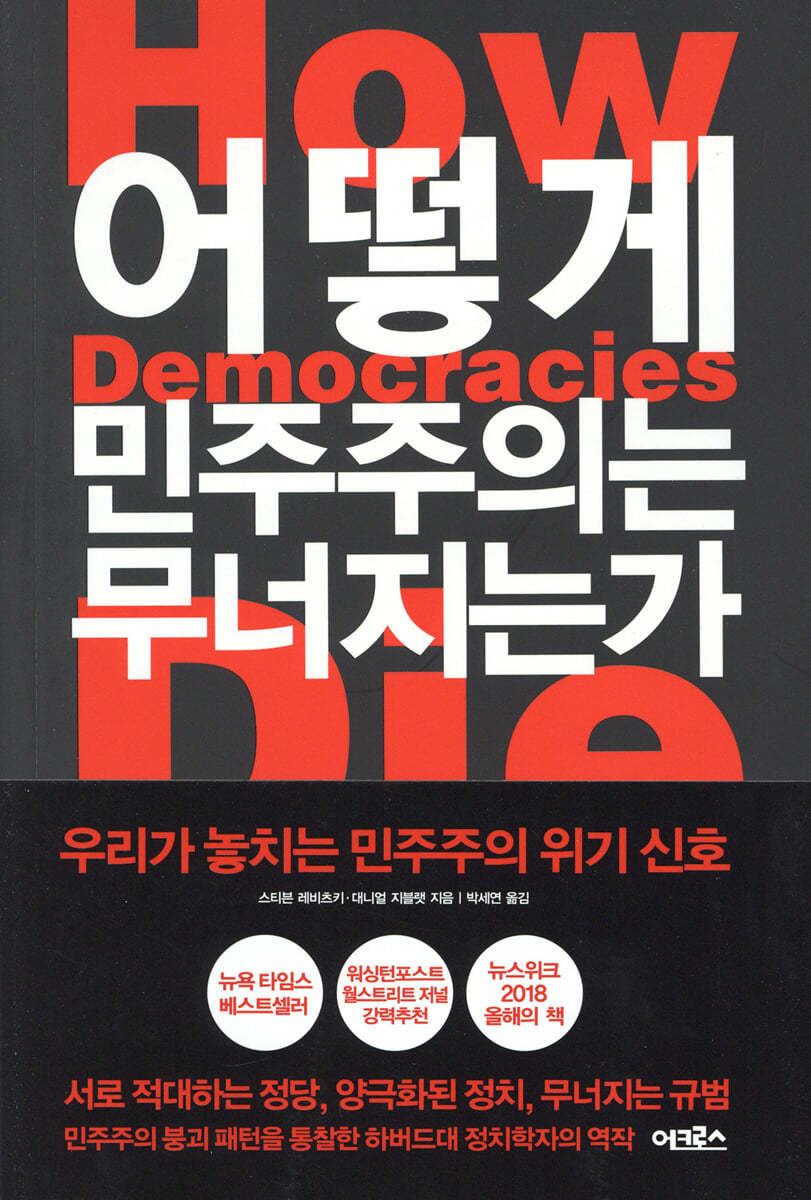
How Democracy Collapses
 |
Description
Book Introduction
A masterpiece by a Harvard political scientist
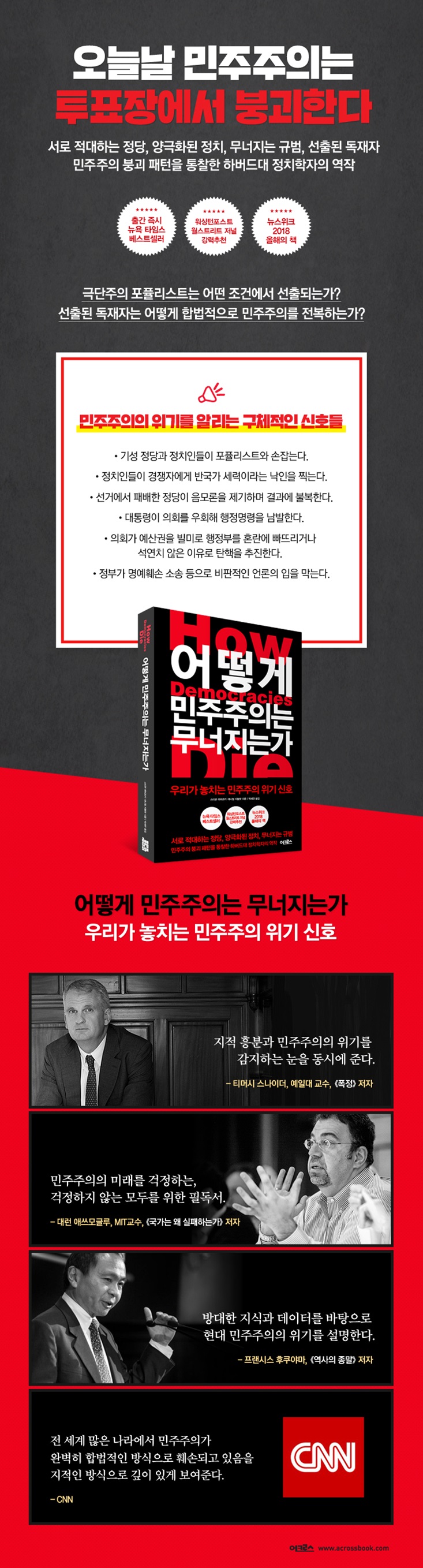
Today's democracy is collapsing at the polls.
Hostile parties, polarized politics, broken norms, and elected dictators
A Harvard political scientist's masterpiece that provides insight into the patterns of democratic collapse.
Immediately after Trump's election, Harvard political science professors Steven Levitsky and Daniel Ziblatt realized that even traditional democracies can easily collapse.
They wrote a column in the New York Times titled “Is Trump a Threat to Democracy?” warning of a crisis in democracy.
The article received significant attention, garnering over a million views, and was later published as the book "How Democracy Falls" at the publisher's request.
The book created a buzz immediately after its publication, reaching the New York Times nonfiction bestseller and Amazon bestseller lists, and was strongly recommended by major media outlets such as the Washington Post and the Wall Street Journal.
In this book, the two authors, both experts in the study of democracy, vividly illustrate, through examples from various countries around the world, the conditions under which extremist populists with a high potential to become dictators are elected and how elected dictators legally destroy democracy.
The two authors find that democracies have collapsed in very similar patterns in many countries around the world.
They found clear signs of democratic collapse within the pattern, such as “parties that have abandoned their role in selecting candidates,” “politicians who regard competitors as enemies,” and “elected leaders who attack the media,” and ultimately argued that what protects democracy is not “institutions” like the constitution, but “norms” like mutual tolerance and institutional restraint.
Through this book, readers will not only deepen their understanding of modern democracy, but also recognize the signs of a democratic crisis here and now, at a time when elected dictators are rising and democracy is declining worldwide, and explore ways to address the crisis.
Hostile parties, polarized politics, broken norms, and elected dictators
A Harvard political scientist's masterpiece that provides insight into the patterns of democratic collapse.
Immediately after Trump's election, Harvard political science professors Steven Levitsky and Daniel Ziblatt realized that even traditional democracies can easily collapse.
They wrote a column in the New York Times titled “Is Trump a Threat to Democracy?” warning of a crisis in democracy.
The article received significant attention, garnering over a million views, and was later published as the book "How Democracy Falls" at the publisher's request.
The book created a buzz immediately after its publication, reaching the New York Times nonfiction bestseller and Amazon bestseller lists, and was strongly recommended by major media outlets such as the Washington Post and the Wall Street Journal.
In this book, the two authors, both experts in the study of democracy, vividly illustrate, through examples from various countries around the world, the conditions under which extremist populists with a high potential to become dictators are elected and how elected dictators legally destroy democracy.
The two authors find that democracies have collapsed in very similar patterns in many countries around the world.
They found clear signs of democratic collapse within the pattern, such as “parties that have abandoned their role in selecting candidates,” “politicians who regard competitors as enemies,” and “elected leaders who attack the media,” and ultimately argued that what protects democracy is not “institutions” like the constitution, but “norms” like mutual tolerance and institutional restraint.
Through this book, readers will not only deepen their understanding of modern democracy, but also recognize the signs of a democratic crisis here and now, at a time when elected dictators are rising and democracy is declining worldwide, and explore ways to address the crisis.
- You can preview some of the book's contents.
Preview
index
Introduction: A Warning to All Democracies
Chapter 1.
A deadly alliance between democrats and extremists
Chapter 2.
a neutralized political party
Chapter 3.
Why Politicians Aid Potential Dictators
Chapter 4.
democracy legally overthrown
Chapter 5.
The invisible norms that have protected democracy
Chapter 6.
A Time Bomb Hidden in Democracy
Chapter 7.
The political tragedy brought about by the disintegration of norms
Chapter 8.
Trump's Destruction of Democracy
Chapter 9.
Saving Democracy
Acknowledgements
main
Search
Chapter 1.
A deadly alliance between democrats and extremists
Chapter 2.
a neutralized political party
Chapter 3.
Why Politicians Aid Potential Dictators
Chapter 4.
democracy legally overthrown
Chapter 5.
The invisible norms that have protected democracy
Chapter 6.
A Time Bomb Hidden in Democracy
Chapter 7.
The political tragedy brought about by the disintegration of norms
Chapter 8.
Trump's Destruction of Democracy
Chapter 9.
Saving Democracy
Acknowledgements
main
Search
Detailed image
Into the book
We need to learn from other countries to recognize warning signs and spot danger signals.
We must also recognize the fatal mistakes that have led to the downfall of democracy in other countries, and examine how citizens in other countries have resisted serious crises in democracy and overcome deep-rooted polarization to prevent its collapse.
Of course, history doesn't repeat itself.
But there is a pattern to it.
(p.16) -Introduction: A Warning to All Democracies
Potential demagogues exist in every democratic society, and they sometimes appeal to the public's emotions.
But in some societies, political leaders recognize the warning signs and guard against these figures from ascending to the center stage of power.
When extremists or agitators gain popularity among the public, established politicians join forces to isolate and neutralize them.
(p.29) - Chapter 1: The Deadly Alliance of Democrats and Extremists
The primary was clearly a more democratic method.
But isn't this approach "too democratic"? By leaving presidential nominations solely in the hands of voters, binding primaries weaken the party's gatekeeping role and, by bypassing the peer evaluation process, open the door to outsiders.
(p.66) -Chapter 2: The Neutralized Political Party
'Collective abdication', that is, the act of handing over power to someone who threatens democracy, generally occurs for two reasons.
First, there is the illusion that a potential dictator can be controlled or tamed.
Second, there is what sociologist Ivan Ermakoff calls “ideological collusion,” which occurs when the interests of mainstream politicians who have chosen collective renunciation align with those of a potential dictator.
(p.86) - Chapter 3: Why Politicians Aid Potential Dictators
Dictatorships often try to prevent anti-government media outlets from "legally" competing by suing them for defamation or insult.
Ecuadorian President Rafael Correa was particularly adept at this technique.
In 2011, Correa won a $40 million defamation lawsuit against the major daily newspaper El Universo for publishing an editorial calling him a "dictator."
(p.108) - Chapter 4: Democracy Legally Overthrown
Mutual tolerance and institutional restraint are closely intertwined.
These two sometimes reinforce each other.
When politicians accept their opponents as legitimate competitors, they are also more willing to practice the norms of self-restraint.
Moreover, politicians who do not see their competitors as threats are less likely to be tempted to force them out of the race for power.
The practice of self-restraint (such as the Republican-controlled Senate passing a Supreme Court nomination proposed by a Democratic president) creates a virtuous cycle by presenting oneself as a tolerant group.
(p.143) - Chapter 5: Invisible Norms That Protect Democracy
The norms that underpin the American political system have in fact been based on racism.
From Reconstruction to the 1980s, the peace of American society was rooted in its original sin.
In other words, it was based on the Compromise of 1877, the subsequent anti-democratic movement in the South, and the Jim Crow laws that discriminated against blacks.
Racial discrimination directly influenced the party collaboration and attitudes that characterized 20th-century American politics.
(p.181) - Chapter 6: The Hidden Time Bomb in Democracy
Republican politicians from Newt Gingrich to Donald Trump have realized that in a polarized society, viewing competitors as enemies is useful, and that viewing politics as war allows them to tap into voters who fear they have too much to lose.
The intensifying assault on norms of mutual tolerance and restraint is shaking the soft guardrails that have long protected American society from the partisan strife that has decimated democracy in much of the world.
(p.219) - Chapter 7: Political Tragedy Caused by the Disintegration of Norms
Even if President Trump hasn't directly dismantled democratic institutions, his norm-busting certainly has.
(...) Trump's continued norm-breaking since taking office is broadening the scope of presidential behavior that American society will tolerate.
Behaviors once considered absolutely unacceptable, such as lying, deception, and oppression, are increasingly entering the tactical toolkit of politicians.
(p.244) - Chapter 8: Trump's Destruction of Democracy
To save American democracy, the American people must now revive the fundamental norms that have protected their democracy.
And furthermore, we must spread that norm throughout society.
The scope of the norms must be expanded.
The core norms of American democracy have remained constant to this day.
But for much of history, racism has been present, and has persisted because of it.
Now we must ensure that those norms function properly in an era of racial equality and unprecedented ethnic diversity.
(p.289) - Chapter 9 Saving Democracy
We must also recognize the fatal mistakes that have led to the downfall of democracy in other countries, and examine how citizens in other countries have resisted serious crises in democracy and overcome deep-rooted polarization to prevent its collapse.
Of course, history doesn't repeat itself.
But there is a pattern to it.
(p.16) -Introduction: A Warning to All Democracies
Potential demagogues exist in every democratic society, and they sometimes appeal to the public's emotions.
But in some societies, political leaders recognize the warning signs and guard against these figures from ascending to the center stage of power.
When extremists or agitators gain popularity among the public, established politicians join forces to isolate and neutralize them.
(p.29) - Chapter 1: The Deadly Alliance of Democrats and Extremists
The primary was clearly a more democratic method.
But isn't this approach "too democratic"? By leaving presidential nominations solely in the hands of voters, binding primaries weaken the party's gatekeeping role and, by bypassing the peer evaluation process, open the door to outsiders.
(p.66) -Chapter 2: The Neutralized Political Party
'Collective abdication', that is, the act of handing over power to someone who threatens democracy, generally occurs for two reasons.
First, there is the illusion that a potential dictator can be controlled or tamed.
Second, there is what sociologist Ivan Ermakoff calls “ideological collusion,” which occurs when the interests of mainstream politicians who have chosen collective renunciation align with those of a potential dictator.
(p.86) - Chapter 3: Why Politicians Aid Potential Dictators
Dictatorships often try to prevent anti-government media outlets from "legally" competing by suing them for defamation or insult.
Ecuadorian President Rafael Correa was particularly adept at this technique.
In 2011, Correa won a $40 million defamation lawsuit against the major daily newspaper El Universo for publishing an editorial calling him a "dictator."
(p.108) - Chapter 4: Democracy Legally Overthrown
Mutual tolerance and institutional restraint are closely intertwined.
These two sometimes reinforce each other.
When politicians accept their opponents as legitimate competitors, they are also more willing to practice the norms of self-restraint.
Moreover, politicians who do not see their competitors as threats are less likely to be tempted to force them out of the race for power.
The practice of self-restraint (such as the Republican-controlled Senate passing a Supreme Court nomination proposed by a Democratic president) creates a virtuous cycle by presenting oneself as a tolerant group.
(p.143) - Chapter 5: Invisible Norms That Protect Democracy
The norms that underpin the American political system have in fact been based on racism.
From Reconstruction to the 1980s, the peace of American society was rooted in its original sin.
In other words, it was based on the Compromise of 1877, the subsequent anti-democratic movement in the South, and the Jim Crow laws that discriminated against blacks.
Racial discrimination directly influenced the party collaboration and attitudes that characterized 20th-century American politics.
(p.181) - Chapter 6: The Hidden Time Bomb in Democracy
Republican politicians from Newt Gingrich to Donald Trump have realized that in a polarized society, viewing competitors as enemies is useful, and that viewing politics as war allows them to tap into voters who fear they have too much to lose.
The intensifying assault on norms of mutual tolerance and restraint is shaking the soft guardrails that have long protected American society from the partisan strife that has decimated democracy in much of the world.
(p.219) - Chapter 7: Political Tragedy Caused by the Disintegration of Norms
Even if President Trump hasn't directly dismantled democratic institutions, his norm-busting certainly has.
(...) Trump's continued norm-breaking since taking office is broadening the scope of presidential behavior that American society will tolerate.
Behaviors once considered absolutely unacceptable, such as lying, deception, and oppression, are increasingly entering the tactical toolkit of politicians.
(p.244) - Chapter 8: Trump's Destruction of Democracy
To save American democracy, the American people must now revive the fundamental norms that have protected their democracy.
And furthermore, we must spread that norm throughout society.
The scope of the norms must be expanded.
The core norms of American democracy have remained constant to this day.
But for much of history, racism has been present, and has persisted because of it.
Now we must ensure that those norms function properly in an era of racial equality and unprecedented ethnic diversity.
(p.289) - Chapter 9 Saving Democracy
--- From the text
Publisher's Review
How Extremist Populists Rise to Power: The Weakening of Parties and the Corruption of Politicians
There have always been populists who, taking advantage of the growing economic disparity and poverty that angers citizens and those seeking scapegoats, incite hatred and discrimination against minorities and the socially disadvantaged, and engage in anti-democratic words and actions.
Many of them failed to seize power, but some succeeded.
Trump in the United States is a representative example.
How did Trump and other extremist populists reach the center of power?
In this book, the authors cite the disappearance of the party's gatekeeper function of screening out extremists before elections.
In the United States, the influence of fellow politicians played a significant role in each party's selection of presidential candidates.
This was clearly an undemocratic method.
But no one knew the abilities, personalities, and ideologies of the candidates running for president as well as their fellow politicians.
They also thoroughly screened out, through verification, inexperienced political agitators and extremists who were likely to destroy democracy.
This is why people like Henry Ford, the founder of Ford Motor Company who supported Hitler, could not become a presidential candidate despite having great support among the citizens.
But things changed after the 1970s.
Each party expanded its primary system, claiming it was a more democratic process, allowing ordinary citizens, rather than party leaders, to select their presidential candidates.
The political party's function of vetting candidates has been significantly weakened.
The authors argue that when the gatekeeping function of political parties weakens, mainstream politicians must do everything they can to keep dangerous figures out of the center of power.
If not, irreversible consequences will occur.
Readers will explore a wide range of cases, from Hitler and Mussolini to Peru's Fujimori, Venezuela's Chavez, and now Trump, to understand how political parties and politicians aided and abetted potential dictators and how this led to the destruction of democracy.
“All democracies collapse in similar ways.”
Warning Signs from a Democracy in Crisis
How can we recognize a potential dictator? How do elected dictators undermine democracy, and what are the signs that precede a dictator's rise to power? The authors of this book compared cases across countries around the world and discovered that democracies collapse through remarkably similar processes, identifying patterns that signal a pattern.
Four Signs to Identify a Potential Dictator
Many dictators show signs of dictatorship before they come to power.
Hitler and Chavez have staged armed uprisings, and Mussolini has engaged in violence against parliament.
But not all dictators display these striking characteristics.
They faithfully follow democratic norms, but later reveal their true colors.
The authors of this book have developed four warning signs to identify potential dictators.
Do you reject democratic norms in word and deed, deny the existence of competitors, condone or encourage violence, or seek to suppress the fundamental rights of your opponents, including freedom of speech?
This mainly applies to populist outsider politicians, and the book provides more specific methods for identifying dictators.
-Bringing referees, suppressing critics, tilting the playing field
Elected dictators bribe referees, suppress critics and competitors, and tilt the playing field.
Because this happens gradually and within the bounds of the law, many citizens are unaware that it is happening.
The bribery of judges is mainly carried out by dismissing public officials or non-party officials and appointing close associates.
In the case of Hungarian Prime Minister Viktor Orban, the prosecution, the Board of Audit and Inspection, and the Constitutional Court were filled with figures from the ruling party.
Next, critics and competitors are silenced.
Ecuador's Rafael Correa won a $40 million defamation lawsuit against the daily El Universo after it called him a "dictator," while Turkey's Erdogan and Russia's Putin have used the law to force the owners of critical and opposition-friendly media giants Doan Yain and NTV to lose control, respectively, by imposing huge fines.
Furthermore, dictators change the rules of the game.
The authors cite examples such as gerrymandering in Malaysia and Hungary, and black voting rights restrictions in the United States.
-Unconditional opposition, abuse of power, and labeling as anti-state forces
When the leftist Allende came to power in Chile, the right-wing camp was obsessed with bringing him down from the beginning.
Unable to properly implement his socialist policies, Allende attempted to pass legislation under presidential authority without going through Congress, and Congress, which had the opposition party in the majority, dismissed the ministers appointed by Allende.
Allende's inner circle called the opposition "fascists" and "enemies of the people," while the opposition called Allende's government a "totalitarian regime."
After a period of extreme hostility and chaos, the military emerged and ruled Chile for 17 years.
The authors show that a similar conflict between Democrats and Republicans has existed in the United States for a long time, and that signs that American democracy is in danger have been around for a long time.
Does a well-designed constitution protect democracy?
It is norms, not institutions, that protect democracy.
In one survey, 85 percent of Americans responded that the Constitution was the core foundation of America's prosperity over the past century.
The American constitutional system, based on checks and balances, was designed to prevent leaders from monopolizing or abusing power, and it has generally worked well.
But the authors of this book, Steven Levitsky and Daniel Ziblatt, argue that even the best-designed constitution cannot protect democracy.
The European and Latin American countries that experienced the collapse of democracy described in this book had excellent constitutions not much different from the U.S. Constitution, and American democracy also faced a crisis with Trump's election.
According to the two authors, democracy is protected by unwritten norms, and among them, mutual tolerance and institutional forbearance play a key role.
Mutual tolerance refers to the collective will of politicians to acknowledge groups and opinions different from their own, while institutional self-restraint refers to an attitude of prudently exercising given legal rights.
Both seem like very obvious concepts at first glance, but when these norms break down, democracy also collapses.
The authors present the Spanish civil war, which broke out after a conflict between left-wing Republican and right-wing forces, as a prime example of the collapse of democracy due to the destruction of norms.
Above all, Trump's election vividly demonstrates that the collapse of the two norms that had protected democracy led to extreme political polarization, through the process of norm formation, establishment, and destruction throughout the 200-year history of American democracy.
There have always been populists who, taking advantage of the growing economic disparity and poverty that angers citizens and those seeking scapegoats, incite hatred and discrimination against minorities and the socially disadvantaged, and engage in anti-democratic words and actions.
Many of them failed to seize power, but some succeeded.
Trump in the United States is a representative example.
How did Trump and other extremist populists reach the center of power?
In this book, the authors cite the disappearance of the party's gatekeeper function of screening out extremists before elections.
In the United States, the influence of fellow politicians played a significant role in each party's selection of presidential candidates.
This was clearly an undemocratic method.
But no one knew the abilities, personalities, and ideologies of the candidates running for president as well as their fellow politicians.
They also thoroughly screened out, through verification, inexperienced political agitators and extremists who were likely to destroy democracy.
This is why people like Henry Ford, the founder of Ford Motor Company who supported Hitler, could not become a presidential candidate despite having great support among the citizens.
But things changed after the 1970s.
Each party expanded its primary system, claiming it was a more democratic process, allowing ordinary citizens, rather than party leaders, to select their presidential candidates.
The political party's function of vetting candidates has been significantly weakened.
The authors argue that when the gatekeeping function of political parties weakens, mainstream politicians must do everything they can to keep dangerous figures out of the center of power.
If not, irreversible consequences will occur.
Readers will explore a wide range of cases, from Hitler and Mussolini to Peru's Fujimori, Venezuela's Chavez, and now Trump, to understand how political parties and politicians aided and abetted potential dictators and how this led to the destruction of democracy.
“All democracies collapse in similar ways.”
Warning Signs from a Democracy in Crisis
How can we recognize a potential dictator? How do elected dictators undermine democracy, and what are the signs that precede a dictator's rise to power? The authors of this book compared cases across countries around the world and discovered that democracies collapse through remarkably similar processes, identifying patterns that signal a pattern.
Four Signs to Identify a Potential Dictator
Many dictators show signs of dictatorship before they come to power.
Hitler and Chavez have staged armed uprisings, and Mussolini has engaged in violence against parliament.
But not all dictators display these striking characteristics.
They faithfully follow democratic norms, but later reveal their true colors.
The authors of this book have developed four warning signs to identify potential dictators.
Do you reject democratic norms in word and deed, deny the existence of competitors, condone or encourage violence, or seek to suppress the fundamental rights of your opponents, including freedom of speech?
This mainly applies to populist outsider politicians, and the book provides more specific methods for identifying dictators.
-Bringing referees, suppressing critics, tilting the playing field
Elected dictators bribe referees, suppress critics and competitors, and tilt the playing field.
Because this happens gradually and within the bounds of the law, many citizens are unaware that it is happening.
The bribery of judges is mainly carried out by dismissing public officials or non-party officials and appointing close associates.
In the case of Hungarian Prime Minister Viktor Orban, the prosecution, the Board of Audit and Inspection, and the Constitutional Court were filled with figures from the ruling party.
Next, critics and competitors are silenced.
Ecuador's Rafael Correa won a $40 million defamation lawsuit against the daily El Universo after it called him a "dictator," while Turkey's Erdogan and Russia's Putin have used the law to force the owners of critical and opposition-friendly media giants Doan Yain and NTV to lose control, respectively, by imposing huge fines.
Furthermore, dictators change the rules of the game.
The authors cite examples such as gerrymandering in Malaysia and Hungary, and black voting rights restrictions in the United States.
-Unconditional opposition, abuse of power, and labeling as anti-state forces
When the leftist Allende came to power in Chile, the right-wing camp was obsessed with bringing him down from the beginning.
Unable to properly implement his socialist policies, Allende attempted to pass legislation under presidential authority without going through Congress, and Congress, which had the opposition party in the majority, dismissed the ministers appointed by Allende.
Allende's inner circle called the opposition "fascists" and "enemies of the people," while the opposition called Allende's government a "totalitarian regime."
After a period of extreme hostility and chaos, the military emerged and ruled Chile for 17 years.
The authors show that a similar conflict between Democrats and Republicans has existed in the United States for a long time, and that signs that American democracy is in danger have been around for a long time.
Does a well-designed constitution protect democracy?
It is norms, not institutions, that protect democracy.
In one survey, 85 percent of Americans responded that the Constitution was the core foundation of America's prosperity over the past century.
The American constitutional system, based on checks and balances, was designed to prevent leaders from monopolizing or abusing power, and it has generally worked well.
But the authors of this book, Steven Levitsky and Daniel Ziblatt, argue that even the best-designed constitution cannot protect democracy.
The European and Latin American countries that experienced the collapse of democracy described in this book had excellent constitutions not much different from the U.S. Constitution, and American democracy also faced a crisis with Trump's election.
According to the two authors, democracy is protected by unwritten norms, and among them, mutual tolerance and institutional forbearance play a key role.
Mutual tolerance refers to the collective will of politicians to acknowledge groups and opinions different from their own, while institutional self-restraint refers to an attitude of prudently exercising given legal rights.
Both seem like very obvious concepts at first glance, but when these norms break down, democracy also collapses.
The authors present the Spanish civil war, which broke out after a conflict between left-wing Republican and right-wing forces, as a prime example of the collapse of democracy due to the destruction of norms.
Above all, Trump's election vividly demonstrates that the collapse of the two norms that had protected democracy led to extreme political polarization, through the process of norm formation, establishment, and destruction throughout the 200-year history of American democracy.
GOODS SPECIFICS
- Date of issue: October 2, 2018
- Page count, weight, size: 352 pages | 550g | 153*225*30mm
- ISBN13: 9791160560589
- ISBN10: 1160560587
You may also like
카테고리
korean


korean

![GQ KOREA Mark (Monthly): December [2025]](http://librairie.coreenne.fr/cdn/shop/files/8ef265dbbfbf186523ed75ba7319009d.jpg?v=1765340328&width=3840)


