

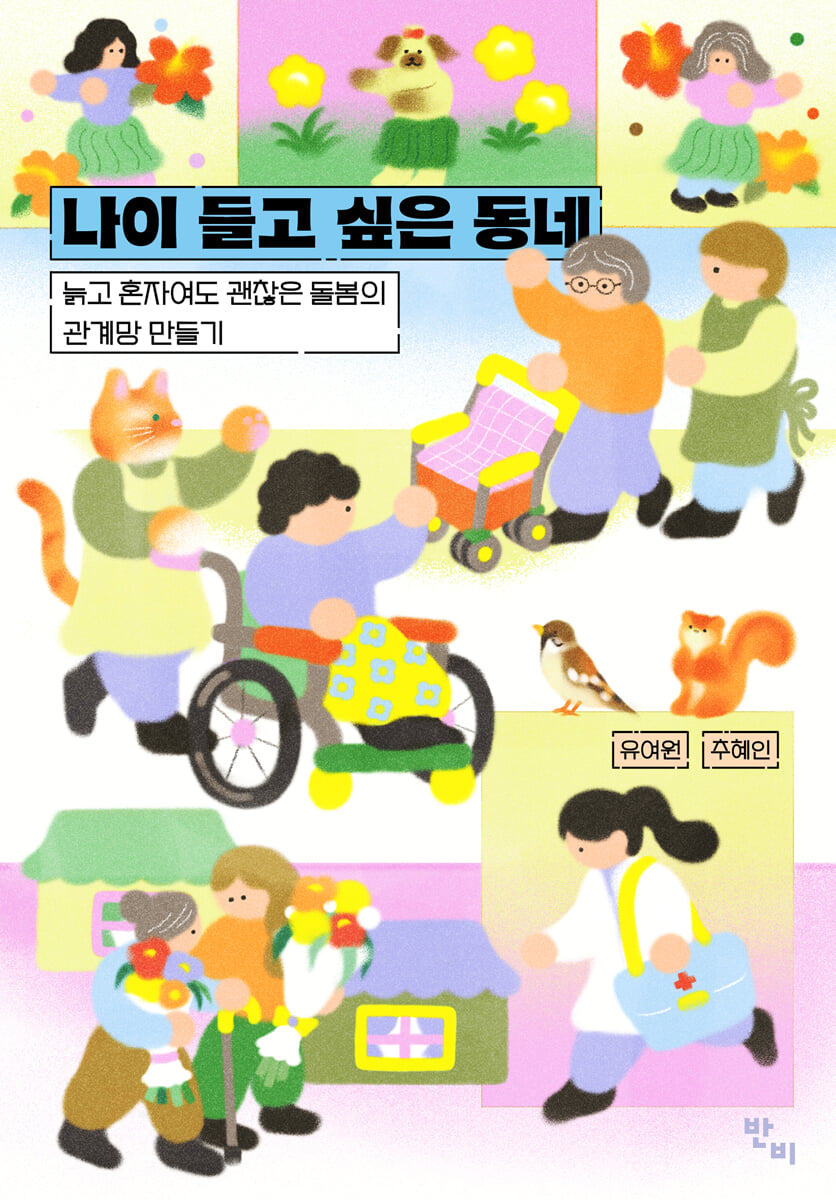
The neighborhood I want to grow old in
 |
Description
Book Introduction
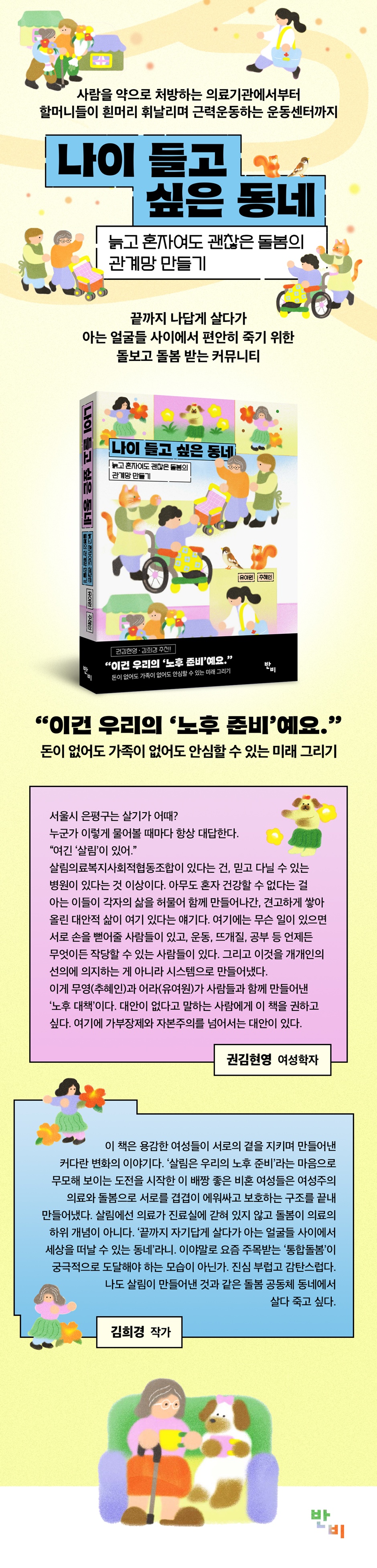
“Who wouldn’t be afraid of a future where they grow old and get sick?”
A new grammar of care to fill the void left by caregiving
Life expectancy is increasing day by day, but growing old is not pleasant.
They say that in order to avoid growing old alone, isolated from society and with nothing to rely on, you need to start saving for retirement from a young age.
Articles are constantly appearing about the national pension fund's imminent depletion, and various pension products, real estate, and financial investment strategies are pouring out everywhere to help people live comfortably in old age.
Living expenses are not enough, so I am at a loss as to where and how to start preparing.
Is saving money really the only way to age well?
Here are some people who have chosen to grow old their way.
They say that by connecting with others and taking good care of each other, they can enjoy a healthier and more fulfilling old age.
It doesn't matter whether you live alone or with someone, whether you're sick or not, whether you have a lot of money or not.
A book titled "The Neighborhood I Want to Grow Old In" has been published, offering alternatives for living in the face of aging, vulnerability, and loneliness.
This is the story of people who have built a safety net for aging in peace into a reality called the Sallim Medical Welfare Social Cooperative (hereafter referred to as “Sallim”).
The book began as a personal struggle between two single feminist authors.
Although I had become independent from my parents and other family members, I needed someone to take care of me when I got sick.
“I witnessed an empty place of care.”
Those who are faced with the reality that care is structured around blood relatives are seeking new relationships and grammar of care.
In this way, feminist activist Yoo Yeo-won and doctor Chu Hye-in, who dreamed of feminist medicine, joined forces to create a 'feminist medical cooperative' in their late 20s and early 30s.
Founded in 2012, Sallim has grown to over 5,000 members and is located in Eunpyeong-gu, Seoul.
We operate medical institutions (Sallim Hospital, Sallim Dental Clinic, Sallim Oriental Medicine Clinic) established with contributions from members, and provide honest and trustworthy medical services to local residents.
Union members study feminism together, write care plans and wills, and envision the kind of care and death they want.
We have various clubs for hiking, football, running, knitting, etc.
“There are people who will reach out to you whenever something happens, and (……) there are people who can do anything at any time” (Kwon Kim Hyun-young) In life, there are people who will reach out to you whenever something happens.
A new grammar of care to fill the void left by caregiving
Life expectancy is increasing day by day, but growing old is not pleasant.
They say that in order to avoid growing old alone, isolated from society and with nothing to rely on, you need to start saving for retirement from a young age.
Articles are constantly appearing about the national pension fund's imminent depletion, and various pension products, real estate, and financial investment strategies are pouring out everywhere to help people live comfortably in old age.
Living expenses are not enough, so I am at a loss as to where and how to start preparing.
Is saving money really the only way to age well?
Here are some people who have chosen to grow old their way.
They say that by connecting with others and taking good care of each other, they can enjoy a healthier and more fulfilling old age.
It doesn't matter whether you live alone or with someone, whether you're sick or not, whether you have a lot of money or not.
A book titled "The Neighborhood I Want to Grow Old In" has been published, offering alternatives for living in the face of aging, vulnerability, and loneliness.
This is the story of people who have built a safety net for aging in peace into a reality called the Sallim Medical Welfare Social Cooperative (hereafter referred to as “Sallim”).
The book began as a personal struggle between two single feminist authors.
Although I had become independent from my parents and other family members, I needed someone to take care of me when I got sick.
“I witnessed an empty place of care.”
Those who are faced with the reality that care is structured around blood relatives are seeking new relationships and grammar of care.
In this way, feminist activist Yoo Yeo-won and doctor Chu Hye-in, who dreamed of feminist medicine, joined forces to create a 'feminist medical cooperative' in their late 20s and early 30s.
Founded in 2012, Sallim has grown to over 5,000 members and is located in Eunpyeong-gu, Seoul.
We operate medical institutions (Sallim Hospital, Sallim Dental Clinic, Sallim Oriental Medicine Clinic) established with contributions from members, and provide honest and trustworthy medical services to local residents.
Union members study feminism together, write care plans and wills, and envision the kind of care and death they want.
We have various clubs for hiking, football, running, knitting, etc.
“There are people who will reach out to you whenever something happens, and (……) there are people who can do anything at any time” (Kwon Kim Hyun-young) In life, there are people who will reach out to you whenever something happens.
- You can preview some of the book's contents.
Preview
index
Recommendation
Entering
Chapter 1: Is it okay to grow old like this?
How did I end up here?
Preparing for our old age
Because I want to be connected
Strange Patients: Union Members Who Live Far Away But Don't Leave
Chapter 2: A Village That Develops Caring Power
A week-long mini-hospice ward
We share a care center where we can be ourselves and be together.
The Avengers of Living Together
Not only disease, but also people
Life-Changing Studies, Feminist School
Become healthy through relationships, not machines
A muscle rich man is a fat rich man!
A gathering like oxygen, O2
Clear-eyed madmen, Sallim FC
People running along Bulkwangcheon
Two weddings and a funeral
Preparing for death
For an advance directive to be written properly
Care Salon: A Public, Private, and Human Dialogue on Care
The future of care that Salim dreams of
Chapter 3: A Doctor Who Cares for People, Not for the Sick
Learning Korean improved my blood sugar levels.
Feminist medicine: Health without discrimination and hatred
Qualitatively different
Are you taking your medicine?
What Numbers Can't Show
A clinic you visit with a doctor's bag
What the doctors of 1,024 residents told us
Pharmacy review with residents
Until the introduction of a single osteoporosis drug
Dental care settings for HIV-infected individuals
LGBTQ+ friendly clinic
Creating a Toilet for Everyone
Chapter 4 Between Care and Medical Care
Healthy me, healthy neighbors, healthy village
An experiment called Care B&B
Mutual Care Café on Saturdays
A strange prescription
Suggestions made in the clinic
Care with a team physician
Caring for the carer
If the number of doctors increases
Chapter 5 Now we create it
The beginning of PPT is a person falling down
We like 3
When a caterpillar becomes a butterfly
Bad relationship with illegal medical cooperatives
The day we decided on our name
Worries after deciding on a name
Job Interview with a Famous Nurse
Evolution of the organizational chart
Chapter 6: Sustainability through Collaboration
People who do cooperatives
A party in name only?
Until you have the right to vote
How cooperatives raise money
Harmony of social and financial values
A proverb interpreted as cooperation in labor
self-defense vigilante group
Self-defense training for employees
I don't want to be called a miss
Cheerful goodbye
The staff also said hello cheerfully
It takes strength to fold it
Going out
Entering
Chapter 1: Is it okay to grow old like this?
How did I end up here?
Preparing for our old age
Because I want to be connected
Strange Patients: Union Members Who Live Far Away But Don't Leave
Chapter 2: A Village That Develops Caring Power
A week-long mini-hospice ward
We share a care center where we can be ourselves and be together.
The Avengers of Living Together
Not only disease, but also people
Life-Changing Studies, Feminist School
Become healthy through relationships, not machines
A muscle rich man is a fat rich man!
A gathering like oxygen, O2
Clear-eyed madmen, Sallim FC
People running along Bulkwangcheon
Two weddings and a funeral
Preparing for death
For an advance directive to be written properly
Care Salon: A Public, Private, and Human Dialogue on Care
The future of care that Salim dreams of
Chapter 3: A Doctor Who Cares for People, Not for the Sick
Learning Korean improved my blood sugar levels.
Feminist medicine: Health without discrimination and hatred
Qualitatively different
Are you taking your medicine?
What Numbers Can't Show
A clinic you visit with a doctor's bag
What the doctors of 1,024 residents told us
Pharmacy review with residents
Until the introduction of a single osteoporosis drug
Dental care settings for HIV-infected individuals
LGBTQ+ friendly clinic
Creating a Toilet for Everyone
Chapter 4 Between Care and Medical Care
Healthy me, healthy neighbors, healthy village
An experiment called Care B&B
Mutual Care Café on Saturdays
A strange prescription
Suggestions made in the clinic
Care with a team physician
Caring for the carer
If the number of doctors increases
Chapter 5 Now we create it
The beginning of PPT is a person falling down
We like 3
When a caterpillar becomes a butterfly
Bad relationship with illegal medical cooperatives
The day we decided on our name
Worries after deciding on a name
Job Interview with a Famous Nurse
Evolution of the organizational chart
Chapter 6: Sustainability through Collaboration
People who do cooperatives
A party in name only?
Until you have the right to vote
How cooperatives raise money
Harmony of social and financial values
A proverb interpreted as cooperation in labor
self-defense vigilante group
Self-defense training for employees
I don't want to be called a miss
Cheerful goodbye
The staff also said hello cheerfully
It takes strength to fold it
Going out
Detailed image
Into the book
When asked, “Why did you decide to live like this?” or “Why did you start living together?” we always answered like this.
This is our 'preparation for old age'.
--- p.29
At that time, the goal of young single women, including us, was ‘independence.’
It was a time when marriage was considered natural at a certain age, and only through marriage could one break away from one's parents and other family of origin and form one's own community.
Regardless of marriage, independence had to be the top priority.
It was good that I struggled to break free from the traditional family structure, but as soon as I did, I witnessed an empty space for care.
(……) If we are to break away from convention, we must rebuild everything anew, one by one.
The relationship of care that was taken for granted and the grammar of care had to be re-created.
--- p.31
There is bound to be a difference between what you say when you think of the doctor sitting across from you as 'my doctor' and what you say when you think of him as a doctor you will never see again once the pain passes.
When a prescribed medication doesn't work well, or when a medication has side effects, doctors you'll never see again don't have the opportunity to hear such important information.
Which patient would come back to the clinic to talk about that?
Just go to another medical institution.
Rather, because I am a 'doctor', I may hear more uncomfortable stories.
It is the patient's role to provide this kind of feedback, and it is this uncomfortable feedback that helps doctors grow.
The characteristic of a cooperative medical institution is crucial in creating patient autonomy as a member of the cooperative.
--- p.42
When you care for someone who cares for you, the care can continue.
To do this, more and more people need to be involved in caregiving, sometimes deeply and sometimes shallowly, including those who care for the caregivers, and those who support them in turn, so that there can be a large number of caregivers.
I hope that we can become a society where we always care for others or those who care for us, where care is a natural part of our daily lives, as if we were breathing, and that I, too, can live, get sick, and die within the magnetic field of care, always being cared for.
--- p.54~55
On the wall of pledges are these words:
“Health is achieved through relationships, not machines.”
Those who are happy and supportive of the increasing number of fitness instructors from Dajim.
People who contact us because they are curious and worried about why someone isn't exercising.
These people came here after being advised to exercise by their doctor, and ended up participating in a weekend cleaning and even joining a Japanese study group that was suddenly formed there.
They met at a foam roller club and became close friends while hiking together.
No matter how good a machine is, it is ultimately relationships that bring us to the machine.
--- p.86
O2's goal of hiking at the pace of the slowest person has never changed from the beginning to the present.
Each person climbs the mountain safely at their own pace and is willing to wait for others.
So, even beginners and people who are climbing a mountain for the first time in a long time will not feel burdened.
It's a three-hour course that takes five hours, but it's so much fun and enjoyable throughout that time.
That's the taste of cooperation I learned at O2.
Still, it is surprising that among the members there are quite a few semi-professional mountaineers who have been active for a long time.
Those who climb the steep rock walls and run along the Seoraksan Dinosaur Ridge participate in the group operation, saying that even the slow mountain hike of O2 is very precious.
Without them, Otu's safe hiking might have been impossible.
--- p.95~96
“I want to live my life true to myself until the end and then die among familiar faces.”
This phrase, which is still being circulated in various places in the union, has now become a representative slogan for proper care.
And we started asking:
"What is my identity? What kind of care do I need to live my life authentically?"
The answer came down to two things.
One was ‘self-determination in death and care’, and the other was ‘diversity of choices’.
--- p.139
To increase care options, we desperately need more people to provide care.
The care crisis in Korean society stems from a lack of people to provide care compared to the need.
However, not only people who work full-time in care work can provide care.
What if we could weave together the diverse care provided by diverse people? That's why Sallim is creating a care structure where "anyone, anything, even just one thing" can be done.
We call this the 'care matrix'.
--- p.141~142
Feminist medicine isn't just about overcoming misogyny.
It doesn't stop at 'medical care by women' or 'medical care for women'.
The key is to critically examine who the medical system is designed for and to see who its structure has been disadvantageous to.
--- p.155
When you visit patients' living spaces directly, you realize that medical care is not everything.
So, it is difficult to properly imagine anything based on numbers alone.
It's not that healthcare isn't important, it's just a small part of being healthy.
We realize that home health care is important, but it is not important because it is everything, but because it is a part of something.
--- p.172
Still, we continue.
Fill in the gaps in the system and create your own system if it doesn't exist.
We are weaving a map of community care, like a quilt made of individual pieces of fabric.
Home visits are not just about one doctor visiting a patient's home.
It is a restructuring of care, a restoration of relationships, and a search for ways for communities to live together.
As we take steps to find someone, the face of the community we desire is gradually being drawn.
--- p.177
Just as I should treat others as I would like to be treated, I should create the community I want to live in by treating others as I would treat myself.
The reason I learn CPR is to save other people's lives.
The same goes for learning about dementia.
Of course, it is to prevent my own dementia, but also to better support others with dementia.
It is for a village where elderly people with dementia can live in peace, and ultimately for my future self.
--- p.227
We decided to try a halfway house.
'Care B&B'! A parody of the name of a popular accommodation sharing platform.
It is a bed and breakfast (B&B), which means a B&B that provides care.
It was clearly stated in the name that it was not a nursing home where people would have to live until they died once they moved in, but a place for temporary stays like a hotel or pension.
In addition to breakfast, you can also get all three meals a day if you wish, or you can prepare them yourself.
It is a temporary stop for those who do not need to be hospitalized but cannot return to their original homes, where they can stay for a short period of one month to six months, receive care and rehabilitate with the goal of returning to their daily lives.
--- p.238
If I had dementia, I'd have a hard time going to cafes or restaurants. It would be the same if my friends or family had dementia.
So isn't there something we can do?
Let's open a cafe where anyone, including people with cognitive impairment and their caregivers, can come with peace of mind.
After a spirited exchange, the union members, who had been running the business without a hitch, rented the neighborhood vegetarian restaurant Bappulkkot every Saturday and started a mutual care cafe.
--- p.244
I've heard stories of menopausal women being prescribed dance, and those with depression being prescribed theater.
Prescribing activities is of course important.
But in life, we don't just prescribe activities.
It's like using a good person as medicine.
This is the space of Sallim Clinic's examination room.
A place that not only prescribes medicine but also builds relationships.
A place that introduces good people.
--- p.254
Comforting crying patients and their families and connecting them with necessary resources is not the sole responsibility of medical professionals.
There is no sharp division between caregivers and care recipients within our team physician system.
The person who was cared for one moment can become the caregiver the next, and I cannot simply repay the kindness of the person who cared for me.
A care ecosystem is possible only when there is reciprocal and equitable care flowing in all directions, within which every village member can become a member of the primary care team.
We are all someone's doctor.
--- p.266
There is a hospital that asks injured people a lot of questions.
This hospital does not stop at treating one person, but rather aims to correct the cause of that person's injury and make the village healthy.
A hospital that prevents others from getting hurt in the same place for the same reason is a medical cooperative.
Let's make it together!
--- p.282~283
At the beginning of the meeting, the members were puzzled, asking, “Can we really decide this?” However, as users of medical institutions, they suggested a standard of “what I am willing to pay,” and as owners of the cooperative, they took the position of the “president” concerned about the sustainability of the hospital, and together they came up with a reasonable price.
The appeal of cooperatives lies in the fact that the identities of CEO and customer, employee and member are not necessarily conflicting.
We acknowledged that multiple identities exist within a single person, and based on that, we made decisions together, considering common interests.
--- p.297
debt.
Medical institutions usually use bank loans to cover their opening costs, so they must start paying off their debts from the moment they begin providing treatment.
What if cooperative medical institutions, established and operated through collaboration between medical professionals and residents, could create a working environment where medical professionals could at least avoid bank debt? Instead of worrying about how to make up for the interest on bank loans, wouldn't they be more conscientious in providing care and providing more thorough consultations? Instead of vaguely expecting good medical care from medical professionals, residents could create the conditions for them to provide appropriate and quality care, and share responsibility for that environment.
That's what it means to run a medical institution together through cooperation.
This is our 'preparation for old age'.
--- p.29
At that time, the goal of young single women, including us, was ‘independence.’
It was a time when marriage was considered natural at a certain age, and only through marriage could one break away from one's parents and other family of origin and form one's own community.
Regardless of marriage, independence had to be the top priority.
It was good that I struggled to break free from the traditional family structure, but as soon as I did, I witnessed an empty space for care.
(……) If we are to break away from convention, we must rebuild everything anew, one by one.
The relationship of care that was taken for granted and the grammar of care had to be re-created.
--- p.31
There is bound to be a difference between what you say when you think of the doctor sitting across from you as 'my doctor' and what you say when you think of him as a doctor you will never see again once the pain passes.
When a prescribed medication doesn't work well, or when a medication has side effects, doctors you'll never see again don't have the opportunity to hear such important information.
Which patient would come back to the clinic to talk about that?
Just go to another medical institution.
Rather, because I am a 'doctor', I may hear more uncomfortable stories.
It is the patient's role to provide this kind of feedback, and it is this uncomfortable feedback that helps doctors grow.
The characteristic of a cooperative medical institution is crucial in creating patient autonomy as a member of the cooperative.
--- p.42
When you care for someone who cares for you, the care can continue.
To do this, more and more people need to be involved in caregiving, sometimes deeply and sometimes shallowly, including those who care for the caregivers, and those who support them in turn, so that there can be a large number of caregivers.
I hope that we can become a society where we always care for others or those who care for us, where care is a natural part of our daily lives, as if we were breathing, and that I, too, can live, get sick, and die within the magnetic field of care, always being cared for.
--- p.54~55
On the wall of pledges are these words:
“Health is achieved through relationships, not machines.”
Those who are happy and supportive of the increasing number of fitness instructors from Dajim.
People who contact us because they are curious and worried about why someone isn't exercising.
These people came here after being advised to exercise by their doctor, and ended up participating in a weekend cleaning and even joining a Japanese study group that was suddenly formed there.
They met at a foam roller club and became close friends while hiking together.
No matter how good a machine is, it is ultimately relationships that bring us to the machine.
--- p.86
O2's goal of hiking at the pace of the slowest person has never changed from the beginning to the present.
Each person climbs the mountain safely at their own pace and is willing to wait for others.
So, even beginners and people who are climbing a mountain for the first time in a long time will not feel burdened.
It's a three-hour course that takes five hours, but it's so much fun and enjoyable throughout that time.
That's the taste of cooperation I learned at O2.
Still, it is surprising that among the members there are quite a few semi-professional mountaineers who have been active for a long time.
Those who climb the steep rock walls and run along the Seoraksan Dinosaur Ridge participate in the group operation, saying that even the slow mountain hike of O2 is very precious.
Without them, Otu's safe hiking might have been impossible.
--- p.95~96
“I want to live my life true to myself until the end and then die among familiar faces.”
This phrase, which is still being circulated in various places in the union, has now become a representative slogan for proper care.
And we started asking:
"What is my identity? What kind of care do I need to live my life authentically?"
The answer came down to two things.
One was ‘self-determination in death and care’, and the other was ‘diversity of choices’.
--- p.139
To increase care options, we desperately need more people to provide care.
The care crisis in Korean society stems from a lack of people to provide care compared to the need.
However, not only people who work full-time in care work can provide care.
What if we could weave together the diverse care provided by diverse people? That's why Sallim is creating a care structure where "anyone, anything, even just one thing" can be done.
We call this the 'care matrix'.
--- p.141~142
Feminist medicine isn't just about overcoming misogyny.
It doesn't stop at 'medical care by women' or 'medical care for women'.
The key is to critically examine who the medical system is designed for and to see who its structure has been disadvantageous to.
--- p.155
When you visit patients' living spaces directly, you realize that medical care is not everything.
So, it is difficult to properly imagine anything based on numbers alone.
It's not that healthcare isn't important, it's just a small part of being healthy.
We realize that home health care is important, but it is not important because it is everything, but because it is a part of something.
--- p.172
Still, we continue.
Fill in the gaps in the system and create your own system if it doesn't exist.
We are weaving a map of community care, like a quilt made of individual pieces of fabric.
Home visits are not just about one doctor visiting a patient's home.
It is a restructuring of care, a restoration of relationships, and a search for ways for communities to live together.
As we take steps to find someone, the face of the community we desire is gradually being drawn.
--- p.177
Just as I should treat others as I would like to be treated, I should create the community I want to live in by treating others as I would treat myself.
The reason I learn CPR is to save other people's lives.
The same goes for learning about dementia.
Of course, it is to prevent my own dementia, but also to better support others with dementia.
It is for a village where elderly people with dementia can live in peace, and ultimately for my future self.
--- p.227
We decided to try a halfway house.
'Care B&B'! A parody of the name of a popular accommodation sharing platform.
It is a bed and breakfast (B&B), which means a B&B that provides care.
It was clearly stated in the name that it was not a nursing home where people would have to live until they died once they moved in, but a place for temporary stays like a hotel or pension.
In addition to breakfast, you can also get all three meals a day if you wish, or you can prepare them yourself.
It is a temporary stop for those who do not need to be hospitalized but cannot return to their original homes, where they can stay for a short period of one month to six months, receive care and rehabilitate with the goal of returning to their daily lives.
--- p.238
If I had dementia, I'd have a hard time going to cafes or restaurants. It would be the same if my friends or family had dementia.
So isn't there something we can do?
Let's open a cafe where anyone, including people with cognitive impairment and their caregivers, can come with peace of mind.
After a spirited exchange, the union members, who had been running the business without a hitch, rented the neighborhood vegetarian restaurant Bappulkkot every Saturday and started a mutual care cafe.
--- p.244
I've heard stories of menopausal women being prescribed dance, and those with depression being prescribed theater.
Prescribing activities is of course important.
But in life, we don't just prescribe activities.
It's like using a good person as medicine.
This is the space of Sallim Clinic's examination room.
A place that not only prescribes medicine but also builds relationships.
A place that introduces good people.
--- p.254
Comforting crying patients and their families and connecting them with necessary resources is not the sole responsibility of medical professionals.
There is no sharp division between caregivers and care recipients within our team physician system.
The person who was cared for one moment can become the caregiver the next, and I cannot simply repay the kindness of the person who cared for me.
A care ecosystem is possible only when there is reciprocal and equitable care flowing in all directions, within which every village member can become a member of the primary care team.
We are all someone's doctor.
--- p.266
There is a hospital that asks injured people a lot of questions.
This hospital does not stop at treating one person, but rather aims to correct the cause of that person's injury and make the village healthy.
A hospital that prevents others from getting hurt in the same place for the same reason is a medical cooperative.
Let's make it together!
--- p.282~283
At the beginning of the meeting, the members were puzzled, asking, “Can we really decide this?” However, as users of medical institutions, they suggested a standard of “what I am willing to pay,” and as owners of the cooperative, they took the position of the “president” concerned about the sustainability of the hospital, and together they came up with a reasonable price.
The appeal of cooperatives lies in the fact that the identities of CEO and customer, employee and member are not necessarily conflicting.
We acknowledged that multiple identities exist within a single person, and based on that, we made decisions together, considering common interests.
--- p.297
debt.
Medical institutions usually use bank loans to cover their opening costs, so they must start paying off their debts from the moment they begin providing treatment.
What if cooperative medical institutions, established and operated through collaboration between medical professionals and residents, could create a working environment where medical professionals could at least avoid bank debt? Instead of worrying about how to make up for the interest on bank loans, wouldn't they be more conscientious in providing care and providing more thorough consultations? Instead of vaguely expecting good medical care from medical professionals, residents could create the conditions for them to provide appropriate and quality care, and share responsibility for that environment.
That's what it means to run a medical institution together through cooperation.
--- p.341~342
Publisher's Review
Beyond healthy individuals, towards a healthy society
Medical care that goes beyond the clinic
Anyone who has visited a medical institution as a patient has probably experienced this.
After waiting for a long time in a crowded waiting room and finally entering the examination room, I feel “frustrated that my pain or discomfort is not being conveyed well.”
It is extremely difficult to become a patient's subject within a bureaucratized medical system.
But patients who have visited Sallim's medical institutions say they have had a different experience here.
I will be more proactive in explaining my symptoms and condition to my doctor and will listen more attentively to what the medical staff say.
How is that possible?
Sallim strives to improve the power relationship between doctors and patients to make it more equal.
Based on the concept of health that the more equal people are, the healthier they are, we do not dichotomize the beneficiaries and providers of medical care.
Non-medical union members decide whether to introduce the drug.
Union members also provide advance directive education to prospective medical professionals who are on internships.
We will reduce the knowledge hierarchy between medical and non-medical professionals and work together to provide democratic healthcare that everyone needs.
That is why the medical care of life does not remain only in the clinic.
Heading lower, to a more vulnerable place.
If the patient is unable to move on his or her own, medical staff will visit the patient's residence and provide treatment.
Find out if the living environment is poor.
Diabetic patients who cannot read Korean are helped to enroll in Korean language classes.
The medical staff allows the patients to read the customized diet plan on their own, and encourages them to socialize with other students in the Korean language class, taking care of not only their bodies but also their minds.
Install gender-neutral restrooms so that anyone can comfortably access medical facilities.
It is a medical service that goes beyond simply treating a patient's illness, but rather aims to make the living environment in which the person lives and, further, the society in which the person lives healthy.
To become healthy together, not just for me
An ecosystem of care created by each and every person coming together
Care is often viewed as separate from or a subordinate concept of healthcare.
But in life, medical care and care are complementary.
Where should those who have been discharged from a tertiary hospital after surgery but are unable to live independently go? The wards are overflowing with patients in urgent need of treatment, and there's no preparation for returning home.
Above all, there is no one to take care of me.
Sallim also piloted a 'Care B&B', a facility located between a hospital and a home, to help these people receive care and reintegrate into society.
It was a stop connecting medical care and care.
But care isn't just about the body and illness.
Care is an act of living together as human beings.
That's why the members of Sallim Cooperative don't just take care of themselves; they seek ways to become healthy together and build a safe community.
I regularly visit the homes of elderly people who are homebound due to frailty and do simple exercises together.
Become a ‘healthy neighbor’ who takes responsibility for not only your own health but also that of your neighbors.
We run a 'mutual care cafe' as a volunteer activity, where people with dementia and their guardians can relax over a cup of tea.
We are opening a 'Dementia-Friendly Village Healthy Neighbor' course with the intention of providing good care to neighbors with dementia at the community level.
The members of Sallim Cooperative are keenly aware that care is not just their own problem, but something that must be practiced at the community level.
Some might consider this an ideal case that is only possible within the organization called Sallim.
However, I would also like to recommend 『The Neighborhood Where I Want to Grow Old』 to those who do not belong to an organization or cannot belong to one.
Single feminists, desperate for survival, created a community of care, starting from their personal wish to “live true to myself until the end and die among familiar faces.”
“We surround and protect each other with layers of medical care and care” (Kim Hee-kyung) This structure was created by ordinary people, more than anyone else.
The future of community, a clear demonstration that collaboration is everything, is already upon us.
Medical care that goes beyond the clinic
Anyone who has visited a medical institution as a patient has probably experienced this.
After waiting for a long time in a crowded waiting room and finally entering the examination room, I feel “frustrated that my pain or discomfort is not being conveyed well.”
It is extremely difficult to become a patient's subject within a bureaucratized medical system.
But patients who have visited Sallim's medical institutions say they have had a different experience here.
I will be more proactive in explaining my symptoms and condition to my doctor and will listen more attentively to what the medical staff say.
How is that possible?
Sallim strives to improve the power relationship between doctors and patients to make it more equal.
Based on the concept of health that the more equal people are, the healthier they are, we do not dichotomize the beneficiaries and providers of medical care.
Non-medical union members decide whether to introduce the drug.
Union members also provide advance directive education to prospective medical professionals who are on internships.
We will reduce the knowledge hierarchy between medical and non-medical professionals and work together to provide democratic healthcare that everyone needs.
That is why the medical care of life does not remain only in the clinic.
Heading lower, to a more vulnerable place.
If the patient is unable to move on his or her own, medical staff will visit the patient's residence and provide treatment.
Find out if the living environment is poor.
Diabetic patients who cannot read Korean are helped to enroll in Korean language classes.
The medical staff allows the patients to read the customized diet plan on their own, and encourages them to socialize with other students in the Korean language class, taking care of not only their bodies but also their minds.
Install gender-neutral restrooms so that anyone can comfortably access medical facilities.
It is a medical service that goes beyond simply treating a patient's illness, but rather aims to make the living environment in which the person lives and, further, the society in which the person lives healthy.
To become healthy together, not just for me
An ecosystem of care created by each and every person coming together
Care is often viewed as separate from or a subordinate concept of healthcare.
But in life, medical care and care are complementary.
Where should those who have been discharged from a tertiary hospital after surgery but are unable to live independently go? The wards are overflowing with patients in urgent need of treatment, and there's no preparation for returning home.
Above all, there is no one to take care of me.
Sallim also piloted a 'Care B&B', a facility located between a hospital and a home, to help these people receive care and reintegrate into society.
It was a stop connecting medical care and care.
But care isn't just about the body and illness.
Care is an act of living together as human beings.
That's why the members of Sallim Cooperative don't just take care of themselves; they seek ways to become healthy together and build a safe community.
I regularly visit the homes of elderly people who are homebound due to frailty and do simple exercises together.
Become a ‘healthy neighbor’ who takes responsibility for not only your own health but also that of your neighbors.
We run a 'mutual care cafe' as a volunteer activity, where people with dementia and their guardians can relax over a cup of tea.
We are opening a 'Dementia-Friendly Village Healthy Neighbor' course with the intention of providing good care to neighbors with dementia at the community level.
The members of Sallim Cooperative are keenly aware that care is not just their own problem, but something that must be practiced at the community level.
Some might consider this an ideal case that is only possible within the organization called Sallim.
However, I would also like to recommend 『The Neighborhood Where I Want to Grow Old』 to those who do not belong to an organization or cannot belong to one.
Single feminists, desperate for survival, created a community of care, starting from their personal wish to “live true to myself until the end and die among familiar faces.”
“We surround and protect each other with layers of medical care and care” (Kim Hee-kyung) This structure was created by ordinary people, more than anyone else.
The future of community, a clear demonstration that collaboration is everything, is already upon us.
GOODS SPECIFICS
- Date of issue: October 17, 2025
- Format: Paperback book binding method guide
- Page count, weight, size: 384 pages | 452g | 139*198*19mm
- ISBN13: 9791194087922
- ISBN10: 1194087922
You may also like
카테고리
korean


korean

![GQ KOREA Mark (Monthly): December [2025]](http://librairie.coreenne.fr/cdn/shop/files/8ef265dbbfbf186523ed75ba7319009d.jpg?v=1765340328&width=3840)


