

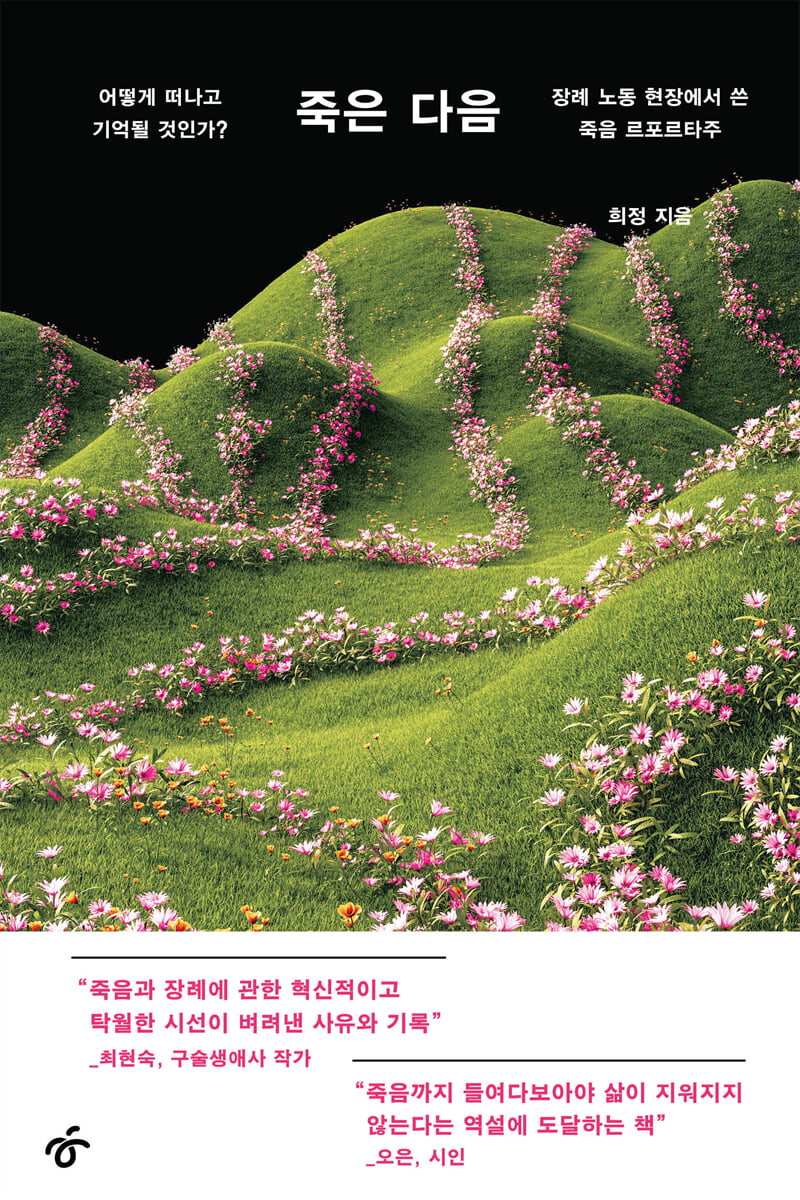
After death
 |
Description
Book Introduction
Heejung, a documentarian who has been telling stories about the lives and labor of those who are injured or sick at work, now stands as a documentarian and a documentarian in the world of labor surrounding death and mourning.
The author, who has come to pay attention to the issue of 'death' in our society due to the number of people who have died from occupational diseases and industrial accidents, the suicide rate that is soaring every year, the news of repeated disasters, and the increase in single-person households without children who worry about the possibility of dying alone, decides to become a funeral worker, wary of the mind that 'observes' the deaths of others.
By obtaining a funeral director's license and directly encountering the deceased in the embalming room, and interviewing funeral workers in various fields such as protocol managers, body restorers, cremators, shroud makers, cemetery managers, pallbearers, and pet funeral directors, I explore the issues of death and mourning in this era through the funeral system that fails to accommodate the increasingly industrialized funeral culture and diversified family composition.
Furthermore, we will look at funeral cultures in other countries that are quite different from Korea, as well as unique funerals attempted in Korea, such as ‘living funerals,’ ‘public funerals,’ and ‘funerals led by female workers.’
This book explores the ways in which our society has dealt with death and mourning, as well as how society views funeral work, what life and death mean to individual funeral workers, and whether there are ways to ensure that the deceased are not marginalized in the final rites of life, through the perspectives of funeral workers, the bereaved, and the deceased themselves.
The author, who has come to pay attention to the issue of 'death' in our society due to the number of people who have died from occupational diseases and industrial accidents, the suicide rate that is soaring every year, the news of repeated disasters, and the increase in single-person households without children who worry about the possibility of dying alone, decides to become a funeral worker, wary of the mind that 'observes' the deaths of others.
By obtaining a funeral director's license and directly encountering the deceased in the embalming room, and interviewing funeral workers in various fields such as protocol managers, body restorers, cremators, shroud makers, cemetery managers, pallbearers, and pet funeral directors, I explore the issues of death and mourning in this era through the funeral system that fails to accommodate the increasingly industrialized funeral culture and diversified family composition.
Furthermore, we will look at funeral cultures in other countries that are quite different from Korea, as well as unique funerals attempted in Korea, such as ‘living funerals,’ ‘public funerals,’ and ‘funerals led by female workers.’
This book explores the ways in which our society has dealt with death and mourning, as well as how society views funeral work, what life and death mean to individual funeral workers, and whether there are ways to ensure that the deceased are not marginalized in the final rites of life, through the perspectives of funeral workers, the bereaved, and the deceased themselves.
- You can preview some of the book's contents.
Preview
index
Entering_ The Labor of Nothing
1.
Gobok
The first thing you see is the hand: in the dyeing room.
Between 'Amuri' and 'Anyone', Funeral: Starting the Writing
2.
case
This is a good job: Kim Young-rae, a master funeral director and corpse restoration expert.
I'd like to add a name: Ianna, a female funeral director with 20 years of experience.
3.
Holy clothes
Whoever you are, that's you: From the deathbed to the funeral, the funeral you don't know
Take a taxi: In front of the wealthy
Ten Hours of Eye Pain: Becoming a Protocol Officer
4.
Funeral
Life Lessons Learned: Im Mi-sook, a Veterinarian with 30 Years of Experience
Don't Be Lonely on the Way: Seon Sori-kun Bang Dong-jin
Three days for a funeral is short: Cremationist Lee Hae-ru
A person who lives in a good house: Choi Hyeon, a funeral home operator
5.
Ban-gok
Funeral Wishes: Living Funeral Planner Han Ju-won
Namjwa Yeou: There is a female pallbearer.
Do you believe in ghosts?: A town built on graves
A funeral is not a move: Should I join a mutual aid association?
Are you ready?: Kim Kyung-hwan, Executive Director of the Hankyoreh Dure Cooperative, and Jeon Seung-uk, Preparation Planner
6.
Right now
Day of the Dead: Funerals Elsewhere
Can You Die Alone?: The Relatives of the Homeless
Making a Sound: Sharing and Sharing Park Jin-ok
Unsettling Funeral: Kyu Kyu, Planning Director of "De-Patriarchy: Ceremony"
Neighbors of the Dying: Pet Funeral Director Lee Sang-ik and Rainbow Station Operator Ji-an
Remembering People: Funerals and Mourning During the COVID-19 Pandemic
7.
Graduation song
I Will Remember Every Spring: Park Jae-ik, a Social Leader and Funeral Director
Loose, messy, somewhat lonely: Choi Go-un, Busan Citizens' Public Funeral Service, Busan Anti-Poverty Center
Coming out_ The place of the living
main
1.
Gobok
The first thing you see is the hand: in the dyeing room.
Between 'Amuri' and 'Anyone', Funeral: Starting the Writing
2.
case
This is a good job: Kim Young-rae, a master funeral director and corpse restoration expert.
I'd like to add a name: Ianna, a female funeral director with 20 years of experience.
3.
Holy clothes
Whoever you are, that's you: From the deathbed to the funeral, the funeral you don't know
Take a taxi: In front of the wealthy
Ten Hours of Eye Pain: Becoming a Protocol Officer
4.
Funeral
Life Lessons Learned: Im Mi-sook, a Veterinarian with 30 Years of Experience
Don't Be Lonely on the Way: Seon Sori-kun Bang Dong-jin
Three days for a funeral is short: Cremationist Lee Hae-ru
A person who lives in a good house: Choi Hyeon, a funeral home operator
5.
Ban-gok
Funeral Wishes: Living Funeral Planner Han Ju-won
Namjwa Yeou: There is a female pallbearer.
Do you believe in ghosts?: A town built on graves
A funeral is not a move: Should I join a mutual aid association?
Are you ready?: Kim Kyung-hwan, Executive Director of the Hankyoreh Dure Cooperative, and Jeon Seung-uk, Preparation Planner
6.
Right now
Day of the Dead: Funerals Elsewhere
Can You Die Alone?: The Relatives of the Homeless
Making a Sound: Sharing and Sharing Park Jin-ok
Unsettling Funeral: Kyu Kyu, Planning Director of "De-Patriarchy: Ceremony"
Neighbors of the Dying: Pet Funeral Director Lee Sang-ik and Rainbow Station Operator Ji-an
Remembering People: Funerals and Mourning During the COVID-19 Pandemic
7.
Graduation song
I Will Remember Every Spring: Park Jae-ik, a Social Leader and Funeral Director
Loose, messy, somewhat lonely: Choi Go-un, Busan Citizens' Public Funeral Service, Busan Anti-Poverty Center
Coming out_ The place of the living
main
Detailed image

Into the book
There was only one thing I could know.
There was no one who did not want to die, no one who wanted to die, no one who thought only of themselves in the face of the approaching time.
People who will be left behind after I leave, people who will not even hear of me when I leave, people who will be a burden to me if I die, people who will conduct my funeral, people who will come to my funeral… The people I think about at the end of my life are people.
So, even if a person is diagnosed with terminal cancer, he goes to work the next day, opens his email, coordinates schedules with business partners, goes grocery shopping, cooks meals, and visits a nursing home on the weekend.
Because no one lives alone.
He prepares to say his final farewell, leaving behind a will.
The only thing I know about death is that no one dies alone.
--- p.15~16
The first person I witnessed was an old man in his eighties.
At that time, I was a funeral director trainee (I was allowed to observe the embalming and burial).
Looking at him lying on the urn, I thought he was so skinny that it was pitiful, but most of the old people I saw after that were like that.
His muscles and flesh were dried up, as if they had been used as fuel for survival.
The abdomen was missing, so the area below the breastbone was steeply slanted, and at least one of the arms or knees was bent.
I was more surprised that the person appeared as an old man than that he appeared as a corpse.
A naked body that clearly shows what aging is.
I wanted to know about death without even knowing that I was getting old.
I learned about growing old before I learned about dying, removing the bedsore bandages from the body of the deceased.
--- p.24
The body was, of course, in an advanced state of decomposition.
If you try to wash the body with water in this case, all the skin will be washed away.
You have to wrap your whole body in cotton and wait.
Because it was a large-scale operation, three or four funeral directors were mobilized.
The problem is the face.
In other places, it was possible to wrap the body in Korean paper, but the face had to be shown to the family when the body was laid in state.
He made the missing eyes, fixed the broken nose, and even drew new eyebrows, one by one.
The job of changing the skin color was done by his wife and colleague, Go Jeong-sun, who is in charge of corpse makeup.
--- p.58
There has been a significant increase in the influx of young women into the funeral industry.
The atmosphere of the funeral industry has changed as the number of mutual aid companies has increased, but the main reason is likely the shift in the nature of funerals from family ceremonies to family events.
People wanted a "planner" who could make their family events run smoothly, rather than a wealthy merchant who knew the ropes (in fact, some mutual aid companies use the term "ending planner" in their promotions, much like "wedding planner").
--- p.70
Immediately after the death of someone close to you, you will likely contact the funeral home or the team leader of the mutual aid company you have signed up for.
That's what everyone does.
The funeral director, who is the team leader, will ask you for the address of the place of death and will send a hearse to transport the body, then give you an assignment.
Ask for a death certificate.
A funeral cannot begin without a death certificate.
In the past, as proof of death, people would put cotton on the nose to confirm that breathing had stopped, and if they went up to the roof with the clothes the deceased had worn while alive and called their name three times and the soul did not return, they were considered to have died. However, this is no longer true.
The medical staff has the initiative to decide life and death.
You must obtain a death certificate from a doctor.
If the deceased passed away in a hospital, go to the hospital administration department.
The death certificate issued by the attending physician will be issued by the administrative staff.
Even when times are tough, remember this.
You need to get multiple copies issued.
When arranging a funeral, cremation, or even when family and relatives seek funeral leave from the company, documentation is required.
--- p.82
Even after the COVID-19 pandemic passed, the memories of this time remained etched in people's minds.
A small funeral home, few mourners, and simple procedures no longer symbolize unfilial piety or evoke an impression of shabbiness.
It was learned that it was possible depending on the situation.
Everyone has become accustomed to small funerals.
There were voices of concern among the funeral home staff.
The quick-moving funeral home has newly prepared a small funeral hall suitable for the family.
Mutual aid companies are also producing and releasing products such as Mubinso and family funeral products.
Even so, a small funeral home means fewer visitors, and there are growing concerns within the industry about this.
Because the funeral home's main source of income is the food business.
--- p.89
When making eye contact with a customer, you should not smile brightly.
It's not even expressionless.
This is a sad place, so a sad expression is even more unacceptable.
At funeral homes and in service positions, you need to draw a line between your facial expressions, gestures, and eyes.
difficult.
You shouldn't run, but you shouldn't walk slowly either.
You should not hunch over with your shoulders hunched over, nor should you carry your bag behind your back while straightening your shoulders.
However, you should not put your hands together in front of you.
“If you put your hands together in front of you, you will be slow when people call you.
“I can’t move right now.” Then what should I do with my hands?
Watching the hands of the 'sisters'.
It doesn't stay still for even a moment.
Clean, move, carry, and organize.
Then, when he sees someone leaning over and looking for something, he leans forward and asks, “Do you need anything?”
--- p.100
For a makeup studio to operate properly, there needs to be work behind the scenes to check and maintain tools and facilities.
It is as necessary as crying together and holding hands.
The more awkward the funeral arrangements, the more tears the bereaved shed.
--- p.155
Cemeteries have become a headache for densely populated cities.
In Korea, the tension between the land of the dead, the cemetery, and the land of the living, the city, ends in the victory of the living.
In 1970, when Gangnam development was in full swing, the Seoul Metropolitan Government closed the city's municipal cemeteries and began relocating graves from eight public cemeteries south of the Han River.
An apartment building was built on the site of the cemetery.
As roads became highways and mountains became tunnels, countless graves were relocated or separated into unclaimed graves and disappeared.
This led to a surge in the number of village chiefs, and it is said that even feng shui experts enjoyed prosperity.
But the glory was short-lived.
People flocked there for transportation and jobs, not for its geomantic location.
The cemetery is gone, and people now seek out the best spots for the burial mound.
--- p.175
“Honestly, the coffin isn’t even heavy.
And it's not like I'm climbing a mountain."
Unless a burial is being held, the distance the coffin is carried is from the funeral parlor to the hearse parked in front of the funeral home.
Even in that short distance, only men touch the coffin.
If you think about it, in a world where men carry water purifiers, men also carry water pipes.
In a world where there is controversy over 'reverse discrimination' such as 'why do men have to carry the water tank when changing the water purifier at work?', there should also be discord in the case of a specific gender carrying the water tank.
--- p.199
There was no choice.
They started building a house on top of a Japanese grave.
The tomb, made of granite marble, had solid walls and a floor, and the chamber where the urn was placed served as a furnace.
There were gravestones scattered all over the place, so there was no need to worry about materials.
Only guilt and fear followed.
Although the names on the tombstones were painted over to erase their traces, for decades afterward, stories of Japanese ghosts wearing kimonos and will-o'-the-wisps continued to be told in Ami-dong.
The uncomfortable and resigned coexistence of the living making room for the dead has returned as a ghost story.
Although generational poverty was a prime condition for incidents and accidents, when misfortune struck a house, the villagers would recall which grave that spot had been.
In the 1990s, the residents of Ami-dong gathered the remaining gravestones, built a five-story stone pagoda, and held a memorial service.
They said that accidents have decreased since then.
I guess what actually decreased was the discomfort felt by the villagers.
--- p.215
Pregnant women lie on cold operating tables, and elderly people lie in nursing home wards, despairing over bodies that are neither theirs nor anyone else's.
An 'ending planner' appeared at the funeral.
They ask you to prepare for a funeral as if you were choosing a set product by handing out Package A, Package B, and Package C.
What the bereaved person who has become a consumer must do at that moment is a rational choice.
It's strange to think of making rational choices at a funeral filled with tears and regret, but it's also hard to accept that the bereaved, tasked with the weighty task of sending someone off, are limited to choosing products and welcoming mourners.
Modern people are not only alienated from the products they produce (labor).
I feel alienated from my own life.
I didn't want to be left out of my death.
--- p.233
But death is also a social thing, and mourning exists within the rules and order of society.
To whom will the resources for survival be allocated?
At the national level, the problem is how the public support system works.
Who to kill is a skill of governance, and who to save is also a skill of power.
This classification overturns the saying, “All men are equal before death,” and creates a hierarchy of death.
There are deaths that society does not bear the cost of mourning.
The deaths of the poor, the deaths of those living in institutions, the deaths of those whose bodies society does not consider 'whole,' and the deaths of those without relatives.
These are deaths that are tolerated even if funeral and mourning procedures are omitted.
Because he is a 'non-existent person'.
But there is no one who doesn't have it.
There are only “people who were treated as if they did not exist.”
--- p.264
There may be no one to hold my funeral.
Even in those moments, I want to create the belief that society will not forget me and will hold a funeral for me.
It's a sense of solidarity.
It's not a big deal to just raise a tablet, but it still sends a social message.
There are people who will take responsibility for your funeral.
It's a constant reminder that I'm not alone, you're not alone, and we're not alone.
That sound is like holding a memorial tablet for me.
--- p.287
The world's answer is simple.
Woman and man.
Adults and children.
Rich and poor.
Humans and animals.
The world is split in half.
Men wear trousers and women wear skirts.
The man presides over the ancestral rites and the woman takes care of the mourners.
The intention of the test is captured by those who either fail to enter the testing room or fail beforehand.
Those who live a life that the world does not recognize as the right answer cannot help but think about what will happen to them.
Moreover, a funeral is not a ceremony that can be avoided like a wedding or a first birthday party.
Whether it's someone else's funeral or your own, a funeral is something that definitely comes into life.
--- p.291~292
Is it sad that animal funerals are held as 'human affairs'?
I don't know.
It is certainly a sad thing to have a funeral where one cannot tell what kind of person he was.
It is certainly sad that we cannot say what kind of animal he was, or what kind of life he led.
But to talk about what life was like in the face of death, you must first live it.
When non-human animals can live as they are, wouldn't their funerals also be as they are?
--- p.329
In a world that asks about the qualifications of those who are to receive condolences, I believe that what placed the death of Sergeant Byun Hee-soo in the position of condolences were the greetings from others.
Greetings to Byun Hee-soo from people who don't know him.
After his death, I learned to answer the question, “Is this a death worthy of social mourning?” with solidarity and relationship, not qualifications.
Perhaps, it is a comrade who has crossed the timeline of a hundred years.
--- p.355
The Care Collective, the authors of the Care Manifesto, said, “Care issues are not just about the intimacy of very close relationships, like family or relatives.”
We need to practice “indiscriminate care for all members of society,” regardless of field, expertise, race, or gender or age.
I would like to bring his concept of 'promiscuous care' to the farewell ritual.
Everyone needs to practice indiscriminate gestures of mourning.
Just as the residents of the shantytown attend the funeral of a migrant worker, or as members of a village reading group show up at the funeral of an unclaimed person, I believe that this act will bring us together as ourselves.
I insisted on choosing and deciding even my own death, but that doesn't mean I'm going to figure it out on my own, deciding when and on what day.
I want to prepare for my death.
As I live, I realize that the term 'I' is not a word that refers to the first person.
I am defined by the foundation and relationships that have shaped me, and a funeral is a place to reveal and reproduce the bonds, relationships, politics, and values we have built during our lifetime.
So I want to take stock of what has made me who I am and prepare to part ways with it.
I want to complete that preparation.
--- p.374~375
As I live, I realize that the term 'I' is not a word that refers to the first person.
I am defined by the foundation and relationships that have shaped me, and a funeral is a place to reveal and reproduce the bonds, relationships, politics, and values we have built during our lifetime.
So I want to take stock of what has made me who I am and prepare to part ways with it.
I want to complete that preparation.
There was no one who did not want to die, no one who wanted to die, no one who thought only of themselves in the face of the approaching time.
People who will be left behind after I leave, people who will not even hear of me when I leave, people who will be a burden to me if I die, people who will conduct my funeral, people who will come to my funeral… The people I think about at the end of my life are people.
So, even if a person is diagnosed with terminal cancer, he goes to work the next day, opens his email, coordinates schedules with business partners, goes grocery shopping, cooks meals, and visits a nursing home on the weekend.
Because no one lives alone.
He prepares to say his final farewell, leaving behind a will.
The only thing I know about death is that no one dies alone.
--- p.15~16
The first person I witnessed was an old man in his eighties.
At that time, I was a funeral director trainee (I was allowed to observe the embalming and burial).
Looking at him lying on the urn, I thought he was so skinny that it was pitiful, but most of the old people I saw after that were like that.
His muscles and flesh were dried up, as if they had been used as fuel for survival.
The abdomen was missing, so the area below the breastbone was steeply slanted, and at least one of the arms or knees was bent.
I was more surprised that the person appeared as an old man than that he appeared as a corpse.
A naked body that clearly shows what aging is.
I wanted to know about death without even knowing that I was getting old.
I learned about growing old before I learned about dying, removing the bedsore bandages from the body of the deceased.
--- p.24
The body was, of course, in an advanced state of decomposition.
If you try to wash the body with water in this case, all the skin will be washed away.
You have to wrap your whole body in cotton and wait.
Because it was a large-scale operation, three or four funeral directors were mobilized.
The problem is the face.
In other places, it was possible to wrap the body in Korean paper, but the face had to be shown to the family when the body was laid in state.
He made the missing eyes, fixed the broken nose, and even drew new eyebrows, one by one.
The job of changing the skin color was done by his wife and colleague, Go Jeong-sun, who is in charge of corpse makeup.
--- p.58
There has been a significant increase in the influx of young women into the funeral industry.
The atmosphere of the funeral industry has changed as the number of mutual aid companies has increased, but the main reason is likely the shift in the nature of funerals from family ceremonies to family events.
People wanted a "planner" who could make their family events run smoothly, rather than a wealthy merchant who knew the ropes (in fact, some mutual aid companies use the term "ending planner" in their promotions, much like "wedding planner").
--- p.70
Immediately after the death of someone close to you, you will likely contact the funeral home or the team leader of the mutual aid company you have signed up for.
That's what everyone does.
The funeral director, who is the team leader, will ask you for the address of the place of death and will send a hearse to transport the body, then give you an assignment.
Ask for a death certificate.
A funeral cannot begin without a death certificate.
In the past, as proof of death, people would put cotton on the nose to confirm that breathing had stopped, and if they went up to the roof with the clothes the deceased had worn while alive and called their name three times and the soul did not return, they were considered to have died. However, this is no longer true.
The medical staff has the initiative to decide life and death.
You must obtain a death certificate from a doctor.
If the deceased passed away in a hospital, go to the hospital administration department.
The death certificate issued by the attending physician will be issued by the administrative staff.
Even when times are tough, remember this.
You need to get multiple copies issued.
When arranging a funeral, cremation, or even when family and relatives seek funeral leave from the company, documentation is required.
--- p.82
Even after the COVID-19 pandemic passed, the memories of this time remained etched in people's minds.
A small funeral home, few mourners, and simple procedures no longer symbolize unfilial piety or evoke an impression of shabbiness.
It was learned that it was possible depending on the situation.
Everyone has become accustomed to small funerals.
There were voices of concern among the funeral home staff.
The quick-moving funeral home has newly prepared a small funeral hall suitable for the family.
Mutual aid companies are also producing and releasing products such as Mubinso and family funeral products.
Even so, a small funeral home means fewer visitors, and there are growing concerns within the industry about this.
Because the funeral home's main source of income is the food business.
--- p.89
When making eye contact with a customer, you should not smile brightly.
It's not even expressionless.
This is a sad place, so a sad expression is even more unacceptable.
At funeral homes and in service positions, you need to draw a line between your facial expressions, gestures, and eyes.
difficult.
You shouldn't run, but you shouldn't walk slowly either.
You should not hunch over with your shoulders hunched over, nor should you carry your bag behind your back while straightening your shoulders.
However, you should not put your hands together in front of you.
“If you put your hands together in front of you, you will be slow when people call you.
“I can’t move right now.” Then what should I do with my hands?
Watching the hands of the 'sisters'.
It doesn't stay still for even a moment.
Clean, move, carry, and organize.
Then, when he sees someone leaning over and looking for something, he leans forward and asks, “Do you need anything?”
--- p.100
For a makeup studio to operate properly, there needs to be work behind the scenes to check and maintain tools and facilities.
It is as necessary as crying together and holding hands.
The more awkward the funeral arrangements, the more tears the bereaved shed.
--- p.155
Cemeteries have become a headache for densely populated cities.
In Korea, the tension between the land of the dead, the cemetery, and the land of the living, the city, ends in the victory of the living.
In 1970, when Gangnam development was in full swing, the Seoul Metropolitan Government closed the city's municipal cemeteries and began relocating graves from eight public cemeteries south of the Han River.
An apartment building was built on the site of the cemetery.
As roads became highways and mountains became tunnels, countless graves were relocated or separated into unclaimed graves and disappeared.
This led to a surge in the number of village chiefs, and it is said that even feng shui experts enjoyed prosperity.
But the glory was short-lived.
People flocked there for transportation and jobs, not for its geomantic location.
The cemetery is gone, and people now seek out the best spots for the burial mound.
--- p.175
“Honestly, the coffin isn’t even heavy.
And it's not like I'm climbing a mountain."
Unless a burial is being held, the distance the coffin is carried is from the funeral parlor to the hearse parked in front of the funeral home.
Even in that short distance, only men touch the coffin.
If you think about it, in a world where men carry water purifiers, men also carry water pipes.
In a world where there is controversy over 'reverse discrimination' such as 'why do men have to carry the water tank when changing the water purifier at work?', there should also be discord in the case of a specific gender carrying the water tank.
--- p.199
There was no choice.
They started building a house on top of a Japanese grave.
The tomb, made of granite marble, had solid walls and a floor, and the chamber where the urn was placed served as a furnace.
There were gravestones scattered all over the place, so there was no need to worry about materials.
Only guilt and fear followed.
Although the names on the tombstones were painted over to erase their traces, for decades afterward, stories of Japanese ghosts wearing kimonos and will-o'-the-wisps continued to be told in Ami-dong.
The uncomfortable and resigned coexistence of the living making room for the dead has returned as a ghost story.
Although generational poverty was a prime condition for incidents and accidents, when misfortune struck a house, the villagers would recall which grave that spot had been.
In the 1990s, the residents of Ami-dong gathered the remaining gravestones, built a five-story stone pagoda, and held a memorial service.
They said that accidents have decreased since then.
I guess what actually decreased was the discomfort felt by the villagers.
--- p.215
Pregnant women lie on cold operating tables, and elderly people lie in nursing home wards, despairing over bodies that are neither theirs nor anyone else's.
An 'ending planner' appeared at the funeral.
They ask you to prepare for a funeral as if you were choosing a set product by handing out Package A, Package B, and Package C.
What the bereaved person who has become a consumer must do at that moment is a rational choice.
It's strange to think of making rational choices at a funeral filled with tears and regret, but it's also hard to accept that the bereaved, tasked with the weighty task of sending someone off, are limited to choosing products and welcoming mourners.
Modern people are not only alienated from the products they produce (labor).
I feel alienated from my own life.
I didn't want to be left out of my death.
--- p.233
But death is also a social thing, and mourning exists within the rules and order of society.
To whom will the resources for survival be allocated?
At the national level, the problem is how the public support system works.
Who to kill is a skill of governance, and who to save is also a skill of power.
This classification overturns the saying, “All men are equal before death,” and creates a hierarchy of death.
There are deaths that society does not bear the cost of mourning.
The deaths of the poor, the deaths of those living in institutions, the deaths of those whose bodies society does not consider 'whole,' and the deaths of those without relatives.
These are deaths that are tolerated even if funeral and mourning procedures are omitted.
Because he is a 'non-existent person'.
But there is no one who doesn't have it.
There are only “people who were treated as if they did not exist.”
--- p.264
There may be no one to hold my funeral.
Even in those moments, I want to create the belief that society will not forget me and will hold a funeral for me.
It's a sense of solidarity.
It's not a big deal to just raise a tablet, but it still sends a social message.
There are people who will take responsibility for your funeral.
It's a constant reminder that I'm not alone, you're not alone, and we're not alone.
That sound is like holding a memorial tablet for me.
--- p.287
The world's answer is simple.
Woman and man.
Adults and children.
Rich and poor.
Humans and animals.
The world is split in half.
Men wear trousers and women wear skirts.
The man presides over the ancestral rites and the woman takes care of the mourners.
The intention of the test is captured by those who either fail to enter the testing room or fail beforehand.
Those who live a life that the world does not recognize as the right answer cannot help but think about what will happen to them.
Moreover, a funeral is not a ceremony that can be avoided like a wedding or a first birthday party.
Whether it's someone else's funeral or your own, a funeral is something that definitely comes into life.
--- p.291~292
Is it sad that animal funerals are held as 'human affairs'?
I don't know.
It is certainly a sad thing to have a funeral where one cannot tell what kind of person he was.
It is certainly sad that we cannot say what kind of animal he was, or what kind of life he led.
But to talk about what life was like in the face of death, you must first live it.
When non-human animals can live as they are, wouldn't their funerals also be as they are?
--- p.329
In a world that asks about the qualifications of those who are to receive condolences, I believe that what placed the death of Sergeant Byun Hee-soo in the position of condolences were the greetings from others.
Greetings to Byun Hee-soo from people who don't know him.
After his death, I learned to answer the question, “Is this a death worthy of social mourning?” with solidarity and relationship, not qualifications.
Perhaps, it is a comrade who has crossed the timeline of a hundred years.
--- p.355
The Care Collective, the authors of the Care Manifesto, said, “Care issues are not just about the intimacy of very close relationships, like family or relatives.”
We need to practice “indiscriminate care for all members of society,” regardless of field, expertise, race, or gender or age.
I would like to bring his concept of 'promiscuous care' to the farewell ritual.
Everyone needs to practice indiscriminate gestures of mourning.
Just as the residents of the shantytown attend the funeral of a migrant worker, or as members of a village reading group show up at the funeral of an unclaimed person, I believe that this act will bring us together as ourselves.
I insisted on choosing and deciding even my own death, but that doesn't mean I'm going to figure it out on my own, deciding when and on what day.
I want to prepare for my death.
As I live, I realize that the term 'I' is not a word that refers to the first person.
I am defined by the foundation and relationships that have shaped me, and a funeral is a place to reveal and reproduce the bonds, relationships, politics, and values we have built during our lifetime.
So I want to take stock of what has made me who I am and prepare to part ways with it.
I want to complete that preparation.
--- p.374~375
As I live, I realize that the term 'I' is not a word that refers to the first person.
I am defined by the foundation and relationships that have shaped me, and a funeral is a place to reveal and reproduce the bonds, relationships, politics, and values we have built during our lifetime.
So I want to take stock of what has made me who I am and prepare to part ways with it.
I want to complete that preparation.
--- p.375
Publisher's Review
"An innovative and exceptional perspective on death and funerals" _Choi Hyun-sook, oral history writer
“A book that reaches the paradox that life cannot be erased unless you look into it until death” _ Oh Eun, poet
How does society remember and care for the dead?
Traversing destiny, technology, mind, institutions, and culture
Exploring death and life in this era
The number of suicide deaths last year was 14,439.
An average of 39.5 people died per day.
It was the second highest number of suicide deaths since statistics on suicide deaths began in 1983.
The industrial accident mortality rate also remains the highest among OECD countries, and the number of deaths from loneliness has also increased significantly, with an annual average of 8.8 percentage points over the past five years.
During the pandemic, there were continuous reports of deaths due to infection.
News of disasters continues to come.
It has become difficult to be confident that one will be able to face “a death that is handled by oneself and greeted with family, without causing burden to family or acquaintances, without physical or mental pain” (Response to ‘good mourning’ in the 2020 Survey on the Status of the Elderly, p. 29).
Most people die alone in hospitals, sick and hopeless, hoping to die peacefully and without loneliness or misery.
As death has become more common, we have also become indifferent to it.
When we recall the incident of poverty-related suicide known as the “family death incident” (“the suicide of three mothers and daughters”) that caused a great stir 10 years ago, we become even more aware of the emotional changes in our society regarding death.
Poverty suicides have become much more frequent, but their deaths are not readily apparent.
Those who have lost loved ones in a disaster are told, “Don’t use your grief for political gain.”
The government changes the term 'disaster' to 'accident'.
While death has become widespread and trivial, most people are unaware of it.
Just as many rituals in the life cycle are outsourced, so too is death.
Everyone “is born in a hospital, grows old in a facility, and dies in a hospital” (p. 232).
After death, the funeral home or mutual aid association takes the lead.
The bereaved are given an average of three days to complete the funeral and mourning and return to their daily lives.
As individual lives become increasingly alienated from “times of care, childcare, illness, and aging” (p. 233), and funeral customs are rapidly becoming more marketized, the funeral system based on patriarchy and nepotism also deepens the alienation of death.
Single-person households, those with unconnected relationships, those without children, and those who have grown apart from their original families and no longer have consistent interactions with them may find it difficult to easily hold a funeral due to the current Funeral Act (under the Funeral Act, the person who will receive the body is determined primarily by blood relatives), the Medical Act (limiting the issuance of death certificates to immediate family members), and the Inheritance Act (designating the legal family as the entity responsible for exercising posthumous rights, including inheritance).
Today, with family structures more diverse than ever before, the number of unclaimed deaths and unclaimed funerals is actually increasing significantly.
By exploring the labor, systems, culture, and emotions surrounding the fate of death, this book reveals that the issue of achieving a "good death (hosang)" is not solely determined by fate, but is deeply connected to the laws, systems, and culture of a society.
“The family that died when water filled the semi-basement did not make it their home because they did not know that the ground was low,” and “Even if a building is built on a site designated by a geomancer brought in by a conglomerate, the construction site worker falls.” (p. 165) The saying, “We are all the same when we die (we are all equal in the face of death)” is used as resignation and consolation, but death announces different statuses of individual “citizenship” through the family relationships revealed on the obituary board at the funeral home, the name of the deceased’s company written on the wreath and disposable containers, and the size of the funeral home and mortuary.
This book, which “thoroughly examines the inequality of life from the inequality of death” (Recommendation, p. 5), ultimately reveals that the issue of death is not an event separate from the issue of living, and that the resources surrounding death, the resources of life, and the resources of mourning can never be separated.
The state has controlled the labor and reproduction (labor) of family members.
The fantasy and practical performance of the 'father' who earns money and the 'mother' who performs reproductive and care work support the capitalist 'market'.
That market has created daughters and wives engaged in informal labor, and has given birth to today's "children generation" engaged in freelance and platform labor.
We are trapped in that 'family', and so the unclaimed dead, with their relatives, rot away alone in the mortuary located in the basement.
At the funeral home on the first floor of the same building, women wearing black mourning skirts and aprons carry yukgaejang, and a person wearing an armband counts the number of wreaths filling the hallway of the funeral home.
The location of the offering is determined from the middle row to the outermost row according to the amount paid by the family.
The place where unclaimed remains are to be found is underground.
The current family system existed before this appearance was created.
Childbirth, childcare, support, life support, medical care, and even funerals.
A society that believes that everything a person needs to live must be resolved solely within the (normal) family unit does not want to see relationships outside of the family.
The number of homeless people is increasing.
_From "Can You Die Alone?"
Funeral directors, crematologists, body restorers, shroud makers…
A Death Reportage Written by a Funeral Worker
The Chinese character '死', meaning death, is a character made by combining the character 'broken bone egg(?)' and the character 'person' (人).
It is an image of a person kneeling in front of a corpse that has turned into skeletons.
There is a person next to the dying person.
Even if you have lived alone or have no one to watch over you as you die, you will still need someone in the end.
Because the body must be recovered, the deceased's affairs must be settled, and the death must be known and mourned. (From "Entering_The Labor of Nothingness")
Just as death reflects life, funeral culture also reflects the grammar of the world.
In just one generation, death has become a very different landscape, driven by urbanization and marketization.
Just 30 to 40 years ago, only about 25 percent of all deaths occurred in medical institutions (now that figure is 75 percent).
At that time, most people died at home.
Since the 1990s, with rapid urbanization, the government has been supporting the opening of funeral homes with low-interest loans in response to complaints about the difficulty of living in a three-story apartment and holding a funeral.
Afterwards, people died in the hospital and their funerals were held in the funeral parlor in the basement of the same hospital.
Additionally, as the number of family members has decreased significantly from extended families to nuclear families and from nuclear families to single-person households, mutual aid societies have emerged to carry out complex ancestral rites procedures on behalf of others.
In a situation where the social safety net is becoming increasingly vulnerable, mutual aid companies quickly expand their influence by marketing the anxiety that “we don’t know when or how things will turn out” (p. 224).
As land became a target of development and investment, cremation became more common than burial to “contribute to the efficient use of land and the promotion of public welfare.”
As ignorance about funerals and the tight schedule of three-day funerals intensified, the outsourcing of funeral services became more severe, and the role of the bereaved was limited to 'purchasing products.'
Likewise, the role of funeral workers has become difficult to go beyond 'selling products'.
Tight funeral arrangements? For these day laborers pressed for time, even "waiting for the bereaved to sob" and "allowing them to see and touch the deceased" (p. 93) are significant acts of devotion, explains the author, who observed the scene as a funeral director trainee.
This is because “even before the previous person’s coffin is placed, the next funeral director is loitering in front of the door,” and “as soon as the previous bereaved people leave the door, the next team is busy laying out plastic on the urn” (p. 93).
In the world of blue-collar jobs for middle-aged women in their 50s and 60s, the author interviews funeral workers who help with the funeral procession and carry food to the funeral home, alternately hearing, “Why are you young people here?” and “It’s good that you young people are here.”
The long-standing taboo against handling corpses and the deep-rooted stigma that “anyone can do it if they put their mind to it” and “people who make money off of other people’s misfortune” have led them to express pride in their profession, saying, “Anyone can come in, but not everyone can do it” (p. 32) and “It’s not something you can do for a long time if you come for the money” (p. 45), but they also feel bitter, saying that there are times when they are “like decorations on a Christmas tree that are not important but are hung to make things look good” (p. 163).
When asked, “Aren’t you afraid of working?”, he answered that he was more afraid of the smell of death than ghosts, and that he was more worried about his job than the smell of death, but he was also careful not to “be intoxicated by his own emotions in the face of the death right before his eyes” (p. 157). He stayed up all night restoring the face of the deceased who died in an accident, thinking about the feelings of the bereaved family who would face the deceased at the funeral, and he took out his own lip balm and applied it to the deceased’s lips because he was concerned about the deceased’s dry lips.
On the other hand, it also challenges the prevailing atmosphere of disapproval of female funeral workers, creating a rift in the gender norms that operate doubly in funeral procedures and funeral work.
By examining the stigma and taboos, history and norms, systems and environments surrounding funeral work, this book unfolds the story of death from various angles, from the moment of death to the funeral.
An era where death has become a commodity
Can I die with dignity and be remembered as myself?
Practical information to know before you die
The saying that no one dies alone is meaningless, but everyone lives with the possibility of dying alone in mind.
The days when marriage and childbirth were essential in life are fading away.
This is not a story limited to the younger generation who say they will not marry or have children.
By the age of 65, one in three people would be living alone.
Living alone meant you could die alone. (From "Entering_The Labor of Nothingness")
This book is also full of practical advice for those who are about to be bereaved or the deceased, who may feel reassured just by signing up for a mutual aid service product and then end up confused later.
This section provides information on the three-day funeral process, what the bereaved should do during the process, what and to what extent they can request from mutual aid societies and funeral homes, and also introduces alternative funeral options such as "living funerals," "public funerals for the unaccompanied," and "funeral cooperatives."
It also broadens the horizons of the concept of death and mourning rituals by introducing unique funeral practices from other countries, such as the bodyless graves of Quang Ngai village in Vietnam, the wind burials of the Mongolian people, the funerals of the Toraja region of Indonesia where the dead are kept with the body for several years, and the Mexican culture of remembering the dead in the form of festivals.
I would like to have cold noodles for the funeral.
No matter what season.
I would like the mourners to wear blue or green.
Please help me find a new family for my remaining pet.
Almost everything in my house was a gift from someone.
Please ask each item individually if it can be thrown away at the funeral.
I'd like my partner to provide cat support. (From "The Unpleasant Funeral")
What if inheritance could be passed on without the constraints of legal family? What if someone who has struggled with skirts throughout their lives could be given a shroud instead? The author meets with those considering alternative funeral cultures and hears stories of how they have envisioned funerals outside the business of death.
This book approaches the possibility of a "different funeral" that reflects the life of the deceased, regardless of gender or family relationships, and once again connects the act of mourning (for me) with the act of living (for me).
Covering both traditional and modern funerals, as well as new funerals that transcend "duty" and "norms," this book also explores the universality and transformation of mourning practices.
The titles of each section are derived from the names of traditional funeral procedures: Gobok, Banham, Seongbok, Balin, Bangok, Uje, and Jolgok.
The meaning of each procedure is explained, and the corresponding modern funeral procedure name is listed below.
There is no corresponding modern funeral procedure for 'Uje' and 'Jolgok', which are ancestral rites performed after the deceased has left the house, so they were not recorded.
The "Guidelines for Healthy Family Rituals," first devised in 1969, still persist despite criticism that it is an outdated, patriarchal relic, but the long-standing tradition of mourning the deceased for a long time has disappeared without a trace.
The changing landscape of death sheds new light on the changing aspects of our lives.
Like other rituals, rituals related to death are also cultural tools that function to ensure the survival of a society.
Therefore, rather than reflecting the actual lives of individuals, it reflects the ideological fantasy of that society, such as a 'healthy, happy, and harmonious normal family.'
“A death chosen by oneself, a death faced alone, a death of poverty…” (p. 259) is perceived as a shameful death, a death that must be hidden.
If the death landscape reflects the illusions and needs of the community we live in, then perhaps we can create change by reflecting our needs and expectations for the community in individual deaths.
Where does the need to carry a coffin come from, where does the need to stand in the place of the chief mourner come from?
Needs change depending on the times and places we live in.
So what matters is not my gender, but what kind of community I live in.
no.
What kind of community do you want to live in? (From “Namjwa Yeou”)
Redefining the continuum of life and death
The saying, 'The living must live'
This book, which points out that death is a “scorecard” that reveals the cultural, economic, and symbolic capital of the deceased, introduces cases in the latter part of the book in which (public) mourning was performed for deaths whose meaning was not recognized by the state.
Koryo people who were forced to migrate during Stalin's rule worked tirelessly to make coffins, even though "today you might die, but tomorrow I might die", "in a wasteland where there was nothing to put in your mouth", and "while making coffins and building graveyards, one more able-bodied hand was left to go out to the fields" (p. 33).
In addition, the history of colonial Koreans commemorating the deaths that the Japanese colonial government did not recognize as objects of mourning at the community level is introduced, the Japanese people who collected and mourned the bodies of the Jeju April 3rd victims that had washed up on the sea, and the story of Park Jae-ik, who was arrested as an executive of the Cheonggye Garment Workers' Union (formed in the wake of Jeon Tae-il's self-immolation) and later lost his original job and became a funeral director, who held social funerals (funerals held voluntarily by social groups) for Jeon Tae-il's mother, Lee So-seon, the fifth evictee of the Yongsan disaster, and laborer Kim Yong-gyun.
Mourning without community approval sometimes becomes a struggle and resistance.
Death is not a scorecard, but those left behind need time to make sense of and understand the life of the departed.
In this regard, this book redefines the old adage, “Those who live must live.”
In this book, the words do not mean to erase the dead from our memories, nor do they mean to talk about “eating tomorrow and sleeping the day after,” but rather to think about what kind of life we will live after someone’s death.
This book offers a comprehensive and vivid analysis of our society's resources for death and mourning, the ethics and attitudes of individuals and communities toward death, and humor that doesn't take the topic of death too seriously. It opens up a world of paradoxes where "the dead save the living" and where examining death opens up the possibility of a different life.
Whether alive or dead, life should not be anonymized or disappear into dichotomies of normal and abnormal, useful and useless, order and deviation.
People spend their entire lives trying to explain themselves.
So, if you can't explain yourself in the face of death, it has nothing to do with dignity. (From "Day of the Dead")
“A book that reaches the paradox that life cannot be erased unless you look into it until death” _ Oh Eun, poet
How does society remember and care for the dead?
Traversing destiny, technology, mind, institutions, and culture
Exploring death and life in this era
The number of suicide deaths last year was 14,439.
An average of 39.5 people died per day.
It was the second highest number of suicide deaths since statistics on suicide deaths began in 1983.
The industrial accident mortality rate also remains the highest among OECD countries, and the number of deaths from loneliness has also increased significantly, with an annual average of 8.8 percentage points over the past five years.
During the pandemic, there were continuous reports of deaths due to infection.
News of disasters continues to come.
It has become difficult to be confident that one will be able to face “a death that is handled by oneself and greeted with family, without causing burden to family or acquaintances, without physical or mental pain” (Response to ‘good mourning’ in the 2020 Survey on the Status of the Elderly, p. 29).
Most people die alone in hospitals, sick and hopeless, hoping to die peacefully and without loneliness or misery.
As death has become more common, we have also become indifferent to it.
When we recall the incident of poverty-related suicide known as the “family death incident” (“the suicide of three mothers and daughters”) that caused a great stir 10 years ago, we become even more aware of the emotional changes in our society regarding death.
Poverty suicides have become much more frequent, but their deaths are not readily apparent.
Those who have lost loved ones in a disaster are told, “Don’t use your grief for political gain.”
The government changes the term 'disaster' to 'accident'.
While death has become widespread and trivial, most people are unaware of it.
Just as many rituals in the life cycle are outsourced, so too is death.
Everyone “is born in a hospital, grows old in a facility, and dies in a hospital” (p. 232).
After death, the funeral home or mutual aid association takes the lead.
The bereaved are given an average of three days to complete the funeral and mourning and return to their daily lives.
As individual lives become increasingly alienated from “times of care, childcare, illness, and aging” (p. 233), and funeral customs are rapidly becoming more marketized, the funeral system based on patriarchy and nepotism also deepens the alienation of death.
Single-person households, those with unconnected relationships, those without children, and those who have grown apart from their original families and no longer have consistent interactions with them may find it difficult to easily hold a funeral due to the current Funeral Act (under the Funeral Act, the person who will receive the body is determined primarily by blood relatives), the Medical Act (limiting the issuance of death certificates to immediate family members), and the Inheritance Act (designating the legal family as the entity responsible for exercising posthumous rights, including inheritance).
Today, with family structures more diverse than ever before, the number of unclaimed deaths and unclaimed funerals is actually increasing significantly.
By exploring the labor, systems, culture, and emotions surrounding the fate of death, this book reveals that the issue of achieving a "good death (hosang)" is not solely determined by fate, but is deeply connected to the laws, systems, and culture of a society.
“The family that died when water filled the semi-basement did not make it their home because they did not know that the ground was low,” and “Even if a building is built on a site designated by a geomancer brought in by a conglomerate, the construction site worker falls.” (p. 165) The saying, “We are all the same when we die (we are all equal in the face of death)” is used as resignation and consolation, but death announces different statuses of individual “citizenship” through the family relationships revealed on the obituary board at the funeral home, the name of the deceased’s company written on the wreath and disposable containers, and the size of the funeral home and mortuary.
This book, which “thoroughly examines the inequality of life from the inequality of death” (Recommendation, p. 5), ultimately reveals that the issue of death is not an event separate from the issue of living, and that the resources surrounding death, the resources of life, and the resources of mourning can never be separated.
The state has controlled the labor and reproduction (labor) of family members.
The fantasy and practical performance of the 'father' who earns money and the 'mother' who performs reproductive and care work support the capitalist 'market'.
That market has created daughters and wives engaged in informal labor, and has given birth to today's "children generation" engaged in freelance and platform labor.
We are trapped in that 'family', and so the unclaimed dead, with their relatives, rot away alone in the mortuary located in the basement.
At the funeral home on the first floor of the same building, women wearing black mourning skirts and aprons carry yukgaejang, and a person wearing an armband counts the number of wreaths filling the hallway of the funeral home.
The location of the offering is determined from the middle row to the outermost row according to the amount paid by the family.
The place where unclaimed remains are to be found is underground.
The current family system existed before this appearance was created.
Childbirth, childcare, support, life support, medical care, and even funerals.
A society that believes that everything a person needs to live must be resolved solely within the (normal) family unit does not want to see relationships outside of the family.
The number of homeless people is increasing.
_From "Can You Die Alone?"
Funeral directors, crematologists, body restorers, shroud makers…
A Death Reportage Written by a Funeral Worker
The Chinese character '死', meaning death, is a character made by combining the character 'broken bone egg(?)' and the character 'person' (人).
It is an image of a person kneeling in front of a corpse that has turned into skeletons.
There is a person next to the dying person.
Even if you have lived alone or have no one to watch over you as you die, you will still need someone in the end.
Because the body must be recovered, the deceased's affairs must be settled, and the death must be known and mourned. (From "Entering_The Labor of Nothingness")
Just as death reflects life, funeral culture also reflects the grammar of the world.
In just one generation, death has become a very different landscape, driven by urbanization and marketization.
Just 30 to 40 years ago, only about 25 percent of all deaths occurred in medical institutions (now that figure is 75 percent).
At that time, most people died at home.
Since the 1990s, with rapid urbanization, the government has been supporting the opening of funeral homes with low-interest loans in response to complaints about the difficulty of living in a three-story apartment and holding a funeral.
Afterwards, people died in the hospital and their funerals were held in the funeral parlor in the basement of the same hospital.
Additionally, as the number of family members has decreased significantly from extended families to nuclear families and from nuclear families to single-person households, mutual aid societies have emerged to carry out complex ancestral rites procedures on behalf of others.
In a situation where the social safety net is becoming increasingly vulnerable, mutual aid companies quickly expand their influence by marketing the anxiety that “we don’t know when or how things will turn out” (p. 224).
As land became a target of development and investment, cremation became more common than burial to “contribute to the efficient use of land and the promotion of public welfare.”
As ignorance about funerals and the tight schedule of three-day funerals intensified, the outsourcing of funeral services became more severe, and the role of the bereaved was limited to 'purchasing products.'
Likewise, the role of funeral workers has become difficult to go beyond 'selling products'.
Tight funeral arrangements? For these day laborers pressed for time, even "waiting for the bereaved to sob" and "allowing them to see and touch the deceased" (p. 93) are significant acts of devotion, explains the author, who observed the scene as a funeral director trainee.
This is because “even before the previous person’s coffin is placed, the next funeral director is loitering in front of the door,” and “as soon as the previous bereaved people leave the door, the next team is busy laying out plastic on the urn” (p. 93).
In the world of blue-collar jobs for middle-aged women in their 50s and 60s, the author interviews funeral workers who help with the funeral procession and carry food to the funeral home, alternately hearing, “Why are you young people here?” and “It’s good that you young people are here.”
The long-standing taboo against handling corpses and the deep-rooted stigma that “anyone can do it if they put their mind to it” and “people who make money off of other people’s misfortune” have led them to express pride in their profession, saying, “Anyone can come in, but not everyone can do it” (p. 32) and “It’s not something you can do for a long time if you come for the money” (p. 45), but they also feel bitter, saying that there are times when they are “like decorations on a Christmas tree that are not important but are hung to make things look good” (p. 163).
When asked, “Aren’t you afraid of working?”, he answered that he was more afraid of the smell of death than ghosts, and that he was more worried about his job than the smell of death, but he was also careful not to “be intoxicated by his own emotions in the face of the death right before his eyes” (p. 157). He stayed up all night restoring the face of the deceased who died in an accident, thinking about the feelings of the bereaved family who would face the deceased at the funeral, and he took out his own lip balm and applied it to the deceased’s lips because he was concerned about the deceased’s dry lips.
On the other hand, it also challenges the prevailing atmosphere of disapproval of female funeral workers, creating a rift in the gender norms that operate doubly in funeral procedures and funeral work.
By examining the stigma and taboos, history and norms, systems and environments surrounding funeral work, this book unfolds the story of death from various angles, from the moment of death to the funeral.
An era where death has become a commodity
Can I die with dignity and be remembered as myself?
Practical information to know before you die
The saying that no one dies alone is meaningless, but everyone lives with the possibility of dying alone in mind.
The days when marriage and childbirth were essential in life are fading away.
This is not a story limited to the younger generation who say they will not marry or have children.
By the age of 65, one in three people would be living alone.
Living alone meant you could die alone. (From "Entering_The Labor of Nothingness")
This book is also full of practical advice for those who are about to be bereaved or the deceased, who may feel reassured just by signing up for a mutual aid service product and then end up confused later.
This section provides information on the three-day funeral process, what the bereaved should do during the process, what and to what extent they can request from mutual aid societies and funeral homes, and also introduces alternative funeral options such as "living funerals," "public funerals for the unaccompanied," and "funeral cooperatives."
It also broadens the horizons of the concept of death and mourning rituals by introducing unique funeral practices from other countries, such as the bodyless graves of Quang Ngai village in Vietnam, the wind burials of the Mongolian people, the funerals of the Toraja region of Indonesia where the dead are kept with the body for several years, and the Mexican culture of remembering the dead in the form of festivals.
I would like to have cold noodles for the funeral.
No matter what season.
I would like the mourners to wear blue or green.
Please help me find a new family for my remaining pet.
Almost everything in my house was a gift from someone.
Please ask each item individually if it can be thrown away at the funeral.
I'd like my partner to provide cat support. (From "The Unpleasant Funeral")
What if inheritance could be passed on without the constraints of legal family? What if someone who has struggled with skirts throughout their lives could be given a shroud instead? The author meets with those considering alternative funeral cultures and hears stories of how they have envisioned funerals outside the business of death.
This book approaches the possibility of a "different funeral" that reflects the life of the deceased, regardless of gender or family relationships, and once again connects the act of mourning (for me) with the act of living (for me).
Covering both traditional and modern funerals, as well as new funerals that transcend "duty" and "norms," this book also explores the universality and transformation of mourning practices.
The titles of each section are derived from the names of traditional funeral procedures: Gobok, Banham, Seongbok, Balin, Bangok, Uje, and Jolgok.
The meaning of each procedure is explained, and the corresponding modern funeral procedure name is listed below.
There is no corresponding modern funeral procedure for 'Uje' and 'Jolgok', which are ancestral rites performed after the deceased has left the house, so they were not recorded.
The "Guidelines for Healthy Family Rituals," first devised in 1969, still persist despite criticism that it is an outdated, patriarchal relic, but the long-standing tradition of mourning the deceased for a long time has disappeared without a trace.
The changing landscape of death sheds new light on the changing aspects of our lives.
Like other rituals, rituals related to death are also cultural tools that function to ensure the survival of a society.
Therefore, rather than reflecting the actual lives of individuals, it reflects the ideological fantasy of that society, such as a 'healthy, happy, and harmonious normal family.'
“A death chosen by oneself, a death faced alone, a death of poverty…” (p. 259) is perceived as a shameful death, a death that must be hidden.
If the death landscape reflects the illusions and needs of the community we live in, then perhaps we can create change by reflecting our needs and expectations for the community in individual deaths.
Where does the need to carry a coffin come from, where does the need to stand in the place of the chief mourner come from?
Needs change depending on the times and places we live in.
So what matters is not my gender, but what kind of community I live in.
no.
What kind of community do you want to live in? (From “Namjwa Yeou”)
Redefining the continuum of life and death
The saying, 'The living must live'
This book, which points out that death is a “scorecard” that reveals the cultural, economic, and symbolic capital of the deceased, introduces cases in the latter part of the book in which (public) mourning was performed for deaths whose meaning was not recognized by the state.
Koryo people who were forced to migrate during Stalin's rule worked tirelessly to make coffins, even though "today you might die, but tomorrow I might die", "in a wasteland where there was nothing to put in your mouth", and "while making coffins and building graveyards, one more able-bodied hand was left to go out to the fields" (p. 33).
In addition, the history of colonial Koreans commemorating the deaths that the Japanese colonial government did not recognize as objects of mourning at the community level is introduced, the Japanese people who collected and mourned the bodies of the Jeju April 3rd victims that had washed up on the sea, and the story of Park Jae-ik, who was arrested as an executive of the Cheonggye Garment Workers' Union (formed in the wake of Jeon Tae-il's self-immolation) and later lost his original job and became a funeral director, who held social funerals (funerals held voluntarily by social groups) for Jeon Tae-il's mother, Lee So-seon, the fifth evictee of the Yongsan disaster, and laborer Kim Yong-gyun.
Mourning without community approval sometimes becomes a struggle and resistance.
Death is not a scorecard, but those left behind need time to make sense of and understand the life of the departed.
In this regard, this book redefines the old adage, “Those who live must live.”
In this book, the words do not mean to erase the dead from our memories, nor do they mean to talk about “eating tomorrow and sleeping the day after,” but rather to think about what kind of life we will live after someone’s death.
This book offers a comprehensive and vivid analysis of our society's resources for death and mourning, the ethics and attitudes of individuals and communities toward death, and humor that doesn't take the topic of death too seriously. It opens up a world of paradoxes where "the dead save the living" and where examining death opens up the possibility of a different life.
Whether alive or dead, life should not be anonymized or disappear into dichotomies of normal and abnormal, useful and useless, order and deviation.
People spend their entire lives trying to explain themselves.
So, if you can't explain yourself in the face of death, it has nothing to do with dignity. (From "Day of the Dead")
GOODS SPECIFICS
- Date of issue: May 6, 2025
- Page count, weight, size: 388 pages | 506g | 140*210*20mm
- ISBN13: 9791172132521
You may also like
카테고리
korean


korean

![GQ KOREA Mark (Monthly): December [2025]](http://librairie.coreenne.fr/cdn/shop/files/8ef265dbbfbf186523ed75ba7319009d.jpg?v=1765340328&width=3840)


