

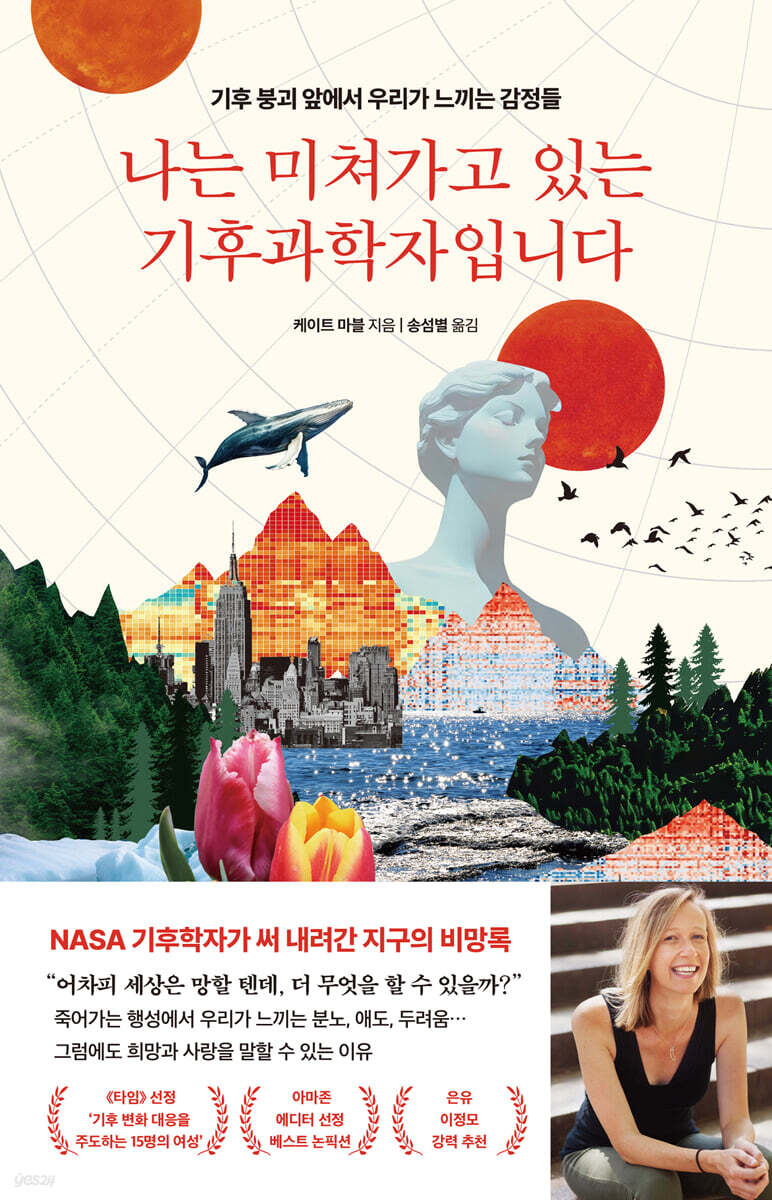
I am a climate scientist who is going crazy.
 |
Description
Book Introduction
“The world is going to end anyway, so what more can we do?”
Love and sadness are as big as the Earth, and it's driving me crazy.
A Memoir of Earth from a NASA-trained Climate Scientist
Eunyu, Lee Jeong-mo strongly recommends
TIME's "15 Women Leading the Way on Climate Change"
Amazon Editors' Choice Best Nonfiction
'The world is going to end anyway, so what's the point?' Everyone has probably felt a sense of immense helplessness in the face of a massive climate disaster at least once.
In reality, the number of people who are anxious about the future and complain of depression due to rapid climate change is increasing, and this phenomenon is called 'climate anxiety' and is emerging as a social problem.
What would it be like for a scientist who simulates a catastrophic future for Earth several times a day using climate prediction models? "It stirs a complex mix of emotions deep within me." Kate Marvel, a young NASA climatologist, decided to delve into the complex emotions she feels as a scientist, forced to use objective language, and as someone living in a vanishing world.
The first thing I encountered was uncontrollable anger and maddening sadness.
But it's not all frustration.
There is also unwavering love and clear hope.
It speaks of anger at those who ignore or lie when they have the chance to prevent a crisis, guilt at contributing to environmental destruction, fear in the face of the reality of climate disasters that seem out of control, hope that things can get better in the future, and love for nature.
From anger to love, this book explores the Earth's past, present, and future across a spectrum of nine emotions. It unfolds with beautiful prose and delightful humor, exploring science, mythology, history, and the struggles of humanity within them.
It tells us what's happening now through the language of cold science, while also reconnecting us all with the planet through the most human empathy.
We received an invitation from a scientist who was going crazy because 'sadness and love are as big as the Earth.'
What can we do on a dying Earth?
“The Earth can change.
We can change too.
Tackling climate change will be a huge experiment.
Still, I would like to try that experiment.
“I’m a mad scientist anyway.”
Love and sadness are as big as the Earth, and it's driving me crazy.
A Memoir of Earth from a NASA-trained Climate Scientist
Eunyu, Lee Jeong-mo strongly recommends
TIME's "15 Women Leading the Way on Climate Change"
Amazon Editors' Choice Best Nonfiction
'The world is going to end anyway, so what's the point?' Everyone has probably felt a sense of immense helplessness in the face of a massive climate disaster at least once.
In reality, the number of people who are anxious about the future and complain of depression due to rapid climate change is increasing, and this phenomenon is called 'climate anxiety' and is emerging as a social problem.
What would it be like for a scientist who simulates a catastrophic future for Earth several times a day using climate prediction models? "It stirs a complex mix of emotions deep within me." Kate Marvel, a young NASA climatologist, decided to delve into the complex emotions she feels as a scientist, forced to use objective language, and as someone living in a vanishing world.
The first thing I encountered was uncontrollable anger and maddening sadness.
But it's not all frustration.
There is also unwavering love and clear hope.
It speaks of anger at those who ignore or lie when they have the chance to prevent a crisis, guilt at contributing to environmental destruction, fear in the face of the reality of climate disasters that seem out of control, hope that things can get better in the future, and love for nature.
From anger to love, this book explores the Earth's past, present, and future across a spectrum of nine emotions. It unfolds with beautiful prose and delightful humor, exploring science, mythology, history, and the struggles of humanity within them.
It tells us what's happening now through the language of cold science, while also reconnecting us all with the planet through the most human empathy.
We received an invitation from a scientist who was going crazy because 'sadness and love are as big as the Earth.'
What can we do on a dying Earth?
“The Earth can change.
We can change too.
Tackling climate change will be a huge experiment.
Still, I would like to try that experiment.
“I’m a mad scientist anyway.”
- You can preview some of the book's contents.
Preview
index
Introduction: Feeling like the end of the world every day
Chapter 1: Wonders: What Science Can Tell Us
The magic of an average temperature of 15 degrees | About the wonders of everyday life | Where does the wind blow? | The sea that flows through a thousand years | The gift of Prometheus | How wonderful it is to know the truth
Chapter 2: Anger: I'm a Mad Scientist Anyway
The First Climate Scientists Were Ignored | Science Fumbles Forward | People Who Don't Believe Science | They Knew | The Liars' Scenario | A Changeable Future
Chapter 3: Guilt: We Are the Real Cause of Climate Change
First suspect: internal variability | Second suspect: the sun | Third suspect: Earth's revolution and rotation | Fourth suspect: volcanic eruptions | Fifth suspect: aerosols | Last suspect: greenhouse gases | The real culprit is somewhere else.
Chapter 4: Fear: What's Scarier Than Monsters in the Dark
The first mass deaths caused by climate change | Heatwaves, droughts, and dust bowls | The true face of extreme rainfall | There are no natural disasters | Sea-level rise is already irreversible | A world we cannot endure | Can we learn from the past? | The Black Death, COVID-19, and the next pandemic | The relationship between climate and violence | What we do to each other
Chapter 5: Mourning: A World Lost Prematurely
The beach I loved will soon disappear | Past and future discovered in glaciers | Pyrosene, the age of wildfires | Our time swallowed by sea level | Mourning all that will remain as ash and memory
Chapter 6: Surprises: Questions Still Remain
Act 1: Climate Sensitivity: How Hot Will the Earth Get? | Act 2: Climate Feedback Loops: Why Don't We Know How Hot the Earth Will Get? | Act 3: Carbon Dioxide Feedbacks: How Bad Will It Get? | Act 4: Tipping Points: Could It Get Worse? | Act 5: Future Emissions: What to Do About It?
Chapter 7: Pride: The Future Created by Ordinary People
How to avoid the sun | Trees don't exist for humans | The largest cleanup operation in history | Can we control the oceans? | We can't stake the Earth | Canute was right
Chapter 8: Hope: It's Time to Do What No One Has Ever Done Before
Why Whales Aren't Extinct | The Clean Air Act That Stopped London's Smog | The Right to Clean Air | The Scientist Who Banned Leaded Gasoline | We Saved the Ozone Layer | For a Better Ending | And They Lived Happily Ever After
Chapter 9: Love: What Climate Models Can't Tell You
From the mountains of the American West to the seas of England | Through the long winter of pandemic | Everything is connected | About Mitch | If you truly love something | Belief in humanity | What exists only in the real world
Acknowledgements
main
Chapter 1: Wonders: What Science Can Tell Us
The magic of an average temperature of 15 degrees | About the wonders of everyday life | Where does the wind blow? | The sea that flows through a thousand years | The gift of Prometheus | How wonderful it is to know the truth
Chapter 2: Anger: I'm a Mad Scientist Anyway
The First Climate Scientists Were Ignored | Science Fumbles Forward | People Who Don't Believe Science | They Knew | The Liars' Scenario | A Changeable Future
Chapter 3: Guilt: We Are the Real Cause of Climate Change
First suspect: internal variability | Second suspect: the sun | Third suspect: Earth's revolution and rotation | Fourth suspect: volcanic eruptions | Fifth suspect: aerosols | Last suspect: greenhouse gases | The real culprit is somewhere else.
Chapter 4: Fear: What's Scarier Than Monsters in the Dark
The first mass deaths caused by climate change | Heatwaves, droughts, and dust bowls | The true face of extreme rainfall | There are no natural disasters | Sea-level rise is already irreversible | A world we cannot endure | Can we learn from the past? | The Black Death, COVID-19, and the next pandemic | The relationship between climate and violence | What we do to each other
Chapter 5: Mourning: A World Lost Prematurely
The beach I loved will soon disappear | Past and future discovered in glaciers | Pyrosene, the age of wildfires | Our time swallowed by sea level | Mourning all that will remain as ash and memory
Chapter 6: Surprises: Questions Still Remain
Act 1: Climate Sensitivity: How Hot Will the Earth Get? | Act 2: Climate Feedback Loops: Why Don't We Know How Hot the Earth Will Get? | Act 3: Carbon Dioxide Feedbacks: How Bad Will It Get? | Act 4: Tipping Points: Could It Get Worse? | Act 5: Future Emissions: What to Do About It?
Chapter 7: Pride: The Future Created by Ordinary People
How to avoid the sun | Trees don't exist for humans | The largest cleanup operation in history | Can we control the oceans? | We can't stake the Earth | Canute was right
Chapter 8: Hope: It's Time to Do What No One Has Ever Done Before
Why Whales Aren't Extinct | The Clean Air Act That Stopped London's Smog | The Right to Clean Air | The Scientist Who Banned Leaded Gasoline | We Saved the Ozone Layer | For a Better Ending | And They Lived Happily Ever After
Chapter 9: Love: What Climate Models Can't Tell You
From the mountains of the American West to the seas of England | Through the long winter of pandemic | Everything is connected | About Mitch | If you truly love something | Belief in humanity | What exists only in the real world
Acknowledgements
main
Detailed image

Into the book
I wrote this book for three reasons.
First, as a climate change researcher, I wanted to objectively report what I know: the facts about today's climate issues.
Second, I wanted to give some idea of what it's like to study climate science in a world that's falling apart uncontrollably.
Third, I wanted to convey the incredibly complex emotions I feel as a scientist and as a human being about climate issues.
--- From the "Introductory Note"
We still know only a part of the infinite truth.
No scientist can accurately predict the future of the Earth.
Because we don't yet fully understand the physical laws of this complex world.
I know how land, ice, water, and air move independently, but I don't know all the ways they interact.
We also have no idea how humans will behave alone or in groups.
--- From "Chapter 1: Wonders"
In fact, Eunice Foote was completely forgotten until 2011.
Then, a researcher happened to read the record of Henry's presentation and realized the importance of the research.
--- From "Chapter 2 Anger"
“Current scientific evidence does not allow us to conclude that human activities have had a significant impact on the global climate,” said Lee Raymond, CEO of global oil company ExxonMobil, in 1997.
He wrote this three years later, in 2000:
“Current science cannot confirm that fossil fuel use causes significant global warming.” But that was a lie, and he knew it.
Because about a decade after the oceanographers published their findings, and the increasing variability of the Keeling curve was accepted as fact, another research team proved that the excess carbon dioxide causing global warming actually comes from fossil fuels.
--- From "Chapter 2 Anger"
Extreme weather events are occurring with surprising frequency.
Record heat waves, devastating floods, and persistent droughts – these are unprecedented times.
But there are some things that don't change.
The choice is always made by the rich, and the price is always paid by the poor.
Those who suffer most from climate change are those least responsible.
--- From "Chapter 3 Guilt"
Whether a heavy rain turns into a flood largely depends on what kind of land it is on.
Rain pouring down on pavement or asphalt lands differently than rain falling on a garden or beach.
As you might expect, areas with more green space tend to have higher proportions of wealthy and white residents.
Flooding caused by Hurricane Harvey was disproportionately concentrated in Spanish-speaking areas of Houston.
It is not the rain that discriminates, it is the state that discriminates.
--- From "Chapter 4: Fear"
The brutal truth we've learned from studying Earth's past is that we will outlive those we love.
Nothing lasts forever.
I know too.
It's a well-known fact.
But I desperately hoped that my beloved California would stay longer than I did.
But now we are losing California.
The redwood forests, the coast, the perfect carefree summer, the blue skies, the clear air, the sun-drenched forests—all are engulfed in flames.
I have already confirmed all of those predictions with science that shows a clear future.
--- From "Chapter 5: Mourning"
Therefore, the climate changes shown by various climate models are not actually fundamentally different.
All models show that the Earth is warming and will continue to warm unless greenhouse gas emissions are reduced to zero.
It also shows that the risk of drought will increase, rainfall will become more extreme, and sea levels will rise.
However, some models predict that doubling the amount of carbon dioxide in the atmosphere would lead to a temperature rise of about 2 degrees Celsius, while others predict a figure that is twice that high.
These differences persist over time and as climate model performance improves.
However, we have made some progress in narrowing this range, and estimate climate sensitivity to be between 2.3 and 4.7 degrees Celsius.
--- From "Chapter 6 Surprise"
Now, many more people are involved in the arduous task of turning the climate around.
It's rare for something they do to look immediately exciting on the surface.
But every electrician who fixes your home's wiring, every accountant who helps you qualify for clean energy tax credits, every engineer researching low-carbon cement or battery efficiency is part of the army that's saving the world.
--- From "Chapter 7 Pride"
As many have pointed out, no one is coming to save us.
If we are saved in the end, it will be thanks to the collective effort of countless people, each with their own flaws and limitations, all doing their best.
Although none of the past examples of successful environmental conservation perfectly align with our current situation, these stories still offer hope.
These stories teach us that we must create the world we want to live in ourselves.
Science sets limits.
We write stories.
There may be hope in that story.
--- From "Chapter 8: Hope"
Then, as I thought about my children, my parents, my husband, and my friends, a mixture of grief, fear, anger, hope, and sadness came over me.
I loved them, and I loved this world.
And I felt completely happy to be alive.
First, as a climate change researcher, I wanted to objectively report what I know: the facts about today's climate issues.
Second, I wanted to give some idea of what it's like to study climate science in a world that's falling apart uncontrollably.
Third, I wanted to convey the incredibly complex emotions I feel as a scientist and as a human being about climate issues.
--- From the "Introductory Note"
We still know only a part of the infinite truth.
No scientist can accurately predict the future of the Earth.
Because we don't yet fully understand the physical laws of this complex world.
I know how land, ice, water, and air move independently, but I don't know all the ways they interact.
We also have no idea how humans will behave alone or in groups.
--- From "Chapter 1: Wonders"
In fact, Eunice Foote was completely forgotten until 2011.
Then, a researcher happened to read the record of Henry's presentation and realized the importance of the research.
--- From "Chapter 2 Anger"
“Current scientific evidence does not allow us to conclude that human activities have had a significant impact on the global climate,” said Lee Raymond, CEO of global oil company ExxonMobil, in 1997.
He wrote this three years later, in 2000:
“Current science cannot confirm that fossil fuel use causes significant global warming.” But that was a lie, and he knew it.
Because about a decade after the oceanographers published their findings, and the increasing variability of the Keeling curve was accepted as fact, another research team proved that the excess carbon dioxide causing global warming actually comes from fossil fuels.
--- From "Chapter 2 Anger"
Extreme weather events are occurring with surprising frequency.
Record heat waves, devastating floods, and persistent droughts – these are unprecedented times.
But there are some things that don't change.
The choice is always made by the rich, and the price is always paid by the poor.
Those who suffer most from climate change are those least responsible.
--- From "Chapter 3 Guilt"
Whether a heavy rain turns into a flood largely depends on what kind of land it is on.
Rain pouring down on pavement or asphalt lands differently than rain falling on a garden or beach.
As you might expect, areas with more green space tend to have higher proportions of wealthy and white residents.
Flooding caused by Hurricane Harvey was disproportionately concentrated in Spanish-speaking areas of Houston.
It is not the rain that discriminates, it is the state that discriminates.
--- From "Chapter 4: Fear"
The brutal truth we've learned from studying Earth's past is that we will outlive those we love.
Nothing lasts forever.
I know too.
It's a well-known fact.
But I desperately hoped that my beloved California would stay longer than I did.
But now we are losing California.
The redwood forests, the coast, the perfect carefree summer, the blue skies, the clear air, the sun-drenched forests—all are engulfed in flames.
I have already confirmed all of those predictions with science that shows a clear future.
--- From "Chapter 5: Mourning"
Therefore, the climate changes shown by various climate models are not actually fundamentally different.
All models show that the Earth is warming and will continue to warm unless greenhouse gas emissions are reduced to zero.
It also shows that the risk of drought will increase, rainfall will become more extreme, and sea levels will rise.
However, some models predict that doubling the amount of carbon dioxide in the atmosphere would lead to a temperature rise of about 2 degrees Celsius, while others predict a figure that is twice that high.
These differences persist over time and as climate model performance improves.
However, we have made some progress in narrowing this range, and estimate climate sensitivity to be between 2.3 and 4.7 degrees Celsius.
--- From "Chapter 6 Surprise"
Now, many more people are involved in the arduous task of turning the climate around.
It's rare for something they do to look immediately exciting on the surface.
But every electrician who fixes your home's wiring, every accountant who helps you qualify for clean energy tax credits, every engineer researching low-carbon cement or battery efficiency is part of the army that's saving the world.
--- From "Chapter 7 Pride"
As many have pointed out, no one is coming to save us.
If we are saved in the end, it will be thanks to the collective effort of countless people, each with their own flaws and limitations, all doing their best.
Although none of the past examples of successful environmental conservation perfectly align with our current situation, these stories still offer hope.
These stories teach us that we must create the world we want to live in ourselves.
Science sets limits.
We write stories.
There may be hope in that story.
--- From "Chapter 8: Hope"
Then, as I thought about my children, my parents, my husband, and my friends, a mixture of grief, fear, anger, hope, and sadness came over me.
I loved them, and I loved this world.
And I felt completely happy to be alive.
--- From "Chapter 9 Love"
Publisher's Review
“I’m a mad scientist anyway.”
A scientist is going crazy because love and sorrow are as big as the Earth…
The debut work of a climatologist who is attracting worldwide attention!
Cool-headedness, objectivity, and detachment from emotions.
This is a common image of a scientist.
It is also an attitude that is essential for scientists.
Kate Marvel, author of "I'm a Crazy Climate Scientist," knows this better than anyone.
Yet, he does not hesitate to reveal his feelings in the face of the great crisis facing this world.
Rather, he calls himself a 'mad scientist'.
Fascinated by the beauty of the Earth, Kate Marvel, a former NASA Goddard Institute for Space Studies researcher who studied astronomy, theoretical physics, and climatology, is one of today's most prominent climate scientists and science communicators.
She was also named one of the '15 Women Leading the Way on Climate Change' by Time magazine in 2019.
He also testified before the U.S. Congress on the severity of the climate crisis and participated in the publication of the U.S. government report, the Fifth National Climate Assessment.
This book is his first popular science book.
What drives this scientist, a man of science to the core, mad? The answer lies in Chapter 2, "Anger," of this book.
It chronicles the struggles of scientists who have warned of the climate crisis since the 19th century, the politicians who ignored their warnings and missed opportunities to alleviate the problem, and the history of corporations that have persistently and subtly spread climate change denial.
In 1856, American physicist Joseph Henry stood at the podium of the American Association for the Advancement of Science and argued that carbon dioxide was raising the temperature of the atmosphere.
His proof experiment was simple.
When a glass bottle containing carbon dioxide and a glass bottle containing hydrogen or normal air were placed in the sun, the temperature of the glass bottle containing carbon dioxide increased compared to the other bottles.
However, his paper, "Factors Affecting the Temperature of Sunlight," based on this experiment, did not receive much attention (it should also be noted that the actual author of the paper was a forgotten female scientist named Eunice Putra).
There was another opportunity.
Let's go to the US Congress in 1988.
Meteorologist Shukuro Manabe, who would later receive the Nobel Prize in Physics, testified that further rises in temperature would lead to more severe and frequent droughts.
The director of the Woods Hole Institute strongly urged senators to immediately develop a plan to reduce carbon dioxide-emitting fossil fuels, including coal and oil.
Both emphasized the existence of long-standing research and scientific consensus.
The next day, the headline on the front page of the New York Times was “Global Warming Has Already Started.”
Even then, it should have been a turning point.
But that didn't happen.
Because of politicians who deny the climate crisis and fossil fuel companies like ExxonMobil.
They have sabotaged efforts to address the climate crisis with the ridiculous but effective rhetoric that winters are still snowy and teeth-chillingly cold, and with "scientific" data that disproves global warming.
“We will emphasize uncertainty.” Indeed, an internal ExxonMobil document released in 1988 clearly reveals their strategy.
The author tells the readers what he would say if he were to go to Congress again.
Below is an excerpt from it.
“The Earth can change.
We can change too.
Tackling climate change will be a huge experiment.
Still, I would like to try that experiment.
“I’m a mad scientist anyway.”
“The real cause of the climate crisis is us.”
Can we bring back the Earth?
Can the Earth change? Can we create an environment where temperatures drop and droughts, floods, heat waves, and extreme cold occur far less frequently than they do now? To do so, we must first understand what caused the Earth to become what it is today.
“Science has advanced since the time of James VI, so we no longer blame witches for climate change.
Modern science has identified a number of factors, both human and natural, that influence Earth's temperature.”
In the late 16th century, when a severe cold wave hit Europe, a 'witch hunt' took place.
A sudden climate change caused famine across Europe, and people at the time, who thought such a thing could not have happened naturally, looked for someone to blame.
Women blamed for the abnormal climate were beaten, starved, and nailed to walls.
It's not the 16th century anymore.
Thanks to modern science, we can now pinpoint the real causes of the climate crisis.
The climate crisis is caused by greenhouse gases.
And we are the ones who create and emit greenhouse gases.
Both are unchanging facts.
Because of this, the temperature of the atmosphere continues to rise (today, the Earth's temperature is more than 1.3 degrees Celsius higher than during the Industrial Revolution).
In Chapter 3, “Guilt,” the author, like a detective on an investigation, identifies the causes of the climate crisis one by one.
The first suspect is internal volatility.
Looking back at the history of the Earth, there have been periods when temperatures were unusually high and low, and we are currently in one of those periods.
But internal variability has not consistently raised Earth's temperature for more than a century.
The author argues that insisting that internal variability is the cause of climate change is like looking at a corpse covered in bloody handprints and saying, "It died of natural causes."
The second is the sun, which has recently become hotter.
But there is no such evidence.
The same goes for the third Earth's revolution and rotation.
Again, insufficient evidence.
Fourth, what about volcanic eruptions? Indeed, the Little Ice Age of the 16th and 17th centuries began with a series of large-scale volcanic eruptions.
In fact, the dust and gases ejected by volcanic eruptions can block out the sun and lower temperatures.
That is, at least global warming is not related.
The fifth is aerosol, which is sulfur dioxide gas produced when fossil fuels are burned.
Is aerosol pollution the main culprit behind global warming? Like volcanic eruptions, the answer is quite the opposite.
Aerosols block sunlight and lower atmospheric temperatures.
In fact, when many factories closed during the COVID-19 pandemic, aerosol emissions decreased and temperatures rose slightly.
Ultimately, the cause of everything lies with us.
Every time we burn fossil fuels, clear forests, make plastics, or use refrigerators and air conditioners, the concentration of greenhouse gases in the atmosphere increases, leading to rising temperatures.
The author makes this point clear and says that we should all feel guilty.
But it doesn't stop there.
Because guilt in itself is useless.
It only makes sense if you take action.
“We have sin.
And that means we can regret and make amends.
Now is the time to act quickly to avoid a worse situation.”
“The stories we write can contain hope.”
Wonder, anger, guilt, fear, grief, surprise, pride, hope, love
The Earth's Crisis and Future as Seen Through Nine Emotions
"I'm a Crazy Climate Scientist" examines the issue of global warming through the lens of universal human emotions like anger and guilt.
There are nine emotions in total: wonder, anger, guilt, fear, grief, surprise, pride, hope, and love.
Even though he is a scientist who must speak clear scientific facts, he approaches the climate crisis through emotions because we are all beings who feel complex and contradictory emotions.
The author himself is no exception.
Also, because we know better than anyone that solving the climate crisis depends on human behavior that is both 'stupid and mean, but also clever and kind.'
In reality, we feel angry about the lack of effective efforts to reduce greenhouse gases, but sometimes we also face guilt about the fact that we ourselves are contributing to environmental destruction.
It's like being a victim and a perpetrator at the same time.
We also feel fear in the face of climate disasters that have become routine, and we are filled with sadness as we think about the things that are disappearing due to the great changes.
Yet, in a corner of my heart, I harbor hope that things can get better in the future, and I feel boundless love in front of the beautiful nature.
“It’s up to us how much worse things get.
The future still lies in the hands of humans.” Stories from the past give us hope.
One of the problems in British and American society in the 1950s and 1960s was air quality.
The sky was literally ashen with smoke billowing from the factory.
The smog that covered London in 1952 killed more than 12,000 people.
Four years earlier, smog in Pennsylvania sickened 6,000 people and killed 20.
The Clean Air Act, enacted in the United States in 1970, put the brakes on this.
It was intended to regulate pollutant emissions from factories and vehicles, and a 1990 amendment mandated a significant reduction in sulfur dioxide emissions.
Thanks to this, sulfur dioxide has been drastically reduced in the United States today, and acid rain has also been greatly reduced.
And that's not all.
After discovering that freon gas, used in air conditioners and fire extinguishers in the past, was destroying the ozone layer, it was successfully withdrawn from the market, and leaded gasoline, which not only spreads lead into the atmosphere but also causes lead poisoning, was successfully banned from being used as a car fuel.
“The vastness can only be endured by love.”
The universal human emotion that connects us to the climate crisis
Unlike most climate science books that focus on research results and statistics, "I'm a Crazy Climate Scientist" opens up new horizons by approaching the climate crisis through emotional lens.
It tells us what's happening now through the language of cold science, while at the same time reconnecting us all to the planet through the most human empathy.
“Talking about climate change often seems to demand a specific response from people.
Emotions like fear, anger, and despair.
But I don't think there is a 'right' emotion we should feel.
To me, who has studied the Earth for a long time, the Earth is a complex place.
It is both vulnerable and resilient, a place both awe-inspiring and terrifying.
“Can we possibly summarize our feelings about this great planet called Earth in just one or two words?”
There is probably no one who does not feel some emotion in the face of the great changes that are now taking place in this world.
Emotions in themselves do not create any change, but neither does feeling something lead to action.
This is why we explore the past, present, and future of the Earth along the spectrum of nine emotions.
And that long journey ends with 'love'.
As the author quotes Carl Sagan, “The only way for small beings like us to endure this vastness is through love.”
Chapter 9, "Love," is filled with memories of places cherished since childhood, loneliness felt during the COVID-19 pandemic, awe felt in front of the vastness of nature, and the moment when one pledged to create a better future in front of a newborn child, leaving a deep resonance.
Another great virtue of this book is its scientific and historical narrative, built through meticulous research and a unique perspective.
It is a fascinating interweaving of the relationship between the rise and fall of the Roman and Mongol Empires and climate change, the stark reality of inequality in American society revealed by hurricanes, anecdotes from scientists and countless ordinary people who fought to prevent the climate crisis, and the impact of natural cataclysms, including volcanic eruptions, on human history.
Despite its considerable length, the delicate and beautiful sentences and well-placed humor keep you hooked until the very end.
It has been recommended by renowned science writers such as Sasha Sagan, Carl Sagan's daughter and science communicator, and John Vaillant, author of Fire Weather, and was named one of the Amazon Editors' Best Nonfiction.
A book about climate change doesn't have to be depressing.
The author shares earth science facts and fascinating anecdotes that science nerds will love, and uses imaginary scenarios to illustrate the consequences of climate change.
- 《Kirkus Reviews》
This work stands out among the discussions of the climate crisis in this day and age.
In this beautiful debut, Marvel tackles the issue of global warming through the emotions evoked by the climate crisis.
- Publisher's Weekly
A scientist is going crazy because love and sorrow are as big as the Earth…
The debut work of a climatologist who is attracting worldwide attention!
Cool-headedness, objectivity, and detachment from emotions.
This is a common image of a scientist.
It is also an attitude that is essential for scientists.
Kate Marvel, author of "I'm a Crazy Climate Scientist," knows this better than anyone.
Yet, he does not hesitate to reveal his feelings in the face of the great crisis facing this world.
Rather, he calls himself a 'mad scientist'.
Fascinated by the beauty of the Earth, Kate Marvel, a former NASA Goddard Institute for Space Studies researcher who studied astronomy, theoretical physics, and climatology, is one of today's most prominent climate scientists and science communicators.
She was also named one of the '15 Women Leading the Way on Climate Change' by Time magazine in 2019.
He also testified before the U.S. Congress on the severity of the climate crisis and participated in the publication of the U.S. government report, the Fifth National Climate Assessment.
This book is his first popular science book.
What drives this scientist, a man of science to the core, mad? The answer lies in Chapter 2, "Anger," of this book.
It chronicles the struggles of scientists who have warned of the climate crisis since the 19th century, the politicians who ignored their warnings and missed opportunities to alleviate the problem, and the history of corporations that have persistently and subtly spread climate change denial.
In 1856, American physicist Joseph Henry stood at the podium of the American Association for the Advancement of Science and argued that carbon dioxide was raising the temperature of the atmosphere.
His proof experiment was simple.
When a glass bottle containing carbon dioxide and a glass bottle containing hydrogen or normal air were placed in the sun, the temperature of the glass bottle containing carbon dioxide increased compared to the other bottles.
However, his paper, "Factors Affecting the Temperature of Sunlight," based on this experiment, did not receive much attention (it should also be noted that the actual author of the paper was a forgotten female scientist named Eunice Putra).
There was another opportunity.
Let's go to the US Congress in 1988.
Meteorologist Shukuro Manabe, who would later receive the Nobel Prize in Physics, testified that further rises in temperature would lead to more severe and frequent droughts.
The director of the Woods Hole Institute strongly urged senators to immediately develop a plan to reduce carbon dioxide-emitting fossil fuels, including coal and oil.
Both emphasized the existence of long-standing research and scientific consensus.
The next day, the headline on the front page of the New York Times was “Global Warming Has Already Started.”
Even then, it should have been a turning point.
But that didn't happen.
Because of politicians who deny the climate crisis and fossil fuel companies like ExxonMobil.
They have sabotaged efforts to address the climate crisis with the ridiculous but effective rhetoric that winters are still snowy and teeth-chillingly cold, and with "scientific" data that disproves global warming.
“We will emphasize uncertainty.” Indeed, an internal ExxonMobil document released in 1988 clearly reveals their strategy.
The author tells the readers what he would say if he were to go to Congress again.
Below is an excerpt from it.
“The Earth can change.
We can change too.
Tackling climate change will be a huge experiment.
Still, I would like to try that experiment.
“I’m a mad scientist anyway.”
“The real cause of the climate crisis is us.”
Can we bring back the Earth?
Can the Earth change? Can we create an environment where temperatures drop and droughts, floods, heat waves, and extreme cold occur far less frequently than they do now? To do so, we must first understand what caused the Earth to become what it is today.
“Science has advanced since the time of James VI, so we no longer blame witches for climate change.
Modern science has identified a number of factors, both human and natural, that influence Earth's temperature.”
In the late 16th century, when a severe cold wave hit Europe, a 'witch hunt' took place.
A sudden climate change caused famine across Europe, and people at the time, who thought such a thing could not have happened naturally, looked for someone to blame.
Women blamed for the abnormal climate were beaten, starved, and nailed to walls.
It's not the 16th century anymore.
Thanks to modern science, we can now pinpoint the real causes of the climate crisis.
The climate crisis is caused by greenhouse gases.
And we are the ones who create and emit greenhouse gases.
Both are unchanging facts.
Because of this, the temperature of the atmosphere continues to rise (today, the Earth's temperature is more than 1.3 degrees Celsius higher than during the Industrial Revolution).
In Chapter 3, “Guilt,” the author, like a detective on an investigation, identifies the causes of the climate crisis one by one.
The first suspect is internal volatility.
Looking back at the history of the Earth, there have been periods when temperatures were unusually high and low, and we are currently in one of those periods.
But internal variability has not consistently raised Earth's temperature for more than a century.
The author argues that insisting that internal variability is the cause of climate change is like looking at a corpse covered in bloody handprints and saying, "It died of natural causes."
The second is the sun, which has recently become hotter.
But there is no such evidence.
The same goes for the third Earth's revolution and rotation.
Again, insufficient evidence.
Fourth, what about volcanic eruptions? Indeed, the Little Ice Age of the 16th and 17th centuries began with a series of large-scale volcanic eruptions.
In fact, the dust and gases ejected by volcanic eruptions can block out the sun and lower temperatures.
That is, at least global warming is not related.
The fifth is aerosol, which is sulfur dioxide gas produced when fossil fuels are burned.
Is aerosol pollution the main culprit behind global warming? Like volcanic eruptions, the answer is quite the opposite.
Aerosols block sunlight and lower atmospheric temperatures.
In fact, when many factories closed during the COVID-19 pandemic, aerosol emissions decreased and temperatures rose slightly.
Ultimately, the cause of everything lies with us.
Every time we burn fossil fuels, clear forests, make plastics, or use refrigerators and air conditioners, the concentration of greenhouse gases in the atmosphere increases, leading to rising temperatures.
The author makes this point clear and says that we should all feel guilty.
But it doesn't stop there.
Because guilt in itself is useless.
It only makes sense if you take action.
“We have sin.
And that means we can regret and make amends.
Now is the time to act quickly to avoid a worse situation.”
“The stories we write can contain hope.”
Wonder, anger, guilt, fear, grief, surprise, pride, hope, love
The Earth's Crisis and Future as Seen Through Nine Emotions
"I'm a Crazy Climate Scientist" examines the issue of global warming through the lens of universal human emotions like anger and guilt.
There are nine emotions in total: wonder, anger, guilt, fear, grief, surprise, pride, hope, and love.
Even though he is a scientist who must speak clear scientific facts, he approaches the climate crisis through emotions because we are all beings who feel complex and contradictory emotions.
The author himself is no exception.
Also, because we know better than anyone that solving the climate crisis depends on human behavior that is both 'stupid and mean, but also clever and kind.'
In reality, we feel angry about the lack of effective efforts to reduce greenhouse gases, but sometimes we also face guilt about the fact that we ourselves are contributing to environmental destruction.
It's like being a victim and a perpetrator at the same time.
We also feel fear in the face of climate disasters that have become routine, and we are filled with sadness as we think about the things that are disappearing due to the great changes.
Yet, in a corner of my heart, I harbor hope that things can get better in the future, and I feel boundless love in front of the beautiful nature.
“It’s up to us how much worse things get.
The future still lies in the hands of humans.” Stories from the past give us hope.
One of the problems in British and American society in the 1950s and 1960s was air quality.
The sky was literally ashen with smoke billowing from the factory.
The smog that covered London in 1952 killed more than 12,000 people.
Four years earlier, smog in Pennsylvania sickened 6,000 people and killed 20.
The Clean Air Act, enacted in the United States in 1970, put the brakes on this.
It was intended to regulate pollutant emissions from factories and vehicles, and a 1990 amendment mandated a significant reduction in sulfur dioxide emissions.
Thanks to this, sulfur dioxide has been drastically reduced in the United States today, and acid rain has also been greatly reduced.
And that's not all.
After discovering that freon gas, used in air conditioners and fire extinguishers in the past, was destroying the ozone layer, it was successfully withdrawn from the market, and leaded gasoline, which not only spreads lead into the atmosphere but also causes lead poisoning, was successfully banned from being used as a car fuel.
“The vastness can only be endured by love.”
The universal human emotion that connects us to the climate crisis
Unlike most climate science books that focus on research results and statistics, "I'm a Crazy Climate Scientist" opens up new horizons by approaching the climate crisis through emotional lens.
It tells us what's happening now through the language of cold science, while at the same time reconnecting us all to the planet through the most human empathy.
“Talking about climate change often seems to demand a specific response from people.
Emotions like fear, anger, and despair.
But I don't think there is a 'right' emotion we should feel.
To me, who has studied the Earth for a long time, the Earth is a complex place.
It is both vulnerable and resilient, a place both awe-inspiring and terrifying.
“Can we possibly summarize our feelings about this great planet called Earth in just one or two words?”
There is probably no one who does not feel some emotion in the face of the great changes that are now taking place in this world.
Emotions in themselves do not create any change, but neither does feeling something lead to action.
This is why we explore the past, present, and future of the Earth along the spectrum of nine emotions.
And that long journey ends with 'love'.
As the author quotes Carl Sagan, “The only way for small beings like us to endure this vastness is through love.”
Chapter 9, "Love," is filled with memories of places cherished since childhood, loneliness felt during the COVID-19 pandemic, awe felt in front of the vastness of nature, and the moment when one pledged to create a better future in front of a newborn child, leaving a deep resonance.
Another great virtue of this book is its scientific and historical narrative, built through meticulous research and a unique perspective.
It is a fascinating interweaving of the relationship between the rise and fall of the Roman and Mongol Empires and climate change, the stark reality of inequality in American society revealed by hurricanes, anecdotes from scientists and countless ordinary people who fought to prevent the climate crisis, and the impact of natural cataclysms, including volcanic eruptions, on human history.
Despite its considerable length, the delicate and beautiful sentences and well-placed humor keep you hooked until the very end.
It has been recommended by renowned science writers such as Sasha Sagan, Carl Sagan's daughter and science communicator, and John Vaillant, author of Fire Weather, and was named one of the Amazon Editors' Best Nonfiction.
A book about climate change doesn't have to be depressing.
The author shares earth science facts and fascinating anecdotes that science nerds will love, and uses imaginary scenarios to illustrate the consequences of climate change.
- 《Kirkus Reviews》
This work stands out among the discussions of the climate crisis in this day and age.
In this beautiful debut, Marvel tackles the issue of global warming through the emotions evoked by the climate crisis.
- Publisher's Weekly
GOODS SPECIFICS
- Date of issue: October 15, 2025
- Page count, weight, size: 396 pages | 580g | 135*210*24mm
- ISBN13: 9788901297538
- ISBN10: 8901297531
You may also like
카테고리
korean


korean

![GQ KOREA Mark (Monthly): December [2025]](http://librairie.coreenne.fr/cdn/shop/files/8ef265dbbfbf186523ed75ba7319009d.jpg?v=1765340328&width=3840)


