

More Than a Novel: Fall 2025
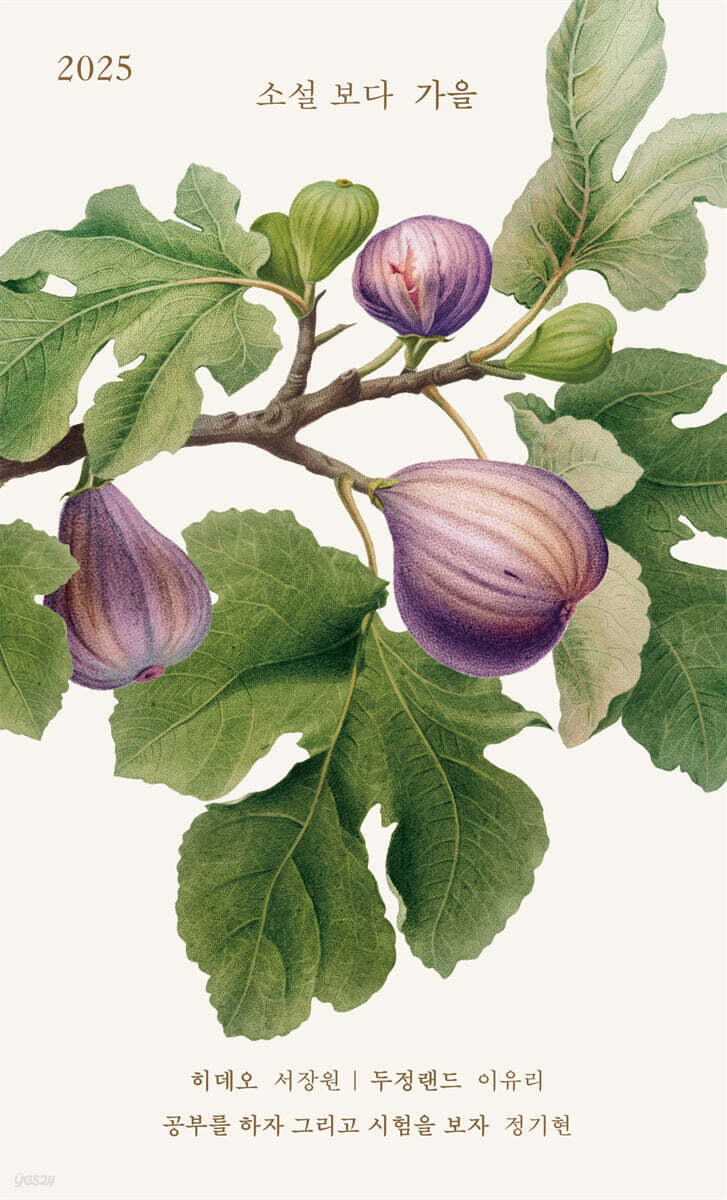 |
Description
Book Introduction
A novelistic autumn landscape drawn by a new generation
A special project that always delivers value beyond readers' expectations, 『Novels: Fall 2025』, has been published.
〈Novels More〉 is a project that began in 2018 where Munhak-kwa-Jiseongsa selects a “novel of the season” every quarter, publishes the results on its website, and compiles and publishes a book of the same each season.
The selected works will be nominated for the Munji Literary Award.
The "Novels" series has been receiving great response from readers for eight years, featuring novels by young writers as well as interviews with authors directly participated by the selection committee.
Going forward, “Novels,” published each season, will faithfully fulfill its role as a bridge connecting promising young writers and readers in the most rapid and intimate way.
『Novels: Fall 2025』 contains three novels selected for the Fall 2025 ‘Novel of the Season’: Seo Jang-won’s “Hideo,” Lee Yu-ri’s “Dujeong Land,” and Jeong Gi-hyeon’s “Let’s Study and Take the Test,” along with interviews with the authors.
This work is a candidate for the 15th Munji Literary Award.
The reviews of the works selected through free discussion by the selection committee (Kang Dong-ho, So Yoo-jeong, Lee So, Lee Hee-woo, Jo Yeon-jeong, Hong Seong-hee) can be found on the Munhak-kwa-Jiseongsa website.
* The book will be sold for a limited time of one year.
A special project that always delivers value beyond readers' expectations, 『Novels: Fall 2025』, has been published.
〈Novels More〉 is a project that began in 2018 where Munhak-kwa-Jiseongsa selects a “novel of the season” every quarter, publishes the results on its website, and compiles and publishes a book of the same each season.
The selected works will be nominated for the Munji Literary Award.
The "Novels" series has been receiving great response from readers for eight years, featuring novels by young writers as well as interviews with authors directly participated by the selection committee.
Going forward, “Novels,” published each season, will faithfully fulfill its role as a bridge connecting promising young writers and readers in the most rapid and intimate way.
『Novels: Fall 2025』 contains three novels selected for the Fall 2025 ‘Novel of the Season’: Seo Jang-won’s “Hideo,” Lee Yu-ri’s “Dujeong Land,” and Jeong Gi-hyeon’s “Let’s Study and Take the Test,” along with interviews with the authors.
This work is a candidate for the 15th Munji Literary Award.
The reviews of the works selected through free discussion by the selection committee (Kang Dong-ho, So Yoo-jeong, Lee So, Lee Hee-woo, Jo Yeon-jeong, Hong Seong-hee) can be found on the Munhak-kwa-Jiseongsa website.
* The book will be sold for a limited time of one year.
- You can preview some of the book's contents.
Preview
index
Hideo Seo Jang-won
Interview with Seo Jang-won and Kang Dong-ho
Lee Yu-ri of Dujeong Land
Interview with Lee Yuri and So Yoo-jung
Let's study and take the test, Jeong Gi-hyeon
Interview with Jeong Gi-hyeon and Hong Seong-hee
Interview with Seo Jang-won and Kang Dong-ho
Lee Yu-ri of Dujeong Land
Interview with Lee Yuri and So Yoo-jung
Let's study and take the test, Jeong Gi-hyeon
Interview with Jeong Gi-hyeon and Hong Seong-hee
Into the book
Hideo liked me, but not in the way I wanted.
There seemed little chance that his feelings would change.
However, twice a week, after the script rehearsals where all the team members attended, Hideo would ask me to walk with him as per the set schedule, and while we were walking, he would tell me stories he had never told anyone before.
--- From "Seo Jang-won, Hideo"
There must have been a time when Grandpa Pinkfong could have been something too.
But when and how did that era end?
How can you notice the end?
There is definitely an end, but the timing and form are unknown, and once it ends, there is truly no turning back, and it all happens only once.
--- From "Lee Yu-ri, Dujeong Land"
People don't know it, but Seung-ju has always been innocent.
If you want to survive long in anything, what could be more important than not deceiving yourself? Luck is a no-no.
It's better not to even wish for it.
Just do your best.
That was the truth Seungju thought.
Seung-ju always reminded himself of this proposition whenever he stood at the crossroads of whether to deceive or not.
There seemed little chance that his feelings would change.
However, twice a week, after the script rehearsals where all the team members attended, Hideo would ask me to walk with him as per the set schedule, and while we were walking, he would tell me stories he had never told anyone before.
--- From "Seo Jang-won, Hideo"
There must have been a time when Grandpa Pinkfong could have been something too.
But when and how did that era end?
How can you notice the end?
There is definitely an end, but the timing and form are unknown, and once it ends, there is truly no turning back, and it all happens only once.
--- From "Lee Yu-ri, Dujeong Land"
People don't know it, but Seung-ju has always been innocent.
If you want to survive long in anything, what could be more important than not deceiving yourself? Luck is a no-no.
It's better not to even wish for it.
Just do your best.
That was the truth Seungju thought.
Seung-ju always reminded himself of this proposition whenever he stood at the crossroads of whether to deceive or not.
--- From "Jeong Gi-hyeon, Let's Study and Take the Test"
Publisher's Review
Autumn, the novel of this season
The sky is rising high and dyed in blue, the days that burned without rest are gradually getting shorter, and it is autumn when the wind of the setting sun makes my tired body lean against it.
How do the traces of pain hidden behind a relaxed face connect with the future to come?
"More Than a Novel: Fall 2025" presents three novels that explore the subtle shifts in the air amidst love, success, and the struggle for truth, and the discovery of an inner voice based on experiences where dreams and reality diverge.
The 'I' who was created by a desire that was difficult to welcome is about to say goodbye to a time.
In the process of connecting with others, the mind trapped in the shackles of comparison and classification leads to repeated failures, but it also foreshadows a new beginning and infinite growth that begins from there.
Seo Jang-won, "Hideo"
“Every time I read his story, I find myself calling Hideo Hideo, not Hideo anymore.”
Seo Jang-won, who began his career as a writer through the 2020 Dong-A Ilbo New Year's Literary Contest and won the 25th Lee Hyo-seok Literary Award for Excellence, the 16th Munhakdongne Young Writer Award, and the 48th Yi Sang Literary Award, will be meeting with us for the second time in 'Novel of This Season' following the summer of 2024.
In his previous work, "Little Pride," the author delicately explored the inner self of a transgender male protagonist and captured the irony that unfolds in the realm of attractive capital. In this selected work, "Hideo," the author meticulously depicts the history of self-reclaim through love.
'Na' and 'Hideo', who met as seniors and juniors in a university theater classroom, quickly became close as they shared secrets.
Born to a Japanese father and a Korean mother, Hideo, who harbored the pain of childhood due to this, immigrated to Korea with his mother after his parents' divorce.
As Hideo confides this fact to her, she gradually begins to feel an attachment close to love, and when Hideo is chosen as an actor for a play written by her, their relationship becomes more secretive.
Through the relationship with 'Youngdo', who has a contrasting personality to the shy and insecure Hideo, and the subsequent breakup, 'Na' tries to confirm her own standards and values for viewing the world.
However, she feels frustrated alone in her interactions with Hideo, who “liked me, but not in the way I wanted.”
The play "Slap Game," which appears as a major device in the novel, serves as a decisive moment for Hideo, who was suffering from identity confusion, to shed the shell that had been strangling him, overcome his shame, and destroy the secret that had fascinated him.
After graduating, Hideo uses his major to continue his life as an actor on a wider stage, and he begins to openly reveal his dark past, using it as the basis of his identity.
I, who live as an office worker, away from my major, recall Hideo, who has now left our world, and “no longer call him Hideo, but Hideo.”
Seo Jang-won's novel traces the origins of wounds, cleverly overlapping the lack and saturation of desire that constitute a human identity with a sharp gaze.
The author captures the hearts of readers by depicting the history of a being who, though at odds with the world, digests shock through intimate and personal relationships, with an exceptional sense of balance.
“While directly addressing issues of racial, gender, and familial discrimination and violence, this novel is also a novel about wounds, secrets, and love.
Furthermore, I would like to call this novel a story of male growth.
“Hideo, who ‘wanted to grow up without being hurt, without being bullied or having secrets,’ can now tell his secret to everyone as a heroic tale without feeling ‘victimized,’ probably because a kind of safety net called social recognition has taken effect” (Cho Yeon-jeong, literary critic).
Hideo, who has reunited with the narrator after a long time, tries to tell his story by saying that he has a new secret instead of being curious about the narrator's secret, but I thought that this statement completely drove out any remaining possibility of romance between the two.
Because this is a statement that perpetuates the imbalance between two people.
I thought it was a scene where a pair of scales that had been held awkwardly fell over.
Afterwards, the speaker experiences a farewell on his own and names the current Hideo as “Hideo, not Hideo.”
As if declaring that the person you loved is no longer there.
In "Interview Seo Jang-won x Kang Dong-ho"
Lee Yuri, "Dujeong Land"
“It felt somehow familiar.
“It’s like I’ve been screaming my whole life.”
After beginning her career through the 2020 Kyunghyang Shinmun New Year's Literary Contest, receiving praise for her "smart yet unfamiliar imagination and lively writing style" (judges Seong Seok-je and Pyeon Hye-young), Lee Yu-ri, who has received much love from readers, is now met for the first time in 'This Season's Novel' with "Dujeong Land."
The author has published short story collections such as Broccoli Punch, The World of All Things, Wafer Boy, and Bubble Pong, and the novella series Meet Me in a Good Place, and his debut work, Red Fruit, was made into a film and received much attention from the public.
'I', who works part-time at 'Dujeong Land' under the pretext of saving for college tuition, and together with Yeondu, who is the same age as me, observe the visitors to the amusement park and indulge in a mischievous game of categorizing them into 'Seoul people' and 'Dujeong people'.
The identity of a 'student on leave from college in Seoul' is something that 'I', obsessed with worldly standards, created to package myself. In reality, he is a young man in his twenties who has never attended college.
On the other hand, Yeondu, who was born and raised in Dujeong, believes in 'me' without much doubt and lightly joins in the entertainment led by 'me'.
And within their sights is 'Pinkfong Grandpa', the old-timer of Dujeong Land and a vagabond whose past is full of rumors.
He is said to be a shaman who celebrities once lined up to receive, but is now an old man who has lost his mind.
When I look at him, who somehow obtained the unlimited ride pass and enjoys riding the rides as much as he wants every day, I can't help but feel uneasy.
'I' yearn for Seoul, but I try hard to ignore the part of me that cannot be absorbed by it, and on my days off, I leave Dujeong and wander around the hot places of the big city.
I, who am well versed in the ins and outs of Seoul's neighborhoods, act and think as if I were completely oblivious to my origins as a "Dujeong person."
Then one day, Yeondu accidentally finds out that the boyfriend she is considering marrying owns a house in Seoul and that they may be moving to Seoul soon.
Unable to suppress the anger that suddenly welled up in me, I lost my reason and sneered at Yeondu's story.
But Yeondoo is consistent with his characteristically innocent reaction.
Anxiety about a future that seems to be fading away as we indulge and yearn for it.
Yeondu shows her regret to 'Na', who has decided to leave Dujeong and is about to quit her part-time job, and recommends that she ride 'Cregal', the famous attraction of Dujeong Land.
'I', who sat down next to Grandpa Pinkfong against my will, felt terrible fear from Grandpa Pinkfong's grumbling, which was like an ominous hint, and ended my life at Dujeong Land by screaming.
Lee Yuri's novel sharply exposes the social "hierarchy and discrimination" that dominates the inner self of individuals.
It deals with a subject that many in reality often experience but miss the point of, and succeeds in creating vivid characters that are problematic in themselves.
Its dynamic sensibility and captivating power ensure a foundation for understanding and draws readers into the novel.
“I’m only just over twenty, so why does the promise of a bright future sound like a foretold downfall?
Hometown is no longer a place of longing but a symbol of backwardness, and the future has become a sign of fear rather than an object of curiosity.
“The experience of a roller coaster that plummets from a high point with no end in sight becomes a metaphorical experience of an uncertain future for me, and unfortunately, it seems that our society has already come too far to conclude that the fear I feel is nothing more than an unsubstantial anxiety” (Literary critic Lee So).
Once the speaker realizes that just as a roller coaster can never be the real death, the Seoul he wants to be can never be the real Seoul, he can become a different person than he is now.
You could be someone who accepts and enjoys the fakeness like Grandpa Pinkfong, or you could be someone who looks at the real thing like Yeondu and lives a somewhat satisfied life.
Either way, you will never be able to return to your original state.
In "Interview Lee Yuri x So Yoo-jung"
Jeong Gi-hyeon, "Let's Study and Take the Test"
“Now all that remained was to wait for the results.”
After starting his career through the literary webzine [LIM] in 2023, he captivated readers with his unique and memorable ideas and strong writing style, and published the short story collection "A Person with a Sad Heart." We meet Jeong Gi-hyeon, who has been active since the fall of 2024, in "This Season's Novel."
In his previous work, "A Person with a Sad Heart," the author spoke of the possibility of solidarity and recovery through the delicate emotion of sadness. In this selected work, "Let's Study and Take the Test," the author presents a teenager experiencing the stormy times firsthand as the main character, thereby opening the door to an immeasurable future, giving readers a fresh pleasure.
Seung-ju, who holds a firm position as the top student in the entire school, is a clever student who does not miss out on a fun relationship with class president Jang Beom-gyu.
For Seung-ju, who meticulously completes his assigned tasks, both grades and love return with predictable results.
Meanwhile, what drives Seung-ju is the desire to “be remembered by people for a long time.”
So, although they are accustomed to the challenges and management toward their goals (which is just doing their best), they are infinitely helpless in the face of external temptations directed at them.
When the routine dates at Jang Beom-gyu's house start to get boring, Seung-ju starts a bizarre prank by making a bomb out of a plastic bag filled with octopus porridge and throwing it out the window.
One day, while feeling a brief sense of guilt and enjoying the dizzying yet intense pleasure, a group of juvenile delinquents called 'Budulchi' appear and soon become Seung-ju's target.
Seung-ju, whose identity is soon discovered by the willow tree, is not retaliated against, but rather forms a strange sense of sympathy for the 'derailment' and is accepted as a member of the group.
After breaking up with Jang Beom-gyu and starting to hang out with the Willow Crabs, Seung-ju slowly gets used to spending time without any meaning or purpose.
A sense that loitering, territorial disputes, possession, and such displays of power are 'important matters'.
Even as he navigates the two worlds of exemplary and deviant, polarized by extremes, Seung-ju never doubts his own superiority over other children, and he observes the changes in his daily life that he has brought about himself as if he were exploring them, asking questions in his mind.
But maybe it's because we're too caught up in change.
On the day of the entrance exam for the foreign language high school, Seung-ju makes the fatal mistake of reading the 'minimum' in the given question as 'maximum'.
What is impressive about Jeong Gi-hyeon's novels is the unique narrative style that breaks down the 'fourth wall'.
Although Seung-ju's voice is borrowed, the series of questions directed at the reader from a third-person perspective, withholding judgment, create a sense of helplessness, as if one cannot control the situation before one's eyes, created by a momentary choice.
From then on, the reader feels a sense of tension as if he or she is at a crossroads of his or her life, and experiences a strange sense of identification with Seung-ju, the protagonist of the novel.
The future we will soon face is beyond everyone's expectations, and the overwhelming weight of life that will fall upon us is only vaguely foreseeable.
The author exquisitely portrays the latent pain that comes just before a new phase in life that one is helplessly dragged into.
“Jung Ki-hyun uses simple and specific words, but the way he combines them is unique.
At the same time, it doesn't give the impression of being written in a deliberately peculiar way.
And yet it is detailed.
Because the novel does not attempt to convey any ideas (especially moral ideas), there are times when you read the novel and wonder, 'What is it trying to say?'
However, the novel's strength and sense of responsibility lies in not ultimately leading the reader towards any concept - leaving the reader before a mere fragment of chance" (literary critic Lee Hee-woo).
But in fact, if you look at Seung-ju, instead of gaining and exerting power as planned, he lives his life being hit by other powers pouring in from unexpected places, sometimes relying on them, and sometimes pretending not to know about them.
Seung-ju is still stuck in his own beliefs, but I think that someday, whether voluntarily or involuntarily, those beliefs will be shattered, so I think he will eventually have to worry about his own strength.
Or, more ultimately, you may end up thinking that you don't need power or that it's better not to have power at all.
In "Interview Jeong Gi-hyeon x Hong Seong-hee"
The sky is rising high and dyed in blue, the days that burned without rest are gradually getting shorter, and it is autumn when the wind of the setting sun makes my tired body lean against it.
How do the traces of pain hidden behind a relaxed face connect with the future to come?
"More Than a Novel: Fall 2025" presents three novels that explore the subtle shifts in the air amidst love, success, and the struggle for truth, and the discovery of an inner voice based on experiences where dreams and reality diverge.
The 'I' who was created by a desire that was difficult to welcome is about to say goodbye to a time.
In the process of connecting with others, the mind trapped in the shackles of comparison and classification leads to repeated failures, but it also foreshadows a new beginning and infinite growth that begins from there.
Seo Jang-won, "Hideo"
“Every time I read his story, I find myself calling Hideo Hideo, not Hideo anymore.”
Seo Jang-won, who began his career as a writer through the 2020 Dong-A Ilbo New Year's Literary Contest and won the 25th Lee Hyo-seok Literary Award for Excellence, the 16th Munhakdongne Young Writer Award, and the 48th Yi Sang Literary Award, will be meeting with us for the second time in 'Novel of This Season' following the summer of 2024.
In his previous work, "Little Pride," the author delicately explored the inner self of a transgender male protagonist and captured the irony that unfolds in the realm of attractive capital. In this selected work, "Hideo," the author meticulously depicts the history of self-reclaim through love.
'Na' and 'Hideo', who met as seniors and juniors in a university theater classroom, quickly became close as they shared secrets.
Born to a Japanese father and a Korean mother, Hideo, who harbored the pain of childhood due to this, immigrated to Korea with his mother after his parents' divorce.
As Hideo confides this fact to her, she gradually begins to feel an attachment close to love, and when Hideo is chosen as an actor for a play written by her, their relationship becomes more secretive.
Through the relationship with 'Youngdo', who has a contrasting personality to the shy and insecure Hideo, and the subsequent breakup, 'Na' tries to confirm her own standards and values for viewing the world.
However, she feels frustrated alone in her interactions with Hideo, who “liked me, but not in the way I wanted.”
The play "Slap Game," which appears as a major device in the novel, serves as a decisive moment for Hideo, who was suffering from identity confusion, to shed the shell that had been strangling him, overcome his shame, and destroy the secret that had fascinated him.
After graduating, Hideo uses his major to continue his life as an actor on a wider stage, and he begins to openly reveal his dark past, using it as the basis of his identity.
I, who live as an office worker, away from my major, recall Hideo, who has now left our world, and “no longer call him Hideo, but Hideo.”
Seo Jang-won's novel traces the origins of wounds, cleverly overlapping the lack and saturation of desire that constitute a human identity with a sharp gaze.
The author captures the hearts of readers by depicting the history of a being who, though at odds with the world, digests shock through intimate and personal relationships, with an exceptional sense of balance.
“While directly addressing issues of racial, gender, and familial discrimination and violence, this novel is also a novel about wounds, secrets, and love.
Furthermore, I would like to call this novel a story of male growth.
“Hideo, who ‘wanted to grow up without being hurt, without being bullied or having secrets,’ can now tell his secret to everyone as a heroic tale without feeling ‘victimized,’ probably because a kind of safety net called social recognition has taken effect” (Cho Yeon-jeong, literary critic).
Hideo, who has reunited with the narrator after a long time, tries to tell his story by saying that he has a new secret instead of being curious about the narrator's secret, but I thought that this statement completely drove out any remaining possibility of romance between the two.
Because this is a statement that perpetuates the imbalance between two people.
I thought it was a scene where a pair of scales that had been held awkwardly fell over.
Afterwards, the speaker experiences a farewell on his own and names the current Hideo as “Hideo, not Hideo.”
As if declaring that the person you loved is no longer there.
In "Interview Seo Jang-won x Kang Dong-ho"
Lee Yuri, "Dujeong Land"
“It felt somehow familiar.
“It’s like I’ve been screaming my whole life.”
After beginning her career through the 2020 Kyunghyang Shinmun New Year's Literary Contest, receiving praise for her "smart yet unfamiliar imagination and lively writing style" (judges Seong Seok-je and Pyeon Hye-young), Lee Yu-ri, who has received much love from readers, is now met for the first time in 'This Season's Novel' with "Dujeong Land."
The author has published short story collections such as Broccoli Punch, The World of All Things, Wafer Boy, and Bubble Pong, and the novella series Meet Me in a Good Place, and his debut work, Red Fruit, was made into a film and received much attention from the public.
'I', who works part-time at 'Dujeong Land' under the pretext of saving for college tuition, and together with Yeondu, who is the same age as me, observe the visitors to the amusement park and indulge in a mischievous game of categorizing them into 'Seoul people' and 'Dujeong people'.
The identity of a 'student on leave from college in Seoul' is something that 'I', obsessed with worldly standards, created to package myself. In reality, he is a young man in his twenties who has never attended college.
On the other hand, Yeondu, who was born and raised in Dujeong, believes in 'me' without much doubt and lightly joins in the entertainment led by 'me'.
And within their sights is 'Pinkfong Grandpa', the old-timer of Dujeong Land and a vagabond whose past is full of rumors.
He is said to be a shaman who celebrities once lined up to receive, but is now an old man who has lost his mind.
When I look at him, who somehow obtained the unlimited ride pass and enjoys riding the rides as much as he wants every day, I can't help but feel uneasy.
'I' yearn for Seoul, but I try hard to ignore the part of me that cannot be absorbed by it, and on my days off, I leave Dujeong and wander around the hot places of the big city.
I, who am well versed in the ins and outs of Seoul's neighborhoods, act and think as if I were completely oblivious to my origins as a "Dujeong person."
Then one day, Yeondu accidentally finds out that the boyfriend she is considering marrying owns a house in Seoul and that they may be moving to Seoul soon.
Unable to suppress the anger that suddenly welled up in me, I lost my reason and sneered at Yeondu's story.
But Yeondoo is consistent with his characteristically innocent reaction.
Anxiety about a future that seems to be fading away as we indulge and yearn for it.
Yeondu shows her regret to 'Na', who has decided to leave Dujeong and is about to quit her part-time job, and recommends that she ride 'Cregal', the famous attraction of Dujeong Land.
'I', who sat down next to Grandpa Pinkfong against my will, felt terrible fear from Grandpa Pinkfong's grumbling, which was like an ominous hint, and ended my life at Dujeong Land by screaming.
Lee Yuri's novel sharply exposes the social "hierarchy and discrimination" that dominates the inner self of individuals.
It deals with a subject that many in reality often experience but miss the point of, and succeeds in creating vivid characters that are problematic in themselves.
Its dynamic sensibility and captivating power ensure a foundation for understanding and draws readers into the novel.
“I’m only just over twenty, so why does the promise of a bright future sound like a foretold downfall?
Hometown is no longer a place of longing but a symbol of backwardness, and the future has become a sign of fear rather than an object of curiosity.
“The experience of a roller coaster that plummets from a high point with no end in sight becomes a metaphorical experience of an uncertain future for me, and unfortunately, it seems that our society has already come too far to conclude that the fear I feel is nothing more than an unsubstantial anxiety” (Literary critic Lee So).
Once the speaker realizes that just as a roller coaster can never be the real death, the Seoul he wants to be can never be the real Seoul, he can become a different person than he is now.
You could be someone who accepts and enjoys the fakeness like Grandpa Pinkfong, or you could be someone who looks at the real thing like Yeondu and lives a somewhat satisfied life.
Either way, you will never be able to return to your original state.
In "Interview Lee Yuri x So Yoo-jung"
Jeong Gi-hyeon, "Let's Study and Take the Test"
“Now all that remained was to wait for the results.”
After starting his career through the literary webzine [LIM] in 2023, he captivated readers with his unique and memorable ideas and strong writing style, and published the short story collection "A Person with a Sad Heart." We meet Jeong Gi-hyeon, who has been active since the fall of 2024, in "This Season's Novel."
In his previous work, "A Person with a Sad Heart," the author spoke of the possibility of solidarity and recovery through the delicate emotion of sadness. In this selected work, "Let's Study and Take the Test," the author presents a teenager experiencing the stormy times firsthand as the main character, thereby opening the door to an immeasurable future, giving readers a fresh pleasure.
Seung-ju, who holds a firm position as the top student in the entire school, is a clever student who does not miss out on a fun relationship with class president Jang Beom-gyu.
For Seung-ju, who meticulously completes his assigned tasks, both grades and love return with predictable results.
Meanwhile, what drives Seung-ju is the desire to “be remembered by people for a long time.”
So, although they are accustomed to the challenges and management toward their goals (which is just doing their best), they are infinitely helpless in the face of external temptations directed at them.
When the routine dates at Jang Beom-gyu's house start to get boring, Seung-ju starts a bizarre prank by making a bomb out of a plastic bag filled with octopus porridge and throwing it out the window.
One day, while feeling a brief sense of guilt and enjoying the dizzying yet intense pleasure, a group of juvenile delinquents called 'Budulchi' appear and soon become Seung-ju's target.
Seung-ju, whose identity is soon discovered by the willow tree, is not retaliated against, but rather forms a strange sense of sympathy for the 'derailment' and is accepted as a member of the group.
After breaking up with Jang Beom-gyu and starting to hang out with the Willow Crabs, Seung-ju slowly gets used to spending time without any meaning or purpose.
A sense that loitering, territorial disputes, possession, and such displays of power are 'important matters'.
Even as he navigates the two worlds of exemplary and deviant, polarized by extremes, Seung-ju never doubts his own superiority over other children, and he observes the changes in his daily life that he has brought about himself as if he were exploring them, asking questions in his mind.
But maybe it's because we're too caught up in change.
On the day of the entrance exam for the foreign language high school, Seung-ju makes the fatal mistake of reading the 'minimum' in the given question as 'maximum'.
What is impressive about Jeong Gi-hyeon's novels is the unique narrative style that breaks down the 'fourth wall'.
Although Seung-ju's voice is borrowed, the series of questions directed at the reader from a third-person perspective, withholding judgment, create a sense of helplessness, as if one cannot control the situation before one's eyes, created by a momentary choice.
From then on, the reader feels a sense of tension as if he or she is at a crossroads of his or her life, and experiences a strange sense of identification with Seung-ju, the protagonist of the novel.
The future we will soon face is beyond everyone's expectations, and the overwhelming weight of life that will fall upon us is only vaguely foreseeable.
The author exquisitely portrays the latent pain that comes just before a new phase in life that one is helplessly dragged into.
“Jung Ki-hyun uses simple and specific words, but the way he combines them is unique.
At the same time, it doesn't give the impression of being written in a deliberately peculiar way.
And yet it is detailed.
Because the novel does not attempt to convey any ideas (especially moral ideas), there are times when you read the novel and wonder, 'What is it trying to say?'
However, the novel's strength and sense of responsibility lies in not ultimately leading the reader towards any concept - leaving the reader before a mere fragment of chance" (literary critic Lee Hee-woo).
But in fact, if you look at Seung-ju, instead of gaining and exerting power as planned, he lives his life being hit by other powers pouring in from unexpected places, sometimes relying on them, and sometimes pretending not to know about them.
Seung-ju is still stuck in his own beliefs, but I think that someday, whether voluntarily or involuntarily, those beliefs will be shattered, so I think he will eventually have to worry about his own strength.
Or, more ultimately, you may end up thinking that you don't need power or that it's better not to have power at all.
In "Interview Jeong Gi-hyeon x Hong Seong-hee"
GOODS SPECIFICS
- Date of issue: September 11, 2025
- Page count, weight, size: 164 pages | 164g | 114*188*10mm
- ISBN13: 9788932044392
You may also like
카테고리
korean


korean

![GQ KOREA Mark (Monthly): December [2025]](http://librairie.coreenne.fr/cdn/shop/files/8ef265dbbfbf186523ed75ba7319009d.jpg?v=1765340328&width=3840)


