

Reading Capital in Your Fifties
 |
Description
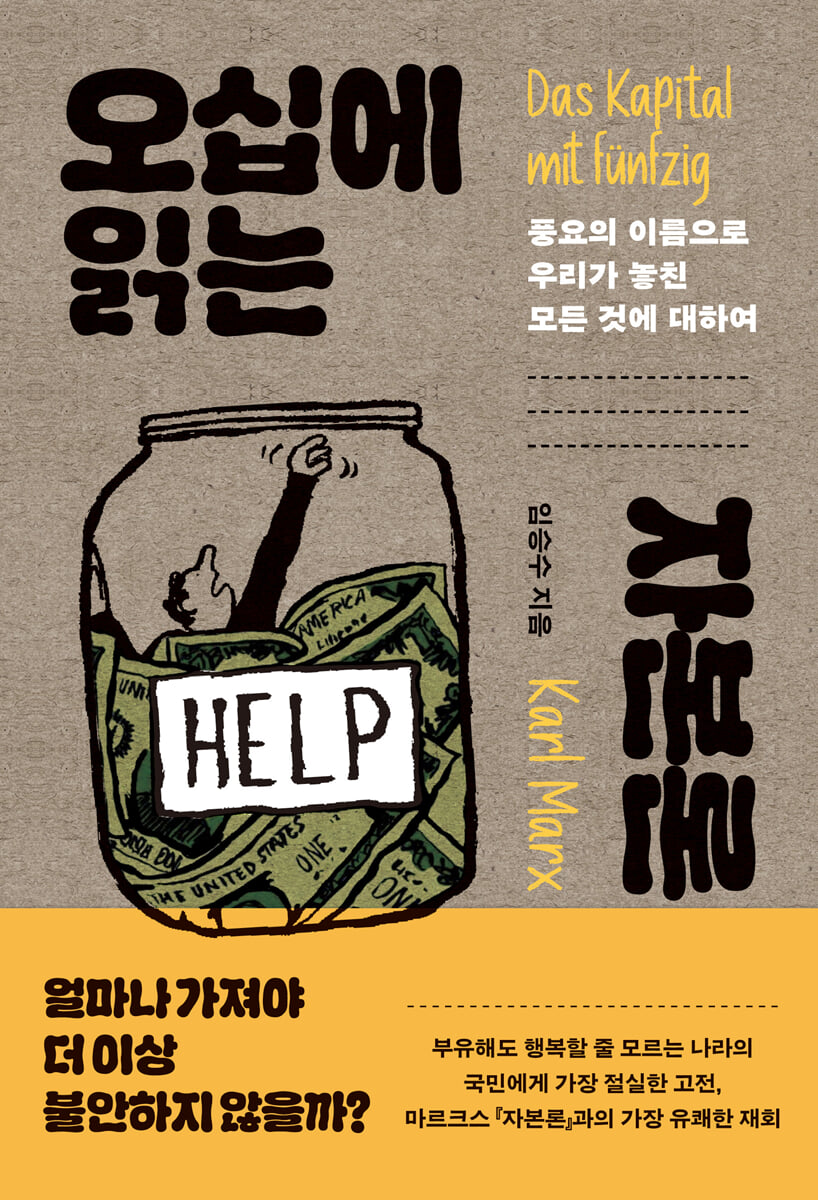
Book Introduction
“How much do I need to have before I feel anxious?”
A classic most desperately needed by the people of a wealthy country who do not know how to be happy.
The most delightful reunion with Marx's "Das Kapital"
Such a strange combination.
A self-made capitalist and a writer who voluntarily came off the rails and has been living as a Marxist for 30 years.
The subject they discuss, sometimes swearing and sometimes getting drunk on, is none other than Das Kapital. Written by Marx, who the BBC called "the most important philosopher in history," this classic book set the world ablaze and redefined its borders.
But this book never said that we should drive out the bourgeoisie and become poor together.
If this book really wants to say anything, it's that even if you don't achieve anything, you're still human.
Author Seung-su Lim, who has played a major role in popularizing Marxism through works such as "Capital Understood by Monkeys," calls out through this book those who have fallen away from their former ideals in the face of the harsh realities of life.
I have been fighting frantically my entire life to protect myself and my family.
I did my best, but the economic value society assigns to me is slowly decreasing.
I'm afraid of being left behind, so I look for business opportunities or investments, but I know this is a game I can't win.
This is why, the more I live, the more I begin to see 『Capital』.
If I were to read Marx at that moment, when I long to step off the treadmill of relentless growth and efficiency, how would the landscape I see change? When I open "Capital: A Guide to Reading at Fifty," I begin to grasp the insight of a classic who possesses the most profound insight into the systems that govern our world today, and begin to interpret my life and the turbulent future.
A classic most desperately needed by the people of a wealthy country who do not know how to be happy.
The most delightful reunion with Marx's "Das Kapital"
Such a strange combination.
A self-made capitalist and a writer who voluntarily came off the rails and has been living as a Marxist for 30 years.
The subject they discuss, sometimes swearing and sometimes getting drunk on, is none other than Das Kapital. Written by Marx, who the BBC called "the most important philosopher in history," this classic book set the world ablaze and redefined its borders.
But this book never said that we should drive out the bourgeoisie and become poor together.
If this book really wants to say anything, it's that even if you don't achieve anything, you're still human.
Author Seung-su Lim, who has played a major role in popularizing Marxism through works such as "Capital Understood by Monkeys," calls out through this book those who have fallen away from their former ideals in the face of the harsh realities of life.
I have been fighting frantically my entire life to protect myself and my family.
I did my best, but the economic value society assigns to me is slowly decreasing.
I'm afraid of being left behind, so I look for business opportunities or investments, but I know this is a game I can't win.
This is why, the more I live, the more I begin to see 『Capital』.
If I were to read Marx at that moment, when I long to step off the treadmill of relentless growth and efficiency, how would the landscape I see change? When I open "Capital: A Guide to Reading at Fifty," I begin to grasp the insight of a classic who possesses the most profound insight into the systems that govern our world today, and begin to interpret my life and the turbulent future.
- You can preview some of the book's contents.
Preview
index
Author's Note: To become human again
To begin with
Chapter 1 So, Are You Living Right?
Isn't the income gap a gap in ability?
Poor people have a reason for being poor.
Do I dig the ground and do business?
There are many good managers in the world.
The most ambitious and warmest idea in the world
Independent Study Note 1.
The root of things taken for granted
Chapter 2: Things that go against human nature
That assumption is wrong.
The nature of altruism
'Problems' are originally meant to be solved together.
People think as they live.
The role-playing game called capitalism
The true meaning of money
A system that can foster good character
Independent Study Note 2.
What Makes Us tick: Evolutionary Psychology vs. Marxism
Chapter 3: First of all, you have to eat to survive.
Why Marxists Help Bosses
Why Capitalists Only Trust Money
Pursuing the same life freely
The tragedy of working only to survive
The most precious thing money can buy
The weight of 260,000 hours
Independent Study Note 3.
Still, the question must be asked
Chapter 4: The Power to Look Outside Us
History moves when it deviates from the course.
Matter rules the mind
New productivity, new contradictions, a new era
The ultimate destination of history
Communists and Basic Income
A world from which we cannot retreat, a change we cannot avoid
Independent Study Note 4.
The superstructure called school
Chapter 5: How to Live Truly for Myself
A trick to persuade your child into Marxism
Socialist Calculation
Change your perspective and the landscape will change.
How to spend half your life
Facing a life without vacations
If you postpone happiness, it won't come.
Five things you regret most when you die
Happiness function and variable weights
To begin with
Chapter 1 So, Are You Living Right?
Isn't the income gap a gap in ability?
Poor people have a reason for being poor.
Do I dig the ground and do business?
There are many good managers in the world.
The most ambitious and warmest idea in the world
Independent Study Note 1.
The root of things taken for granted
Chapter 2: Things that go against human nature
That assumption is wrong.
The nature of altruism
'Problems' are originally meant to be solved together.
People think as they live.
The role-playing game called capitalism
The true meaning of money
A system that can foster good character
Independent Study Note 2.
What Makes Us tick: Evolutionary Psychology vs. Marxism
Chapter 3: First of all, you have to eat to survive.
Why Marxists Help Bosses
Why Capitalists Only Trust Money
Pursuing the same life freely
The tragedy of working only to survive
The most precious thing money can buy
The weight of 260,000 hours
Independent Study Note 3.
Still, the question must be asked
Chapter 4: The Power to Look Outside Us
History moves when it deviates from the course.
Matter rules the mind
New productivity, new contradictions, a new era
The ultimate destination of history
Communists and Basic Income
A world from which we cannot retreat, a change we cannot avoid
Independent Study Note 4.
The superstructure called school
Chapter 5: How to Live Truly for Myself
A trick to persuade your child into Marxism
Socialist Calculation
Change your perspective and the landscape will change.
How to spend half your life
Facing a life without vacations
If you postpone happiness, it won't come.
Five things you regret most when you die
Happiness function and variable weights
Detailed image

Into the book
Those who steal time accumulate great wealth, while those who are robbed of time cannot escape the harshness of life.
The moment you understand this massive exploitative mechanism, the world takes on a completely different face, just like when Neo swallowed the red pill in the movie The Matrix.
In that sense, 『Capital』 is not just a classic of economics, but a book of social anatomy that reveals in detail the source of the unequal world we face every day and the anxiety and helplessness that arise from it.
The artificial intelligence and robots we face today are the new productive forces of today.
If the machines that emerged during the Industrial Revolution replaced human arms and legs, artificial intelligence and robots are now replacing humans themselves.
This is shaking the very foundations of the capitalist social order, pushing us beyond mere job changes to a situation that questions the fundamental meaning of human existence.
If we want to properly understand and cope with this enormous change, we must return to Marx.
--- From "To Become Human Again"
Isn't that what a classic is?
You've heard the title, but not many people have actually read it.
That's why there are many misunderstandings about the content.
As the title suggests, Marx's 『Capital』 is a book that scientifically analyzes the capitalist system.
If someone says they don't read Capital because they don't like socialism, it's like saying they don't read the Bible because they don't like Buddha.
--- From "Isn't the income gap a gap in ability?"
The rules of the world we live in today—where did they all come from? It wasn't like this from the beginning.
In fact, if you think about it, everything we take for granted was created in a specific era, in a specific history.
But if we just accept it as 'that's just the way it is', at some point our minds become trapped in that frame.
In the intellectual prison called capitalist logic.
Because capitalism feels so natural to us, it becomes increasingly difficult to imagine anything outside of it.
In the past, slavery and feudalism were considered natural, but that's not the case anymore.
Likewise, wouldn't future generations someday view today's capitalism as an unfair society? If we truly desire freedom of thought, I believe we need the courage and wisdom to break free from this intellectual prison at least once.
--- From "I Dig the Ground and Do Business"
There are also cases where an individual brings about amazing innovation through outstanding knowledge and capabilities.
But much of the knowledge possessed by these great individuals owes much to the towers of knowledge built by countless others in the past.
How much of the knowledge in my head could I possibly know without the passion, effort, and dedication of people in the past?
Even for me, everything I'm teaching right now is indebted to Marx.
So did Marx develop the theory all by himself? No.
If there had been no senior scholars like Adam Smith or David Ricardo, there would have been no Marx.
No matter how smart Bill Gates or Mark Zuckerberg are, most of their knowledge is based on the achievements of people in the past.
They are just one more brick in the great tower of knowledge that humanity has built.
From a Marxist perspective, their enormous wealth was not due to any remarkable innovations.
They became rich simply because they were capitalists, because they could steal other people's time and turn it into profit.
--- From "There are many good managers in the world"
What I'm trying to overcome is the system itself that produces inequality and discrimination, not a specific individual capitalist.
Just as we cannot arbitrarily judge a person from the past by the standards of the present, we cannot criticize an individual capitalist by the standards of a future that has not yet arrived, that is, socialism.
But I want to make this point clear.
How absurd would it be if someone were to suggest that we return to the class-based society of the past, saying that a good king would rule and that an era of peace could continue?
It's the same.
Some people argue that capitalism would function more healthily if capitalists operated their companies with a sense of ethics and social responsibility, but from a Marxist perspective, this is completely wrong.
The capitalist system is one in which exploitation of workers inevitably occurs on a daily basis, regardless of whether the capitalists are good or evil.
--- From "There are many good managers in the world"
What Marx denied was not property rights in general.
It criticized capitalist private ownership.
In short, he criticized the structure in which capitalists who privately own the means of production exploit workers to accumulate wealth and monopolize the profits, but he did not take issue with owning personal items or houses per se.
When we criticize a slave society, we don't say anything about the slave owners owning various valuables.
Because it criticizes ‘slave ownership’, which exploits slaves by owning them like objects.
--- From "The World's Most Ambitious and Warm Thoughts"
Western anthropologists conducted intelligence tests on Native Americans.
I gave each member of the tribe a test paper and told them to solve the problems on their own.
Perhaps you wanted to know the average intelligence of that tribe.
However, it is said that the tribesmen gathered together and discussed and solved the problem.
The anthropologist approached them and repeatedly emphasized that each person had to solve the problem separately.
The natives answered.
"If there's a problem, shouldn't we discuss it together and resolve it? I don't understand why they keep telling us to solve it separately."
I think what all socialists are pursuing is not a world where everyone drinks soju, but a world where more people enjoy wine and hobbies.
In order for the public to enjoy cultural life more actively, distribution must be fair to prevent excessive wealth from being concentrated in the hands of a few, and working hours must be shortened to increase leisure time.
As you know, this is generally the social image that socialists pursue.
--- From “Problems are originally meant to be solved together”
Of course, capitalist society clearly has many advantages over the societies that humanity has experienced in the past.
However, this does not mean that this is the final destination for humanity.
We must resolve the current contradictions and move to a new stage where people can live happier lives.
The task of our generation is to realize that the labor of others is just as valuable as our own, and to create a community where we respect one another and live in harmony.
Wouldn't such a society be a perfect fit for the communal nature ingrained in our genes? If a slave in the Joseon Dynasty had predicted, "A world without nobles or commoners will come," he would have been labeled a dreamer.
But now the slave's words have become reality.
We need to remember that the world is constantly changing.
--- From "A System That Can Cultivate Good Character"
I think many people live under the terrible illusion that capitalism is free.
In capitalism, you can only exercise your freedom to the extent of the amount of money you own.
--- From "The Most Precious Things Money Can Buy"
By the age of twenty, you have lived about 170,000 hours, and by the age of thirty, you have lived well over 260,000 hours.
For example, if I were to sit down with a young man in his 30s and lecture him on "Das Kapital" for two hours, confident that I could completely change his perspective? In fact, there's no more arrogant thought than that.
Because you are completely ignoring the 260,000 hours the other person has lived.
--- From "The Weight of 260,000 Hours"
If AI and robots completely replace human labor in the future, how will humanity survive and avoid extinction? You probably already know that the capitalist model, whereby individual capitalists privately own the means of production—AI and robots—for profit, is no longer feasible.
In a society where new means of production are widespread, the majority of workers will lose their jobs and incomes. No matter how many goods and services capitalists produce with artificial intelligence and robots, who will buy them?
Companies also lose their foundation and collapse.
Ultimately, it must be converted to public goods, that is, social ownership.
Just like national health insurance and public schools, artificial intelligence and robots will be operated for the public good.
It is about providing goods and services produced by artificial intelligence and robots to all members of the community equally, without discrimination, in terms of welfare and basic rights.
The moment you understand this massive exploitative mechanism, the world takes on a completely different face, just like when Neo swallowed the red pill in the movie The Matrix.
In that sense, 『Capital』 is not just a classic of economics, but a book of social anatomy that reveals in detail the source of the unequal world we face every day and the anxiety and helplessness that arise from it.
The artificial intelligence and robots we face today are the new productive forces of today.
If the machines that emerged during the Industrial Revolution replaced human arms and legs, artificial intelligence and robots are now replacing humans themselves.
This is shaking the very foundations of the capitalist social order, pushing us beyond mere job changes to a situation that questions the fundamental meaning of human existence.
If we want to properly understand and cope with this enormous change, we must return to Marx.
--- From "To Become Human Again"
Isn't that what a classic is?
You've heard the title, but not many people have actually read it.
That's why there are many misunderstandings about the content.
As the title suggests, Marx's 『Capital』 is a book that scientifically analyzes the capitalist system.
If someone says they don't read Capital because they don't like socialism, it's like saying they don't read the Bible because they don't like Buddha.
--- From "Isn't the income gap a gap in ability?"
The rules of the world we live in today—where did they all come from? It wasn't like this from the beginning.
In fact, if you think about it, everything we take for granted was created in a specific era, in a specific history.
But if we just accept it as 'that's just the way it is', at some point our minds become trapped in that frame.
In the intellectual prison called capitalist logic.
Because capitalism feels so natural to us, it becomes increasingly difficult to imagine anything outside of it.
In the past, slavery and feudalism were considered natural, but that's not the case anymore.
Likewise, wouldn't future generations someday view today's capitalism as an unfair society? If we truly desire freedom of thought, I believe we need the courage and wisdom to break free from this intellectual prison at least once.
--- From "I Dig the Ground and Do Business"
There are also cases where an individual brings about amazing innovation through outstanding knowledge and capabilities.
But much of the knowledge possessed by these great individuals owes much to the towers of knowledge built by countless others in the past.
How much of the knowledge in my head could I possibly know without the passion, effort, and dedication of people in the past?
Even for me, everything I'm teaching right now is indebted to Marx.
So did Marx develop the theory all by himself? No.
If there had been no senior scholars like Adam Smith or David Ricardo, there would have been no Marx.
No matter how smart Bill Gates or Mark Zuckerberg are, most of their knowledge is based on the achievements of people in the past.
They are just one more brick in the great tower of knowledge that humanity has built.
From a Marxist perspective, their enormous wealth was not due to any remarkable innovations.
They became rich simply because they were capitalists, because they could steal other people's time and turn it into profit.
--- From "There are many good managers in the world"
What I'm trying to overcome is the system itself that produces inequality and discrimination, not a specific individual capitalist.
Just as we cannot arbitrarily judge a person from the past by the standards of the present, we cannot criticize an individual capitalist by the standards of a future that has not yet arrived, that is, socialism.
But I want to make this point clear.
How absurd would it be if someone were to suggest that we return to the class-based society of the past, saying that a good king would rule and that an era of peace could continue?
It's the same.
Some people argue that capitalism would function more healthily if capitalists operated their companies with a sense of ethics and social responsibility, but from a Marxist perspective, this is completely wrong.
The capitalist system is one in which exploitation of workers inevitably occurs on a daily basis, regardless of whether the capitalists are good or evil.
--- From "There are many good managers in the world"
What Marx denied was not property rights in general.
It criticized capitalist private ownership.
In short, he criticized the structure in which capitalists who privately own the means of production exploit workers to accumulate wealth and monopolize the profits, but he did not take issue with owning personal items or houses per se.
When we criticize a slave society, we don't say anything about the slave owners owning various valuables.
Because it criticizes ‘slave ownership’, which exploits slaves by owning them like objects.
--- From "The World's Most Ambitious and Warm Thoughts"
Western anthropologists conducted intelligence tests on Native Americans.
I gave each member of the tribe a test paper and told them to solve the problems on their own.
Perhaps you wanted to know the average intelligence of that tribe.
However, it is said that the tribesmen gathered together and discussed and solved the problem.
The anthropologist approached them and repeatedly emphasized that each person had to solve the problem separately.
The natives answered.
"If there's a problem, shouldn't we discuss it together and resolve it? I don't understand why they keep telling us to solve it separately."
I think what all socialists are pursuing is not a world where everyone drinks soju, but a world where more people enjoy wine and hobbies.
In order for the public to enjoy cultural life more actively, distribution must be fair to prevent excessive wealth from being concentrated in the hands of a few, and working hours must be shortened to increase leisure time.
As you know, this is generally the social image that socialists pursue.
--- From “Problems are originally meant to be solved together”
Of course, capitalist society clearly has many advantages over the societies that humanity has experienced in the past.
However, this does not mean that this is the final destination for humanity.
We must resolve the current contradictions and move to a new stage where people can live happier lives.
The task of our generation is to realize that the labor of others is just as valuable as our own, and to create a community where we respect one another and live in harmony.
Wouldn't such a society be a perfect fit for the communal nature ingrained in our genes? If a slave in the Joseon Dynasty had predicted, "A world without nobles or commoners will come," he would have been labeled a dreamer.
But now the slave's words have become reality.
We need to remember that the world is constantly changing.
--- From "A System That Can Cultivate Good Character"
I think many people live under the terrible illusion that capitalism is free.
In capitalism, you can only exercise your freedom to the extent of the amount of money you own.
--- From "The Most Precious Things Money Can Buy"
By the age of twenty, you have lived about 170,000 hours, and by the age of thirty, you have lived well over 260,000 hours.
For example, if I were to sit down with a young man in his 30s and lecture him on "Das Kapital" for two hours, confident that I could completely change his perspective? In fact, there's no more arrogant thought than that.
Because you are completely ignoring the 260,000 hours the other person has lived.
--- From "The Weight of 260,000 Hours"
If AI and robots completely replace human labor in the future, how will humanity survive and avoid extinction? You probably already know that the capitalist model, whereby individual capitalists privately own the means of production—AI and robots—for profit, is no longer feasible.
In a society where new means of production are widespread, the majority of workers will lose their jobs and incomes. No matter how many goods and services capitalists produce with artificial intelligence and robots, who will buy them?
Companies also lose their foundation and collapse.
Ultimately, it must be converted to public goods, that is, social ownership.
Just like national health insurance and public schools, artificial intelligence and robots will be operated for the public good.
It is about providing goods and services produced by artificial intelligence and robots to all members of the community equally, without discrimination, in terms of welfare and basic rights.
--- From "New Productivity, New Contradictions, New Era"
Publisher's Review
To the classics that shook the world
Asking again what path one should take in life
According to a 2024 KDI study, 76 percent of South Koreans believe they are poorer than they actually are.
Although Korea today is more abundant than ever before, the dominant emotions felt by Koreans today are deprivation and anxiety.
The suicide rate, which has been the highest in the world for over 20 years, and the world's lowest birth rate are clear indicators of the mental fatigue of Koreans.
Our success may be closely linked to our misfortune.
If you are satisfied and at peace, there is no need to prove yourself by putting yourself out there, and there is no emptiness that requires you to consume something to fill it.
But a life driven by anxiety eats away at humanity.
To bear that weight, we indulge in small pleasures, and we turn to philosophy, mindfulness, and psychiatric treatment.
But isn't what we truly need not the comfort of enduring the world as it is, but the strength to imagine a different world? That's why now is the perfect time to encounter "Das Kapital."
You might ask why we should read a once subversive book and a book of ideology from a fallen system.
However, the 『Capital』 that author Seungsu Lim, who has played a major role in popularizing Marxism for the past twenty years, talks about in this book is not a legacy of the past.
This is a book of social anatomy that reveals in detail the unequal world we face every day and the source of the anxiety and helplessness that arise from it, and it is the only book that contains unique and valid insights into the principles that make our world work today.
Author Seungsu Lim has distilled twenty years of effort into a novel that unfolds the core insights of Capital in a delightful and accessible manner that even the most cynical of readers can enjoy.
Through a book that once shook and set the world ablaze, I now read about my life and the path I should take.
“My daughter is a Marxist! You’re responsible!”
The delightful novel 『Capital』
However, even in such an important book, not many readers have encountered its ideas.
This is because of the extremely high level of difficulty that is characteristic of 『Capital』.
Accordingly, author Seungsu Lim has completed the story by putting Marx's core ideas, including 'Das Kapital', into a form that is most closely related to our lives and enjoyable to read.
Occasionally, when I meet high school students through lectures, I find that some of them are deeply immersed in Marx's thoughts.
It was to the point where writer Seungsu Lim had to turn off the lights to tell him to study hard and approach things slowly.
At times like that, there was a feeling of anxiety that crossed the writer's mind.
"If students who were so brilliant that they were applying to medical school suddenly became immersed in Marxism and tried to change their career path, wouldn't their parents come after me right away?"
That's how the idea for this book began.
He sets up a capitalist who is devastated when he learns that his daughter, who was good enough to study medicine, is changing her career path to sociology, and a writer who closely resembles the author as the main characters.
A heated debate unfolds between a capitalist who has become self-made through hardship and is convinced that he knows the world very well, and an author who believes that human nature also changes depending on the system we live in.
If you observe the heated exchanges, you will sometimes find your own voice in the capitalist, and sometimes in the writer.
In their stories, the inner workings of this world we took for granted are revealed in detail, and we are given the opportunity to question the assumptions of life that have weighed us down.
As I lived, I realized that Marx was wrong.
As I lived longer, I realized that Marx was right.
Today's fifty-somethings are people who dreamed of change during their youth.
I believed that the world could become more prosperous, equal, and peaceful.
At the recommendation of my seniors, I would read a page or two of Marx, and even though I didn't participate in the movement seriously, I would secretly vote in agreement with its ideals.
However, as soon as they entered society, their lives became about survival, even before they reached adolescence, as they experienced the IMF crisis.
Twenty years of struggling to support my family and maintain stability.
Some people are financially successful, others are not.
But if there's one thing they all know, it's that this life has no end.
Living in a world where no matter how hard they struggle, safety never comes, now that they've lived their entire lives and experienced everything they've ever experienced, what would they read if they were to re-open the pages of the book they closed in their youth? Was it a foolish ideal, or the path the world should take?
However, I am not recommending that you read 『Capital』 as a way to escape reality or to reminisce about the ideals of your youth.
Author Seungsu Lim says that now, when artificial intelligence and robots are beginning to appear in earnest, is the time when Marx's foresight is most urgently needed.
One of Marx's most brilliant insights was that whenever new productive forces emerged, the old social order collapsed and history moved forward.
In fact, the dissolution of medieval feudalism and the establishment of modern capitalism were due to the emergence of a new productive force called mechanized large-scale industry.
Artificial intelligence and robots, which are becoming more deeply intertwined with our lives even at this very moment, are today's new productive forces.
If the machines that emerged during the Industrial Revolution replaced human arms and legs, artificial intelligence and robots are now replacing humans themselves.
It is delving into not only simple labor but also professional and creative fields such as accounting, law, writing, and drawing.
The new productive force known as artificial intelligence is shaking the very foundations of the capitalist social order, pushing us beyond mere job changes to a situation that questions the fundamental meaning of human existence.
If we want to properly understand and cope with this enormous change, we must return to Marx.
Author Seungsu Lim does not try to persuade readers.
He doesn't believe that humans, who have lived hundreds of thousands of hours in their own way, are simple beings who can change their minds with a single book.
However, if you read it with a cheerful smile, you may find yourself breaking free from the intellectual prison of capitalism and considering some new ideas.
And in that gap, the imagination begins to imagine a world where we can escape the hamster wheel of achievement, efficiency, and growth and finally live as ourselves again.
Asking again what path one should take in life
According to a 2024 KDI study, 76 percent of South Koreans believe they are poorer than they actually are.
Although Korea today is more abundant than ever before, the dominant emotions felt by Koreans today are deprivation and anxiety.
The suicide rate, which has been the highest in the world for over 20 years, and the world's lowest birth rate are clear indicators of the mental fatigue of Koreans.
Our success may be closely linked to our misfortune.
If you are satisfied and at peace, there is no need to prove yourself by putting yourself out there, and there is no emptiness that requires you to consume something to fill it.
But a life driven by anxiety eats away at humanity.
To bear that weight, we indulge in small pleasures, and we turn to philosophy, mindfulness, and psychiatric treatment.
But isn't what we truly need not the comfort of enduring the world as it is, but the strength to imagine a different world? That's why now is the perfect time to encounter "Das Kapital."
You might ask why we should read a once subversive book and a book of ideology from a fallen system.
However, the 『Capital』 that author Seungsu Lim, who has played a major role in popularizing Marxism for the past twenty years, talks about in this book is not a legacy of the past.
This is a book of social anatomy that reveals in detail the unequal world we face every day and the source of the anxiety and helplessness that arise from it, and it is the only book that contains unique and valid insights into the principles that make our world work today.
Author Seungsu Lim has distilled twenty years of effort into a novel that unfolds the core insights of Capital in a delightful and accessible manner that even the most cynical of readers can enjoy.
Through a book that once shook and set the world ablaze, I now read about my life and the path I should take.
“My daughter is a Marxist! You’re responsible!”
The delightful novel 『Capital』
However, even in such an important book, not many readers have encountered its ideas.
This is because of the extremely high level of difficulty that is characteristic of 『Capital』.
Accordingly, author Seungsu Lim has completed the story by putting Marx's core ideas, including 'Das Kapital', into a form that is most closely related to our lives and enjoyable to read.
Occasionally, when I meet high school students through lectures, I find that some of them are deeply immersed in Marx's thoughts.
It was to the point where writer Seungsu Lim had to turn off the lights to tell him to study hard and approach things slowly.
At times like that, there was a feeling of anxiety that crossed the writer's mind.
"If students who were so brilliant that they were applying to medical school suddenly became immersed in Marxism and tried to change their career path, wouldn't their parents come after me right away?"
That's how the idea for this book began.
He sets up a capitalist who is devastated when he learns that his daughter, who was good enough to study medicine, is changing her career path to sociology, and a writer who closely resembles the author as the main characters.
A heated debate unfolds between a capitalist who has become self-made through hardship and is convinced that he knows the world very well, and an author who believes that human nature also changes depending on the system we live in.
If you observe the heated exchanges, you will sometimes find your own voice in the capitalist, and sometimes in the writer.
In their stories, the inner workings of this world we took for granted are revealed in detail, and we are given the opportunity to question the assumptions of life that have weighed us down.
As I lived, I realized that Marx was wrong.
As I lived longer, I realized that Marx was right.
Today's fifty-somethings are people who dreamed of change during their youth.
I believed that the world could become more prosperous, equal, and peaceful.
At the recommendation of my seniors, I would read a page or two of Marx, and even though I didn't participate in the movement seriously, I would secretly vote in agreement with its ideals.
However, as soon as they entered society, their lives became about survival, even before they reached adolescence, as they experienced the IMF crisis.
Twenty years of struggling to support my family and maintain stability.
Some people are financially successful, others are not.
But if there's one thing they all know, it's that this life has no end.
Living in a world where no matter how hard they struggle, safety never comes, now that they've lived their entire lives and experienced everything they've ever experienced, what would they read if they were to re-open the pages of the book they closed in their youth? Was it a foolish ideal, or the path the world should take?
However, I am not recommending that you read 『Capital』 as a way to escape reality or to reminisce about the ideals of your youth.
Author Seungsu Lim says that now, when artificial intelligence and robots are beginning to appear in earnest, is the time when Marx's foresight is most urgently needed.
One of Marx's most brilliant insights was that whenever new productive forces emerged, the old social order collapsed and history moved forward.
In fact, the dissolution of medieval feudalism and the establishment of modern capitalism were due to the emergence of a new productive force called mechanized large-scale industry.
Artificial intelligence and robots, which are becoming more deeply intertwined with our lives even at this very moment, are today's new productive forces.
If the machines that emerged during the Industrial Revolution replaced human arms and legs, artificial intelligence and robots are now replacing humans themselves.
It is delving into not only simple labor but also professional and creative fields such as accounting, law, writing, and drawing.
The new productive force known as artificial intelligence is shaking the very foundations of the capitalist social order, pushing us beyond mere job changes to a situation that questions the fundamental meaning of human existence.
If we want to properly understand and cope with this enormous change, we must return to Marx.
Author Seungsu Lim does not try to persuade readers.
He doesn't believe that humans, who have lived hundreds of thousands of hours in their own way, are simple beings who can change their minds with a single book.
However, if you read it with a cheerful smile, you may find yourself breaking free from the intellectual prison of capitalism and considering some new ideas.
And in that gap, the imagination begins to imagine a world where we can escape the hamster wheel of achievement, efficiency, and growth and finally live as ourselves again.
GOODS SPECIFICS
- Date of issue: September 22, 2025
- Page count, weight, size: 328 pages | 140*205*30mm
- ISBN13: 9791130670966
- ISBN10: 1130670961
You may also like
카테고리
korean


korean

![GQ KOREA Mark (Monthly): December [2025]](http://librairie.coreenne.fr/cdn/shop/files/8ef265dbbfbf186523ed75ba7319009d.jpg?v=1765340328&width=3840)


