

Beasts of the Small Land
 |
Description
Book Introduction
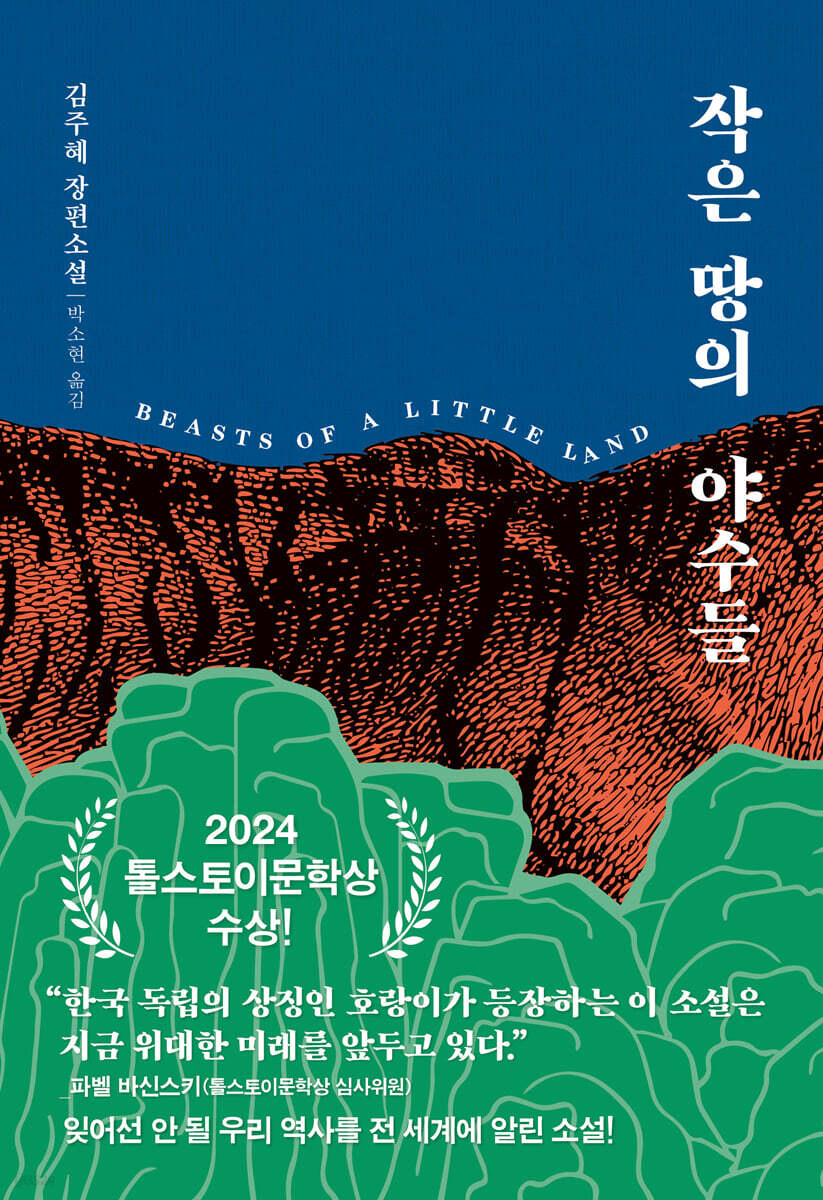
Winner of the 2024 Tolstoy Literature Prize!
A novel that made our unforgettable history known to the world
“This novel features a tiger, a symbol of Korean independence.
“We are now facing a great future.”
_Pavel Basinsky (Tolstoy Literary Award Jury Member)
Praise from over 40 major English-speaking media outlets, including The Times and The New York Times
Translated and published in 14 countries worldwide, currently being adapted into a global OTT video.
The monumental debut work of Korean-American author Kim Joo-hye, winner of the 2024 Tolstoy Prize in Literature.
Beginning with a powerful prologue depicting a confrontation between tigers and humans, "Beasts of a Small Land" is a grand epic about the fateful entanglement of diverse human beings with different desires in a chaotic era, leading to their rise and fall.
In 1917, during the Japanese colonial period in Korea, a hunter, fighting hunger and extreme cold in the deep snow-covered mountains, chases wild animals and rescues a Japanese captain who is being attacked by a tiger.
From this encounter, their lives are linked by fate, and a story unfolds that spans half a century.
This novel, which is said to be reminiscent of Tolstoy's work in terms of its breadth of narrative and breath, has been highly praised by over 40 media outlets in the English-speaking world and has been translated and published in 14 countries, making our history known around the world.
It was nominated for three literary awards, including the Dayton Literary Peace Prize, which is awarded to literary works that contribute to world peace, and in 2024, it was finally honored with being selected as the winner of the Yasnaya Polyana Prize (Tolstoy Literature Prize), Russia's most prestigious literary award, in the foreign literature category.
Readers have called this book, which transports readers to the heart of Gyeongseong in an instant with vivid descriptions that make them feel as if they are seeing it with their own eyes, “a work of art expressed in words,” and have even gone so far as to cast a virtual main character. As if to live up to this, work is underway to make it into a film, raising expectations for how this beautiful story will be adapted.
The Korean edition is significant in that it is the first publication in the native language of “Our Story,” which was first written in English.
We put great effort into the translation to preserve the beauty of our language, and included a special message from the author to Korean readers.
Readers continued to praise the novel, saying, “It accurately expresses the unique Korean sentiment to the point that it is hard to believe it is a translated novel,” and the high value of the native language version was recognized, establishing it as a “novel that all Koreans must read.”
A novel that made our unforgettable history known to the world
“This novel features a tiger, a symbol of Korean independence.
“We are now facing a great future.”
_Pavel Basinsky (Tolstoy Literary Award Jury Member)
Praise from over 40 major English-speaking media outlets, including The Times and The New York Times
Translated and published in 14 countries worldwide, currently being adapted into a global OTT video.
The monumental debut work of Korean-American author Kim Joo-hye, winner of the 2024 Tolstoy Prize in Literature.
Beginning with a powerful prologue depicting a confrontation between tigers and humans, "Beasts of a Small Land" is a grand epic about the fateful entanglement of diverse human beings with different desires in a chaotic era, leading to their rise and fall.
In 1917, during the Japanese colonial period in Korea, a hunter, fighting hunger and extreme cold in the deep snow-covered mountains, chases wild animals and rescues a Japanese captain who is being attacked by a tiger.
From this encounter, their lives are linked by fate, and a story unfolds that spans half a century.
This novel, which is said to be reminiscent of Tolstoy's work in terms of its breadth of narrative and breath, has been highly praised by over 40 media outlets in the English-speaking world and has been translated and published in 14 countries, making our history known around the world.
It was nominated for three literary awards, including the Dayton Literary Peace Prize, which is awarded to literary works that contribute to world peace, and in 2024, it was finally honored with being selected as the winner of the Yasnaya Polyana Prize (Tolstoy Literature Prize), Russia's most prestigious literary award, in the foreign literature category.
Readers have called this book, which transports readers to the heart of Gyeongseong in an instant with vivid descriptions that make them feel as if they are seeing it with their own eyes, “a work of art expressed in words,” and have even gone so far as to cast a virtual main character. As if to live up to this, work is underway to make it into a film, raising expectations for how this beautiful story will be adapted.
The Korean edition is significant in that it is the first publication in the native language of “Our Story,” which was first written in English.
We put great effort into the translation to preserve the beauty of our language, and included a special message from the author to Korean readers.
Readers continued to praise the novel, saying, “It accurately expresses the unique Korean sentiment to the point that it is hard to believe it is a translated novel,” and the high value of the native language version was recognized, establishing it as a “novel that all Koreans must read.”
- You can preview some of the book's contents.
Preview
index
008 for Korean readers
Prologue Hunter 017
[Part 1] 1918–1919
Chapter 1 Secret Letters 051
Chapter 2 Wolhyang 078
Chapter 3: Things to Remember When You're Sad 089
Chapter 4 Orphan 103
Chapter 5: A Friend from Shanghai 119
Chapter 6 Street Procession 140
Chapter 7 Escape 153
Chapter 8: Finally Met That Person 164
Chapter 9 March Demonstrations 184
Chapter 10: The Darkest Blue 208
[Part 2] 1925–1937
Chapter 11: Jeongho's Story 231
Chapter 12: The Proposal 251
Chapter 13 Left and Right 275
Chapter 14 Some Men Are Good and Some Men Are Bad 292
Chapter 15: All Night 308
Chapter 16: Because You Just Stand There 335
Chapter 17: Badatong Cafe 355
Chapter 18: A Rainy Night 377
Chapter 19 Frost 387
Chapter 20: The Dreamers 415
[Part 3] 1941–1948
Chapter 21: Purple Shadows 435
Chapter 22: The Animals Left Behind 462
Chapter 23: The Beginning of the End 482
Chapter 24 Cranberries 516
Chapter 25: Republic 528
[Part 4] 1964
Chapter 26: The Hourglass 555
Chapter 27 March 579
Epilogue Haenyeo 590
Acknowledgments 604
Translator's Note 608
Prologue Hunter 017
[Part 1] 1918–1919
Chapter 1 Secret Letters 051
Chapter 2 Wolhyang 078
Chapter 3: Things to Remember When You're Sad 089
Chapter 4 Orphan 103
Chapter 5: A Friend from Shanghai 119
Chapter 6 Street Procession 140
Chapter 7 Escape 153
Chapter 8: Finally Met That Person 164
Chapter 9 March Demonstrations 184
Chapter 10: The Darkest Blue 208
[Part 2] 1925–1937
Chapter 11: Jeongho's Story 231
Chapter 12: The Proposal 251
Chapter 13 Left and Right 275
Chapter 14 Some Men Are Good and Some Men Are Bad 292
Chapter 15: All Night 308
Chapter 16: Because You Just Stand There 335
Chapter 17: Badatong Cafe 355
Chapter 18: A Rainy Night 377
Chapter 19 Frost 387
Chapter 20: The Dreamers 415
[Part 3] 1941–1948
Chapter 21: Purple Shadows 435
Chapter 22: The Animals Left Behind 462
Chapter 23: The Beginning of the End 482
Chapter 24 Cranberries 516
Chapter 25: Republic 528
[Part 4] 1964
Chapter 26: The Hourglass 555
Chapter 27 March 579
Epilogue Haenyeo 590
Acknowledgments 604
Translator's Note 608
Detailed image

Into the book
Although Ok-hee was still young, it was easy for her to figure out what the men wanted in this house.
Their motivation was simple.
Wanting to feel alive.
What Ok-hee couldn't quite understand were women.
Have women ever felt alive while making men feel alive?
--- pp.52~53
The most amazing events start with a single, unnoticed needle dropping, and then follow a chain reaction.
It is as ordinary as the appearance of a stray dog, just another incident that passes away with the passage of time.
--- p.78
As far as Wolhyang could remember, there were dozens of stories like this about women who desperately wanted children.
But those stories never talk about the women who didn't want to be mothers.
In reality, there are many parasites, servants, unmarried women, widows, and women who already have many mouths to feed.
These women also had to pray to heaven and swallow bitter herbs to fulfill their wishes.
--- p.91
The unwavering belief that life is a process of constant progress is a characteristic of youth.
Ok-hee, too, took it for granted that after passing one stage of life, the next would come right away, and she believed that in the street parade, she had experienced a definite moment of taking a step into adulthood.
So when he realized that nothing had changed in his daily life since that day, he couldn't hide his surprise and disappointment.
--- p.153
If you want to learn my secret to winning every fight, this is it.
Forget everything else and remember that those who are in desperate need are the most dangerous.
--- pp.239~240
As I get older, I realize that life isn't about what protects me, but what I protect, and that's what ultimately matters.
--- p.250
“People think they want money, but I often realize that most of them actually want something other than money.
They say that becoming rich and wealthy is their ultimate goal because they think it's safer to just say that than to admit what they really want...
Do you understand what I mean?
--- p.290
Love is something that happens all at once, but it also spreads gradually.
--- p.331
People can have quite a few conversations without any real desire to know each other.
But when you meet your soulmate, whether you talk much or not, you can't help but feel completely connected.
--- p.332
Time tends to flatten the amplitude of all emotions, but it cannot erase what truly exists.
--- p.359
All people in this world are divided into two types, and the majority belong to the first category.
At some point in their lives, people realize that they cannot progress further towards success from their current state and will never be able to do so.
Then you have to learn to rationalize the fate that has been given to you in life and be content with where you are.
The point at which the poorest people realize this is surprisingly early, usually before they are twenty.
People who have benefited from education also come to the same conclusion between the ages of thirty and forty.
Some people, by virtue of their circumstances, their own ambitions, and their talents, come to a similar realization around the age of fifty, and at that age, this lull doesn't seem so terrible.
--- p.387
Every wedding is meant to bring a deeper light and shade to the interpersonal relationships of the guests compared to the ideal happiness of the bride and groom.
A wedding is a ceremony that unites two people in love forever.
But how many people fight, despair, and ultimately decide to break up after that?
--- p.408
Ok-hee recalled the nights she had spent in her mountain village long ago.
The pitch-black darkness vibrated with the howling of hungry animals, and on the mornings after snowfall, I often saw their footprints as they circled the hut and then returned.
But the beasts never scared Ok-hee.
It was always humans who had terrified him with their truly savage and bestial behavior.
--- pp.513~514
Life is bearable.
Because time makes you forget everything.
Still, life is worth living.
Because love makes you remember everything.
Their motivation was simple.
Wanting to feel alive.
What Ok-hee couldn't quite understand were women.
Have women ever felt alive while making men feel alive?
--- pp.52~53
The most amazing events start with a single, unnoticed needle dropping, and then follow a chain reaction.
It is as ordinary as the appearance of a stray dog, just another incident that passes away with the passage of time.
--- p.78
As far as Wolhyang could remember, there were dozens of stories like this about women who desperately wanted children.
But those stories never talk about the women who didn't want to be mothers.
In reality, there are many parasites, servants, unmarried women, widows, and women who already have many mouths to feed.
These women also had to pray to heaven and swallow bitter herbs to fulfill their wishes.
--- p.91
The unwavering belief that life is a process of constant progress is a characteristic of youth.
Ok-hee, too, took it for granted that after passing one stage of life, the next would come right away, and she believed that in the street parade, she had experienced a definite moment of taking a step into adulthood.
So when he realized that nothing had changed in his daily life since that day, he couldn't hide his surprise and disappointment.
--- p.153
If you want to learn my secret to winning every fight, this is it.
Forget everything else and remember that those who are in desperate need are the most dangerous.
--- pp.239~240
As I get older, I realize that life isn't about what protects me, but what I protect, and that's what ultimately matters.
--- p.250
“People think they want money, but I often realize that most of them actually want something other than money.
They say that becoming rich and wealthy is their ultimate goal because they think it's safer to just say that than to admit what they really want...
Do you understand what I mean?
--- p.290
Love is something that happens all at once, but it also spreads gradually.
--- p.331
People can have quite a few conversations without any real desire to know each other.
But when you meet your soulmate, whether you talk much or not, you can't help but feel completely connected.
--- p.332
Time tends to flatten the amplitude of all emotions, but it cannot erase what truly exists.
--- p.359
All people in this world are divided into two types, and the majority belong to the first category.
At some point in their lives, people realize that they cannot progress further towards success from their current state and will never be able to do so.
Then you have to learn to rationalize the fate that has been given to you in life and be content with where you are.
The point at which the poorest people realize this is surprisingly early, usually before they are twenty.
People who have benefited from education also come to the same conclusion between the ages of thirty and forty.
Some people, by virtue of their circumstances, their own ambitions, and their talents, come to a similar realization around the age of fifty, and at that age, this lull doesn't seem so terrible.
--- p.387
Every wedding is meant to bring a deeper light and shade to the interpersonal relationships of the guests compared to the ideal happiness of the bride and groom.
A wedding is a ceremony that unites two people in love forever.
But how many people fight, despair, and ultimately decide to break up after that?
--- p.408
Ok-hee recalled the nights she had spent in her mountain village long ago.
The pitch-black darkness vibrated with the howling of hungry animals, and on the mornings after snowfall, I often saw their footprints as they circled the hut and then returned.
But the beasts never scared Ok-hee.
It was always humans who had terrified him with their truly savage and bestial behavior.
--- pp.513~514
Life is bearable.
Because time makes you forget everything.
Still, life is worth living.
Because love makes you remember everything.
--- p.603
Publisher's Review
★2024 Russian Tolstoy Literature Prize (Yasnaya Polyana Prize) Winner
★2022 Dayton Literary Peace Prize Finalist
★Rave reviews from over 40 major English-speaking media outlets, including The Times and The New York Times.
★Amazon Book of the Month 2021
★2021 Book of the Year by Real Simple, Harper's Bazaar, Ms. Magazine, and Portland Monthly
★Recommended major domestic daily newspapers: Chosun, Kyunghyang, Donga, Maeil, Munhwa, Seoul, and Hankyoreh
★Translated and published in 14 countries worldwide
★Video adaptation confirmed
“This work, featuring the tiger, a symbol of Korean independence, is poised for a great future.”
The most Korean and most global story that raised the status of South Korea.
"Beasts of a Small Land," which unfolds the history of the small land of Korea on a grand scale, was first published in the English-speaking world in 2021, providing an opportunity to introduce Korean history to readers around the world.
This work, which received rave reviews from over 40 British and American media outlets and sold its copyright to 14 countries, was nominated as a finalist for the 2022 Dayton Literary Peace Prize, awarded to literary works that contribute to world peace.
Immediately after the Korean version is published, the film rights will be sold and the series will be produced.
The Korean version became a bestseller immediately after its publication in Korea.
In particular, domestic readers praised the novel for accurately expressing Korea's unique emotions to the point that they could not believe it was a translated novel, and were amazed by the beauty of the native language version that cannot be accurately expressed in other languages.
And in 2024, he finally won the Yasnaya Polyana Prize, one of Russia's three major literary awards.
The Yasnaya Polyana Prize, also known as the Tolstoy Literary Prize, was established to honor the humanism and literary quality of the world-renowned author Tolstoy and to encourage the development of Russian literature.
It began in 2003 with the support of Samsung Electronics and is currently considered Russia's most prestigious literary award.
The nominees also included Nobel Prize winner for Literature Olga Tokarczuk.
Among Korean authors, Han Kang, Kim Ae-ran, and Jeong I-hyeon were nominated but did not win the award. This year, Kim Joo-hye has finally been nominated.
Past winners include Wi Hwa, Julian Barnes, and Orhan Pamuk.
“Russians who grew up between the two mountains of Tolstoy and Dostoevsky often think that there is no true literature outside of Russian literature, but this is a misconception; excellent literature exists everywhere.
The Yasnaya Polyana Prize annually honors Russian literature and translated literature, showcasing literary trends from around the world.
Also, I would like to say a few words about the work of a young Korean writer, “Beasts of Small Land.”
There are beasts here.
Among them, the tiger is a symbol of Korean independence.
I would compare this work to Alexei Tolstoy's The Road to Calvary.
It's really well written, transparent and mature, a remarkable piece for a young author.
“I think this work has a great future ahead of it.” _Pavel Basinsky (Tolstoy Literary Award jury)
At a press conference in Moscow ahead of the announcement of the winner, Tolstoy Prize jury member and author Pavel Basinsky specifically mentioned Beasts of a Small Land.
Author Kim Joo-hye expressed her thoughts, saying, “I think this was an opportunity to make the tiger, our heritage, known worldwide as a symbol of Korean independence, and more broadly, I think it helped raise pride in our culture and history.”
Where will Kim Joo-hye's literature, which achieved global success at the same time as her leap forward, reach? That powerful journey will soon mark the future of Korean literature.
“This is a story we all know so well, but it needs to be told more widely.”
Our story that heated the blood of people all over the world!
The struggle and love of those who live bravely, overcoming the sorrow of lost land.
"Beasts of a Small Land" is the story of Korean-American author Joo-hye Kim's journey back in time to find the "seeds" of her own identity, which inevitably became her first novel.
For the author, who grew up hearing stories from his mother about his maternal grandfather who helped in the independence movement, the Korean independence movement and modern history were not boring history, but a part of reality.
Because of this family history, the author naturally recognized Korean history as a part of his life.
Even going back to his grandfather's time, the Korean Peninsula had fought off Japanese invaders with blood, and wild beasts roamed the undivided territories of the South and the North.
The author wanted to share this close Korean history with readers around the world, and furthermore, through the characters in the novel, show us how we can live meaningful lives.
In 『Beasts of a Small Land』, all kinds of human figures are shown.
They are all people who have been caught up in the struggle for independence of the Republic of Korea over the past several decades and lived through those turbulent times.
The goal is to awaken the values of love, empathy, and compassion that unite humanity through various characters.
The author said, “I wrote it not only as a story about Koreans who lived in a small land far away from here about a hundred years ago, but also as a story about humanity as a whole.”
“We, born Koreans, are beasts of a small land.”
It started with a scene of a hunter and a tiger facing off on a snowy field.
Stories of our just and brave ancestors
“I really don’t want to miss the tiger.
There are no such ferocious beasts in Japan.
Even though we are a much larger country in terms of territory.
It is a mystery how such huge beasts could thrive in this small land.” _From the text
The tiger that appears in the prologue creates tension just by its existence.
The novel begins with an episode about a tiger that is both an object of fear and a favor repaid, and this powerful first scene seems to envelop the entire novel.
As the title of the novel, 'Beasts of a Small Land', suggests, tigers play an important symbolic role in the novel.
During the Japanese colonial period, the tiger served as a symbol of the independence movement and boosted the morale of the Korean people.
Because of that, at that time, Japan hunted tigers as part of an effort to destroy the spirit of our people.
The author says that the fact that beasts like tigers have been able to coexist with humans for five thousand years on the small Korean Peninsula is due to our people's respect and love for nature.
This novel reminds us of the spirit of the Korean people who survived a horrific era through the beast called the tiger.
★2022 Dayton Literary Peace Prize Finalist
★Rave reviews from over 40 major English-speaking media outlets, including The Times and The New York Times.
★Amazon Book of the Month 2021
★2021 Book of the Year by Real Simple, Harper's Bazaar, Ms. Magazine, and Portland Monthly
★Recommended major domestic daily newspapers: Chosun, Kyunghyang, Donga, Maeil, Munhwa, Seoul, and Hankyoreh
★Translated and published in 14 countries worldwide
★Video adaptation confirmed
“This work, featuring the tiger, a symbol of Korean independence, is poised for a great future.”
The most Korean and most global story that raised the status of South Korea.
"Beasts of a Small Land," which unfolds the history of the small land of Korea on a grand scale, was first published in the English-speaking world in 2021, providing an opportunity to introduce Korean history to readers around the world.
This work, which received rave reviews from over 40 British and American media outlets and sold its copyright to 14 countries, was nominated as a finalist for the 2022 Dayton Literary Peace Prize, awarded to literary works that contribute to world peace.
Immediately after the Korean version is published, the film rights will be sold and the series will be produced.
The Korean version became a bestseller immediately after its publication in Korea.
In particular, domestic readers praised the novel for accurately expressing Korea's unique emotions to the point that they could not believe it was a translated novel, and were amazed by the beauty of the native language version that cannot be accurately expressed in other languages.
And in 2024, he finally won the Yasnaya Polyana Prize, one of Russia's three major literary awards.
The Yasnaya Polyana Prize, also known as the Tolstoy Literary Prize, was established to honor the humanism and literary quality of the world-renowned author Tolstoy and to encourage the development of Russian literature.
It began in 2003 with the support of Samsung Electronics and is currently considered Russia's most prestigious literary award.
The nominees also included Nobel Prize winner for Literature Olga Tokarczuk.
Among Korean authors, Han Kang, Kim Ae-ran, and Jeong I-hyeon were nominated but did not win the award. This year, Kim Joo-hye has finally been nominated.
Past winners include Wi Hwa, Julian Barnes, and Orhan Pamuk.
“Russians who grew up between the two mountains of Tolstoy and Dostoevsky often think that there is no true literature outside of Russian literature, but this is a misconception; excellent literature exists everywhere.
The Yasnaya Polyana Prize annually honors Russian literature and translated literature, showcasing literary trends from around the world.
Also, I would like to say a few words about the work of a young Korean writer, “Beasts of Small Land.”
There are beasts here.
Among them, the tiger is a symbol of Korean independence.
I would compare this work to Alexei Tolstoy's The Road to Calvary.
It's really well written, transparent and mature, a remarkable piece for a young author.
“I think this work has a great future ahead of it.” _Pavel Basinsky (Tolstoy Literary Award jury)
At a press conference in Moscow ahead of the announcement of the winner, Tolstoy Prize jury member and author Pavel Basinsky specifically mentioned Beasts of a Small Land.
Author Kim Joo-hye expressed her thoughts, saying, “I think this was an opportunity to make the tiger, our heritage, known worldwide as a symbol of Korean independence, and more broadly, I think it helped raise pride in our culture and history.”
Where will Kim Joo-hye's literature, which achieved global success at the same time as her leap forward, reach? That powerful journey will soon mark the future of Korean literature.
“This is a story we all know so well, but it needs to be told more widely.”
Our story that heated the blood of people all over the world!
The struggle and love of those who live bravely, overcoming the sorrow of lost land.
"Beasts of a Small Land" is the story of Korean-American author Joo-hye Kim's journey back in time to find the "seeds" of her own identity, which inevitably became her first novel.
For the author, who grew up hearing stories from his mother about his maternal grandfather who helped in the independence movement, the Korean independence movement and modern history were not boring history, but a part of reality.
Because of this family history, the author naturally recognized Korean history as a part of his life.
Even going back to his grandfather's time, the Korean Peninsula had fought off Japanese invaders with blood, and wild beasts roamed the undivided territories of the South and the North.
The author wanted to share this close Korean history with readers around the world, and furthermore, through the characters in the novel, show us how we can live meaningful lives.
In 『Beasts of a Small Land』, all kinds of human figures are shown.
They are all people who have been caught up in the struggle for independence of the Republic of Korea over the past several decades and lived through those turbulent times.
The goal is to awaken the values of love, empathy, and compassion that unite humanity through various characters.
The author said, “I wrote it not only as a story about Koreans who lived in a small land far away from here about a hundred years ago, but also as a story about humanity as a whole.”
“We, born Koreans, are beasts of a small land.”
It started with a scene of a hunter and a tiger facing off on a snowy field.
Stories of our just and brave ancestors
“I really don’t want to miss the tiger.
There are no such ferocious beasts in Japan.
Even though we are a much larger country in terms of territory.
It is a mystery how such huge beasts could thrive in this small land.” _From the text
The tiger that appears in the prologue creates tension just by its existence.
The novel begins with an episode about a tiger that is both an object of fear and a favor repaid, and this powerful first scene seems to envelop the entire novel.
As the title of the novel, 'Beasts of a Small Land', suggests, tigers play an important symbolic role in the novel.
During the Japanese colonial period, the tiger served as a symbol of the independence movement and boosted the morale of the Korean people.
Because of that, at that time, Japan hunted tigers as part of an effort to destroy the spirit of our people.
The author says that the fact that beasts like tigers have been able to coexist with humans for five thousand years on the small Korean Peninsula is due to our people's respect and love for nature.
This novel reminds us of the spirit of the Korean people who survived a horrific era through the beast called the tiger.
GOODS SPECIFICS
- Date of issue: June 19, 2023
- Page count, weight, size: 612 pages | 860g | 142*207*35mm
- ISBN13: 9791130642574
- ISBN10: 1130642577
You may also like
카테고리
korean


korean

![ELLE 엘르 스페셜 에디션 A형 : 12월 [2025]](http://librairie.coreenne.fr/cdn/shop/files/b8e27a3de6c9538896439686c6b0e8fb.jpg?v=1766436872&width=3840)


