

Read the Constitution at least once in your life.
 |
Description
Book Introduction
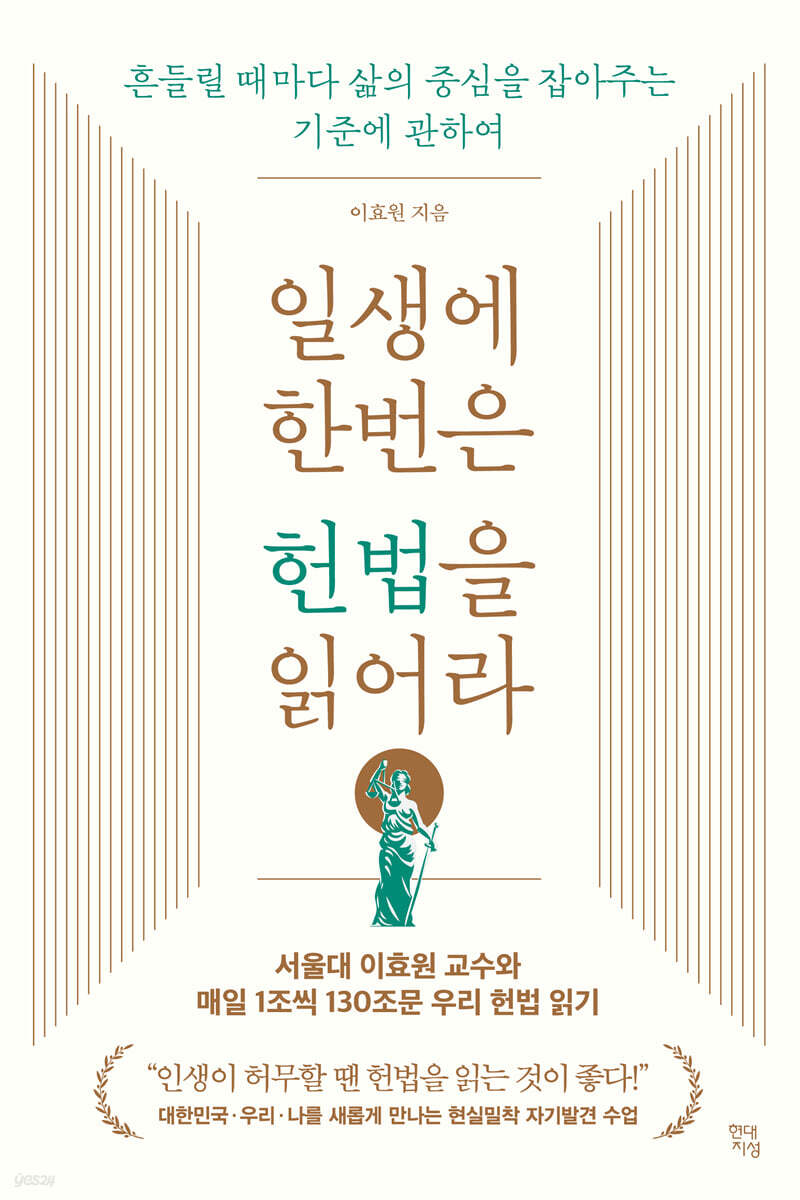
"When life feels empty, it's a good idea to read the Constitution."
Let's meet the Republic of Korea, us, and me anew
A realistic self-discovery class that reflects on one's attitude toward life.
★★★ Read all 130 articles of our Constitution, one article a day.
★★★ A constitutional user guide from a leading constitutional scholar in the Republic of Korea
Perhaps it was thanks to the strong shield called the 'Constitution' that you were able to return home peacefully and lie down in bed today.
Contrary to the heaviness and rigidity felt in the words ‘Constitution of the Republic of Korea,’ the Constitution is closely connected to our lives.
The freedom to live and move wherever you want, the right to freely choose your dream job, and even the privacy of private conversations and daily life with friends and lovers—more than you might think are protected and regulated by the Constitution.
The author of this book, Professor Lee Hyo-won of Seoul National University Law School, says that the Constitution is a transparent mirror of human life and strongly recommends that everyone read the Constitution at least once in their life.
By studying the Constitution, which is a concise set of rules that outline what kind of country the Republic of Korea should be and a foundation created for people with diverse ways of thinking and lifestyles to live together, I can reflect on what kind of person I should be and how I should live.
For those who struggle to find meaning in life while struggling to find meaning in life, wondering, "Why do I have to live like this?" on the subway on their way to work, "Read the Constitution Once in Your Life" will help them properly see the society and the nation, the specific reality of the "here and now," and discover "myself" within it, thereby allowing them to reflect on their attitude toward life.
Let's meet the Republic of Korea, us, and me anew
A realistic self-discovery class that reflects on one's attitude toward life.
★★★ Read all 130 articles of our Constitution, one article a day.
★★★ A constitutional user guide from a leading constitutional scholar in the Republic of Korea
Perhaps it was thanks to the strong shield called the 'Constitution' that you were able to return home peacefully and lie down in bed today.
Contrary to the heaviness and rigidity felt in the words ‘Constitution of the Republic of Korea,’ the Constitution is closely connected to our lives.
The freedom to live and move wherever you want, the right to freely choose your dream job, and even the privacy of private conversations and daily life with friends and lovers—more than you might think are protected and regulated by the Constitution.
The author of this book, Professor Lee Hyo-won of Seoul National University Law School, says that the Constitution is a transparent mirror of human life and strongly recommends that everyone read the Constitution at least once in their life.
By studying the Constitution, which is a concise set of rules that outline what kind of country the Republic of Korea should be and a foundation created for people with diverse ways of thinking and lifestyles to live together, I can reflect on what kind of person I should be and how I should live.
For those who struggle to find meaning in life while struggling to find meaning in life, wondering, "Why do I have to live like this?" on the subway on their way to work, "Read the Constitution Once in Your Life" will help them properly see the society and the nation, the specific reality of the "here and now," and discover "myself" within it, thereby allowing them to reflect on their attitude toward life.
- You can preview some of the book's contents.
Preview
index
Introduction: When life feels empty, it's a good idea to read the Constitution.
specialty
The birth of the Constitution in 1948 and the 9th amendment in 1987
Chapter 1 General Provisions
The future of the Republic of Korea as envisioned by the Constitution
Chapter 2 Rights and Obligations of Citizens
Liberty, Equality, Justice
Chapter 3 National Assembly
The power of discussion and persuasion to agree on rules
Chapter 4 Government
Why Leadership and Communication Skills Are Important
Chapter 5 Courts
So that no one is wronged
Chapter 6 Constitutional Court
No law shall be contrary to the supreme law.
Chapter 7 Election Management
How to wisely elect the right representative
Chapter 8 Local Autonomy
Laying the foundation for local autonomy in Korea
Chapter 9 Economy
Why economic order is stipulated in the Constitution
Chapter 10 Constitutional Amendment
The Constitution cannot be changed arbitrarily.
Supplementary provisions
Even if the law changes, the world goes on
specialty
The birth of the Constitution in 1948 and the 9th amendment in 1987
Chapter 1 General Provisions
The future of the Republic of Korea as envisioned by the Constitution
Chapter 2 Rights and Obligations of Citizens
Liberty, Equality, Justice
Chapter 3 National Assembly
The power of discussion and persuasion to agree on rules
Chapter 4 Government
Why Leadership and Communication Skills Are Important
Chapter 5 Courts
So that no one is wronged
Chapter 6 Constitutional Court
No law shall be contrary to the supreme law.
Chapter 7 Election Management
How to wisely elect the right representative
Chapter 8 Local Autonomy
Laying the foundation for local autonomy in Korea
Chapter 9 Economy
Why economic order is stipulated in the Constitution
Chapter 10 Constitutional Amendment
The Constitution cannot be changed arbitrarily.
Supplementary provisions
Even if the law changes, the world goes on
Detailed image

Into the book
As I studied the Constitution, I began to think about what meaning and direction each provision provided for my daily life.
The Constitution is a fundamental norm that summarizes the core values that present the future vision of the nation.
It is desirable that the study of the Constitution, the highest law of a country, develop into 'Phronesis', the wisdom of concrete practice, rather than 'Sophia', the abstract, theorized knowledge.
--- From "Introduction: When life feels meaningless, it's good to read the Constitution"
What does the nation mean to me? I don't exist for the nation; the nation exists for me.
I'm not sure if I need a country in my life.
However, humans, as social animals, live in an inseparable relationship with the state from the moment they are born.
In other words, our country is my mirror.
Just as the question, “Who am I?” is the beginning of existence, the question, “What is the Republic of Korea?” is a fundamental question about the identity of the national community to which I belong and a concern about my own existence.
--- From “Chapter 1 General Proposition: The Future of the Republic of Korea as Envisioned by the Constitution”
As communication methods diversify, the space for communication expands globally and information overflows.
When the amount of input information becomes too confusing, the output speech naturally becomes confusing.
So, to make my words clear, I decided to say everything to 'me', what I really wanted to say to my precious 'you', and what 'he' wanted to hear to everyone else.
--- From Chapter 2, Rights and Duties of the People: Freedom, Equality, and Justice
Just as it is difficult for the people to elect good members of the National Assembly, it is also difficult for members of the National Assembly to judge the will of the people and the national interest.
The world as perceived by humans always deceives them.
Even the people I elect cannot satisfy all my desires.
People desire others, desire to be desired by others, and desire what others desire.
Desire is the source of life force, and although it cannot be eradicated, we must not fall into its swamp.
We must always be careful of the 'desiring self'.
--- From "Chapter 3 National Assembly: The Power of Debate and Persuasion to Agree on Rules"
The moment we realize how little we know about someone we thought we knew, we gain insight into whether we know what we don't know or not.
Is knowledge truly power, or is it a disease? It depends on what you know, but for me, as I get older, there are more and more things that become a disease if you know them, and a cure if you don't.
I agree with the saying that the less wise a man is, the happier he is, and that to think is to go against nature.
--- From “Chapter 4 Government: Why Leadership and Communication Are Important”
There is also frequent criticism that the judiciary is becoming politicized.
This means that the court does not only decide on legal issues in trials, but also takes public opinion and political positions into account.
Judges have neither the authority nor the legitimacy to make political judgments in trials.
If the judiciary becomes politicized, its independence will be undermined and the public's trust will be lost.
Both the judicialization of politics and the politicization of the judiciary are undesirable, but the former is not dangerous as long as judicial independence is guaranteed.
However, the latter is much more dangerous as it can ruin the country.
--- From “Chapter 5 Courts: To Prevent Injustice”
As we live as humans, we all intuitively realize the futility of life.
I vaguely feel that even if I endure the pain today, it will be repeated tomorrow.
So, some people live in emptiness and helplessness, while others live their one and only life to the fullest.
Some people abandon the foolishness of this world and turn to religion with the hope of heaven or nirvana.
I try to accept the futility of life as it is and give it my own meaning and put it into practice.
--- From “Chapter 7 Election Management: How to Wisely Elect the Right Representative”
Our country attempted to establish local autonomy and local councils in the 1948 Constitution, but failed to implement it properly.
It was not until 1988 that the Local Autonomy Act was revised, and local autonomy began with the formation of local councils in 1991 and the election of local government heads in 1995.
However, due to the central government's heavy interference and inability to secure finances, various problems arose.
It seems that more time is needed before local autonomy is properly established.
--- From “Chapter 8 Local Autonomy: Laying the Foundation for Local Autonomy in the Republic of Korea”
According to the Buddha's teachings, "all things are impermanent" and "birth and death are not dual," then essence and end are not different, and I and all humans are merely parts of nature and the universe.
Humans evaluate the world and history from a humanistic perspective, but we also need to consider whether humans are truly the measure of all things.
In order for humans to live as dignified and valuable beings, humans should not be treated as mere purposeful beings.
--- From “Chapter 9 Economy: Reasons for Inscribing Economic Order in the Constitution”
Amending the Constitution is a gradual reform, as it is done in accordance with the provisions of the Constitution.
It also involves revolution, which seeks rapid and fundamental change.
Reforms, even when justified, tend to be violent because they bring about changes to the existing order.
Moreover, it is the fate of the reformer to not be able to enjoy the fruits of reform.
Because reform is completed and its results are revealed only when the subject of reform becomes the object of new reform and is liquidated.
--- From “Chapter 10 Constitutional Amendment: The Constitution cannot be arbitrarily changed”
The Constitution seeks legal stability through supplementary provisions.
Bylaws are a means of maintaining unity and continuity in the face of change.
Every being is born with its own unique laws, and changes every moment, constantly renewing itself.
In this way, ‘yesterday’s me’ and ‘tomorrow’s me’ live as beings that are the same as ‘today’s me’, yet different from each other.
You can't expect a new tomorrow by living the same way as yesterday.
We must change the historical present and create a new past.
The Constitution is a fundamental norm that summarizes the core values that present the future vision of the nation.
It is desirable that the study of the Constitution, the highest law of a country, develop into 'Phronesis', the wisdom of concrete practice, rather than 'Sophia', the abstract, theorized knowledge.
--- From "Introduction: When life feels meaningless, it's good to read the Constitution"
What does the nation mean to me? I don't exist for the nation; the nation exists for me.
I'm not sure if I need a country in my life.
However, humans, as social animals, live in an inseparable relationship with the state from the moment they are born.
In other words, our country is my mirror.
Just as the question, “Who am I?” is the beginning of existence, the question, “What is the Republic of Korea?” is a fundamental question about the identity of the national community to which I belong and a concern about my own existence.
--- From “Chapter 1 General Proposition: The Future of the Republic of Korea as Envisioned by the Constitution”
As communication methods diversify, the space for communication expands globally and information overflows.
When the amount of input information becomes too confusing, the output speech naturally becomes confusing.
So, to make my words clear, I decided to say everything to 'me', what I really wanted to say to my precious 'you', and what 'he' wanted to hear to everyone else.
--- From Chapter 2, Rights and Duties of the People: Freedom, Equality, and Justice
Just as it is difficult for the people to elect good members of the National Assembly, it is also difficult for members of the National Assembly to judge the will of the people and the national interest.
The world as perceived by humans always deceives them.
Even the people I elect cannot satisfy all my desires.
People desire others, desire to be desired by others, and desire what others desire.
Desire is the source of life force, and although it cannot be eradicated, we must not fall into its swamp.
We must always be careful of the 'desiring self'.
--- From "Chapter 3 National Assembly: The Power of Debate and Persuasion to Agree on Rules"
The moment we realize how little we know about someone we thought we knew, we gain insight into whether we know what we don't know or not.
Is knowledge truly power, or is it a disease? It depends on what you know, but for me, as I get older, there are more and more things that become a disease if you know them, and a cure if you don't.
I agree with the saying that the less wise a man is, the happier he is, and that to think is to go against nature.
--- From “Chapter 4 Government: Why Leadership and Communication Are Important”
There is also frequent criticism that the judiciary is becoming politicized.
This means that the court does not only decide on legal issues in trials, but also takes public opinion and political positions into account.
Judges have neither the authority nor the legitimacy to make political judgments in trials.
If the judiciary becomes politicized, its independence will be undermined and the public's trust will be lost.
Both the judicialization of politics and the politicization of the judiciary are undesirable, but the former is not dangerous as long as judicial independence is guaranteed.
However, the latter is much more dangerous as it can ruin the country.
--- From “Chapter 5 Courts: To Prevent Injustice”
As we live as humans, we all intuitively realize the futility of life.
I vaguely feel that even if I endure the pain today, it will be repeated tomorrow.
So, some people live in emptiness and helplessness, while others live their one and only life to the fullest.
Some people abandon the foolishness of this world and turn to religion with the hope of heaven or nirvana.
I try to accept the futility of life as it is and give it my own meaning and put it into practice.
--- From “Chapter 7 Election Management: How to Wisely Elect the Right Representative”
Our country attempted to establish local autonomy and local councils in the 1948 Constitution, but failed to implement it properly.
It was not until 1988 that the Local Autonomy Act was revised, and local autonomy began with the formation of local councils in 1991 and the election of local government heads in 1995.
However, due to the central government's heavy interference and inability to secure finances, various problems arose.
It seems that more time is needed before local autonomy is properly established.
--- From “Chapter 8 Local Autonomy: Laying the Foundation for Local Autonomy in the Republic of Korea”
According to the Buddha's teachings, "all things are impermanent" and "birth and death are not dual," then essence and end are not different, and I and all humans are merely parts of nature and the universe.
Humans evaluate the world and history from a humanistic perspective, but we also need to consider whether humans are truly the measure of all things.
In order for humans to live as dignified and valuable beings, humans should not be treated as mere purposeful beings.
--- From “Chapter 9 Economy: Reasons for Inscribing Economic Order in the Constitution”
Amending the Constitution is a gradual reform, as it is done in accordance with the provisions of the Constitution.
It also involves revolution, which seeks rapid and fundamental change.
Reforms, even when justified, tend to be violent because they bring about changes to the existing order.
Moreover, it is the fate of the reformer to not be able to enjoy the fruits of reform.
Because reform is completed and its results are revealed only when the subject of reform becomes the object of new reform and is liquidated.
--- From “Chapter 10 Constitutional Amendment: The Constitution cannot be arbitrarily changed”
The Constitution seeks legal stability through supplementary provisions.
Bylaws are a means of maintaining unity and continuity in the face of change.
Every being is born with its own unique laws, and changes every moment, constantly renewing itself.
In this way, ‘yesterday’s me’ and ‘tomorrow’s me’ live as beings that are the same as ‘today’s me’, yet different from each other.
You can't expect a new tomorrow by living the same way as yesterday.
We must change the historical present and create a new past.
--- From "Supplementary Provisions: The World Goes On Even When the Law Changes"
Publisher's Review
A dignified response to the question, “How should we live?”
Reading the Constitution reveals an intelligent and wise attitude toward life.
Professor Lee Hyo-won, a leading constitutional scholar in South Korea who spent 13 years as a prosecutor researching and planning legal systems and formulating policies in the legal profession and then taught law as a professor at Seoul National University, has published “Read the Constitution Once in Your Life.”
This book is a "Constitutional User Manual for My Life," which examines the 130 articles of the Constitution of the Republic of Korea, from the preamble to the supplementary provisions, in depth and connects the legal meaning contained therein to the values of life.
To date, countless books have been published that link law and society.
There were books that addressed social issues that arose from the changing times and emphasized the need for new laws, while others harshly criticized the loopholes in old laws by drawing attention to the gap between case law and reality.
However, this is the first book that breaks down each provision of the Constitution, explaining it in an easy-to-understand way for readers, and expanding upon it to discover a life attitude and philosophy.
At least once in my life, I wonder about the constitution that surrounds my life.
You can easily find the Constitution of the Republic of Korea by accessing the National Law Information Center on a portal site, but unless you are a law student, it is by no means easy to properly understand the meaning contained between the lines simply by reading the articles.
Moreover, the first article of the Constitution, the 'Preamble', contains a vast amount of content exceeding 300 characters in a single sentence, which can be overwhelming to first-time readers.
The author guides readers into the world of the Constitution by explaining the meaning and background of each provision in clear and concise language.
If you ponder the meaning and direction of each clause in daily life presented by the author, you will naturally obtain answers to the questions, “How should I live?” and “At the very least, what kind of person should I become?”
To you who find meaning in life even on the subway on your way to work
Here and Now, the Constitution's User Manual for Finding My Happiness
The author, after studying the Constitution for a long time, came to the conclusion that understanding the Constitution should not stop at 'Sophia', an abstract theory, but should develop into 'Phronesis', a concrete practical wisdom.
In other words, rather than interpreting the Constitution limited to the rule of law or norms, the proposal is to apply its meaning to daily life and use it as a guide for value judgment and direction setting.
For example, Article 16 of the Constitution deals with ‘freedom of residence.’
Rather than explaining the meaning and concept of the phrase, “All citizens shall not be deprived of their freedom of residence,” he goes a step further and says, “For an individual to freely choose and decide on their residence is like building their own castle.”
We all say that we become truly ourselves only when we are in our own intimate space, and just as a crowded subway car on the way to work can become our own personal space, we have the insight that the meaning of space can be created by ourselves, no matter where it is.
Article 64 of the Constitution deals with the internal discipline of the National Assembly. Here, too, the author does not simply explain the scope and effect of the discipline, but expands the scope of the concept of "autonomy."
“Autonomy is the right to regulate oneself according to one’s own rules without being governed by others,” he says, prompting readers to reflect on whether the decisions they believed they had made autonomously might have been the result of a hasty error of self-confidence.
The 'otherized decision' that unquestioningly accepts the values of the world and the standards set by others reminds us that it is not true autonomy.
Additionally, Article 82 of the Constitution deals with the power of the Prime Minister and State Council members to counteract the President's acts.
The department refers to the Prime Minister and State Council members sharing responsibility for all of the President's legal acts and signing to control the procedures.
Here, too, we do not simply mention the department as a national institution, but also reflect on the meaning of records, writing, and reading.
I am impressed by the author's insight, who describes his reading method as "three readings" and likens it to "a screw that circles around in place but goes deeper" and thus becomes a different person through reading.
The structure of this book is such that even ordinary people can easily approach the Constitution, with the Constitutional provisions on one page and the author's writing on the next page.
If you read one article a day, the author's essays that draw meaning from each constitutional provision, you will naturally realize that the Constitution is not just a difficult and strict legal code, but a deeply realistic and valuable text that serves as a reference for our lives.
“The power that makes me who I am lies in the Constitution!”
"Rediscovering the Constitution": A Guide to Moving Forward
The greatest gift we can gain from reading the Constitution is the courage to move forward into tomorrow.
In the preface, the author states, “Just as everything can begin from nothing, I believe that through the Constitution, I and my country can be reborn anew.”
Sometimes, we may feel overwhelmed by the power we are given, and our lives may feel empty as we are consumed by the responsibilities we are given. However, just as we must hit rock bottom to start over, we can rediscover the meaning of life through the Constitution, the foundation of the Republic of Korea.
In particular, the article that the author, who has studied the Constitution for over 30 years, values the most is Article 10.
This clause, which begins with “All citizens have dignity and worth as human beings and the right to pursue happiness,” is a core clause that guides the entire Constitution.
What is noteworthy here is that it is described as the “right to pursue happiness” rather than the “right to be happy.”
Why does the Constitution guarantee only the "right to pursue happiness" and not the "right to be happy"? This implies that if the state determines the nature of happiness and unilaterally guarantees it, it could actually make individuals unhappy.
Because happiness does not exist as an ideal that is the same for everyone.
What does your happiness look like? What are you doing now to find it? Every being is born with its own unique laws, and every moment changes, constantly renewing itself.
Just as the Constitution must change the historical present and create a new past through amendments and supplementary provisions, happiness will come quickly when we break free from the daily routine of yesterday and create a new tomorrow.
Reading the Constitution reveals an intelligent and wise attitude toward life.
Professor Lee Hyo-won, a leading constitutional scholar in South Korea who spent 13 years as a prosecutor researching and planning legal systems and formulating policies in the legal profession and then taught law as a professor at Seoul National University, has published “Read the Constitution Once in Your Life.”
This book is a "Constitutional User Manual for My Life," which examines the 130 articles of the Constitution of the Republic of Korea, from the preamble to the supplementary provisions, in depth and connects the legal meaning contained therein to the values of life.
To date, countless books have been published that link law and society.
There were books that addressed social issues that arose from the changing times and emphasized the need for new laws, while others harshly criticized the loopholes in old laws by drawing attention to the gap between case law and reality.
However, this is the first book that breaks down each provision of the Constitution, explaining it in an easy-to-understand way for readers, and expanding upon it to discover a life attitude and philosophy.
At least once in my life, I wonder about the constitution that surrounds my life.
You can easily find the Constitution of the Republic of Korea by accessing the National Law Information Center on a portal site, but unless you are a law student, it is by no means easy to properly understand the meaning contained between the lines simply by reading the articles.
Moreover, the first article of the Constitution, the 'Preamble', contains a vast amount of content exceeding 300 characters in a single sentence, which can be overwhelming to first-time readers.
The author guides readers into the world of the Constitution by explaining the meaning and background of each provision in clear and concise language.
If you ponder the meaning and direction of each clause in daily life presented by the author, you will naturally obtain answers to the questions, “How should I live?” and “At the very least, what kind of person should I become?”
To you who find meaning in life even on the subway on your way to work
Here and Now, the Constitution's User Manual for Finding My Happiness
The author, after studying the Constitution for a long time, came to the conclusion that understanding the Constitution should not stop at 'Sophia', an abstract theory, but should develop into 'Phronesis', a concrete practical wisdom.
In other words, rather than interpreting the Constitution limited to the rule of law or norms, the proposal is to apply its meaning to daily life and use it as a guide for value judgment and direction setting.
For example, Article 16 of the Constitution deals with ‘freedom of residence.’
Rather than explaining the meaning and concept of the phrase, “All citizens shall not be deprived of their freedom of residence,” he goes a step further and says, “For an individual to freely choose and decide on their residence is like building their own castle.”
We all say that we become truly ourselves only when we are in our own intimate space, and just as a crowded subway car on the way to work can become our own personal space, we have the insight that the meaning of space can be created by ourselves, no matter where it is.
Article 64 of the Constitution deals with the internal discipline of the National Assembly. Here, too, the author does not simply explain the scope and effect of the discipline, but expands the scope of the concept of "autonomy."
“Autonomy is the right to regulate oneself according to one’s own rules without being governed by others,” he says, prompting readers to reflect on whether the decisions they believed they had made autonomously might have been the result of a hasty error of self-confidence.
The 'otherized decision' that unquestioningly accepts the values of the world and the standards set by others reminds us that it is not true autonomy.
Additionally, Article 82 of the Constitution deals with the power of the Prime Minister and State Council members to counteract the President's acts.
The department refers to the Prime Minister and State Council members sharing responsibility for all of the President's legal acts and signing to control the procedures.
Here, too, we do not simply mention the department as a national institution, but also reflect on the meaning of records, writing, and reading.
I am impressed by the author's insight, who describes his reading method as "three readings" and likens it to "a screw that circles around in place but goes deeper" and thus becomes a different person through reading.
The structure of this book is such that even ordinary people can easily approach the Constitution, with the Constitutional provisions on one page and the author's writing on the next page.
If you read one article a day, the author's essays that draw meaning from each constitutional provision, you will naturally realize that the Constitution is not just a difficult and strict legal code, but a deeply realistic and valuable text that serves as a reference for our lives.
“The power that makes me who I am lies in the Constitution!”
"Rediscovering the Constitution": A Guide to Moving Forward
The greatest gift we can gain from reading the Constitution is the courage to move forward into tomorrow.
In the preface, the author states, “Just as everything can begin from nothing, I believe that through the Constitution, I and my country can be reborn anew.”
Sometimes, we may feel overwhelmed by the power we are given, and our lives may feel empty as we are consumed by the responsibilities we are given. However, just as we must hit rock bottom to start over, we can rediscover the meaning of life through the Constitution, the foundation of the Republic of Korea.
In particular, the article that the author, who has studied the Constitution for over 30 years, values the most is Article 10.
This clause, which begins with “All citizens have dignity and worth as human beings and the right to pursue happiness,” is a core clause that guides the entire Constitution.
What is noteworthy here is that it is described as the “right to pursue happiness” rather than the “right to be happy.”
Why does the Constitution guarantee only the "right to pursue happiness" and not the "right to be happy"? This implies that if the state determines the nature of happiness and unilaterally guarantees it, it could actually make individuals unhappy.
Because happiness does not exist as an ideal that is the same for everyone.
What does your happiness look like? What are you doing now to find it? Every being is born with its own unique laws, and every moment changes, constantly renewing itself.
Just as the Constitution must change the historical present and create a new past through amendments and supplementary provisions, happiness will come quickly when we break free from the daily routine of yesterday and create a new tomorrow.
GOODS SPECIFICS
- Date of issue: August 5, 2024
- Page count, weight, size: 328 pages | 496g | 150*225*20mm
- ISBN13: 9791139717013
- ISBN10: 1139717014
You may also like
카테고리
korean


korean

![GQ KOREA Mark (Monthly): December [2025]](http://librairie.coreenne.fr/cdn/shop/files/8ef265dbbfbf186523ed75ba7319009d.jpg?v=1765340328&width=3840)


