

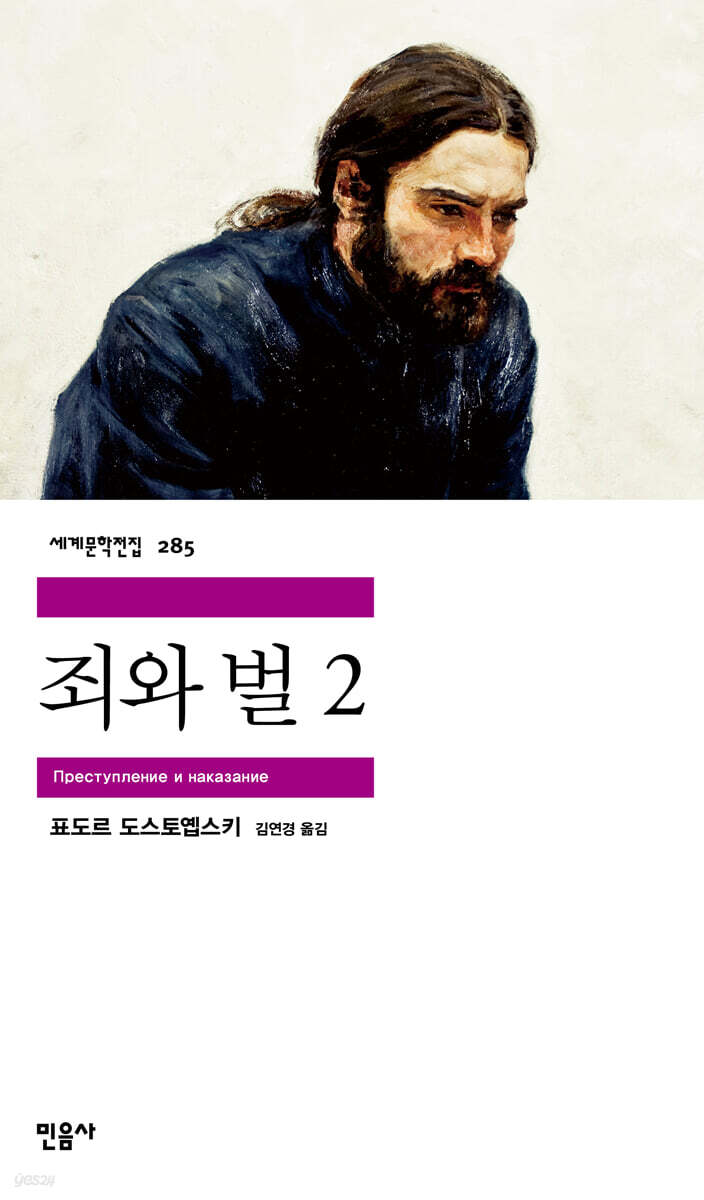
Crime and Punishment 2
 |
Description
Book Introduction
A masterpiece published by the great Russian author Dostoevsky after eight years of exile A novel that became an 'event' in 20th-century literature, philosophy, and psychology by creating 'Raskolnikov', the archetype of an autistic man and tormented youth who sinks into the madness of reason. The two-volume Crime and Punishment by the great Russian author Fyodor Dostoevsky has been published in Minumsa's World Literature Collection. Crime and Punishment is Dostoevsky's second work published after eight years of exile following his death sentence. The new 'character types' and novel techniques that sprouted from the previous work, 'Notes from the Underground', are fully blossomed in this novel, and the deepest hidden psychology of human beings is thoroughly unearthed. As the author himself stated, “Crime and Punishment” is “a psychological report on crime,” and various perceptions of sin and atonement are in intense conflict and intersect. This novel marked the peak of Dostoevsky's maturity as a writer, and also inspired Joyce, Hemingway, Gorky, Virginia Woolf, Thomas Mann, Henry Miller, and D. It was a great inspiration to great writers including H. Lawrence. |
- You can preview some of the book's contents.
Preview
Into the book
“In the end, you did the same thing, didn’t you? Because you too overcame it… because you were able to overcome it.
You've basically committed suicide, you've ruined your life... your own life. (It's all the same!) You could have lived with a clear mind and reason, but you'll end up in Sennaya Square...
But you won't be able to bear it, and if you're left alone, you'll go crazy like me.
You still seem like a crazy woman.
So we must go together, on the same path! Let's go!”
You've basically committed suicide, you've ruined your life... your own life. (It's all the same!) You could have lived with a clear mind and reason, but you'll end up in Sennaya Square...
But you won't be able to bear it, and if you're left alone, you'll go crazy like me.
You still seem like a crazy woman.
So we must go together, on the same path! Let's go!”
--- From the text
Publisher's Review
The birth of Raskolnikov, a lonely cry to the world and a symbol of the anguish and conflict of youth.
“I just killed a louse, a useless, dirty, harmful louse.”
Crime and Punishment is set in St. Petersburg in the late 1860s, in the sweltering heat of early July.
The protagonist, Raskolnikov, is 23 years old and was a law student, but had to drop out due to financial difficulties.
His mother and sister support him in their small hometown, desperately hoping that he will become successful and make a name for himself in the family.
But after dropping out of school, Raskolnikov locks himself in a room that resembles a 'coffin' and devises his own perfect plan, which he puts into action one evening.
He killed the old pawnbroker and her half-sister Lizaveta with an axe.
After returning home, he collapses and suffers from a fever for several days.
A perfect crime that goes unnoticed by anyone, but the examining magistrate Porfiry, despite the lack of concrete evidence, sees through Raskolnikov's mind and pressures him.
“I just killed a lice, a useless, dirty, and harmful lice,” he claims, but in his mind, which was filled with only reason and ideas, an unexpected anxiety begins to sprout little by little.
He becomes increasingly confused as he meets Sonya, who sells her body to feed her family, but is more 'pure' than anyone else.
Sonya lives with her remarried father Marmeladov, her stepmother Katerina, and her three children.
Marmeladov is an unemployed official who sells his wife's socks to drink, and Katerina suffers from a serious lung disease.
Eighteen-year-old Sonya sells her body after being told by Katerina, "What are you so fond of? What kind of treasure is that?" and uses the money she earns to support her family.
After asking Sonya to read the Bible, Raskolnikov confesses to the murder for the first time, and only to her.
“In the end, you did the same thing, didn’t you? Because you too overcame it… because you were able to overcome it.
You've basically committed suicide, you've ruined your life... your own life. (It's all the same!) You could have lived with a clear mind and reason, but you'll end up in Sennaya Square...
But you won't be able to bear it, and if you're left alone, you'll go crazy like me.
You still seem like a crazy woman.
So we must go together, on the same path! Let's go!" (from the text)
A monumental work that completes the novel with the thoughts and philosophy that changed after the death sentence, prison life, and exile.
―“Life has replaced dialectics.”
Dostoevsky was sentenced to death at the age of 28 for reading Belinsky's letter to Gogol at the 'Petrashevsky gathering'.
The execution was dramatically overturned, but he spent four years in prison and another four years serving in Siberia.
The only book he was allowed to read while in prison was the Bible.
After this period, when he became a free man, Dostoevsky had become a true ultra-right conservative (Slavism).
Additionally, the issues of God and salvation, which were rarely found in his early works, appear as topics of discussion in his later works.
"Crime and Punishment" is the second work he published after becoming free.
While his previous work, Notes from the Underground, was closer to a relatively short novella, Crime and Punishment is a masterpiece that marks the peak of Dostoyev's literary world.
Moreover, while Notes from the Underground presented a new character type and narrative development method, and was an aesthetic and poetic experiment, in Crime and Punishment, the novel technique blossoms, and the deepest hidden psychology of human beings is thoroughly explored.
Translator Kim Yeon-kyung commented, “When looking at Dostoevsky’s life as a writer, if Notes from Underground (1864) shows the moment of metamorphosis and shedding of the shell, then Crime and Punishment (1866) is the first novel that reveals the true nature of what came after that.”
The work consists of six parts and an epilogue. In the first part, Raskolnikov commits murder, and the rest of the story reveals why he committed such a crime.
In particular, Raskolnikov himself is depicted as struggling and struggling with his own motives for the crime more than anyone else.
He said, “I didn’t kill a man, I killed a principle!” “So I wanted to be Napoleon, and that’s why I killed people…” “Did I really kill the old woman? I killed myself, not the old woman!” “I just killed her.
He keeps repeating, “I killed for myself, for myself alone,” and he never really repents for his crimes until the very end.
The reason he is suffering is because his theory was flawed, he made a mistake in judgment, he did it.
This “noble murderer” Raskolnikov meets the “holy prostitute” Sonya and makes a confession that is close to confession.
She brings him a 'life' he never had, a life that is not a 'theory'.
Until the last chapter of the novel, he has not (or does not) open the Bible, and it is unclear whether he has attained atonement or salvation for his sins.
However, if 『Crime and Punishment』 is “a record of the ‘disillusionment and frustration’ experienced by a young man,” then after the novel ends, the two young men, Raskolnikov and Sonya, will have a ‘life’ that goes beyond disillusionment and frustration.
What makes 『Crime and Punishment』 so appealing is the tension between the specific 'line' (or 'wall') set by the characters or the author themselves and the will to overcome it.
The author left a note saying, “Svidrigailov (despair), the most cynical Sonya (hope), the most unrealizable” (Author’s Note to Crime and Punishment).
Raskolnikov's dreams and disillusionment are beautiful because of the tight tension between these two extremes.
The same goes for the epilogues that are added like a dull appendix to a powerful novel and the sequels that are never written.
The will to overcome the "madness of reason," which can be called the delusion of modernity, with "spirituality" is the invisible driving force that drives Dostoevsky's novels. (From "Commentary on the Work")
Rereading Dostoevsky with a younger, more sensuous, and more accurate translation
Kim Yeon-kyung, the translator of this book, is a young scholar who received her doctorate in Dostoevsky studies from Seoul National University and Moscow State Pedagogical University.
He is also a novelist who debuted at the age of 21 and published works such as the short story collections 『A Novel of Cats, by Cats, for Cats』 and 『Everything About My Wife』, and the full-length novel 『The Double Life of a Cat』.
As a young scholar and novelist, Kim Yeon-kyung sensationally translated Crime and Punishment, following The Brothers Karamazov and Notes from the Underground.
In particular, this translation redefined the concept of 'superhuman thought', which had previously referred to Raskolnikov's thought.
This was the term Raskolnikov used to describe the logic that justified his crimes.
However, Kim Yeon-kyung said, “Neither ‘superhuman’ nor ‘superhuman thought’ are words mentioned in ‘Crime and Punishment.’
The idea of the 'extraordinary man' is also a coined term based on the concept used by Porfiry and Raskolnikov in their discussion of the latter's treatise 'On Crime'.
(Omitted) The original word itself is extremely ordinary, and Raskolnikov's thoughts are also ordinary to the point of being trite; this is precisely the core of his despair." As a result of this consideration, the Russian words translated as 'ordinary person' and 'extraordinary person' in the existing Korean translation were translated as 'ordinary person(s)' and 'extraordinary person(s)', respectively.
It is the result of deep consideration and reflection on the author's intentions and the characters' thoughts.
We also corrected errors that were commonly mistranslated in the past.
Dostoevsky cited Solon, an Athenian politician and poet, along with Napoleon, Muhammad, and Lycurgus, as examples of 'extraordinary people', but existing translations have often mistakenly translated him as 'Solomon'.
We also attempted to change several terms that had been used in Japanese to suit our circumstances.
For example, one of the administrative divisions of Russia in the 19th century was translated as 'county' according to the custom of referring to the Japanese translation, but this was changed to 'province'.
Also, the 'dark flax-colored hair' that completed Raskolnikov's image was changed from 'flax color' to 'yellow-brown' to make it easier to understand.
“I just killed a louse, a useless, dirty, harmful louse.”
Crime and Punishment is set in St. Petersburg in the late 1860s, in the sweltering heat of early July.
The protagonist, Raskolnikov, is 23 years old and was a law student, but had to drop out due to financial difficulties.
His mother and sister support him in their small hometown, desperately hoping that he will become successful and make a name for himself in the family.
But after dropping out of school, Raskolnikov locks himself in a room that resembles a 'coffin' and devises his own perfect plan, which he puts into action one evening.
He killed the old pawnbroker and her half-sister Lizaveta with an axe.
After returning home, he collapses and suffers from a fever for several days.
A perfect crime that goes unnoticed by anyone, but the examining magistrate Porfiry, despite the lack of concrete evidence, sees through Raskolnikov's mind and pressures him.
“I just killed a lice, a useless, dirty, and harmful lice,” he claims, but in his mind, which was filled with only reason and ideas, an unexpected anxiety begins to sprout little by little.
He becomes increasingly confused as he meets Sonya, who sells her body to feed her family, but is more 'pure' than anyone else.
Sonya lives with her remarried father Marmeladov, her stepmother Katerina, and her three children.
Marmeladov is an unemployed official who sells his wife's socks to drink, and Katerina suffers from a serious lung disease.
Eighteen-year-old Sonya sells her body after being told by Katerina, "What are you so fond of? What kind of treasure is that?" and uses the money she earns to support her family.
After asking Sonya to read the Bible, Raskolnikov confesses to the murder for the first time, and only to her.
“In the end, you did the same thing, didn’t you? Because you too overcame it… because you were able to overcome it.
You've basically committed suicide, you've ruined your life... your own life. (It's all the same!) You could have lived with a clear mind and reason, but you'll end up in Sennaya Square...
But you won't be able to bear it, and if you're left alone, you'll go crazy like me.
You still seem like a crazy woman.
So we must go together, on the same path! Let's go!" (from the text)
A monumental work that completes the novel with the thoughts and philosophy that changed after the death sentence, prison life, and exile.
―“Life has replaced dialectics.”
Dostoevsky was sentenced to death at the age of 28 for reading Belinsky's letter to Gogol at the 'Petrashevsky gathering'.
The execution was dramatically overturned, but he spent four years in prison and another four years serving in Siberia.
The only book he was allowed to read while in prison was the Bible.
After this period, when he became a free man, Dostoevsky had become a true ultra-right conservative (Slavism).
Additionally, the issues of God and salvation, which were rarely found in his early works, appear as topics of discussion in his later works.
"Crime and Punishment" is the second work he published after becoming free.
While his previous work, Notes from the Underground, was closer to a relatively short novella, Crime and Punishment is a masterpiece that marks the peak of Dostoyev's literary world.
Moreover, while Notes from the Underground presented a new character type and narrative development method, and was an aesthetic and poetic experiment, in Crime and Punishment, the novel technique blossoms, and the deepest hidden psychology of human beings is thoroughly explored.
Translator Kim Yeon-kyung commented, “When looking at Dostoevsky’s life as a writer, if Notes from Underground (1864) shows the moment of metamorphosis and shedding of the shell, then Crime and Punishment (1866) is the first novel that reveals the true nature of what came after that.”
The work consists of six parts and an epilogue. In the first part, Raskolnikov commits murder, and the rest of the story reveals why he committed such a crime.
In particular, Raskolnikov himself is depicted as struggling and struggling with his own motives for the crime more than anyone else.
He said, “I didn’t kill a man, I killed a principle!” “So I wanted to be Napoleon, and that’s why I killed people…” “Did I really kill the old woman? I killed myself, not the old woman!” “I just killed her.
He keeps repeating, “I killed for myself, for myself alone,” and he never really repents for his crimes until the very end.
The reason he is suffering is because his theory was flawed, he made a mistake in judgment, he did it.
This “noble murderer” Raskolnikov meets the “holy prostitute” Sonya and makes a confession that is close to confession.
She brings him a 'life' he never had, a life that is not a 'theory'.
Until the last chapter of the novel, he has not (or does not) open the Bible, and it is unclear whether he has attained atonement or salvation for his sins.
However, if 『Crime and Punishment』 is “a record of the ‘disillusionment and frustration’ experienced by a young man,” then after the novel ends, the two young men, Raskolnikov and Sonya, will have a ‘life’ that goes beyond disillusionment and frustration.
What makes 『Crime and Punishment』 so appealing is the tension between the specific 'line' (or 'wall') set by the characters or the author themselves and the will to overcome it.
The author left a note saying, “Svidrigailov (despair), the most cynical Sonya (hope), the most unrealizable” (Author’s Note to Crime and Punishment).
Raskolnikov's dreams and disillusionment are beautiful because of the tight tension between these two extremes.
The same goes for the epilogues that are added like a dull appendix to a powerful novel and the sequels that are never written.
The will to overcome the "madness of reason," which can be called the delusion of modernity, with "spirituality" is the invisible driving force that drives Dostoevsky's novels. (From "Commentary on the Work")
Rereading Dostoevsky with a younger, more sensuous, and more accurate translation
Kim Yeon-kyung, the translator of this book, is a young scholar who received her doctorate in Dostoevsky studies from Seoul National University and Moscow State Pedagogical University.
He is also a novelist who debuted at the age of 21 and published works such as the short story collections 『A Novel of Cats, by Cats, for Cats』 and 『Everything About My Wife』, and the full-length novel 『The Double Life of a Cat』.
As a young scholar and novelist, Kim Yeon-kyung sensationally translated Crime and Punishment, following The Brothers Karamazov and Notes from the Underground.
In particular, this translation redefined the concept of 'superhuman thought', which had previously referred to Raskolnikov's thought.
This was the term Raskolnikov used to describe the logic that justified his crimes.
However, Kim Yeon-kyung said, “Neither ‘superhuman’ nor ‘superhuman thought’ are words mentioned in ‘Crime and Punishment.’
The idea of the 'extraordinary man' is also a coined term based on the concept used by Porfiry and Raskolnikov in their discussion of the latter's treatise 'On Crime'.
(Omitted) The original word itself is extremely ordinary, and Raskolnikov's thoughts are also ordinary to the point of being trite; this is precisely the core of his despair." As a result of this consideration, the Russian words translated as 'ordinary person' and 'extraordinary person' in the existing Korean translation were translated as 'ordinary person(s)' and 'extraordinary person(s)', respectively.
It is the result of deep consideration and reflection on the author's intentions and the characters' thoughts.
We also corrected errors that were commonly mistranslated in the past.
Dostoevsky cited Solon, an Athenian politician and poet, along with Napoleon, Muhammad, and Lycurgus, as examples of 'extraordinary people', but existing translations have often mistakenly translated him as 'Solomon'.
We also attempted to change several terms that had been used in Japanese to suit our circumstances.
For example, one of the administrative divisions of Russia in the 19th century was translated as 'county' according to the custom of referring to the Japanese translation, but this was changed to 'province'.
Also, the 'dark flax-colored hair' that completed Raskolnikov's image was changed from 'flax color' to 'yellow-brown' to make it easier to understand.
GOODS SPECIFICS
- Date of issue: March 30, 2012
- Page count, weight, size: 526 pages | 616g | 130*200*35mm
- ISBN13: 9788937462856
- ISBN10: 8937462850
You may also like
카테고리
korean


korean

![ELLE 엘르 스페셜 에디션 A형 : 12월 [2025]](http://librairie.coreenne.fr/cdn/shop/files/b8e27a3de6c9538896439686c6b0e8fb.jpg?v=1766436872&width=3840)


