

Studying the fatherland
 |
Description
Book Introduction
The Power to Cultivate Hope and Optimism in Times of Despair and Pessimism
Reading the deep inner self of the fatherland now
Former President Moon Jae-in recommends author Jo Jeong-rae!
A book about the wounded intellect of our time, the essence of our nation's intellectual origins and philosophical reflection! It's about studying for self-respect and happiness, and politics for coexistence and solidarity.
Even amidst personal trials and tribulations, he confronts the contradictions of the Republic of Korea and presents a comprehensive insight that maintains positivity and optimism.
It shows a courageous confession written with one's whole body, holding a fountain pen in the lowest and darkest place.
It tells us that we can grow as individuals and as a nation through a dialogue with ourselves, quietly looking within and carefully reflecting on “what flaws we have as humans, whether we have any shortcomings or excesses, whether we are caught up in arrogance or prejudice.”
"The Study of the Fatherland" centers on the question, "What and how should we study in times of crisis?" and is based on three conversations between Cho Kuk and Jeong Yeo-ul over the past 16 years, as well as letters written by Cho Kuk between December 2024 and June 2025.
The four parts, “Growing Study,” “Participatory Study,” “Living Study,” and “Healing Study,” contain three-dimensional and multi-layered thoughts on “study that protects my dignity and changes the world.”
Where should South Korea go?
How to heal the scars of the past and look to the future.
What enriches life?
Regarding this question, we reflect and explore “history interwoven with success and failure, advance and retreat, faith and betrayal,” crossing over literature and law, social science and humanities, prisons and public squares.
“I was locked up, but I read, wrote, thought, and reflected.
Politician Cho Kuk refined and condensed his thoughts and vision.
Beyond the end of the civil war, we envisioned the institutionalization of coexistence, solidarity, and happiness.
Before becoming a politician, he honestly revealed the suffering and aspirations of a human being's country.
Although I have been deprived of many things and am at the lowest level, I maintain my self-esteem and happiness through studying.
“I am enduring trials and tribulations, and developing the power of positivity and optimism.” (From a letter to a reader, Cho Kuk)
Reading the deep inner self of the fatherland now
Former President Moon Jae-in recommends author Jo Jeong-rae!
A book about the wounded intellect of our time, the essence of our nation's intellectual origins and philosophical reflection! It's about studying for self-respect and happiness, and politics for coexistence and solidarity.
Even amidst personal trials and tribulations, he confronts the contradictions of the Republic of Korea and presents a comprehensive insight that maintains positivity and optimism.
It shows a courageous confession written with one's whole body, holding a fountain pen in the lowest and darkest place.
It tells us that we can grow as individuals and as a nation through a dialogue with ourselves, quietly looking within and carefully reflecting on “what flaws we have as humans, whether we have any shortcomings or excesses, whether we are caught up in arrogance or prejudice.”
"The Study of the Fatherland" centers on the question, "What and how should we study in times of crisis?" and is based on three conversations between Cho Kuk and Jeong Yeo-ul over the past 16 years, as well as letters written by Cho Kuk between December 2024 and June 2025.
The four parts, “Growing Study,” “Participatory Study,” “Living Study,” and “Healing Study,” contain three-dimensional and multi-layered thoughts on “study that protects my dignity and changes the world.”
Where should South Korea go?
How to heal the scars of the past and look to the future.
What enriches life?
Regarding this question, we reflect and explore “history interwoven with success and failure, advance and retreat, faith and betrayal,” crossing over literature and law, social science and humanities, prisons and public squares.
“I was locked up, but I read, wrote, thought, and reflected.
Politician Cho Kuk refined and condensed his thoughts and vision.
Beyond the end of the civil war, we envisioned the institutionalization of coexistence, solidarity, and happiness.
Before becoming a politician, he honestly revealed the suffering and aspirations of a human being's country.
Although I have been deprived of many things and am at the lowest level, I maintain my self-esteem and happiness through studying.
“I am enduring trials and tribulations, and developing the power of positivity and optimism.” (From a letter to a reader, Cho Kuk)
- You can preview some of the book's contents.
Preview
index
Opening Remarks: Studying for Self-Respect and Happiness, Politics for Coexistence and Solidarity—Cho Kuk
Opening Remarks: What Are You Afraid of? - Jeong Yeo-ul
1 Growing study
Heart: The heart that makes you a warrior in times of crisis
The courage that transformed him from a scholar to a warrior
I've always had literature
Les Misérables: The Courage to Overcome Difficult Times
Taebaek Mountains: A Spirit of Protecting People from Ideological Conflict
The way to regain lost self-esteem
The art of mind care
Cho's orphan and 'no right to sue'
Towards those who collect and purge their opponents
Singing "Arirang Alone" and Realizing You're Not Alone
Reading: To find an axe to break the dull life
A boy who loved studying Chinese characters
Closed-door reading, a time to close the door and immerse yourself in a book
"The Boy Comes": The Courage of Humans Facing Trauma
Literacy, the power to think for oneself
Women's Copies of the Constitution: A First in Our Constitutional History
Daily life of reading and sharing books
Reading that changes your destiny
Learning: A communal study that considers everything from oneself to nature.
What is community learning?
Education reform to prevent endless cutthroat competition
From a power elite to a symbiotic elite
Medical school and law school
Studying to find alternatives
Philosophizing through Film
Studying that protects my dignity is not lonely.
2 Participatory study
Yeon (連): The struggle and solidarity for a lost Korea to find its way again.
Koreans' political and social DNA
The beautiful miracle created by the revolution of light
What happens when you are loyal only to yourself
Cut the sorrow with a knife that sticks out in your chest
Dichotomous view of international relations
The essence hidden in numerical calculations
Defendant Yoon Seok-yeol is dismissed.
The Power of K-Democracy
The disgrace of K-elite
Fire back
Search and seizure
The interpretation of the legal elite and the people's right to choose
A time for dialogue, compromise, and firmness.
Where are we going
People: When politics with good intentions develops democracy
The most beautiful scenery I've seen since I was born
What kind of ideology are you?
crowd, mob, crowd
Decentralization Constitutional Amendment
The weak and welfare
Political, economic, and social democratization
The tragedy of one-sided power
Fact-checking legacy media and YouTube
Elitism in Korean society
About social rights
Law: Things you see when you know the law
Why I Study Law
Dharma stele and Dharma plume
Even if the law is fair, if the lawyers are not fair
Retrial, the power to change a wrongful verdict
Gender bias in criminal law
Liberation from everyday violence
Are acts defined as crimes really crimes?
3. Studying to survive
In (人): The driving force that makes us love human weaknesses
In memory of my respected junior, Jong-cheol Park
My shining friend, Choi Kang-wook
The intellectual of intellectuals, writer Yoo Si-min
Friendship, a relationship that shines even brighter in difficult times
About the Master
The virtue of gathering comrades
A leader, someone who points the finger at himself rather than others.
Seung (勝): May everyone live a life of victory.
Living alone, a time to look inward
Letter from prison
What has changed and what has not changed
Without saying anything, just write the word 'victory'
Victory of the Wounded
Life: A fiery wounded healer
A book written with bare hands in the lowest place
The true meaning of success, inner happiness
gentle person, scary person
Hunting for the Fatherland, Not the Fatherland Situation, and What Happened After That
Politics of Terms and Conditions and Politics of Yi Sun
Wounded Healer
A phrase to be engraved on the heart
Pride and Prejudice
The Living Antigone
If I am released to the human homeland
Aging gracefully
4 Healing Studies
First Encounter with the Fatherland in 2009: Dreaming of a Reflective Progress in Democracy
Where is democracy headed in Korean society after Roh Moo-hyun?
We are each erecting our own tombstone in our hearts.
The flashy lip service of moderate practicality
Are the 'politics of desire' and democracy at odds?
Creative Class Betrayal or the Institutionalization of Hope
The Path to Institutionalizing Happiness
The oxygen of democracy, so precious
Reuniting with the Fatherland in 2023: Studying Saved Me
The Beginning of Intelligence: The Courage to Apologize with Sincerity
Studying Chinese characters in childhood: the beginning of "The Studying Fatherland"
They can never kill me
I, we will not fall apart
The study of empathy, passionate solidarity with fellow citizens
Jeong Yeo-ul's Rewriting of the Fatherland in 2025: The Theory of the Fatherland
Studying to give strength even in pain
Presenting a milestone of progress - Reflective Progress
First Impressions of a Dialogue-Open Homeland: "Progressive Government Plan"
A Time to Find Hope in Despair - "The Time of the Fatherland"
Finding Hope Even in the Worst Dictatorship - "Dike's Tears"
South Korea's Blueprint: "A Pay-as-you-go Advanced Country"
Jurist Cho Kuk's Renowned Lectures - "A Walk Through Cho Kuk's Classic Laws"
Finding the Center of Mind in a World Divided by Pros and Cons
A world where only those who struggle can find happiness - Jeong Yeo-ul
Americas
Opening Remarks: What Are You Afraid of? - Jeong Yeo-ul
1 Growing study
Heart: The heart that makes you a warrior in times of crisis
The courage that transformed him from a scholar to a warrior
I've always had literature
Les Misérables: The Courage to Overcome Difficult Times
Taebaek Mountains: A Spirit of Protecting People from Ideological Conflict
The way to regain lost self-esteem
The art of mind care
Cho's orphan and 'no right to sue'
Towards those who collect and purge their opponents
Singing "Arirang Alone" and Realizing You're Not Alone
Reading: To find an axe to break the dull life
A boy who loved studying Chinese characters
Closed-door reading, a time to close the door and immerse yourself in a book
"The Boy Comes": The Courage of Humans Facing Trauma
Literacy, the power to think for oneself
Women's Copies of the Constitution: A First in Our Constitutional History
Daily life of reading and sharing books
Reading that changes your destiny
Learning: A communal study that considers everything from oneself to nature.
What is community learning?
Education reform to prevent endless cutthroat competition
From a power elite to a symbiotic elite
Medical school and law school
Studying to find alternatives
Philosophizing through Film
Studying that protects my dignity is not lonely.
2 Participatory study
Yeon (連): The struggle and solidarity for a lost Korea to find its way again.
Koreans' political and social DNA
The beautiful miracle created by the revolution of light
What happens when you are loyal only to yourself
Cut the sorrow with a knife that sticks out in your chest
Dichotomous view of international relations
The essence hidden in numerical calculations
Defendant Yoon Seok-yeol is dismissed.
The Power of K-Democracy
The disgrace of K-elite
Fire back
Search and seizure
The interpretation of the legal elite and the people's right to choose
A time for dialogue, compromise, and firmness.
Where are we going
People: When politics with good intentions develops democracy
The most beautiful scenery I've seen since I was born
What kind of ideology are you?
crowd, mob, crowd
Decentralization Constitutional Amendment
The weak and welfare
Political, economic, and social democratization
The tragedy of one-sided power
Fact-checking legacy media and YouTube
Elitism in Korean society
About social rights
Law: Things you see when you know the law
Why I Study Law
Dharma stele and Dharma plume
Even if the law is fair, if the lawyers are not fair
Retrial, the power to change a wrongful verdict
Gender bias in criminal law
Liberation from everyday violence
Are acts defined as crimes really crimes?
3. Studying to survive
In (人): The driving force that makes us love human weaknesses
In memory of my respected junior, Jong-cheol Park
My shining friend, Choi Kang-wook
The intellectual of intellectuals, writer Yoo Si-min
Friendship, a relationship that shines even brighter in difficult times
About the Master
The virtue of gathering comrades
A leader, someone who points the finger at himself rather than others.
Seung (勝): May everyone live a life of victory.
Living alone, a time to look inward
Letter from prison
What has changed and what has not changed
Without saying anything, just write the word 'victory'
Victory of the Wounded
Life: A fiery wounded healer
A book written with bare hands in the lowest place
The true meaning of success, inner happiness
gentle person, scary person
Hunting for the Fatherland, Not the Fatherland Situation, and What Happened After That
Politics of Terms and Conditions and Politics of Yi Sun
Wounded Healer
A phrase to be engraved on the heart
Pride and Prejudice
The Living Antigone
If I am released to the human homeland
Aging gracefully
4 Healing Studies
First Encounter with the Fatherland in 2009: Dreaming of a Reflective Progress in Democracy
Where is democracy headed in Korean society after Roh Moo-hyun?
We are each erecting our own tombstone in our hearts.
The flashy lip service of moderate practicality
Are the 'politics of desire' and democracy at odds?
Creative Class Betrayal or the Institutionalization of Hope
The Path to Institutionalizing Happiness
The oxygen of democracy, so precious
Reuniting with the Fatherland in 2023: Studying Saved Me
The Beginning of Intelligence: The Courage to Apologize with Sincerity
Studying Chinese characters in childhood: the beginning of "The Studying Fatherland"
They can never kill me
I, we will not fall apart
The study of empathy, passionate solidarity with fellow citizens
Jeong Yeo-ul's Rewriting of the Fatherland in 2025: The Theory of the Fatherland
Studying to give strength even in pain
Presenting a milestone of progress - Reflective Progress
First Impressions of a Dialogue-Open Homeland: "Progressive Government Plan"
A Time to Find Hope in Despair - "The Time of the Fatherland"
Finding Hope Even in the Worst Dictatorship - "Dike's Tears"
South Korea's Blueprint: "A Pay-as-you-go Advanced Country"
Jurist Cho Kuk's Renowned Lectures - "A Walk Through Cho Kuk's Classic Laws"
Finding the Center of Mind in a World Divided by Pros and Cons
A world where only those who struggle can find happiness - Jeong Yeo-ul
Americas
Detailed image

Into the book
Even though I am locked up in prison, I am 'lucky' to be able to read, write, and think in silence and solitude.
Even if you are locked up, this is your own domain, completely free from interference from anyone.
Because it is an isolated condition, the concentration and density of study actually increases.
I am 'lucky' to have had the time to read books I would not have read if I had not been locked up and to think calmly and deeply.
Also, I am 'lucky' because I can wake up to the sound of sparrows, look at the brightening sky, and fall asleep listening to the sound of frogs after the sun sets.
I accept all this 'luck' with a grateful heart.
It may be a time of despair and pessimism, but through study, we cultivate hope and optimism.
--- From "Opening Remarks: Studying for Self-Respect and Happiness, Politics for Coexistence and Solidarity"
He endured such harsh and cruel 'times of the fatherland', yet he wants to share our fears rather than worry about his own safety.
He asks.
What are you most afraid of?
He sets out on another long journey of struggle, without even having time to mend his wounded heart and apply healing ointment, so that the knife that stabs him will not eventually stab someone else.
His words become sharp daggers that pierce our hearts.
Because what we fear most is the power that can put us in jail at any time.
The 'tears of Dike, the goddess of justice' soon become 'tears of us all', wetting our hearts that are already becoming torn apart by shocking news day by day.
On the one hand, his bravery is refreshing.
We had become so accustomed to the shadow of the Prosecutor's Republic led by Yoon Seok-yeol that we could not bring ourselves to say those words, but they finally came from an unexpected person: Cho Kuk.
Despite being one of the greatest victims of the prosecution's republic's shifting of responsibility, searches and seizures, and excessive punishment, he was not afraid, did not back down, and brought out the cries that had been hushed in all of our hearts.
--- From "Opening: What Are You Afraid of?"
There is an old saying that when the world is in chaos, you should stay home and read a book.
The so-called 'closed reading'.
In addition to studying law, systems, and policies, I read and organize books on culture, art, history, etc.
(……) It is unfortunate to be locked up in prison, but it is ‘lucky’ to be able to read all the books I couldn’t read before.
--- From "Closed Reading, a Time to Close the Door and Fall Into a Book"
We criticize the problems and contradictions of the Republic of Korea for the sake of innovation and development of the Republic of Korea.
But I love the Republic of Korea itself.
Love for this land where my ancestors lived, this land where I will be buried, and this land where my descendants will live will always be in my heart.
--- From "What kind of ideology are you?"
We must remember that France, which was once the 'Paris Republic', declared itself a 'decentralized republic' based on constitutional reform.
We too must establish a constitutional basis for strong local decentralization.
Because the Constitutional Court previously ruled that the administrative capital was a violation of the ‘customary constitution.’
Apart from the decentralization amendment, the current 1987 Constitution has many shortcomings.
The 1987 Constitution brought about important changes, including the end of military dictatorship, the introduction of direct elections, and the establishment of a Constitutional Court.
But 38 years have passed since then.
The amount of time that has passed since the Constitution was enacted in 1948 until 1987.
In the meantime, society has changed a lot and people's needs have diversified.
A revision of the highest standards is needed to reflect this.
First of all, the spirit of May 18th is not included in the preamble of the Constitution.
As a result, even now, acts of denigrating the spirit of May 18 are still taking place.
And the spirit of June 10th is also missing.
To reflect the diverse voices of the people in the power structure, we must activate 'coalition politics.'
To this end, measures are needed to constitutionally support coalition politics.
For example, there is a need to introduce a runoff voting system in the presidential election.
This is a mechanism that allows minor parties, in addition to major political parties, to freely present their platforms and policies in the presidential election and then form alliances.
This is something France has been doing for a long time.
Above all, this ensures diversity while enabling political solidarity.
And I hope that the powers of the President and the Prime Minister will be adjusted to introduce a ‘responsible prime minister system.’
I would like to see this Prime Minister appointed by the President upon recommendation of the National Assembly.
In addition, we must establish new social rights guarantee regulations to resolve polarization and strengthen people's livelihood and welfare.
As consensus on constitutional amendments spreads beyond the ruling and opposition parties, holding a national referendum on the amendments during the 2026 local elections is one option.
For this purpose, the National Assembly's special committee on constitutional amendments should be activated.
--- From the "Local Decentralization Constitutional Amendment"
Are we, the citizens of the Republic of Korea, a developed nation, happy? The Fatherland Innovation Party's argument that we must advance toward becoming a socially advanced nation stems from this question.
This is something I've emphasized since before I became a politician, and it became a core goal of the party when it was founded on March 3, 2024.
(……) Social rights are different from welfare.
As the word 'right' suggests, this is the right of the people.
Social rights, rooted in the UN Covenant on Economic, Social and Cultural Rights, must be stipulated in the Constitution and, even before that, implemented through laws, systems, and policies.
Only then can we improve the lives of our citizens, who are insecure and precarious.
Furthermore, K-democracy can become even stronger.
--- From "On Social Rights"
Institutionalizing legal punishment will not eliminate violence.
It is also difficult for the law to always penetrate deep into schools and homes.
In fact, there was a very long period of time when this type of violence was not legally regulated.
Rather, state violence was taken for granted or even worshipped, and the era of authoritarianism or military dictatorship was long.
The consciousness and behavior of the people who lived there do not change easily.
In that respect, I would like to talk about the importance of education and culture.
From childhood, education must be given that violence is not acceptable.
Furthermore, efforts are needed to eliminate cultures that encourage or condone violence.
--- From "Liberation from Daily Violence"
It's easy to point the finger at others.
It is difficult to admit responsibility and apologize.
People, politics, and democracy all develop and mature based on the latter.
You can't see this kind of behavior from the internal rebellion group led by Yoon Seok-yeol.
While I have criticized the targeted investigations of Prosecutor General Yoon Seok-yeol, I have also apologized for my own shortcomings and mistakes on numerous occasions.
I hope that politicians and forces who are enraged by the December 3rd martial law and who desire the restoration of constitutional rule will reflect on themselves and unite.
--- From "A leader is someone who points his finger at himself, not others"
Jeong Yeo-ul: I'd like to ask you what the first thing you want to do when you get out of prison is.
What is the first thing you want to do as a ‘human fatherland’ rather than a ‘political fatherland’?
Homeland: It's a hot water bath.
In prison, they are allowed one hot shower a week in the winter, but no hot water in the summer.
I should have a meal with my family and a drink with my friends and comrades.
After that, I have to go to my hometown, Busan, pay my respects to my mother, and then go to the ancestral grave to bow to my father and other ancestors.
--- From "If I am released to the human homeland"
Many people worry that he has nothing left now because of his 'hunting for the fatherland, not the fatherland situation', but if you look closely, he is an incredibly rich soul.
For him, there was always 'the study of the fatherland'.
There are people of the homeland, there is hope for the homeland, and there is love for the homeland.
They could only take away the social status of the motherland, but they could never take away its intellect, its beliefs, or the support of the countless people who love it.
As long as there is a "studying nation" that always strives not for its own safety but for the happiness of its fellow citizens, I feel that we have a hill to lean on and a corner to trust.
Because he, like a stalwart gatekeeper, like an icebreaker breaking through obstacles at the very front of a frozen glacier, protects the democracy and right to happiness of the people of the Republic of Korea, we can live, fight, and love to our hearts' content.
I hope he is truly happy now.
I wish he, who doesn't show his emotions well and endures all the pain to the end, could say that he's sad when he's sad and that he's hurt when he's hurt.
His studies will soon become our victory, the restoration of a "world where people can live," and the dazzling beginning of a world where only those who fight without losing their dreams can truly find happiness.
Even if you are locked up, this is your own domain, completely free from interference from anyone.
Because it is an isolated condition, the concentration and density of study actually increases.
I am 'lucky' to have had the time to read books I would not have read if I had not been locked up and to think calmly and deeply.
Also, I am 'lucky' because I can wake up to the sound of sparrows, look at the brightening sky, and fall asleep listening to the sound of frogs after the sun sets.
I accept all this 'luck' with a grateful heart.
It may be a time of despair and pessimism, but through study, we cultivate hope and optimism.
--- From "Opening Remarks: Studying for Self-Respect and Happiness, Politics for Coexistence and Solidarity"
He endured such harsh and cruel 'times of the fatherland', yet he wants to share our fears rather than worry about his own safety.
He asks.
What are you most afraid of?
He sets out on another long journey of struggle, without even having time to mend his wounded heart and apply healing ointment, so that the knife that stabs him will not eventually stab someone else.
His words become sharp daggers that pierce our hearts.
Because what we fear most is the power that can put us in jail at any time.
The 'tears of Dike, the goddess of justice' soon become 'tears of us all', wetting our hearts that are already becoming torn apart by shocking news day by day.
On the one hand, his bravery is refreshing.
We had become so accustomed to the shadow of the Prosecutor's Republic led by Yoon Seok-yeol that we could not bring ourselves to say those words, but they finally came from an unexpected person: Cho Kuk.
Despite being one of the greatest victims of the prosecution's republic's shifting of responsibility, searches and seizures, and excessive punishment, he was not afraid, did not back down, and brought out the cries that had been hushed in all of our hearts.
--- From "Opening: What Are You Afraid of?"
There is an old saying that when the world is in chaos, you should stay home and read a book.
The so-called 'closed reading'.
In addition to studying law, systems, and policies, I read and organize books on culture, art, history, etc.
(……) It is unfortunate to be locked up in prison, but it is ‘lucky’ to be able to read all the books I couldn’t read before.
--- From "Closed Reading, a Time to Close the Door and Fall Into a Book"
We criticize the problems and contradictions of the Republic of Korea for the sake of innovation and development of the Republic of Korea.
But I love the Republic of Korea itself.
Love for this land where my ancestors lived, this land where I will be buried, and this land where my descendants will live will always be in my heart.
--- From "What kind of ideology are you?"
We must remember that France, which was once the 'Paris Republic', declared itself a 'decentralized republic' based on constitutional reform.
We too must establish a constitutional basis for strong local decentralization.
Because the Constitutional Court previously ruled that the administrative capital was a violation of the ‘customary constitution.’
Apart from the decentralization amendment, the current 1987 Constitution has many shortcomings.
The 1987 Constitution brought about important changes, including the end of military dictatorship, the introduction of direct elections, and the establishment of a Constitutional Court.
But 38 years have passed since then.
The amount of time that has passed since the Constitution was enacted in 1948 until 1987.
In the meantime, society has changed a lot and people's needs have diversified.
A revision of the highest standards is needed to reflect this.
First of all, the spirit of May 18th is not included in the preamble of the Constitution.
As a result, even now, acts of denigrating the spirit of May 18 are still taking place.
And the spirit of June 10th is also missing.
To reflect the diverse voices of the people in the power structure, we must activate 'coalition politics.'
To this end, measures are needed to constitutionally support coalition politics.
For example, there is a need to introduce a runoff voting system in the presidential election.
This is a mechanism that allows minor parties, in addition to major political parties, to freely present their platforms and policies in the presidential election and then form alliances.
This is something France has been doing for a long time.
Above all, this ensures diversity while enabling political solidarity.
And I hope that the powers of the President and the Prime Minister will be adjusted to introduce a ‘responsible prime minister system.’
I would like to see this Prime Minister appointed by the President upon recommendation of the National Assembly.
In addition, we must establish new social rights guarantee regulations to resolve polarization and strengthen people's livelihood and welfare.
As consensus on constitutional amendments spreads beyond the ruling and opposition parties, holding a national referendum on the amendments during the 2026 local elections is one option.
For this purpose, the National Assembly's special committee on constitutional amendments should be activated.
--- From the "Local Decentralization Constitutional Amendment"
Are we, the citizens of the Republic of Korea, a developed nation, happy? The Fatherland Innovation Party's argument that we must advance toward becoming a socially advanced nation stems from this question.
This is something I've emphasized since before I became a politician, and it became a core goal of the party when it was founded on March 3, 2024.
(……) Social rights are different from welfare.
As the word 'right' suggests, this is the right of the people.
Social rights, rooted in the UN Covenant on Economic, Social and Cultural Rights, must be stipulated in the Constitution and, even before that, implemented through laws, systems, and policies.
Only then can we improve the lives of our citizens, who are insecure and precarious.
Furthermore, K-democracy can become even stronger.
--- From "On Social Rights"
Institutionalizing legal punishment will not eliminate violence.
It is also difficult for the law to always penetrate deep into schools and homes.
In fact, there was a very long period of time when this type of violence was not legally regulated.
Rather, state violence was taken for granted or even worshipped, and the era of authoritarianism or military dictatorship was long.
The consciousness and behavior of the people who lived there do not change easily.
In that respect, I would like to talk about the importance of education and culture.
From childhood, education must be given that violence is not acceptable.
Furthermore, efforts are needed to eliminate cultures that encourage or condone violence.
--- From "Liberation from Daily Violence"
It's easy to point the finger at others.
It is difficult to admit responsibility and apologize.
People, politics, and democracy all develop and mature based on the latter.
You can't see this kind of behavior from the internal rebellion group led by Yoon Seok-yeol.
While I have criticized the targeted investigations of Prosecutor General Yoon Seok-yeol, I have also apologized for my own shortcomings and mistakes on numerous occasions.
I hope that politicians and forces who are enraged by the December 3rd martial law and who desire the restoration of constitutional rule will reflect on themselves and unite.
--- From "A leader is someone who points his finger at himself, not others"
Jeong Yeo-ul: I'd like to ask you what the first thing you want to do when you get out of prison is.
What is the first thing you want to do as a ‘human fatherland’ rather than a ‘political fatherland’?
Homeland: It's a hot water bath.
In prison, they are allowed one hot shower a week in the winter, but no hot water in the summer.
I should have a meal with my family and a drink with my friends and comrades.
After that, I have to go to my hometown, Busan, pay my respects to my mother, and then go to the ancestral grave to bow to my father and other ancestors.
--- From "If I am released to the human homeland"
Many people worry that he has nothing left now because of his 'hunting for the fatherland, not the fatherland situation', but if you look closely, he is an incredibly rich soul.
For him, there was always 'the study of the fatherland'.
There are people of the homeland, there is hope for the homeland, and there is love for the homeland.
They could only take away the social status of the motherland, but they could never take away its intellect, its beliefs, or the support of the countless people who love it.
As long as there is a "studying nation" that always strives not for its own safety but for the happiness of its fellow citizens, I feel that we have a hill to lean on and a corner to trust.
Because he, like a stalwart gatekeeper, like an icebreaker breaking through obstacles at the very front of a frozen glacier, protects the democracy and right to happiness of the people of the Republic of Korea, we can live, fight, and love to our hearts' content.
I hope he is truly happy now.
I wish he, who doesn't show his emotions well and endures all the pain to the end, could say that he's sad when he's sad and that he's hurt when he's hurt.
His studies will soon become our victory, the restoration of a "world where people can live," and the dazzling beginning of a world where only those who fight without losing their dreams can truly find happiness.
--- From "Closing Note: A World Where Only Those Who Struggle Can Be Happy"
Publisher's Review
The Power to Cultivate Hope and Optimism in Times of Despair and Pessimism
Reading the deep inner self of the fatherland now
Former President Moon Jae-in recommends author Jo Jeong-rae!
What kind of study do we need now?
Life without a script and the power of reflection
『The Study of the Fatherland』 is a book filled with deep thoughts and insights cultivated through ‘closed-door study.’
From closing the door and reflecting on oneself to thinking about the growth of the nation and community, it asks again what true study is.
This study is also a question that should be asked by all who endure pain and trials, pursue self-esteem and happiness, and further, seek coexistence and solidarity.
This book explores and contemplates how we can continue to speak the voice of our times without collapsing through study, crossing literature and law, social science and humanities, prisons and public squares.
It goes beyond 'studying for survival' and emphasizes the need for 'studying for dignity', and talks about the strength to never stop reading and writing no matter what difficulties one faces, the courage to rise again after experiencing the catastrophe of the destruction of one's family, and the perseverance to constantly plan and practice for the 'institutionalization of happiness'.
This book is divided into four parts.
Part 1, “Growing Study,” shows the journey of restoring broken self-esteem and developing inner strength through mindfulness, closed-door reading, and communal learning.
Part 2, “Participatory Study,” proposes civic study for the restoration of democracy, fairness in real politics, and legal justice.
Part 3, “Studying to Survive,” is a record of prison life, where the prisoner practiced patience and never let go of the bonds of friendship, solidarity, and reason.
The final part, Part 4, “Healing Study,” encapsulates the trajectory of his life and thoughts through the three encounters between Cho Kuk and Jeong Yeo-ul and Cho Kuk’s writings.
“Life has no script.
A completely unexpected misfortune occurs and you suffer as a result.
If we pursue change while clashing with vested interests, it may have been planned from the beginning.
To avoid collapsing in the face of this ordeal, you must maintain faith in the value of what you have set out to do and in people.
And we need to reflect and contemplate with a cool head on ourselves and the world.
For this, study is essential.
Because of the accumulated studies I had accumulated over time, I was able to rise again through politics without being discouraged by the judgments of the prosecution and the court.
“I highly recommend this book to anyone who wants to understand the ideology and vision of the politician Cho Kuk, and the struggles and aspirations of the human Cho Kuk before he became a politician.” (Cho Kuk, “Introduction: Studying for Self-Respect and Happiness, Politics for Coexistence and Solidarity”)
What is growing study?
The essence of the intellectual origins and philosophical reflections of the fatherland
Part 1 of this book begins with a story about 'courage'.
The fatherland emphasizes that faith in people and history is the source of courage, and that faith held deep within is the power to overcome adversity.
This is a confession of the process of enduring hardships with dignity, from the path of a scholar to the path of a fighter, to the path of helping to judge those who had distorted the Constitution through letters from prison.
When Cho Kuk feels shaken in a reality rife with sophistry, he thinks about his “true self” and “affirmation of life,” and says, “I gain the strength to live in the present and look forward to the future by looking back on history, which is interwoven with success and failure, advance and retreat, faith and betrayal” (〈I Always Had Literature〉).
He finds inspiration to overcome life's difficulties in reading.
While in prison, he reads literary works such as Les Misérables, Taebaek Mountains, and A Boy Acts, as well as classics such as Mencius, Xunzi, and Records of the Grand Historian, and even the memoirs of elders who have weathered the turbulent waves of modern history. He ponders “the appearance of the protagonists who overcome upheaval and trials” (“Les Misérables, Courage to Overcome Difficult Times”) and gains “the wisdom necessary to live in this time and space” (“The Boy Who Loved Studying Chinese Characters”).
“Reading a book allows the reader to communicate and empathize with the author, transforming and reconstructing themselves.
Your way of thinking and behavior may also change.
When this accumulates, a person develops his or her own perspective.
“That perspective constitutes the uniqueness and independence of each person, and when such perspective exists, a person is reborn as a subjective human being.” (〈Reading that Changes Destiny〉) He defines the meaning of reading as follows, and studies are “knowing the essence and operating principles of oneself, humans, society, and nature” (〈What is Community Study〉), and clearly states the need for educational reform to prevent “endless cutthroat competition.”
“We need to unite all national and public universities into one system, establish specialized universities in each region, and foster them by concentrating and allocating human resources.” (“Educational Reform to Prevent Infinite Cutthroat Competition”) “We also need reforms to drastically lower tuition fees at national and public universities.” (“Educational Reform to Prevent Infinite Cutthroat Competition”) “During the 2025 June 3 presidential election, the ruling and opposition parties each proposed ‘creating 10 Seoul National Universities’ and ‘joint degree programs between Seoul National University and regional universities,’ and it is important to put them into practice.” (“Educational Reform to Prevent Infinite Cutthroat Competition”) emphasizes.
What is participatory learning?
The dangers and greatness of K-democracy and the advanced social rights of the country
Part 2 sheds light on the meaning of participatory learning, focusing on ‘solidarity and citizenship,’ ‘democracy and responsible politics,’ and ‘legal sensitivity.’
Cho Kuk speaks resolutely about the crisis of democracy, from the unconstitutional and illegal martial law of December 3rd to the impeachment of President Yoon Seok-yeol on April 4th, and the series of events that occurred within it.
“Professional politicians and social activists are a minority, but the entire nation watches, remembers, and engraves them in its memory” (Koreans’ Political and Social DAN).
The courageous solidarity of citizens against dictatorship, oppression, abuse of power, and unconstitutional and illegal martial law reminds us that this is the essence and hope of Korean democracy.
He wished the Lee Jae-myung administration success, saying, “This is a once-in-a-lifetime opportunity to realize reforms that will change the framework of the Republic of Korea, including prosecution reform, judicial reform, and media reform.
I hope that the administration will implement various reforms early in its term, along with measures to revitalize the economy and strengthen people's livelihoods.
Power must be used when it is available.
“Reforms should be carried out when the government’s approval rating is high,” he suggests in “Where Are We Going?”
This book also poses the question, “Are our people living in the advanced country of the Republic of Korea happy?” (On Social Rights), and states that the happiness of the people depends on the structure and system of politics.
It also presents concrete measures for achieving substantive democracy, such as institutionalizing social rights based on the UN Covenant on Economic, Social and Cultural Rights, constitutional amendments for decentralization, and comprehensive anti-discrimination laws.
“Social rights are different from welfare.
As the word 'right' suggests, this is the right of the people.
Social rights, rooted in the UN Covenant on Economic, Social and Cultural Rights, must be stipulated in the Constitution and, even before that, implemented through laws, systems, and policies.
Only then can we improve the lives of our citizens, who are insecure and precarious.
Furthermore, K-democracy can become even stronger.” (On Social Rights)
Meanwhile, he is wary of the distortion of the 'rule of law'.
Even in a reality where the 'rule of law' is being reduced to 'rule by law', he criticizes the elitism and excessive punitiveness of lawyers, emphasizing that "the reason for studying law is to ensure that democracy is implemented" (Why I Study Law).
We pledge to continuously strive for an order that prioritizes citizens' freedom and rights, and for 'substantial democracy.'
What is the study of survival?
A brilliant thought written from the lowest place with bare hands
Part 3 most vividly reveals the human side of the fatherland.
Through his relationships with people around him, including martyr Park Jong-cheol, former lawmaker Choi Kang-wook, and writer Yoo Si-min, he tells us that values such as friendship, camaraderie, and leadership are the foundation of life.
Here we will realize anew that true friendship is not a bomb shot, but an outstretched hand in silence.
Now, in his solitary cell, he quietly looks into his inner self and calmly depicts how humans come to love their own weaknesses, how letters received from prison can be a comfort, and how a wounded person can recover and become a healer of others.
"What do you truly desire, what are you pursuing? What cannot be given up, no matter the difficulties or trials?" (From "Living Alone, Time to Look Within Yourself").
He will never forget the face of an inmate in prison who held up a piece of paper with the word 'victory' written on it.
That 'victory' meant the resurrection of the individual, the victory of the people, and the victory of democracy.
“Every saint has a past, every sinner a future,” says Cho Kuk, quoting Oscar Wilde.
“I, too, live with a humble heart and attitude as a prisoner.” (〈Writing only the word ‘victory’ without saying anything〉) ‘Victory’ is not just the result of an election, but the name of those who rise again even in despair.
In Part 3, Jo Gook examines what has and has not changed in the politics of the terms and conditions and the politics of Yi Sun, what he would do first if he were released as a human Jo Gook, and whether there is a blueprint for aging gracefully.
And about what a 'successful life' is, he says this:
“I think the question that determines whether you are successful is, ‘Are you happy?’
This question asks whether you are someone who is recognized and respected by your family, friends, and society, or whether you play a meaningful role, even if it is small, based on the premise that you can meet basic needs such as food, clothing, and shelter.
“If you become this kind of being, you will be happy, and if you are happy, you will be successful.” (〈The True Meaning of Success, Inner Happiness〉)
Since 2019, Cho Kuk has been reborn as a "wounded healer," and the people say they gave him a political opportunity despite knowing his flaws.
“I am not a perfect person.
It has limitations and flaws.
I honestly acknowledged this, laid out the tasks I needed to accomplish, and demonstrated my determination and courage to accomplish them.
“I think this is the real reason why he won the hearts of the people.” (The Wounded Healer) Now, from the lowest place, Cho Kuk writes with his bare body, once again engraving his calling.
In the lowly place of prison, he proves himself by putting his voice into words with the pen and paper allowed.
What is healing study?
A world where only those who struggle can find happiness
The last part 4 contains the story of 'the studying fatherland' as seen by Jeong Yeo-ul.
The first meeting in 2009, the second meeting in 2023, and the trajectory of his life and thoughts, contained in “Jeong Yeo-ul’s Rewriting of the Homeland in 2025,” unfold.
Jo Gook and Jeong Yeo-ul first met in 2009.
At the time, Cho Kuk was a legal scholar who pondered the reflective advancement of democracy, and Jeong Yeo-ul was a writer who wove her inner wounds into writing.
At that time, Cho Kuk mentioned the “collective sense of debt” and the “collapse of the Maginot Line of democracy” that had spread throughout Korean society since the death of President Roh Moo-hyun, and firmly stated, “We must learn what we need to learn and discard what we need to discard” (“We are each erecting a tombstone in our hearts”).
He noted that while the direct actions of citizens holding candlelight vigils are great, if they are not connected to institutional politics, they can become a futile war of attrition. He criticized the single-member district system and regionalism, which are structural limitations of Korean democracy, and specifically proposed a transition to a multi-member district system.
It sought a way to move beyond formal procedural democracy and toward ‘substantive democracy.’
16 years have passed since then.
Meanwhile, the country continues to fulfill its mission, still envisioning the "institutionalization of happiness," and confronting the essential tension between capitalism and democracy.
We are striving to achieve prosecution reform, political reform, and substantive democracy that goes beyond mere formalities.
The second meeting was in 2023, when planning for this book began in earnest.
At that time, even in the midst of political trials, Cho Kuk showed humility and wisdom in seeing the world broadly through sincere apologies and a consistent attitude toward study.
From a young age, he laid the foundation for his thinking through books and Chinese characters, and like Sima Qian and Jeong Yak-yong, he strengthened himself through writing even in difficult times.
Then and now, he fights against anti-intellectualism and dreams of restoring democracy and building an "imagined community" through solidarity with fellow citizens.
The last chapter of Part 4 features the 'Theory of Cho Kuk' written in 2025.
Jeong Yeo-ul condenses and unravels the study theory of the fatherland through books such as 『Reflective Progress』, 『Dike's Tears』, 『Gabul Advanced Countries』, and 『A Walk Through the Legal Classics of the Fatherland』.
I will copy and write down the sentence that Jeong Yeo-ul wrote at the end.
“The reason why ‘Study of the Fatherland’ is meaningful to us is because it reminds us of the meaning of ‘jurisprudence that heals the hearts of the suffering, and jurisprudence that restores solidarity and a sense of identity among awakened fellow citizens,’ rather than ‘jurisprudence that governs the elite through law.’
Studying the fatherland is not about becoming a person of power, but about sharing that power with fellow citizens, awakening them to the rights of sovereign citizens, and dreaming of a world where no one—not women, workers, children, the disabled, or minorities—is discriminated against or marginalized.
“It is a study that does not turn a blind eye to the suffering of others, a study that willingly participates in the world’s sorrows and joys, a study that wipes away the tears of the world’s people, a study that smiles together with the world’s people and moves toward a better world.” (Jeong Yeo-ul, “Jeong Yeo-ul’s Rewriting of the Homeland in 2025”)
"The Study of the Fatherland" was fully realized in 2023, 14 years after the first meeting between the fatherland and Jeong Yeo-ul, and was completed in 2025 with the writings that the fatherland had written in prison.
As author Jo Jeong-rae said in his recommendation, “This book is enterprising and exploratory, groundbreaking and reflective, controversial and emotional.
How was such a seemingly conflicting intellectual harmony achieved?
This is the result of a sincere and earnest soul-to-soul conversation between Cho Kuk, a lawyer and politician, and Jeong Yeo-ul, a literary critic and writer.
And readers will encounter a resolute portrait of the new politician, Cho Kuk, looking toward the future.” (From author Jo Jeong-rae’s recommendation)
The people of the Republic of Korea have been asking the right questions to the dark recklessness and have wisely passed through the darkness with upright actions.
What pierced the darkness was the light each and every person held in their hands.
It was the look in those people's eyes.
The light of one person has made the light of another person beside him not feel lonely, and has led history in the right direction, even when it was blind and deaf.
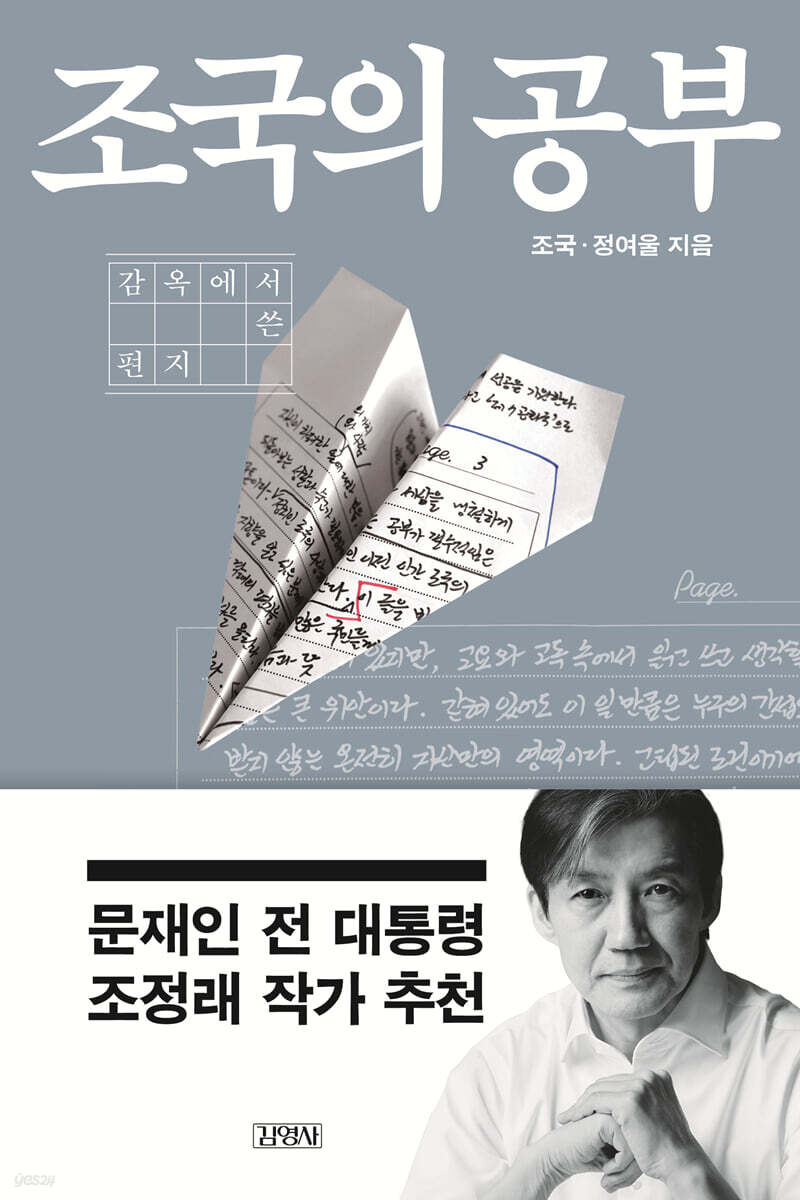
The cover of the book is a 'paper airplane' made by folding handwritten letters from the motherland.
Like a light piercing through the darkness, like a welcome paper airplane that arrives one day, I hope that the message of study conveyed in this book will reach the readers.
Reading the deep inner self of the fatherland now
Former President Moon Jae-in recommends author Jo Jeong-rae!
What kind of study do we need now?
Life without a script and the power of reflection
『The Study of the Fatherland』 is a book filled with deep thoughts and insights cultivated through ‘closed-door study.’
From closing the door and reflecting on oneself to thinking about the growth of the nation and community, it asks again what true study is.
This study is also a question that should be asked by all who endure pain and trials, pursue self-esteem and happiness, and further, seek coexistence and solidarity.
This book explores and contemplates how we can continue to speak the voice of our times without collapsing through study, crossing literature and law, social science and humanities, prisons and public squares.
It goes beyond 'studying for survival' and emphasizes the need for 'studying for dignity', and talks about the strength to never stop reading and writing no matter what difficulties one faces, the courage to rise again after experiencing the catastrophe of the destruction of one's family, and the perseverance to constantly plan and practice for the 'institutionalization of happiness'.
This book is divided into four parts.
Part 1, “Growing Study,” shows the journey of restoring broken self-esteem and developing inner strength through mindfulness, closed-door reading, and communal learning.
Part 2, “Participatory Study,” proposes civic study for the restoration of democracy, fairness in real politics, and legal justice.
Part 3, “Studying to Survive,” is a record of prison life, where the prisoner practiced patience and never let go of the bonds of friendship, solidarity, and reason.
The final part, Part 4, “Healing Study,” encapsulates the trajectory of his life and thoughts through the three encounters between Cho Kuk and Jeong Yeo-ul and Cho Kuk’s writings.
“Life has no script.
A completely unexpected misfortune occurs and you suffer as a result.
If we pursue change while clashing with vested interests, it may have been planned from the beginning.
To avoid collapsing in the face of this ordeal, you must maintain faith in the value of what you have set out to do and in people.
And we need to reflect and contemplate with a cool head on ourselves and the world.
For this, study is essential.
Because of the accumulated studies I had accumulated over time, I was able to rise again through politics without being discouraged by the judgments of the prosecution and the court.
“I highly recommend this book to anyone who wants to understand the ideology and vision of the politician Cho Kuk, and the struggles and aspirations of the human Cho Kuk before he became a politician.” (Cho Kuk, “Introduction: Studying for Self-Respect and Happiness, Politics for Coexistence and Solidarity”)
What is growing study?
The essence of the intellectual origins and philosophical reflections of the fatherland
Part 1 of this book begins with a story about 'courage'.
The fatherland emphasizes that faith in people and history is the source of courage, and that faith held deep within is the power to overcome adversity.
This is a confession of the process of enduring hardships with dignity, from the path of a scholar to the path of a fighter, to the path of helping to judge those who had distorted the Constitution through letters from prison.
When Cho Kuk feels shaken in a reality rife with sophistry, he thinks about his “true self” and “affirmation of life,” and says, “I gain the strength to live in the present and look forward to the future by looking back on history, which is interwoven with success and failure, advance and retreat, faith and betrayal” (〈I Always Had Literature〉).
He finds inspiration to overcome life's difficulties in reading.
While in prison, he reads literary works such as Les Misérables, Taebaek Mountains, and A Boy Acts, as well as classics such as Mencius, Xunzi, and Records of the Grand Historian, and even the memoirs of elders who have weathered the turbulent waves of modern history. He ponders “the appearance of the protagonists who overcome upheaval and trials” (“Les Misérables, Courage to Overcome Difficult Times”) and gains “the wisdom necessary to live in this time and space” (“The Boy Who Loved Studying Chinese Characters”).
“Reading a book allows the reader to communicate and empathize with the author, transforming and reconstructing themselves.
Your way of thinking and behavior may also change.
When this accumulates, a person develops his or her own perspective.
“That perspective constitutes the uniqueness and independence of each person, and when such perspective exists, a person is reborn as a subjective human being.” (〈Reading that Changes Destiny〉) He defines the meaning of reading as follows, and studies are “knowing the essence and operating principles of oneself, humans, society, and nature” (〈What is Community Study〉), and clearly states the need for educational reform to prevent “endless cutthroat competition.”
“We need to unite all national and public universities into one system, establish specialized universities in each region, and foster them by concentrating and allocating human resources.” (“Educational Reform to Prevent Infinite Cutthroat Competition”) “We also need reforms to drastically lower tuition fees at national and public universities.” (“Educational Reform to Prevent Infinite Cutthroat Competition”) “During the 2025 June 3 presidential election, the ruling and opposition parties each proposed ‘creating 10 Seoul National Universities’ and ‘joint degree programs between Seoul National University and regional universities,’ and it is important to put them into practice.” (“Educational Reform to Prevent Infinite Cutthroat Competition”) emphasizes.
What is participatory learning?
The dangers and greatness of K-democracy and the advanced social rights of the country
Part 2 sheds light on the meaning of participatory learning, focusing on ‘solidarity and citizenship,’ ‘democracy and responsible politics,’ and ‘legal sensitivity.’
Cho Kuk speaks resolutely about the crisis of democracy, from the unconstitutional and illegal martial law of December 3rd to the impeachment of President Yoon Seok-yeol on April 4th, and the series of events that occurred within it.
“Professional politicians and social activists are a minority, but the entire nation watches, remembers, and engraves them in its memory” (Koreans’ Political and Social DAN).
The courageous solidarity of citizens against dictatorship, oppression, abuse of power, and unconstitutional and illegal martial law reminds us that this is the essence and hope of Korean democracy.
He wished the Lee Jae-myung administration success, saying, “This is a once-in-a-lifetime opportunity to realize reforms that will change the framework of the Republic of Korea, including prosecution reform, judicial reform, and media reform.
I hope that the administration will implement various reforms early in its term, along with measures to revitalize the economy and strengthen people's livelihoods.
Power must be used when it is available.
“Reforms should be carried out when the government’s approval rating is high,” he suggests in “Where Are We Going?”
This book also poses the question, “Are our people living in the advanced country of the Republic of Korea happy?” (On Social Rights), and states that the happiness of the people depends on the structure and system of politics.
It also presents concrete measures for achieving substantive democracy, such as institutionalizing social rights based on the UN Covenant on Economic, Social and Cultural Rights, constitutional amendments for decentralization, and comprehensive anti-discrimination laws.
“Social rights are different from welfare.
As the word 'right' suggests, this is the right of the people.
Social rights, rooted in the UN Covenant on Economic, Social and Cultural Rights, must be stipulated in the Constitution and, even before that, implemented through laws, systems, and policies.
Only then can we improve the lives of our citizens, who are insecure and precarious.
Furthermore, K-democracy can become even stronger.” (On Social Rights)
Meanwhile, he is wary of the distortion of the 'rule of law'.
Even in a reality where the 'rule of law' is being reduced to 'rule by law', he criticizes the elitism and excessive punitiveness of lawyers, emphasizing that "the reason for studying law is to ensure that democracy is implemented" (Why I Study Law).
We pledge to continuously strive for an order that prioritizes citizens' freedom and rights, and for 'substantial democracy.'
What is the study of survival?
A brilliant thought written from the lowest place with bare hands
Part 3 most vividly reveals the human side of the fatherland.
Through his relationships with people around him, including martyr Park Jong-cheol, former lawmaker Choi Kang-wook, and writer Yoo Si-min, he tells us that values such as friendship, camaraderie, and leadership are the foundation of life.
Here we will realize anew that true friendship is not a bomb shot, but an outstretched hand in silence.
Now, in his solitary cell, he quietly looks into his inner self and calmly depicts how humans come to love their own weaknesses, how letters received from prison can be a comfort, and how a wounded person can recover and become a healer of others.
"What do you truly desire, what are you pursuing? What cannot be given up, no matter the difficulties or trials?" (From "Living Alone, Time to Look Within Yourself").
He will never forget the face of an inmate in prison who held up a piece of paper with the word 'victory' written on it.
That 'victory' meant the resurrection of the individual, the victory of the people, and the victory of democracy.
“Every saint has a past, every sinner a future,” says Cho Kuk, quoting Oscar Wilde.
“I, too, live with a humble heart and attitude as a prisoner.” (〈Writing only the word ‘victory’ without saying anything〉) ‘Victory’ is not just the result of an election, but the name of those who rise again even in despair.
In Part 3, Jo Gook examines what has and has not changed in the politics of the terms and conditions and the politics of Yi Sun, what he would do first if he were released as a human Jo Gook, and whether there is a blueprint for aging gracefully.
And about what a 'successful life' is, he says this:
“I think the question that determines whether you are successful is, ‘Are you happy?’
This question asks whether you are someone who is recognized and respected by your family, friends, and society, or whether you play a meaningful role, even if it is small, based on the premise that you can meet basic needs such as food, clothing, and shelter.
“If you become this kind of being, you will be happy, and if you are happy, you will be successful.” (〈The True Meaning of Success, Inner Happiness〉)
Since 2019, Cho Kuk has been reborn as a "wounded healer," and the people say they gave him a political opportunity despite knowing his flaws.
“I am not a perfect person.
It has limitations and flaws.
I honestly acknowledged this, laid out the tasks I needed to accomplish, and demonstrated my determination and courage to accomplish them.
“I think this is the real reason why he won the hearts of the people.” (The Wounded Healer) Now, from the lowest place, Cho Kuk writes with his bare body, once again engraving his calling.
In the lowly place of prison, he proves himself by putting his voice into words with the pen and paper allowed.
What is healing study?
A world where only those who struggle can find happiness
The last part 4 contains the story of 'the studying fatherland' as seen by Jeong Yeo-ul.
The first meeting in 2009, the second meeting in 2023, and the trajectory of his life and thoughts, contained in “Jeong Yeo-ul’s Rewriting of the Homeland in 2025,” unfold.
Jo Gook and Jeong Yeo-ul first met in 2009.
At the time, Cho Kuk was a legal scholar who pondered the reflective advancement of democracy, and Jeong Yeo-ul was a writer who wove her inner wounds into writing.
At that time, Cho Kuk mentioned the “collective sense of debt” and the “collapse of the Maginot Line of democracy” that had spread throughout Korean society since the death of President Roh Moo-hyun, and firmly stated, “We must learn what we need to learn and discard what we need to discard” (“We are each erecting a tombstone in our hearts”).
He noted that while the direct actions of citizens holding candlelight vigils are great, if they are not connected to institutional politics, they can become a futile war of attrition. He criticized the single-member district system and regionalism, which are structural limitations of Korean democracy, and specifically proposed a transition to a multi-member district system.
It sought a way to move beyond formal procedural democracy and toward ‘substantive democracy.’
16 years have passed since then.
Meanwhile, the country continues to fulfill its mission, still envisioning the "institutionalization of happiness," and confronting the essential tension between capitalism and democracy.
We are striving to achieve prosecution reform, political reform, and substantive democracy that goes beyond mere formalities.
The second meeting was in 2023, when planning for this book began in earnest.
At that time, even in the midst of political trials, Cho Kuk showed humility and wisdom in seeing the world broadly through sincere apologies and a consistent attitude toward study.
From a young age, he laid the foundation for his thinking through books and Chinese characters, and like Sima Qian and Jeong Yak-yong, he strengthened himself through writing even in difficult times.
Then and now, he fights against anti-intellectualism and dreams of restoring democracy and building an "imagined community" through solidarity with fellow citizens.
The last chapter of Part 4 features the 'Theory of Cho Kuk' written in 2025.
Jeong Yeo-ul condenses and unravels the study theory of the fatherland through books such as 『Reflective Progress』, 『Dike's Tears』, 『Gabul Advanced Countries』, and 『A Walk Through the Legal Classics of the Fatherland』.
I will copy and write down the sentence that Jeong Yeo-ul wrote at the end.
“The reason why ‘Study of the Fatherland’ is meaningful to us is because it reminds us of the meaning of ‘jurisprudence that heals the hearts of the suffering, and jurisprudence that restores solidarity and a sense of identity among awakened fellow citizens,’ rather than ‘jurisprudence that governs the elite through law.’
Studying the fatherland is not about becoming a person of power, but about sharing that power with fellow citizens, awakening them to the rights of sovereign citizens, and dreaming of a world where no one—not women, workers, children, the disabled, or minorities—is discriminated against or marginalized.
“It is a study that does not turn a blind eye to the suffering of others, a study that willingly participates in the world’s sorrows and joys, a study that wipes away the tears of the world’s people, a study that smiles together with the world’s people and moves toward a better world.” (Jeong Yeo-ul, “Jeong Yeo-ul’s Rewriting of the Homeland in 2025”)
"The Study of the Fatherland" was fully realized in 2023, 14 years after the first meeting between the fatherland and Jeong Yeo-ul, and was completed in 2025 with the writings that the fatherland had written in prison.
As author Jo Jeong-rae said in his recommendation, “This book is enterprising and exploratory, groundbreaking and reflective, controversial and emotional.
How was such a seemingly conflicting intellectual harmony achieved?
This is the result of a sincere and earnest soul-to-soul conversation between Cho Kuk, a lawyer and politician, and Jeong Yeo-ul, a literary critic and writer.
And readers will encounter a resolute portrait of the new politician, Cho Kuk, looking toward the future.” (From author Jo Jeong-rae’s recommendation)
The people of the Republic of Korea have been asking the right questions to the dark recklessness and have wisely passed through the darkness with upright actions.
What pierced the darkness was the light each and every person held in their hands.
It was the look in those people's eyes.
The light of one person has made the light of another person beside him not feel lonely, and has led history in the right direction, even when it was blind and deaf.
The cover of the book is a 'paper airplane' made by folding handwritten letters from the motherland.
Like a light piercing through the darkness, like a welcome paper airplane that arrives one day, I hope that the message of study conveyed in this book will reach the readers.
GOODS SPECIFICS
- Date of issue: July 30, 2025
- Page count, weight, size: 288 pages | 396g | 140*210*20mm
- ISBN13: 9791173322952
- ISBN10: 1173322957
You may also like
카테고리
korean


korean

![GQ KOREA Mark (Monthly): December [2025]](http://librairie.coreenne.fr/cdn/shop/files/8ef265dbbfbf186523ed75ba7319009d.jpg?v=1765340328&width=3840)


