

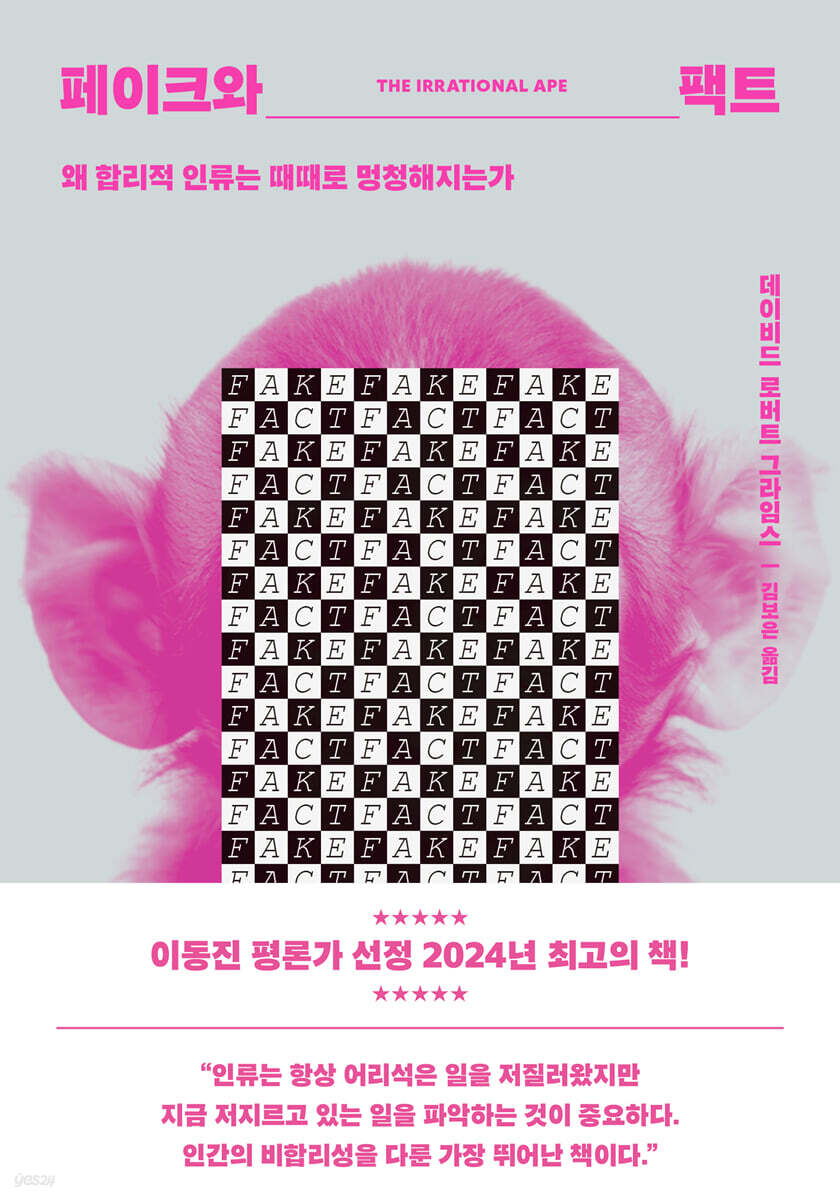
Fake and Fact
 |
Description
Book Introduction
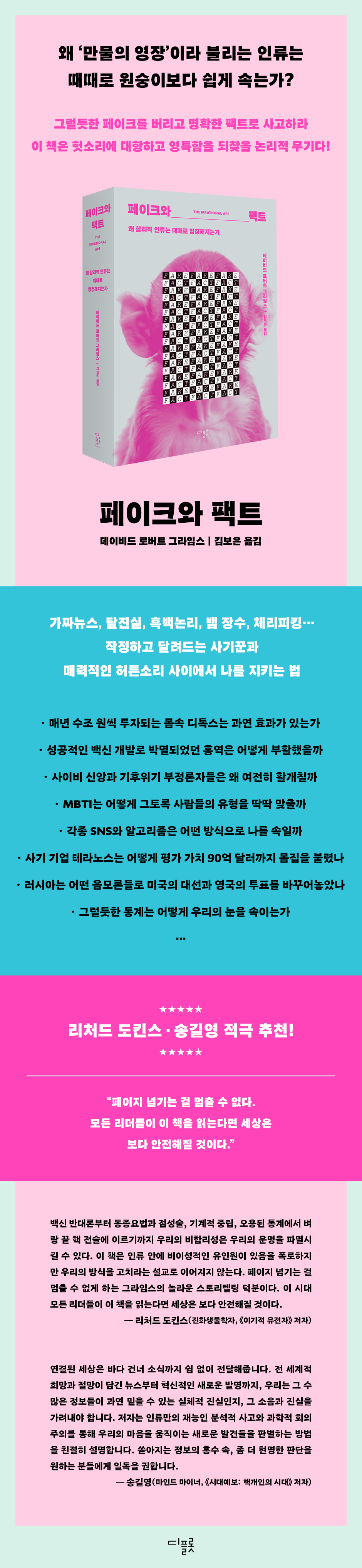
Fake news, post-truth, black-and-white thinking, snake traders, cherry-picking…
A world ruined by blind faith, flawed logic, and commonplace pretense.
Throw away the plausible fakes and think with clear facts.
This book is a logical weapon to fight against nonsense and regain your intelligence!
“I can’t stop turning the pages.
“If all leaders read this book, the world would be a safer place.”
★★★Highly recommended by Richard Dawkins and Song Gil-young!★★★
In the age of social media, rumors spread like wildfire.
If it were true, it would be, “See, I was right,” but even if it turns out to be false, it doesn’t make any difference.
“That can’t be true.
“It’s clear they’re hiding something.” During the Sewol ferry disaster, there were stories about ‘fake bereaved families,’ during the Itaewon disaster, there was fake news about a person wearing a mask and spreading avocado oil on the street, and during the coronavirus outbreak, there were ‘vaccine horror stories’ even before vaccinations became routine.
Conspiracy theories and fake news are rampant. A world where social media newsfeeds focus on our interests and only show us the opinions of influencers we trust blinds us.
In a society where 'fake' and 'fact' are so entangled, how can we think based on facts rather than beliefs or feelings?
This book provides ways to understand our irrational thinking patterns and develop critical thinking skills.
It shows failures throughout history and talks about how to develop insight and avoid repeating mistakes.
The answer to protecting myself and saving the future from being fooled by fakes is here.
A world ruined by blind faith, flawed logic, and commonplace pretense.
Throw away the plausible fakes and think with clear facts.
This book is a logical weapon to fight against nonsense and regain your intelligence!
“I can’t stop turning the pages.
“If all leaders read this book, the world would be a safer place.”
★★★Highly recommended by Richard Dawkins and Song Gil-young!★★★
In the age of social media, rumors spread like wildfire.
If it were true, it would be, “See, I was right,” but even if it turns out to be false, it doesn’t make any difference.
“That can’t be true.
“It’s clear they’re hiding something.” During the Sewol ferry disaster, there were stories about ‘fake bereaved families,’ during the Itaewon disaster, there was fake news about a person wearing a mask and spreading avocado oil on the street, and during the coronavirus outbreak, there were ‘vaccine horror stories’ even before vaccinations became routine.
Conspiracy theories and fake news are rampant. A world where social media newsfeeds focus on our interests and only show us the opinions of influencers we trust blinds us.
In a society where 'fake' and 'fact' are so entangled, how can we think based on facts rather than beliefs or feelings?
This book provides ways to understand our irrational thinking patterns and develop critical thinking skills.
It shows failures throughout history and talks about how to develop insight and avoid repeating mistakes.
The answer to protecting myself and saving the future from being fooled by fakes is here.
- You can preview some of the book's contents.
Preview
index
[Prologue] Heroes Who Hold on Tight to Reason
[Introduction] How to Save Us from Stupid Decisions
Part 1: A World Without Logic
Chapter 1: Inappropriate Conclusions from Inappropriate Propositions: How the Syllogism Strikes Us Down
Chapter 2: Facing Irrationality: Logical Fallacies That Lead to Mistakes
Chapter 3: The Unbelievable: People Who Are Fooled by Ads and Scammers
Part 2: The Truth Is Not Simple
Chapter 4: The Devil Lives in the Details: Vitamin C's Cure, Viral Infections, and Germany's Defeat
Chapter 5: Smoke Comes Out of the Chimney: The Vague Fear of Vaccines
Chapter 6: The Nature of the Beast: Discrimination and Hatred Surrounding Skin Color
Chapter 7: Bait and Switch: Darwin's Evolution and Marijuana Legalization
Part 3: Manipulation of the Mind
Chapter 8: Schrödinger's Bin Laden: The Unquenchable Cult and Climate Denial
Chapter 9: Memory is an Illusion: Distorted Testimony from Witnesses
Chapter 10: Don't Rely on Your Senses: The Distortion of Human Perception
Chapter 11: Believing What You Want to Believe: Similarities Between MBTI and Alternative Medicine
Part 4: Lies, Damn Lies, and Statistics
Chapter 12: Encountering Probability: The Perils of Statistics
Chapter 13: Switching Signals: Silicon Valley's Biggest Scam
Chapter 14: Bigger is Better: The Remaining Popularity of Natural Healing and Homeopathy
Part 5: The Great Transformation News
Chapter 15: Trying to Maintain Neutrality Burns Down the House: Trump's Lies and Post-Truth Politics
Chapter 16: Biased Voices: Social Media and Algorithms Filled with What You Want to See
Chapter 17: Fake Even If It's Okay: The Age of Fake News and Post-Truth
Chapter 18: Bad Influencers: People Driven by Profit
Part 6: A Candle that Lights the Darkness
Chapter 19: The Frontiers of Science: What Is and Is Not Science
Chapter 20: The Emergence of Cargo Faith: Pseudosciences Dressed as Science
Chapter 21: Healthy Skepticism: Why Conspiracy Theories Persist
[Going out] If the world burns, so will we.
[Acknowledgements]
[References]
[Search]
[Introduction] How to Save Us from Stupid Decisions
Part 1: A World Without Logic
Chapter 1: Inappropriate Conclusions from Inappropriate Propositions: How the Syllogism Strikes Us Down
Chapter 2: Facing Irrationality: Logical Fallacies That Lead to Mistakes
Chapter 3: The Unbelievable: People Who Are Fooled by Ads and Scammers
Part 2: The Truth Is Not Simple
Chapter 4: The Devil Lives in the Details: Vitamin C's Cure, Viral Infections, and Germany's Defeat
Chapter 5: Smoke Comes Out of the Chimney: The Vague Fear of Vaccines
Chapter 6: The Nature of the Beast: Discrimination and Hatred Surrounding Skin Color
Chapter 7: Bait and Switch: Darwin's Evolution and Marijuana Legalization
Part 3: Manipulation of the Mind
Chapter 8: Schrödinger's Bin Laden: The Unquenchable Cult and Climate Denial
Chapter 9: Memory is an Illusion: Distorted Testimony from Witnesses
Chapter 10: Don't Rely on Your Senses: The Distortion of Human Perception
Chapter 11: Believing What You Want to Believe: Similarities Between MBTI and Alternative Medicine
Part 4: Lies, Damn Lies, and Statistics
Chapter 12: Encountering Probability: The Perils of Statistics
Chapter 13: Switching Signals: Silicon Valley's Biggest Scam
Chapter 14: Bigger is Better: The Remaining Popularity of Natural Healing and Homeopathy
Part 5: The Great Transformation News
Chapter 15: Trying to Maintain Neutrality Burns Down the House: Trump's Lies and Post-Truth Politics
Chapter 16: Biased Voices: Social Media and Algorithms Filled with What You Want to See
Chapter 17: Fake Even If It's Okay: The Age of Fake News and Post-Truth
Chapter 18: Bad Influencers: People Driven by Profit
Part 6: A Candle that Lights the Darkness
Chapter 19: The Frontiers of Science: What Is and Is Not Science
Chapter 20: The Emergence of Cargo Faith: Pseudosciences Dressed as Science
Chapter 21: Healthy Skepticism: Why Conspiracy Theories Persist
[Going out] If the world burns, so will we.
[Acknowledgements]
[References]
[Search]
Detailed image
Publisher's Review
Why do rational humans sometimes become stupid?
The logical errors that have shaped humanity's dark history are revealed.
Humans, with their large and powerful brains, are often called the 'primates of all creation.'
The reason Homo sapiens was able to develop so uniquely is because we have a superior ability to think, reflect, and reason than any other species.
The problem is that even with such a brain, we still make countless mistakes and errors.
Why do humans, often called the most rational of living beings, sometimes become so stupid? Our ability to perceive our surroundings and our boundless curiosity undoubtedly played a significant role in giving birth to today's civilization.
However, because of this excellent instinct, humans often make wrong judgments.
It is about finding patterns among random events or making inferences based only on the results you have observed.
For example, numbers in a lottery come out with equal probability, but it is generally difficult to accept this.
If you flip a coin twenty times, the probability of getting heads each time is exactly 50 percent, but if you get heads all twenty times, you would expect to get tails on the twenty-first flip.
This is called the 'gambler's fallacy'.
Political situations also influence thinking.
In the 1950s, the Chinese Communist Party considered sparrows to be "a symbol of the bourgeoisie that exploits and parasitizes the proletariat" and exterminated them in China.
With the disappearance of the sparrow, their only natural enemy, swarms of locusts swarmed the continent, resulting in a three-year famine starting in 1959.
Scientist Zheng Zhexun and others tried to prevent this situation, but Mao Zedong instead sentenced him to ideological re-education and forced labor, labeling him an "authoritarian reactionary."
Mao Zedong said, 'Something must be done.
→ That's exactly what happened.
→ Therefore, we were trapped in the political syllogism of ‘this must be done’ and this resulted in the tragedy of starving tens of millions of people.
If Mao Zedong had listened to Zheng Zexun and recognized his own mistakes, this fatal accident could have been prevented.
This book explores the dark history of logic that has occurred since the birth of mankind.
We trace the errors that deceive us through various cases, such as the Pope who was accused of murder because he was already a corpse but could not defend himself, the salesman who became a billionaire by selling snake oil as a panacea during the 19th century American transcontinental railroad project, the election of Trump, a producer of all kinds of hate and a suspect in various crimes, the UK's withdrawal from the EU due to the involvement of Russian cyber forces, and the naturalistic parent who opposes vaccines on the grounds that they reject 'unnatural things' to protect their children.
For example, it exposes logical fallacies such as the gambler's fallacy, survivorship bias, straw man argument, Forer effect, false causality, mechanical neutrality, single cause fallacy, and cargo science.
“Love the truth, but embrace error.”
Intellectual assets of humanity gifted by science
For humanity to advance, correcting past mistakes may be more important than acquiring new knowledge.
The author of this book, David Robert Grimes, says that as a scientist, we should consider 'critical thinking', the basic attitude of science, as an asset to humanity.
Science is a discipline that rigorously tests a claim, and thereby develops or discards it.
In the scientific community, even if a high school student challenges the claims of a leading scientist, if the evidence presented by the student is factual, the scholar will bow his head and abandon his beliefs.
If we continue to shatter and re-establish conventional wisdom through the analytical thinking training emphasized in this book, we will not be deceived by the lies, the propaganda of bad politicians, or the deception of con artists.
This scientific approach applies to all areas of humanity, from small but crucial choices for personal well-being to overcoming global catastrophes like climate change, antibiotic resistance, pandemics, and geopolitical instability.
The logical errors that have shaped humanity's dark history are revealed.
Humans, with their large and powerful brains, are often called the 'primates of all creation.'
The reason Homo sapiens was able to develop so uniquely is because we have a superior ability to think, reflect, and reason than any other species.
The problem is that even with such a brain, we still make countless mistakes and errors.
Why do humans, often called the most rational of living beings, sometimes become so stupid? Our ability to perceive our surroundings and our boundless curiosity undoubtedly played a significant role in giving birth to today's civilization.
However, because of this excellent instinct, humans often make wrong judgments.
It is about finding patterns among random events or making inferences based only on the results you have observed.
For example, numbers in a lottery come out with equal probability, but it is generally difficult to accept this.
If you flip a coin twenty times, the probability of getting heads each time is exactly 50 percent, but if you get heads all twenty times, you would expect to get tails on the twenty-first flip.
This is called the 'gambler's fallacy'.
Political situations also influence thinking.
In the 1950s, the Chinese Communist Party considered sparrows to be "a symbol of the bourgeoisie that exploits and parasitizes the proletariat" and exterminated them in China.
With the disappearance of the sparrow, their only natural enemy, swarms of locusts swarmed the continent, resulting in a three-year famine starting in 1959.
Scientist Zheng Zhexun and others tried to prevent this situation, but Mao Zedong instead sentenced him to ideological re-education and forced labor, labeling him an "authoritarian reactionary."
Mao Zedong said, 'Something must be done.
→ That's exactly what happened.
→ Therefore, we were trapped in the political syllogism of ‘this must be done’ and this resulted in the tragedy of starving tens of millions of people.
If Mao Zedong had listened to Zheng Zexun and recognized his own mistakes, this fatal accident could have been prevented.
This book explores the dark history of logic that has occurred since the birth of mankind.
We trace the errors that deceive us through various cases, such as the Pope who was accused of murder because he was already a corpse but could not defend himself, the salesman who became a billionaire by selling snake oil as a panacea during the 19th century American transcontinental railroad project, the election of Trump, a producer of all kinds of hate and a suspect in various crimes, the UK's withdrawal from the EU due to the involvement of Russian cyber forces, and the naturalistic parent who opposes vaccines on the grounds that they reject 'unnatural things' to protect their children.
For example, it exposes logical fallacies such as the gambler's fallacy, survivorship bias, straw man argument, Forer effect, false causality, mechanical neutrality, single cause fallacy, and cargo science.
“Love the truth, but embrace error.”
Intellectual assets of humanity gifted by science
For humanity to advance, correcting past mistakes may be more important than acquiring new knowledge.
The author of this book, David Robert Grimes, says that as a scientist, we should consider 'critical thinking', the basic attitude of science, as an asset to humanity.
Science is a discipline that rigorously tests a claim, and thereby develops or discards it.
In the scientific community, even if a high school student challenges the claims of a leading scientist, if the evidence presented by the student is factual, the scholar will bow his head and abandon his beliefs.
If we continue to shatter and re-establish conventional wisdom through the analytical thinking training emphasized in this book, we will not be deceived by the lies, the propaganda of bad politicians, or the deception of con artists.
This scientific approach applies to all areas of humanity, from small but crucial choices for personal well-being to overcoming global catastrophes like climate change, antibiotic resistance, pandemics, and geopolitical instability.
GOODS SPECIFICS
- Date of issue: July 26, 2024
- Page count, weight, size: 544 pages | 686g | 140*200*35mm
- ISBN13: 9791193591147
- ISBN10: 1193591147
You may also like
카테고리
korean


korean

![GQ KOREA Mark (Monthly): December [2025]](http://librairie.coreenne.fr/cdn/shop/files/8ef265dbbfbf186523ed75ba7319009d.jpg?v=1765340328&width=3840)


