

The End of Average
 |
Description
Book Introduction
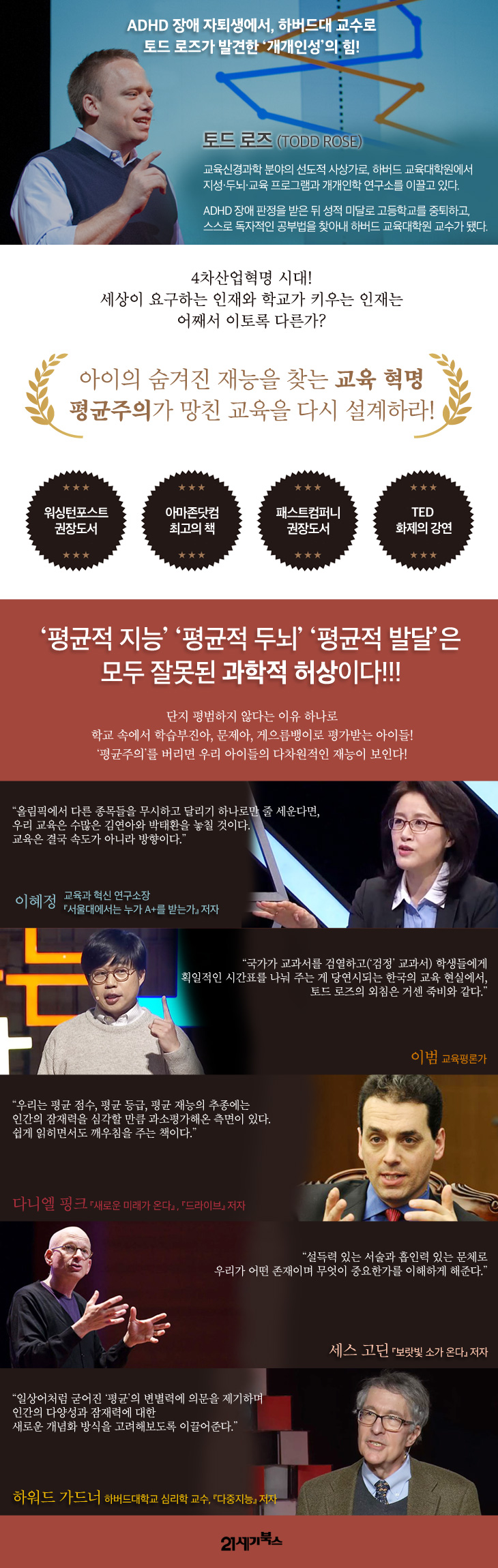
Best Books on Amazon.com, Trending TED Talks Washington Post Recommended Books Fast Company Recommended Books An educational revolution that uncovers hidden talents Redesign education, which has been ruined by mediocrity! “Lazy, troublemaker, pathetic.” This is the story of Todd Rose, a professor at Harvard Graduate School of Education and a leading authority in educational neuroscience, during his high school years. It may be hard to believe, but he dropped out of high school due to poor grades and ADHD. Todd Rose, who had been treated as a troublemaker his entire life, turned his life around because he discovered his own 'unique talent' that was not recognized at school and studied it on his own. Each child has different innate talents. Some children have good memorization skills, others are quick to judge situations, others have a high mathematical understanding, and still others have a strong artistic sense. However, public education ignores such multidimensional 'individuality' and evaluates everything about a child solely based on their 'ability to do well on tests.' By setting the subjects and difficulty levels of learning based on the standard of 'average intelligence by age', it is said that all talents can be known simply by looking at whether the child's score is higher or lower than the 'average score'. Todd Rose, a former "problem child" within the school system, uses solid scientific theory to point out that the very standard of "average" is a flawed illusion. And, to break free from the trap of 'averageism' that dominates schools and to nurture each child into a creative talent, we propose innovative teaching and evaluation methods. As times change, education must also change. As we enter the era of the Fourth Industrial Revolution and creative talent becomes increasingly necessary, both the rote learning approach that kills creativity and the methods for evaluating talent must change. The beginning is to shatter the illusion of 'average' that has deceived education so far. |
- You can preview some of the book's contents.
Preview
index
A Word from the Editor: Education: The Hottest Topic in the Era of the Fourth Industrial Revolution
Introduction_Find the Similarity Contest
Part 1: The Age of Average
Chapter 1: The Birth of the Average
Analyzing Humans with Mathematics / The Average Human / The Superior and the Ignorant / The Average Society
Chapter 2: A Standardized World
Taylor's Standardization System / The Birth of the Manager / Factory-Style Schooling / The Gifted and the Incurable / The World of Types and Grades
Chapter 3: Overturning the Mean
The Ergodic Switch / The Science of the Individual / The Traps of 'Normal Development' / In Search of True Talent
Part 2: The Principle of Individuality for an Educational Revolution
Chapter 4: Human Talent is Multidimensional
The Jagged Principle / The Illusion of IQ / Google's Talent Recruitment Method / Finding Pearls in the Mud
Chapter 5: Breaking Down Essentialist Thinking
The Principle of Context / Temperament in Contextual Situations / There is No Nature / Harmony between Talent and Context / True Understanding and Respect
Chapter 6: Walking the Road Without Signposts
The Path Principle / The Lie That Faster is Smarter / The Web of Development / Forge Your Own Path
Part 3: A World Without Averages
Chapter 7: A Company Growing on the Principle of Individuality
Costco: The Secret to Employee Loyalty / Zoho: The Secret to Surpassing the Giants / Morningstar: The Managerless Factory / From Taylorism to Symbiotic Capitalism
Chapter 8: Change Education
A Game of Averages with No Winners / Degree System Innovation / Grade System Innovation / Self-Determined Education / A New Era of Educational Models
Chapter 9 Beyond Averageism
Equal Opportunity and Equal Fit / Reclaiming the Dream
Acknowledgements
References
Search
Introduction_Find the Similarity Contest
Part 1: The Age of Average
Chapter 1: The Birth of the Average
Analyzing Humans with Mathematics / The Average Human / The Superior and the Ignorant / The Average Society
Chapter 2: A Standardized World
Taylor's Standardization System / The Birth of the Manager / Factory-Style Schooling / The Gifted and the Incurable / The World of Types and Grades
Chapter 3: Overturning the Mean
The Ergodic Switch / The Science of the Individual / The Traps of 'Normal Development' / In Search of True Talent
Part 2: The Principle of Individuality for an Educational Revolution
Chapter 4: Human Talent is Multidimensional
The Jagged Principle / The Illusion of IQ / Google's Talent Recruitment Method / Finding Pearls in the Mud
Chapter 5: Breaking Down Essentialist Thinking
The Principle of Context / Temperament in Contextual Situations / There is No Nature / Harmony between Talent and Context / True Understanding and Respect
Chapter 6: Walking the Road Without Signposts
The Path Principle / The Lie That Faster is Smarter / The Web of Development / Forge Your Own Path
Part 3: A World Without Averages
Chapter 7: A Company Growing on the Principle of Individuality
Costco: The Secret to Employee Loyalty / Zoho: The Secret to Surpassing the Giants / Morningstar: The Managerless Factory / From Taylorism to Symbiotic Capitalism
Chapter 8: Change Education
A Game of Averages with No Winners / Degree System Innovation / Grade System Innovation / Self-Determined Education / A New Era of Educational Models
Chapter 9 Beyond Averageism
Equal Opportunity and Equal Fit / Reclaiming the Dream
Acknowledgements
References
Search
Detailed image
Publisher's Review
How are our children preparing for the Fourth Industrial Revolution?
The crux of the problem is education!
We live in an era of unprecedented cataclysmic change, the 'Fourth Industrial Revolution', a term so frequently mentioned that it has become almost cliché.
However, compared to the flood of issues, artificial intelligence experts diagnose that Korea's competitiveness in the Fourth Industrial Revolution is very low.
The main reason cited is that the 'golden time' for investment in talent has been missed, and the biggest problem is public education that is not keeping up with the times.
Students are still taught to memorize knowledge unilaterally imparted by teachers, take tests, and that their scores will determine their colleges, their companies, and ultimately their futures.
The gap between the creative talent that society desires and the talent that is actually taught in educational settings is too large.
Todd Rose, author of this book, The End of Average, is someone who has personally experienced this gap.
A professor at Harvard School of Education and a leading thinker in educational neuroscience, he surprisingly dropped out of high school due to poor academic performance. He suffered from ADHD, was labeled a troublemaker by teachers due to his inattention, and struggled to understand class material, resulting in poor grades.
Because he was neither a "student with average intelligence" nor a "student with average personality" as required by the school, he ended up becoming a rough stone and had to leave the school.
But Todd Rose's life took a turn when he left school.
He discovered his talents that were not recognized at school, and instead of relying on spoon-fed lessons, he found a learning method that suited him and studied subjects that interested him.
And now, as a world-renowned authority on education, he continues his research for children like himself who have been overlooked and overlooked by the illusion of "average."
In this book, he reveals that the concepts of 'average talent, average intelligence, and average personality' do not exist, and that such concepts are completely false and are an illusion created by scientific imagination.
We also propose innovative teaching and evaluation methods to replace the flawed standard of 'average'.
Education is said to be a country's long-term plan.
Discovering a child's innate talents and teaching them to develop them is tantamount to fostering the creative talent needed in the era of the Fourth Industrial Revolution, thereby fostering national competitiveness for the future.
This is why, right now, public education must thoroughly reflect and start anew.
This book will provide a solid theoretical foundation for drawing up a blueprint for new education.
A must-read for teachers, parents, and education policymakers.
There is no such thing as an 'average brain' or 'average development'?
Let go of the illusion of 'average' that has deceived education!
Todd Rose talks about himself in school:
“People around me said that nine out of ten times, I was the problem.
“I was treated like a lazy, pathetic kid, and the word I heard most often was ‘problem child.’” Even now, schools are overflowing with ‘problem children’ like Todd Rose.
They are being treated as hopeless simply because they are not 'average'.
In a world where all children receive the same education at the same age and where group fit is valued over individuality, teachers, parents, and students are all bound to fall into the trap of "average."
Maybe that's why.
From the moment a child is born, parents become anxious, comparing their child's development to whether it is growing up to or falling short of 'average development'.
This is because the developmental stages of turning over, crawling, standing up, and walking are all set to an ‘average’ level.
It's the same at school.
Because there is a set learning difficulty level that can be understood 'on average' by age, if you don't understand the class, you are easily labeled as having a 'learning delay'.
It goes without saying that children themselves may feel inferior or have negative self-evaluations when they receive their report cards.
In a world where "average" is often considered "normal," there's a shocking and fascinating case that demonstrates just how absurd the concepts of an average brain or average development are.
We are familiar with the 'average brain map', having seen it many times.
This is an fMRI brain scan image that we see in studies, such as one that shows that the areas of the brain that are activated when we feel love are different from the areas that are activated when we feel fear.
In 2002, a neuroscientist named Michael Miller analyzed video footage of participants and discovered that not a single brain region activated the same way under the same conditions, but rather that each individual had their own unique, systematic pattern.
Even though other researchers were aware of this fact, they dismissed such results as "variables" because of their reliance on the "average brain."
In short, there is no such thing as an 'average brain'.
Discovering your child's hidden talents
The Three Principles of Individuality
In Part 1 of this book, "The Age of Average," Todd Rose shatters the illusion of averageness, which has played a significant role in designing public education, one by one, through scientific findings such as the aforementioned "brain scan images."
And in Chapter 2, 'Principles of Individuality for an Educational Revolution', three 'Principles of Individuality' are presented to break away from averageism and discover and evaluate children's talents.
The first is the ‘principle of jagged edges’.
Edward Thorndike, a psychologist who laid the foundation for modern education, believed that there was a close relationship between school grades and career success.
The hypothesis is that individuals have a kind of 'overall intelligence', such that people who are good at studying are also good at work.
However, actual research shows that even with the same IQ, the intelligence of each individual varies depending on the field.
Whether it's studying or work, it's clear that children can achieve greater success in areas where they have superior intelligence.
The second principle is the 'principle of context'.
We try to divide humans into two types.
It is said that one has one of two tendencies: introverted or extroverted, thinking or feeling.
And they believe that personality tests can reveal a child's "true identity."
But Todd Rose shows that all humans have contradictory tendencies: they are both introverted and extroverted, rational and emotional.
It's just that we react differently depending on the situation, but our morality, patience, and sincerity are all the same.
It is the role of parents and teachers to create the appropriate situations and context for children to fully demonstrate their natural abilities.
The final principle is the 'principle of path'.
In our society, there is a 'normal' path that the average person should take.
Even in the case of physical or intellectual development, if a child shows rapid growth, we expect them to be smarter, and if they fall behind, we worry as if they are a failure in life.
This is also an illusion of being trapped in the illusion of average.
In reality, there is no one developmental path that applies equally to all children; each child has a different developmental path that is appropriate for him or her.
We live in an unknown world every moment.
This is especially true in this era of the Fourth Industrial Revolution.
We don't know what kind of world the future will bring, what skills will be needed, or what role children will play in it.
However, the reality of public education today is that by evaluating or labeling children under the illusion of 'averageism,' we end up closing doors that were open to children one by one.
We must remember that every child has hidden talents that cannot be discovered through test scores and school performance alone.
And the responsibility to discover and nurture them and make them into future leaders lies not only with the educational community but with our entire society.
The crux of the problem is education!
We live in an era of unprecedented cataclysmic change, the 'Fourth Industrial Revolution', a term so frequently mentioned that it has become almost cliché.
However, compared to the flood of issues, artificial intelligence experts diagnose that Korea's competitiveness in the Fourth Industrial Revolution is very low.
The main reason cited is that the 'golden time' for investment in talent has been missed, and the biggest problem is public education that is not keeping up with the times.
Students are still taught to memorize knowledge unilaterally imparted by teachers, take tests, and that their scores will determine their colleges, their companies, and ultimately their futures.
The gap between the creative talent that society desires and the talent that is actually taught in educational settings is too large.
Todd Rose, author of this book, The End of Average, is someone who has personally experienced this gap.
A professor at Harvard School of Education and a leading thinker in educational neuroscience, he surprisingly dropped out of high school due to poor academic performance. He suffered from ADHD, was labeled a troublemaker by teachers due to his inattention, and struggled to understand class material, resulting in poor grades.
Because he was neither a "student with average intelligence" nor a "student with average personality" as required by the school, he ended up becoming a rough stone and had to leave the school.
But Todd Rose's life took a turn when he left school.
He discovered his talents that were not recognized at school, and instead of relying on spoon-fed lessons, he found a learning method that suited him and studied subjects that interested him.
And now, as a world-renowned authority on education, he continues his research for children like himself who have been overlooked and overlooked by the illusion of "average."
In this book, he reveals that the concepts of 'average talent, average intelligence, and average personality' do not exist, and that such concepts are completely false and are an illusion created by scientific imagination.
We also propose innovative teaching and evaluation methods to replace the flawed standard of 'average'.
Education is said to be a country's long-term plan.
Discovering a child's innate talents and teaching them to develop them is tantamount to fostering the creative talent needed in the era of the Fourth Industrial Revolution, thereby fostering national competitiveness for the future.
This is why, right now, public education must thoroughly reflect and start anew.
This book will provide a solid theoretical foundation for drawing up a blueprint for new education.
A must-read for teachers, parents, and education policymakers.
There is no such thing as an 'average brain' or 'average development'?
Let go of the illusion of 'average' that has deceived education!
Todd Rose talks about himself in school:
“People around me said that nine out of ten times, I was the problem.
“I was treated like a lazy, pathetic kid, and the word I heard most often was ‘problem child.’” Even now, schools are overflowing with ‘problem children’ like Todd Rose.
They are being treated as hopeless simply because they are not 'average'.
In a world where all children receive the same education at the same age and where group fit is valued over individuality, teachers, parents, and students are all bound to fall into the trap of "average."
Maybe that's why.
From the moment a child is born, parents become anxious, comparing their child's development to whether it is growing up to or falling short of 'average development'.
This is because the developmental stages of turning over, crawling, standing up, and walking are all set to an ‘average’ level.
It's the same at school.
Because there is a set learning difficulty level that can be understood 'on average' by age, if you don't understand the class, you are easily labeled as having a 'learning delay'.
It goes without saying that children themselves may feel inferior or have negative self-evaluations when they receive their report cards.
In a world where "average" is often considered "normal," there's a shocking and fascinating case that demonstrates just how absurd the concepts of an average brain or average development are.
We are familiar with the 'average brain map', having seen it many times.
This is an fMRI brain scan image that we see in studies, such as one that shows that the areas of the brain that are activated when we feel love are different from the areas that are activated when we feel fear.
In 2002, a neuroscientist named Michael Miller analyzed video footage of participants and discovered that not a single brain region activated the same way under the same conditions, but rather that each individual had their own unique, systematic pattern.
Even though other researchers were aware of this fact, they dismissed such results as "variables" because of their reliance on the "average brain."
In short, there is no such thing as an 'average brain'.
Discovering your child's hidden talents
The Three Principles of Individuality
In Part 1 of this book, "The Age of Average," Todd Rose shatters the illusion of averageness, which has played a significant role in designing public education, one by one, through scientific findings such as the aforementioned "brain scan images."
And in Chapter 2, 'Principles of Individuality for an Educational Revolution', three 'Principles of Individuality' are presented to break away from averageism and discover and evaluate children's talents.
The first is the ‘principle of jagged edges’.
Edward Thorndike, a psychologist who laid the foundation for modern education, believed that there was a close relationship between school grades and career success.
The hypothesis is that individuals have a kind of 'overall intelligence', such that people who are good at studying are also good at work.
However, actual research shows that even with the same IQ, the intelligence of each individual varies depending on the field.
Whether it's studying or work, it's clear that children can achieve greater success in areas where they have superior intelligence.
The second principle is the 'principle of context'.
We try to divide humans into two types.
It is said that one has one of two tendencies: introverted or extroverted, thinking or feeling.
And they believe that personality tests can reveal a child's "true identity."
But Todd Rose shows that all humans have contradictory tendencies: they are both introverted and extroverted, rational and emotional.
It's just that we react differently depending on the situation, but our morality, patience, and sincerity are all the same.
It is the role of parents and teachers to create the appropriate situations and context for children to fully demonstrate their natural abilities.
The final principle is the 'principle of path'.
In our society, there is a 'normal' path that the average person should take.
Even in the case of physical or intellectual development, if a child shows rapid growth, we expect them to be smarter, and if they fall behind, we worry as if they are a failure in life.
This is also an illusion of being trapped in the illusion of average.
In reality, there is no one developmental path that applies equally to all children; each child has a different developmental path that is appropriate for him or her.
We live in an unknown world every moment.
This is especially true in this era of the Fourth Industrial Revolution.
We don't know what kind of world the future will bring, what skills will be needed, or what role children will play in it.
However, the reality of public education today is that by evaluating or labeling children under the illusion of 'averageism,' we end up closing doors that were open to children one by one.
We must remember that every child has hidden talents that cannot be discovered through test scores and school performance alone.
And the responsibility to discover and nurture them and make them into future leaders lies not only with the educational community but with our entire society.
GOODS SPECIFICS
- Publication date: June 14, 2021
- Page count, weight, size: 324 pages | 574g | 152*225*20mm
- ISBN13: 9788950995874
- ISBN10: 8950995875
You may also like
카테고리
korean


korean

![GQ KOREA Mark (Monthly): December [2025]](http://librairie.coreenne.fr/cdn/shop/files/8ef265dbbfbf186523ed75ba7319009d.jpg?v=1765340328&width=3840)


