

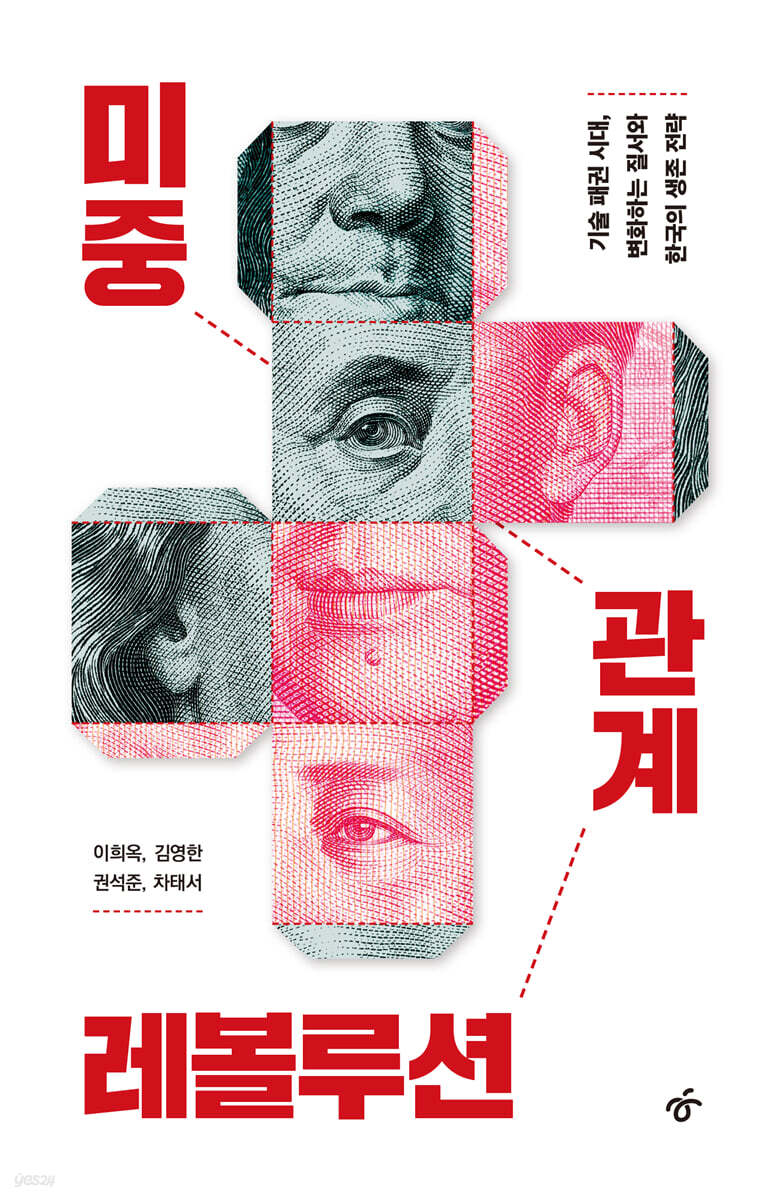
Revolution in US-China Relations
 |
Description
Book Introduction
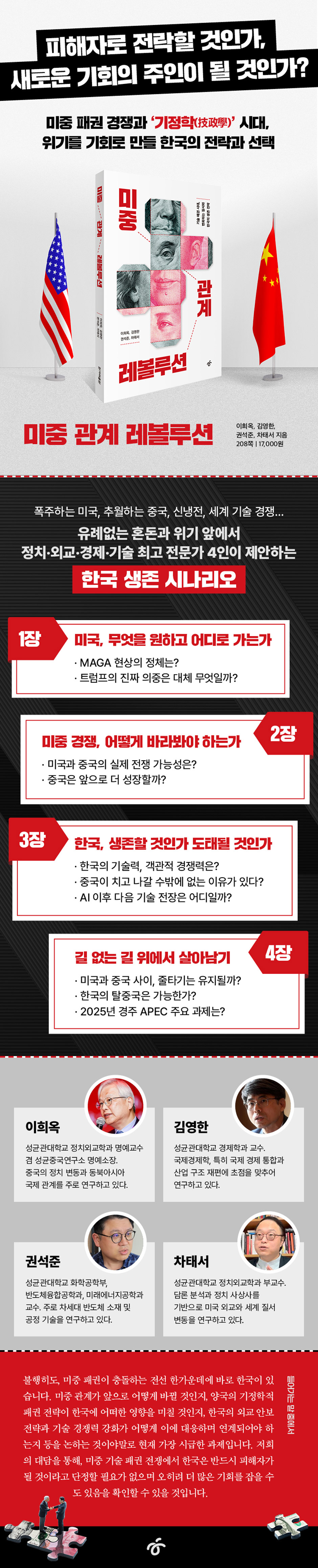
The era of US-China hegemony competition and 'technopolitics'
What are Korea's strategies and choices to turn crisis into opportunity?
According to a joint survey conducted by the JoongAng Ilbo and the East Asia Research Institute in June 2025, when asked what the biggest threat facing Korea is, approximately 65 percent of respondents answered “US-China strategic competition and conflict.”
The majority of the public is experiencing firsthand the intensifying US-China conflict since Trump's second term.
With South Korea still struggling to fully recover from the shock of the December 3 martial law incident, the escalating US-China conflict is a source of uncertainty that threatens to shake up the entire national strategy.
At the same time, the world is entering the era of 'technopolitics'.
In an era where technological advancement, not geographic environment, determines international order, AI, considered a new "game changer," has now become a pressing issue directly linked to national survival.
However, it is difficult to be optimistic about Korea's future.
Korea lacks the fundamental technology for GPU production and AI chips, and even in the DRAM semiconductor sector, where it is considered to have a comparative advantage, it is being overtaken by China at a frightening pace or has already been overtaken. Furthermore, Korea is highly dependent on overseas supply chains across the entire technology industry.
As a result, Korea's future will inevitably be greatly influenced by trends in the United States and China, and it must develop a sophisticated and effective survival strategy within this context.
"Revolution in US-China Relations" is a collection of discussions held by four experts in the fields of politics, economics, diplomacy, and technology, with a sense of urgency that Korea must confront the crisis it faces and find appropriate solutions.
Based on the knowledge content "Between Question Marks and Exclamation Marks" planned by the official YouTube channel of Sungkyunkwan University, this book reflects the latest trends in domestic and international political and economic situations, technology industry trends, and the Gyeongju APEC to be held on October 31, 2025.
Through this book, readers will be able to objectively assess current US-China relations, which are difficult to clearly explain solely through existing discourses such as realism and geopolitics, as well as Korea's existential crisis in the supply chain and its limitations in the field of AI.
Moreover, it will allow us to gauge Korea's future in the turbulent international order and even explore individual survival strategies.
What are Korea's strategies and choices to turn crisis into opportunity?
According to a joint survey conducted by the JoongAng Ilbo and the East Asia Research Institute in June 2025, when asked what the biggest threat facing Korea is, approximately 65 percent of respondents answered “US-China strategic competition and conflict.”
The majority of the public is experiencing firsthand the intensifying US-China conflict since Trump's second term.
With South Korea still struggling to fully recover from the shock of the December 3 martial law incident, the escalating US-China conflict is a source of uncertainty that threatens to shake up the entire national strategy.
At the same time, the world is entering the era of 'technopolitics'.
In an era where technological advancement, not geographic environment, determines international order, AI, considered a new "game changer," has now become a pressing issue directly linked to national survival.
However, it is difficult to be optimistic about Korea's future.
Korea lacks the fundamental technology for GPU production and AI chips, and even in the DRAM semiconductor sector, where it is considered to have a comparative advantage, it is being overtaken by China at a frightening pace or has already been overtaken. Furthermore, Korea is highly dependent on overseas supply chains across the entire technology industry.
As a result, Korea's future will inevitably be greatly influenced by trends in the United States and China, and it must develop a sophisticated and effective survival strategy within this context.
"Revolution in US-China Relations" is a collection of discussions held by four experts in the fields of politics, economics, diplomacy, and technology, with a sense of urgency that Korea must confront the crisis it faces and find appropriate solutions.
Based on the knowledge content "Between Question Marks and Exclamation Marks" planned by the official YouTube channel of Sungkyunkwan University, this book reflects the latest trends in domestic and international political and economic situations, technology industry trends, and the Gyeongju APEC to be held on October 31, 2025.
Through this book, readers will be able to objectively assess current US-China relations, which are difficult to clearly explain solely through existing discourses such as realism and geopolitics, as well as Korea's existential crisis in the supply chain and its limitations in the field of AI.
Moreover, it will allow us to gauge Korea's future in the turbulent international order and even explore individual survival strategies.
- You can preview some of the book's contents.
Preview
index
Introduction
Chapter 1: America: What It Wants and Where It's Going
The MAGA Phenomenon | The Political Engineering of Anger | Keeping the Yards Narrow, Keeping the Fences High | Has America Relinquished Its Hegemony? | Will the Strategy That Won 40 Years Ago Work Again? | Trump's Justified 'Ripping Off' Strategy | Is America Really Weakening?
Chapter 2: How Should We View the US-China Competition?
America's "Ingratitude Frame" | Is US-China Competition an Inevitable "Fate"? | A Critical Miscalculation by the US | This Approach to US-China Relations Must Be Cautioned | The Reality of the "Peak China Theory"?
Chapter 3: Will Korea Survive or Be Eliminated?
China's Paradoxical Innovation, Created by Sanctions and Deprivation | The Answer Lies in Past History | Now is Both a Crisis and an Opportunity | Korea at a Life-or-Death Crossroads | Four Secrets to China's AI Innovation | Why Korea Can't Follow China's Path | Timely Government Intervention is Essential | Post-AI: Where Will the Next Battleground Be?
Chapter 4: Surviving on the Road Without a Path
Will we be swept up or abandoned? | Impossible de-China or necessary de-China? | Before Korea aims to leap into the 'AI G3' | Are we facing the crisis properly? | In the cold winter of the new Cold War, what is our path? | Victory Day and APEC: Clues and opportunities not to be missed | In conclusion
Chapter 1: America: What It Wants and Where It's Going
The MAGA Phenomenon | The Political Engineering of Anger | Keeping the Yards Narrow, Keeping the Fences High | Has America Relinquished Its Hegemony? | Will the Strategy That Won 40 Years Ago Work Again? | Trump's Justified 'Ripping Off' Strategy | Is America Really Weakening?
Chapter 2: How Should We View the US-China Competition?
America's "Ingratitude Frame" | Is US-China Competition an Inevitable "Fate"? | A Critical Miscalculation by the US | This Approach to US-China Relations Must Be Cautioned | The Reality of the "Peak China Theory"?
Chapter 3: Will Korea Survive or Be Eliminated?
China's Paradoxical Innovation, Created by Sanctions and Deprivation | The Answer Lies in Past History | Now is Both a Crisis and an Opportunity | Korea at a Life-or-Death Crossroads | Four Secrets to China's AI Innovation | Why Korea Can't Follow China's Path | Timely Government Intervention is Essential | Post-AI: Where Will the Next Battleground Be?
Chapter 4: Surviving on the Road Without a Path
Will we be swept up or abandoned? | Impossible de-China or necessary de-China? | Before Korea aims to leap into the 'AI G3' | Are we facing the crisis properly? | In the cold winter of the new Cold War, what is our path? | Victory Day and APEC: Clues and opportunities not to be missed | In conclusion
Detailed image
Into the book
Interestingly, even the previous Biden administration, while not using the specific term "MAGA," had quite specific policy moves to regain American leadership in manufacturing and high-tech industries.
(Omitted) In particular, everyone knows that the IRA Act was ostensibly a law created to alleviate inflation, but in reality, it was a law targeting Chinese electric vehicles and their components, such as batteries.
So, why, among all the various industries, did they adopt such an unusual policy, reminiscent of World War II, for specific industries like semiconductors, electric vehicles, batteries, and even AI? Why would they go to such lengths to blatantly favor domestic industries and so strongly contain China?
--- p.28~30
Since joining the WTO in 2001, China has been a crucial contributor to the U.S. economy, particularly its demanufacturing.
(Omitted) The problem is that the labor force and production factors were not redistributed smoothly thereafter.
There were multiple shocks, including accumulating income inequality and the continued decline of traditional manufacturing jobs.
American voters who experienced this eventually came to believe that it was all because of China.
However, this perception of China, which was particularly prevalent among workers employed in comparatively disadvantaged sectors, was competitively exploited by both the Republican and Democratic parties.
They say that China is the country that made America unhappy, or that China is the country that created the current situation where the real income of most workers is not much different from 50 years ago.
--- p.65~66
It seems important to continue examining the context within which the domestic and international discourse surrounding Peak China is being produced.
The recent rumor of Xi Jinping's downfall seems similar.
It was a farce created by fake news coming from groups that wanted to shake up Chinese politics, whether it was Taiwanese intelligence agencies or anti-Chinese groups like Falun Gong, and passing through new media.
In the end, Xi Jinping's continued presence was clearly demonstrated through this 80th anniversary military parade.
Going forward, we must carefully examine where and in what context specific stories are produced, why they reach us through the United States and are amplified, and what political implications and contexts they are distributed and consumed within.
--- p.98~99
It's worth considering how DeepSeek was able to achieve this level of performance at such a low cost.
The reason, ironically, is that the United States has tightly controlled the export of graphics processing units (GPUs), which are currently produced almost exclusively in the United States, to Chinese AI startups, especially the high-performance, ultra-expensive GPUs made by Nvidia.
So, even though DeepSeek did not have sufficient capital and did not have a sufficiently secured internal semiconductor supply chain in China, it was able to optimize its internal resources by literally 'squeezing' them.
(Omitted) One thing we need to consider here is whether the shock from Deep Seek was a one-time thing or whether it was due to the special luck of a particular company.
I don't think it's a one-off, nor is it just a special 'innovation secret' of one company called DeepSec.
--- p.108~110
Even without considering the variable of China, Korea's current technological advantage in some fields is not very solid.
(Omitted) If the U.S. government were to immediately block Samsung Electronics and Hynix from using Synopsys or Cadence licenses, semiconductor production would effectively become impossible.
(Omitted) The strategy we can take in this situation is to secure an irreplaceable price-performance ratio and maintain a certain level of lead over next-generation technologies, rather than complete independence.
I believe this very point could be both a crisis and an opportunity for Korea.
--- p.124~127
It seems that China is also moving in the direction of thinking, "From now on, it's a competition to dominate ASI. This area has passed the point where agreement between countries is possible. From now on, it's going to be an endless competition."
I believe this change will have a profound impact not only on the United States and China, but also on Korea in the future.
In particular, the United States is pushing ASI and forcing other countries to 'join the AI ecosystem that the United States is creating.'
In the past, there was a choice, but now it's all or nothing.
Either join the ecosystem we've built or become our enemy.
Whether a country is currently an ally or friend of the United States, or how close it has been to the United States, no longer has much meaning.
--- p.135
The current climate in China is such that even athletes, farmers, and even police officers are considering utilizing AI in their fields. AI is spreading like a thread throughout society.
And China doesn't exaggerate its achievements in science and technology policy.
This is something we need to be very mindful of.
There is a word in Chinese called 'Jinruzi (?日子)'.
It means a time of austerity and poverty, but the underlying meaning is that 'now is the time to prepare, not to exaggerate achievements and show off.'
This means that China may be intentionally underestimating its own level of science and technology compared to what is perceived by outsiders.
--- p.139
Simply put, a superhuman is a being that does not age or get sick.
If there is a problem with any organ, it can be easily replaced.
Stem cells can be transformed into cultured organs, or they can be replaced with artificial organs or mechanical devices, making us cyborgs.
In fact, a company called Neuralink, founded by Elon Musk, is researching technology to selectively enhance human intelligence by implanting a type of chip in the cerebral cortex that can interact with neural networks.
It is highly likely that more technologies like this, which seem to appear only in science fiction, will emerge in the future.
One of the reasons I believe this is possible is that, once ASI is established, the areas where it can be applied first are not only the energy sector I mentioned earlier, but also the advanced bio-health sector.
--- p.153~154
Rather than approaching de-China as a vague ideological concept, I think we need to approach it concretely, calculating the costs we will have to pay and the benefits we will gain from de-China.
First, we may ask whether the kind of de-Chinaization the United States envisions—that is, a complete severance of strategic interaction with China in various supply chains and high-tech cooperation—is feasible, and whether it is truly desirable from the perspective of economic sustainability.
When I look at it, it seems fundamentally nonsense.
(Omitted) However, what is important is to break away from the deformed dependence on China that reduces the sustainability of our economy and industrial structure.
To minimize risks to our industrial structure, it is essential to move away from our over-reliance on the Chinese market itself and on the production bases of our major corporations in China.
--- p.168~169
The APEC summit will be held in Korea for the first time in 20 years from October 31 to November 1, 2025.
Korea holds the 'chairman's leverage' in this meeting.
We need to use this strategically.
(Omitted) In the United States, the importance of AI trust and safety issues is gradually weakening following Trump's executive order to "focus on AI innovation and securing America's technological superiority."
Without provoking the United States, we must cooperate with APEC member countries to establish "basic principles for AI trustworthiness, transparency, and safety" that adhere to OECD and G7 standards, and to discuss issues such as data access transparency.
(Omitted) In particular, everyone knows that the IRA Act was ostensibly a law created to alleviate inflation, but in reality, it was a law targeting Chinese electric vehicles and their components, such as batteries.
So, why, among all the various industries, did they adopt such an unusual policy, reminiscent of World War II, for specific industries like semiconductors, electric vehicles, batteries, and even AI? Why would they go to such lengths to blatantly favor domestic industries and so strongly contain China?
--- p.28~30
Since joining the WTO in 2001, China has been a crucial contributor to the U.S. economy, particularly its demanufacturing.
(Omitted) The problem is that the labor force and production factors were not redistributed smoothly thereafter.
There were multiple shocks, including accumulating income inequality and the continued decline of traditional manufacturing jobs.
American voters who experienced this eventually came to believe that it was all because of China.
However, this perception of China, which was particularly prevalent among workers employed in comparatively disadvantaged sectors, was competitively exploited by both the Republican and Democratic parties.
They say that China is the country that made America unhappy, or that China is the country that created the current situation where the real income of most workers is not much different from 50 years ago.
--- p.65~66
It seems important to continue examining the context within which the domestic and international discourse surrounding Peak China is being produced.
The recent rumor of Xi Jinping's downfall seems similar.
It was a farce created by fake news coming from groups that wanted to shake up Chinese politics, whether it was Taiwanese intelligence agencies or anti-Chinese groups like Falun Gong, and passing through new media.
In the end, Xi Jinping's continued presence was clearly demonstrated through this 80th anniversary military parade.
Going forward, we must carefully examine where and in what context specific stories are produced, why they reach us through the United States and are amplified, and what political implications and contexts they are distributed and consumed within.
--- p.98~99
It's worth considering how DeepSeek was able to achieve this level of performance at such a low cost.
The reason, ironically, is that the United States has tightly controlled the export of graphics processing units (GPUs), which are currently produced almost exclusively in the United States, to Chinese AI startups, especially the high-performance, ultra-expensive GPUs made by Nvidia.
So, even though DeepSeek did not have sufficient capital and did not have a sufficiently secured internal semiconductor supply chain in China, it was able to optimize its internal resources by literally 'squeezing' them.
(Omitted) One thing we need to consider here is whether the shock from Deep Seek was a one-time thing or whether it was due to the special luck of a particular company.
I don't think it's a one-off, nor is it just a special 'innovation secret' of one company called DeepSec.
--- p.108~110
Even without considering the variable of China, Korea's current technological advantage in some fields is not very solid.
(Omitted) If the U.S. government were to immediately block Samsung Electronics and Hynix from using Synopsys or Cadence licenses, semiconductor production would effectively become impossible.
(Omitted) The strategy we can take in this situation is to secure an irreplaceable price-performance ratio and maintain a certain level of lead over next-generation technologies, rather than complete independence.
I believe this very point could be both a crisis and an opportunity for Korea.
--- p.124~127
It seems that China is also moving in the direction of thinking, "From now on, it's a competition to dominate ASI. This area has passed the point where agreement between countries is possible. From now on, it's going to be an endless competition."
I believe this change will have a profound impact not only on the United States and China, but also on Korea in the future.
In particular, the United States is pushing ASI and forcing other countries to 'join the AI ecosystem that the United States is creating.'
In the past, there was a choice, but now it's all or nothing.
Either join the ecosystem we've built or become our enemy.
Whether a country is currently an ally or friend of the United States, or how close it has been to the United States, no longer has much meaning.
--- p.135
The current climate in China is such that even athletes, farmers, and even police officers are considering utilizing AI in their fields. AI is spreading like a thread throughout society.
And China doesn't exaggerate its achievements in science and technology policy.
This is something we need to be very mindful of.
There is a word in Chinese called 'Jinruzi (?日子)'.
It means a time of austerity and poverty, but the underlying meaning is that 'now is the time to prepare, not to exaggerate achievements and show off.'
This means that China may be intentionally underestimating its own level of science and technology compared to what is perceived by outsiders.
--- p.139
Simply put, a superhuman is a being that does not age or get sick.
If there is a problem with any organ, it can be easily replaced.
Stem cells can be transformed into cultured organs, or they can be replaced with artificial organs or mechanical devices, making us cyborgs.
In fact, a company called Neuralink, founded by Elon Musk, is researching technology to selectively enhance human intelligence by implanting a type of chip in the cerebral cortex that can interact with neural networks.
It is highly likely that more technologies like this, which seem to appear only in science fiction, will emerge in the future.
One of the reasons I believe this is possible is that, once ASI is established, the areas where it can be applied first are not only the energy sector I mentioned earlier, but also the advanced bio-health sector.
--- p.153~154
Rather than approaching de-China as a vague ideological concept, I think we need to approach it concretely, calculating the costs we will have to pay and the benefits we will gain from de-China.
First, we may ask whether the kind of de-Chinaization the United States envisions—that is, a complete severance of strategic interaction with China in various supply chains and high-tech cooperation—is feasible, and whether it is truly desirable from the perspective of economic sustainability.
When I look at it, it seems fundamentally nonsense.
(Omitted) However, what is important is to break away from the deformed dependence on China that reduces the sustainability of our economy and industrial structure.
To minimize risks to our industrial structure, it is essential to move away from our over-reliance on the Chinese market itself and on the production bases of our major corporations in China.
--- p.168~169
The APEC summit will be held in Korea for the first time in 20 years from October 31 to November 1, 2025.
Korea holds the 'chairman's leverage' in this meeting.
We need to use this strategically.
(Omitted) In the United States, the importance of AI trust and safety issues is gradually weakening following Trump's executive order to "focus on AI innovation and securing America's technological superiority."
Without provoking the United States, we must cooperate with APEC member countries to establish "basic principles for AI trustworthiness, transparency, and safety" that adhere to OECD and G7 standards, and to discuss issues such as data access transparency.
--- p.201~202
Publisher's Review
The True Face of America Revealed by 'MAGA'
What exactly does America want? Chapter 1 provides a three-dimensional analysis of the rise of Trump, the nature of the MAGA phenomenon, and America's current "true intentions."
The United States, which has claimed to be the defender of free trade and democracy since World War II, is now undermining the liberal order by implementing policies such as tariff bombs, establishing an America-first supply chain, and pressuring allies to shoulder more defense costs, all under the guise of "America First."
Is America's unpredictable behavior a temporary phenomenon stemming from the idiosyncrasies of one individual, Trump? The authors argue that the current state of the United States, epitomized by "MAGA (Make America Great Again)" slogan, is the result of a complex interplay of factors: the decline of American manufacturing due to globalization and the rise of China, mass unemployment and deepening inequality, the anxiety caused by the "majority-minority" phenomenon, and the political incompetence that has neglected this.
Since the 1980s, the wave of globalization has brought enormous wealth to the United States, but it has also spurred the rise of emerging economies like China.
The United States actively supported China's entry into the WTO in 2001 and attempted to manage "Rising China" within the liberal order, but as a result, American manufacturing was quickly replaced by Chinese manufacturing.
In addition, as the number of immigrants of color flowing into the United States increased, not only economic discontent but also cultural anxiety and conflict began to deepen.
This accumulated 'anger of half of America' is the very basis of the MAGA phenomenon.
In other words, MAGA is not a temporary political slogan born from a single cause, Trump, but rather an undeniable “new face of America” born from the contradictions and conflicts of the liberal order.
The authors also point out that the current US course of action is rooted in “the perception that ‘our allies have been eating us up over the past 30 years’” (p. 50).
According to the hegemonic stability theory, when the power of a hegemonic power is relatively weak, the existing hegemon focuses on short-term national interests and exhibits a predatory behavior that seeks to extract a kind of "tribute" from its allies. The current United States is similar to this.
So, is America's national power objectively declining? The authors argue that America's hard-line policy toward China and its protectionist trade policies are not due to a weakening of American power or a strengthening of Chinese power, but rather to a "rapid decline in the 'subjective will' of the United States" (p. 36), diagnosing that the United States is abandoning its role as a "benevolent hegemon providing global public goods."
The United States will now be blatantly focused solely on competition with China, and as such, South Korea must acknowledge that the existing perception of the United States as the "leader of the liberal order" is outdated and emphasize the need to closely monitor the intensifying US-China competition and the global trend toward de-unipolarity and multipolarity.
America's "Ingratitude Frame" and "Peak China Theory"
“US Secretary of State Marco Rubio has repeatedly denied the US-centric liberal international order that has persisted since the Cold War and acknowledged the emergence of a G2 system or multipolar system involving the US and China” (p. 58). Chapter 2 interprets the mutual perceptions and competitive structure of the US and China and examines what position South Korea should take within it.
At one time, the United States tried to assimilate China into the liberal order.
However, the tone changed drastically during the first Trump administration.
Professor Cha Tae-seo currently calls the U.S.’s frame toward China the “ingratitude frame” (p. 63).
“The US’s perception is that after supporting China’s accession to the WTO and giving it a chance, it is now trying to shake up the free world order” (p. 63).
Professor Kim Young-han also explained that this public perception in the U.S. stemmed from the sentiments of American manufacturing workers who felt their jobs were being stolen by China, and as a result, U.S. industrial policy increasingly focused on "securing competitiveness against China," which, coupled with the international leadership competition between the U.S. and China, further deepened the conflict between the two countries.
So, does this mean the US-China conflict is beyond resolution? Professor Kwon Seok-jun believes it will be difficult for the US to give up the benefits of free trade, such as technological compatibility and cost savings.
He also analyzed that “it is now becoming increasingly difficult for the United States to play the card of decoupling to contain China, and on the other hand, China has already achieved internalization and self-sufficiency in most industries, limiting the impact of sanctions” (p. 69).
The US-China conflict cannot simply devolve into a 'race to the bottom.'
Professor Lee Hee-ok goes a step further, stating, “Even if China wants a ‘battle of existence’ with the United States, the cost of a breakdown in negotiations is too high” (p. 76).
Realistically, open confrontation is inevitable, and as the US-China relationship unfolds amidst multilayered interests and close interdependence, South Korea needs to read its complex context more carefully going forward.
In this context, the analysis of the 'peak China theory' that was mainly developed in this chapter offers very important implications at a time when 'anti-Chinese sentiment' is spreading indiscriminately.
Has China already passed its growth peak? Or does it still have potential? We must not overlook the possibility that the various discourses surrounding China are the product of ideological interpretations.
For example, the 80th anniversary military parade held last year confirmed Xi Jinping's continued presence.
The recent rumor of Xi Jinping's downfall has clearly revealed itself to be fake news spread by external forces seeking to highlight China's instability.
The authors emphasize that to accurately understand US-China relations and devise strategies, it is necessary to objectively and dispassionately grasp the complex context surrounding these three countries.
In an era where technology is a weapon, Korea's present and future
Chapter 3 delves into the current state of the technology industries in the U.S., China, and Korea, and provides a detailed analysis of how Korea can secure its own competitiveness while maintaining its technological sovereignty amidst the U.S.-China competition.
In January 2025, the AI model 'DeepSeek-R1' released by the Chinese startup DeepSeek sent a huge shockwave around the world.
Currently, in China, AI is deeply penetrating our daily lives and promoting new technological developments, to the point where “a robot dog called ‘B2’ is clearing trash from Mount Tai, and Starbucks coffee is delivered by drone to the Great Wall of China” (p. 138).
Professors Kwon Seok-jun and Lee Hee-ok analyze that the fundamental cause of technological innovation in China is 'deficiency caused by the United States.'
Ironically, the United States' strong sanctions have promoted China's independence.
Moreover, China's massive investment in the technology sector foreshadows the possibility of a second or third DeepSec shock in the future.
What about Korea? The authors offer a sobering assessment: "At least in manufacturing and high-tech industries, Korea faces an existential crisis" (p. 123).
In addition, Professor Lee Hee-ok warns that “China may be intentionally underestimating its own technological level” (p. 139), and that innovation in China is progressing at a much faster rate than Korea realizes.
So, does this mean Korea has no chance of becoming a technologically advanced nation? Professor Kwon Seok-jun argues, "It's not that Korea has no way out of this situation" (p. 126).
With advanced semiconductor production technologies increasingly reaching their limits in terms of manufacturing processes, engineering, physics, and cost-effectiveness, now is the perfect time to secure technologies with superior price-performance ratios.
Meanwhile, the authors' four-part outlook on the next-generation technology battlefield after semiconductors and AI is one of the most interesting parts of this chapter.
Professors Kim Young-han and Kwon Seok-jun's insights into the question, "What is humanity's greatest deficiency and need now?" (p. 151) and "The answer can be found by thinking about what 'humanity's greatest challenge' is" (p. 154) stimulate diverse imaginations about future society.
Professor Kim Young-han's prediction that "people's main demand in the future will likely come from 'fields that make people less unhappy or happier'" (p. 152) is particularly meaningful in a situation where concerns are rampant that artificial intelligence and technology will alienate humans.
How will Korea become a leader in new opportunities?
Chapter 4 analyzes Korea's current situation, focusing on keywords that capture current issues such as the "ROK-US alliance," "de-China," and "sovereign AI," and suggests the direction Korea should take.
Regarding the Taiwan issue, South Korea faces two crises simultaneously: the "dilemma of involvement," which could lead to its being drawn into an unwanted conflict within the ROK-US alliance, and the "dilemma of abandonment," which could lead to its being abandoned if necessary.
This is a harsh diplomatic reality that has been newly highlighted as the US-China competition intensifies.
Meanwhile, the previous administration's excessive ideological approach diminished the realism of its perception of China and instead led to a reexamination of the effectiveness of de-China.
With South Korea-China trade surging into a deficit, is "de-China" truly necessary? If so, how far is it realistically feasible? Professor Kim Young-han asserts that the "complete de-China" demanded by the United States is unrealistic.
However, he also emphasizes the importance of a trade diversification strategy to reduce risks, stating that “escaping excessive dependence on the Chinese market and the Chinese production bases of our large corporations is an essential task for minimizing risks to the Korean industrial structure” (p. 169).
Professor Kwon Seok-jun also agrees with this perspective and suggests that Hyundai Motor Company's electric vehicle business case should be benchmarked in other industries.
So, what policy direction should Korea establish in the technology industry going forward? There's no disagreement that AI is now a core area that determines the nation's fate, and that both the government and the private sector must fully mobilize their capabilities.
The current government is pursuing various policies with the goal of achieving the "AI G3" leap forward, and various discussions, including sovereign AI, are actively underway under this framework.
Professor Kwon Seok-jun argues that “China, not the United States, is the country most likely to develop sovereign AI, sovereign AX, and sovereign vertical AI” (p. 183), and closely compares and analyzes the current state of the technology industry environments in the United States and China.
Furthermore, based on this, it objectively identifies what Korea lacks to become a true AI powerhouse and presents in detail the key conditions that must be secured in the future. This is sufficient to serve as a standard for objectively reviewing the current administration's AI policies.
Finally, by covering the North Korea-China-Russia connection between the 80th anniversary of China's Victory Day parade held in September and the APEC summit scheduled for October 31st in Gyeongju, we examine the implications of the recent international situation for Korea and provide a guide for a more three-dimensional understanding of US-China relations and the technology industry.
"The Revolution in US-China Relations" reminds us that the challenges facing South Korea amidst the intensifying US-China competition are not simply diplomatic choices, but strategic issues that will determine the nation's sustainability.
And he emphasizes that the answer lies not in which side one takes, but in how Korea establishes its own technological sovereignty and strategic autonomy.
What exactly does America want? Chapter 1 provides a three-dimensional analysis of the rise of Trump, the nature of the MAGA phenomenon, and America's current "true intentions."
The United States, which has claimed to be the defender of free trade and democracy since World War II, is now undermining the liberal order by implementing policies such as tariff bombs, establishing an America-first supply chain, and pressuring allies to shoulder more defense costs, all under the guise of "America First."
Is America's unpredictable behavior a temporary phenomenon stemming from the idiosyncrasies of one individual, Trump? The authors argue that the current state of the United States, epitomized by "MAGA (Make America Great Again)" slogan, is the result of a complex interplay of factors: the decline of American manufacturing due to globalization and the rise of China, mass unemployment and deepening inequality, the anxiety caused by the "majority-minority" phenomenon, and the political incompetence that has neglected this.
Since the 1980s, the wave of globalization has brought enormous wealth to the United States, but it has also spurred the rise of emerging economies like China.
The United States actively supported China's entry into the WTO in 2001 and attempted to manage "Rising China" within the liberal order, but as a result, American manufacturing was quickly replaced by Chinese manufacturing.
In addition, as the number of immigrants of color flowing into the United States increased, not only economic discontent but also cultural anxiety and conflict began to deepen.
This accumulated 'anger of half of America' is the very basis of the MAGA phenomenon.
In other words, MAGA is not a temporary political slogan born from a single cause, Trump, but rather an undeniable “new face of America” born from the contradictions and conflicts of the liberal order.
The authors also point out that the current US course of action is rooted in “the perception that ‘our allies have been eating us up over the past 30 years’” (p. 50).
According to the hegemonic stability theory, when the power of a hegemonic power is relatively weak, the existing hegemon focuses on short-term national interests and exhibits a predatory behavior that seeks to extract a kind of "tribute" from its allies. The current United States is similar to this.
So, is America's national power objectively declining? The authors argue that America's hard-line policy toward China and its protectionist trade policies are not due to a weakening of American power or a strengthening of Chinese power, but rather to a "rapid decline in the 'subjective will' of the United States" (p. 36), diagnosing that the United States is abandoning its role as a "benevolent hegemon providing global public goods."
The United States will now be blatantly focused solely on competition with China, and as such, South Korea must acknowledge that the existing perception of the United States as the "leader of the liberal order" is outdated and emphasize the need to closely monitor the intensifying US-China competition and the global trend toward de-unipolarity and multipolarity.
America's "Ingratitude Frame" and "Peak China Theory"
“US Secretary of State Marco Rubio has repeatedly denied the US-centric liberal international order that has persisted since the Cold War and acknowledged the emergence of a G2 system or multipolar system involving the US and China” (p. 58). Chapter 2 interprets the mutual perceptions and competitive structure of the US and China and examines what position South Korea should take within it.
At one time, the United States tried to assimilate China into the liberal order.
However, the tone changed drastically during the first Trump administration.
Professor Cha Tae-seo currently calls the U.S.’s frame toward China the “ingratitude frame” (p. 63).
“The US’s perception is that after supporting China’s accession to the WTO and giving it a chance, it is now trying to shake up the free world order” (p. 63).
Professor Kim Young-han also explained that this public perception in the U.S. stemmed from the sentiments of American manufacturing workers who felt their jobs were being stolen by China, and as a result, U.S. industrial policy increasingly focused on "securing competitiveness against China," which, coupled with the international leadership competition between the U.S. and China, further deepened the conflict between the two countries.
So, does this mean the US-China conflict is beyond resolution? Professor Kwon Seok-jun believes it will be difficult for the US to give up the benefits of free trade, such as technological compatibility and cost savings.
He also analyzed that “it is now becoming increasingly difficult for the United States to play the card of decoupling to contain China, and on the other hand, China has already achieved internalization and self-sufficiency in most industries, limiting the impact of sanctions” (p. 69).
The US-China conflict cannot simply devolve into a 'race to the bottom.'
Professor Lee Hee-ok goes a step further, stating, “Even if China wants a ‘battle of existence’ with the United States, the cost of a breakdown in negotiations is too high” (p. 76).
Realistically, open confrontation is inevitable, and as the US-China relationship unfolds amidst multilayered interests and close interdependence, South Korea needs to read its complex context more carefully going forward.
In this context, the analysis of the 'peak China theory' that was mainly developed in this chapter offers very important implications at a time when 'anti-Chinese sentiment' is spreading indiscriminately.
Has China already passed its growth peak? Or does it still have potential? We must not overlook the possibility that the various discourses surrounding China are the product of ideological interpretations.
For example, the 80th anniversary military parade held last year confirmed Xi Jinping's continued presence.
The recent rumor of Xi Jinping's downfall has clearly revealed itself to be fake news spread by external forces seeking to highlight China's instability.
The authors emphasize that to accurately understand US-China relations and devise strategies, it is necessary to objectively and dispassionately grasp the complex context surrounding these three countries.
In an era where technology is a weapon, Korea's present and future
Chapter 3 delves into the current state of the technology industries in the U.S., China, and Korea, and provides a detailed analysis of how Korea can secure its own competitiveness while maintaining its technological sovereignty amidst the U.S.-China competition.
In January 2025, the AI model 'DeepSeek-R1' released by the Chinese startup DeepSeek sent a huge shockwave around the world.
Currently, in China, AI is deeply penetrating our daily lives and promoting new technological developments, to the point where “a robot dog called ‘B2’ is clearing trash from Mount Tai, and Starbucks coffee is delivered by drone to the Great Wall of China” (p. 138).
Professors Kwon Seok-jun and Lee Hee-ok analyze that the fundamental cause of technological innovation in China is 'deficiency caused by the United States.'
Ironically, the United States' strong sanctions have promoted China's independence.
Moreover, China's massive investment in the technology sector foreshadows the possibility of a second or third DeepSec shock in the future.
What about Korea? The authors offer a sobering assessment: "At least in manufacturing and high-tech industries, Korea faces an existential crisis" (p. 123).
In addition, Professor Lee Hee-ok warns that “China may be intentionally underestimating its own technological level” (p. 139), and that innovation in China is progressing at a much faster rate than Korea realizes.
So, does this mean Korea has no chance of becoming a technologically advanced nation? Professor Kwon Seok-jun argues, "It's not that Korea has no way out of this situation" (p. 126).
With advanced semiconductor production technologies increasingly reaching their limits in terms of manufacturing processes, engineering, physics, and cost-effectiveness, now is the perfect time to secure technologies with superior price-performance ratios.
Meanwhile, the authors' four-part outlook on the next-generation technology battlefield after semiconductors and AI is one of the most interesting parts of this chapter.
Professors Kim Young-han and Kwon Seok-jun's insights into the question, "What is humanity's greatest deficiency and need now?" (p. 151) and "The answer can be found by thinking about what 'humanity's greatest challenge' is" (p. 154) stimulate diverse imaginations about future society.
Professor Kim Young-han's prediction that "people's main demand in the future will likely come from 'fields that make people less unhappy or happier'" (p. 152) is particularly meaningful in a situation where concerns are rampant that artificial intelligence and technology will alienate humans.
How will Korea become a leader in new opportunities?
Chapter 4 analyzes Korea's current situation, focusing on keywords that capture current issues such as the "ROK-US alliance," "de-China," and "sovereign AI," and suggests the direction Korea should take.
Regarding the Taiwan issue, South Korea faces two crises simultaneously: the "dilemma of involvement," which could lead to its being drawn into an unwanted conflict within the ROK-US alliance, and the "dilemma of abandonment," which could lead to its being abandoned if necessary.
This is a harsh diplomatic reality that has been newly highlighted as the US-China competition intensifies.
Meanwhile, the previous administration's excessive ideological approach diminished the realism of its perception of China and instead led to a reexamination of the effectiveness of de-China.
With South Korea-China trade surging into a deficit, is "de-China" truly necessary? If so, how far is it realistically feasible? Professor Kim Young-han asserts that the "complete de-China" demanded by the United States is unrealistic.
However, he also emphasizes the importance of a trade diversification strategy to reduce risks, stating that “escaping excessive dependence on the Chinese market and the Chinese production bases of our large corporations is an essential task for minimizing risks to the Korean industrial structure” (p. 169).
Professor Kwon Seok-jun also agrees with this perspective and suggests that Hyundai Motor Company's electric vehicle business case should be benchmarked in other industries.
So, what policy direction should Korea establish in the technology industry going forward? There's no disagreement that AI is now a core area that determines the nation's fate, and that both the government and the private sector must fully mobilize their capabilities.
The current government is pursuing various policies with the goal of achieving the "AI G3" leap forward, and various discussions, including sovereign AI, are actively underway under this framework.
Professor Kwon Seok-jun argues that “China, not the United States, is the country most likely to develop sovereign AI, sovereign AX, and sovereign vertical AI” (p. 183), and closely compares and analyzes the current state of the technology industry environments in the United States and China.
Furthermore, based on this, it objectively identifies what Korea lacks to become a true AI powerhouse and presents in detail the key conditions that must be secured in the future. This is sufficient to serve as a standard for objectively reviewing the current administration's AI policies.
Finally, by covering the North Korea-China-Russia connection between the 80th anniversary of China's Victory Day parade held in September and the APEC summit scheduled for October 31st in Gyeongju, we examine the implications of the recent international situation for Korea and provide a guide for a more three-dimensional understanding of US-China relations and the technology industry.
"The Revolution in US-China Relations" reminds us that the challenges facing South Korea amidst the intensifying US-China competition are not simply diplomatic choices, but strategic issues that will determine the nation's sustainability.
And he emphasizes that the answer lies not in which side one takes, but in how Korea establishes its own technological sovereignty and strategic autonomy.
GOODS SPECIFICS
- Date of issue: November 5, 2025
- Page count, weight, size: 208 pages | 300g | 130*200*13mm
- ISBN13: 9791172133269
You may also like
카테고리
korean


korean

![GQ KOREA Mark (Monthly): December [2025]](http://librairie.coreenne.fr/cdn/shop/files/8ef265dbbfbf186523ed75ba7319009d.jpg?v=1765340328&width=3840)


