

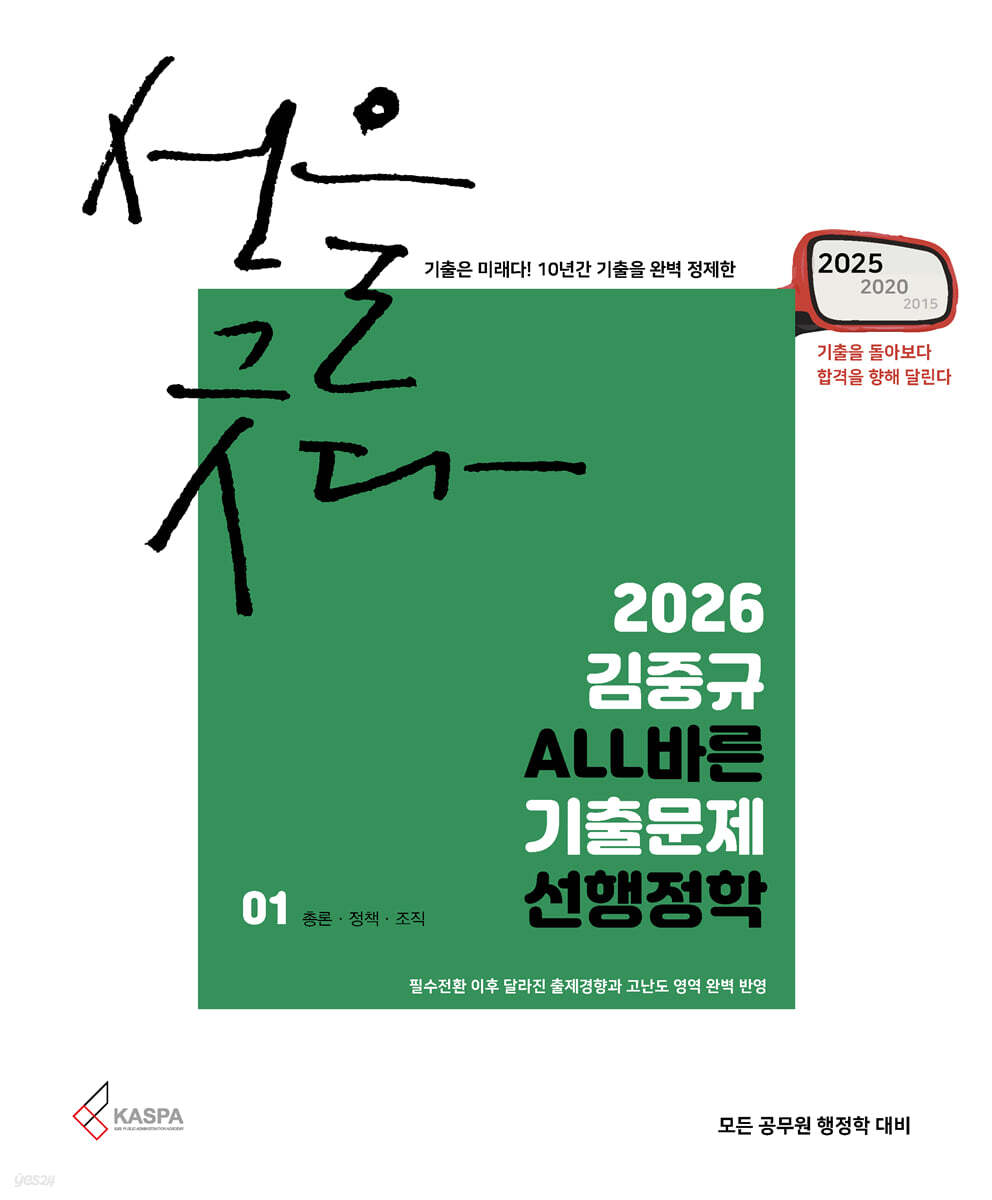
2026 Kim Jung-gyu ALL Correct Past Exam Questions Pre-School Suspension
 |
Description
Book Introduction
First, it is an integrated collection of past exam questions for all civil service administrative studies, including grades 9 and 7.
Second, it fully reflects recent past exam questions and revised laws.
Third, we have carefully selected and refined approximately 1,600 questions.
Fourth, the theory and the problem were systematically linked.
Fifth, 100% full fingerprint explanations were provided.
Sixth, we did not avoid controversial issues.
Seventh, the path to finding the correct answer and the memorization technique were presented as tips.
Eighth, it was created together with the successful candidates.
Ninth, it was made so that it could also serve as a basic book.
Tenth, matters requiring attention were emphasized separately.
Eleventh, perfectly reflecting the recent increase in difficulty.
Lastly, the difficulty and importance of each problem were indicated.
Second, it fully reflects recent past exam questions and revised laws.
Third, we have carefully selected and refined approximately 1,600 questions.
Fourth, the theory and the problem were systematically linked.
Fifth, 100% full fingerprint explanations were provided.
Sixth, we did not avoid controversial issues.
Seventh, the path to finding the correct answer and the memorization technique were presented as tips.
Eighth, it was created together with the successful candidates.
Ninth, it was made so that it could also serve as a basic book.
Tenth, matters requiring attention were emphasized separately.
Eleventh, perfectly reflecting the recent increase in difficulty.
Lastly, the difficulty and importance of each problem were indicated.
- You can preview some of the book's contents.
Preview
index
Chapter 1: Basic Theories of Public Administration
Section 1 The Nature of Administration
01 Concept of Administration 3
02 Administration as a Public Good 5
03 Administrative Functions & Administrative Processes 10
Section 2 Administration and Environment
01 Politics of Administration 11
02 Administration and Management 14
03 Civil Society and the Third Sector/NGOs 16
04 Social Capital 19
Section 3 Changes in Administration
01 Characteristics of Modern Administration 23
02 Progressive and Conservative Views of Government 26
03 Administration in Post-Industrial Society (Postmodernity) 27
Section 4: The Reason for the Existence of Administration - Market Failure
01 Market Failure 28
02 Government Regulations 30
03 Administrative Map 39
Section 5: Limitations of Administration - Government Failure and Response
01 Government Failure 40
02 Appropriate supply scale of public goods 45
03 Reduction Management Theory - Small Government Theory 47
04 Privatization of the Public Sector 48
Section 6: Direction and Value of Administration
01 Changes in Administrative Ideology and Relationships 54
02 The Essential Value of Administration 56
03 The Instrumental Value of Administration 62
Comprehensive Administrative Philosophy 68
Section 7: Characteristics and System of Public Administration
01 The Nature and Approach of Public Administration 72
02 The Establishment and Development of Public Administration 74
Section 8: Major theories of public administration
01 Scientific Management Theory 78
02 Human Relations 80
03 Behavioral Approach 82
04 Ecological Approach 85
05 Systems Approach 86
06 Comparative Public Administration 88
07 Development Administration Theory 89
08 New Administrative Theory 90
09 Phenomenology 94
10 Critical Public Administration and Discourse Theory 96
11 Public Choice Theory 97
12 New Institutional Theory 105
13 New Public Management Theory 113
14 Governance Theory 118
15 New Public Service Theory 129
16 Post-New Public Management Theory 134
17 Nudge Theory and Public Value Management Theory 136
Comprehensive Administrative Theory 140
Chapter 2 Policy Theory
Section 1: The Nature of Policy and Policy Science
01 The Characteristics and Essence of Policy Science 155
02 The Nature and Types of Policy 157
Section 2 Policy Agenda and Policy Goals
01 Setting the Policy Agenda 169
02 Theoretical Model on Policy Agenda Setting 178
03 Policy Network Model 187
04 Policy Goal 193
Section 3 Policy Analysis and Future Forecasting
01 Exploring and Evaluating Policy Alternatives 195
02 Types and Dimensions of Policy Analysis 196
03 System Analysis 197
04 Management Science 203
05 Intuitive (Judgmental) Prediction 204
06 Uncertainty and Future Forecasting 210
Section 4 Policy Decisions
01 The Nature and Process of Policy Decision-Making 214
02 Policy Decision Factor Theory 216
03 Individual-Level Decision-Making Model 218
04 Group-Level Decision-Making Model 226
Comprehensive Policy Decision Model 235
Section 5 Policy Execution
01 The Essence of Policy Execution 241
02 Research and Theory on Policy Implementation 242
03 Policy Implementation Theory 245
04 Factors Influencing Policy Implementation 259
Section 6 Planning
01 The Essence of Planning 262
02 Development and Types of Planning 263
Section 7 Policy Evaluation and Feedback
01 The Nature and Purpose of Policy Evaluation 264
02 Types and Methods of Policy Evaluation 266
03 Government Performance Evaluation 270
04 Causality, Variables, and Validity 275
05 Policy Evaluation Methods: Experiment 284
06 Policy Changes and Reflux 292
Chapter 3 Organizational Theory
Section 1: The Nature and Basic Theory of Organization
01 Types of Organizations 299
02 Evolution and Types of Organizational Theory 311
Section 2 Organizational Behavior
01 Human Relations and Motivation Theory 314
Comprehensive Motivation Theory 324
02 Organizational Culture 333
03 Communication 336
04 Conflict 338
05 Power 345
06 Leadership 346
Section 3 Organizational Structure Theory
01 Organizational Structural Variables 358
02 Principles of Organization 367
03 Bureaucracy 371
04 Adhocracy 377
05 Formal and Informal Organizations 388
06 Line and Staff 389
07 Committee (Consensual Administrative Body) 391
08 Government Organizational Structure 393
09 Responsible Management Agency 398
10 public corporations 404
Section 4 Organizational Environment Theory
01 Macro-Organizational Theory 409
02 Chaos Theory 418
Section 5 Organizational Management Theory
01 Administrative PR and Information Disclosure 420
02 Management by Objectives (MBO) 423
03 Organization Development (OD) 426
04 Strategic Management & Crisis Management 429
05 Reengineering 431
06 Total Quality Management (TQM) 432
07 Citizens' Charter - Administrative Service Charter 436
08 Performance Management - Performance-Oriented Administration 437
09 Balanced Scorecard (BSC) 439
Comprehensive Performance Management 444
Chapter 4: Personnel Administration
Section 1: Basic Theory of Personnel Administration
01 Characteristics and Flow of Personnel Administration 449
02 Leaf Crown 450
03 Performance-based 453
04 Career Civil Service System 457
05 Representative Bureaucracy 461
Evolution of the Comprehensive Personnel Administration System 466
06 Central Personnel Administration Agency 470
07 Active Personnel Administration & Human Resource Management 747
Section 2 Classification of Public Offices
01 Career and Special Career Positions 478
02 Open and Closed Greetings 484
03 Class System 489
04 Position Classification System 491
05 Senior Civil Service System 499
Section 3 Appointment of Civil Servants
01 Appointment 503
02 Test 506
Section 4: Capacity Development of Civil Servants
01 Training 511
02 Performance Evaluation 513
03 Promotion, Reassignment, and Career Development 523
04 Competency-Based Personnel Management 527
Section 5: Welfare and morale of public officials
01 Civil servant fraud 530
02 Civil servant compensation 531
03 Civil Servant Pension 537
04 Identity Guarantee 543
05 Civil Service Organization - Civil Service Union 553
Section 6 Public Service Ethics and Corruption
01 Political Neutrality 559
02 Public Service Ethics 561
03 Public Corruption 577
04 Whistleblower Protection System 581
Chapter 5: Financial Administration
Section 1: Concept and Essence of Budget
01 Budget and Finance 585
02 Budget-Related Law 587
03 Planning and Budgeting, Central Budget Agency 596
04 Functions of the Budget 598
05 Budget Principles 600
06 Classification of Budget 608
Section 2 Types of Budgets
01 Classification by nature of revenue and expenditure 612
02 Government Fund 615
03 Integrated Finance 620
04 Tax Expenditure Budget 623
05 Gender Equality Budget (Gender Budget) 626
06 Original Budget, Revised Budget, and Supplementary Budget 628
07 Supplementary Budget, Provisional Budget, and Provisional Budget 630
Comprehensive Budget Type 632
Section 3 Budget Decision Theory
01 Development and Types of Budget Theory 637
02 Budgetary Rationalism and Incrementalism 638
03 Resource Scarcity and the Discipline of Public Expenditure Management 645
Section 4 Budget System Theory
01 Budget by Item (LIBS) 647
02 Performance-Based Budgeting (PBS) 649
03 Planning Budget (PPBS) 653
04 Zero Base Budget (ZBB) 656
05 Capital Budgeting (CBS) 661
06. NPB (Non-Profitable Budget) 665
Comprehensive Budget System 671
Section 5 Budget Process
01 Budget Cycle 679
02 Budget Preparation 682
03 Budget Review 686
04 Budget Execution 689
05 Purchasing Administration (Procurement Administration) 704
06 Settlement 705
07 Government Accounting 708
08 Accounting Audit 717
Comprehensive Budget Process 719
Chapter 6: Theory of Reflux Administration
Section 1 Administrative Responsibility
01 Administrative Responsibility 725
02 Administrative Control 729
03 Ombudsman System 736
04 Civil Affairs Administration 740
05 Administrative Participation 742
06 Participatory Budgeting System 744
Section 2 Administrative Reform
01 The Essence of Administrative Reform 749
02 Administrative Reforms and Lessons from Advanced Countries 752
03 Administrative Reform in Our Country 753
Section 3 Informatization and Administration
01 Knowledge Information Society and Administration 756
02 Administrative Information System 760
03 E-Government 764
04 Knowledge Administration Management 781
Chapter 7 Local Autonomy
Section 1 Basic Theory of Local Autonomy
01 Concept and Characteristics of Local Administration 785
02 The Essence and Value of Local Autonomy 786
03 Autonomy 791
04 The Evolution and History of Local Autonomy 795
05 Local Autonomy in Our Country 798
Section 2 Relationship between local governments and the state
01 Intergovernmental Relations 805
02 Central Control 812
03 Special Local Government Agencies (Frontline Agencies) 818
04 Intergovernmental Conflicts and Disputes 821
05 Metropolitan Administration 824
Section 3 Organization of local governments
01 Types of Local Governments 830
02 Hierarchical Structure of Local Governments 835
03 Local Government District 838
04 Organizational Structure of Local Governments 839
Comprehensive Local Autonomy System in Korea 852
Section 4 Functions and Affairs of Local Governments
01 Distribution of local government functions 855
02 Local Government Affairs 860
Section 5 Local Government Finances
01 The Nature and System of Local Finance 868
02 Evaluation of Local Financial Capacity 870
03 Local Tax 874
04 Non-tax income 881
05 Local Public Enterprises 884
06 National Treasury Subsidy 888
07 Local government allocation tax 890
08 Municipal Bond 896
Comprehensive Local Finance 898
Section 6 Local Autonomy and Residents
01 Resident Participation 902
02 Residents' Lawsuit 907
03 Referendum 908
04 Resident Recall 912
Comprehensive Citizen Participation 913
supplement
Comparison and Summary of Amendments to the Local Autonomy Act 922
Comparative Summary of the Citizens' Initiative Act 923
Comparison and Summary of the Amendments to the Resident Referendum Act 923
Section 1 The Nature of Administration
01 Concept of Administration 3
02 Administration as a Public Good 5
03 Administrative Functions & Administrative Processes 10
Section 2 Administration and Environment
01 Politics of Administration 11
02 Administration and Management 14
03 Civil Society and the Third Sector/NGOs 16
04 Social Capital 19
Section 3 Changes in Administration
01 Characteristics of Modern Administration 23
02 Progressive and Conservative Views of Government 26
03 Administration in Post-Industrial Society (Postmodernity) 27
Section 4: The Reason for the Existence of Administration - Market Failure
01 Market Failure 28
02 Government Regulations 30
03 Administrative Map 39
Section 5: Limitations of Administration - Government Failure and Response
01 Government Failure 40
02 Appropriate supply scale of public goods 45
03 Reduction Management Theory - Small Government Theory 47
04 Privatization of the Public Sector 48
Section 6: Direction and Value of Administration
01 Changes in Administrative Ideology and Relationships 54
02 The Essential Value of Administration 56
03 The Instrumental Value of Administration 62
Comprehensive Administrative Philosophy 68
Section 7: Characteristics and System of Public Administration
01 The Nature and Approach of Public Administration 72
02 The Establishment and Development of Public Administration 74
Section 8: Major theories of public administration
01 Scientific Management Theory 78
02 Human Relations 80
03 Behavioral Approach 82
04 Ecological Approach 85
05 Systems Approach 86
06 Comparative Public Administration 88
07 Development Administration Theory 89
08 New Administrative Theory 90
09 Phenomenology 94
10 Critical Public Administration and Discourse Theory 96
11 Public Choice Theory 97
12 New Institutional Theory 105
13 New Public Management Theory 113
14 Governance Theory 118
15 New Public Service Theory 129
16 Post-New Public Management Theory 134
17 Nudge Theory and Public Value Management Theory 136
Comprehensive Administrative Theory 140
Chapter 2 Policy Theory
Section 1: The Nature of Policy and Policy Science
01 The Characteristics and Essence of Policy Science 155
02 The Nature and Types of Policy 157
Section 2 Policy Agenda and Policy Goals
01 Setting the Policy Agenda 169
02 Theoretical Model on Policy Agenda Setting 178
03 Policy Network Model 187
04 Policy Goal 193
Section 3 Policy Analysis and Future Forecasting
01 Exploring and Evaluating Policy Alternatives 195
02 Types and Dimensions of Policy Analysis 196
03 System Analysis 197
04 Management Science 203
05 Intuitive (Judgmental) Prediction 204
06 Uncertainty and Future Forecasting 210
Section 4 Policy Decisions
01 The Nature and Process of Policy Decision-Making 214
02 Policy Decision Factor Theory 216
03 Individual-Level Decision-Making Model 218
04 Group-Level Decision-Making Model 226
Comprehensive Policy Decision Model 235
Section 5 Policy Execution
01 The Essence of Policy Execution 241
02 Research and Theory on Policy Implementation 242
03 Policy Implementation Theory 245
04 Factors Influencing Policy Implementation 259
Section 6 Planning
01 The Essence of Planning 262
02 Development and Types of Planning 263
Section 7 Policy Evaluation and Feedback
01 The Nature and Purpose of Policy Evaluation 264
02 Types and Methods of Policy Evaluation 266
03 Government Performance Evaluation 270
04 Causality, Variables, and Validity 275
05 Policy Evaluation Methods: Experiment 284
06 Policy Changes and Reflux 292
Chapter 3 Organizational Theory
Section 1: The Nature and Basic Theory of Organization
01 Types of Organizations 299
02 Evolution and Types of Organizational Theory 311
Section 2 Organizational Behavior
01 Human Relations and Motivation Theory 314
Comprehensive Motivation Theory 324
02 Organizational Culture 333
03 Communication 336
04 Conflict 338
05 Power 345
06 Leadership 346
Section 3 Organizational Structure Theory
01 Organizational Structural Variables 358
02 Principles of Organization 367
03 Bureaucracy 371
04 Adhocracy 377
05 Formal and Informal Organizations 388
06 Line and Staff 389
07 Committee (Consensual Administrative Body) 391
08 Government Organizational Structure 393
09 Responsible Management Agency 398
10 public corporations 404
Section 4 Organizational Environment Theory
01 Macro-Organizational Theory 409
02 Chaos Theory 418
Section 5 Organizational Management Theory
01 Administrative PR and Information Disclosure 420
02 Management by Objectives (MBO) 423
03 Organization Development (OD) 426
04 Strategic Management & Crisis Management 429
05 Reengineering 431
06 Total Quality Management (TQM) 432
07 Citizens' Charter - Administrative Service Charter 436
08 Performance Management - Performance-Oriented Administration 437
09 Balanced Scorecard (BSC) 439
Comprehensive Performance Management 444
Chapter 4: Personnel Administration
Section 1: Basic Theory of Personnel Administration
01 Characteristics and Flow of Personnel Administration 449
02 Leaf Crown 450
03 Performance-based 453
04 Career Civil Service System 457
05 Representative Bureaucracy 461
Evolution of the Comprehensive Personnel Administration System 466
06 Central Personnel Administration Agency 470
07 Active Personnel Administration & Human Resource Management 747
Section 2 Classification of Public Offices
01 Career and Special Career Positions 478
02 Open and Closed Greetings 484
03 Class System 489
04 Position Classification System 491
05 Senior Civil Service System 499
Section 3 Appointment of Civil Servants
01 Appointment 503
02 Test 506
Section 4: Capacity Development of Civil Servants
01 Training 511
02 Performance Evaluation 513
03 Promotion, Reassignment, and Career Development 523
04 Competency-Based Personnel Management 527
Section 5: Welfare and morale of public officials
01 Civil servant fraud 530
02 Civil servant compensation 531
03 Civil Servant Pension 537
04 Identity Guarantee 543
05 Civil Service Organization - Civil Service Union 553
Section 6 Public Service Ethics and Corruption
01 Political Neutrality 559
02 Public Service Ethics 561
03 Public Corruption 577
04 Whistleblower Protection System 581
Chapter 5: Financial Administration
Section 1: Concept and Essence of Budget
01 Budget and Finance 585
02 Budget-Related Law 587
03 Planning and Budgeting, Central Budget Agency 596
04 Functions of the Budget 598
05 Budget Principles 600
06 Classification of Budget 608
Section 2 Types of Budgets
01 Classification by nature of revenue and expenditure 612
02 Government Fund 615
03 Integrated Finance 620
04 Tax Expenditure Budget 623
05 Gender Equality Budget (Gender Budget) 626
06 Original Budget, Revised Budget, and Supplementary Budget 628
07 Supplementary Budget, Provisional Budget, and Provisional Budget 630
Comprehensive Budget Type 632
Section 3 Budget Decision Theory
01 Development and Types of Budget Theory 637
02 Budgetary Rationalism and Incrementalism 638
03 Resource Scarcity and the Discipline of Public Expenditure Management 645
Section 4 Budget System Theory
01 Budget by Item (LIBS) 647
02 Performance-Based Budgeting (PBS) 649
03 Planning Budget (PPBS) 653
04 Zero Base Budget (ZBB) 656
05 Capital Budgeting (CBS) 661
06. NPB (Non-Profitable Budget) 665
Comprehensive Budget System 671
Section 5 Budget Process
01 Budget Cycle 679
02 Budget Preparation 682
03 Budget Review 686
04 Budget Execution 689
05 Purchasing Administration (Procurement Administration) 704
06 Settlement 705
07 Government Accounting 708
08 Accounting Audit 717
Comprehensive Budget Process 719
Chapter 6: Theory of Reflux Administration
Section 1 Administrative Responsibility
01 Administrative Responsibility 725
02 Administrative Control 729
03 Ombudsman System 736
04 Civil Affairs Administration 740
05 Administrative Participation 742
06 Participatory Budgeting System 744
Section 2 Administrative Reform
01 The Essence of Administrative Reform 749
02 Administrative Reforms and Lessons from Advanced Countries 752
03 Administrative Reform in Our Country 753
Section 3 Informatization and Administration
01 Knowledge Information Society and Administration 756
02 Administrative Information System 760
03 E-Government 764
04 Knowledge Administration Management 781
Chapter 7 Local Autonomy
Section 1 Basic Theory of Local Autonomy
01 Concept and Characteristics of Local Administration 785
02 The Essence and Value of Local Autonomy 786
03 Autonomy 791
04 The Evolution and History of Local Autonomy 795
05 Local Autonomy in Our Country 798
Section 2 Relationship between local governments and the state
01 Intergovernmental Relations 805
02 Central Control 812
03 Special Local Government Agencies (Frontline Agencies) 818
04 Intergovernmental Conflicts and Disputes 821
05 Metropolitan Administration 824
Section 3 Organization of local governments
01 Types of Local Governments 830
02 Hierarchical Structure of Local Governments 835
03 Local Government District 838
04 Organizational Structure of Local Governments 839
Comprehensive Local Autonomy System in Korea 852
Section 4 Functions and Affairs of Local Governments
01 Distribution of local government functions 855
02 Local Government Affairs 860
Section 5 Local Government Finances
01 The Nature and System of Local Finance 868
02 Evaluation of Local Financial Capacity 870
03 Local Tax 874
04 Non-tax income 881
05 Local Public Enterprises 884
06 National Treasury Subsidy 888
07 Local government allocation tax 890
08 Municipal Bond 896
Comprehensive Local Finance 898
Section 6 Local Autonomy and Residents
01 Resident Participation 902
02 Residents' Lawsuit 907
03 Referendum 908
04 Resident Recall 912
Comprehensive Citizen Participation 913
supplement
Comparison and Summary of Amendments to the Local Autonomy Act 922
Comparative Summary of the Citizens' Initiative Act 923
Comparison and Summary of the Amendments to the Resident Referendum Act 923
Publisher's Review
2026 Kim Jung-gyu ALL Correct Past Exam Questions The characteristics and strengths of pre-existing studies are
First, it is an integrated collection of past exam questions for all civil service administrative studies, including grades 9 and 7.
For the convenience of test takers preparing for multiple exams, this book covers a wide range of administrative exams, including 9th and 7th grade exams, National Assembly exams, police exams, military exams, public corporation exams, and other exams. It has been refined, analyzed, and compiled across various past exam questions, transcending the boundaries of previous exam questions, and has been integrated and published in two volumes in line with the 2026 basic textbook system.
Second, it fully reflects recent past exam questions and revised laws.
All past exam questions have been revised to reflect changes in the system since the exam was first presented, recent revisions to laws and regulations (including the Government Organization Act, the Resident Referendum Act, the Public Institution Operation Act, the Civil Servants' Union Act, the National Accounting Act, and the Local Autonomy Act), and other changes in a timely and realistic manner.
In particular, in the case of the “Local Autonomy Act,” the changes from the previous version were compared and organized for the benefit of retakers and included in the appendix.
Not only the civil service exam, but also some important questions from recent public enterprise and military service exams are included, and even the 2025 National Assembly 8th grade, national 9th grade, and local 9th grade questions that were recently administered are all analyzed and included.
Third, we have carefully selected and refined approximately 1,600 questions.
We have carefully selected and refined over 1,600 questions from the past 10 years.
After thoroughly analyzing past exam questions, we boldly excluded questions that had lost their timeliness, were similar or duplicated, were one-time questions, or were unlikely to be re-asked. We strictly refined the questions to only those with a high probability of being re-asked, and finally selected approximately 1,600 questions (including 100 questions for Grade 7).
However, this does not mean that there are any gaps in the connection or flow of the problem, and the net is tightly woven to ensure that not a single problem is left out.
So, although the quantity has decreased slightly, the quality has actually increased.
Fourth, we systematically linked theory and problem.
By systematically linking theory and problems and arranging key theories and summary tables, we have taken care to ensure that any parts not understood at the theory stage can be understood at the previous exam stage.
Fifth, I added 100% full fingerprint explanations.
We have included explanations and summaries as concisely and clearly as possible, and have provided explanations for each correct passage as well as the incorrect passage for every question, so that test takers can clearly understand why the passage is correct, why it is incorrect, and which part is incorrect.
In particular, unlike other textbooks on the market that consistently provide half-hearted explanations that seem to only roughly fit the correct answer, we have made every effort to provide accurate and clear explanations based on theory.
Sixth, we did not avoid controversial issues.
Rather than excluding or avoiding controversial issues, we tackled them head-on. Furthermore, out of consideration for test-takers who might be harmed by incorrect explanations, we attempted to provide open and bold explanations that corrected even the errors in other textbooks based on questions posted on the Kaspa (Kim Jung-gyu Public Administration Academy) bulletin board.
In preparation for the mandatory subject of public administration, we have further strengthened the breadth and depth of our explanations to provide a high-scoring strategy.
Seventh, we have provided tips on how to find the correct answer and how to memorize it.
For important, frequently asked, or incorrect questions, we created a “Junggyu Teacher Tips” section that provides not only simple answers but also the process and path to solving the problem, so that you can solve the problem quickly and easily by pattern without making mistakes.
In addition, for problems that require the use of memorization techniques that were emphasized in class, I have even marked the memorization techniques as good.
Eighth, it was created together with the successful candidates.
We have reflected and improved all the areas that students who have been studying with advanced textbooks have been disappointed with, and have presented the process and ideas that students who have been successful in solving problems as tips for students who have been successful, tailored to the test takers' level.
Ninth, it can also serve as a basic book.
For parts that require organization or understanding, supplementary explanations are provided in the form of summary tables and comments, so that the collection of past exam questions can serve as a basic textbook, making it feel like you are listening to a lecture.
Tenth, the points requiring attention are emphasized separately.
Confusing or important information that determines whether you get a high score or not is clearly summarized and organized in a simple and clear manner by placing it in a prominent notice format at the bottom of the question.
Eleventh, it perfectly reflects the recent increase in difficulty.
Since the introduction of the 9th grade mandatory subject and the 7th grade PAST, we have fully reflected the changing trends in exam questions and even the most difficult areas. In particular, we have provided thorough explanations for the difficult legal questions that have been frequently appearing recently.
Finally, we have marked each problem by its difficulty and importance.
We have indicated the importance and difficulty of each problem to help you choose the right one to study.
Difficulty and importance are different.
Importance refers to the importance of a problem that must be known, taking into account factors such as the possibility of it being re-issued in the future, and difficulty refers to the skill or technique required to solve the problem, as well as the frequency of mistakes.
This is presented separately to prevent test takers from making the common mistake of focusing on difficult questions (high-difficulty questions) rather than important questions as the exam approaches.
Importance is much more meaningful and important than difficulty.
As the exam approaches, it is recommended that you focus on finishing important problems rather than problems that you frequently make mistakes on (unimportant problems).
First, it is an integrated collection of past exam questions for all civil service administrative studies, including grades 9 and 7.
For the convenience of test takers preparing for multiple exams, this book covers a wide range of administrative exams, including 9th and 7th grade exams, National Assembly exams, police exams, military exams, public corporation exams, and other exams. It has been refined, analyzed, and compiled across various past exam questions, transcending the boundaries of previous exam questions, and has been integrated and published in two volumes in line with the 2026 basic textbook system.
Second, it fully reflects recent past exam questions and revised laws.
All past exam questions have been revised to reflect changes in the system since the exam was first presented, recent revisions to laws and regulations (including the Government Organization Act, the Resident Referendum Act, the Public Institution Operation Act, the Civil Servants' Union Act, the National Accounting Act, and the Local Autonomy Act), and other changes in a timely and realistic manner.
In particular, in the case of the “Local Autonomy Act,” the changes from the previous version were compared and organized for the benefit of retakers and included in the appendix.
Not only the civil service exam, but also some important questions from recent public enterprise and military service exams are included, and even the 2025 National Assembly 8th grade, national 9th grade, and local 9th grade questions that were recently administered are all analyzed and included.
Third, we have carefully selected and refined approximately 1,600 questions.
We have carefully selected and refined over 1,600 questions from the past 10 years.
After thoroughly analyzing past exam questions, we boldly excluded questions that had lost their timeliness, were similar or duplicated, were one-time questions, or were unlikely to be re-asked. We strictly refined the questions to only those with a high probability of being re-asked, and finally selected approximately 1,600 questions (including 100 questions for Grade 7).
However, this does not mean that there are any gaps in the connection or flow of the problem, and the net is tightly woven to ensure that not a single problem is left out.
So, although the quantity has decreased slightly, the quality has actually increased.
Fourth, we systematically linked theory and problem.
By systematically linking theory and problems and arranging key theories and summary tables, we have taken care to ensure that any parts not understood at the theory stage can be understood at the previous exam stage.
Fifth, I added 100% full fingerprint explanations.
We have included explanations and summaries as concisely and clearly as possible, and have provided explanations for each correct passage as well as the incorrect passage for every question, so that test takers can clearly understand why the passage is correct, why it is incorrect, and which part is incorrect.
In particular, unlike other textbooks on the market that consistently provide half-hearted explanations that seem to only roughly fit the correct answer, we have made every effort to provide accurate and clear explanations based on theory.
Sixth, we did not avoid controversial issues.
Rather than excluding or avoiding controversial issues, we tackled them head-on. Furthermore, out of consideration for test-takers who might be harmed by incorrect explanations, we attempted to provide open and bold explanations that corrected even the errors in other textbooks based on questions posted on the Kaspa (Kim Jung-gyu Public Administration Academy) bulletin board.
In preparation for the mandatory subject of public administration, we have further strengthened the breadth and depth of our explanations to provide a high-scoring strategy.
Seventh, we have provided tips on how to find the correct answer and how to memorize it.
For important, frequently asked, or incorrect questions, we created a “Junggyu Teacher Tips” section that provides not only simple answers but also the process and path to solving the problem, so that you can solve the problem quickly and easily by pattern without making mistakes.
In addition, for problems that require the use of memorization techniques that were emphasized in class, I have even marked the memorization techniques as good.
Eighth, it was created together with the successful candidates.
We have reflected and improved all the areas that students who have been studying with advanced textbooks have been disappointed with, and have presented the process and ideas that students who have been successful in solving problems as tips for students who have been successful, tailored to the test takers' level.
Ninth, it can also serve as a basic book.
For parts that require organization or understanding, supplementary explanations are provided in the form of summary tables and comments, so that the collection of past exam questions can serve as a basic textbook, making it feel like you are listening to a lecture.
Tenth, the points requiring attention are emphasized separately.
Confusing or important information that determines whether you get a high score or not is clearly summarized and organized in a simple and clear manner by placing it in a prominent notice format at the bottom of the question.
Eleventh, it perfectly reflects the recent increase in difficulty.
Since the introduction of the 9th grade mandatory subject and the 7th grade PAST, we have fully reflected the changing trends in exam questions and even the most difficult areas. In particular, we have provided thorough explanations for the difficult legal questions that have been frequently appearing recently.
Finally, we have marked each problem by its difficulty and importance.
We have indicated the importance and difficulty of each problem to help you choose the right one to study.
Difficulty and importance are different.
Importance refers to the importance of a problem that must be known, taking into account factors such as the possibility of it being re-issued in the future, and difficulty refers to the skill or technique required to solve the problem, as well as the frequency of mistakes.
This is presented separately to prevent test takers from making the common mistake of focusing on difficult questions (high-difficulty questions) rather than important questions as the exam approaches.
Importance is much more meaningful and important than difficulty.
As the exam approaches, it is recommended that you focus on finishing important problems rather than problems that you frequently make mistakes on (unimportant problems).
GOODS SPECIFICS
- Date of issue: July 1, 2025
- Page count, weight, size: 960 pages | 215*260*20mm
- ISBN13: 9791192405742
- ISBN10: 1192405749
You may also like
카테고리
korean


korean

![GQ KOREA Mark (Monthly): December [2025]](http://librairie.coreenne.fr/cdn/shop/files/8ef265dbbfbf186523ed75ba7319009d.jpg?v=1765340328&width=3840)


