

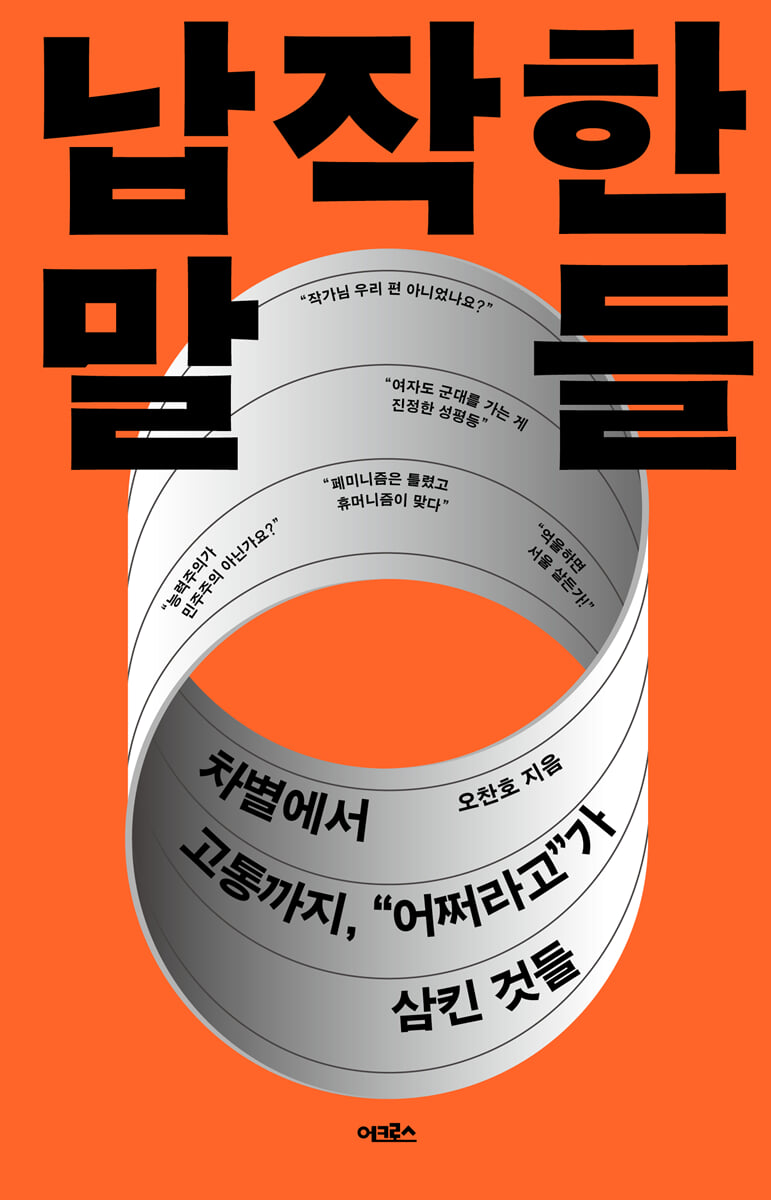
Flat words
 |
Description
Book Introduction
Sociologist Oh Chan-ho, who has bravely stared at the bare face of our society since the bestseller "We Support Discrimination," delves into the broken communication in South Korea, a country filled with "insults" and "cider."
In his new work, Flat Words, Oh Chan-ho discusses how discussions about complex social contexts are ruined by flat and lazy language, and how meritocracy and survivalism permeate everyday language, solidifying discrimination and violence.
We have become accustomed to the assertion that there is no need to understand the world in a complex way.
Pointing out the gap between the rich and the poor brings back the sarcastic remark, “Go to North Korea,” and talking about the hardships of irregular workers brings back the mocking remark, “Who threatened you with a knife to make you do that?”
The simplicity of thought and language leads to violence that flattens the lives of others.
This book will provide those tired of lazy language like "Soda," "True Education," and "Are you a swindler?" with a clue to imagine a more advanced debate.
In his new work, Flat Words, Oh Chan-ho discusses how discussions about complex social contexts are ruined by flat and lazy language, and how meritocracy and survivalism permeate everyday language, solidifying discrimination and violence.
We have become accustomed to the assertion that there is no need to understand the world in a complex way.
Pointing out the gap between the rich and the poor brings back the sarcastic remark, “Go to North Korea,” and talking about the hardships of irregular workers brings back the mocking remark, “Who threatened you with a knife to make you do that?”
The simplicity of thought and language leads to violence that flattens the lives of others.
This book will provide those tired of lazy language like "Soda," "True Education," and "Are you a swindler?" with a clue to imagine a more advanced debate.
- You can preview some of the book's contents.
Preview
index
Prologue: What We Lose to Survive
Part 1: The Words That Flow When Talking About Sexism
Why did Mother become the most loving word?
Oppose the equalization of suffering
Should women also join the military for equality in housework?
Modify the default values
Pieces of a heart that makes you happy
The roughness of delicacy
The stereotype that breaks stereotypes
There is no brave new world
Part 2: Words that mock the right to live
Why was that disabled person so kind?
Freedom is felt only by the 'have-nots'
Human rights education isn't about "living well."
Do you remember this column, “Afghan refugees, don’t come to Korea”?
Who are we to us?
The anti-discrimination law complements the spirit of the Constitution.
An age of poor thinking, a land of flat arguments
Can't you see discrimination beyond institutional discrimination?
Part 3: Words that only think about my feelings
That's not what I meant to hear.
I have to work harder than you
When you get excited, you make mistakes.
Our sticky side
The bare face of affection
If you talk about social issues, are you an antisocial person?
There is no such thing as a savory Gyeongsang dialect.
I don't know my MBTI, and I never will.
You've experienced it too? The violence of true education.
Part 4: Success or Failure
Luck is also a skill?
The god of private education speaks
If you just keep digging wells
Who is ordinary and who is extraordinary?
The effect of reading is reading.
I have no friends and can't date, so should I just die?
If that person hadn't graduated from Harvard
Words that turn society back on itself
Will you give me the freedom to work harder?
Is the policy to discriminate further?
Hitler also said, the right of the people to resist
They are setting a trap called 'Generation MZ'.
Republic of Tests
Private education is not the cause of national ruin, but its consequence.
How to read a suicide rate graph?
We are pieces of the republic
Epilogue: If only it hadn't been so
Part 1: The Words That Flow When Talking About Sexism
Why did Mother become the most loving word?
Oppose the equalization of suffering
Should women also join the military for equality in housework?
Modify the default values
Pieces of a heart that makes you happy
The roughness of delicacy
The stereotype that breaks stereotypes
There is no brave new world
Part 2: Words that mock the right to live
Why was that disabled person so kind?
Freedom is felt only by the 'have-nots'
Human rights education isn't about "living well."
Do you remember this column, “Afghan refugees, don’t come to Korea”?
Who are we to us?
The anti-discrimination law complements the spirit of the Constitution.
An age of poor thinking, a land of flat arguments
Can't you see discrimination beyond institutional discrimination?
Part 3: Words that only think about my feelings
That's not what I meant to hear.
I have to work harder than you
When you get excited, you make mistakes.
Our sticky side
The bare face of affection
If you talk about social issues, are you an antisocial person?
There is no such thing as a savory Gyeongsang dialect.
I don't know my MBTI, and I never will.
You've experienced it too? The violence of true education.
Part 4: Success or Failure
Luck is also a skill?
The god of private education speaks
If you just keep digging wells
Who is ordinary and who is extraordinary?
The effect of reading is reading.
I have no friends and can't date, so should I just die?
If that person hadn't graduated from Harvard
Words that turn society back on itself
Will you give me the freedom to work harder?
Is the policy to discriminate further?
Hitler also said, the right of the people to resist
They are setting a trap called 'Generation MZ'.
Republic of Tests
Private education is not the cause of national ruin, but its consequence.
How to read a suicide rate graph?
We are pieces of the republic
Epilogue: If only it hadn't been so
Detailed image
.jpg)
Into the book
The core issue of men being discriminated against by the state has disappeared, and what social benefit can there be in a policy of equalizing suffering that fundamentally seeks to satisfy the bizarre complaint, "Why aren't women discriminated against?"
I served for 26 months and then served in the reserves, civil defense, and emergency call-ups for 17 years until I turned 40.
If my wife experiences this, will my irritation be insignificant? Will my anxiety about my son going to the military disappear completely once my daughter joins?
--- From "Against the Equalization of Pain"
It is a sin to touch meritocracy.
Even in places where people criticize the justification of discrimination and hatred based on ability rather than differences, the argument, “Why is meritocracy a problem?” is common.
Even if you're confident, you're too confident.
We try to avoid pointing out the negative aspects by only looking at the positive aspects.
Here and there, only individual stories of bravery abound.
No one cares about the social context of the phenomenon.
(…) No matter how much we talk about the problem of inequality, I think I understand why only lazy analyses that say, “human history has always been unequal” continue to circulate.
Because this is a country of flat debate.
--- From "The Age of Impoverished Thinking, the Land of Flat Debate"
A place where the sentiment that you can hit someone because they did something wrong is disguised as a justified revenge is a 'jungle', not society.
The reason we do not allow individuals the right to seek revenge is because the other person's wrongdoing is not clearly determined but rather subjectively defined.
Let's think about customer abuse.
Those guests, from their own perspective, think it's justified.
An objectively unpleasant situation has occurred, and giving back is considered the objectively right thing to do.
It's all subjective, you know.
--- From "You've Experienced It Too? The Violence Called True Education"
Human immunity is formed by uncontrollable coincidences that accumulate from the time of conception.
Even if we are born to the same parents, people are different.
A person's health is not just the sum of their individual efforts.
But in a 'meritocracy republic' where people are somehow evaluated, classified, and excluded, the saying that even pain is a skill floats around like a great saying.
--- From "Luck is a skill?"
The right of the people to resist, as evaluated by history, was a moment when people fought for human dignity even when resistance meant death.
So I'm crying.
But the words of those who spread this rumor are all like this.
Reds, pro-North Korean leftists, you will be pulverized, this is your only way to survive, etc.
This is not a readiness to die, but a determination to kill.
It is not the courage to overcome fear, but the violence to make the other person afraid.
I served for 26 months and then served in the reserves, civil defense, and emergency call-ups for 17 years until I turned 40.
If my wife experiences this, will my irritation be insignificant? Will my anxiety about my son going to the military disappear completely once my daughter joins?
--- From "Against the Equalization of Pain"
It is a sin to touch meritocracy.
Even in places where people criticize the justification of discrimination and hatred based on ability rather than differences, the argument, “Why is meritocracy a problem?” is common.
Even if you're confident, you're too confident.
We try to avoid pointing out the negative aspects by only looking at the positive aspects.
Here and there, only individual stories of bravery abound.
No one cares about the social context of the phenomenon.
(…) No matter how much we talk about the problem of inequality, I think I understand why only lazy analyses that say, “human history has always been unequal” continue to circulate.
Because this is a country of flat debate.
--- From "The Age of Impoverished Thinking, the Land of Flat Debate"
A place where the sentiment that you can hit someone because they did something wrong is disguised as a justified revenge is a 'jungle', not society.
The reason we do not allow individuals the right to seek revenge is because the other person's wrongdoing is not clearly determined but rather subjectively defined.
Let's think about customer abuse.
Those guests, from their own perspective, think it's justified.
An objectively unpleasant situation has occurred, and giving back is considered the objectively right thing to do.
It's all subjective, you know.
--- From "You've Experienced It Too? The Violence Called True Education"
Human immunity is formed by uncontrollable coincidences that accumulate from the time of conception.
Even if we are born to the same parents, people are different.
A person's health is not just the sum of their individual efforts.
But in a 'meritocracy republic' where people are somehow evaluated, classified, and excluded, the saying that even pain is a skill floats around like a great saying.
--- From "Luck is a skill?"
The right of the people to resist, as evaluated by history, was a moment when people fought for human dignity even when resistance meant death.
So I'm crying.
But the words of those who spread this rumor are all like this.
Reds, pro-North Korean leftists, you will be pulverized, this is your only way to survive, etc.
This is not a readiness to die, but a determination to kill.
It is not the courage to overcome fear, but the violence to make the other person afraid.
--- From "Even Hitler said, the right of the people to resist"
Publisher's Review
“Our conversation is
“How did it come to this?”
Sociologist Oh Chan-ho,
Full of insults and cider
Uncovering South Korea's Broken Communication System
Sociologist Oh Chan-ho, who has bravely stared at the bare face of our society since his bestseller “We Support Discrimination,” has returned with his new work “Flat Words.”
Oh Chan-ho describes the scenes of Korean society that he witnessed and experienced while working as a writer.
The retort to “Go to North Korea” in response to the criticism about the gap between rich and poor.
The mockery of “Who threatened you with a knife to make you do that?” comes back to the demand for improved treatment of irregular workers.
The complex social contexts are erased, and the broken public sphere of South Korea, where people silence others with insults, is starkly revealed through Oh Chan-ho's characteristically sharp gaze.
Flat Words tells the story of how the simplicity of thought and language distorts the lives of others, and how meritocracy and survivalism permeate everyday language, solidifying discrimination and violence.
The landscapes organized through five themes—gender, human rights, daily life, self-development, and society—contain the vertical structure of meritocracy, survivalism, and superiority and inferiority that form the core of Korean society.
This book presents the possibility of a more advanced debate to those tired of lazy language like "Soda, true education, are you scratched?"
Health is also a skill? Don't blame society?
The Myth of Meritocracy That Blocks All Debate
This book is full of 'flat words', many of which are created out of blind faith in meritocracy.
Videos of famous instructors with titles like 'Star Instructor's Fact Bomb' and 'Ilta Instructor's Bitter Words' have been dominating Reels and YouTube for a long time.
They spread the distorted egalitarianism that "everyone's conditions are the same," saying that they know this because they have lived for a long time, and they ridicule the lives of certain people by saying that "people who live their lives carelessly are destined to fail."
Because meritocracy is considered the absolute truth that explains everything in the world, even in areas where structural problems need to be examined, the yardstick of 'individual ability is the problem' appears.
Minimal solutions, such as special admissions for the disabled or mandatory employment for the disabled, are blocked by comments like, "Why are you giving a position to someone who doesn't have the ability?" and "I worked hard to get here, so this isn't fair."
When we talk about women's success stories using terms like "alpha girl" and "supermom," we spread the perception that gender discrimination is a problem that can be overcome.
A politician constantly mentions that he is a Harvard graduate, suggesting that no one "below" Harvard would dare to know, and describes his school days in Mokdong, where 700 students in the same grade fiercely competed for rankings, as "perfectly fair competition."
"Flat Words" shows how discrimination and suffering are obscured when all phenomena are explained solely in terms of differences in ability, and urges us to look beyond "fact bombing" and "bitter words."
If we don't see the conditions of class, region, parents, and time behind someone's good grades, if we don't see the reality that even highly educated women are blocked by the glass ceiling, if we don't see the situation of the disabled who have to fight to obtain even the rights that are natural to the non-disabled, then all social problems will end up being explained as 'that's just how it is.'
The absurd language of "freedom to hate"
When language is distorted, society regresses.
The attack on the Western District Court on January 19, 2025, was a clear act of terrorism against democracy.
However, some people defended those who committed terrorism using the words 'civil disobedience' and 'the right to resist the people'.
Originally, civil disobedience and the right to resist were the words of those who had the courage to defend human dignity in situations where resisting power would have resulted in death, but they have been misused as words to justify disobedience to democracy.
This book examines how words that once embodied the meaning of equality and democracy came to serve diametrically opposed values.
For example, fairness has changed to mean unconditional acceptance of test scores and acceptance of all inequalities.
Freedom has long been mobilized for discriminatory logic, such as the "freedom to hate minorities," and for runaway market logic, such as the "freedom to earn less than the minimum wage."
For a healthy debate to take place, we must distinguish between common sense and nonsense, and exclude the justification of discrimination and hatred.
But in arguments dominated by prejudice and rejecting three-dimensional thinking, only stereotypes ring hollow.
If you say that something like the 'freedom to hate' is impossible to establish in the first place, you will be responded with 'old-fashioned logic that does not recognize diversity.'
This book explains how misused words distort debate in Korean society and envisions a society where these words can realize their original meaning and value.
Not a flat language,
In the language of imagining the lives of others
'Flat words' are also words that flatten someone's life, something that cannot be explained in a single word.
Hong Gil-dong, who appears in one episode of this book, had to always live as a 'good disabled person' at work.
I couldn't easily refuse to do work that I shouldn't have done, and I couldn't hold others accountable even when they were at fault.
This is because even if I spoke a little strongly, I had to experience other people gossiping, saying, "Why are you acting like that when you get special treatment at work?"
Even in the company's promotional video and new employee training, Mr. Hong Gil-dong had to send the message that our company is a non-discriminatory company and that he is always grateful.
Eventually, the day he took a picture smiling brightly to promote the company's creation of a disabled-accessible restroom, he decided to quit.
This is because I am tired of having to routinely say thank yous that non-disabled people don't, and of hearing things like, "If you were as kind as Hong Gil-dong, everyone around you would treat you well, but why are those people so rough?" that are thrown at protests for the rights of disabled people.
The book also addresses the illogical distortions of gender issues.
For example, the message, “Women should join the military too!” has rarely been used in a logical way.
The argument that women should also serve in the military is mostly based on the logic of why only men should be discriminated against.
The author questions what social benefit there is in equalizing suffering, which seeks to satisfy the fundamentally bizarre complaint that "women aren't discriminated against!" while the core issue of men being discriminated against by the state disappears.
And, citing an example of a politician who argued that gender equality in military service must be achieved in order to achieve gender equality in housework, he pointed out that this was a serious admission of the argument that "women only know how hard it is for men when they go through hardships", and thus forced a connection between two completely different issues: housework and military service.
Outdated language habits contain structural problems that strangle individual lives.
Before asking why I'm suddenly angry when I've always been like that, here's why I need to look back at my old way of thinking.
"Flat Words" tells us that change is possible only when yesterday's current stops moving and changes direction.
This book will help you take the words that flow naturally and not take them for granted, and will help you look at the absurdity contained within them.
“How did it come to this?”
Sociologist Oh Chan-ho,
Full of insults and cider
Uncovering South Korea's Broken Communication System
Sociologist Oh Chan-ho, who has bravely stared at the bare face of our society since his bestseller “We Support Discrimination,” has returned with his new work “Flat Words.”
Oh Chan-ho describes the scenes of Korean society that he witnessed and experienced while working as a writer.
The retort to “Go to North Korea” in response to the criticism about the gap between rich and poor.
The mockery of “Who threatened you with a knife to make you do that?” comes back to the demand for improved treatment of irregular workers.
The complex social contexts are erased, and the broken public sphere of South Korea, where people silence others with insults, is starkly revealed through Oh Chan-ho's characteristically sharp gaze.
Flat Words tells the story of how the simplicity of thought and language distorts the lives of others, and how meritocracy and survivalism permeate everyday language, solidifying discrimination and violence.
The landscapes organized through five themes—gender, human rights, daily life, self-development, and society—contain the vertical structure of meritocracy, survivalism, and superiority and inferiority that form the core of Korean society.
This book presents the possibility of a more advanced debate to those tired of lazy language like "Soda, true education, are you scratched?"
Health is also a skill? Don't blame society?
The Myth of Meritocracy That Blocks All Debate
This book is full of 'flat words', many of which are created out of blind faith in meritocracy.
Videos of famous instructors with titles like 'Star Instructor's Fact Bomb' and 'Ilta Instructor's Bitter Words' have been dominating Reels and YouTube for a long time.
They spread the distorted egalitarianism that "everyone's conditions are the same," saying that they know this because they have lived for a long time, and they ridicule the lives of certain people by saying that "people who live their lives carelessly are destined to fail."
Because meritocracy is considered the absolute truth that explains everything in the world, even in areas where structural problems need to be examined, the yardstick of 'individual ability is the problem' appears.
Minimal solutions, such as special admissions for the disabled or mandatory employment for the disabled, are blocked by comments like, "Why are you giving a position to someone who doesn't have the ability?" and "I worked hard to get here, so this isn't fair."
When we talk about women's success stories using terms like "alpha girl" and "supermom," we spread the perception that gender discrimination is a problem that can be overcome.
A politician constantly mentions that he is a Harvard graduate, suggesting that no one "below" Harvard would dare to know, and describes his school days in Mokdong, where 700 students in the same grade fiercely competed for rankings, as "perfectly fair competition."
"Flat Words" shows how discrimination and suffering are obscured when all phenomena are explained solely in terms of differences in ability, and urges us to look beyond "fact bombing" and "bitter words."
If we don't see the conditions of class, region, parents, and time behind someone's good grades, if we don't see the reality that even highly educated women are blocked by the glass ceiling, if we don't see the situation of the disabled who have to fight to obtain even the rights that are natural to the non-disabled, then all social problems will end up being explained as 'that's just how it is.'
The absurd language of "freedom to hate"
When language is distorted, society regresses.
The attack on the Western District Court on January 19, 2025, was a clear act of terrorism against democracy.
However, some people defended those who committed terrorism using the words 'civil disobedience' and 'the right to resist the people'.
Originally, civil disobedience and the right to resist were the words of those who had the courage to defend human dignity in situations where resisting power would have resulted in death, but they have been misused as words to justify disobedience to democracy.
This book examines how words that once embodied the meaning of equality and democracy came to serve diametrically opposed values.
For example, fairness has changed to mean unconditional acceptance of test scores and acceptance of all inequalities.
Freedom has long been mobilized for discriminatory logic, such as the "freedom to hate minorities," and for runaway market logic, such as the "freedom to earn less than the minimum wage."
For a healthy debate to take place, we must distinguish between common sense and nonsense, and exclude the justification of discrimination and hatred.
But in arguments dominated by prejudice and rejecting three-dimensional thinking, only stereotypes ring hollow.
If you say that something like the 'freedom to hate' is impossible to establish in the first place, you will be responded with 'old-fashioned logic that does not recognize diversity.'
This book explains how misused words distort debate in Korean society and envisions a society where these words can realize their original meaning and value.
Not a flat language,
In the language of imagining the lives of others
'Flat words' are also words that flatten someone's life, something that cannot be explained in a single word.
Hong Gil-dong, who appears in one episode of this book, had to always live as a 'good disabled person' at work.
I couldn't easily refuse to do work that I shouldn't have done, and I couldn't hold others accountable even when they were at fault.
This is because even if I spoke a little strongly, I had to experience other people gossiping, saying, "Why are you acting like that when you get special treatment at work?"
Even in the company's promotional video and new employee training, Mr. Hong Gil-dong had to send the message that our company is a non-discriminatory company and that he is always grateful.
Eventually, the day he took a picture smiling brightly to promote the company's creation of a disabled-accessible restroom, he decided to quit.
This is because I am tired of having to routinely say thank yous that non-disabled people don't, and of hearing things like, "If you were as kind as Hong Gil-dong, everyone around you would treat you well, but why are those people so rough?" that are thrown at protests for the rights of disabled people.
The book also addresses the illogical distortions of gender issues.
For example, the message, “Women should join the military too!” has rarely been used in a logical way.
The argument that women should also serve in the military is mostly based on the logic of why only men should be discriminated against.
The author questions what social benefit there is in equalizing suffering, which seeks to satisfy the fundamentally bizarre complaint that "women aren't discriminated against!" while the core issue of men being discriminated against by the state disappears.
And, citing an example of a politician who argued that gender equality in military service must be achieved in order to achieve gender equality in housework, he pointed out that this was a serious admission of the argument that "women only know how hard it is for men when they go through hardships", and thus forced a connection between two completely different issues: housework and military service.
Outdated language habits contain structural problems that strangle individual lives.
Before asking why I'm suddenly angry when I've always been like that, here's why I need to look back at my old way of thinking.
"Flat Words" tells us that change is possible only when yesterday's current stops moving and changes direction.
This book will help you take the words that flow naturally and not take them for granted, and will help you look at the absurdity contained within them.
GOODS SPECIFICS
- Date of issue: July 11, 2025
- Page count, weight, size: 288 pages | 372g | 135*210*24mm
- ISBN13: 9791167742179
- ISBN10: 1167742176
You may also like
카테고리
korean


korean

![GQ KOREA Mark (Monthly): December [2025]](http://librairie.coreenne.fr/cdn/shop/files/8ef265dbbfbf186523ed75ba7319009d.jpg?v=1765340328&width=3840)


