

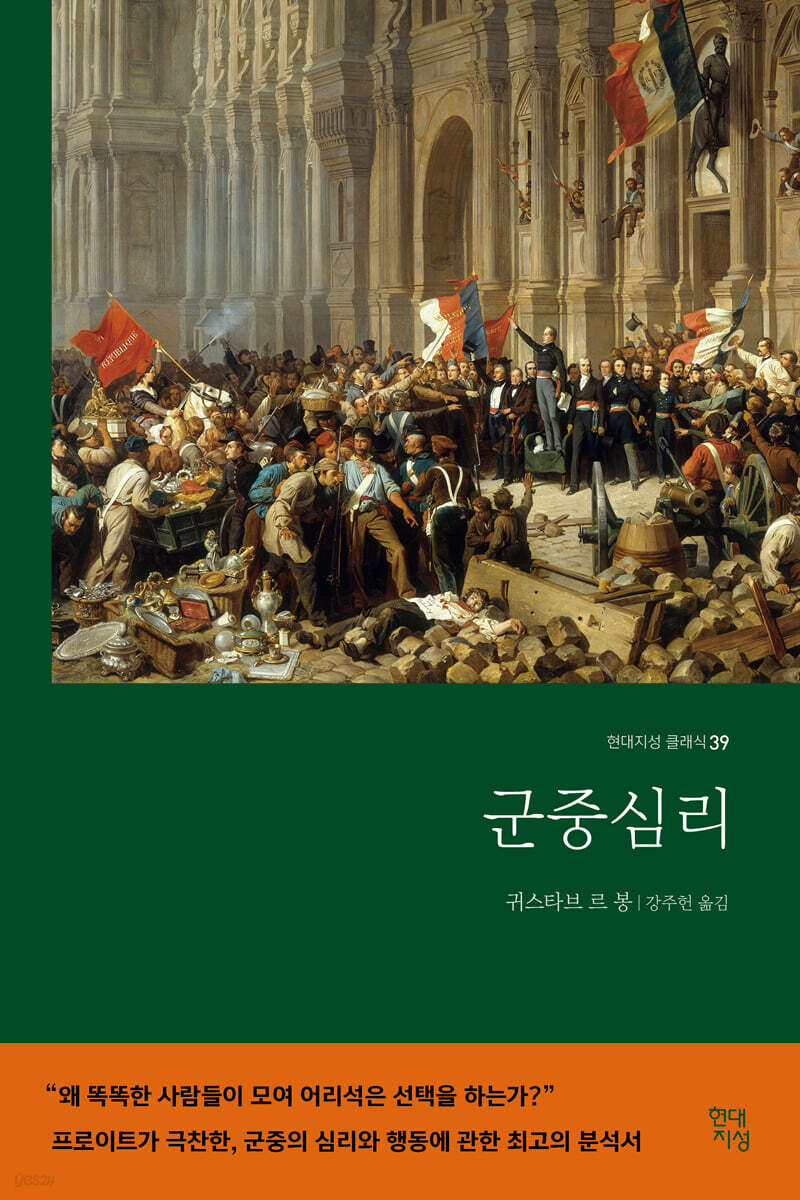
crowd psychology
 |
Description
Book Introduction
“Why do smart people make stupid choices?”
The psychology and behavior of human groups and the leadership principles that guide them.
The best social psychology classics still relevant in the metaverse era.
* Selected by Le Monde as one of "20 books that changed the world."
* “A must-read to understand the public psychology of the stock market.”
André Kostolany (legendary investor known as “European Buffett”)
“It’s okay to make exaggerated promises as long as you can get elected.
“Voters applaud promises, but they don’t care to know how well they’ve kept them.” “You can use smear campaigns to harm your opponents, but you don’t need to find and present evidence.” “Sometimes public opinion turns into intimidation and even changes a politician’s course of action.” This may seem like a criticism of today’s political behavior, but it’s actually from Gustave Le Bon’s book, “The Psychology of Crowds,” written in the late 19th century.
His analysis of society and the crowd is completely relevant even in the 21st century.
What makes this book stand out among the studies on crowds is that it opens up a field for practical discussion.
Le Bon not only keenly perceives the reality of the crowd, but also presents powerful principles that lead them in the intended direction.
From psychology giants Freud and Allport to rulers like de Gaulle and Roosevelt, and even the legendary investor Kostolany, known as the “Buffett of Europe,” countless leaders have read this book and applied it to their own fields, achieving great success.
Le Bon came to notice the power of the crowd while experiencing turbulent times in history, such as the Franco-Prussian War and the Paris Commune.
The crowd he speaks of is not simply a group of people gathered in the same place, but a 'psychological crowd' united by certain emotions or beliefs.
Individuals in a crowd lose their unique characteristics, think impulsively, and act according to instinct.
Intellectuals who have eaten sesame seeds are no different.
Because the crowd judges by 'emotions', not 'logic'.
With the advent of the metaverse era, the value of crowd psychology is being re-evaluated.
This is because the influence of the ‘psychological crowd’ that Le Bon spoke of is growing.
This book provides clear observations and analyses of recent phenomena, such as fandom politics, the process of forming online public opinion, and even the madness of religion and politics, which have been difficult to understand until now.
"The Psychology of Crowds," a must-read for leaders seeking to win the hearts and minds of the masses, is presented in a complete translation faithful to the original text, with rich background information and in-depth commentary.
The psychology and behavior of human groups and the leadership principles that guide them.
The best social psychology classics still relevant in the metaverse era.
* Selected by Le Monde as one of "20 books that changed the world."
* “A must-read to understand the public psychology of the stock market.”
André Kostolany (legendary investor known as “European Buffett”)
“It’s okay to make exaggerated promises as long as you can get elected.
“Voters applaud promises, but they don’t care to know how well they’ve kept them.” “You can use smear campaigns to harm your opponents, but you don’t need to find and present evidence.” “Sometimes public opinion turns into intimidation and even changes a politician’s course of action.” This may seem like a criticism of today’s political behavior, but it’s actually from Gustave Le Bon’s book, “The Psychology of Crowds,” written in the late 19th century.
His analysis of society and the crowd is completely relevant even in the 21st century.
What makes this book stand out among the studies on crowds is that it opens up a field for practical discussion.
Le Bon not only keenly perceives the reality of the crowd, but also presents powerful principles that lead them in the intended direction.
From psychology giants Freud and Allport to rulers like de Gaulle and Roosevelt, and even the legendary investor Kostolany, known as the “Buffett of Europe,” countless leaders have read this book and applied it to their own fields, achieving great success.
Le Bon came to notice the power of the crowd while experiencing turbulent times in history, such as the Franco-Prussian War and the Paris Commune.
The crowd he speaks of is not simply a group of people gathered in the same place, but a 'psychological crowd' united by certain emotions or beliefs.
Individuals in a crowd lose their unique characteristics, think impulsively, and act according to instinct.
Intellectuals who have eaten sesame seeds are no different.
Because the crowd judges by 'emotions', not 'logic'.
With the advent of the metaverse era, the value of crowd psychology is being re-evaluated.
This is because the influence of the ‘psychological crowd’ that Le Bon spoke of is growing.
This book provides clear observations and analyses of recent phenomena, such as fandom politics, the process of forming online public opinion, and even the madness of religion and politics, which have been difficult to understand until now.
"The Psychology of Crowds," a must-read for leaders seeking to win the hearts and minds of the masses, is presented in a complete translation faithful to the original text, with rich background information and in-depth commentary.
- You can preview some of the book's contents.
Preview
index
preface
Introduction: The Age of the Crowd
Part 1: The Mental Structure of the Crowd
Chapter 1 General Characteristics of Crowds: Psychological Laws that Unify the Mind of Crowds
Chapter 2: Crowd Emotions and Morality
1.
2. Impulsiveness, fickleness, and irritability of crowds.
The suggestibility and blind faith of the crowd
3.
Simple and exaggerated emotions 4.
The narrow-mindedness, self-righteousness, and conservatism of the crowd
5.
The morality of the crowd
Chapter 3: Crowd Thought, Reasoning, and Imagination
1.
Crowd Thought 2.
Crowd Reasoning 3.
The imagination of the crowd
Chapter 4: The Religious Form of All the Crowd's Convictions
Part 2: Crowd Opinions and Beliefs
Chapter 1 Indirect Factors Influencing Crowd Opinions and Beliefs
1.
Nation 2.
Tradition 3.
hour
4.
Political and social systems 5.
Learning and Education
Chapter 2 Direct Factors Influencing Crowd Opinion
1.
Images, words, phrases 2.
Fantasy 3.
Experience 4.
Reason
Chapter 3: Leaders of the Crowd and Their Means of Persuasion
1.
Leader of the Crowd 2.
How leaders behave: Affirm, repeat, and contagion 3.
prestige
Chapter 4: The Variable Limits of Crowd Belief and Opinion
1.
Unchanging Belief 2.
The changing opinions of the crowd
Part 3: Classification of Crowds and Their Different Types
Chapter 1 Classification of Crowds
1.
Heterogeneous crowd 2.
homogeneous crowd
Chapter 2: The Criminal Crowd
Chapter 3 The Jury in Court
Chapter 4: The Voter Crowd
Chapter 5: The Parliamentary Crowd
Release | Kang Joo-heon
Gustave Le Bon Chronology
Introduction: The Age of the Crowd
Part 1: The Mental Structure of the Crowd
Chapter 1 General Characteristics of Crowds: Psychological Laws that Unify the Mind of Crowds
Chapter 2: Crowd Emotions and Morality
1.
2. Impulsiveness, fickleness, and irritability of crowds.
The suggestibility and blind faith of the crowd
3.
Simple and exaggerated emotions 4.
The narrow-mindedness, self-righteousness, and conservatism of the crowd
5.
The morality of the crowd
Chapter 3: Crowd Thought, Reasoning, and Imagination
1.
Crowd Thought 2.
Crowd Reasoning 3.
The imagination of the crowd
Chapter 4: The Religious Form of All the Crowd's Convictions
Part 2: Crowd Opinions and Beliefs
Chapter 1 Indirect Factors Influencing Crowd Opinions and Beliefs
1.
Nation 2.
Tradition 3.
hour
4.
Political and social systems 5.
Learning and Education
Chapter 2 Direct Factors Influencing Crowd Opinion
1.
Images, words, phrases 2.
Fantasy 3.
Experience 4.
Reason
Chapter 3: Leaders of the Crowd and Their Means of Persuasion
1.
Leader of the Crowd 2.
How leaders behave: Affirm, repeat, and contagion 3.
prestige
Chapter 4: The Variable Limits of Crowd Belief and Opinion
1.
Unchanging Belief 2.
The changing opinions of the crowd
Part 3: Classification of Crowds and Their Different Types
Chapter 1 Classification of Crowds
1.
Heterogeneous crowd 2.
homogeneous crowd
Chapter 2: The Criminal Crowd
Chapter 3 The Jury in Court
Chapter 4: The Voter Crowd
Chapter 5: The Parliamentary Crowd
Release | Kang Joo-heon
Gustave Le Bon Chronology
Detailed image

Into the book
Strictly speaking, all the rulers of the world, the founders of religions and empires, the apostles of faith, the prominent politicians, and even, more simply, the heads of small groups of people—all leaders were "unconscious psychologists" who instinctively knew the psychology of the crowd.
Because they knew the crowd psychology so well, they could easily become rulers.
---From the "Introduction"
Psychologically, the word 'crowd' has a completely different meaning.
A group of individuals that forms in a particular situation exhibits characteristics that are very different from the individuals that compose the group.
Conscious individuality disappears, and individual emotions and thoughts become grouped and all move in the same direction.
And a group spirit is formed that is temporary but has very distinct characteristics.
For lack of a better term, I will call these groups "organized crowds" or "psychological crowds."
Such crowds form a single entity and follow the 'psychological law of unifying the spirit of the crowd'.
---From "Part 1, Chapter 1"
The main characteristics of individuals who are part of a crowd are loss of consciousness, a predominance of unconscious activity, suggestion and contagion that direct emotions and thoughts in the same direction, and a tendency to act immediately as suggested.
The individual in the crowd is no longer himself.
He is nothing more than a puppet who cannot act according to his own will.
(…) If he were alone, he might have been a cultured person, but when he is in a crowd, he becomes a savage, a person who acts according to instinct.
Individuals in a crowd are not only impulsive, violent, and cruel, but also enthusiastic like primitive people and sometimes even courageous.
Such individuals are easily swayed by words and images that would have no effect on an independent individual, and they tend to act contrary to their natural habits and to the detriment of their own obvious interests, showing a tendency close to primitive people.
An individual in a crowd is like countless grains of sand blown about by the wind.
---From "Part 1, Chapter 1"
An individual in a crowd loses the very concept of impossibility.
An independent individual knows full well that he cannot set fire to a palace or loot a store on his own, so he easily resists such temptations.
But when one becomes part of a crowd, one becomes aware of the power that 'numbers' give.
If you suggest to him at this time that he is going to kill or plunder, he will succumb to the temptation without delay.
Even if you encounter an unexpected obstacle, you will smash it like crazy.
If the human body could sustain a state of rage forever, then such a state of rage would be a normal manifestation of a crowd with repressed desires.
---From "Part 1, Chapter 2"
The power of the conqueror and the strength of the state are also based on the imagination of the crowd.
Using this kind of imagination can help you attract crowds more easily.
(…) How can we make a lasting impression on the crowd's imagination? We'll find out soon, but for now, let's just say that you shouldn't appeal to their intellect or reason—that is, you shouldn't try to logically prove your point.
(…) Anything that strongly stimulates the imagination of the crowd takes the form of an image that is strong and clear.
In other words, it should be an image that does not require any secondary interpretation.
(…) If you know how to capture the imagination of the crowd, you have learned how to command the crowd.
---From "Part 1, Chapter 3"
Crowds are not influenced by rational reasoning and can only understand the results of roughly paired ideas.
Therefore, an orator who knows how to impress a crowd appeals to emotions, not to reason.
Because the laws of logic have no effect on the crowd.
To persuade a crowd, you must first thoroughly understand the emotions that will stimulate them, pretend to share those emotions, and then, through basic associations, evoke well-suggested images to guide their emotions in the desired direction.
---From "Part 2, Chapter 2"
The jury provides clear evidence that the intellectual level of the various individuals who make up the crowd is of little importance when making a final decision.
When a council convenes to give its opinion on a completely unprofessional matter, the intellectual level of its members plays no role.
Just because they are made up of scholars and artists, it doesn't mean that they will make judgments on common problems that are significantly different from those of a group of stonemasons or apothecaries.
(…) Statistics show that no matter how the jury was composed, their verdict was the same.
(…) Jurors are also greatly influenced by emotions and are not swayed by rational reasoning.
---From "Part 3, Chapter 3"
Voters want candidates to satisfy their desires and vanity.
So candidates should not hesitate to flatter voters excessively and make unrealistic promises.
(…) Also, the opposing candidate is a total idiot and has committed numerous crimes, and we must make it widely known to the voters through confirmation, repetition, and propagation that this fact is known to everyone, in order to block the possibility of his being elected.
Of course, there is no need to find and present evidence.
(…) The documented promises of a candidate should not be overly definitive, as they can later be refuted by political opponents.
But it doesn't matter if the verbal promises are greatly exaggerated.
It's okay to make bold promises of grand reforms.
Exaggerated promises not only have a huge immediate effect, but also carry no future responsibilities.
Our ongoing observation is that voters don't care to know how well the elected officials keep the promises that won them applause and that likely contributed significantly to their election.
Because they knew the crowd psychology so well, they could easily become rulers.
---From the "Introduction"
Psychologically, the word 'crowd' has a completely different meaning.
A group of individuals that forms in a particular situation exhibits characteristics that are very different from the individuals that compose the group.
Conscious individuality disappears, and individual emotions and thoughts become grouped and all move in the same direction.
And a group spirit is formed that is temporary but has very distinct characteristics.
For lack of a better term, I will call these groups "organized crowds" or "psychological crowds."
Such crowds form a single entity and follow the 'psychological law of unifying the spirit of the crowd'.
---From "Part 1, Chapter 1"
The main characteristics of individuals who are part of a crowd are loss of consciousness, a predominance of unconscious activity, suggestion and contagion that direct emotions and thoughts in the same direction, and a tendency to act immediately as suggested.
The individual in the crowd is no longer himself.
He is nothing more than a puppet who cannot act according to his own will.
(…) If he were alone, he might have been a cultured person, but when he is in a crowd, he becomes a savage, a person who acts according to instinct.
Individuals in a crowd are not only impulsive, violent, and cruel, but also enthusiastic like primitive people and sometimes even courageous.
Such individuals are easily swayed by words and images that would have no effect on an independent individual, and they tend to act contrary to their natural habits and to the detriment of their own obvious interests, showing a tendency close to primitive people.
An individual in a crowd is like countless grains of sand blown about by the wind.
---From "Part 1, Chapter 1"
An individual in a crowd loses the very concept of impossibility.
An independent individual knows full well that he cannot set fire to a palace or loot a store on his own, so he easily resists such temptations.
But when one becomes part of a crowd, one becomes aware of the power that 'numbers' give.
If you suggest to him at this time that he is going to kill or plunder, he will succumb to the temptation without delay.
Even if you encounter an unexpected obstacle, you will smash it like crazy.
If the human body could sustain a state of rage forever, then such a state of rage would be a normal manifestation of a crowd with repressed desires.
---From "Part 1, Chapter 2"
The power of the conqueror and the strength of the state are also based on the imagination of the crowd.
Using this kind of imagination can help you attract crowds more easily.
(…) How can we make a lasting impression on the crowd's imagination? We'll find out soon, but for now, let's just say that you shouldn't appeal to their intellect or reason—that is, you shouldn't try to logically prove your point.
(…) Anything that strongly stimulates the imagination of the crowd takes the form of an image that is strong and clear.
In other words, it should be an image that does not require any secondary interpretation.
(…) If you know how to capture the imagination of the crowd, you have learned how to command the crowd.
---From "Part 1, Chapter 3"
Crowds are not influenced by rational reasoning and can only understand the results of roughly paired ideas.
Therefore, an orator who knows how to impress a crowd appeals to emotions, not to reason.
Because the laws of logic have no effect on the crowd.
To persuade a crowd, you must first thoroughly understand the emotions that will stimulate them, pretend to share those emotions, and then, through basic associations, evoke well-suggested images to guide their emotions in the desired direction.
---From "Part 2, Chapter 2"
The jury provides clear evidence that the intellectual level of the various individuals who make up the crowd is of little importance when making a final decision.
When a council convenes to give its opinion on a completely unprofessional matter, the intellectual level of its members plays no role.
Just because they are made up of scholars and artists, it doesn't mean that they will make judgments on common problems that are significantly different from those of a group of stonemasons or apothecaries.
(…) Statistics show that no matter how the jury was composed, their verdict was the same.
(…) Jurors are also greatly influenced by emotions and are not swayed by rational reasoning.
---From "Part 3, Chapter 3"
Voters want candidates to satisfy their desires and vanity.
So candidates should not hesitate to flatter voters excessively and make unrealistic promises.
(…) Also, the opposing candidate is a total idiot and has committed numerous crimes, and we must make it widely known to the voters through confirmation, repetition, and propagation that this fact is known to everyone, in order to block the possibility of his being elected.
Of course, there is no need to find and present evidence.
(…) The documented promises of a candidate should not be overly definitive, as they can later be refuted by political opponents.
But it doesn't matter if the verbal promises are greatly exaggerated.
It's okay to make bold promises of grand reforms.
Exaggerated promises not only have a huge immediate effect, but also carry no future responsibilities.
Our ongoing observation is that voters don't care to know how well the elected officials keep the promises that won them applause and that likely contributed significantly to their election.
---From "Part 3, Chapter 4"
Publisher's Review
Freud, the founder of psychoanalysis, de Gaulle, the symbol of the leader,
Benedict, the father of modern PR, Kostolany, the god of stocks…
A book that inspired pioneers in various fields
“Any study of the masses should begin with this book,” says Anson Rabinbach, professor emeritus of history at Princeton University.
As he evaluated, Gustave Le Bon's 『The Psychology of Crowds』 has maintained its position as a major textbook on psychology and an introductory book to the study of the masses since its publication in 1895.
Many scholars, including Sigmund Freud, the founder of psychoanalysis, developed their own theories based on Le Bon's theory presented in this book.
Gordon Allport, a leading personality psychologist and professor at Harvard University, praised Crowd Psychology as “the most influential book in the field of social psychology.”
This book has had an impact on a wide range of fields, beyond psychology and sociology.
Many leaders, including Edward Benays, the “father of modern PR” who established public relations as an industry, world leaders Charles de Gaulle and Theodore Roosevelt, and legendary investor André Kostolany, known as the “Buffett of Europe,” have achieved great success by applying Le Bon’s theories and have selected this book as a must-read.
It is rare for a single book to contribute to the advancement of so many fields.
Above all, it is truly remarkable that a book written over 130 years ago still offers a useful perspective for analyzing today's social phenomena, and that the human figures cited as examples are no different from the current state of affairs.
I am simply amazed by the author's insight and foresight, which allowed him to accurately grasp the true nature of the crowd through observation alone, without any experiments.
“The crowd judges by emotion, not logic.”
Politics, society, education, religion… even advertising and marketing
A must-read for any leader who needs to win the hearts and minds of the crowd.
There is a term called the “reserve force effect.”
This is an expression that compares a perfectly healthy person to someone who acts rudely and deviates when wearing a reserve military uniform.
When we caught and investigated the malicious commenters, we found that most of them were ordinary people, many of the hooligans who caused trouble at soccer stadiums were timid people, and there are many similar cases, such as people with impeccable character and education who were swept up in the biased public opinion of their group and made foolish choices.
Why do individuals lose their individuality and become completely different when they join a crowd? To answer this, we must first examine the definition of a crowd.
The crowd, the subject of this book's study, is not a group of people gathered by chance, but a single entity formed by a group spirit, which the author calls a "psychological crowd."
Individuals in a crowd are subject to the psychological law of 'unifying the spirit of the crowd.'
Rather than sticking to one's personal beliefs, one is swayed by external circumstances or the surrounding atmosphere.
A crowd so anonymous loses self-control and acts on instinct.
So, they commit crimes and sometimes even risk their lives for the sake of group interests.
What makes Le Bon's research stand out is that he doesn't just list these phenomena; he also uncovers the forces that govern crowd psychology and suggests the principles that guide crowds in the intended direction.
What makes a deep impression on the crowd is a simple, yet provocative image.
Historically, great rulers have often been those who captured the imagination of the masses with powerful images.
The crowd has been willing to sacrifice itself to protect the ideas and beliefs imprinted on them through the images they have presented.
Moreover, the factor that most influences crowd decision-making is emotion, not reason.
So, you shouldn't try to convince them with logic.
By identifying the emotions that will stimulate them and evoking the images that suggest them, you can lead the crowd in the direction you want.
Above all, individuals in a crowd that has lost their individuality instinctively follow those with strong wills.
So the crowd is extremely rebellious, yet at the same time extremely obedient.
If a leader uses affirmation, repetition, and contagion appropriately, he can easily win the hearts and minds of the crowd.
In this way, Le Bon's 『The Psychology of Crowds』 had a great influence on rulers by providing a theoretical basis for how to understand and lead crowds.
After the establishment of democracy, it became a must-read for politicians who had to read public sentiment and win voters' elections.
Not only that, but people in advertising, marketing, and finance are also devouring this book to analyze consumer psychology and behavior and understand investor sentiment.
A thorough and complete translation of the French original
Introducing with added rich explanation
The definitive edition of the modern intellectual classic, "Crowd Psychology"!
Gustave Le Bon's career is quite unique.
Although he studied medicine in college and received a doctorate, he took a different path than other doctors.
With a strong intellectual curiosity, he wrote monumental works across anthropology, psychology, and sociology, and was even nominated for the Nobel Prize in Physics.
He was an explorer who traveled extensively throughout Europe, Asia, and North Africa, a rarity for his time, and was the inventor of a skull measuring tool.
He even wrote a book on horse training.
In this way, he was a Renaissance man who was interested in various fields, enjoyed new challenges, and pioneered a different path from others.
Although he was born in the 19th century, he is a figure more suited to the 21st century, where integration and convergence have become the zeitgeist.
『The Psychology of Crowds』 is a representative work that highlights his brilliant insight.
Korean translations began to be published in 1946 (based on RISS searches), but during that time they were mainly read by researchers and professionals and did not attract the attention of general readers.
Rather, this book is receiving even more attention today.
As social networks develop and we enter the metaverse era, Le Bon's argument that crowds are not 'spatial' but 'psychological' entities is becoming more persuasive.
Furthermore, Le Bon's insights provide insight into understanding the state of our society, from issues that confuse the world, such as blind support for politicians and conflicts between generations, classes, and genders, to the phenomenon of focusing on specific issues and the consumer movement represented by "Donjul" and "Honjul."
In line with this trend, “Modern Intellectual Classics” presents “Crowd Psychology” in a 21st-century form.
Professor Kang Joo-heon, winner of the “Publisher of the Year Special Award” and a teacher of numerous translators, has translated the original French text in its entirety and added a detailed commentary.
Considering that classics can only be fully understood when supported by background knowledge, images depicting the times and historical events were inserted throughout the text.
To provide a three-dimensional perspective on the original text, the book includes a review by contemporary intellectual and political philosopher Bernard Bozenket, along with excerpts from various parts of the author's books.
Benedict, the father of modern PR, Kostolany, the god of stocks…
A book that inspired pioneers in various fields
“Any study of the masses should begin with this book,” says Anson Rabinbach, professor emeritus of history at Princeton University.
As he evaluated, Gustave Le Bon's 『The Psychology of Crowds』 has maintained its position as a major textbook on psychology and an introductory book to the study of the masses since its publication in 1895.
Many scholars, including Sigmund Freud, the founder of psychoanalysis, developed their own theories based on Le Bon's theory presented in this book.
Gordon Allport, a leading personality psychologist and professor at Harvard University, praised Crowd Psychology as “the most influential book in the field of social psychology.”
This book has had an impact on a wide range of fields, beyond psychology and sociology.
Many leaders, including Edward Benays, the “father of modern PR” who established public relations as an industry, world leaders Charles de Gaulle and Theodore Roosevelt, and legendary investor André Kostolany, known as the “Buffett of Europe,” have achieved great success by applying Le Bon’s theories and have selected this book as a must-read.
It is rare for a single book to contribute to the advancement of so many fields.
Above all, it is truly remarkable that a book written over 130 years ago still offers a useful perspective for analyzing today's social phenomena, and that the human figures cited as examples are no different from the current state of affairs.
I am simply amazed by the author's insight and foresight, which allowed him to accurately grasp the true nature of the crowd through observation alone, without any experiments.
“The crowd judges by emotion, not logic.”
Politics, society, education, religion… even advertising and marketing
A must-read for any leader who needs to win the hearts and minds of the crowd.
There is a term called the “reserve force effect.”
This is an expression that compares a perfectly healthy person to someone who acts rudely and deviates when wearing a reserve military uniform.
When we caught and investigated the malicious commenters, we found that most of them were ordinary people, many of the hooligans who caused trouble at soccer stadiums were timid people, and there are many similar cases, such as people with impeccable character and education who were swept up in the biased public opinion of their group and made foolish choices.
Why do individuals lose their individuality and become completely different when they join a crowd? To answer this, we must first examine the definition of a crowd.
The crowd, the subject of this book's study, is not a group of people gathered by chance, but a single entity formed by a group spirit, which the author calls a "psychological crowd."
Individuals in a crowd are subject to the psychological law of 'unifying the spirit of the crowd.'
Rather than sticking to one's personal beliefs, one is swayed by external circumstances or the surrounding atmosphere.
A crowd so anonymous loses self-control and acts on instinct.
So, they commit crimes and sometimes even risk their lives for the sake of group interests.
What makes Le Bon's research stand out is that he doesn't just list these phenomena; he also uncovers the forces that govern crowd psychology and suggests the principles that guide crowds in the intended direction.
What makes a deep impression on the crowd is a simple, yet provocative image.
Historically, great rulers have often been those who captured the imagination of the masses with powerful images.
The crowd has been willing to sacrifice itself to protect the ideas and beliefs imprinted on them through the images they have presented.
Moreover, the factor that most influences crowd decision-making is emotion, not reason.
So, you shouldn't try to convince them with logic.
By identifying the emotions that will stimulate them and evoking the images that suggest them, you can lead the crowd in the direction you want.
Above all, individuals in a crowd that has lost their individuality instinctively follow those with strong wills.
So the crowd is extremely rebellious, yet at the same time extremely obedient.
If a leader uses affirmation, repetition, and contagion appropriately, he can easily win the hearts and minds of the crowd.
In this way, Le Bon's 『The Psychology of Crowds』 had a great influence on rulers by providing a theoretical basis for how to understand and lead crowds.
After the establishment of democracy, it became a must-read for politicians who had to read public sentiment and win voters' elections.
Not only that, but people in advertising, marketing, and finance are also devouring this book to analyze consumer psychology and behavior and understand investor sentiment.
A thorough and complete translation of the French original
Introducing with added rich explanation
The definitive edition of the modern intellectual classic, "Crowd Psychology"!
Gustave Le Bon's career is quite unique.
Although he studied medicine in college and received a doctorate, he took a different path than other doctors.
With a strong intellectual curiosity, he wrote monumental works across anthropology, psychology, and sociology, and was even nominated for the Nobel Prize in Physics.
He was an explorer who traveled extensively throughout Europe, Asia, and North Africa, a rarity for his time, and was the inventor of a skull measuring tool.
He even wrote a book on horse training.
In this way, he was a Renaissance man who was interested in various fields, enjoyed new challenges, and pioneered a different path from others.
Although he was born in the 19th century, he is a figure more suited to the 21st century, where integration and convergence have become the zeitgeist.
『The Psychology of Crowds』 is a representative work that highlights his brilliant insight.
Korean translations began to be published in 1946 (based on RISS searches), but during that time they were mainly read by researchers and professionals and did not attract the attention of general readers.
Rather, this book is receiving even more attention today.
As social networks develop and we enter the metaverse era, Le Bon's argument that crowds are not 'spatial' but 'psychological' entities is becoming more persuasive.
Furthermore, Le Bon's insights provide insight into understanding the state of our society, from issues that confuse the world, such as blind support for politicians and conflicts between generations, classes, and genders, to the phenomenon of focusing on specific issues and the consumer movement represented by "Donjul" and "Honjul."
In line with this trend, “Modern Intellectual Classics” presents “Crowd Psychology” in a 21st-century form.
Professor Kang Joo-heon, winner of the “Publisher of the Year Special Award” and a teacher of numerous translators, has translated the original French text in its entirety and added a detailed commentary.
Considering that classics can only be fully understood when supported by background knowledge, images depicting the times and historical events were inserted throughout the text.
To provide a three-dimensional perspective on the original text, the book includes a review by contemporary intellectual and political philosopher Bernard Bozenket, along with excerpts from various parts of the author's books.
GOODS SPECIFICS
- Publication date: October 8, 2021
- Page count, weight, size: 296 pages | 384g | 150*225*16mm
- ISBN13: 9791139700114
- ISBN10: 1139700111
You may also like
카테고리
korean


korean

![GQ KOREA Mark (Monthly): December [2025]](http://librairie.coreenne.fr/cdn/shop/files/8ef265dbbfbf186523ed75ba7319009d.jpg?v=1765340328&width=3840)


