

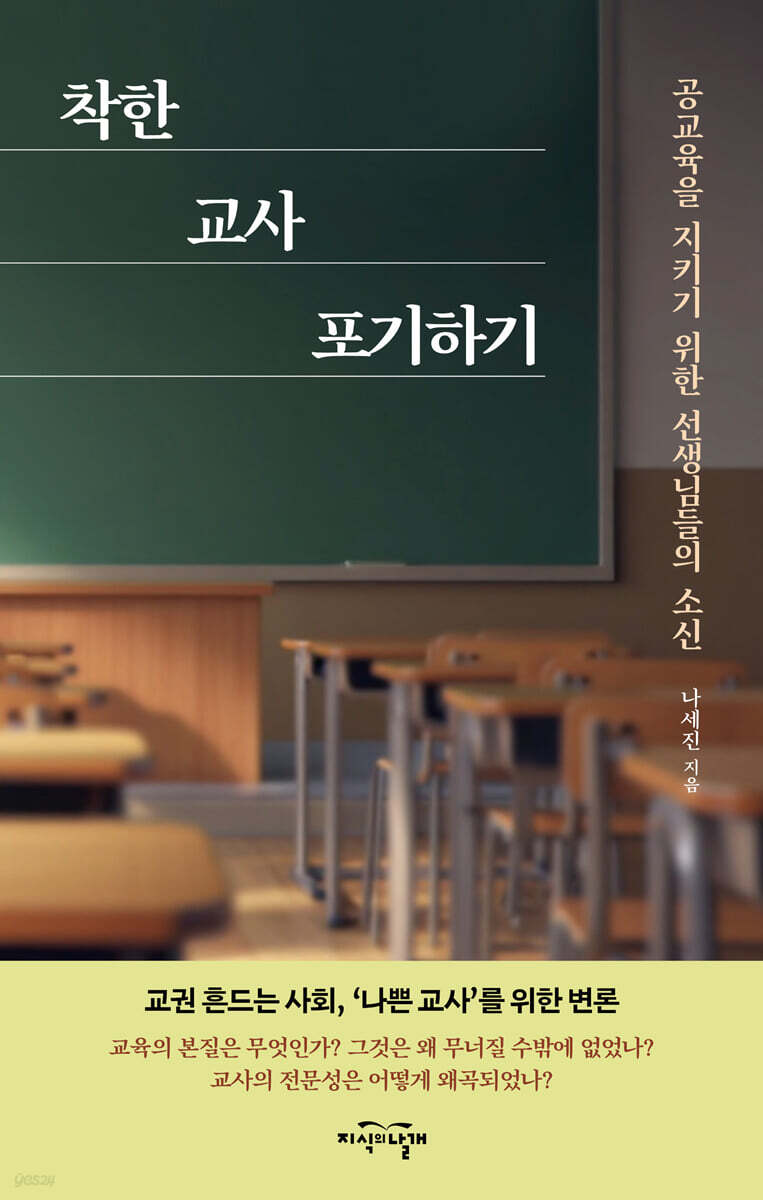
Give up on being a good teacher
 |
Description
Book Introduction
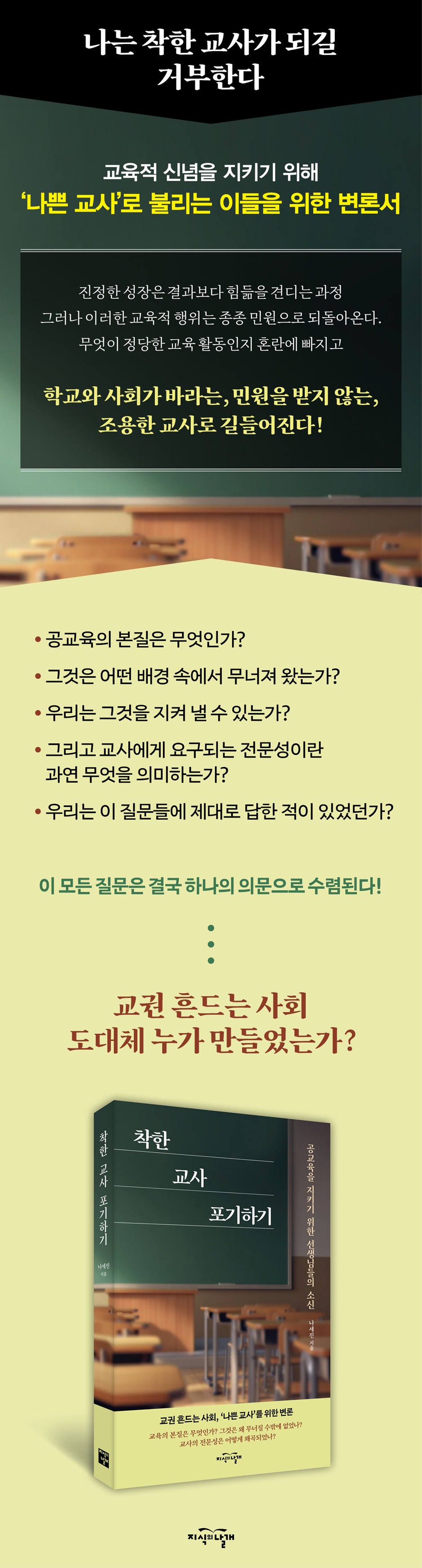
“I refuse to be a good teacher.”
What is the essence of education? Why was it destined to collapse?
How has the professionalism of teachers been distorted?
Anyone who has lived in the world even a little knows.
The school began to fall into disrepair over 30 years ago.
As South Korea began to prosper, excessive entrance exam stress began to encroach on schools.
Students, unable to bear the weight of competition, began to turn into stars one by one, and now even teachers are returning to the sky and beginning to shine.
To protect public education, teachers sometimes assign students uncomfortable assignments and provide harsh feedback.
Because I know that true growth comes from the process of enduring hardship rather than the results.
However, these educational activities often come back as complaints.
Teachers become confused about what constitutes legitimate educational activity, and eventually become conditioned to be the quiet, non-complaining teachers that schools and society want.
As the number of good teachers packaged as ideal teachers increases, public education is gradually being reduced to a service industry.
"Giving Up on Being a Good Teacher" critically reflects on this social phenomenon and serves as a defense for those who are labeled "bad teachers" for defending their educational beliefs.
This book asks:
What is the essence of public education? Under what circumstances has it collapsed? Can we preserve it? And what exactly does the professionalism required of teachers mean? Have we ever properly answered these questions? Following these questions will expose the true face of our educational system.
And you find that all questions ultimately converge to one question.
“Who on earth created a society where religious authority is shaken?”
What is the essence of education? Why was it destined to collapse?
How has the professionalism of teachers been distorted?
Anyone who has lived in the world even a little knows.
The school began to fall into disrepair over 30 years ago.
As South Korea began to prosper, excessive entrance exam stress began to encroach on schools.
Students, unable to bear the weight of competition, began to turn into stars one by one, and now even teachers are returning to the sky and beginning to shine.
To protect public education, teachers sometimes assign students uncomfortable assignments and provide harsh feedback.
Because I know that true growth comes from the process of enduring hardship rather than the results.
However, these educational activities often come back as complaints.
Teachers become confused about what constitutes legitimate educational activity, and eventually become conditioned to be the quiet, non-complaining teachers that schools and society want.
As the number of good teachers packaged as ideal teachers increases, public education is gradually being reduced to a service industry.
"Giving Up on Being a Good Teacher" critically reflects on this social phenomenon and serves as a defense for those who are labeled "bad teachers" for defending their educational beliefs.
This book asks:
What is the essence of public education? Under what circumstances has it collapsed? Can we preserve it? And what exactly does the professionalism required of teachers mean? Have we ever properly answered these questions? Following these questions will expose the true face of our educational system.
And you find that all questions ultimately converge to one question.
“Who on earth created a society where religious authority is shaken?”
- You can preview some of the book's contents.
Preview
index
I A society that nurtures good teachers
1.
The Death of a Good Teacher and Free Riding
2.
A child with the king's DNA
3.
Academic background + academic backgroundism and the collapse of teachers' authority
4.
Public education services in a bullying society
5.
I give up on being a good teacher.
II The Worries of a Bad Teacher
6.
Teacher Evaluation: Training Teachers to Be Good
7.
Constructivist Education and Weekly Study Guide
8.
Leviathan and the Educator
9.
Knowledge or experience?
10.
Teachers in the Age of Artificial Intelligence
III The Bad Teacher's Teaching Method
11.
Developing each person's talents
12.
Dilemma Discussion and Practical Moral Education
13.
There is no question as stupid as this.
14.
If it's fun, I get absorbed in it.
15.
Developing human intelligence with artificial intelligence
IV The Bad Teacher's Master
16.
The Educator's Mind: Expanding Possibilities: Holmboe and My Math Teacher
17.
A Comprehensive Education of Love that Embraces the Weakest: Lee Tae-seok and Pestalozzi
18.
Education that teaches us to look at society for ourselves: Yulgok Yi I and Prairie
19.
Educators Who Connected People with Disabilities to the World: Montessori and Park Du-seong
20.
Bad teachers are ruining public education.
1.
The Death of a Good Teacher and Free Riding
2.
A child with the king's DNA
3.
Academic background + academic backgroundism and the collapse of teachers' authority
4.
Public education services in a bullying society
5.
I give up on being a good teacher.
II The Worries of a Bad Teacher
6.
Teacher Evaluation: Training Teachers to Be Good
7.
Constructivist Education and Weekly Study Guide
8.
Leviathan and the Educator
9.
Knowledge or experience?
10.
Teachers in the Age of Artificial Intelligence
III The Bad Teacher's Teaching Method
11.
Developing each person's talents
12.
Dilemma Discussion and Practical Moral Education
13.
There is no question as stupid as this.
14.
If it's fun, I get absorbed in it.
15.
Developing human intelligence with artificial intelligence
IV The Bad Teacher's Master
16.
The Educator's Mind: Expanding Possibilities: Holmboe and My Math Teacher
17.
A Comprehensive Education of Love that Embraces the Weakest: Lee Tae-seok and Pestalozzi
18.
Education that teaches us to look at society for ourselves: Yulgok Yi I and Prairie
19.
Educators Who Connected People with Disabilities to the World: Montessori and Park Du-seong
20.
Bad teachers are ruining public education.
Detailed image
Into the book
September 4th Public Education Stop Day
August 17, 2023.
The September 4th Seoicho Memorial Ceremony Operation Team released a statement.
“If the law protecting teachers’ rights is not revised by September 4th, we will go on collective strike and stand in front of the National Assembly,” they said.
September 4th, the 49th day of the deceased teacher's death, was named 'Public Education Stop Day'.
Teachers, centering around Indie School, gathered their thoughts one by one, and some schools decided to make this day a discretionary holiday after internal discussions.
However, the debate within the educational field was heated.
Is it right to participate in the memorial service on an official holiday, or should we express our opinions by taking personal leave or sick leave?
Teachers grappled with the issue online and in conference rooms, and their struggles weren't simply administrative decisions; they were a tightrope walk between survival and identity as teachers, between fear and justice.
Our school teachers also gathered for an emergency meeting chaired by the principal.
In the heavy silence, I entered the conference room with the thought, 'It's finally here.'
The meeting was like a poem, a process in which each person's sincerity was gradually accumulated.
Ultimately, we decided to designate September 4th as a discretionary holiday and for all teachers to participate in the memorial service.
Of course, this decision was not simple.
It might have been a more powerful way to voice your opinion through vacation or sick leave on regular school days.
Because it is the most desperate cry for a teacher, just as a worker expresses his will by vacating his position.
If Article 66, Paragraph 1 of the National Civil Service Act is applied, the Ministry of Education may consider it an “illegal strike” if teachers use annual leave or sick leave on a large scale during regular school days.
This fact, like a sharp threat, cast a shadow over the livelihood of teachers who, out of a righteous heart, decided to use vacation and sick leave.
The fear that the disciplinary action could ruin the honor they enjoyed in the teaching profession silenced their colleagues.
--- 「1.
From "The Death of a Good Teacher and Free Riding"
Teacher growth is student growth
The existing Teacher Competency Development Evaluation was abolished, and the Ministry of Education established a new system to replace it, the ‘Teacher Competency Development Support System’3.
The system is scheduled to be fully implemented starting in 2026.
One notable change in the new system is that the existing student satisfaction survey will be converted into a student perception survey.
While the existing survey asked students about their satisfaction with their teachers' teaching activities, the new survey will focus on asking students how they perceived the changes in learning and growth they experienced through their teachers' classes.
In other words, it is not a simple emotional evaluation, but rather a change in the structure of the questions centered on the student's own reflection.
Additionally, the descriptive evaluation items that resulted in cases of violations of teachers' rights will be abolished, and the parent survey will be changed from an evaluation of individual teachers to a form of providing opinions on the overall school curriculum and operation.
Furthermore, evaluation results are cumulatively provided to teachers to enable practical improvements in educational activities, and a customized training recommendation system is operated based on these results.
In addition, we plan to systematically support teacher growth through the Teacher Capacity Development Center.
It is not yet certain whether the new system will be implemented on the ground without any flaws.
Therefore, it is important to examine whether the teacher evaluation system is functioning properly and in a desirable direction.
Above all, evaluation should not be a means of punishment or ranking, but rather a form of feedback that helps teachers grow and reflect.
In other words, evaluation results should serve as a compass that guides teachers in the direction of their development, and should not act as a burden or a stigma in itself.
Students' and parents' opinions should be respected as reference material, but a process of reviewing their validity and reflecting them is necessary.
Additionally, it would be good to establish a structure in which a head teacher is assigned to many schools, fully responsible for the role of teacher educator, and in which they reflect on and develop the overall teaching and educational activities.
It is also important to establish evaluation indicators that are reliable and valid.
Rather than abstract "satisfaction," we need indicators that focus on concrete educational outcomes, such as student growth contribution, achievement of educational goals, and class participation.
(syncopation...)
He said that his will to teach was broken after hearing from a student, “What are you going to do if I don’t do it?”
After that, the teacher is said to have followed the following method to become a 'perfect(?) teacher'.
1.
Don't ask students who don't attend class to do anything.
2.
When talking to parents, only tell them what they want to hear.
3.
Never raise your voice at children.
4.
Not only do I not nag, I also do not make them write diaries, do homework, or study anything else.
5.
Don't do things that children hate.
6.
Finish classes early and give plenty of breaks.
--- 「6.
From “Teacher Evaluation: Training Good Teachers”
Moral behavior and moral thinking
American psychologist Lawrence Kohlberg (1927-1987) emphasized 'dilemma discussion' when explaining the stages of moral development.
By asking questions about complex moral situations that have no right answers and having students logically explain their judgments and listen to the opinions of others, higher-level moral thinking is developed.
In other words, the more often you are exposed to dilemmas, the more likely you are to think deeply and make mature judgments.
What we really must not lose in education is not the ability to memorize the right answer, but the attitude of being able to think and express opinions when faced with a problem that may not have a right answer.
These abilities do not develop through mere information-based classes.
It is nurtured through experiences of facing dilemmas, contemplating right and wrong from each person's perspective, and clashing and reconciling different opinions.
Times when children face dilemmas can be confusing.
But it is precisely that confusion that gives rise to thought, thought gives rise to discussion, and discussion gives rise to growth.
“Kids, we’re going to have a morality test today.” The students’ ears perked up at the word test.
When something is tested at school, children take interest and think of it as something they absolutely have to do.
The students in our class were also curious about what kind of test it was and asked various questions.
“Everyone encounters situations in life where they can’t do anything.
It's like a mathematical formula that doesn't have a definitive answer.
At that time, you will have to think about what kind of thoughts you should have and what kind of actions you should take.
Why not try encountering such situations in the classroom beforehand? The process of thinking about them can help develop your moral character.
“Could you explain what development means?”
“We’re moving on to the next step.”
“That’s right, development is about growing to the next level.
There are ten steps, but you can't jump from the first step to the tenth step in one go.
Just as people wouldn't be able to walk like you do now if they hadn't gone through the stages of crawling, walking, and falling countless times before learning to walk,
“Morality also has stages of development.”
Children learned that even in invisible areas like morality, there are levels.
According to Kohlberg, just as temperature can be measured by a thermometer and intelligence can be measured by test scores, morality can also vary in depth and be divided into levels.
From being kind to others, picking up trash, or helping a friend on crutches, to living a life of medical service in South Sudan, like Father Lee Tae-seok (1962-2010), who gave up wealth and fame, children all lump them together under the word “good.”
Although the children's expressions are not wrong, there is a clear difference between the lofty practices of Jesus' agape love and Confucius' benevolence and the everyday consideration of sharing sweets with a friend.
So, there was a need to explore the value of ‘being good’ more deeply with students.
“A scholar named Kohlberg divided moral development into three levels and six stages.
Today, I'm going to look at what level of morality I have now, based on those steps.
“It is important to broaden your thinking through this process.”
--- 「11.
From “Dilemma Discussion and Practical Moral Education”
The relationship between education and practice
We often reduce education to a matter of 'knowing'.
But if someone's knowledge leaves no trace on that person's life or on the order of the community, is that education truly meaningful?
Education is not simply intellectual play.
In particular, public education can only fulfill its role when it goes beyond individual self-realization and embraces social responsibility and practicality.
But the reality is different.
Even if we learn about democracy in school, it is rare for that learning to lead to actions that create a better society.
Democracy remains a concept in exam questions, and human rights education is also reduced to knowledge for grades.
It is not difficult to witness students who have learned about human rights inadvertently violating the rights of others in their daily lives.
The gap between education and practice is not simply due to individual indifference.
The deep-rooted cause lies in the entrance exam-centered evaluation system.
Schools focus on measuring quantifiable abilities rather than fostering the ability to reflect on life and engage with the world.
Students memorize textbook concepts precisely, but rarely have the opportunity to explore how they come to life in real life.
Another problem is the social perception of schools as ‘isolated spaces.’
Schools often still function as 'places for test preparation.'
Learning is forgotten once the test is over, and education cultivates an attitude of quiet compliance rather than questioning the contradictions of reality.
Teachers are also victims of the social structure and trapped within it.
It is not easy to sustain "practical education" under the triple pressure of textbook progress, college entrance exam preparation, and parental expectations.
Education is becoming increasingly detached from life, practice is pushed out of the classroom, and knowledge and life are instilled in students in a distorted form, separated from each other.
To overcome this, I attempted a character education project using workbooks in elementary schools.
After defining the values learned in ethics class in their own words and organizing ways to put them into practice in their daily lives, we checked the results of the practice in the next class.
The activities that continued throughout the semester were an attempt to connect knowledge, will, and practice in everyday life.
Of course it wasn't easy.
The biggest challenge was the teacher's constant observation and feedback.
Reading the twenty-five workbooks and leaving personalized feedback required a lot of dedication, and it also took a considerable amount of time for the children's practices to become habits.
I couldn't give persistent and thorough feedback every week.
But at some point, I felt a great sense of accomplishment when I saw that some of the children had developed a habit of practicing consistently.
These activities can also be done in middle and high schools.
For example, we can find human rights concepts learned in textbooks in real-life examples, discuss ways to improve them, draw conclusions, and then put them into action.
This way, students come to accept certain concepts not as mere knowledge to be memorized, but as values connected to their lives.
Of course, it is difficult to sustain such attempts because the current secondary education structure is centered on the transfer of vast knowledge and evaluation.
But even within that, there are clearly teachers who strive to connect education and practice.
These are the people who tirelessly provide 'living learning' to students in places that are not visible.
In this context, there were educators who, although the times and environments were different, tried to cultivate proactive individuals who could create a better society through education.
Yulgok Yi I (1536-1584) of Joseon and Paulo Freire (1921-1997) of Brazil are representative figures who held such beliefs.
They are the 'legendary seniors' and still living guides for today's teachers.
August 17, 2023.
The September 4th Seoicho Memorial Ceremony Operation Team released a statement.
“If the law protecting teachers’ rights is not revised by September 4th, we will go on collective strike and stand in front of the National Assembly,” they said.
September 4th, the 49th day of the deceased teacher's death, was named 'Public Education Stop Day'.
Teachers, centering around Indie School, gathered their thoughts one by one, and some schools decided to make this day a discretionary holiday after internal discussions.
However, the debate within the educational field was heated.
Is it right to participate in the memorial service on an official holiday, or should we express our opinions by taking personal leave or sick leave?
Teachers grappled with the issue online and in conference rooms, and their struggles weren't simply administrative decisions; they were a tightrope walk between survival and identity as teachers, between fear and justice.
Our school teachers also gathered for an emergency meeting chaired by the principal.
In the heavy silence, I entered the conference room with the thought, 'It's finally here.'
The meeting was like a poem, a process in which each person's sincerity was gradually accumulated.
Ultimately, we decided to designate September 4th as a discretionary holiday and for all teachers to participate in the memorial service.
Of course, this decision was not simple.
It might have been a more powerful way to voice your opinion through vacation or sick leave on regular school days.
Because it is the most desperate cry for a teacher, just as a worker expresses his will by vacating his position.
If Article 66, Paragraph 1 of the National Civil Service Act is applied, the Ministry of Education may consider it an “illegal strike” if teachers use annual leave or sick leave on a large scale during regular school days.
This fact, like a sharp threat, cast a shadow over the livelihood of teachers who, out of a righteous heart, decided to use vacation and sick leave.
The fear that the disciplinary action could ruin the honor they enjoyed in the teaching profession silenced their colleagues.
--- 「1.
From "The Death of a Good Teacher and Free Riding"
Teacher growth is student growth
The existing Teacher Competency Development Evaluation was abolished, and the Ministry of Education established a new system to replace it, the ‘Teacher Competency Development Support System’3.
The system is scheduled to be fully implemented starting in 2026.
One notable change in the new system is that the existing student satisfaction survey will be converted into a student perception survey.
While the existing survey asked students about their satisfaction with their teachers' teaching activities, the new survey will focus on asking students how they perceived the changes in learning and growth they experienced through their teachers' classes.
In other words, it is not a simple emotional evaluation, but rather a change in the structure of the questions centered on the student's own reflection.
Additionally, the descriptive evaluation items that resulted in cases of violations of teachers' rights will be abolished, and the parent survey will be changed from an evaluation of individual teachers to a form of providing opinions on the overall school curriculum and operation.
Furthermore, evaluation results are cumulatively provided to teachers to enable practical improvements in educational activities, and a customized training recommendation system is operated based on these results.
In addition, we plan to systematically support teacher growth through the Teacher Capacity Development Center.
It is not yet certain whether the new system will be implemented on the ground without any flaws.
Therefore, it is important to examine whether the teacher evaluation system is functioning properly and in a desirable direction.
Above all, evaluation should not be a means of punishment or ranking, but rather a form of feedback that helps teachers grow and reflect.
In other words, evaluation results should serve as a compass that guides teachers in the direction of their development, and should not act as a burden or a stigma in itself.
Students' and parents' opinions should be respected as reference material, but a process of reviewing their validity and reflecting them is necessary.
Additionally, it would be good to establish a structure in which a head teacher is assigned to many schools, fully responsible for the role of teacher educator, and in which they reflect on and develop the overall teaching and educational activities.
It is also important to establish evaluation indicators that are reliable and valid.
Rather than abstract "satisfaction," we need indicators that focus on concrete educational outcomes, such as student growth contribution, achievement of educational goals, and class participation.
(syncopation...)
He said that his will to teach was broken after hearing from a student, “What are you going to do if I don’t do it?”
After that, the teacher is said to have followed the following method to become a 'perfect(?) teacher'.
1.
Don't ask students who don't attend class to do anything.
2.
When talking to parents, only tell them what they want to hear.
3.
Never raise your voice at children.
4.
Not only do I not nag, I also do not make them write diaries, do homework, or study anything else.
5.
Don't do things that children hate.
6.
Finish classes early and give plenty of breaks.
--- 「6.
From “Teacher Evaluation: Training Good Teachers”
Moral behavior and moral thinking
American psychologist Lawrence Kohlberg (1927-1987) emphasized 'dilemma discussion' when explaining the stages of moral development.
By asking questions about complex moral situations that have no right answers and having students logically explain their judgments and listen to the opinions of others, higher-level moral thinking is developed.
In other words, the more often you are exposed to dilemmas, the more likely you are to think deeply and make mature judgments.
What we really must not lose in education is not the ability to memorize the right answer, but the attitude of being able to think and express opinions when faced with a problem that may not have a right answer.
These abilities do not develop through mere information-based classes.
It is nurtured through experiences of facing dilemmas, contemplating right and wrong from each person's perspective, and clashing and reconciling different opinions.
Times when children face dilemmas can be confusing.
But it is precisely that confusion that gives rise to thought, thought gives rise to discussion, and discussion gives rise to growth.
“Kids, we’re going to have a morality test today.” The students’ ears perked up at the word test.
When something is tested at school, children take interest and think of it as something they absolutely have to do.
The students in our class were also curious about what kind of test it was and asked various questions.
“Everyone encounters situations in life where they can’t do anything.
It's like a mathematical formula that doesn't have a definitive answer.
At that time, you will have to think about what kind of thoughts you should have and what kind of actions you should take.
Why not try encountering such situations in the classroom beforehand? The process of thinking about them can help develop your moral character.
“Could you explain what development means?”
“We’re moving on to the next step.”
“That’s right, development is about growing to the next level.
There are ten steps, but you can't jump from the first step to the tenth step in one go.
Just as people wouldn't be able to walk like you do now if they hadn't gone through the stages of crawling, walking, and falling countless times before learning to walk,
“Morality also has stages of development.”
Children learned that even in invisible areas like morality, there are levels.
According to Kohlberg, just as temperature can be measured by a thermometer and intelligence can be measured by test scores, morality can also vary in depth and be divided into levels.
From being kind to others, picking up trash, or helping a friend on crutches, to living a life of medical service in South Sudan, like Father Lee Tae-seok (1962-2010), who gave up wealth and fame, children all lump them together under the word “good.”
Although the children's expressions are not wrong, there is a clear difference between the lofty practices of Jesus' agape love and Confucius' benevolence and the everyday consideration of sharing sweets with a friend.
So, there was a need to explore the value of ‘being good’ more deeply with students.
“A scholar named Kohlberg divided moral development into three levels and six stages.
Today, I'm going to look at what level of morality I have now, based on those steps.
“It is important to broaden your thinking through this process.”
--- 「11.
From “Dilemma Discussion and Practical Moral Education”
The relationship between education and practice
We often reduce education to a matter of 'knowing'.
But if someone's knowledge leaves no trace on that person's life or on the order of the community, is that education truly meaningful?
Education is not simply intellectual play.
In particular, public education can only fulfill its role when it goes beyond individual self-realization and embraces social responsibility and practicality.
But the reality is different.
Even if we learn about democracy in school, it is rare for that learning to lead to actions that create a better society.
Democracy remains a concept in exam questions, and human rights education is also reduced to knowledge for grades.
It is not difficult to witness students who have learned about human rights inadvertently violating the rights of others in their daily lives.
The gap between education and practice is not simply due to individual indifference.
The deep-rooted cause lies in the entrance exam-centered evaluation system.
Schools focus on measuring quantifiable abilities rather than fostering the ability to reflect on life and engage with the world.
Students memorize textbook concepts precisely, but rarely have the opportunity to explore how they come to life in real life.
Another problem is the social perception of schools as ‘isolated spaces.’
Schools often still function as 'places for test preparation.'
Learning is forgotten once the test is over, and education cultivates an attitude of quiet compliance rather than questioning the contradictions of reality.
Teachers are also victims of the social structure and trapped within it.
It is not easy to sustain "practical education" under the triple pressure of textbook progress, college entrance exam preparation, and parental expectations.
Education is becoming increasingly detached from life, practice is pushed out of the classroom, and knowledge and life are instilled in students in a distorted form, separated from each other.
To overcome this, I attempted a character education project using workbooks in elementary schools.
After defining the values learned in ethics class in their own words and organizing ways to put them into practice in their daily lives, we checked the results of the practice in the next class.
The activities that continued throughout the semester were an attempt to connect knowledge, will, and practice in everyday life.
Of course it wasn't easy.
The biggest challenge was the teacher's constant observation and feedback.
Reading the twenty-five workbooks and leaving personalized feedback required a lot of dedication, and it also took a considerable amount of time for the children's practices to become habits.
I couldn't give persistent and thorough feedback every week.
But at some point, I felt a great sense of accomplishment when I saw that some of the children had developed a habit of practicing consistently.
These activities can also be done in middle and high schools.
For example, we can find human rights concepts learned in textbooks in real-life examples, discuss ways to improve them, draw conclusions, and then put them into action.
This way, students come to accept certain concepts not as mere knowledge to be memorized, but as values connected to their lives.
Of course, it is difficult to sustain such attempts because the current secondary education structure is centered on the transfer of vast knowledge and evaluation.
But even within that, there are clearly teachers who strive to connect education and practice.
These are the people who tirelessly provide 'living learning' to students in places that are not visible.
In this context, there were educators who, although the times and environments were different, tried to cultivate proactive individuals who could create a better society through education.
Yulgok Yi I (1536-1584) of Joseon and Paulo Freire (1921-1997) of Brazil are representative figures who held such beliefs.
They are the 'legendary seniors' and still living guides for today's teachers.
--- 「18.
Education that allows us to look at society for ourselves: Yulgok Yi I and Prairie
Education that allows us to look at society for ourselves: Yulgok Yi I and Prairie
Publisher's Review
A good teacher is a bad teacher
On the identity of teachers in protecting public education
In 2023, a young teacher at Seoi Elementary School made an extreme choice.
This incident brought back to light the long-buried issue of religious authority.
Even in a reality where more and more teachers are giving up on being “good teachers” to avoid getting hurt, there are still teachers who struggle.
So, who is a "good teacher"? Where does the line between a "good teacher" and a "bad teacher" lie? Even for the same person, evaluations can vary depending on the situation and context.
Just as language and meaning are so fluid, judgments about teachers cannot be simply divided into right and wrong.
The author, a young elementary school teacher, vividly illustrates the various dilemmas and conflicts encountered in public education settings.
Through this, we criticize the reality that teachers who try to stick to their convictions are sometimes labeled as "bad teachers," and ask what our society needs to consider to establish a healthy public education system.
Our teacher
In the tradition of not even stepping on the shadow of a teacher, teachers were a powerful presence to us as children.
In a time when we learned and grew by paying attention to every single word and every small action, school was not just a place to impart knowledge, but a place to teach us the direction of life.
The teacher was more than just a transmitter of knowledge; he was a guide who demonstrated character and values.
But when did the original meaning of "teacher" gradually disappear, and it began to degenerate into a being evaluated by numbers?
Middle school teachers were evaluated on their ability to help students advance to higher education, while elementary school teachers focused on "safe childcare" rather than education.
As external criteria such as test scores, college advancement rates, and administrative evaluations became the yardstick for judging teachers' abilities, their original role of teaching and developing children was diminished and distorted.
The results are disastrous.
Teachers with passion and conviction are exhausted by the pressure of evaluation and performance, and children are losing the opportunity to experience human growth in a learning environment focused on grades and rankings.
Schools have been reduced to spaces for knowledge and management, and the inherent authority and value of teachers have faded.
Now we must ask:
Where have our teachers gone, and how can we rediscover the true meaning of education in this corrupted system?
Good Teacher 1.
A good teacher tamed by society
Now, our teachers are establishing a new image of themselves as teachers in line with social demands.
It is difficult to meet the demands of school administrators and parents, let alone discipline children sufficiently.
As avoiding complaints and meeting parents' expectations becomes the ideal teacher image, teachers are being trained to be "good teachers" who avoid conflict and are mindful of others' opinions, rather than fulfilling their original role of teaching and developing students.
However, this image of teachers conflicts with the essence of public education.
The teacher's role is not simply to avoid complaints or satisfy parents' demands, but to help students develop a balanced knowledge and character.
However, the image of a ‘good teacher’ created by society hinders this.
Even when faced with correcting wrongdoing or sometimes facing uncomfortable truths, teachers often struggle to assert their convictions due to social pressures.
Ultimately, teachers with passion and expertise find themselves restrained and act based on external criteria rather than educational judgment.
In this situation, we must ask:
Is the ideal teacher we envision truly the right standard? To uphold the purpose of public education and the essence of education—student growth—what role should society demand of teachers? Can teachers, who are trained as "good teachers," truly shape the future of education? Now, teachers and society must work together to find ways to restore true educational value.
Good teacher 2.
A good teacher = a bad teacher
The pressures teachers face in today's schools are invisible but very powerful.
Despite the fact that the educational field is not simply a space for imparting knowledge, but rather a place responsible for students' growth and character formation, teachers often have to restrain their judgment amidst external expectations and demands.
Numerical and outcome-based criteria such as test scores, college advancement rates, parent satisfaction, and administrative evaluations limit teachers' actions, and their original intention to properly guide and teach children is easily shaken.
In such an environment, teachers are forced to repeatedly choose between giving up their educational convictions or being cautious to avoid conflict.
The author demonstrates these problems through various examples from school settings.
Cases where teachers fail to strictly discipline children who have made mistakes during class due to concerns about their parents' opinions, or where teachers give up their educational convictions to avoid causing inconvenience to school administrators, all show the conflict that arises between the social standard of a "good teacher" and the inherent educational judgment of teachers.
This allows the reader to understand why teachers who simply cater to societal needs are not truly helpful to students and education.
Ultimately, the teacher the author is talking about is not one who has been trained to fit social standards, but one who has the right and courage to defend his or her own educational convictions as an educator.
These teachers may sometimes refuse the demands of school administrators or parents, and when necessary, they will endure discomfort to ensure proper teaching of students.
Through various school episodes, the author shows that this type of teacher is a true 'good teacher'.
On the identity of teachers in protecting public education
In 2023, a young teacher at Seoi Elementary School made an extreme choice.
This incident brought back to light the long-buried issue of religious authority.
Even in a reality where more and more teachers are giving up on being “good teachers” to avoid getting hurt, there are still teachers who struggle.
So, who is a "good teacher"? Where does the line between a "good teacher" and a "bad teacher" lie? Even for the same person, evaluations can vary depending on the situation and context.
Just as language and meaning are so fluid, judgments about teachers cannot be simply divided into right and wrong.
The author, a young elementary school teacher, vividly illustrates the various dilemmas and conflicts encountered in public education settings.
Through this, we criticize the reality that teachers who try to stick to their convictions are sometimes labeled as "bad teachers," and ask what our society needs to consider to establish a healthy public education system.
Our teacher
In the tradition of not even stepping on the shadow of a teacher, teachers were a powerful presence to us as children.
In a time when we learned and grew by paying attention to every single word and every small action, school was not just a place to impart knowledge, but a place to teach us the direction of life.
The teacher was more than just a transmitter of knowledge; he was a guide who demonstrated character and values.
But when did the original meaning of "teacher" gradually disappear, and it began to degenerate into a being evaluated by numbers?
Middle school teachers were evaluated on their ability to help students advance to higher education, while elementary school teachers focused on "safe childcare" rather than education.
As external criteria such as test scores, college advancement rates, and administrative evaluations became the yardstick for judging teachers' abilities, their original role of teaching and developing children was diminished and distorted.
The results are disastrous.
Teachers with passion and conviction are exhausted by the pressure of evaluation and performance, and children are losing the opportunity to experience human growth in a learning environment focused on grades and rankings.
Schools have been reduced to spaces for knowledge and management, and the inherent authority and value of teachers have faded.
Now we must ask:
Where have our teachers gone, and how can we rediscover the true meaning of education in this corrupted system?
Good Teacher 1.
A good teacher tamed by society
Now, our teachers are establishing a new image of themselves as teachers in line with social demands.
It is difficult to meet the demands of school administrators and parents, let alone discipline children sufficiently.
As avoiding complaints and meeting parents' expectations becomes the ideal teacher image, teachers are being trained to be "good teachers" who avoid conflict and are mindful of others' opinions, rather than fulfilling their original role of teaching and developing students.
However, this image of teachers conflicts with the essence of public education.
The teacher's role is not simply to avoid complaints or satisfy parents' demands, but to help students develop a balanced knowledge and character.
However, the image of a ‘good teacher’ created by society hinders this.
Even when faced with correcting wrongdoing or sometimes facing uncomfortable truths, teachers often struggle to assert their convictions due to social pressures.
Ultimately, teachers with passion and expertise find themselves restrained and act based on external criteria rather than educational judgment.
In this situation, we must ask:
Is the ideal teacher we envision truly the right standard? To uphold the purpose of public education and the essence of education—student growth—what role should society demand of teachers? Can teachers, who are trained as "good teachers," truly shape the future of education? Now, teachers and society must work together to find ways to restore true educational value.
Good teacher 2.
A good teacher = a bad teacher
The pressures teachers face in today's schools are invisible but very powerful.
Despite the fact that the educational field is not simply a space for imparting knowledge, but rather a place responsible for students' growth and character formation, teachers often have to restrain their judgment amidst external expectations and demands.
Numerical and outcome-based criteria such as test scores, college advancement rates, parent satisfaction, and administrative evaluations limit teachers' actions, and their original intention to properly guide and teach children is easily shaken.
In such an environment, teachers are forced to repeatedly choose between giving up their educational convictions or being cautious to avoid conflict.
The author demonstrates these problems through various examples from school settings.
Cases where teachers fail to strictly discipline children who have made mistakes during class due to concerns about their parents' opinions, or where teachers give up their educational convictions to avoid causing inconvenience to school administrators, all show the conflict that arises between the social standard of a "good teacher" and the inherent educational judgment of teachers.
This allows the reader to understand why teachers who simply cater to societal needs are not truly helpful to students and education.
Ultimately, the teacher the author is talking about is not one who has been trained to fit social standards, but one who has the right and courage to defend his or her own educational convictions as an educator.
These teachers may sometimes refuse the demands of school administrators or parents, and when necessary, they will endure discomfort to ensure proper teaching of students.
Through various school episodes, the author shows that this type of teacher is a true 'good teacher'.
GOODS SPECIFICS
- Date of issue: November 5, 2025
- Page count, weight, size: 284 pages | 140*220*20mm
- ISBN13: 9788920054662
- ISBN10: 8920054665
You may also like
카테고리
korean


korean

![GQ KOREA Mark (Monthly): December [2025]](http://librairie.coreenne.fr/cdn/shop/files/8ef265dbbfbf186523ed75ba7319009d.jpg?v=1765340328&width=3840)


