

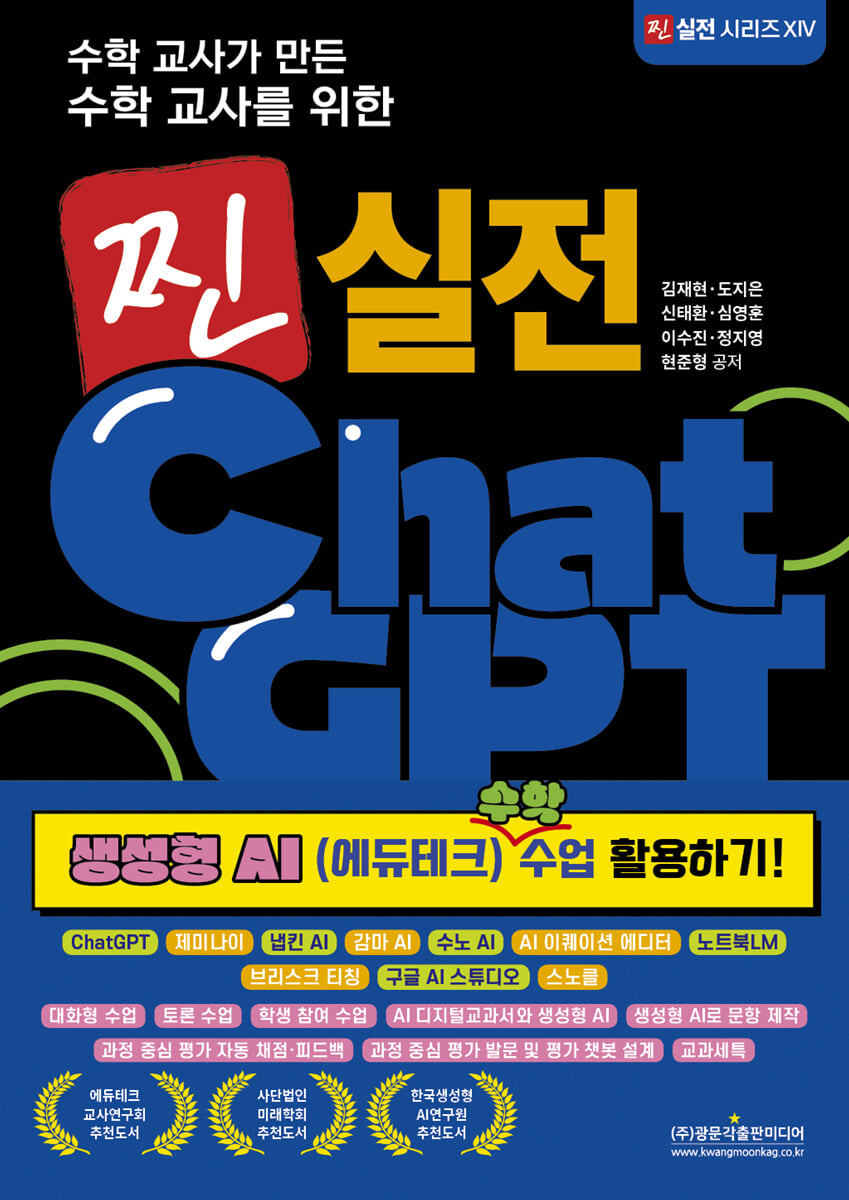
Real-World ChatGPT for Math Teachers, Created by Math Teachers (Using Generative AI in Math Classes!)
 |
Description
Book Introduction
In the drama “Deep-Rooted Tree,” Milbon opposes Hangul, saying that it is a plague-like alphabet, and King Sejong counters that it will spread like a plague.
In Plato's Phaedrus, Socrates criticizes writing for weakening memory, misusing knowledge, and hindering genuine conversation and thought.
So, was the invention of writing and its simpler forms a disaster for humanity? In fact, the invention of writing enabled people to think deeply, read, and write.
The emergence of easier writing systems led to greater participation and the accumulation of knowledge.
The generative AI craze began in November 2022 with the release of ChatGPT-3.5.
According to an annual internet usage survey, the domestic usage rate of generative AI reached 17.6% in the 2023 survey, less than a year ago, and 33.3% in the 2024 survey.
Among these, the usage rates among teenagers and those in their 20s reached 41.3% and 58.9%, respectively.
Considering ChatGPT's "Ghibli craze" in early 2025 led to a surge in users, the usage of generative AI will likely be much higher.
While there are concerns about the use of generative AI, we cannot stop this epidemic that is already spreading.
Rather, we should closely examine the social changes brought about by new technologies and consider how to maximize their potential.
While text simply enabled reading and writing information, generative AI provides a new grammar that enables high-level thinking and learning based on massive amounts of data.
This will be a powerful tool to support higher-order thinking activities such as metacognition and future literacy.
This new tool will bring about a fundamental change in the way we teach.
By complementing the limitations of traditional teacher-centered, lecture-style classes, generative AI can identify each student's weaknesses and provide personalized learning.
Accordingly, teachers will be able to move beyond their role as mere imparters of knowledge to that of coaches and tutors who design and facilitate students' learning.
Students can leverage AI to learn independently and expand their knowledge through more creative and in-depth discussions with their teachers.
These changes will also bring about significant changes in how learning is assessed.
Current objective assessments are closer to binary bit assessments that simply determine right or wrong.
On the other hand, essay-type evaluations are closer to text-type evaluations that express thoughts in writing.
Utilizing generative AI here can lead to the development of big data assessments that analyze students' learning processes in a multidimensional manner.
This is similar to the trend of classical programs with fixed answers evolving into text generation models that write text, and further developing into multimodal AI or agent AI that reads diverse data and creatively generates it.
Likewise, process assessments, task assessments, and portfolio assessments will become part of big data assessments that encompass the entire learning activity, not just text.
How we assess students and conduct classes determines what kind of talents we will cultivate.
Beyond simply finding the right answers, school education must be enhanced to enable students to read and write information freely, understand the flow of various data processes, and develop future capabilities.
In this increasingly advanced learning landscape, generative AI is essential as a fundamental tool, and schools and teachers must actively utilize AI to process this big data.
This book introduces useful generative AI tools for mathematics education and examples of classrooms utilizing them, and aims to explore the possibilities and directions of mathematics education together.
Beyond simply introducing new technologies, I hope this journey will allow us to envision the future of education brought about by AI and seriously explore what kind of intellectual experiences we should provide our students.
- All authors
In Plato's Phaedrus, Socrates criticizes writing for weakening memory, misusing knowledge, and hindering genuine conversation and thought.
So, was the invention of writing and its simpler forms a disaster for humanity? In fact, the invention of writing enabled people to think deeply, read, and write.
The emergence of easier writing systems led to greater participation and the accumulation of knowledge.
The generative AI craze began in November 2022 with the release of ChatGPT-3.5.
According to an annual internet usage survey, the domestic usage rate of generative AI reached 17.6% in the 2023 survey, less than a year ago, and 33.3% in the 2024 survey.
Among these, the usage rates among teenagers and those in their 20s reached 41.3% and 58.9%, respectively.
Considering ChatGPT's "Ghibli craze" in early 2025 led to a surge in users, the usage of generative AI will likely be much higher.
While there are concerns about the use of generative AI, we cannot stop this epidemic that is already spreading.
Rather, we should closely examine the social changes brought about by new technologies and consider how to maximize their potential.
While text simply enabled reading and writing information, generative AI provides a new grammar that enables high-level thinking and learning based on massive amounts of data.
This will be a powerful tool to support higher-order thinking activities such as metacognition and future literacy.
This new tool will bring about a fundamental change in the way we teach.
By complementing the limitations of traditional teacher-centered, lecture-style classes, generative AI can identify each student's weaknesses and provide personalized learning.
Accordingly, teachers will be able to move beyond their role as mere imparters of knowledge to that of coaches and tutors who design and facilitate students' learning.
Students can leverage AI to learn independently and expand their knowledge through more creative and in-depth discussions with their teachers.
These changes will also bring about significant changes in how learning is assessed.
Current objective assessments are closer to binary bit assessments that simply determine right or wrong.
On the other hand, essay-type evaluations are closer to text-type evaluations that express thoughts in writing.
Utilizing generative AI here can lead to the development of big data assessments that analyze students' learning processes in a multidimensional manner.
This is similar to the trend of classical programs with fixed answers evolving into text generation models that write text, and further developing into multimodal AI or agent AI that reads diverse data and creatively generates it.
Likewise, process assessments, task assessments, and portfolio assessments will become part of big data assessments that encompass the entire learning activity, not just text.
How we assess students and conduct classes determines what kind of talents we will cultivate.
Beyond simply finding the right answers, school education must be enhanced to enable students to read and write information freely, understand the flow of various data processes, and develop future capabilities.
In this increasingly advanced learning landscape, generative AI is essential as a fundamental tool, and schools and teachers must actively utilize AI to process this big data.
This book introduces useful generative AI tools for mathematics education and examples of classrooms utilizing them, and aims to explore the possibilities and directions of mathematics education together.
Beyond simply introducing new technologies, I hope this journey will allow us to envision the future of education brought about by AI and seriously explore what kind of intellectual experiences we should provide our students.
- All authors
index
preface
Chapter 1: Generative AI for Math Teachers: Basics
1.
Key Keywords for Understanding Generative AI
2.
Introduction to ChatGPT and its Use in Math Education
3.
Introducing Google Gemini and its Use in Math Education
4.
Math software frequently used in classes
Chapter 2 Generative AI for Math Teachers: Recommendation Tools
1.
Idea Visualization Tool: Napkin AI
2.
Easy Presentation Creation: Gamma AI
3.
A tool that turns anything into a song: SUNO AI
4.
Enter Equations Easily in Google Docs: AI Equation Editor
5.
Data-Based AI Knowledge Management Assistant: NotebookLM
6.
All-in-one teaching tool for teachers: Brisk Teaching
7.
AI Labs Expand Your Classroom: Google AI Studio
8.
Personalized assessment and feedback based on handwriting and oral presentations: Snorkl
Chapter 3: Generative AI for Math Teachers: Applications
1.
Approaching Active Interactive Classes with Generative AI: Properties of Parallelograms in Second-Year Middle School Students
2.
Approaching Active Interactive Classes with Generative AI: Using Simultaneous Equations for Second-Year Middle School Students
3.
Approaching Active Interactive Classes with Generative AI: A Case Study for Second-Year Middle School Students
4.
Using Generative AI for Discussion Classes to Broaden Understanding: Coordinate Planes and Graphs for Middle School 1st Graders
5.
Using Generative AI for Broadening Understanding in Debate Classes: Proofs from First-Year Propositions
6.
Using Generative AI for Concept-Based Inquiry Learning that Sparks Understanding and Inquiry: Using Derivatives in Calculus I
7.
Transforming Classes with Generative AI: Designing Your Own Environmental Symbols for Middle School 1st Graders
8.
Transforming Classes with Diverse Student Engagement Using Generative AI: The Ecological Transition Statistics Project for Middle School 1st Graders
9.
Transforming Classes with Generative AI: A Reading Appreciation Graph for Third-Year Middle School Students
10.
Transforming Classrooms with Generative AI: Finding Correlations in the Daily Lives of Third-Year Middle School Students
11.
Transforming Classes with Generative AI: A Look at the World Through High School Matrixes
12. AI Digital Textbooks Meet Generative AI: Properties of High School 1st Grade Identities and the Remainder Theorem
13.
Creating Questions Using Generative AI for the Implementation of Achievement Assessment Systems
14.
Generative AI makes it easy to automatically grade and provide feedback on process-oriented assessments.
15.
Designing a Questioning and Assessment Chatbot for Process-Oriented Assessment Using Generative AI
16.
Generating AI to record textbook tax information at once
17.
ChatGPT API: Recording Lessons in One Place in the Classroom
Chapter 1: Generative AI for Math Teachers: Basics
1.
Key Keywords for Understanding Generative AI
2.
Introduction to ChatGPT and its Use in Math Education
3.
Introducing Google Gemini and its Use in Math Education
4.
Math software frequently used in classes
Chapter 2 Generative AI for Math Teachers: Recommendation Tools
1.
Idea Visualization Tool: Napkin AI
2.
Easy Presentation Creation: Gamma AI
3.
A tool that turns anything into a song: SUNO AI
4.
Enter Equations Easily in Google Docs: AI Equation Editor
5.
Data-Based AI Knowledge Management Assistant: NotebookLM
6.
All-in-one teaching tool for teachers: Brisk Teaching
7.
AI Labs Expand Your Classroom: Google AI Studio
8.
Personalized assessment and feedback based on handwriting and oral presentations: Snorkl
Chapter 3: Generative AI for Math Teachers: Applications
1.
Approaching Active Interactive Classes with Generative AI: Properties of Parallelograms in Second-Year Middle School Students
2.
Approaching Active Interactive Classes with Generative AI: Using Simultaneous Equations for Second-Year Middle School Students
3.
Approaching Active Interactive Classes with Generative AI: A Case Study for Second-Year Middle School Students
4.
Using Generative AI for Discussion Classes to Broaden Understanding: Coordinate Planes and Graphs for Middle School 1st Graders
5.
Using Generative AI for Broadening Understanding in Debate Classes: Proofs from First-Year Propositions
6.
Using Generative AI for Concept-Based Inquiry Learning that Sparks Understanding and Inquiry: Using Derivatives in Calculus I
7.
Transforming Classes with Generative AI: Designing Your Own Environmental Symbols for Middle School 1st Graders
8.
Transforming Classes with Diverse Student Engagement Using Generative AI: The Ecological Transition Statistics Project for Middle School 1st Graders
9.
Transforming Classes with Generative AI: A Reading Appreciation Graph for Third-Year Middle School Students
10.
Transforming Classrooms with Generative AI: Finding Correlations in the Daily Lives of Third-Year Middle School Students
11.
Transforming Classes with Generative AI: A Look at the World Through High School Matrixes
12. AI Digital Textbooks Meet Generative AI: Properties of High School 1st Grade Identities and the Remainder Theorem
13.
Creating Questions Using Generative AI for the Implementation of Achievement Assessment Systems
14.
Generative AI makes it easy to automatically grade and provide feedback on process-oriented assessments.
15.
Designing a Questioning and Assessment Chatbot for Process-Oriented Assessment Using Generative AI
16.
Generating AI to record textbook tax information at once
17.
ChatGPT API: Recording Lessons in One Place in the Classroom
Detailed image

GOODS SPECIFICS
- Date of issue: October 24, 2025
- Page count, weight, size: 256 pages | 592g | 174*246*14mm
- ISBN13: 9791193205747
- ISBN10: 1193205743
You may also like
카테고리
korean


korean

![GQ KOREA Mark (Monthly): December [2025]](http://librairie.coreenne.fr/cdn/shop/files/8ef265dbbfbf186523ed75ba7319009d.jpg?v=1765340328&width=3840)


