

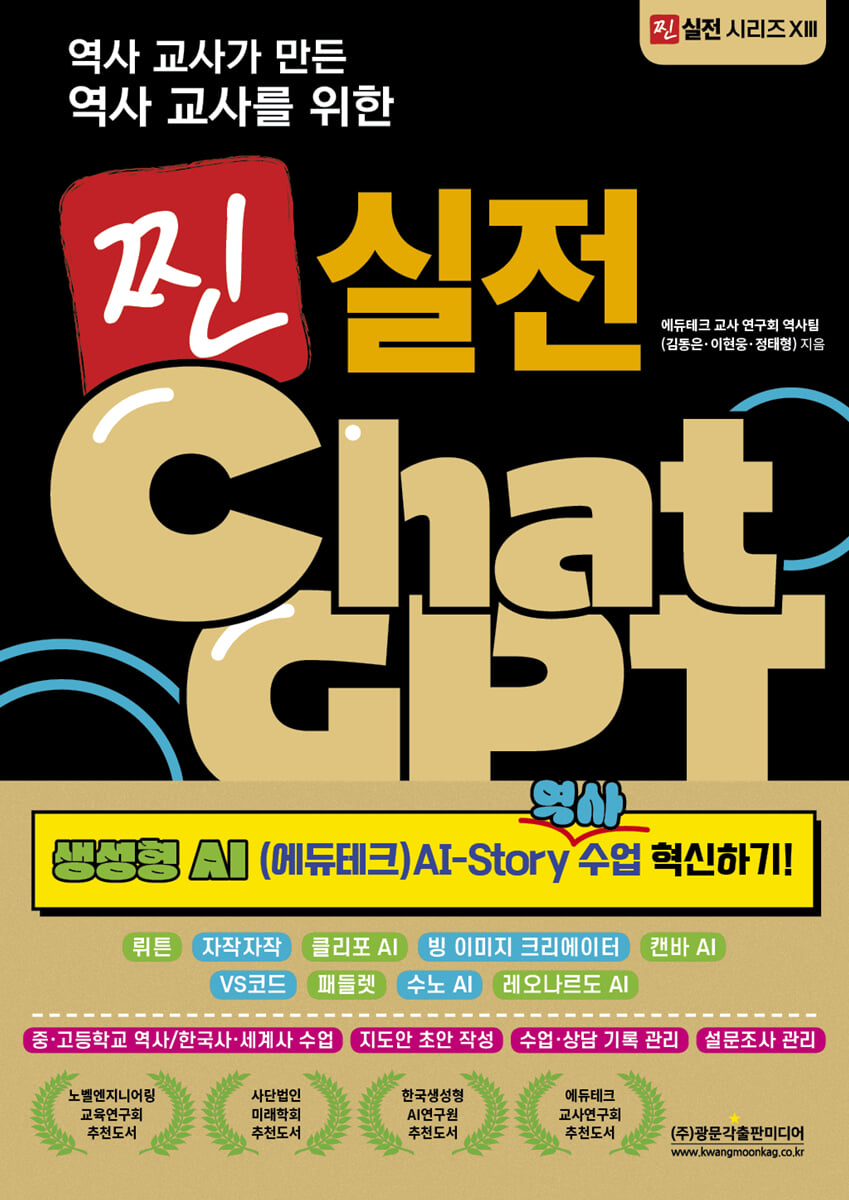
Real-World ChatGPT for History Teachers, Created by History Teachers (Generative AI (Edtech) AI-Story: Transforming History Classes!)
 |
Description
Book Introduction
Opening the Classroom: Innovations in History Classrooms Using Generative AI
Generative AI Shakes Up Education
Artificial intelligence technology, represented by generative AI, is having a profound impact on our lives.
The Ministry of Education is implementing personalized learning and communication-centered classrooms using various edutech tools, including AI, with the goal of achieving "High Touch, High Tech."
In addition, digital transformation is rapidly progressing in the education sector.
In August 2025, the Ministry of Education held the '2025 AI and Digital-Based Education Innovation Conference.'
Various programs were held, including experiencing the latest edtech and policies related to digital education innovation, sharing the results of training for leading teachers in education innovation, and seminars on successful cases of classroom innovation.
In this way, the educational field is facing a full-scale digital transformation.
In this trend, the use of generative AI such as ChatGPT and Gemini is being actively attempted in the educational field.
Teachers are implementing AI in their classes and administrative tasks to improve learning effectiveness and efficiency.
In particular, as digital transformation accelerates, interest in introducing generative AI into various subjects is growing.
However, due to the nature of history, the use of AI in history subjects was more limited than in other subjects.
History education requires logical interpretation based on agreed-upon facts, and generative AI has shown limitations in implementing this specificity.
The main problems are data bias and hallucination.
Data bias is a problem where AI can produce distorted results by focusing on certain information, and hallucination is an error where non-existent information is created as if it were real.
In particular, in the case of data bias, it not only shows information and interpretations favorable to Anglo-American countries that post a lot of information on the Internet, but also makes information favorable to Japan appear.
This can increase the influence of certain regions or countries, and can also create problems of interpretation.
Moreover, AI for Africa is practically impossible to achieve.
Because the research results are cumulative, data bias is likely to increase.
To address this, AI companies emphasize political correctness (PC) and try to correct biased data, but this too can lead to new errors if excessive.
In fact, there was an instance where Google Gemini included images of black and Asian people when generating images of German soldiers from World War II.
Therefore, a fact-based subject like history requires a cautious approach.
Fortunately, recent AI platforms have added features for verifying information sources and reviewing context, making them more accessible to teachers in classrooms. Recognizing AI's limitations and critically analyzing its errors can serve as educational opportunities for students to develop their critical thinking skills.
Generative AI Shakes Up Education
Artificial intelligence technology, represented by generative AI, is having a profound impact on our lives.
The Ministry of Education is implementing personalized learning and communication-centered classrooms using various edutech tools, including AI, with the goal of achieving "High Touch, High Tech."
In addition, digital transformation is rapidly progressing in the education sector.
In August 2025, the Ministry of Education held the '2025 AI and Digital-Based Education Innovation Conference.'
Various programs were held, including experiencing the latest edtech and policies related to digital education innovation, sharing the results of training for leading teachers in education innovation, and seminars on successful cases of classroom innovation.
In this way, the educational field is facing a full-scale digital transformation.
In this trend, the use of generative AI such as ChatGPT and Gemini is being actively attempted in the educational field.
Teachers are implementing AI in their classes and administrative tasks to improve learning effectiveness and efficiency.
In particular, as digital transformation accelerates, interest in introducing generative AI into various subjects is growing.
However, due to the nature of history, the use of AI in history subjects was more limited than in other subjects.
History education requires logical interpretation based on agreed-upon facts, and generative AI has shown limitations in implementing this specificity.
The main problems are data bias and hallucination.
Data bias is a problem where AI can produce distorted results by focusing on certain information, and hallucination is an error where non-existent information is created as if it were real.
In particular, in the case of data bias, it not only shows information and interpretations favorable to Anglo-American countries that post a lot of information on the Internet, but also makes information favorable to Japan appear.
This can increase the influence of certain regions or countries, and can also create problems of interpretation.
Moreover, AI for Africa is practically impossible to achieve.
Because the research results are cumulative, data bias is likely to increase.
To address this, AI companies emphasize political correctness (PC) and try to correct biased data, but this too can lead to new errors if excessive.
In fact, there was an instance where Google Gemini included images of black and Asian people when generating images of German soldiers from World War II.
Therefore, a fact-based subject like history requires a cautious approach.
Fortunately, recent AI platforms have added features for verifying information sources and reviewing context, making them more accessible to teachers in classrooms. Recognizing AI's limitations and critically analyzing its errors can serve as educational opportunities for students to develop their critical thinking skills.
index
Opening the Classroom: Innovations in History Classrooms Using Generative AI
Chapter 1: Preparing for AI Story: Arranging a Generative AI and History Class
1.
The Relationship Between Generative AI and History Classes
2.
Generative AI Ethics Education Before History Class
1. Guidelines for Using Generative AI by School Level
2" Understanding Generative AI through Q&A
3. Considerations when using generative AI in history classes
3.
Preparation before history class
1. Features of major platforms and how to sign up
2. Check the class environment
3. Optimizing History Lessons: Prompt Engineering (Command Writing)
Chapter 2: Putting AI Story into Practice: Empowering History Classes with Generative AI
1.
Middle School History ver.1
1. Writing based on historical inquiry using AI to enhance critical thinking skills
2. AI-based original text analysis and interpretation to enhance historical research skills.
3. Creating an AI History Chatbot that Fosters Historical Empathy
4. Creating AI-powered videos and creating video theaters that expand historical imagination.
2.
Middle School History ver.2
1. Planning a Narrative-Based History Class: Increasing Engagement with AI-Generated Images
2. Conducting a history class based on experiential learning: Conducting virtual interviews with historical figures
3. Creating Project Class Guidelines: Setting Project Direction with AI
4. Outlining a Historical Drama Project Using ChatGPT
3.
High School Korean History
1" Escape Room Game Class with AI Assistant in the Metaverse
2. "I Can Do It Too! Creating a Korean History Game with AI
4.
High School World History
1. Describe the East-West trade route with your own illustration.
2" Guide to Creating Citizen Revolution Songs Using Generative AI
Chapter 3: Improving the Efficiency of Class-Related Administrative Work Using Generative AI
1.
Easily Draft Maps with Generative AI
1. Creating lesson plans with generative AI?
2. Writing Effective Prompts
3. Advantages and Precautions of Creating Maps Using AI
2.
Systematically manage class records and counseling records
3.
Managing Surveys Efficiently
1. Automated questionnaire creation
2" Response Analysis and Visualization
3. Proposal for utilization of survey results
Closing the Class: Hoping for a Sustainable History Class Using Generative AI
Chapter 1: Preparing for AI Story: Arranging a Generative AI and History Class
1.
The Relationship Between Generative AI and History Classes
2.
Generative AI Ethics Education Before History Class
1. Guidelines for Using Generative AI by School Level
2" Understanding Generative AI through Q&A
3. Considerations when using generative AI in history classes
3.
Preparation before history class
1. Features of major platforms and how to sign up
2. Check the class environment
3. Optimizing History Lessons: Prompt Engineering (Command Writing)
Chapter 2: Putting AI Story into Practice: Empowering History Classes with Generative AI
1.
Middle School History ver.1
1. Writing based on historical inquiry using AI to enhance critical thinking skills
2. AI-based original text analysis and interpretation to enhance historical research skills.
3. Creating an AI History Chatbot that Fosters Historical Empathy
4. Creating AI-powered videos and creating video theaters that expand historical imagination.
2.
Middle School History ver.2
1. Planning a Narrative-Based History Class: Increasing Engagement with AI-Generated Images
2. Conducting a history class based on experiential learning: Conducting virtual interviews with historical figures
3. Creating Project Class Guidelines: Setting Project Direction with AI
4. Outlining a Historical Drama Project Using ChatGPT
3.
High School Korean History
1" Escape Room Game Class with AI Assistant in the Metaverse
2. "I Can Do It Too! Creating a Korean History Game with AI
4.
High School World History
1. Describe the East-West trade route with your own illustration.
2" Guide to Creating Citizen Revolution Songs Using Generative AI
Chapter 3: Improving the Efficiency of Class-Related Administrative Work Using Generative AI
1.
Easily Draft Maps with Generative AI
1. Creating lesson plans with generative AI?
2. Writing Effective Prompts
3. Advantages and Precautions of Creating Maps Using AI
2.
Systematically manage class records and counseling records
3.
Managing Surveys Efficiently
1. Automated questionnaire creation
2" Response Analysis and Visualization
3. Proposal for utilization of survey results
Closing the Class: Hoping for a Sustainable History Class Using Generative AI
Detailed image

Publisher's Review
If you were to ask, “Why should we use generative AI in history classes?” to properly deploy generative AI in history classes, the answer would be, “Because it allows us to find and organize historical information much more efficiently, and it also helps develop historical imagination.”
But simply using AI doesn't automatically create good history classes.
In fact, it requires a lot of preparation to use it effectively in class.
First, we need to consider which parts of generative AI we want to connect with history classes.
It is difficult to simply approach this with the mindset of “Edutech is the trend, so let’s try using AI.”
Of course, it is important to diversify teaching methods to keep pace with the times, but we must also consider the system and specificity of the history curriculum we teach.
This is because we need to find the justification for utilizing AI so that we can effectively convey historical content to students while also enabling them to understand it independently.
So, before considering AI-powered classes, it's important to ask the fundamental question, "What changes or developments in students' thinking skills does my class aim to bring?"
In the author's case, he designed a class that fostered "historical imagination" and "critical thinking," two aspects of historical thinking. To facilitate understanding, he introduces an example of a class he actually conducted.
The class the author taught was a class related to the topic of 'World War I'.
We guided students to use generative AI to research and organize sources, enabling them to explore not only the content related to World War I in their textbooks, but also a variety of materials not included in textbooks.
In particular, we set the topic of 'Inventions related to World War I' and had students create prompts based on their research, and then had them use these to generate images using AI.
Afterwards, the class was conducted by writing subtitles using the created images and ultimately producing historical content in the form of YouTube Shorts.
In this process, students filled in the gaps in the AI-generated images based on the historical background and concepts of the time.
In other words, the historical gap was filled with ‘historical imagination.’
Furthermore, generative AI is used not only as a simple information provider, but also as a tool to help verify data and organize sources, enabling students to create their own historical content.
Thanks to this, students were able to develop their capabilities as 'creators' beyond just acquiring historical knowledge.
Of course, there is nothing special about this class.
But it was by no means easy.
What is important at this time is the ‘Classroom Orchestration’ capability.
The concept of classroom orchestration skills literally comes from the word 'orchestra'.
In music, orchestration means arranging and coordinating multiple instruments to create harmony, and a similar concept is used in class.
Classroom orchestration refers to a teaching method that systematically manages the activities of individual students, groups, and the entire class, while appropriately utilizing edutech and AI-based learning tools to encourage student interaction.
Simply put, it's about effectively deploying and utilizing AI tools to help students progress through the inquiry process step by step.
Through this classroom orchestration, the core of history classes utilizing generative AI is not simply to utilize generative AI in class, but to help students develop, develop, and cultivate their capabilities in line with the learning objectives of the history department.
History classes utilizing generative AI in this way can provide students with engaging and practical learning experiences.
Beyond information retrieval and resource provision, generative AI can play a vital role in enhancing students' creative thinking and collaborative skills.
This will allow history education to move beyond mere memorization and provide opportunities to broaden one's thinking and cultivate the ability to think critically.
- All authors
But simply using AI doesn't automatically create good history classes.
In fact, it requires a lot of preparation to use it effectively in class.
First, we need to consider which parts of generative AI we want to connect with history classes.
It is difficult to simply approach this with the mindset of “Edutech is the trend, so let’s try using AI.”
Of course, it is important to diversify teaching methods to keep pace with the times, but we must also consider the system and specificity of the history curriculum we teach.
This is because we need to find the justification for utilizing AI so that we can effectively convey historical content to students while also enabling them to understand it independently.
So, before considering AI-powered classes, it's important to ask the fundamental question, "What changes or developments in students' thinking skills does my class aim to bring?"
In the author's case, he designed a class that fostered "historical imagination" and "critical thinking," two aspects of historical thinking. To facilitate understanding, he introduces an example of a class he actually conducted.
The class the author taught was a class related to the topic of 'World War I'.
We guided students to use generative AI to research and organize sources, enabling them to explore not only the content related to World War I in their textbooks, but also a variety of materials not included in textbooks.
In particular, we set the topic of 'Inventions related to World War I' and had students create prompts based on their research, and then had them use these to generate images using AI.
Afterwards, the class was conducted by writing subtitles using the created images and ultimately producing historical content in the form of YouTube Shorts.
In this process, students filled in the gaps in the AI-generated images based on the historical background and concepts of the time.
In other words, the historical gap was filled with ‘historical imagination.’
Furthermore, generative AI is used not only as a simple information provider, but also as a tool to help verify data and organize sources, enabling students to create their own historical content.
Thanks to this, students were able to develop their capabilities as 'creators' beyond just acquiring historical knowledge.
Of course, there is nothing special about this class.
But it was by no means easy.
What is important at this time is the ‘Classroom Orchestration’ capability.
The concept of classroom orchestration skills literally comes from the word 'orchestra'.
In music, orchestration means arranging and coordinating multiple instruments to create harmony, and a similar concept is used in class.
Classroom orchestration refers to a teaching method that systematically manages the activities of individual students, groups, and the entire class, while appropriately utilizing edutech and AI-based learning tools to encourage student interaction.
Simply put, it's about effectively deploying and utilizing AI tools to help students progress through the inquiry process step by step.
Through this classroom orchestration, the core of history classes utilizing generative AI is not simply to utilize generative AI in class, but to help students develop, develop, and cultivate their capabilities in line with the learning objectives of the history department.
History classes utilizing generative AI in this way can provide students with engaging and practical learning experiences.
Beyond information retrieval and resource provision, generative AI can play a vital role in enhancing students' creative thinking and collaborative skills.
This will allow history education to move beyond mere memorization and provide opportunities to broaden one's thinking and cultivate the ability to think critically.
- All authors
GOODS SPECIFICS
- Date of issue: August 25, 2025
- Page count, weight, size: 216 pages | 516g | 175*247*18mm
- ISBN13: 9791193205723
- ISBN10: 1193205727
You may also like
카테고리
korean


korean

![GQ KOREA Mark (Monthly): December [2025]](http://librairie.coreenne.fr/cdn/shop/files/8ef265dbbfbf186523ed75ba7319009d.jpg?v=1765340328&width=3840)


