

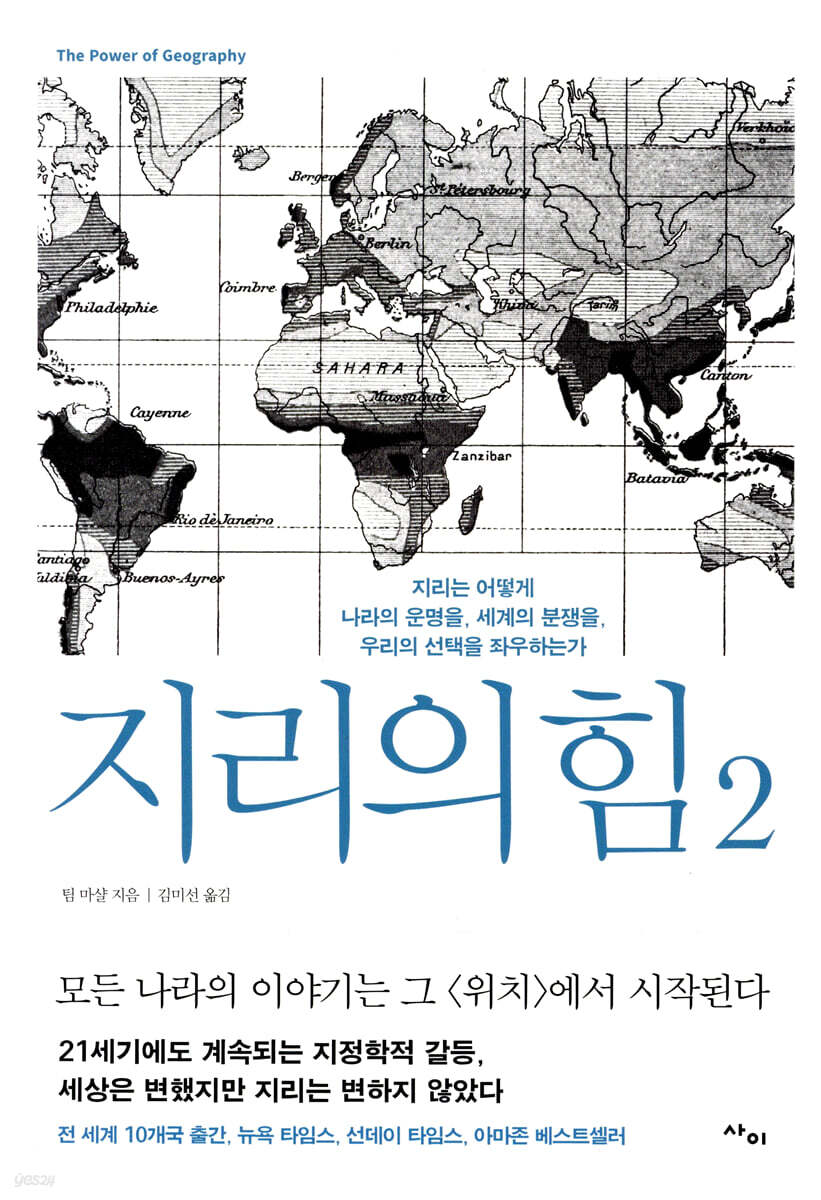
The Power of Geography 2
 |
Description
Book Introduction
- A word from MD
-
Understanding a Multipolar WorldConflicts around the world, including the wars in Ukraine and Russia, indicate that the US-led world order is shaking.
Seven years after "The Power of Geography," Tim Marshall discusses world affairs.
The scope of analysis has been expanded to include the space stage, along with traditional geopolitical strongholds such as Australia and Iran.
April 5, 2022. Social and Political PD Son Min-gyu
The second installment of 『The Power of Geography』, released after 7 years!
Geopolitical conflicts that still persist in the 21st century,
The world has changed so much, but geography remains the same.
Geography is a double-edged sword.
Geography can either be our hindrance or our ally.
Our countless choices can never be separated from where we stand.
Geographical factors still shake up this world today.
Geography determines the lives of individuals, the fate of nations, the conflicts of the world, and our choices.
From the far southern tip of Australia to the high places of space,
Explore the geopolitical realities of key global regions with over 30 maps.
Tim Marshall, an international conflict journalist who has covered over 30 conflict zones around the world, including the Balkans and the Middle East, for over 30 years while working as a Turkey correspondent for the Financial Times, a Foreign Office correspondent, and a BBC reporter, has now published 『The Power of Geography 2』.
This book is a sequel to his previous work, Prisoners of Geography, and covers ten regions of the world that are geopolitically significant because of their "location": Australia, Iran, Saudi Arabia, the United Kingdom, Greece, Turkey, the Sahel, Ethiopia, Spain, and space.
His previous work, The Power of Geography, was published in 30 countries around the world, selling over 1.5 million copies and becoming a bestseller in many countries, including Korea.
The author, who was praised as “another outstanding guide to the modern world” for his unique perspective on world history, politics, economics, trade, conflicts and disputes, and the gap between rich and poor through “Geography as a Lens,” is looking into regions not covered in his previous work in this sequel published seven years later.
In particular, the author examines the causes of current geopolitical conflicts, including economic wars, territorial disputes, political conflicts, nationalistic disputes, and greed and competition over maritime routes, through some 30 maps. Ultimately, he argues that everything "originates from geography," presenting keen insight into geography as one of the key factors that has determined world history.
Geopolitical conflicts that still persist in the 21st century,
The world has changed so much, but geography remains the same.
Geography is a double-edged sword.
Geography can either be our hindrance or our ally.
Our countless choices can never be separated from where we stand.
Geographical factors still shake up this world today.
Geography determines the lives of individuals, the fate of nations, the conflicts of the world, and our choices.
From the far southern tip of Australia to the high places of space,
Explore the geopolitical realities of key global regions with over 30 maps.
Tim Marshall, an international conflict journalist who has covered over 30 conflict zones around the world, including the Balkans and the Middle East, for over 30 years while working as a Turkey correspondent for the Financial Times, a Foreign Office correspondent, and a BBC reporter, has now published 『The Power of Geography 2』.
This book is a sequel to his previous work, Prisoners of Geography, and covers ten regions of the world that are geopolitically significant because of their "location": Australia, Iran, Saudi Arabia, the United Kingdom, Greece, Turkey, the Sahel, Ethiopia, Spain, and space.
His previous work, The Power of Geography, was published in 30 countries around the world, selling over 1.5 million copies and becoming a bestseller in many countries, including Korea.
The author, who was praised as “another outstanding guide to the modern world” for his unique perspective on world history, politics, economics, trade, conflicts and disputes, and the gap between rich and poor through “Geography as a Lens,” is looking into regions not covered in his previous work in this sequel published seven years later.
In particular, the author examines the causes of current geopolitical conflicts, including economic wars, territorial disputes, political conflicts, nationalistic disputes, and greed and competition over maritime routes, through some 30 maps. Ultimately, he argues that everything "originates from geography," presenting keen insight into geography as one of the key factors that has determined world history.
- You can preview some of the book's contents.
Preview
index
Preface: Ideology may pass, but geography remains.
Chapter 1: Australia: Geographic Location and Size Become Both Strengths and Weaknesses
The world's sixth largest country, but less than a third of it is habitable.
Strange foreigners who seek the unknown lands of the south, and those who are deprived of their lands by them.
White Australia policy that rejects people of color
The Birth of Modern Australia as a Multicultural Nation
Abundant natural resources, but water shortages and climate change
A country helpless against a naval blockade
Who is the most important ally: Britain, the United States, or China?
Relations with China, and managing them, are not easy.
Anyway, it's a tough tightrope walk
Chapter 2: Iran, Fighting the World and Carrying Out God's Work
A terrain that is difficult for an enemy to invade, but also difficult to unite the people.
The Strait of Hormuz, a double-edged sword
From the Persian Empire to a Shia Islamic state
It is prey to external forces, and coups and protests are rampant within the country.
1979, Khomeini and the Iranian Revolution
The eight-year war between Iran and Iraq
Oppression under the pretext of religion and citizens' outrage over it
A Shiite country surrounded by Sunni countries
Will the political marriage with the United States continue?
People who laugh at their own revolutionaries
From crown to turban, from turban to boots
A country carrying out God's work
Chapter 3: Saudi Arabia: A Family's Last Name Becomes the Nation's Name
A sandy country bordering eight countries
A coalition of two forces, one political and the other religious.
A country born by force
Oil, Money, and America
Islamic extremists block modernization
Al Qaeda is ready to take on Saudi Arabia.
The 31-Year-Old Crown Prince's Journey to Hegemony in the Middle East
Tyranny and reform at the same time
The gamble to get off oil
Relations with the United States, China, and Israel
The end of the oil age: what is the fate of this country?
Chapter 4: Britain, a Geographically Derived Sentiment of Separation Remains
The development gap created by geographical separation
Until the battlefields of the invaders were united into one kingdom.
A win-win strategy for both Scotland and England
An empire reaching its peak by controlling the seas
The balance of power has begun to shift.
One foot in the US, one foot in the EU (but not deeply)
A hybrid strategy becomes necessary after Brexit.
Still have friends
Not the best power, but a second-tier power
What if Scotland declares a break in diplomatic relations?
Chapter 5: Greece, because of its location, has been the object of games between great powers from ancient times to the present.
A country created by God by scattering rocks and stones
The birthplace of Western civilization, occupied by Persia and Rome.
Left behind, marginalized, and pushed out even within Europe
The Balkan Wars, World Wars, and Occupation by Foreign Powers
Civil war, civil war again
Refugees: The Beginning of Another Conflict and Strife
A huge defense budget for 6,000 islands and seas
A dangerous game over Cyprus
“We are a more trustworthy partner than Türkiye!”
Chapter 6: Türkiye, a place with a good neck, but few friends.
From far away Mongolia to founding the Ottoman Empire
After its heyday, it fell into decline as the sick man of Europe.
The birth of the Republic of Türkiye, but with a sense of unease
Dreaming of the revival of the Ottoman Empire, but without friends
Constant conflict with neighboring countries
“Paralysis Batan, we are the nation that will rule the blue sea!”
A water war with a neighboring country, and a war with the Kurds at home.
Change direction while moving towards democracy
Living in the middle of a brutal neighborhood
Chapter 7: The Sahel, at the center of a conflict plagued by a vicious cycle of terrorism and violence.
Deserts, Camels, Trade Routes, and Islam
The border is divided by mountains and rivers, but we do not know where those mountains and rivers are.
rebel forces supported by international terrorist groups
Civil war continues despite the coronavirus pandemic.
Between the eyes of the great powers and the conflicts of the tribes
A resistance movement taking place in the poorest region of the poorest country
The vicious cycle of climate change, desertification, and violence
Abundant natural resources, a source of funding for terrorists
China builds a strong power in the Sahel
The United States wants to withdraw, while China and Russia wait for an opportunity to get in.
Chapter 8: Ethiopia, but geography is on Ethiopia's side
Water gives strength, while canyons and waterfalls impede development.
A country of heterogeneous communities that has never been colonized
The Birth of Modern Ethiopia: Emergence as a Unique Power
Coups, reigns of terror, war! Yet, the winds of change blow.
The bloody inter-ethnic conflict that has yet to end
Maintaining learned neutrality and keeping an eye on the powerful countries
Power to Ethiopia, instability to Egypt
Chapter 9: Spain, Geography's Obstacles Still Ahead
Geography hinders wealth creation, trade, and political integration.
Muslims took control of the Iberian Peninsula, and the Christian forces defeated them again.
Persecution of Jews and Muslims
From Europe's strongest nation to a paper tiger
Internal divisions and conflicts hinder growth.
Franco brought civil war, terror, and hunger
A country of fascism left alone, ostracized from all sides
The emergence of a new king
Severe conflict between the central and local governments
The EU's Dilemma Regarding Catalan Independence
For the defense of the vast seas
Chapter 10: Space Could Be Another Afghanistan or Iraq
The lunar exploration race between the United States and the Soviet Union
Construction of the International Space Station, a space home with a fantastic view
“Six million dollars is falling from the sky.”
The Space Treaty and Moon Treaty are losing their power
Low Earth Orbit, the Starting Point of Space War
Militarization of space
Developing killer satellites that can destroy satellites of various countries
What will the universe of the future look like?
Space is not the property of any particular nation.
Acknowledgements
References
Chapter 1: Australia: Geographic Location and Size Become Both Strengths and Weaknesses
The world's sixth largest country, but less than a third of it is habitable.
Strange foreigners who seek the unknown lands of the south, and those who are deprived of their lands by them.
White Australia policy that rejects people of color
The Birth of Modern Australia as a Multicultural Nation
Abundant natural resources, but water shortages and climate change
A country helpless against a naval blockade
Who is the most important ally: Britain, the United States, or China?
Relations with China, and managing them, are not easy.
Anyway, it's a tough tightrope walk
Chapter 2: Iran, Fighting the World and Carrying Out God's Work
A terrain that is difficult for an enemy to invade, but also difficult to unite the people.
The Strait of Hormuz, a double-edged sword
From the Persian Empire to a Shia Islamic state
It is prey to external forces, and coups and protests are rampant within the country.
1979, Khomeini and the Iranian Revolution
The eight-year war between Iran and Iraq
Oppression under the pretext of religion and citizens' outrage over it
A Shiite country surrounded by Sunni countries
Will the political marriage with the United States continue?
People who laugh at their own revolutionaries
From crown to turban, from turban to boots
A country carrying out God's work
Chapter 3: Saudi Arabia: A Family's Last Name Becomes the Nation's Name
A sandy country bordering eight countries
A coalition of two forces, one political and the other religious.
A country born by force
Oil, Money, and America
Islamic extremists block modernization
Al Qaeda is ready to take on Saudi Arabia.
The 31-Year-Old Crown Prince's Journey to Hegemony in the Middle East
Tyranny and reform at the same time
The gamble to get off oil
Relations with the United States, China, and Israel
The end of the oil age: what is the fate of this country?
Chapter 4: Britain, a Geographically Derived Sentiment of Separation Remains
The development gap created by geographical separation
Until the battlefields of the invaders were united into one kingdom.
A win-win strategy for both Scotland and England
An empire reaching its peak by controlling the seas
The balance of power has begun to shift.
One foot in the US, one foot in the EU (but not deeply)
A hybrid strategy becomes necessary after Brexit.
Still have friends
Not the best power, but a second-tier power
What if Scotland declares a break in diplomatic relations?
Chapter 5: Greece, because of its location, has been the object of games between great powers from ancient times to the present.
A country created by God by scattering rocks and stones
The birthplace of Western civilization, occupied by Persia and Rome.
Left behind, marginalized, and pushed out even within Europe
The Balkan Wars, World Wars, and Occupation by Foreign Powers
Civil war, civil war again
Refugees: The Beginning of Another Conflict and Strife
A huge defense budget for 6,000 islands and seas
A dangerous game over Cyprus
“We are a more trustworthy partner than Türkiye!”
Chapter 6: Türkiye, a place with a good neck, but few friends.
From far away Mongolia to founding the Ottoman Empire
After its heyday, it fell into decline as the sick man of Europe.
The birth of the Republic of Türkiye, but with a sense of unease
Dreaming of the revival of the Ottoman Empire, but without friends
Constant conflict with neighboring countries
“Paralysis Batan, we are the nation that will rule the blue sea!”
A water war with a neighboring country, and a war with the Kurds at home.
Change direction while moving towards democracy
Living in the middle of a brutal neighborhood
Chapter 7: The Sahel, at the center of a conflict plagued by a vicious cycle of terrorism and violence.
Deserts, Camels, Trade Routes, and Islam
The border is divided by mountains and rivers, but we do not know where those mountains and rivers are.
rebel forces supported by international terrorist groups
Civil war continues despite the coronavirus pandemic.
Between the eyes of the great powers and the conflicts of the tribes
A resistance movement taking place in the poorest region of the poorest country
The vicious cycle of climate change, desertification, and violence
Abundant natural resources, a source of funding for terrorists
China builds a strong power in the Sahel
The United States wants to withdraw, while China and Russia wait for an opportunity to get in.
Chapter 8: Ethiopia, but geography is on Ethiopia's side
Water gives strength, while canyons and waterfalls impede development.
A country of heterogeneous communities that has never been colonized
The Birth of Modern Ethiopia: Emergence as a Unique Power
Coups, reigns of terror, war! Yet, the winds of change blow.
The bloody inter-ethnic conflict that has yet to end
Maintaining learned neutrality and keeping an eye on the powerful countries
Power to Ethiopia, instability to Egypt
Chapter 9: Spain, Geography's Obstacles Still Ahead
Geography hinders wealth creation, trade, and political integration.
Muslims took control of the Iberian Peninsula, and the Christian forces defeated them again.
Persecution of Jews and Muslims
From Europe's strongest nation to a paper tiger
Internal divisions and conflicts hinder growth.
Franco brought civil war, terror, and hunger
A country of fascism left alone, ostracized from all sides
The emergence of a new king
Severe conflict between the central and local governments
The EU's Dilemma Regarding Catalan Independence
For the defense of the vast seas
Chapter 10: Space Could Be Another Afghanistan or Iraq
The lunar exploration race between the United States and the Soviet Union
Construction of the International Space Station, a space home with a fantastic view
“Six million dollars is falling from the sky.”
The Space Treaty and Moon Treaty are losing their power
Low Earth Orbit, the Starting Point of Space War
Militarization of space
Developing killer satellites that can destroy satellites of various countries
What will the universe of the future look like?
Space is not the property of any particular nation.
Acknowledgements
References
Detailed image
.jpg)
Into the book
Welcome to the year 2020.
The Cold War era, when the United States and the Soviet Union dominated the world, is now a distant memory.
We are now entering an era in which new powers are emerging and confronting each other.
Numerous leading actors, as well as supporting actors, fight each other to get to the center stage.
Moreover, the geopolitical drama is now spilling beyond Earth's borders, with nations now laying claim to the moon and beyond.
--- p.8
There is no doubt that economic and geopolitical giants will still hold sway over and shake up the international situation.
These include the United States, China, Russia, each country in the EU, and rapidly growing economic powerhouses like India.
However, we cannot overlook smaller countries.
Geopolitics attracts alliances, and in the constantly turbulent world order of today, great powers need weaker nations on their side as much as on their opponents.
--- p.13
Like its predecessor, The Power of Geography, this book aims to provide a concretized understanding of geopolitical realities by examining mountains, rivers, and seas.
Geography is a major factor that limits what humans can and cannot do.
Of course, politicians play an important role, but geography plays even more.
The decisions people make, present and future, can never be separated from their physical background.
In any country, their story begins with their “location” in relation to neighboring countries, sea routes, natural resources, etc.
--- p.14
Australia has gone from being in the middle of nowhere to being somewhere very important, and now it's at the center stage.
So what happened in the meantime?
--- p.22
Iran has rarely been out of the news.
Iran is a major power in the Middle East, a repressive regime that spreads terror, fear, and bloodshed throughout the region, a potential nuclear power with a tense relationship with Israel and a constant presence in the United States, yet a country neither the United States nor any other country is willing to deploy troops.
--- p.67~68
Do you want to solve or manage a problem?
If so, it is necessary to first clearly define the problem.
In Saudi Arabia, this issue is defined in two words:
Saudi Arabia and Arabia.
If a country is named after a particular family, what happens to those who aren't part of that family? Not all Saudi citizens are members of the House of Saud, nor are they all treated equally.
--- p.116
In recent centuries, Britain's access to the sea has kept it safe from the excessive political turmoil and warfare of mainland Europe.
This partly explains why this island nation feels less connected to the common European home than other European countries.
The carnage that occurred during the two world wars did not shake Britain as much as it did mainland Europe.
It is clear that this “sentiment of separation” influenced Brexit.
--- p.167
A summer in the eastern Mediterranean? Or a vacation in the Aegean? They all sound fantastic, but the region has become too hot recently to enjoy such comforts.
After decades of relative quiet, the region is once again at the forefront of volatile geopolitics.
The discovery of an offshore gas field here has thrown a fresh spark into the long-running feud between Greece and Türkiye.
--- p.212
Greece no longer needs to belong to Britain, Russia or the United States.
Greece is Greece.
Yet, once again, the country became important real estate for external powers.
Meanwhile, gods departed, empires came and went, and alliances changed.
But the constants that made Greece what it is still remain.
That is, the mountains and the sea.
--- p.246
Turkey holds the key to the flow of migrants and refugees into Europe, as one of the gateways through which they pass.
Being a gatekeeper also means holding power.
Turkey's ambition to expand its dominance and influence is a clear sign of neo-Ottomanism.
This is an attempt to once again demonstrate its power to exert significant influence across all fronts, including Europe, the Middle East, and Central Asia.
--- p.281
“We divided the mountains, rivers and lakes among ourselves.
The only difficulty was not knowing exactly where the mountains, rivers, and lakes were.”
--- p.301
In Afghanistan, the Taliban said this about foreign forces opposing them:
“You have watches, we have time.” And that’s exactly what happened.
They waited until the foreigners got tired and left, and eventually most of them went home.
So how much time, blood, and resources are external powers prepared to pour into the Sahel?
--- p.332
In fact, Ethiopia's only ally is its geography, but it has no other friend like this.
For all countries dependent on the Nile River basin, water is a matter of national security.
But no country is as unstable as Egypt, and no country is less unstable than Ethiopia.
--- p.371
The Spanish commander said:
“La geographia manda.” That is, geography governs everything.
But geography was not on their side.
--- p.394
If you establish a colony on the moon, would you be considered a colonialist? Russia and China seem to think so.
Actually, there is some truth to that statement.
But what can we do, it seems written in the stars that we will be competing for them.
The "Space Race" is currently heating up.
If the outbreak of nuclear war threatened to destroy our lives in the 20th century, now the "militarization of space" seems to pose a similar danger.
A war in space could shake the Earth.
The Cold War era, when the United States and the Soviet Union dominated the world, is now a distant memory.
We are now entering an era in which new powers are emerging and confronting each other.
Numerous leading actors, as well as supporting actors, fight each other to get to the center stage.
Moreover, the geopolitical drama is now spilling beyond Earth's borders, with nations now laying claim to the moon and beyond.
--- p.8
There is no doubt that economic and geopolitical giants will still hold sway over and shake up the international situation.
These include the United States, China, Russia, each country in the EU, and rapidly growing economic powerhouses like India.
However, we cannot overlook smaller countries.
Geopolitics attracts alliances, and in the constantly turbulent world order of today, great powers need weaker nations on their side as much as on their opponents.
--- p.13
Like its predecessor, The Power of Geography, this book aims to provide a concretized understanding of geopolitical realities by examining mountains, rivers, and seas.
Geography is a major factor that limits what humans can and cannot do.
Of course, politicians play an important role, but geography plays even more.
The decisions people make, present and future, can never be separated from their physical background.
In any country, their story begins with their “location” in relation to neighboring countries, sea routes, natural resources, etc.
--- p.14
Australia has gone from being in the middle of nowhere to being somewhere very important, and now it's at the center stage.
So what happened in the meantime?
--- p.22
Iran has rarely been out of the news.
Iran is a major power in the Middle East, a repressive regime that spreads terror, fear, and bloodshed throughout the region, a potential nuclear power with a tense relationship with Israel and a constant presence in the United States, yet a country neither the United States nor any other country is willing to deploy troops.
--- p.67~68
Do you want to solve or manage a problem?
If so, it is necessary to first clearly define the problem.
In Saudi Arabia, this issue is defined in two words:
Saudi Arabia and Arabia.
If a country is named after a particular family, what happens to those who aren't part of that family? Not all Saudi citizens are members of the House of Saud, nor are they all treated equally.
--- p.116
In recent centuries, Britain's access to the sea has kept it safe from the excessive political turmoil and warfare of mainland Europe.
This partly explains why this island nation feels less connected to the common European home than other European countries.
The carnage that occurred during the two world wars did not shake Britain as much as it did mainland Europe.
It is clear that this “sentiment of separation” influenced Brexit.
--- p.167
A summer in the eastern Mediterranean? Or a vacation in the Aegean? They all sound fantastic, but the region has become too hot recently to enjoy such comforts.
After decades of relative quiet, the region is once again at the forefront of volatile geopolitics.
The discovery of an offshore gas field here has thrown a fresh spark into the long-running feud between Greece and Türkiye.
--- p.212
Greece no longer needs to belong to Britain, Russia or the United States.
Greece is Greece.
Yet, once again, the country became important real estate for external powers.
Meanwhile, gods departed, empires came and went, and alliances changed.
But the constants that made Greece what it is still remain.
That is, the mountains and the sea.
--- p.246
Turkey holds the key to the flow of migrants and refugees into Europe, as one of the gateways through which they pass.
Being a gatekeeper also means holding power.
Turkey's ambition to expand its dominance and influence is a clear sign of neo-Ottomanism.
This is an attempt to once again demonstrate its power to exert significant influence across all fronts, including Europe, the Middle East, and Central Asia.
--- p.281
“We divided the mountains, rivers and lakes among ourselves.
The only difficulty was not knowing exactly where the mountains, rivers, and lakes were.”
--- p.301
In Afghanistan, the Taliban said this about foreign forces opposing them:
“You have watches, we have time.” And that’s exactly what happened.
They waited until the foreigners got tired and left, and eventually most of them went home.
So how much time, blood, and resources are external powers prepared to pour into the Sahel?
--- p.332
In fact, Ethiopia's only ally is its geography, but it has no other friend like this.
For all countries dependent on the Nile River basin, water is a matter of national security.
But no country is as unstable as Egypt, and no country is less unstable than Ethiopia.
--- p.371
The Spanish commander said:
“La geographia manda.” That is, geography governs everything.
But geography was not on their side.
--- p.394
If you establish a colony on the moon, would you be considered a colonialist? Russia and China seem to think so.
Actually, there is some truth to that statement.
But what can we do, it seems written in the stars that we will be competing for them.
The "Space Race" is currently heating up.
If the outbreak of nuclear war threatened to destroy our lives in the 20th century, now the "militarization of space" seems to pose a similar danger.
A war in space could shake the Earth.
--- p.426
Publisher's Review
The story of every country begins from its “location”!
In particular, this book focuses on regions that deserve more attention because of their “geographic location.”
We will look at a total of 10 regions: Australia, which is so far south that it would be helpless if sea routes were blocked; Iran, which has only the narrow Strait of Hormuz as its only access to the ocean but is using it as its own weapon; the United Kingdom, which is located in a place that weakens its sense of belonging to the common home called Europe while at the same time being advantageous for expanding into the world; Greece, which is located between the Aegean Sea and the Mediterranean Sea and has become prey to powerful countries seeking to dominate the sea and natural gas; Turkey, which is located in a very convenient location but has no friends; Ethiopia, which is located on the upper reaches of the Blue Nile River and has the potential to emerge as a key African country through hydroelectric power; and Spain, which is located at the westernmost tip of the European continent and could become Europe's last bastion.
For these countries, geography can be either an enemy that holds them back or their only ally and friend.
The Cold War era's "bipolar system" centered on the United States and the Soviet Union has ended and the "multipolar era" has arrived, so even though "ideology" has passed by, "geography" is still there!
The Cold War era, when the United States and the Soviet Union led the world, is now a distant memory.
The 21st century marked a shift from a bipolar system dominated by the two superpowers, the United States and the Soviet Union, to a multipolar system with the emergence of several new powers.
The United States is no longer the “world policeman,” and the Soviet Union has fallen apart.
Now the “age of ideology” has come to an end.
Moreover, the world is spinning at a frantic pace and changing at an incredible rate.
But the geography remains unchanged.
In addition to the tendencies, ideologies, and skills of individual leaders, many other factors influence the state of affairs in a country or internationally.
However, the effect is temporary.
But even as generations change, geography remains the same.
The Strait of Hormuz is still narrow, the Himalayas still divide India and China, the South China Sea is still important as a major trade route, Spain's geography still holds them back, Greece's 6,000 islands, whose number does not decrease, are putting pressure on defense spending, Turkey's location, which is coveted by Western powers, determines its foreign policy, and the Hindu Kush and Pyrenees are still physical obstacles.
Ultimately, ideologies may pass away, but geographical elements remain even after a long time.
Emerging powers and smaller nations seeking their own geopolitical roles
As we transition to a multipolar system, China has emerged as a major hegemonic power, the UK has withdrawn from the EU, Middle Eastern countries have spread terror under the pretext of religion, emerging economic powers such as India have emerged, and the US's diplomatic influence has declined, forcing countries to engage in a war of nerves between China and the US. As a result, it has become impossible to accurately predict which way the balance of power will shift in the future.
Geopolitical conflicts that have persisted since ancient times are still not over, and old conflicts and even new ones are emerging.
We are now entering an era of conflict between emerging powers.
Numerous leading actors, as well as “extra actors,” fight each other to get to the center stage.
Therefore, we need to pay attention to the “other players” who have the power to shape the future.
This is because not only the geopolitical dinosaurs, but also the newly emerged great powers and even the “small countries” are repeatedly pushing and pulling each other to seek “their own geopolitical roles.”
Chapter 1 Australia: A Country Where Geographic Location and Size Are Both Strengths and Weaknesses
Australia, the world's sixth-largest country but with less than a third of its land area habitable, has long been considered the "uncharted land of the south."
From here, the United States is 11,500 kilometers away, South America 13,000 kilometers away, Africa 8,000 kilometers away, Britain 19,000 kilometers away, Antarctica 5,000 kilometers away, and even our nearest neighbor, New Zealand, is 2,000 kilometers away.
Therefore, although it is difficult for enemies to invade due to its location, the economic damage would inevitably be severe if the main sea route were blocked.
On the other hand, to the north, there is a huge power called China.
Therefore, the country must walk a tightrope between China and the United States, both economically and militarily.
Chapter 2: Iran: Carrying out its "Godly Work" by waging war against the world under the banner of "Nuclear and Religion."
Iran's mountain ranges and vast deserts make it difficult for enemies to invade, but it is also difficult to unite its people.
Geography thus becomes a condition that “limits Iran’s power.”
Iran has rarely been out of the news.
Iran is a major power in the Middle East, a repressive regime that spreads terror, fear, and bloodshed throughout the region, a potential nuclear power with a tense relationship with Israel and a constant presence in the United States, yet a country neither the United States nor any other country is willing to deploy troops.
In particular, Iran, which is dominated by a Shiite government, is engaged in a “war of nerves with its neighbors for hegemony in the Middle East” by intervening in civil wars in Yemen, Lebanon, and Syria, while being surrounded by Sunni countries.
Furthermore, following the 1979 Iranian Revolution led by Khomeini, the government is exerting an iron fist over all aspects of society with the determination to instill the spirit of the Islamic revolution in all areas of the people's lives through "violence under the guise of religion."
Moreover, Iran's aggressive approach to the international community is further deepening the country's isolation.
This is how they are carrying out the “work of God.”
Chapter 4: Britain: Unrivaled Geographical Position, Yet the Separatist Sentiment That Derived from Its Geography Remains
Even in the 21st century, the influence of its "geographical location" as an island at the western end of the Nordic Plain remains strong.
The country's ability to flourish as a British Empire was partly due to its geography.
Above all, the ease of access to the ocean played a major role.
Britain was safe from the excessive political turmoil, wars, and massacres of mainland Europe thanks to the sea.
In short, Britain is a country with “unrivalled geographical power.”
It is clear that this “sentiment of separation” born of geography has influenced Brexit.
Britain's "rapid rise in economic and military power" began after the Acts of Union 1707, which united Scotland and England into a single nation.
However, this country, which enjoyed its greatest glory through “integration,” is now in danger due to “Brexit,” a form of “separation and withdrawal.”
Since then, it has been looking for “new allies” and has also shown itself trying to form a power bloc “outside” the EU.
But the bigger problem is Scottish independence.
If Scotland were to leave, the UK would lose the strategic and geopolitical advantages it enjoyed as a single nation, and the negative impact on the UK's international standing could be "incomparably greater than if the UK left the EU."
Chapter 5 Greece: Because of its location, it has been the subject of games between great powers from ancient times to the present.
Greece, which is said to have originated when God sifted the earth and scattered it on the world, is surrounded by over 6,000 islands and the Aegean, Mediterranean, and Ionian Seas, with no place being more than 100 kilometers from the sea.
The mountains in the north, while impeding trade, also serve as a good barrier against enemy threats.
However, if Greece is to achieve stability and prosperity, it must first seize maritime power.
In other words, we must become a maritime power.
Therefore, the two elements of “sea and mountains” are the key to understanding Greece’s past, present, and future.
Since ancient times, Greece's geography has limited the country and made it a target for the games of the great powers.
Rome, Byzantium, the Ottoman Empire, Britain, Türkiye, and even Russia have constantly invaded or ruled Greece.
These countries all wanted to dominate the Aegean Sea and the eastern Mediterranean, and Greece was a good target for achieving that goal.
As a result, we fell behind, were marginalized, and were pushed out compared to other European countries.
We now find ourselves at the crossroads of the EU, NATO, a turbulent Middle East, and the refugee crisis.
Moreover, with the discovery of an offshore gas field here, many countries around the world joined in, making the country once again an important real estate for external powers.
Chapter 6: Türkiye: Well-positioned, but dreaming of the "revival of the Ottoman Empire" and making few friends.
Places with good views like this are always subject to greedy eyes from outside forces.
In particular, trade ships heading east, west, south, north, and all directions had to pass through here to reach their final destination.
Moreover, Turkey holds the key to the passage of migrants and refugees into Europe as one of the gateways through which they pass.
Becoming this gatekeeper also means “holding power.”
It also increasingly intervenes in conflicts across the Arab world, including in Syria and Libya, often clashing with the interests of other major powers.
Turkey's ambition to expand its dominance and influence is a clear sign of neo-Ottomanism.
This is an attempt to once again demonstrate its power to exert enormous influence across all directions, including Europe, the Middle East, and Central Asia.
Even amidst some awkward coughing and muttering about the situation at home, Turkey's geographical location inevitably occupied a unique place in the minds of Western powers.
The country, which was modernized under the reformist policies of its first president, Atatürk, has been led by a party rooted in Islamic ideology that is lukewarm toward NATO and angry about the loss of influence in former Ottoman territories under the Erdogan administration.
As the new century began and Turkey's chances of joining the EU became slim, they turned their attention to the "past."
In other words, this country, which had been aiming for a democratic society but then changed its direction to an Islamic society, is now in constant conflict with its neighbors, is increasingly isolated on the diplomatic front, and is losing trust.
Chapter 8: Ethiopia: Geography is on their side, though.
It is water that determines Ethiopia's geopolitical location and importance.
Ethiopia, located on the upper reaches of the Blue Nile, has 〈12 large lakes and 9 large rivers〉.
Because it supplies water to most of its neighboring countries, it holds great political influence over them.
What this country lacks, on the other hand, is a coast and direct access to the sea.
Ethiopia, a country of heterogeneous communities that has never been colonized, is located in the heart of one of the most troubled regions on Earth.
Although the country still grapples with bloody ethnic conflicts and struggles with poverty and famine, geography has contributed to its success story.
This is thanks to the construction of the Grand Ethiopian Renaissance Dam, which utilizes the Nile River system.
In fact, "Ethiopia's only ally is its geography, but it has no other friend like this one."
As Africa's water tower, if Ethiopia can use its technology and resources wisely, it could become a key force in the region.
Chapter 9: Spain: Geography's Interference Still Not Over
Spain is the most mountainous country in Europe.
The country's mountainous terrain and size (twice the size of Britain!) have hindered wealth creation, trade, and political integration even at its peak.
Because mountain ranges and rivers made the movement of goods and people difficult, Spain had great difficulty becoming a strong centralized state, and each region maintained its own distinct cultural and linguistic identity and governed itself in its own way.
Accordingly, regions such as the Basque Country and Catalonia are continuing the “endless conflict between the central and local governments,” with violence occurring in regions demanding “separation and independence.”
These domestic problems, born of this country's geography, and the fissures that impede development, still persist.
A Spanish commander said:
“La geographia manda.” That is, “Geography governs everything.”
But “geography was not on their side.”
Chapter 10: Space: The Future Could Be "Another Afghanistan or Iraq"
Space is now becoming an arena for political competition.
The most important area for future space exploration in the next few decades will be low Earth orbit.
This is also where satellites, which are expanding into the communications and military fields, are located.
Whoever controls this place will gain a huge military advantage across the entire surface of the Earth.
“He who rules low orbit commands the space near Earth.
Whoever controls the space near Earth rules Terra.
“Whoever controls Terra determines the fate of humanity,” said the US Department of Defense. “Space is a battlefield!”
If in the 20th century the outbreak of nuclear war threatened to destroy our lives, now war in space could shake the Earth.
In particular, this book focuses on regions that deserve more attention because of their “geographic location.”
We will look at a total of 10 regions: Australia, which is so far south that it would be helpless if sea routes were blocked; Iran, which has only the narrow Strait of Hormuz as its only access to the ocean but is using it as its own weapon; the United Kingdom, which is located in a place that weakens its sense of belonging to the common home called Europe while at the same time being advantageous for expanding into the world; Greece, which is located between the Aegean Sea and the Mediterranean Sea and has become prey to powerful countries seeking to dominate the sea and natural gas; Turkey, which is located in a very convenient location but has no friends; Ethiopia, which is located on the upper reaches of the Blue Nile River and has the potential to emerge as a key African country through hydroelectric power; and Spain, which is located at the westernmost tip of the European continent and could become Europe's last bastion.
For these countries, geography can be either an enemy that holds them back or their only ally and friend.
The Cold War era's "bipolar system" centered on the United States and the Soviet Union has ended and the "multipolar era" has arrived, so even though "ideology" has passed by, "geography" is still there!
The Cold War era, when the United States and the Soviet Union led the world, is now a distant memory.
The 21st century marked a shift from a bipolar system dominated by the two superpowers, the United States and the Soviet Union, to a multipolar system with the emergence of several new powers.
The United States is no longer the “world policeman,” and the Soviet Union has fallen apart.
Now the “age of ideology” has come to an end.
Moreover, the world is spinning at a frantic pace and changing at an incredible rate.
But the geography remains unchanged.
In addition to the tendencies, ideologies, and skills of individual leaders, many other factors influence the state of affairs in a country or internationally.
However, the effect is temporary.
But even as generations change, geography remains the same.
The Strait of Hormuz is still narrow, the Himalayas still divide India and China, the South China Sea is still important as a major trade route, Spain's geography still holds them back, Greece's 6,000 islands, whose number does not decrease, are putting pressure on defense spending, Turkey's location, which is coveted by Western powers, determines its foreign policy, and the Hindu Kush and Pyrenees are still physical obstacles.
Ultimately, ideologies may pass away, but geographical elements remain even after a long time.
Emerging powers and smaller nations seeking their own geopolitical roles
As we transition to a multipolar system, China has emerged as a major hegemonic power, the UK has withdrawn from the EU, Middle Eastern countries have spread terror under the pretext of religion, emerging economic powers such as India have emerged, and the US's diplomatic influence has declined, forcing countries to engage in a war of nerves between China and the US. As a result, it has become impossible to accurately predict which way the balance of power will shift in the future.
Geopolitical conflicts that have persisted since ancient times are still not over, and old conflicts and even new ones are emerging.
We are now entering an era of conflict between emerging powers.
Numerous leading actors, as well as “extra actors,” fight each other to get to the center stage.
Therefore, we need to pay attention to the “other players” who have the power to shape the future.
This is because not only the geopolitical dinosaurs, but also the newly emerged great powers and even the “small countries” are repeatedly pushing and pulling each other to seek “their own geopolitical roles.”
Chapter 1 Australia: A Country Where Geographic Location and Size Are Both Strengths and Weaknesses
Australia, the world's sixth-largest country but with less than a third of its land area habitable, has long been considered the "uncharted land of the south."
From here, the United States is 11,500 kilometers away, South America 13,000 kilometers away, Africa 8,000 kilometers away, Britain 19,000 kilometers away, Antarctica 5,000 kilometers away, and even our nearest neighbor, New Zealand, is 2,000 kilometers away.
Therefore, although it is difficult for enemies to invade due to its location, the economic damage would inevitably be severe if the main sea route were blocked.
On the other hand, to the north, there is a huge power called China.
Therefore, the country must walk a tightrope between China and the United States, both economically and militarily.
Chapter 2: Iran: Carrying out its "Godly Work" by waging war against the world under the banner of "Nuclear and Religion."
Iran's mountain ranges and vast deserts make it difficult for enemies to invade, but it is also difficult to unite its people.
Geography thus becomes a condition that “limits Iran’s power.”
Iran has rarely been out of the news.
Iran is a major power in the Middle East, a repressive regime that spreads terror, fear, and bloodshed throughout the region, a potential nuclear power with a tense relationship with Israel and a constant presence in the United States, yet a country neither the United States nor any other country is willing to deploy troops.
In particular, Iran, which is dominated by a Shiite government, is engaged in a “war of nerves with its neighbors for hegemony in the Middle East” by intervening in civil wars in Yemen, Lebanon, and Syria, while being surrounded by Sunni countries.
Furthermore, following the 1979 Iranian Revolution led by Khomeini, the government is exerting an iron fist over all aspects of society with the determination to instill the spirit of the Islamic revolution in all areas of the people's lives through "violence under the guise of religion."
Moreover, Iran's aggressive approach to the international community is further deepening the country's isolation.
This is how they are carrying out the “work of God.”
Chapter 4: Britain: Unrivaled Geographical Position, Yet the Separatist Sentiment That Derived from Its Geography Remains
Even in the 21st century, the influence of its "geographical location" as an island at the western end of the Nordic Plain remains strong.
The country's ability to flourish as a British Empire was partly due to its geography.
Above all, the ease of access to the ocean played a major role.
Britain was safe from the excessive political turmoil, wars, and massacres of mainland Europe thanks to the sea.
In short, Britain is a country with “unrivalled geographical power.”
It is clear that this “sentiment of separation” born of geography has influenced Brexit.
Britain's "rapid rise in economic and military power" began after the Acts of Union 1707, which united Scotland and England into a single nation.
However, this country, which enjoyed its greatest glory through “integration,” is now in danger due to “Brexit,” a form of “separation and withdrawal.”
Since then, it has been looking for “new allies” and has also shown itself trying to form a power bloc “outside” the EU.
But the bigger problem is Scottish independence.
If Scotland were to leave, the UK would lose the strategic and geopolitical advantages it enjoyed as a single nation, and the negative impact on the UK's international standing could be "incomparably greater than if the UK left the EU."
Chapter 5 Greece: Because of its location, it has been the subject of games between great powers from ancient times to the present.
Greece, which is said to have originated when God sifted the earth and scattered it on the world, is surrounded by over 6,000 islands and the Aegean, Mediterranean, and Ionian Seas, with no place being more than 100 kilometers from the sea.
The mountains in the north, while impeding trade, also serve as a good barrier against enemy threats.
However, if Greece is to achieve stability and prosperity, it must first seize maritime power.
In other words, we must become a maritime power.
Therefore, the two elements of “sea and mountains” are the key to understanding Greece’s past, present, and future.
Since ancient times, Greece's geography has limited the country and made it a target for the games of the great powers.
Rome, Byzantium, the Ottoman Empire, Britain, Türkiye, and even Russia have constantly invaded or ruled Greece.
These countries all wanted to dominate the Aegean Sea and the eastern Mediterranean, and Greece was a good target for achieving that goal.
As a result, we fell behind, were marginalized, and were pushed out compared to other European countries.
We now find ourselves at the crossroads of the EU, NATO, a turbulent Middle East, and the refugee crisis.
Moreover, with the discovery of an offshore gas field here, many countries around the world joined in, making the country once again an important real estate for external powers.
Chapter 6: Türkiye: Well-positioned, but dreaming of the "revival of the Ottoman Empire" and making few friends.
Places with good views like this are always subject to greedy eyes from outside forces.
In particular, trade ships heading east, west, south, north, and all directions had to pass through here to reach their final destination.
Moreover, Turkey holds the key to the passage of migrants and refugees into Europe as one of the gateways through which they pass.
Becoming this gatekeeper also means “holding power.”
It also increasingly intervenes in conflicts across the Arab world, including in Syria and Libya, often clashing with the interests of other major powers.
Turkey's ambition to expand its dominance and influence is a clear sign of neo-Ottomanism.
This is an attempt to once again demonstrate its power to exert enormous influence across all directions, including Europe, the Middle East, and Central Asia.
Even amidst some awkward coughing and muttering about the situation at home, Turkey's geographical location inevitably occupied a unique place in the minds of Western powers.
The country, which was modernized under the reformist policies of its first president, Atatürk, has been led by a party rooted in Islamic ideology that is lukewarm toward NATO and angry about the loss of influence in former Ottoman territories under the Erdogan administration.
As the new century began and Turkey's chances of joining the EU became slim, they turned their attention to the "past."
In other words, this country, which had been aiming for a democratic society but then changed its direction to an Islamic society, is now in constant conflict with its neighbors, is increasingly isolated on the diplomatic front, and is losing trust.
Chapter 8: Ethiopia: Geography is on their side, though.
It is water that determines Ethiopia's geopolitical location and importance.
Ethiopia, located on the upper reaches of the Blue Nile, has 〈12 large lakes and 9 large rivers〉.
Because it supplies water to most of its neighboring countries, it holds great political influence over them.
What this country lacks, on the other hand, is a coast and direct access to the sea.
Ethiopia, a country of heterogeneous communities that has never been colonized, is located in the heart of one of the most troubled regions on Earth.
Although the country still grapples with bloody ethnic conflicts and struggles with poverty and famine, geography has contributed to its success story.
This is thanks to the construction of the Grand Ethiopian Renaissance Dam, which utilizes the Nile River system.
In fact, "Ethiopia's only ally is its geography, but it has no other friend like this one."
As Africa's water tower, if Ethiopia can use its technology and resources wisely, it could become a key force in the region.
Chapter 9: Spain: Geography's Interference Still Not Over
Spain is the most mountainous country in Europe.
The country's mountainous terrain and size (twice the size of Britain!) have hindered wealth creation, trade, and political integration even at its peak.
Because mountain ranges and rivers made the movement of goods and people difficult, Spain had great difficulty becoming a strong centralized state, and each region maintained its own distinct cultural and linguistic identity and governed itself in its own way.
Accordingly, regions such as the Basque Country and Catalonia are continuing the “endless conflict between the central and local governments,” with violence occurring in regions demanding “separation and independence.”
These domestic problems, born of this country's geography, and the fissures that impede development, still persist.
A Spanish commander said:
“La geographia manda.” That is, “Geography governs everything.”
But “geography was not on their side.”
Chapter 10: Space: The Future Could Be "Another Afghanistan or Iraq"
Space is now becoming an arena for political competition.
The most important area for future space exploration in the next few decades will be low Earth orbit.
This is also where satellites, which are expanding into the communications and military fields, are located.
Whoever controls this place will gain a huge military advantage across the entire surface of the Earth.
“He who rules low orbit commands the space near Earth.
Whoever controls the space near Earth rules Terra.
“Whoever controls Terra determines the fate of humanity,” said the US Department of Defense. “Space is a battlefield!”
If in the 20th century the outbreak of nuclear war threatened to destroy our lives, now war in space could shake the Earth.
GOODS SPECIFICS
- Publication date: April 10, 2022
- Page count, weight, size: 472 pages | 622g | 153*225*30mm
- ISBN13: 9788993178982
- ISBN10: 8993178984
You may also like
카테고리
korean


korean

![GQ KOREA Mark (Monthly): December [2025]](http://librairie.coreenne.fr/cdn/shop/files/8ef265dbbfbf186523ed75ba7319009d.jpg?v=1765340328&width=3840)


