

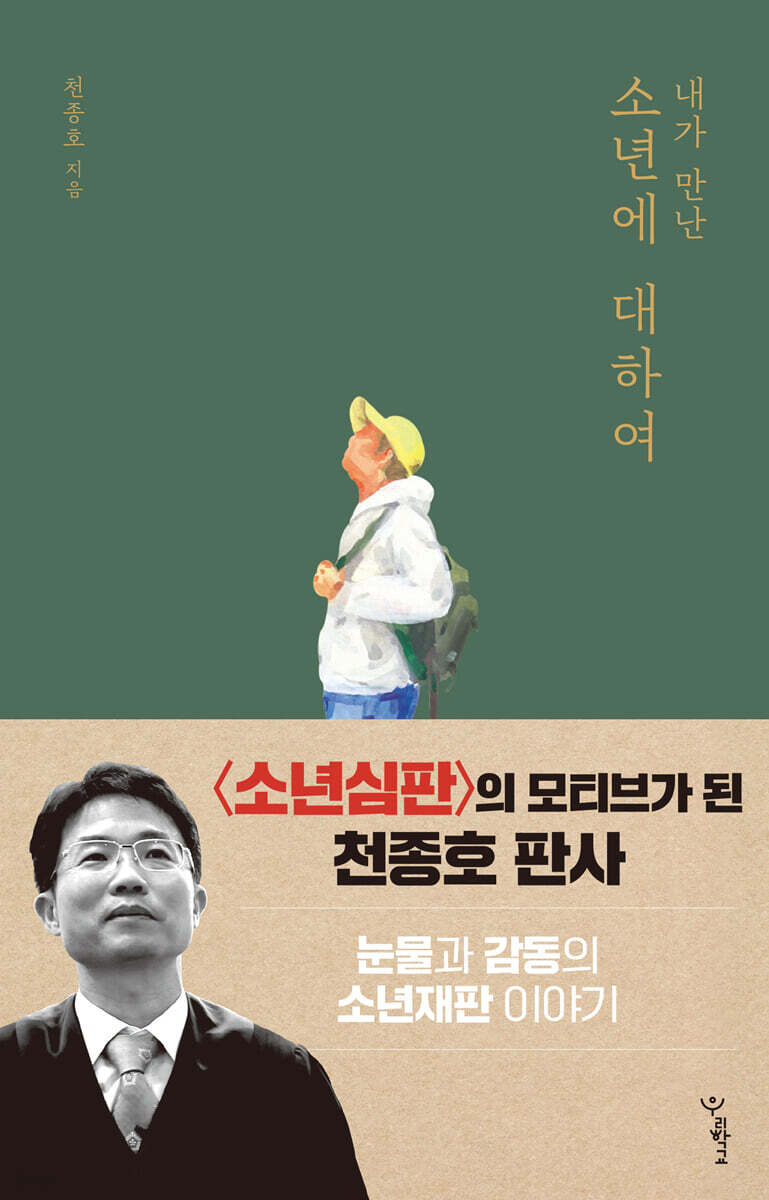
About the boy I met
 |
Description
Book Introduction
Judge Cheon Jong-ho, the inspiration for [Juvenile Justice]
A tearful and moving story of a juvenile trial
"About the Boy I Met" is a special edition of Judge Jong-ho Cheon, the "godfather of juvenile offenders," which has selected essays that have resonated greatly with readers from his previous books.
All sentences have been refined and the content has been enriched to make it easy to read for both teenagers and adults, and warm and affectionate illustrations have been added.
New articles on law and justice, the rule of law and community, as well as recent debates regarding the Juvenile Act, are also included.
Judge Chun Jong-ho makes the boys tremble with his harsh scolding in the courtroom, but after the trial, he sheds tears over the poor conditions of the boys and listens to their heartbreaking stories.
He says it again and again.
When the formwork of flight is removed, the vulnerability of children who are thrown without any protection in the face of the absurdity and violence of life is fully revealed.
There are many children in the world who are in situations that no one should ever have to go through, and no child should ever be in that kind of environment.
While we are living in times of anxiety and cynicism, Judge Chun Jong-ho has been changing the world little by little, fearless and throwing himself into it.
This book delivers a small but shining ray of hope to our cold community, where voices of criticism are only growing louder.
* This book is a donation book, with all royalties donated to the Youth Recovery Center.
A tearful and moving story of a juvenile trial
"About the Boy I Met" is a special edition of Judge Jong-ho Cheon, the "godfather of juvenile offenders," which has selected essays that have resonated greatly with readers from his previous books.
All sentences have been refined and the content has been enriched to make it easy to read for both teenagers and adults, and warm and affectionate illustrations have been added.
New articles on law and justice, the rule of law and community, as well as recent debates regarding the Juvenile Act, are also included.
Judge Chun Jong-ho makes the boys tremble with his harsh scolding in the courtroom, but after the trial, he sheds tears over the poor conditions of the boys and listens to their heartbreaking stories.
He says it again and again.
When the formwork of flight is removed, the vulnerability of children who are thrown without any protection in the face of the absurdity and violence of life is fully revealed.
There are many children in the world who are in situations that no one should ever have to go through, and no child should ever be in that kind of environment.
While we are living in times of anxiety and cynicism, Judge Chun Jong-ho has been changing the world little by little, fearless and throwing himself into it.
This book delivers a small but shining ray of hope to our cold community, where voices of criticism are only growing louder.
* This book is a donation book, with all royalties donated to the Youth Recovery Center.
- You can preview some of the book's contents.
Preview
index
Introduction_About the Boy We Never Knew_7
The Boy Is Here _13
An Apology for Young Jean Valjeans _25
A child loves you so much _34
If you're tempted to steal, think of this wallet _46
A Father's Heart, a Judge's Conscience _57
No, rather, we are sorry _70
Judge, I will never repay your kindness _79
Please let me call you Mom _91
Your Honor, please have some samgyetang _100
I can do it I can do it well _108
I endured hunger because of you, Judge _117
Are 'kids these days' the problem? _128
Fun School? Disaster School? _139
May it be a pain we share together _151
Law and Justice for Humanity _162
When one door closes, another opens _172
Rethinking the Juvenile Act _181
Outgoing Writing_Cheers for the Boy's Life Journey_199
The Boy Is Here _13
An Apology for Young Jean Valjeans _25
A child loves you so much _34
If you're tempted to steal, think of this wallet _46
A Father's Heart, a Judge's Conscience _57
No, rather, we are sorry _70
Judge, I will never repay your kindness _79
Please let me call you Mom _91
Your Honor, please have some samgyetang _100
I can do it I can do it well _108
I endured hunger because of you, Judge _117
Are 'kids these days' the problem? _128
Fun School? Disaster School? _139
May it be a pain we share together _151
Law and Justice for Humanity _162
When one door closes, another opens _172
Rethinking the Juvenile Act _181
Outgoing Writing_Cheers for the Boy's Life Journey_199
Detailed image

Into the book
Because the juvenile judge's decision could determine a boy's life, I always calmed my mind and prayed before entering the courtroom.
Please let me give the boys the most appropriate yet fair punishment, and let them accept my punishment not as retribution for their sins, but as a new beginning in life.
--- From the "Introductory Note"
Among the children who were tried by me as juveniles, there were cases where they safely completed their time in juvenile detention centers or returned home after completing their period of placement and contacted me often.
They may suddenly call crying, saying they are so sick they are dying but there is no one to take care of them, or ask what to do when their parents are filing for divorce, or call asking for help because they were in a car accident while riding a motorcycle.
It's always a pleasure and a blessing when children contact me, a judge, because it means they're not doing anything wrong.
--- From "The Boy Is Here"
The fact is that, contrary to expectations, the proportion of serious crimes such as school violence, murder, and sexual assault among all juvenile crime cases is not as large as one might think.
So-called 'livelihood' crimes are far more common than these incidents.
Among the children I met in juvenile court, the overwhelming majority were children who had been brought to court for livelihood-related crimes.
The largest proportion of juvenile crimes is theft, which involves stealing items. Among these, there was a child who was brought to court for stealing snacks from a supermarket.
--- From "An Apology for Young Jean Valjeans"
It is natural that if you commit a sin, you will be punished.
There can be no exception just because he is a juvenile offender.
But people seem to prefer dividing and separating rather than pooling their strength.
There are so many different divisions and divisions: good kids and bad kids, problem kids and model students, at-risk youth and normal youth.
Perhaps this kind of discernment comes from the minds of people who have never experienced the hardships of life.
Anyone who has ever experienced the hardships of life knows how thin and fragile the boundaries between one thing and another can be.
--- From "When you're tempted to steal, think of this wallet"
'It's not your fault that you were born to irresponsible parents...
A girl with many dreams has only one wish: to have her whole family gather for a meal together. What sin can there be in your tender heart that cannot even resent your parents for not being able to grant even that small wish?
It is not you who should apologize, but rather us adults.
Rather, we are sorry.
We who did not offer you a single warm word when you were wandering alone, we who did not extend a hand when you were struggling so much that you wanted to die, we who did not create a good environment for you… … .
--- From "No, rather, we are sorry"
The flying boy is the invisible man of our society.
Because they are children who clearly exist but no one pays attention to.
The only time these children show their presence is when an incident occurs.
Normally, we don't even know about it, but when a shocking incident occurs, all the world's sharp eyes are focused on the flying boy.
There is no favor in that gaze.
Few people think about what kind of lives these children lived before their accidents or what kind of lives they will lead in the future.
--- From "Judge, I will never repay your kindness"
Instead of my mother's voice, only a cold, mechanical voice saying, "Your number is out of service" was heard on the phone.
My mom canceled my phone number because she was afraid that Sangjun would call again.
At that time, Sangjun is said to have cried and said this to the center director's wife.
“But I still wanted to see your face once…….
I wanted to see what my mom looked like, even from far away… … .
--- From "Please Let Me Call You Mom"
“When I was sent to the medical detention center for juveniles, I had a lot of resentment toward the judge.
I was so angry I couldn't stand it.
But while I was there, I happened to read the judge's book.
After reading that book, I made a vow to the judge in my heart that I would become a new person.
Because of that, I worked hard in juvenile detention center.
After leaving my aunt's house, I survived on 70,000 won for 10 days, and after I ran out of money, I continued to starve.
But I didn't steal.
The reason is because of the promise I made to the judge.”
--- From "I endured hunger because of you, Judge"
No matter what excuses are made, the current state of society was created by the 'adults' of our society.
In a society where violence is primarily learned at home, where violence is tolerated with impunity, what can children possibly learn? Most children are already gradually losing the ability to empathize with pain and sorrow on a human-to-human level.
--- From "These days, kids are the problem?"
This is precisely why school violence is so scary.
Because there are children who choose to commit suicide because they cannot overcome their suffering.
What kind of violence did they experience that drove them to such extreme measures as suicide? Even if they fortunately avoid such choices, the aftereffects of school violence can be severe, with victims suffering from resentment and hostility toward the perpetrators, or even depression.
--- From "Fun School? Disaster School?"
Have you ever considered how to truly help victims like H? Will simply expressing your hatred for the perpetrator, petitioning for severe punishment, and leaving comments on articles truly heal and restore the perpetrator's wounds? No.
That alone is not enough.
--- From "May we share the pain together"
In France, there is a walking tour program for young flight attendants called 'Seuil'.
The recidivism rate of the youth who completed the walking tour was 15 percent, which was significantly lower than the 85 percent recidivism rate of the general juvenile delinquent.
… … I, too, was deeply moved by the direction that Soyuiyu was pursuing, and since 2015, with the help of the Mansa Boys Foundation and sponsors, I have been doing my best to implement the ‘2-person 3-legged walking tour’ with children.
Please let me give the boys the most appropriate yet fair punishment, and let them accept my punishment not as retribution for their sins, but as a new beginning in life.
--- From the "Introductory Note"
Among the children who were tried by me as juveniles, there were cases where they safely completed their time in juvenile detention centers or returned home after completing their period of placement and contacted me often.
They may suddenly call crying, saying they are so sick they are dying but there is no one to take care of them, or ask what to do when their parents are filing for divorce, or call asking for help because they were in a car accident while riding a motorcycle.
It's always a pleasure and a blessing when children contact me, a judge, because it means they're not doing anything wrong.
--- From "The Boy Is Here"
The fact is that, contrary to expectations, the proportion of serious crimes such as school violence, murder, and sexual assault among all juvenile crime cases is not as large as one might think.
So-called 'livelihood' crimes are far more common than these incidents.
Among the children I met in juvenile court, the overwhelming majority were children who had been brought to court for livelihood-related crimes.
The largest proportion of juvenile crimes is theft, which involves stealing items. Among these, there was a child who was brought to court for stealing snacks from a supermarket.
--- From "An Apology for Young Jean Valjeans"
It is natural that if you commit a sin, you will be punished.
There can be no exception just because he is a juvenile offender.
But people seem to prefer dividing and separating rather than pooling their strength.
There are so many different divisions and divisions: good kids and bad kids, problem kids and model students, at-risk youth and normal youth.
Perhaps this kind of discernment comes from the minds of people who have never experienced the hardships of life.
Anyone who has ever experienced the hardships of life knows how thin and fragile the boundaries between one thing and another can be.
--- From "When you're tempted to steal, think of this wallet"
'It's not your fault that you were born to irresponsible parents...
A girl with many dreams has only one wish: to have her whole family gather for a meal together. What sin can there be in your tender heart that cannot even resent your parents for not being able to grant even that small wish?
It is not you who should apologize, but rather us adults.
Rather, we are sorry.
We who did not offer you a single warm word when you were wandering alone, we who did not extend a hand when you were struggling so much that you wanted to die, we who did not create a good environment for you… … .
--- From "No, rather, we are sorry"
The flying boy is the invisible man of our society.
Because they are children who clearly exist but no one pays attention to.
The only time these children show their presence is when an incident occurs.
Normally, we don't even know about it, but when a shocking incident occurs, all the world's sharp eyes are focused on the flying boy.
There is no favor in that gaze.
Few people think about what kind of lives these children lived before their accidents or what kind of lives they will lead in the future.
--- From "Judge, I will never repay your kindness"
Instead of my mother's voice, only a cold, mechanical voice saying, "Your number is out of service" was heard on the phone.
My mom canceled my phone number because she was afraid that Sangjun would call again.
At that time, Sangjun is said to have cried and said this to the center director's wife.
“But I still wanted to see your face once…….
I wanted to see what my mom looked like, even from far away… … .
--- From "Please Let Me Call You Mom"
“When I was sent to the medical detention center for juveniles, I had a lot of resentment toward the judge.
I was so angry I couldn't stand it.
But while I was there, I happened to read the judge's book.
After reading that book, I made a vow to the judge in my heart that I would become a new person.
Because of that, I worked hard in juvenile detention center.
After leaving my aunt's house, I survived on 70,000 won for 10 days, and after I ran out of money, I continued to starve.
But I didn't steal.
The reason is because of the promise I made to the judge.”
--- From "I endured hunger because of you, Judge"
No matter what excuses are made, the current state of society was created by the 'adults' of our society.
In a society where violence is primarily learned at home, where violence is tolerated with impunity, what can children possibly learn? Most children are already gradually losing the ability to empathize with pain and sorrow on a human-to-human level.
--- From "These days, kids are the problem?"
This is precisely why school violence is so scary.
Because there are children who choose to commit suicide because they cannot overcome their suffering.
What kind of violence did they experience that drove them to such extreme measures as suicide? Even if they fortunately avoid such choices, the aftereffects of school violence can be severe, with victims suffering from resentment and hostility toward the perpetrators, or even depression.
--- From "Fun School? Disaster School?"
Have you ever considered how to truly help victims like H? Will simply expressing your hatred for the perpetrator, petitioning for severe punishment, and leaving comments on articles truly heal and restore the perpetrator's wounds? No.
That alone is not enough.
--- From "May we share the pain together"
In France, there is a walking tour program for young flight attendants called 'Seuil'.
The recidivism rate of the youth who completed the walking tour was 15 percent, which was significantly lower than the 85 percent recidivism rate of the general juvenile delinquent.
… … I, too, was deeply moved by the direction that Soyuiyu was pursuing, and since 2015, with the help of the Mansa Boys Foundation and sponsors, I have been doing my best to implement the ‘2-person 3-legged walking tour’ with children.
--- From "When one door closes, another opens"
Publisher's Review
The story of the juvenile trial of Judge Chun Jong-ho, the "scolding judge."
A solid and beautiful record built over eight years
Society is shocked by the heinous crimes committed by juveniles that are reported daily in the news, and there are growing calls for the death penalty or life imprisonment to be applied to juvenile offenders.
But in the midst of such cold and seething public opinion, there is someone who dares to speak out on behalf of juvenile offenders.
This is Judge Cheon Jong-ho, who is called the ‘loud judge.’
Judge Chun Jong-ho volunteered to handle juvenile trials, a job considered unimportant in the legal profession, and has met with over 12,000 children in juvenile courts over the past eight years.
The three books he wrote created great excitement and buzz with their warm gaze and heartfelt confessions toward marginalized and wounded children.
"About the Boy I Met" is a special edition that selects the essays that particularly resonated with readers from Judge Cheon Jong-ho's book.
All sentences have been refined and the content has been enriched to make it easy to read for both teenagers and adults, and warm and affectionate illustrations have been added.
It also includes new articles on law and justice, the rule of law and community, as well as recent debates regarding the Juvenile Act.
Juveniles who commit serious crimes should be punished severely.
Judge Cheon Jong-ho is also famous for handing down severe punishments.
But if we place all the blame for the flight and the subsequent flight solely on the children, there will be no way to save the child who stole bread because he was hungry.
Faced with our society's sharp and piercing question, "What on earth are we going to do with these children who have crossed the danger line?" Judge Chun Jong-ho calmly asks why young boys are driven to delinquency and how our society has driven them.
Severe punishment and condemnation are only the easiest stopgap measures.
The reason the law does not permanently isolate juvenile offenders from society but gives them a chance is because 'juveniles are beings who can rebuild their lives with just a little help and a word of encouragement from someone.'
“Whose fault is it for a juvenile to commit a crime?”
We support the life journey of these boys, the ones we've turned our backs on.
It is difficult for children to grow up properly in a society where adults do not fulfill their responsibilities.
In this climate, Judge Cheong Jong-ho did not hesitate to scold the 'bullies' harshly and to criticize the adults who were only eager to cover up the incident.
In court, he would make the boys tremble with his harsh scolding, but after the trial, he would shed tears for the boys' poor circumstances and listen to their heartbreaking stories.
He gives a maternity jacket to a seventeen-year-old single mother who is being sent to a juvenile detention center, and gives a wallet with allowance to a sister who stole money because she was hungry, telling her to think of this wallet if she ever feels like stealing.
It breaks my heart to hear that the child's wish is for the family to be together for a meal, and I also feel sad for the family who were separated for a long time and finally reunited in court.
Even in the midst of a busy work schedule, he visits the group home whenever he can to meet the children and sits down with them in front of a table of 'samgyetang' (samgyetang) with ramen and eggs prepared by the children, and sometimes cries.
We meet with children who are victims of assault and offer them encouragement, helping them rebuild their lives after the incident.
It urges children who have been neglected by their parents and society to deeply reflect on their mistakes and live properly from now on.
Judge Cheon Jong-ho says again and again.
When the formwork of flight is removed, the vulnerability of children who are thrown without any protection in the face of the absurdity and violence of life is fully revealed.
There are many children in the world who are in situations that no one should ever have to go through, and no child should ever be in that kind of environment.
This book contains the healing journey of children in crisis situations caused by family breakdown, children who have been neglected and ignored by our society, finding hope again.
Furthermore, this book is a record of empathy and communication that transcends the law, and a painful reflection for all of us living in this era.
It's not too late to love these kids.
Now, let's walk not on abandoned streets, but on the path we chose ourselves!
Judge Chun Jong-ho not only communicates with children through trials in the courtroom, but also meets and cares for children outside the courtroom.
He was passionate about creating a system to protect children before they fell into deeper criminal behavior, and as a result, he was able to establish the Youth Recovery Center.
The families of juvenile delinquents are often broken homes or low-income families, making it practically impossible to supervise the boys 24 hours a day.
Therefore, sending these boys back home is like leaving them to fly again.
A youth recovery center is a kind of alternative home where caring adults become guardians of boys and share their joys and sorrows with them 24 hours a day.
The recidivism rate of children who lived in youth recovery centers during the period of protective disposition is very low.
It was the warm care and proper teaching they had not received before that changed the children.
Inspired by the French "Seouille" walking tour program, which has shown results in reducing juvenile recidivism, we have been implementing the "Two-person, Three-legged Walking Tour" since 2015, and are also carrying out activities such as Mansa Boys FC, extreme mountain climbing, book concerts, and self-reliance support projects.
Through this, countless boys have healed their wounds, corrected their twisted personalities, and restored their relationships with their parents and society.
While we are living in times of anxiety and cynicism, Judge Chun Jong-ho has been changing the world little by little, fearless and throwing himself into it.
This book is a beautiful and precious record that conveys a small but shining warmth of hope to our cold community where voices of criticism only grow louder.
A solid and beautiful record built over eight years
Society is shocked by the heinous crimes committed by juveniles that are reported daily in the news, and there are growing calls for the death penalty or life imprisonment to be applied to juvenile offenders.
But in the midst of such cold and seething public opinion, there is someone who dares to speak out on behalf of juvenile offenders.
This is Judge Cheon Jong-ho, who is called the ‘loud judge.’
Judge Chun Jong-ho volunteered to handle juvenile trials, a job considered unimportant in the legal profession, and has met with over 12,000 children in juvenile courts over the past eight years.
The three books he wrote created great excitement and buzz with their warm gaze and heartfelt confessions toward marginalized and wounded children.
"About the Boy I Met" is a special edition that selects the essays that particularly resonated with readers from Judge Cheon Jong-ho's book.
All sentences have been refined and the content has been enriched to make it easy to read for both teenagers and adults, and warm and affectionate illustrations have been added.
It also includes new articles on law and justice, the rule of law and community, as well as recent debates regarding the Juvenile Act.
Juveniles who commit serious crimes should be punished severely.
Judge Cheon Jong-ho is also famous for handing down severe punishments.
But if we place all the blame for the flight and the subsequent flight solely on the children, there will be no way to save the child who stole bread because he was hungry.
Faced with our society's sharp and piercing question, "What on earth are we going to do with these children who have crossed the danger line?" Judge Chun Jong-ho calmly asks why young boys are driven to delinquency and how our society has driven them.
Severe punishment and condemnation are only the easiest stopgap measures.
The reason the law does not permanently isolate juvenile offenders from society but gives them a chance is because 'juveniles are beings who can rebuild their lives with just a little help and a word of encouragement from someone.'
“Whose fault is it for a juvenile to commit a crime?”
We support the life journey of these boys, the ones we've turned our backs on.
It is difficult for children to grow up properly in a society where adults do not fulfill their responsibilities.
In this climate, Judge Cheong Jong-ho did not hesitate to scold the 'bullies' harshly and to criticize the adults who were only eager to cover up the incident.
In court, he would make the boys tremble with his harsh scolding, but after the trial, he would shed tears for the boys' poor circumstances and listen to their heartbreaking stories.
He gives a maternity jacket to a seventeen-year-old single mother who is being sent to a juvenile detention center, and gives a wallet with allowance to a sister who stole money because she was hungry, telling her to think of this wallet if she ever feels like stealing.
It breaks my heart to hear that the child's wish is for the family to be together for a meal, and I also feel sad for the family who were separated for a long time and finally reunited in court.
Even in the midst of a busy work schedule, he visits the group home whenever he can to meet the children and sits down with them in front of a table of 'samgyetang' (samgyetang) with ramen and eggs prepared by the children, and sometimes cries.
We meet with children who are victims of assault and offer them encouragement, helping them rebuild their lives after the incident.
It urges children who have been neglected by their parents and society to deeply reflect on their mistakes and live properly from now on.
Judge Cheon Jong-ho says again and again.
When the formwork of flight is removed, the vulnerability of children who are thrown without any protection in the face of the absurdity and violence of life is fully revealed.
There are many children in the world who are in situations that no one should ever have to go through, and no child should ever be in that kind of environment.
This book contains the healing journey of children in crisis situations caused by family breakdown, children who have been neglected and ignored by our society, finding hope again.
Furthermore, this book is a record of empathy and communication that transcends the law, and a painful reflection for all of us living in this era.
It's not too late to love these kids.
Now, let's walk not on abandoned streets, but on the path we chose ourselves!
Judge Chun Jong-ho not only communicates with children through trials in the courtroom, but also meets and cares for children outside the courtroom.
He was passionate about creating a system to protect children before they fell into deeper criminal behavior, and as a result, he was able to establish the Youth Recovery Center.
The families of juvenile delinquents are often broken homes or low-income families, making it practically impossible to supervise the boys 24 hours a day.
Therefore, sending these boys back home is like leaving them to fly again.
A youth recovery center is a kind of alternative home where caring adults become guardians of boys and share their joys and sorrows with them 24 hours a day.
The recidivism rate of children who lived in youth recovery centers during the period of protective disposition is very low.
It was the warm care and proper teaching they had not received before that changed the children.
Inspired by the French "Seouille" walking tour program, which has shown results in reducing juvenile recidivism, we have been implementing the "Two-person, Three-legged Walking Tour" since 2015, and are also carrying out activities such as Mansa Boys FC, extreme mountain climbing, book concerts, and self-reliance support projects.
Through this, countless boys have healed their wounds, corrected their twisted personalities, and restored their relationships with their parents and society.
While we are living in times of anxiety and cynicism, Judge Chun Jong-ho has been changing the world little by little, fearless and throwing himself into it.
This book is a beautiful and precious record that conveys a small but shining warmth of hope to our cold community where voices of criticism only grow louder.
GOODS SPECIFICS
- Publication date: March 15, 2021
- Page count, weight, size: 208 pages | 294g | 130*200*13mm
- ISBN13: 9791190337687
- ISBN10: 1190337681
You may also like
카테고리
korean


korean

![GQ KOREA Mark (Monthly): December [2025]](http://librairie.coreenne.fr/cdn/shop/files/8ef265dbbfbf186523ed75ba7319009d.jpg?v=1765340328&width=3840)


