

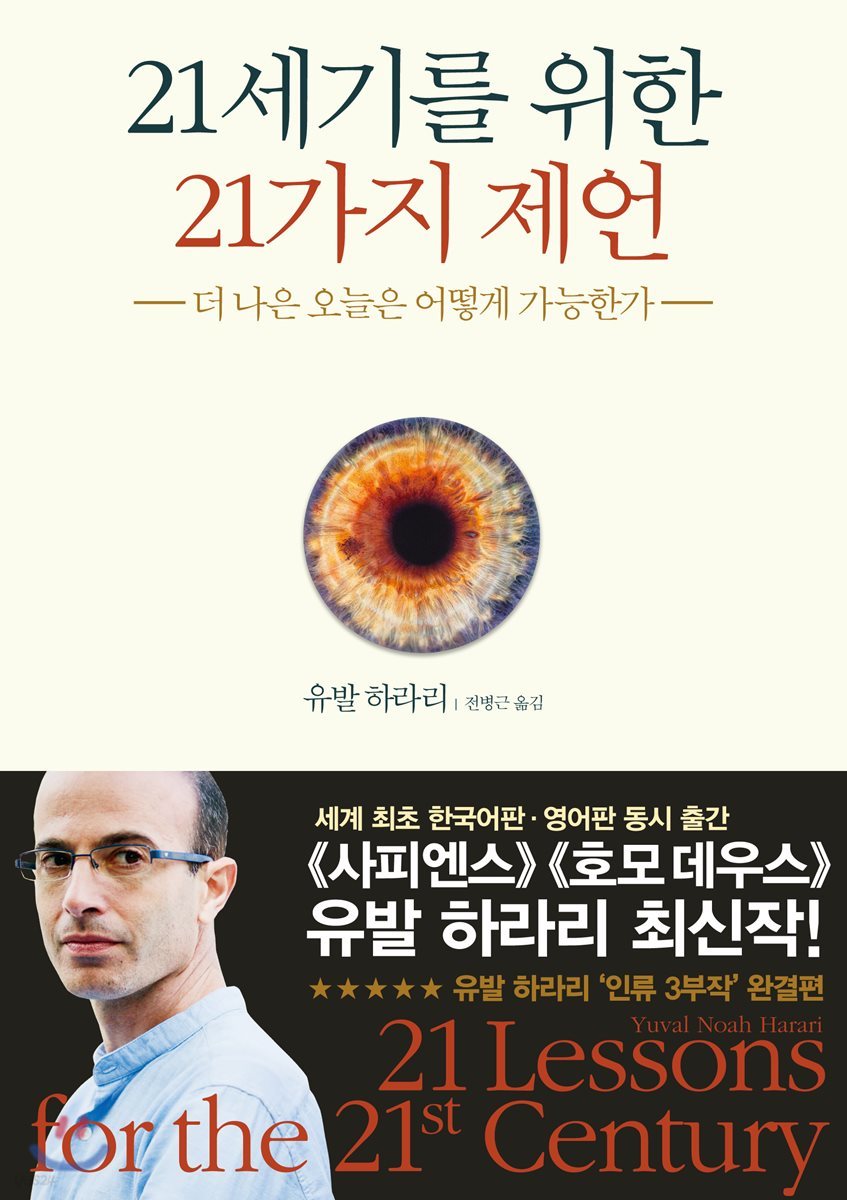
21 Lessons for the 21st Century
 |
Description
Book Introduction
The final installment in Yuval Harari's "Humanity Trilogy," following "Sapiens" and "Homo Deus."
The world's first simultaneous publication of Korean and English editions
The Ultimate Guide to Understanding a Great Transition
A must-read for 21st-century Sapiens at a crossroads.
The author, who discussed the past in Sapiens and the future in Homo Deus, now talks about the present.
Will robots take our jobs? Will democracy fail? Will the Earth be safe from environmental destruction? If you desire prosperity, not destruction, pay attention to Yuval Harari's advice.
The author does not address all the implications of new technologies in this book.
It mainly aims to highlight the threats and risks it poses.
Part 1 provides an overview of the challenges we face, while Part 2 explores a broader range of potential responses.
Part 3 analyzes how to address the threat of terrorism, the danger of global war, and the prejudice and hatred that fuel such conflicts.
Part 4 explores the concept of post-truth, asking to what extent we can understand the unfolding world and distinguish between justice and wrongdoing, while Part 5 takes a more comprehensive look at our lives in these chaotic times.
Through this, it presents a solution to what kind of tomorrow humanity will create today, trapped in conflict between race, religion, and racism.
The world's first simultaneous publication of Korean and English editions
The Ultimate Guide to Understanding a Great Transition
A must-read for 21st-century Sapiens at a crossroads.
The author, who discussed the past in Sapiens and the future in Homo Deus, now talks about the present.
Will robots take our jobs? Will democracy fail? Will the Earth be safe from environmental destruction? If you desire prosperity, not destruction, pay attention to Yuval Harari's advice.
The author does not address all the implications of new technologies in this book.
It mainly aims to highlight the threats and risks it poses.
Part 1 provides an overview of the challenges we face, while Part 2 explores a broader range of potential responses.
Part 3 analyzes how to address the threat of terrorism, the danger of global war, and the prejudice and hatred that fuel such conflicts.
Part 4 explores the concept of post-truth, asking to what extent we can understand the unfolding world and distinguish between justice and wrongdoing, while Part 5 takes a more comprehensive look at our lives in these chaotic times.
Through this, it presents a solution to what kind of tomorrow humanity will create today, trapped in conflict between race, religion, and racism.
- You can preview some of the book's contents.
Preview
index
introduction
Part 1: Technical Challenges
Chapter 1: Disillusionment | Chapter 2: Work | Chapter 3: Freedom | Chapter 4: Equality
Part 2 Political Challenges
Chapter 5: Community | Chapter 6: Civilization | Chapter 7: Nationalism | Chapter 8: Religion | Chapter 9: Immigration
Part 3: Despair and Hope
Chapter 10: Terrorism | Chapter 11: War | Chapter 12: Humility | Chapter 13: God | Chapter 14: Secularism
Part 4: The Truth
Chapter 15: Ignorance | Chapter 16: Justice | Chapter 17: Post-Truth | Chapter 18: Science Fiction
Part 5 Resilience
Chapter 19: Education | Chapter 20: Meaning | Chapter 21: Meditation
7 Questions and Answers for Korean Readers
Acknowledgements
main
Search
Part 1: Technical Challenges
Chapter 1: Disillusionment | Chapter 2: Work | Chapter 3: Freedom | Chapter 4: Equality
Part 2 Political Challenges
Chapter 5: Community | Chapter 6: Civilization | Chapter 7: Nationalism | Chapter 8: Religion | Chapter 9: Immigration
Part 3: Despair and Hope
Chapter 10: Terrorism | Chapter 11: War | Chapter 12: Humility | Chapter 13: God | Chapter 14: Secularism
Part 4: The Truth
Chapter 15: Ignorance | Chapter 16: Justice | Chapter 17: Post-Truth | Chapter 18: Science Fiction
Part 5 Resilience
Chapter 19: Education | Chapter 20: Meaning | Chapter 21: Meditation
7 Questions and Answers for Korean Readers
Acknowledgements
main
Search
Into the book
There is no doubt that the technological revolution will gain momentum in the coming decades, and that it will present humanity with some of the most difficult challenges it has ever faced.
If there is a story that seeks to win humanity's loyalty in this process, it will be tested, above all, on its ability to cope with the twin revolutions in information technology and biotechnology.
If liberalism, nationalism, Islam, or any other novel creed wants to shape the world of 2050, they will need to go beyond understanding artificial intelligence, big data algorithms, and biotechnology to integrating them into a meaningful new narrative.
_1.
disillusionment
To cope with the unprecedented technological and economic disruption of the 21st century, we must develop new social and economic models as quickly as possible.
These models must follow the principle of protecting people over jobs.
Many jobs are boring, drudgery, and not worth pursuing.
No one dreams of being a cashier their whole life.
What we should focus on is meeting people's basic needs and protecting their social status and self-esteem.
_2.
Day
Computer algorithms were not created by natural selection, and they have no emotions or intuition.
Therefore, even in times of crisis, they may be able to follow ethical guidelines better than humans.
But this is only possible if we find a way to encode ethics into precise numbers and statistics.
If we taught Kant, Mill, and Rawls how to write code, and they carefully programmed self-driving cars in the comfort of their labs, the cars would follow the moral codes they had programmed when driving on the highway.
In fact, we will find ourselves in a situation where every car is driven by a driver who is a combination of Michael Schumacher and Immanuel Kant.
_3.
freedom
If these two processes combine—the rise of AI and biotechnology—humanity could be divided into a small class of superhumans and a subordinate class of useless Homo sapiens.
To make matters worse, as the masses lose economic importance and political power, the state may lose at least some of its incentive to invest in their health, education, and well-being.
It is very dangerous to become useless.
In that case, the future of the public will depend on the goodwill of a small elite.
As a result, globalization may actually end up in the 'species differentiation' rather than in the unification of the world.
This means that humanity could diversify into different biological classes or even different species.
Globalization will unite the world horizontally and eliminate borders, but at the same time it will divide humanity vertically.
_4.
equality
In previous centuries, ethnic identities emerged because humanity faced problems and opportunities that extended far beyond local tribal boundaries.
Only nationwide cooperation could hope to bring about a solution.
In the 21st century, nations find themselves in a similar situation to the tribes of the past.
Individual nations are not the right framework to address the most important challenges of our time.
We need a new global identity.
Because national institutions are ill-equipped to deal with an unprecedented series of global challenges.
We now have a planet-wide ecosystem, economy, and science.
But we are still stuck in nationalist politics.
This dissonance prevents our political system from effectively addressing our major problems.
To have effective politics, we must either deglobalize the march of ecology, economy, and science, or globalize our politics.
Since it is impossible to deglobalize the march of ecology and science, and since the costs of deglobalizing the economy will likely be enormous, the only realistic solution is to globalize politics.
This does not mean that we should establish a 'world government'.
It is a dubious and unrealistic vision.
Rather, it means that global issues and interests should be given more weight in the political processes of a country or even a city.
Nationalist sentiment is unlikely to help much.
_7.
nationalism
To allay these fears, states ultimately respond to the theater of terror with their own theater of security.
In fact, the most effective way to combat terrorism is to use superior intelligence and covert operations to disrupt the financial networks that support terrorism.
However, citizens cannot see these activities on TV.
Citizens have already watched the drama of terrorists bringing down the World Trade Center.
As a nation, we feel compelled to present a counter-terrorism drama that is equally dramatic and even more fiery.
As a result, instead of acting quietly and efficiently, the state unleashes a storm of powerful counterterrorism operations, and the terrorists often achieve their goals.
_10.
terrorism
Non-dogmatic secular movements tend to make relatively modest promises.
Because I know my imperfections, I hope to make small, incremental changes.
It's like raising the minimum wage by a few dollars and lowering the child mortality rate by a few percentage points.
Dogmatic ideologies, on the other hand, are characterized by excessive self-confidence and habitually vow to achieve the impossible.
Their leader speaks so bluntly about 'eternity', 'purity', and 'salvation'.
As if enforcing some law, building some temple, or conquering some territory could save the world in one fell swoop.
_14.
secularism
Most injustice in the world today stems from large-scale structural biases rather than individual prejudices.
But our hunter-gatherer brains didn't evolve to detect such structural biases.
We are all complicit in at least some of those biases.
But we don't have the time or energy to discover it.
While writing this book, I realized that lesson keenly myself.
When discussing global issues, I always run the risk of prioritizing the perspectives of global elites over those of diverse marginalized groups.
Global elites dominate the conversation.
So, their perspectives cannot be missed.
On the other hand, marginalized groups are often silent.
If you do that, it's easy to forget their existence.
All of this is not due to deliberate malice, but rather pure ignorance.
_16.
definition
If you want reliable information, you have to pay a fair amount for it.
If you get the news for free, you are likely a commodity.
Let's say some shady billionaire offers you this deal:
“I will give you thirty dollars a month.
In return, you allow me to brainwash you for an hour every day, implanting in your head the political and commercial biases I desire." Would you accept such a deal? It's unlikely anyone in their right mind would.
Then the suspicious billionaire proposes a slightly different deal.
“Allow me to brainwash you for one hour every day.
Instead, we won't charge you for this service." And suddenly, hundreds of millions of people are getting excited.
I hope you don't follow that example.
_17.
Post-truth
A crucial step toward understanding ourselves is to acknowledge that the "self" is a fictional story constantly being constructed, updated, and rewritten by the complex mechanisms of our minds.
There is a storyteller within our minds that explains who we are, where we came from, where we are going, and what is happening right now.
Like a government press officer explaining the latest political developments, my inner narrator repeatedly misunderstands situations and, very rarely, admits to being wrong.
And just as the government constructs its national mythology with flags, symbols, and parades, the propaganda machine within me constructs my own mythology with my cherished memories and the traumas that lie deep within me.
But this too often bears little resemblance to the truth.
_20.
meaning
If there is a story that seeks to win humanity's loyalty in this process, it will be tested, above all, on its ability to cope with the twin revolutions in information technology and biotechnology.
If liberalism, nationalism, Islam, or any other novel creed wants to shape the world of 2050, they will need to go beyond understanding artificial intelligence, big data algorithms, and biotechnology to integrating them into a meaningful new narrative.
_1.
disillusionment
To cope with the unprecedented technological and economic disruption of the 21st century, we must develop new social and economic models as quickly as possible.
These models must follow the principle of protecting people over jobs.
Many jobs are boring, drudgery, and not worth pursuing.
No one dreams of being a cashier their whole life.
What we should focus on is meeting people's basic needs and protecting their social status and self-esteem.
_2.
Day
Computer algorithms were not created by natural selection, and they have no emotions or intuition.
Therefore, even in times of crisis, they may be able to follow ethical guidelines better than humans.
But this is only possible if we find a way to encode ethics into precise numbers and statistics.
If we taught Kant, Mill, and Rawls how to write code, and they carefully programmed self-driving cars in the comfort of their labs, the cars would follow the moral codes they had programmed when driving on the highway.
In fact, we will find ourselves in a situation where every car is driven by a driver who is a combination of Michael Schumacher and Immanuel Kant.
_3.
freedom
If these two processes combine—the rise of AI and biotechnology—humanity could be divided into a small class of superhumans and a subordinate class of useless Homo sapiens.
To make matters worse, as the masses lose economic importance and political power, the state may lose at least some of its incentive to invest in their health, education, and well-being.
It is very dangerous to become useless.
In that case, the future of the public will depend on the goodwill of a small elite.
As a result, globalization may actually end up in the 'species differentiation' rather than in the unification of the world.
This means that humanity could diversify into different biological classes or even different species.
Globalization will unite the world horizontally and eliminate borders, but at the same time it will divide humanity vertically.
_4.
equality
In previous centuries, ethnic identities emerged because humanity faced problems and opportunities that extended far beyond local tribal boundaries.
Only nationwide cooperation could hope to bring about a solution.
In the 21st century, nations find themselves in a similar situation to the tribes of the past.
Individual nations are not the right framework to address the most important challenges of our time.
We need a new global identity.
Because national institutions are ill-equipped to deal with an unprecedented series of global challenges.
We now have a planet-wide ecosystem, economy, and science.
But we are still stuck in nationalist politics.
This dissonance prevents our political system from effectively addressing our major problems.
To have effective politics, we must either deglobalize the march of ecology, economy, and science, or globalize our politics.
Since it is impossible to deglobalize the march of ecology and science, and since the costs of deglobalizing the economy will likely be enormous, the only realistic solution is to globalize politics.
This does not mean that we should establish a 'world government'.
It is a dubious and unrealistic vision.
Rather, it means that global issues and interests should be given more weight in the political processes of a country or even a city.
Nationalist sentiment is unlikely to help much.
_7.
nationalism
To allay these fears, states ultimately respond to the theater of terror with their own theater of security.
In fact, the most effective way to combat terrorism is to use superior intelligence and covert operations to disrupt the financial networks that support terrorism.
However, citizens cannot see these activities on TV.
Citizens have already watched the drama of terrorists bringing down the World Trade Center.
As a nation, we feel compelled to present a counter-terrorism drama that is equally dramatic and even more fiery.
As a result, instead of acting quietly and efficiently, the state unleashes a storm of powerful counterterrorism operations, and the terrorists often achieve their goals.
_10.
terrorism
Non-dogmatic secular movements tend to make relatively modest promises.
Because I know my imperfections, I hope to make small, incremental changes.
It's like raising the minimum wage by a few dollars and lowering the child mortality rate by a few percentage points.
Dogmatic ideologies, on the other hand, are characterized by excessive self-confidence and habitually vow to achieve the impossible.
Their leader speaks so bluntly about 'eternity', 'purity', and 'salvation'.
As if enforcing some law, building some temple, or conquering some territory could save the world in one fell swoop.
_14.
secularism
Most injustice in the world today stems from large-scale structural biases rather than individual prejudices.
But our hunter-gatherer brains didn't evolve to detect such structural biases.
We are all complicit in at least some of those biases.
But we don't have the time or energy to discover it.
While writing this book, I realized that lesson keenly myself.
When discussing global issues, I always run the risk of prioritizing the perspectives of global elites over those of diverse marginalized groups.
Global elites dominate the conversation.
So, their perspectives cannot be missed.
On the other hand, marginalized groups are often silent.
If you do that, it's easy to forget their existence.
All of this is not due to deliberate malice, but rather pure ignorance.
_16.
definition
If you want reliable information, you have to pay a fair amount for it.
If you get the news for free, you are likely a commodity.
Let's say some shady billionaire offers you this deal:
“I will give you thirty dollars a month.
In return, you allow me to brainwash you for an hour every day, implanting in your head the political and commercial biases I desire." Would you accept such a deal? It's unlikely anyone in their right mind would.
Then the suspicious billionaire proposes a slightly different deal.
“Allow me to brainwash you for one hour every day.
Instead, we won't charge you for this service." And suddenly, hundreds of millions of people are getting excited.
I hope you don't follow that example.
_17.
Post-truth
A crucial step toward understanding ourselves is to acknowledge that the "self" is a fictional story constantly being constructed, updated, and rewritten by the complex mechanisms of our minds.
There is a storyteller within our minds that explains who we are, where we came from, where we are going, and what is happening right now.
Like a government press officer explaining the latest political developments, my inner narrator repeatedly misunderstands situations and, very rarely, admits to being wrong.
And just as the government constructs its national mythology with flags, symbols, and parades, the propaganda machine within me constructs my own mythology with my cherished memories and the traumas that lie deep within me.
But this too often bears little resemblance to the truth.
_20.
meaning
--- From the text
Publisher's Review
The final installment in Yuval Harari's "Humanity Trilogy," following "Sapiens" and "Homo Deus."
The world's first Korean and English editions published simultaneously.
The Ultimate Guide to Understanding a Great Transition
A must-read for 21st-century Sapiens at a crossroads.
Sapiens, a mega-bestseller published in 50 countries around the world with 7 million copies sold, provides an overview of the past, explaining how a lowly ape became the ruler of the planet Earth, while its sequel, Homo Deus, explores the future, speculating on how humans might eventually become gods.
"21 Lessons for the 21st Century" examines the current state of humanity.
Artificial intelligence is poised to take away human jobs.
The harm of fake news and the fear of terrorism are clouding our judgment, and the threat of climate change and nuclear war are giving rise to apocalyptic prophecies.
Trapped in conflict by ethnicity, religion, and racism, what kind of tomorrow will humanity build? A brilliant thinker offers clear solutions to an uncertain and complex world, presented through 21 themes!
What's happening now? What does it mean?
A diagnosis and vision for the present situation facing Sapiens in the 21st century.
How will we reclaim jobs lost to AI? Should we embrace immigrants and refugees? What is the nature of the proliferation of fake news? How should we address climate change and terrorism? What do Donald Trump and Brexit mean? Will Google and Facebook usher in an era of digital dictatorship? In this unprecedented revolution driven by rapid advancements in information technology and biotechnology, humanity faces new challenges and threats.
The changes that are coming are so profound that they will alter the very fabric of life.
We need a new blueprint to overcome the crisis and create a better world.
The next ten years will be a time of intense self-reflection and the formulation and preparation of new socio-political models.
The world's first Korean and English editions published simultaneously.
The Ultimate Guide to Understanding a Great Transition
A must-read for 21st-century Sapiens at a crossroads.
Sapiens, a mega-bestseller published in 50 countries around the world with 7 million copies sold, provides an overview of the past, explaining how a lowly ape became the ruler of the planet Earth, while its sequel, Homo Deus, explores the future, speculating on how humans might eventually become gods.
"21 Lessons for the 21st Century" examines the current state of humanity.
Artificial intelligence is poised to take away human jobs.
The harm of fake news and the fear of terrorism are clouding our judgment, and the threat of climate change and nuclear war are giving rise to apocalyptic prophecies.
Trapped in conflict by ethnicity, religion, and racism, what kind of tomorrow will humanity build? A brilliant thinker offers clear solutions to an uncertain and complex world, presented through 21 themes!
What's happening now? What does it mean?
A diagnosis and vision for the present situation facing Sapiens in the 21st century.
How will we reclaim jobs lost to AI? Should we embrace immigrants and refugees? What is the nature of the proliferation of fake news? How should we address climate change and terrorism? What do Donald Trump and Brexit mean? Will Google and Facebook usher in an era of digital dictatorship? In this unprecedented revolution driven by rapid advancements in information technology and biotechnology, humanity faces new challenges and threats.
The changes that are coming are so profound that they will alter the very fabric of life.
We need a new blueprint to overcome the crisis and create a better world.
The next ten years will be a time of intense self-reflection and the formulation and preparation of new socio-political models.
GOODS SPECIFICS
- Date of issue: September 3, 2018
- Page count, weight, size: 560 pages | 882g | 147*215*35mm
- ISBN13: 9788934982975
- ISBN10: 8934982977
You may also like
카테고리
korean


korean

![GQ KOREA Mark (Monthly): December [2025]](http://librairie.coreenne.fr/cdn/shop/files/8ef265dbbfbf186523ed75ba7319009d.jpg?v=1765340328&width=3840)


