

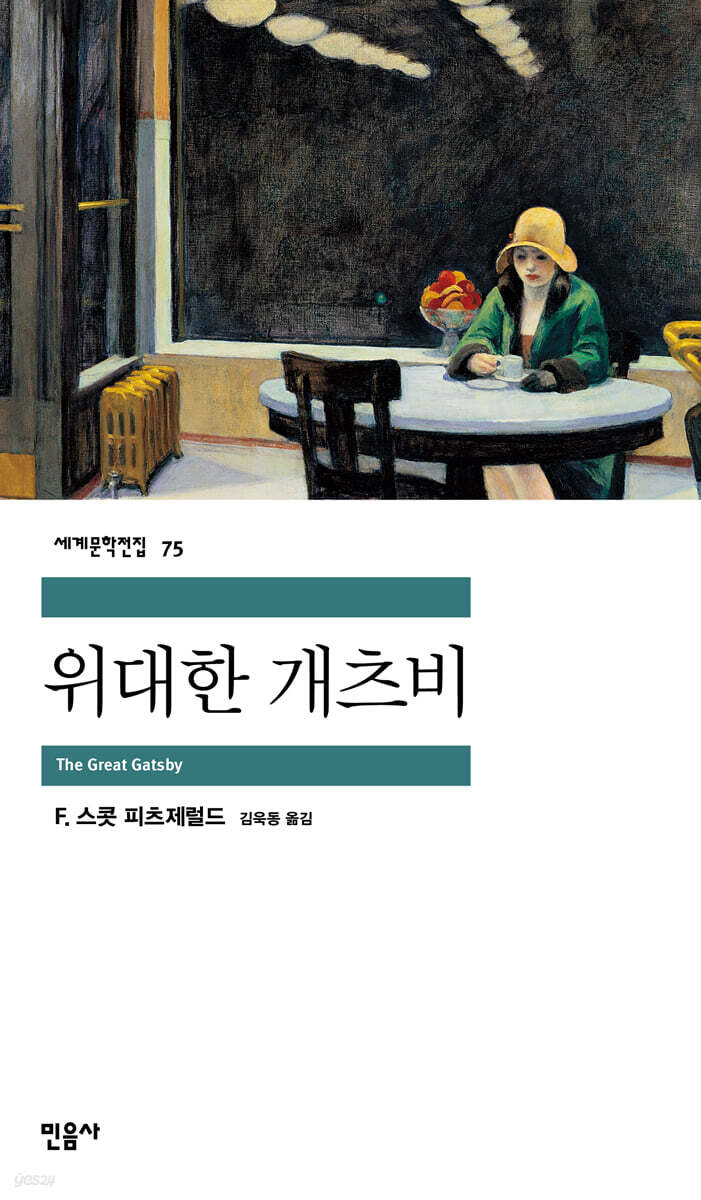
The Great Gatsby
 |
Description
Book Introduction
Set in the 1920s in America, the 'Age of Jazz', the story depicts the crumbling American Dream.
The most outstanding American novel of the 20th century, written with a sharp pen. The Great Gatsby is considered one of the greatest American novels of the 20th century. It has been published dozens of times in Korea alone, and there are currently 27 editions on sale. Classics that have been translated and read over generations are often thought to be textually accurate, but in reality, this is often not the case. The Great Gatsby has also had textual problems since its publication, but these problems were resolved in 1991 when Cambridge University Press published a definitive edition of the text. Based on this, Minumsa published a complete translation of The Great Gatsby. Minumsa's edition of "The Great Gatsby" was selected as the only recommended translation by the "Anglo-American Classical Literature Translation Evaluation Project," a project that selects "reliable translations." “It was translated neatly, preserving the meaning of the original text very accurately. It was evaluated as “excellent compared to other translations, accurate, and easy to read.” “The number of confirmed translations of ‘The Great Gatsby’ to date is 52 editions by 24 translators. Among these, the only one worth recommending is the one translated by Kim Wook-dong. Kim Wook-dong corrected many of the long-standing mistranslations and opened a new chapter in the translation of The Great Gatsby with sentences that are both elegant and preserve the flavor of the original text. “Excellent in both fidelity and readability.” - Recommended edition selected by the Translation Evaluation Team of the British and American Literature Research Association |
- You can preview some of the book's contents.
Preview
Into the book
He was quite successful in the military.
He had already been promoted to captain before being deployed to the front, and after the Battle of Argonne he was promoted to major and became the commander of the division's machine gun unit.
After the armistice, he was in a mad rush to return home, but due to some operational error or misunderstanding, he ended up being sent to Oxford.
He was starting to get worried now.
Daisy's letter contained a kind of nervous despair.
She couldn't understand why he couldn't return home.
She was under pressure from those around her, and she wanted to see him, she wanted him by her side, and ultimately, she wanted to be reassured that she was doing the right thing.
Daisy was young, and her unnatural world smelled of orchids, of cheerful, cheerful snobbery, of orchestras, and these set the rhythm of the year, setting a new melody to a life full of sorrow and suggestion.
Hundreds of pairs of gold and silver shoes kicked up a cloud of glittering dust as saxophones wailed the desperate dirges of "Beale Street Blues" all night long.
He had already been promoted to captain before being deployed to the front, and after the Battle of Argonne he was promoted to major and became the commander of the division's machine gun unit.
After the armistice, he was in a mad rush to return home, but due to some operational error or misunderstanding, he ended up being sent to Oxford.
He was starting to get worried now.
Daisy's letter contained a kind of nervous despair.
She couldn't understand why he couldn't return home.
She was under pressure from those around her, and she wanted to see him, she wanted him by her side, and ultimately, she wanted to be reassured that she was doing the right thing.
Daisy was young, and her unnatural world smelled of orchids, of cheerful, cheerful snobbery, of orchestras, and these set the rhythm of the year, setting a new melody to a life full of sorrow and suggestion.
Hundreds of pairs of gold and silver shoes kicked up a cloud of glittering dust as saxophones wailed the desperate dirges of "Beale Street Blues" all night long.
---pp.
212~213
212~213
Publisher's Review
The only edition recommended by the English-American Literature Research Association Translation Evaluation Team!
The best translation chosen by 170,000 readers since its publication in 2003.
Complete translation of the 'definitive edition' text (1991) published by Cambridge University Press
Professor Kim Wook-dong, who translated this book, is a scholar and translator specializing in early 20th-century American novels, including those by Fitzgerald, Hemingway, and Faulkner. His in-depth understanding of the works and authors allowed him to present an excellent translation.
He continued to study this work after its publication in 2003, and published a completely revised new translation in 2010.
“They didn’t just replace a few old rafters or put a new roof on it; they tore down the walls, leaving only the frame of the house, and rebuilt every nook and cranny of the house.
In fact, there is hardly a single paragraph, not even a single sentence, that has not been reworked.” In the revised edition, we have made special efforts to translate it anew to suit the sensibilities of young readers.
We changed vocabulary that is not commonly used these days, and modified honorifics to suit the current situation.
For example, when Daisy speaks to Nick, I translated it a little lower, considering that he is a distant cousin with a small age difference, and that even relatives don't use excessive formality these days.
I also tried to organize the sentences to better fit Korean grammar, carefully checking to see if there were any sentences that sounded like translations.
Also, considering that young readers who are increasingly becoming estranged from Chinese character culture may find Chinese characters unfamiliar as if they were a foreign language, we tried to change Chinese character vocabulary and Chinese sentences into pure native language.
Another feature of the revised edition is that, except in special cases, written sentences have been reorganized into colloquial sentences.
“As time passed, I realized that translation is indeed a difficult task.
Because in translation, ‘how’ you say something is just as important as ‘what’ you say.
In this revised edition, I have tried to strike a balance between the 'what' and the 'how.'
On the one hand, we looked for 'over-translation', and on the other hand, we looked for 'under-translation'.
In short, we tried to convey the original meaning intact while also maintaining the original style as much as possible.
Even if you say it this way, it is not easy to actually transfer the body of the starting text, let alone its soul.
Whether the structural changes were properly implemented according to the translator's intention is left to the reader's judgment.
“I only hope for the readers’ whip.” (Kim Wook-dong, “On the Revised Edition”)
Meanwhile, The Great Gatsby, first published in 1925, had been plagued by problems with its original text, but in 1991, Cambridge University Press in England published a definitive edition, resolving these problems.
Professor Kim Wook-dong added to the value of the work by translating the complete version of The Great Gatsby using this Cambridge 'definitive edition' as the original text.
170,000 readers' choice: "I read Minumsa's translation, which is said to be the best among translations!"
The legendary "Minumsa World Literature Collection," which surpassed 10 million copies, ranked 7th in the bestseller list.
Since its publication, Minumsa's "The Great Gatsby" has sold over 170,000 copies, establishing itself as the most beloved edition among Korean readers.
Among the Minumsa World Literature Collection, which surpassed 300 volumes in sales in November last year, it ranked 7th in sales, following works such as The Catcher in the Rye, Pride and Prejudice, Animal Farm, and Demian.
Since its publication in 2003, it has been reprinted 59 times.
Readers said, “I read the Minumsa translation, which is said to be the best among the translations.” “I felt that good about the Minumsa translation.
He expressed his satisfaction with Minumsa's 『The Great Gatsby』 through reviews such as, "I also thought about sharing it with many people and reading it."
A definitive text translation that corrects numerous errors that have persisted for 60 years.
There was good reason for raising textual issues regarding The Great Gatsby, which was published less than a hundred years ago.
The first edition of The Great Gatsby contained numerous errors, as Fitzgerald was not living in the United States when the work was written and published, but was in Europe (this was before airmail), the author's handwriting was illegible, and the book underwent numerous revisions in the galleys and was rushed through by Scribner's.
Fitzgerald initially expected sales of over 75,000 copies, but he only printed 20,000 copies in the first printing in April 1925 and an additional 3,000 copies in August.
(The last quarterly royalties Fitzgerald received before his death in 1940 were for only seven copies.) Contrary to popular rumors that even this second printing had sold out, many copies were discovered in Scribner's warehouse after Fitzgerald's death.
Fitzgerald attributed the disappointing sales results to, what now seems absurd, the bland title and the absence of a significant female character.
It was republished in hardcover in 1934, but it is presumed that at that time Fitzgerald paid little attention to The Great Gatsby as it coincided with the publication of his new work, Tender is the Night.
The Great Gatsby, which had been forgotten by the world, was republished in 1941 to coincide with the publication of the author's posthumous work, The Last Tycoon, and began to receive explosive interest from the public and critics in the 1950s.
Since then, The Great Gatsby has become an unwavering bestseller, with over 300,000 copies of the Scribner's edition alone selling in the United States every year. From this point on, the issue of inaccurate editions also began to be raised.
One of the most authoritative Fitzgerald scholars, Matthew J.
Professor Bruccoli (Department of American Literature, University of South Carolina) has been working to address these textual issues through his various writings.
Professor Bruccoli conducted thorough textual criticism based on the author's handwritten manuscripts and proofs for decades, reconstructing the text as close as possible to the author's intention.
This was ultimately published as the 'definitive edition' text of the first volume of Fitzgerald's complete works, The Great Gatsby (1991), planned by Cambridge University Press in England.
A definitive text, often referred to as a "critical edition," is a reliable text that can be read with confidence by both scholars and general readers.
Professor Broccoli was astonishingly able to identify and correct 75 misspelled words in the first edition.
We identified four significant gaps that could be helpful in understanding temporal progression, and corrected approximately 1,100 punctuation marks that could affect meaning or rhythm.
Examples include:
⑴ There was a place where the sentence “I was him too” was incorrectly written as “I saw him too” due to a typographical error.
Mistake: I could see those people looking up at the window and wondering.
Jeong: I was also one of those people who looked up and wondered.
(Minumsa, page 56, line 5) ⑵ The word orgastic was misspelled as orgiastic.
Mistake: Gatsby believed in a mad future.
Positive: I came to believe in a future filled with extreme joy.
(Minumsa, page 255, line 12) ⑶ In addition, the typos were corrected to Vladmir→Vladimir and rythmic→rhythmic.
Professor Bruccoli's work is so widely recognized for its authority that even Scribners, the publisher of the first edition of The Great Gatsby, acknowledged the problems with the text and has been publishing his edition since 1995.
Oxford University Press also incorporated Professor Bruccoli's research findings into its publication of The Great Gatsby as Oxford World Classics, but before the definitive text was published in 1987, the University of Pittsburgh Press published F.
Scott Fitzgerald: A Descriptive Bibliography」 was used as reference only, so only six revisions were reflected.
The following passages are missing or misspelled in the Oxford edition:
⑴ There was a place where unmoved was incorrectly corrected to shocking.
Error: They looked at Gatsby with startled rabbit eyes as they pushed aside the sheet. Correct: Even while they were pushing away the sheet and looking at him with numb eyes (Minumsa, page 233, line 3) ⑵ The phrase 'or rigid sitting' is missing.
Mistake: Never lifted a heavy object or was very nervous like playing cards Correct: Never lifted a heavy object or sat still for a long time (Minumsa, page 93, line 12) ⑶ The 3rd Division, 9th Machine Gun Battalion, and 7th Infantry Regiment were incorrectly listed as the 1st Division, 28th Machine Gun Battalion, and 16th Infantry Regiment, respectively.
(Minumsa, page 72, lines 3-6) If we look at the context, the 9th Machine Gun Battalion, which Nick Carraway belonged to, and the 7th Infantry Battalion, which Gatsby belonged to, were both part of the 3rd Division, so they are familiar with each other.
In addition, the age of the protagonist Daisy Buchanan's daughter was written as 3 years old in the first edition, but it was changed to 2 years old based on the year of her wedding, and the length of Daisy's marriage was also changed from 4 years to 3 years based on the same reasoning, etc., in the definitive text.
While the publication of a text that can be trusted and read by anyone is certainly worthy of praise, its significance can easily fade when translated into other languages.
However, the Korean translations published so far have been criticized for having various problems beyond simply using inaccurate texts as their base.
There are books that arbitrarily divide chapters into 10 chapters even though the original text consists of 9 chapters. There are also cases where the original text is damaged by incorrect paragraph divisions that break the flow of the work and by processing text into dialogue, which is too numerous to point out.
And there are many mistranslations that confuse readers, such as interpreting “You look so cool.” (Minumsa, p. 176, line 11) as “You’re so cold,” which is out of context, or simply treating “But they knew then, I firmly believe.” (Minumsa, p. 235, lines 22-23) as “But they already knew.”
Furthermore, the poem by Thomas Park Dinvilleas that begins the work (a fictional poem that Fitzgerald wrote using the name of a character from his other work, This Side of Paradise) is not only part of the text itself, but also well embodies the impossible dreams and romantic idealism that are the themes of The Great Gatsby, and is essential to understanding the work. However, it is omitted from many translations.
With the publication of this book, Minumsa has resolved all of these issues and provided Korean readers with the opportunity to encounter the most accurate version of The Great Gatsby by reconstructing the definitive text as closely as possible to the author's intentions.
Detailed annotations and rich commentary to aid understanding of the work
The Great Gatsby, considered a representative piece of American literature from the 1920s, vividly depicts the social conditions of America immediately following World War I.
However, most of the existing domestic editions of The Great Gatsby omitted this explanation or even misunderstood it and paraphrased the work.
This book includes detailed explanations and various footnotes to help readers better understand the work's background and the author's intentions.
For example, expressions such as “……rumors like ‘an underground pipeline to Canada’ were associated with it……” (page 148, lines 3-4) were explained to reflect the times when rumors of alcohol being smuggled from Canada through underground pipes were circulating during Prohibition, and the explanation was added that the 1919 World Series rigging incident (page 112, lines 2), in which Meyer Wolfshiem was mentioned as being involved, was an actual incident known as the ‘Black Sox Cheating Incident’ and that the model was Arnold Rothstein, a famous gambler and gangster who actually existed.
And he also provided an explanation of the author's intentions for the fictional magazines and real books that appear in the work.
For example, Nick, the protagonist of Robert Keeble's Simon Called Peter, says, "I don't know if it was because the content was so bad or because I was in a daze from the whiskey, but I couldn't understand what was being said" (page 54, lines 8-9). In fact, the note that Fitzgerald pointed out the book's shortcomings serves as a factor that makes reading more interesting.
And in the part where Dan Cody, who was like Gatsby's guardian, describes going on a sailing trip to the Barbary Coast (page 151, line 15), the author subtly points out the fact that this coast is in North Africa, thereby pointing out a mistake on the part of the author.
And, in keeping with the author's intention of including jazz songs that were actually popular at the time in his work, each song was given a corresponding explanation.
Additionally, the commentary on the work explains in detail why The Great Gatsby is not simply a 'romantic love story' but has become a classic that transcends generations and regions.
1920s America: 'Modern Babylon' or 'The Moon That Never Rises'
After World War I, the United States achieved remarkable economic growth, unlike Europe, which was struggling with post-war reconstruction.
Stock returns rose 108 percent, corporate profits rose 76 percent, and personal income rose 33 percent.
But in the shadow of this economic growth, moral decay and corruption were growing like poisonous mushrooms.
Set in a time when bootleggers and gangsters were rampant and all manner of luxury and pleasure abounded, The Great Gatsby features a diverse cast of characters.
Tom Buchanan, who thought it was normal to bring a whole team of horses from another city to play polo, Daisy Buchanan, who knew of her husband's infidelity but couldn't give it up for the sake of immediate comfort, and Jordan Baker, who was calm even after cheating and winning a golf match, are characters who reflect the reality of American society at the time.
Those who stand before the narrator Nick Carraway's gaze are all morally corrupt bourgeois and arouse disgust, but Gatsby is different.
Although his appearance is adorned with pretense, Gatsby can be called 'great' in that he cherishes dreams and fantasies and is willing to make all kinds of sacrifices to achieve them.
Fitzgerald, who suffered poverty as a child when his father's business failed and was broken up with by his lover due to his low income, also pursued a life of pleasure, hungry for wealth and fame throughout his life.
For him, 'life was too harsh and merciless to humans.'
Fitzgerald's attitude of trying to overcome the tragic meaning of life through romantic illusions, even if they would soon be shattered, is perfectly depicted in 'The Great Gatsby'.
The romantic fantasy or idealism displayed by Gatsby, who believed that the past could be turned back and gave up everything for his dream, not only left a deep mark on the consciousness of the American people, but also became a part of the American imagination and culture.
It must have been so bad that they even created a new word, ‘Gatsbyesque.’
Now officially listed in several dictionaries, this adjective is used to refer to a capacity for romantic wonder or a remarkable talent for transforming everyday experiences into transcendent possibilities.
The best translation chosen by 170,000 readers since its publication in 2003.
Complete translation of the 'definitive edition' text (1991) published by Cambridge University Press
Professor Kim Wook-dong, who translated this book, is a scholar and translator specializing in early 20th-century American novels, including those by Fitzgerald, Hemingway, and Faulkner. His in-depth understanding of the works and authors allowed him to present an excellent translation.
He continued to study this work after its publication in 2003, and published a completely revised new translation in 2010.
“They didn’t just replace a few old rafters or put a new roof on it; they tore down the walls, leaving only the frame of the house, and rebuilt every nook and cranny of the house.
In fact, there is hardly a single paragraph, not even a single sentence, that has not been reworked.” In the revised edition, we have made special efforts to translate it anew to suit the sensibilities of young readers.
We changed vocabulary that is not commonly used these days, and modified honorifics to suit the current situation.
For example, when Daisy speaks to Nick, I translated it a little lower, considering that he is a distant cousin with a small age difference, and that even relatives don't use excessive formality these days.
I also tried to organize the sentences to better fit Korean grammar, carefully checking to see if there were any sentences that sounded like translations.
Also, considering that young readers who are increasingly becoming estranged from Chinese character culture may find Chinese characters unfamiliar as if they were a foreign language, we tried to change Chinese character vocabulary and Chinese sentences into pure native language.
Another feature of the revised edition is that, except in special cases, written sentences have been reorganized into colloquial sentences.
“As time passed, I realized that translation is indeed a difficult task.
Because in translation, ‘how’ you say something is just as important as ‘what’ you say.
In this revised edition, I have tried to strike a balance between the 'what' and the 'how.'
On the one hand, we looked for 'over-translation', and on the other hand, we looked for 'under-translation'.
In short, we tried to convey the original meaning intact while also maintaining the original style as much as possible.
Even if you say it this way, it is not easy to actually transfer the body of the starting text, let alone its soul.
Whether the structural changes were properly implemented according to the translator's intention is left to the reader's judgment.
“I only hope for the readers’ whip.” (Kim Wook-dong, “On the Revised Edition”)
Meanwhile, The Great Gatsby, first published in 1925, had been plagued by problems with its original text, but in 1991, Cambridge University Press in England published a definitive edition, resolving these problems.
Professor Kim Wook-dong added to the value of the work by translating the complete version of The Great Gatsby using this Cambridge 'definitive edition' as the original text.
170,000 readers' choice: "I read Minumsa's translation, which is said to be the best among translations!"
The legendary "Minumsa World Literature Collection," which surpassed 10 million copies, ranked 7th in the bestseller list.
Since its publication, Minumsa's "The Great Gatsby" has sold over 170,000 copies, establishing itself as the most beloved edition among Korean readers.
Among the Minumsa World Literature Collection, which surpassed 300 volumes in sales in November last year, it ranked 7th in sales, following works such as The Catcher in the Rye, Pride and Prejudice, Animal Farm, and Demian.
Since its publication in 2003, it has been reprinted 59 times.
Readers said, “I read the Minumsa translation, which is said to be the best among the translations.” “I felt that good about the Minumsa translation.
He expressed his satisfaction with Minumsa's 『The Great Gatsby』 through reviews such as, "I also thought about sharing it with many people and reading it."
A definitive text translation that corrects numerous errors that have persisted for 60 years.
There was good reason for raising textual issues regarding The Great Gatsby, which was published less than a hundred years ago.
The first edition of The Great Gatsby contained numerous errors, as Fitzgerald was not living in the United States when the work was written and published, but was in Europe (this was before airmail), the author's handwriting was illegible, and the book underwent numerous revisions in the galleys and was rushed through by Scribner's.
Fitzgerald initially expected sales of over 75,000 copies, but he only printed 20,000 copies in the first printing in April 1925 and an additional 3,000 copies in August.
(The last quarterly royalties Fitzgerald received before his death in 1940 were for only seven copies.) Contrary to popular rumors that even this second printing had sold out, many copies were discovered in Scribner's warehouse after Fitzgerald's death.
Fitzgerald attributed the disappointing sales results to, what now seems absurd, the bland title and the absence of a significant female character.
It was republished in hardcover in 1934, but it is presumed that at that time Fitzgerald paid little attention to The Great Gatsby as it coincided with the publication of his new work, Tender is the Night.
The Great Gatsby, which had been forgotten by the world, was republished in 1941 to coincide with the publication of the author's posthumous work, The Last Tycoon, and began to receive explosive interest from the public and critics in the 1950s.
Since then, The Great Gatsby has become an unwavering bestseller, with over 300,000 copies of the Scribner's edition alone selling in the United States every year. From this point on, the issue of inaccurate editions also began to be raised.
One of the most authoritative Fitzgerald scholars, Matthew J.
Professor Bruccoli (Department of American Literature, University of South Carolina) has been working to address these textual issues through his various writings.
Professor Bruccoli conducted thorough textual criticism based on the author's handwritten manuscripts and proofs for decades, reconstructing the text as close as possible to the author's intention.
This was ultimately published as the 'definitive edition' text of the first volume of Fitzgerald's complete works, The Great Gatsby (1991), planned by Cambridge University Press in England.
A definitive text, often referred to as a "critical edition," is a reliable text that can be read with confidence by both scholars and general readers.
Professor Broccoli was astonishingly able to identify and correct 75 misspelled words in the first edition.
We identified four significant gaps that could be helpful in understanding temporal progression, and corrected approximately 1,100 punctuation marks that could affect meaning or rhythm.
Examples include:
⑴ There was a place where the sentence “I was him too” was incorrectly written as “I saw him too” due to a typographical error.
Mistake: I could see those people looking up at the window and wondering.
Jeong: I was also one of those people who looked up and wondered.
(Minumsa, page 56, line 5) ⑵ The word orgastic was misspelled as orgiastic.
Mistake: Gatsby believed in a mad future.
Positive: I came to believe in a future filled with extreme joy.
(Minumsa, page 255, line 12) ⑶ In addition, the typos were corrected to Vladmir→Vladimir and rythmic→rhythmic.
Professor Bruccoli's work is so widely recognized for its authority that even Scribners, the publisher of the first edition of The Great Gatsby, acknowledged the problems with the text and has been publishing his edition since 1995.
Oxford University Press also incorporated Professor Bruccoli's research findings into its publication of The Great Gatsby as Oxford World Classics, but before the definitive text was published in 1987, the University of Pittsburgh Press published F.
Scott Fitzgerald: A Descriptive Bibliography」 was used as reference only, so only six revisions were reflected.
The following passages are missing or misspelled in the Oxford edition:
⑴ There was a place where unmoved was incorrectly corrected to shocking.
Error: They looked at Gatsby with startled rabbit eyes as they pushed aside the sheet. Correct: Even while they were pushing away the sheet and looking at him with numb eyes (Minumsa, page 233, line 3) ⑵ The phrase 'or rigid sitting' is missing.
Mistake: Never lifted a heavy object or was very nervous like playing cards Correct: Never lifted a heavy object or sat still for a long time (Minumsa, page 93, line 12) ⑶ The 3rd Division, 9th Machine Gun Battalion, and 7th Infantry Regiment were incorrectly listed as the 1st Division, 28th Machine Gun Battalion, and 16th Infantry Regiment, respectively.
(Minumsa, page 72, lines 3-6) If we look at the context, the 9th Machine Gun Battalion, which Nick Carraway belonged to, and the 7th Infantry Battalion, which Gatsby belonged to, were both part of the 3rd Division, so they are familiar with each other.
In addition, the age of the protagonist Daisy Buchanan's daughter was written as 3 years old in the first edition, but it was changed to 2 years old based on the year of her wedding, and the length of Daisy's marriage was also changed from 4 years to 3 years based on the same reasoning, etc., in the definitive text.
While the publication of a text that can be trusted and read by anyone is certainly worthy of praise, its significance can easily fade when translated into other languages.
However, the Korean translations published so far have been criticized for having various problems beyond simply using inaccurate texts as their base.
There are books that arbitrarily divide chapters into 10 chapters even though the original text consists of 9 chapters. There are also cases where the original text is damaged by incorrect paragraph divisions that break the flow of the work and by processing text into dialogue, which is too numerous to point out.
And there are many mistranslations that confuse readers, such as interpreting “You look so cool.” (Minumsa, p. 176, line 11) as “You’re so cold,” which is out of context, or simply treating “But they knew then, I firmly believe.” (Minumsa, p. 235, lines 22-23) as “But they already knew.”
Furthermore, the poem by Thomas Park Dinvilleas that begins the work (a fictional poem that Fitzgerald wrote using the name of a character from his other work, This Side of Paradise) is not only part of the text itself, but also well embodies the impossible dreams and romantic idealism that are the themes of The Great Gatsby, and is essential to understanding the work. However, it is omitted from many translations.
With the publication of this book, Minumsa has resolved all of these issues and provided Korean readers with the opportunity to encounter the most accurate version of The Great Gatsby by reconstructing the definitive text as closely as possible to the author's intentions.
Detailed annotations and rich commentary to aid understanding of the work
The Great Gatsby, considered a representative piece of American literature from the 1920s, vividly depicts the social conditions of America immediately following World War I.
However, most of the existing domestic editions of The Great Gatsby omitted this explanation or even misunderstood it and paraphrased the work.
This book includes detailed explanations and various footnotes to help readers better understand the work's background and the author's intentions.
For example, expressions such as “……rumors like ‘an underground pipeline to Canada’ were associated with it……” (page 148, lines 3-4) were explained to reflect the times when rumors of alcohol being smuggled from Canada through underground pipes were circulating during Prohibition, and the explanation was added that the 1919 World Series rigging incident (page 112, lines 2), in which Meyer Wolfshiem was mentioned as being involved, was an actual incident known as the ‘Black Sox Cheating Incident’ and that the model was Arnold Rothstein, a famous gambler and gangster who actually existed.
And he also provided an explanation of the author's intentions for the fictional magazines and real books that appear in the work.
For example, Nick, the protagonist of Robert Keeble's Simon Called Peter, says, "I don't know if it was because the content was so bad or because I was in a daze from the whiskey, but I couldn't understand what was being said" (page 54, lines 8-9). In fact, the note that Fitzgerald pointed out the book's shortcomings serves as a factor that makes reading more interesting.
And in the part where Dan Cody, who was like Gatsby's guardian, describes going on a sailing trip to the Barbary Coast (page 151, line 15), the author subtly points out the fact that this coast is in North Africa, thereby pointing out a mistake on the part of the author.
And, in keeping with the author's intention of including jazz songs that were actually popular at the time in his work, each song was given a corresponding explanation.
Additionally, the commentary on the work explains in detail why The Great Gatsby is not simply a 'romantic love story' but has become a classic that transcends generations and regions.
1920s America: 'Modern Babylon' or 'The Moon That Never Rises'
After World War I, the United States achieved remarkable economic growth, unlike Europe, which was struggling with post-war reconstruction.
Stock returns rose 108 percent, corporate profits rose 76 percent, and personal income rose 33 percent.
But in the shadow of this economic growth, moral decay and corruption were growing like poisonous mushrooms.
Set in a time when bootleggers and gangsters were rampant and all manner of luxury and pleasure abounded, The Great Gatsby features a diverse cast of characters.
Tom Buchanan, who thought it was normal to bring a whole team of horses from another city to play polo, Daisy Buchanan, who knew of her husband's infidelity but couldn't give it up for the sake of immediate comfort, and Jordan Baker, who was calm even after cheating and winning a golf match, are characters who reflect the reality of American society at the time.
Those who stand before the narrator Nick Carraway's gaze are all morally corrupt bourgeois and arouse disgust, but Gatsby is different.
Although his appearance is adorned with pretense, Gatsby can be called 'great' in that he cherishes dreams and fantasies and is willing to make all kinds of sacrifices to achieve them.
Fitzgerald, who suffered poverty as a child when his father's business failed and was broken up with by his lover due to his low income, also pursued a life of pleasure, hungry for wealth and fame throughout his life.
For him, 'life was too harsh and merciless to humans.'
Fitzgerald's attitude of trying to overcome the tragic meaning of life through romantic illusions, even if they would soon be shattered, is perfectly depicted in 'The Great Gatsby'.
The romantic fantasy or idealism displayed by Gatsby, who believed that the past could be turned back and gave up everything for his dream, not only left a deep mark on the consciousness of the American people, but also became a part of the American imagination and culture.
It must have been so bad that they even created a new word, ‘Gatsbyesque.’
Now officially listed in several dictionaries, this adjective is used to refer to a capacity for romantic wonder or a remarkable talent for transforming everyday experiences into transcendent possibilities.
GOODS SPECIFICS
- Date of issue: May 6, 2003
- Page count, weight, size: 284 pages | 392g | 132*225*20mm
- ISBN13: 9788937460753
- ISBN10: 8937460750
You may also like
카테고리
korean


korean

![ELLE 엘르 스페셜 에디션 A형 : 12월 [2025]](http://librairie.coreenne.fr/cdn/shop/files/b8e27a3de6c9538896439686c6b0e8fb.jpg?v=1766436872&width=3840)


