

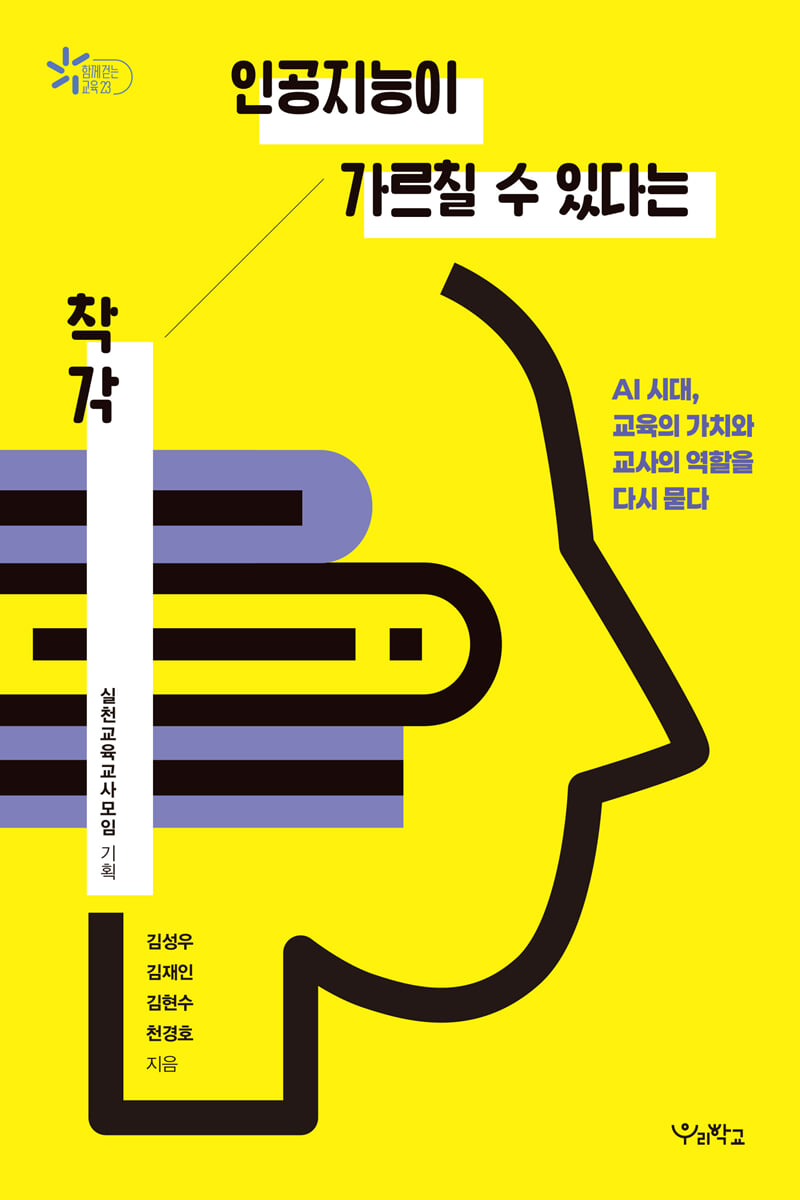
The illusion that artificial intelligence can teach
 |
Description
Book Introduction
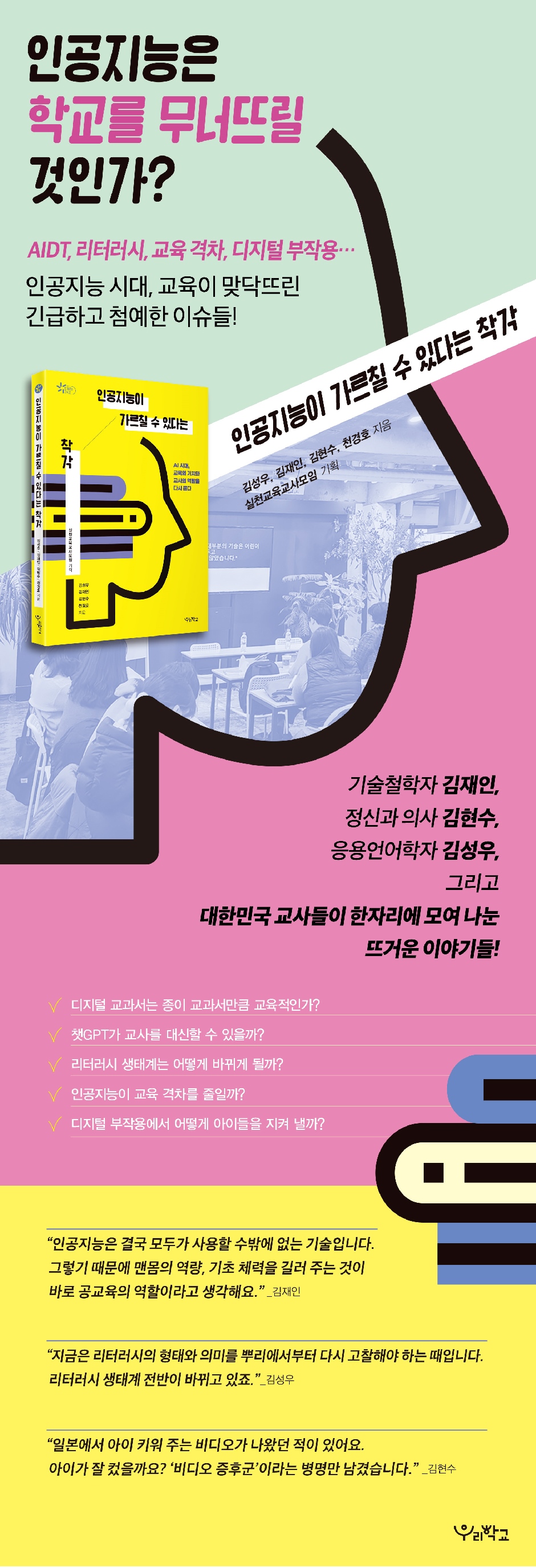
Will AI destroy schools?
AIDT, literacy, education gap, digital side effects…
Discusses the urgent issues facing education in the age of artificial intelligence.
The typhoon called artificial intelligence has also hit schools.
While the introduction of AI-powered digital textbooks is causing controversy, teachers are increasingly concerned about the feasibility of utilizing ChatGPT in education.
As artificial intelligence disrupts society, where should our education go, and what can teachers do? Experts from various fields and South Korean teachers gathered to consider education in the age of artificial intelligence.
Technological philosopher Kim Jae-in, applied linguist Kim Seong-woo, and psychiatrist and principal of Seongjang School Byeol Kim Hyeon-su closely analyze the urgent issues facing education today, from the controversy surrounding AIDT to the side effects of digital technology and literacy education, and explore the future of education and alternatives.
In this book, which captures the passionate lectures given to teachers, the three authors each offer meaningful perspectives, but they also speak with unwavering unwaveringly about the roles of schools and teachers.
Artificial intelligence can never replace teachers, and the role of schools will become even more important in the future.
At the end of the book, there is an article by elementary school teacher Cheon Gyeong-ho analyzing and criticizing AIDT from a teacher's perspective.
This is a must-read for teachers considering the direction of education in the age of artificial intelligence.
AIDT, literacy, education gap, digital side effects…
Discusses the urgent issues facing education in the age of artificial intelligence.
The typhoon called artificial intelligence has also hit schools.
While the introduction of AI-powered digital textbooks is causing controversy, teachers are increasingly concerned about the feasibility of utilizing ChatGPT in education.
As artificial intelligence disrupts society, where should our education go, and what can teachers do? Experts from various fields and South Korean teachers gathered to consider education in the age of artificial intelligence.
Technological philosopher Kim Jae-in, applied linguist Kim Seong-woo, and psychiatrist and principal of Seongjang School Byeol Kim Hyeon-su closely analyze the urgent issues facing education today, from the controversy surrounding AIDT to the side effects of digital technology and literacy education, and explore the future of education and alternatives.
In this book, which captures the passionate lectures given to teachers, the three authors each offer meaningful perspectives, but they also speak with unwavering unwaveringly about the roles of schools and teachers.
Artificial intelligence can never replace teachers, and the role of schools will become even more important in the future.
At the end of the book, there is an article by elementary school teacher Cheon Gyeong-ho analyzing and criticizing AIDT from a teacher's perspective.
This is a must-read for teachers considering the direction of education in the age of artificial intelligence.
- You can preview some of the book's contents.
Preview
index
Entering_Rethinking Education in the Age of Artificial Intelligence
1.
Artificial Intelligence and the School System_ Kim Jae-in
+Kim Jae-in x Han Hee-jung Dialogue
2.
Protecting Children from Digital Harm_Kim Hyun-soo
+ Kim Hyun-soo x Dong So-hee conversation
3.
How Will Artificial Intelligence Transform the Literacy Ecosystem and Education? _Kim Seong-woo
+Kim Seong-woo x Cheon Kyung-ho Dialogue
Postscript: Can AIDT Close the Education Gap? _Cheon Kyung-ho
1.
Artificial Intelligence and the School System_ Kim Jae-in
+Kim Jae-in x Han Hee-jung Dialogue
2.
Protecting Children from Digital Harm_Kim Hyun-soo
+ Kim Hyun-soo x Dong So-hee conversation
3.
How Will Artificial Intelligence Transform the Literacy Ecosystem and Education? _Kim Seong-woo
+Kim Seong-woo x Cheon Kyung-ho Dialogue
Postscript: Can AIDT Close the Education Gap? _Cheon Kyung-ho
Detailed image
Into the book
What's the most important aspect of human intelligence? Recognizing a problem and then organizing it effectively.
We can solve the problem ourselves or ask AI to solve it, but all of these are commands given by humans to AI.
AI has absolutely no ability to find and structure problems on its own.
In some ways, it is more important for humans to recognize and sort out what the problem is than to solve it well.
--- p.30
There's no need to talk about the need to use artificial intelligence anymore.
I've already written it all down.
So, ultimately, what's important is the ability to do things without artificial intelligence.
That is the function and capacity of the bare body.
--- p.34
Helplessness is actually a phenomenon of resistance.
You feel helpless because you have nothing to do, but that helplessness comes not from your own desires, but from the system that makes you helpless.
--- p.76
Humanistic education allows for exceptions.
You don't have to remove the exception.
Respect diversity and respect mutations when they occur.
The idea that mutations drive evolution and create new cultures is a very important theory in evolutionary psychology.
But artificial intelligence is likely to make the world revolve around averages.
There may be certain biases involved.
That's very dangerous --- p.
86
So why are other countries in the process of abandoning their AIDTs? We've been using AIDT, and the results are starting to show up, compared to previous years.
There have been many studies showing that digital textbooks are inferior to paper books, and that they only scroll faster, but do not provide meaningful learning.
Lack of meaningful learning means that you made progress, but nothing was learned.
--- p.99
In traditional task performance, reading was a prerequisite for writing.
But now, even if we skip the reading process entirely and start with AI-generated text, the result can still be similar to completing a reading and writing task.
I call this the inversion of reading and writing, starting from the beginning, that is, from creation, without reading.
The order of the two is reversed.
--- p.140
On the other hand, I think the metaphor of artificial intelligence as a bridge is also possible.
If the Tower of Babel is vertical, the bridge is a horizontal metaphor.
We can imagine an artificial intelligence that connects me with others, with nature, with subjects I don't know, and thus connects all of us, humans and non-humans, and allows us to dream of a better life and planet.
Artificial intelligence, viewed from this perspective, offers the possibility of mutual understanding and cooperation.
--- p.150
A second change that occurs in learners is a decrease in the amount of self-organization, summarization, and writing down thoughts.
The important thing in developing literacy is organizing and summarizing, writing down my opinions or thoughts, and looking up and writing down unfamiliar words.
But now we can ask AI to do this.
--- p.157
What I want to emphasize is that as technology radically reshapes the world, education must respond by introducing even more radical values.
If technology is certain to transform life and society as a whole, we should not respond by reemphasizing traditional values, but rather by raising our voices about values and aspirations that have been difficult to even articulate.
We can solve the problem ourselves or ask AI to solve it, but all of these are commands given by humans to AI.
AI has absolutely no ability to find and structure problems on its own.
In some ways, it is more important for humans to recognize and sort out what the problem is than to solve it well.
--- p.30
There's no need to talk about the need to use artificial intelligence anymore.
I've already written it all down.
So, ultimately, what's important is the ability to do things without artificial intelligence.
That is the function and capacity of the bare body.
--- p.34
Helplessness is actually a phenomenon of resistance.
You feel helpless because you have nothing to do, but that helplessness comes not from your own desires, but from the system that makes you helpless.
--- p.76
Humanistic education allows for exceptions.
You don't have to remove the exception.
Respect diversity and respect mutations when they occur.
The idea that mutations drive evolution and create new cultures is a very important theory in evolutionary psychology.
But artificial intelligence is likely to make the world revolve around averages.
There may be certain biases involved.
That's very dangerous --- p.
86
So why are other countries in the process of abandoning their AIDTs? We've been using AIDT, and the results are starting to show up, compared to previous years.
There have been many studies showing that digital textbooks are inferior to paper books, and that they only scroll faster, but do not provide meaningful learning.
Lack of meaningful learning means that you made progress, but nothing was learned.
--- p.99
In traditional task performance, reading was a prerequisite for writing.
But now, even if we skip the reading process entirely and start with AI-generated text, the result can still be similar to completing a reading and writing task.
I call this the inversion of reading and writing, starting from the beginning, that is, from creation, without reading.
The order of the two is reversed.
--- p.140
On the other hand, I think the metaphor of artificial intelligence as a bridge is also possible.
If the Tower of Babel is vertical, the bridge is a horizontal metaphor.
We can imagine an artificial intelligence that connects me with others, with nature, with subjects I don't know, and thus connects all of us, humans and non-humans, and allows us to dream of a better life and planet.
Artificial intelligence, viewed from this perspective, offers the possibility of mutual understanding and cooperation.
--- p.150
A second change that occurs in learners is a decrease in the amount of self-organization, summarization, and writing down thoughts.
The important thing in developing literacy is organizing and summarizing, writing down my opinions or thoughts, and looking up and writing down unfamiliar words.
But now we can ask AI to do this.
--- p.157
What I want to emphasize is that as technology radically reshapes the world, education must respond by introducing even more radical values.
If technology is certain to transform life and society as a whole, we should not respond by reemphasizing traditional values, but rather by raising our voices about values and aspirations that have been difficult to even articulate.
--- p.188
Publisher's Review
How will artificial intelligence impact schools and education?
What should teachers and students prepare?
Hot topics shared by experts and teachers in each field
Artificial Intelligence Digital Textbooks (AIDT), which became a hot topic last year with the pilot introduction, have once again become a hot topic with the current government's announcement of a comprehensive review and the administrative lawsuit filed by AIDT publishers. The confusion surrounding the introduction of AIDT itself illustrates the turmoil facing education in the age of AI.
Where should education go in the age of AI? If AI is the trend of the times, should schools and teachers diligently keep pace? South Korean teachers and experts from various fields have come forward to share their concerns surrounding AI and explore alternatives.
First, in Chapter 1, Kim Jae-in, a philosopher of technology, analyzes why the role of teachers is irreplaceable, based on his insight into the role of schools in human civilization and survival.
As a philosopher of technology, he compares artificial intelligence and humans and points out unique characteristics of humans that artificial intelligence cannot imitate.
He explains that artificial intelligence is an 'augmentation technology' and repeatedly emphasizes that education that develops basic capabilities is important for this very reason.
In Chapter 2, psychiatrist Kim Hyeon-su continues the story, focusing on the side effects of digital technology.
In the era of short-form learning, he points out that problems like loss of concentration are no longer individual problems but rather social ones, and emphasizes that when introducing new technologies to children who are not yet fully developed, side effects must be considered first.
We take a more firm stance on digital textbooks.
It presents the latest research findings on digital textbooks and notes that digital textbooks are already being phased out in many countries.
This is because it is already an established academic theory that digital textbooks are less effective in learning than paper books and have various side effects.
In Chapter 3, applied linguist Kim Seong-woo unfolds the story focusing on changes in the literacy ecosystem.
It mentions that literacy is undergoing a major transformation due to generative artificial intelligence, such as the reversal of reading and writing, and examines the nature and meaning of this transformation step by step.
While teachers are still grappling with the question of whether to utilize generative AI like ChatGPT in writing education, an alternative approach is suggested: greater attention should be paid to the "process" of writing.
In addition, we introduce several topics to consider and guidelines for teachers who cannot completely exclude or actively introduce AI.
Each chapter ends with one-on-one discussions between the speakers and practicing teachers.
As teachers, we actively share our struggles and concerns, as well as insights gained from the field, enriching discussions about artificial intelligence.
At the end of the book, there is an article by Cheon Gyeong-ho, president of the Practical Education Teachers Association and an elementary school teacher, analyzing the introduction of AIDT from a teacher's perspective.
This article thoroughly discusses which of the various educational policies and alternatives are most educational and effective for children, and which can reduce the educational gap.
Artificial intelligence has already deeply permeated our daily lives.
However, if artificial intelligence is indiscriminately introduced into education simply because it is convenient and an excellent technology, it could cause serious problems.
This is a time when vigilance against it is more important than ever.
A must-read for all teachers who want to stay balanced amidst the AI craze.
What should teachers and students prepare?
Hot topics shared by experts and teachers in each field
Artificial Intelligence Digital Textbooks (AIDT), which became a hot topic last year with the pilot introduction, have once again become a hot topic with the current government's announcement of a comprehensive review and the administrative lawsuit filed by AIDT publishers. The confusion surrounding the introduction of AIDT itself illustrates the turmoil facing education in the age of AI.
Where should education go in the age of AI? If AI is the trend of the times, should schools and teachers diligently keep pace? South Korean teachers and experts from various fields have come forward to share their concerns surrounding AI and explore alternatives.
First, in Chapter 1, Kim Jae-in, a philosopher of technology, analyzes why the role of teachers is irreplaceable, based on his insight into the role of schools in human civilization and survival.
As a philosopher of technology, he compares artificial intelligence and humans and points out unique characteristics of humans that artificial intelligence cannot imitate.
He explains that artificial intelligence is an 'augmentation technology' and repeatedly emphasizes that education that develops basic capabilities is important for this very reason.
In Chapter 2, psychiatrist Kim Hyeon-su continues the story, focusing on the side effects of digital technology.
In the era of short-form learning, he points out that problems like loss of concentration are no longer individual problems but rather social ones, and emphasizes that when introducing new technologies to children who are not yet fully developed, side effects must be considered first.
We take a more firm stance on digital textbooks.
It presents the latest research findings on digital textbooks and notes that digital textbooks are already being phased out in many countries.
This is because it is already an established academic theory that digital textbooks are less effective in learning than paper books and have various side effects.
In Chapter 3, applied linguist Kim Seong-woo unfolds the story focusing on changes in the literacy ecosystem.
It mentions that literacy is undergoing a major transformation due to generative artificial intelligence, such as the reversal of reading and writing, and examines the nature and meaning of this transformation step by step.
While teachers are still grappling with the question of whether to utilize generative AI like ChatGPT in writing education, an alternative approach is suggested: greater attention should be paid to the "process" of writing.
In addition, we introduce several topics to consider and guidelines for teachers who cannot completely exclude or actively introduce AI.
Each chapter ends with one-on-one discussions between the speakers and practicing teachers.
As teachers, we actively share our struggles and concerns, as well as insights gained from the field, enriching discussions about artificial intelligence.
At the end of the book, there is an article by Cheon Gyeong-ho, president of the Practical Education Teachers Association and an elementary school teacher, analyzing the introduction of AIDT from a teacher's perspective.
This article thoroughly discusses which of the various educational policies and alternatives are most educational and effective for children, and which can reduce the educational gap.
Artificial intelligence has already deeply permeated our daily lives.
However, if artificial intelligence is indiscriminately introduced into education simply because it is convenient and an excellent technology, it could cause serious problems.
This is a time when vigilance against it is more important than ever.
A must-read for all teachers who want to stay balanced amidst the AI craze.
GOODS SPECIFICS
- Date of issue: June 23, 2025
- Page count, weight, size: 240 pages | 370g | 140*210*17mm
- ISBN13: 9791167553386
- ISBN10: 1167553381
You may also like
카테고리
korean


korean

![GQ KOREA Mark (Monthly): December [2025]](http://librairie.coreenne.fr/cdn/shop/files/8ef265dbbfbf186523ed75ba7319009d.jpg?v=1765340328&width=3840)


