

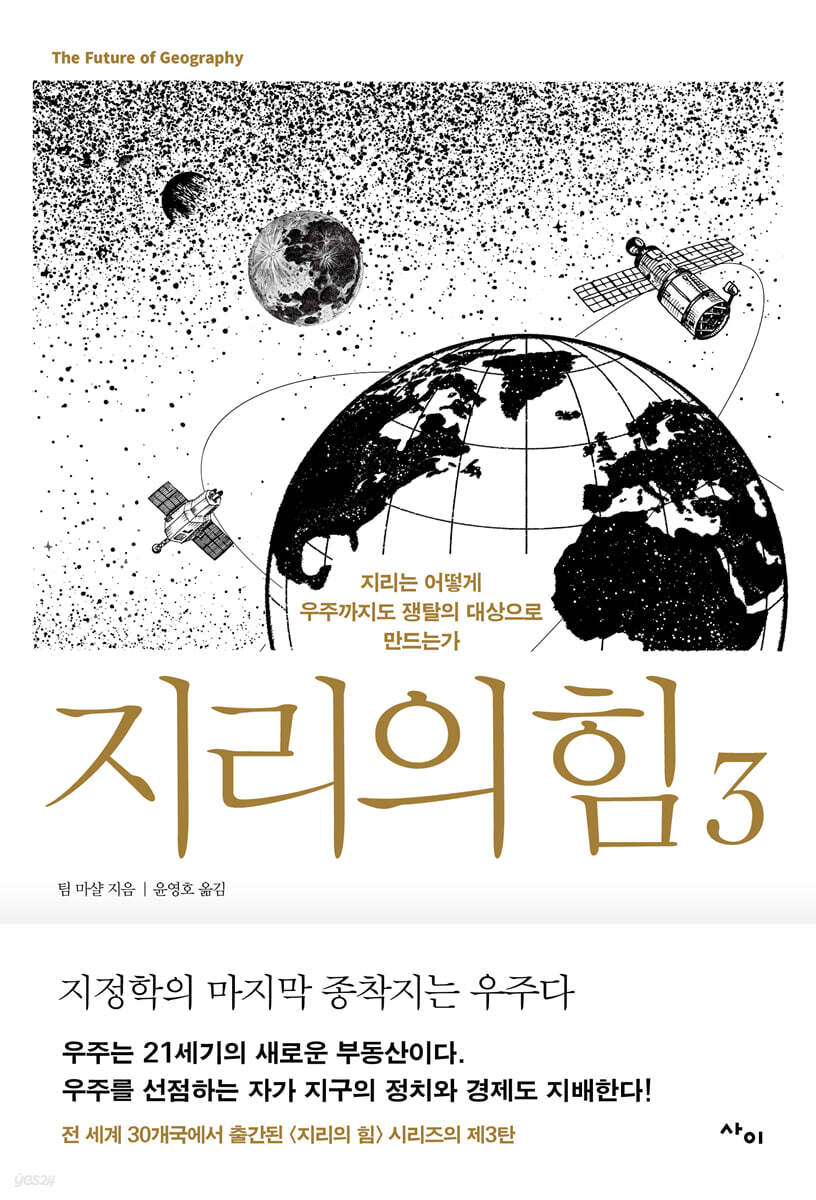
The Power of Geography 3
 |
Description
Book Introduction
The final destination of geopolitics is space.
Space is the “new real estate” of the 21st century.
Whoever dominates space also dominates Earth's politics and economy!
Geopolitics of Space is an extension of geopolitics of Earth.
The geography of the Earth, the Earth's "competition for hegemony" is expanding into space!
The third installment in the global bestseller "The Power of Geography," published in 30 countries worldwide.
Tim Marshall, author of the "The Power of Geography" series, which sold over 3 million copies worldwide and exploded popular interest in geography, has returned with "The Power of Geography Volume 3." The author, who has been praised as "the most popular geopolitics writer of our time" and "another outstanding guide to the modern world" for illuminating international politics, economics, war, and the gap between rich and poor through the lens of geography, has worked as a journalist specializing in international conflicts for over 30 years, covering over 30 conflict zones around the world, including the Balkans and the Middle East, while working as a reporter for the BBC, a correspondent for the Financial Times, and a correspondent covering foreign affairs.
In his previous work, "The Power of Geography 1, 2," he analyzed the reasons why geopolitical conflicts persist in the 21st century through geographic factors, examining major countries around the world and countries at the center of geopolitical issues, from the North Pole up high to Australia down south. In this book, he shifts his gaze from the ground to the "space" above our heads.
This book examines the space capabilities, degree of space militarization, and space development competition of 15 countries: the current "Big 3 space powers"—the United States, China, and Russia—along with the United Kingdom, France, the United Arab Emirates, Israel, Iran, Japan, South Korea, India, North Korea, Australia, and the African continent.
Signs that space will become a central figure in the 21st century's geopolitical discourse have long been building.
Now, humanity is engaged in a fierce battle over the geography of the universe, just as it has done over the geography of the Earth.
As such, the geography of the Earth is expanding into space, and the competition for hegemony on Earth is extending into space.
Space is the “new real estate” of the 21st century.
Whoever dominates space also dominates Earth's politics and economy!
Geopolitics of Space is an extension of geopolitics of Earth.
The geography of the Earth, the Earth's "competition for hegemony" is expanding into space!
The third installment in the global bestseller "The Power of Geography," published in 30 countries worldwide.
Tim Marshall, author of the "The Power of Geography" series, which sold over 3 million copies worldwide and exploded popular interest in geography, has returned with "The Power of Geography Volume 3." The author, who has been praised as "the most popular geopolitics writer of our time" and "another outstanding guide to the modern world" for illuminating international politics, economics, war, and the gap between rich and poor through the lens of geography, has worked as a journalist specializing in international conflicts for over 30 years, covering over 30 conflict zones around the world, including the Balkans and the Middle East, while working as a reporter for the BBC, a correspondent for the Financial Times, and a correspondent covering foreign affairs.
In his previous work, "The Power of Geography 1, 2," he analyzed the reasons why geopolitical conflicts persist in the 21st century through geographic factors, examining major countries around the world and countries at the center of geopolitical issues, from the North Pole up high to Australia down south. In this book, he shifts his gaze from the ground to the "space" above our heads.
This book examines the space capabilities, degree of space militarization, and space development competition of 15 countries: the current "Big 3 space powers"—the United States, China, and Russia—along with the United Kingdom, France, the United Arab Emirates, Israel, Iran, Japan, South Korea, India, North Korea, Australia, and the African continent.
Signs that space will become a central figure in the 21st century's geopolitical discourse have long been building.
Now, humanity is engaged in a fierce battle over the geography of the universe, just as it has done over the geography of the Earth.
As such, the geography of the Earth is expanding into space, and the competition for hegemony on Earth is extending into space.
- You can preview some of the book's contents.
Preview
index
Introduction: Space: A New Geopolitical Battleground
Chapter 1: Humans Look Up at the Sky
God will rule the stars above.
The ancient Greeks approached mathematics, not oracles.
From the Islamic Golden Age to the Renaissance
The Earth must not rotate, because the Pope forbids it!
God steps aside and science reigns supreme
Even in the 20th century, we only know about water droplets and not about the sea.
Chapter 2: The Cold War Drove Us into Space
The first thing you need to go into space is a rocket.
The Cold War began with the rocket competition between the two countries.
Sputnik 1 gets there before the US
The United States continues to lose its title of "first"
Now all that remains is who will reach the moon first.
Ultimately, the United States left the greatest footprint on humanity.
“We must make sure that no one knows that we have been overtaken.”
A competition between systems over the moon
Chapter 3: Space is the New Real Estate of the 21st Century
The geography of the universe begins on Earth.
Low Earth Orbit: The Most Attractive Real Estate in Space
Medium orbit, which provides guidance, and high orbit, which is quite busy.
Parking lot of the universe
The moon is slightly larger than the African continent
First come, first served?
He who controls the universe controls the Earth.
Chapter 4: The Universe Is Now (Virtually) Lawless
The Artemis Accords have more holes than the moon's surface.
An outdated agreement that only space lawyers would appreciate.
Is it okay to attack private satellites?
If a murder occurs in space
Kessler syndrome
Satellites attacking satellites
It's more dangerous not to crash into Earth
A disaster coming from that distant universe
Chapter 5: China Wants to Be a Leader, Not a Winner
More interested in technological advancement than boasting about being a winner
"Excluding us? Well, then..."
Linking nationalism to space exploration
It is a well-known fact that China has outstanding space capabilities.
Land on the moon before the US?
The only country in the world with its own space station
Chapter 6: America, If We Don't Own It, Opportunity Goes to Others
It's not as desperate as it used to be, though.
Creation of the Space Force
A country that wants to become a space police officer
Return to the Moon, This Time I'm Going to Stay
Elon Musk, Jeff Bezos, and the Era of Space Commercialization
Chapter 7: Russia's Heyday, Both on Land and in Space
A red star that is losing its power
Russian incidents in space
Putin: Space military power is unrivaled.
It is Russia, not China, that is more desperate.
Ambitious but lacking in funds, equipment, or expertise.
The Fall of "Made in Russia"
Chapter 8: Space Expansion by Countries in Europe, the Middle East, Asia, and Africa
Europe, apart yet together
France, which seeks to avoid relying on the US, and Germany, which has not been prominent in the space industry.
Britain may be a powerhouse on earth, but it lags far behind in space.
China's efforts to overtake US GPS
Japan's non-military participation is more active than its military participation
South Korea joins the ranks of space powers, while North Korea successfully conducts a solid-fuel ICBM test flight.
India's rise as a second-tier space power
Australia relies on other countries' satellites for weather forecasts.
Israel launches satellites in the opposite direction to most countries
The United Arab Emirates has allowed Chinese companies to enter its space industry.
Iran disguises military use
Africa cannot remain an importer of space technology.
Chapter 9: 2038: The Space War Finally Breaks Out
2030: China and the United States on the brink of war
Satellites: Attractive Attack Targets
2038, the moon becomes a battlefield
Strategies to Prevent Space War
Chapter 10: The Moon, Mars, and the Human Mind
385,000 kilometers from home, we're now going to live there.
Elon Musk's 79th birthday party on Mars in 2050!
Rotating space cities, rocket-driven sails, and the human mind
In the distant future we
Well then, have a nice trip!
Conclusion: The Universe Awaits Us, Homo Sapiens
Acknowledgements
References
Chapter 1: Humans Look Up at the Sky
God will rule the stars above.
The ancient Greeks approached mathematics, not oracles.
From the Islamic Golden Age to the Renaissance
The Earth must not rotate, because the Pope forbids it!
God steps aside and science reigns supreme
Even in the 20th century, we only know about water droplets and not about the sea.
Chapter 2: The Cold War Drove Us into Space
The first thing you need to go into space is a rocket.
The Cold War began with the rocket competition between the two countries.
Sputnik 1 gets there before the US
The United States continues to lose its title of "first"
Now all that remains is who will reach the moon first.
Ultimately, the United States left the greatest footprint on humanity.
“We must make sure that no one knows that we have been overtaken.”
A competition between systems over the moon
Chapter 3: Space is the New Real Estate of the 21st Century
The geography of the universe begins on Earth.
Low Earth Orbit: The Most Attractive Real Estate in Space
Medium orbit, which provides guidance, and high orbit, which is quite busy.
Parking lot of the universe
The moon is slightly larger than the African continent
First come, first served?
He who controls the universe controls the Earth.
Chapter 4: The Universe Is Now (Virtually) Lawless
The Artemis Accords have more holes than the moon's surface.
An outdated agreement that only space lawyers would appreciate.
Is it okay to attack private satellites?
If a murder occurs in space
Kessler syndrome
Satellites attacking satellites
It's more dangerous not to crash into Earth
A disaster coming from that distant universe
Chapter 5: China Wants to Be a Leader, Not a Winner
More interested in technological advancement than boasting about being a winner
"Excluding us? Well, then..."
Linking nationalism to space exploration
It is a well-known fact that China has outstanding space capabilities.
Land on the moon before the US?
The only country in the world with its own space station
Chapter 6: America, If We Don't Own It, Opportunity Goes to Others
It's not as desperate as it used to be, though.
Creation of the Space Force
A country that wants to become a space police officer
Return to the Moon, This Time I'm Going to Stay
Elon Musk, Jeff Bezos, and the Era of Space Commercialization
Chapter 7: Russia's Heyday, Both on Land and in Space
A red star that is losing its power
Russian incidents in space
Putin: Space military power is unrivaled.
It is Russia, not China, that is more desperate.
Ambitious but lacking in funds, equipment, or expertise.
The Fall of "Made in Russia"
Chapter 8: Space Expansion by Countries in Europe, the Middle East, Asia, and Africa
Europe, apart yet together
France, which seeks to avoid relying on the US, and Germany, which has not been prominent in the space industry.
Britain may be a powerhouse on earth, but it lags far behind in space.
China's efforts to overtake US GPS
Japan's non-military participation is more active than its military participation
South Korea joins the ranks of space powers, while North Korea successfully conducts a solid-fuel ICBM test flight.
India's rise as a second-tier space power
Australia relies on other countries' satellites for weather forecasts.
Israel launches satellites in the opposite direction to most countries
The United Arab Emirates has allowed Chinese companies to enter its space industry.
Iran disguises military use
Africa cannot remain an importer of space technology.
Chapter 9: 2038: The Space War Finally Breaks Out
2030: China and the United States on the brink of war
Satellites: Attractive Attack Targets
2038, the moon becomes a battlefield
Strategies to Prevent Space War
Chapter 10: The Moon, Mars, and the Human Mind
385,000 kilometers from home, we're now going to live there.
Elon Musk's 79th birthday party on Mars in 2050!
Rotating space cities, rocket-driven sails, and the human mind
In the distant future we
Well then, have a nice trip!
Conclusion: The Universe Awaits Us, Homo Sapiens
Acknowledgements
References
Detailed image

Into the book
Now more than ever, the geography of the Earth is expanding into space.
Humanity is elevating nations, corporations, history, politics, and even all kinds of conflicts to a higher level.
This situation could also bring about huge changes in our lives above the surface of the earth.
Moreover, space is now becoming the “latest stadium” where fierce competition among humans will unfold.
--- p.9
“The universe is not far away at all.
If your car could go straight up at 100 kilometers per hour, it would only be about an hour away.”
--- p.10
Among the players who have entered the “stage” of space in the present age, there are three major players we should know.
They are China, the United States, and Russia.
These are nations capable of independent spaceflight, and how they proceed with space exploration will affect everyone on Earth.
--- p.13
The White House played it down.
President Eisenhower referred to Sputnik 1 as “a little ball in the sky,” one aide said the United States would not play “basketball in space,” and another even disparaged Sputnik as “a ridiculous marble.”
That little ball floating in the sky shattered the perception of America as impregnable.
--- p.55
Space is not a place without any special features.
There are highly radioactive zones, vast oceans, superhighways where the planet's gravity can accelerate spacecraft, strategic corridors for deploying military and commercial equipment, and lands rich in natural resources.
All of this attracts the attention of the great powers, and so they will try to “gain the upper hand” there by any means necessary.
--- p.82
Low Earth orbit is an attractive real estate location because it is where most satellites operate.
It is also the most used location for taking satellite images.
The closer you are to the surface, the clearer the image quality.
The resolution of cameras mounted on modern, cutting-edge military satellites is said to have increased to 0.15 meters, and thanks to this, we can now even see what brand of sunglasses Jason Bourne, the protagonist of spy movies, is wearing.
--- p.88
The notion that space is a global commons is fading away.
The situation is very precarious right now.
We need to establish new rules and apply them to the universe.
There are 8 billion reasons why this should be done.
Every human being on Earth should be concerned with the rule-based order of the universe and global cooperation in the universe.
Without such interest, we would end up fighting fiercely over the geography of the universe, just as we did over the geography of the Earth.
--- p.104
Let's look at a more gruesome case... ... , if, although unlikely, a Japanese astronaut were to kill a Japanese colleague in a Japanese module, the law would be very clear.
But things get more complicated when two people from different countries are implicated in a truly horrific murder, and it happens during a spacewalk outside the International Space Station.
--- p.123
Satellites from each country are attractive targets to other countries for various reasons.
Therefore, various anti-satellite weapons (ASAT) were developed to target and attack enemy satellites moving at high speeds thousands of kilometers above the ground.
--- p.130
In the 21st century, the Chinese Communist Party knew it had to use satellites to propagandize to everyone that China had the potential to become a world leader in military, technological, and economic fields.
--- p.154
Building a base on the moon would capture the imagination of a generation, much like the moon landing did in 1969.
This is not just about “planting a flag,” but about “occupying the space frontier” to gain military and commercial dominance.
The spoils of this war are the potential wealth of the moon and the potential use of lunar bases as staging grounds for military satellites that would be difficult for rival powers to detect.
--- p.168
The US space shuttle was now recording a fatal accident at a rate of one in 67 flights. NASA claimed it could launch the shuttle once a month, but in reality, launching more than once every three months was difficult and costly.
--- p.181
In terms of space military power, the United States is currently clearly ahead of China.
But in 2021, Space Force's David D.
General Thompson warned:
“The fact that China is actually building its space capabilities at twice the rate we are on average means that if we don’t accelerate our development and launch capabilities, they will soon overtake us,” he said. His projection is 2030.
--- p.189
While Russia has certainly demonstrated the ability and willingness to launch rockets at densely populated civilian areas, its world-renowned spaceflight capabilities appear to be faltering.
--- p.209
Dmitry Rogozin even revealed his nationalist leanings by sarcastically suggesting that American astronauts would have to use trampolines to reach the International Space Station instead of the Russian rockets they have been using for years.
The day after the US sanctions went into effect, he quipped:
“Let’s let them fly away on something else.
“Their brooms.”
--- p.210
South Korea is another country that is growing into a space powerhouse by leveraging its outstanding technological prowess.
The country announced it had joined the ranks of space nations in 2022 when it sent a lunar probe to study the moon's chemistry and magnetic field.
But the fact that the spacecraft was sent into space aboard a SpaceX rocket launched from Cape Canaveral Air Force Station in the United States reveals South Korea's current limitations.
--- p.257
North Korea said it had successfully conducted its first test flight of a solid-fuel ICBM.
Solid-fuel ICBMs are more maneuverable than missiles that use liquid propellants because they use fuel already mounted on the fuselage.
It is also easier to conceal and can be prepared for launch in just minutes.
By possessing solid-fuel ICBMs, North Korea increases its ability to strike other countries' satellites with direct-attack missiles.
--- p.258
Australia has no means of protecting its few satellites from potential Chinese attack.
Their territory may be vast, but their space capabilities are meager.
Because it does not have its own satellite system, it currently relies on satellite data from other countries for weather forecasts and monitoring of natural disasters ranging from volcanic activity to forest fires.
--- p.262
The United Arab Emirates became the fifth country in history to reach Mars, following the United States, the Soviet Union, the European Space Agency, and India, on February 9, 2021, when the Hope spacecraft entered Mars' orbit to study the Martian atmosphere.
--- p.269
On August 23, the lander finally successfully landed on the lunar surface, a source of immense national pride.
With this, India became the fourth country to successfully land on the lunar surface and the first country to land on the lunar south pole.
Now, India has solidified its position as a leading second-tier space power while also revealing a clear ambition to leap forward as a first-tier space power.
--- p.261
Just as terrestrial powers compete for control of the seas around their coastlines, scholars of space politics argue that the space war should be understood as a fight for control of the transportation routes in the sky. Just as nations on Earth have competed for maritime routes and the transportation and trade that go with them, nations around the world will now compete for orbital routes in space.
--- p.286
For at least the next decade, wars in space will largely be linked to wars on Earth.
In the short term, a space war is most likely to stem from tensions in the Asia-Pacific region, including China, Taiwan, India, Japan, and the United States.
Humanity is elevating nations, corporations, history, politics, and even all kinds of conflicts to a higher level.
This situation could also bring about huge changes in our lives above the surface of the earth.
Moreover, space is now becoming the “latest stadium” where fierce competition among humans will unfold.
--- p.9
“The universe is not far away at all.
If your car could go straight up at 100 kilometers per hour, it would only be about an hour away.”
--- p.10
Among the players who have entered the “stage” of space in the present age, there are three major players we should know.
They are China, the United States, and Russia.
These are nations capable of independent spaceflight, and how they proceed with space exploration will affect everyone on Earth.
--- p.13
The White House played it down.
President Eisenhower referred to Sputnik 1 as “a little ball in the sky,” one aide said the United States would not play “basketball in space,” and another even disparaged Sputnik as “a ridiculous marble.”
That little ball floating in the sky shattered the perception of America as impregnable.
--- p.55
Space is not a place without any special features.
There are highly radioactive zones, vast oceans, superhighways where the planet's gravity can accelerate spacecraft, strategic corridors for deploying military and commercial equipment, and lands rich in natural resources.
All of this attracts the attention of the great powers, and so they will try to “gain the upper hand” there by any means necessary.
--- p.82
Low Earth orbit is an attractive real estate location because it is where most satellites operate.
It is also the most used location for taking satellite images.
The closer you are to the surface, the clearer the image quality.
The resolution of cameras mounted on modern, cutting-edge military satellites is said to have increased to 0.15 meters, and thanks to this, we can now even see what brand of sunglasses Jason Bourne, the protagonist of spy movies, is wearing.
--- p.88
The notion that space is a global commons is fading away.
The situation is very precarious right now.
We need to establish new rules and apply them to the universe.
There are 8 billion reasons why this should be done.
Every human being on Earth should be concerned with the rule-based order of the universe and global cooperation in the universe.
Without such interest, we would end up fighting fiercely over the geography of the universe, just as we did over the geography of the Earth.
--- p.104
Let's look at a more gruesome case... ... , if, although unlikely, a Japanese astronaut were to kill a Japanese colleague in a Japanese module, the law would be very clear.
But things get more complicated when two people from different countries are implicated in a truly horrific murder, and it happens during a spacewalk outside the International Space Station.
--- p.123
Satellites from each country are attractive targets to other countries for various reasons.
Therefore, various anti-satellite weapons (ASAT) were developed to target and attack enemy satellites moving at high speeds thousands of kilometers above the ground.
--- p.130
In the 21st century, the Chinese Communist Party knew it had to use satellites to propagandize to everyone that China had the potential to become a world leader in military, technological, and economic fields.
--- p.154
Building a base on the moon would capture the imagination of a generation, much like the moon landing did in 1969.
This is not just about “planting a flag,” but about “occupying the space frontier” to gain military and commercial dominance.
The spoils of this war are the potential wealth of the moon and the potential use of lunar bases as staging grounds for military satellites that would be difficult for rival powers to detect.
--- p.168
The US space shuttle was now recording a fatal accident at a rate of one in 67 flights. NASA claimed it could launch the shuttle once a month, but in reality, launching more than once every three months was difficult and costly.
--- p.181
In terms of space military power, the United States is currently clearly ahead of China.
But in 2021, Space Force's David D.
General Thompson warned:
“The fact that China is actually building its space capabilities at twice the rate we are on average means that if we don’t accelerate our development and launch capabilities, they will soon overtake us,” he said. His projection is 2030.
--- p.189
While Russia has certainly demonstrated the ability and willingness to launch rockets at densely populated civilian areas, its world-renowned spaceflight capabilities appear to be faltering.
--- p.209
Dmitry Rogozin even revealed his nationalist leanings by sarcastically suggesting that American astronauts would have to use trampolines to reach the International Space Station instead of the Russian rockets they have been using for years.
The day after the US sanctions went into effect, he quipped:
“Let’s let them fly away on something else.
“Their brooms.”
--- p.210
South Korea is another country that is growing into a space powerhouse by leveraging its outstanding technological prowess.
The country announced it had joined the ranks of space nations in 2022 when it sent a lunar probe to study the moon's chemistry and magnetic field.
But the fact that the spacecraft was sent into space aboard a SpaceX rocket launched from Cape Canaveral Air Force Station in the United States reveals South Korea's current limitations.
--- p.257
North Korea said it had successfully conducted its first test flight of a solid-fuel ICBM.
Solid-fuel ICBMs are more maneuverable than missiles that use liquid propellants because they use fuel already mounted on the fuselage.
It is also easier to conceal and can be prepared for launch in just minutes.
By possessing solid-fuel ICBMs, North Korea increases its ability to strike other countries' satellites with direct-attack missiles.
--- p.258
Australia has no means of protecting its few satellites from potential Chinese attack.
Their territory may be vast, but their space capabilities are meager.
Because it does not have its own satellite system, it currently relies on satellite data from other countries for weather forecasts and monitoring of natural disasters ranging from volcanic activity to forest fires.
--- p.262
The United Arab Emirates became the fifth country in history to reach Mars, following the United States, the Soviet Union, the European Space Agency, and India, on February 9, 2021, when the Hope spacecraft entered Mars' orbit to study the Martian atmosphere.
--- p.269
On August 23, the lander finally successfully landed on the lunar surface, a source of immense national pride.
With this, India became the fourth country to successfully land on the lunar surface and the first country to land on the lunar south pole.
Now, India has solidified its position as a leading second-tier space power while also revealing a clear ambition to leap forward as a first-tier space power.
--- p.261
Just as terrestrial powers compete for control of the seas around their coastlines, scholars of space politics argue that the space war should be understood as a fight for control of the transportation routes in the sky. Just as nations on Earth have competed for maritime routes and the transportation and trade that go with them, nations around the world will now compete for orbital routes in space.
--- p.286
For at least the next decade, wars in space will largely be linked to wars on Earth.
In the short term, a space war is most likely to stem from tensions in the Asia-Pacific region, including China, Taiwan, India, Japan, and the United States.
--- p.287
Publisher's Review
Space is a place that can be reached in an hour by a car traveling at 100 kilometers per hour.
NASA defines space as beginning at 80 kilometers above sea level, and the Federation Aeronautics Internationale (FAI) defines space as beginning at 100 kilometers above sea level.
So if you had a car that could go straight up at 100 kilometers per hour, you could get to space in under an hour.
That's how close the universe is to us.
Space is the "new real estate" and "new geopolitical battleground" of the 21st century.
There are parking lots in space, popular launch pads teeming with over 8,000 satellites, a moon slightly larger than Africa that is now being inhabited, Mars, a seven-month journey away with the latest spacecraft, highly radioactive zones, vast oceans, areas ripe for development, strategic corridors for military deployments, and lands rich in natural resources.
All of this attracts the attention of the great powers, who are trying to gain an advantage there by any means necessary.
Ultimately, space has become another “object of contention” and a new geopolitical battlefield.
In the Age of Space, geopolitics has become just as important in space as on land.
Space has already become central to Earth's economy, communications, military strategy, and international relations.
As space grows in importance from a military, economic, and geopolitical perspective, competition becomes fiercer.
Ultimately, space is something that humans must explore, develop, and perhaps conquer.
It is also the “latest arena” where power struggles take place between countries.
The world is busy now and will become even busier in the future.
From physical territory and resources to satellites, weapons, and strategic locations, geopolitics is now as important in space as it is on land.
We have now entered the era of the space race.
Who wins this battle will bring about a huge change in our lives on the surface of the earth below.
Competition, alliances, and conflicts on Earth are expanding into space.
The notion that space is a "global commons" is fading. The slogan "space is a battlefield" may sound a bit aggressive, but it's a stark truth.
Space is already "militarized," and the great powers are quickly moving into space to "maintain their superiority on earth," while the rest of the world is rushing to seize the opportunity.
What happens in space is an extension of what happens on Earth.
Therefore, the geopolitics of space cannot be unaffected by the geopolitics of Earth.
Now, wars between nations begin in space, not on land.
However, humanity has not yet established a set of norms to regulate this competition.
Without agreed-upon rules to regulate human activity in space, conflict would escalate to a staggering degree.
Low Earth orbit, a strategically important space hub and gateway, is home to the largest number of satellites.
Low Earth orbit, which is about 160 to 2,000 kilometers above the Earth, is an attractive real estate site because it is where most artificial satellites are located.
Because it is close to the Earth's surface, the image quality is clear and it is most often used for satellite imagery.
The resolution of the cameras onboard modern, cutting-edge military satellites is so high that they can even tell what brand of sunglasses Jason Bourne is wearing.
Low Earth orbit can be likened to the Suez Canal or Strait of Hormuz on Earth.
To venture into the vast ocean of space, we must have access to the communications networks provided by satellites in low orbit, while at the same time traveling through low orbit.
Medium orbit, where GPS satellites are located; high orbit, where communication and surveillance satellites are located.
When it reaches about 2,000 kilometers above the ground, it enters medium orbit, which continues to about 35,786 kilometers above the ground.
Many of the satellites located here provide services to Earth such as positioning and navigation.
In contrast, a single satellite in a high-Earth orbit, exceeding 35,786 kilometers, can observe up to 42 percent of the Earth's surface.
Military communications satellites and wiretapping satellites are stationed here, along with TV satellites, radio satellites, and wide-area weather satellites.
Right here, the United States operates six state-of-the-art ultra-high frequency satellites for both military and civilian commercial use.
The Moon, slightly larger than the African continent but containing 1 million tons of helium-3
The moon is 385,000 kilometers from our home planet, Earth, and it takes about three days for a manned spacecraft to reach it.
The challenge to reach the moon is being undertaken for various reasons, including national honor, commercial and strategic purposes.
The moon is an amazing place with mountains, ridges, valleys, plains, and vast caves, providing sources of water, oxygen, and energy, as well as natural resources including rare earth elements.
But more than anything, there is a lot of helium-3 accumulated on the lunar surface, and helium-3 can be used as fuel to cause nuclear fusion.
Nuclear fusion is practically the holy grail of energy production because it produces more energy than nuclear fission while producing far less radiation.
On Earth, helium-3 accounts for only 0.0001 percent of all helium, but on the moon, a whopping 1 million tons exist.
According to scientists, if we can harness helium-3, “we could solve humanity’s energy problems for about 10,000 years.”
Ultimately, whoever rules the universe also rules the politics and economy of Earth!
In this way, there are various strategic locations in space that terrestrial nations would covet.
If a space superpower could control the path out of the atmosphere, it could block other nations from spaceflight.
Moreover, if that country were to control the moon, it would not only monopolize the moon's wealth but also enjoy the same advantages enjoyed by past maritime powers.
Those who are first to land will have the first chance to access the moon's potential wealth and bring some of it back to Earth.
It also becomes the only nation that can travel further into the solar system using the moon as a base.
Those who pioneer the path first can set the conditions that others must follow.
And if that country controls even low-orbit, it can dominate the satellite belt and control the world based on that.
Ultimately, whoever rules the universe will also rule the Earth.
Professor Everett Dolman, a world-renowned theorist of space politics and author of Astropolitics, left one of the most famous maxims in this regard:
“He who rules low orbit commands the space near Earth.
He who rules the space around Earth rules Terra (Earth).
“Whoever rules Terra determines the fate of humanity.”
The space industry is expected to generate 648 trillion won in revenue in 2022, and by 2050, there will be 50,000 satellites in space.
The space industry generated $450 billion in revenue in 2022, and is projected to generate over $1 trillion by 2040, according to Morgan Stanley. The GPS satellite navigation system has provided a $1.4 trillion boost to the U.S. economy, with most of that growth occurring over the past decade.
Also, more than 80 countries have launched satellites, and it is expected that at least 50,000 satellites will be in orbit by 2050. China plans to launch at least 1,000 satellites in the next 10 years, and by 2028, the United States is expected to have 100 early warning satellites to act as a defense against hypersonic missiles.
If there is a problem with the satellite, a major industrial country like the UK will suffer a loss of about 2 trillion won per day.
This dependence on space makes us perceive space as an important “geographical place.”
The First Space War takes place amidst tensions in the Asia-Pacific region.
For at least the next decade, wars in space will largely be linked to wars on Earth.
In the short term, experts predict that a space war is most likely to stem from tensions in the Asia-Pacific region, including China, Taiwan, India, Japan, and the United States.
Chapter 9 of this book presents a hypothetical space war scenario related to this.
Each country is engaged in a fierce battle over the geography of space.
To properly respond to the coming “Space Age,” we must understand space in its historical, political, military, and economic context.
Therefore, this book examines the space capabilities of 15 major countries along these lines.
China wants to become a technological leader rather than boasting as a winner in the space race.
ㆍRussia's heyday is already over, both on land and in space.
The United States wants to be a space policeman, but it also has to compete with China for hegemony in space.
ㆍBritain may be a military power on land, but it lags far behind in space.
France, which does not want to rely on the US nuclear umbrella
The United Arab Emirates, an emerging space power
Australia relies on other countries' satellites for weather forecasts.
ㆍIndia became the first country in human history to land on the moon's south pole
ㆍKorea has joined the ranks of space nations, but still has limitations.
North Korea successfully test-flights solid-fuel ICBMs
Iran seeks to prevent its adversaries from gaining superiority in space.
Israel launches satellites in the opposite direction to most countries
ㆍAfrica, a large continent without a single launch facility
China wants to be a technological leader rather than a winner.
China, the fastest-growing of the Big Three space powers, has outstanding space-related capabilities.
Xi Jinping stressed that “the dream of space is part of the dream of making China stronger.”
China became the fifth country to place a satellite in orbit in 1970, the third to send humans into space in 2003, and the first to land on the far side of the moon in 2019.
It is also the only country in the world that currently has its own space station (Tiangong).
As Western rockets grow larger and fly farther, Beijing becomes more alarmed that they could be weaponized and used against China.
Therefore, China's space program is more "militarized" than that of any other country.
Accordingly, we are attempting to modernize through a “techno-nationalist” approach.
Moreover, China has the financial resources, infrastructure, and technological prowess to form a two-tier power in space with the United States.
If we don't own the moon, the opportunity will go to someone else.
The United States won the space race with the Soviet Union during the Cold War.
But since then, America's interest in space has waned.
Then, in the 21st century, we want to return to the moon again.
The biggest difference from the Cold War is that this time we are going to the moon to “stay.”
The U.S. Space Shuttle had a fatal accident rate of "one in every 67 flights." NASA claimed it could launch the shuttle once a month, but in reality, launching more than once every three months was difficult and costly.
While many countries recognize spaceflight as a national issue, Americans believe that private industry should take the lead and that they are better prepared for spaceflight.
Certainly, American companies such as SpaceX and Blue Origin are ahead of the curve, and through partnerships with NASA, they are reducing spaceflight costs and conducting various space developments.
The United States believes China poses a “serious threat” to its space supremacy.
As on Earth, the United States wants to play the role of policeman in space, but there too it faces a competition for hegemony with China.
In military terms, the United States is currently clearly ahead of China.
However, the United States is feeling a sense of crisis, saying, “China could overtake the United States by 2030.”
Russia's heyday is over, both on land and in space.
Russia's space capabilities, once so formidable that they sent the first humans into space and competed with the United States in a space race during the Cold War, are showing signs of decline.
Even though the space industry is expanding at a faster rate than it has in decades, Russia remains left out of most partnerships, investments, and expertise.
It was also losing market share in competition such as rocket engine sales, satellite launch services, and transporting astronauts to the International Space Station.
This is also a self-inflicted problem.
Russia has ambitions, but it lacks the funding, equipment, and expertise needed to compete with the U.S. and Chinese space programs.
Even in its relationship with China, Russia is more desperate.
Space advancements by countries in Europe, Asia, the Middle East, and Africa
While China, the United States, and Russia are the three major space powers, many other countries are also striving to increase their presence.
New technologies have made it easier for more and more countries, including developing countries, to access opportunities.
More than 80 countries have launched satellites, with the help of 11 countries that have (or had) the capability to launch rockets.
However, due to cost and infrastructure issues, most countries cannot launch rockets independently.
Britain still relies on the United States for military satellite imagery, and in return the National Security Agency uses British facilities.
Britain may be one of Europe's military powers alongside France, but when it comes to space, it lags far behind Japan, France, the United Arab Emirates, and others.
Australia has no means of protecting its few satellites from potential Chinese attack.
Their territory may be vast, but their space capabilities are meager.
Because they do not have their own satellite systems, they rely on data from satellites provided by Japan, China, the European Space Agency, the United States, and others for weather forecasts and monitoring of natural disasters ranging from volcanic activity to forest fires.
<Korea> joined the ranks of space nations by sending a lunar probe (Danuri) in 2022 using its outstanding technological prowess, but the fact that the spacecraft was sent into space aboard a SpaceX rocket launched from Cape Canaveral Air Force Station in the United States exposed Korea's limitations.
North Korea announced that it had successfully conducted its first test flight of a solid-fuel ICBM in 2023.
Solid-fuel ICBMs are more maneuverable than missiles that use liquid propellants because they use fuel already mounted on the fuselage.
It is also easier to conceal and can be prepared for launch in just minutes.
This suggests that North Korea could directly strike other countries' satellites with missiles.
India became the first country to land on the lunar south pole in 2023.
The driving force behind India's space program stems from its desire not to lag behind its archrival, China, in military power.
They know that China's expertise in space military operations will benefit Pakistan, China's ally and India's arch-enemy.
The United Arab Emirates, a rising space power in the Middle East, has entered space development as part of a broader economic diversification effort to shift away from its reliance on oil and gas.
When the probe entered Mars' orbit in 2021, it became the fifth country in history to reach the Red Planet, following the United States, the Soviet Union, the European Space Agency, and India.
But allowing Chinese companies to enter its space industry is causing anxiety among Western allies.
The universe is now a rough and rugged place, virtually a lawless zone.
Space is humanity's last frontier and is currently a virtual lawless zone.
The notion that space is a “global commons” is now fading.
The situation is very precarious right now.
We need to establish new rules and apply them to the universe.
There are 8 billion reasons why this should be done.
Every human being on Earth should be concerned with the rule-based order of the universe and global cooperation in the universe.
Without such interest, we would end up fighting fiercely over the geography of the universe, just as we did over the geography of the Earth.
NASA defines space as beginning at 80 kilometers above sea level, and the Federation Aeronautics Internationale (FAI) defines space as beginning at 100 kilometers above sea level.
So if you had a car that could go straight up at 100 kilometers per hour, you could get to space in under an hour.
That's how close the universe is to us.
Space is the "new real estate" and "new geopolitical battleground" of the 21st century.
There are parking lots in space, popular launch pads teeming with over 8,000 satellites, a moon slightly larger than Africa that is now being inhabited, Mars, a seven-month journey away with the latest spacecraft, highly radioactive zones, vast oceans, areas ripe for development, strategic corridors for military deployments, and lands rich in natural resources.
All of this attracts the attention of the great powers, who are trying to gain an advantage there by any means necessary.
Ultimately, space has become another “object of contention” and a new geopolitical battlefield.
In the Age of Space, geopolitics has become just as important in space as on land.
Space has already become central to Earth's economy, communications, military strategy, and international relations.
As space grows in importance from a military, economic, and geopolitical perspective, competition becomes fiercer.
Ultimately, space is something that humans must explore, develop, and perhaps conquer.
It is also the “latest arena” where power struggles take place between countries.
The world is busy now and will become even busier in the future.
From physical territory and resources to satellites, weapons, and strategic locations, geopolitics is now as important in space as it is on land.
We have now entered the era of the space race.
Who wins this battle will bring about a huge change in our lives on the surface of the earth below.
Competition, alliances, and conflicts on Earth are expanding into space.
The notion that space is a "global commons" is fading. The slogan "space is a battlefield" may sound a bit aggressive, but it's a stark truth.
Space is already "militarized," and the great powers are quickly moving into space to "maintain their superiority on earth," while the rest of the world is rushing to seize the opportunity.
What happens in space is an extension of what happens on Earth.
Therefore, the geopolitics of space cannot be unaffected by the geopolitics of Earth.
Now, wars between nations begin in space, not on land.
However, humanity has not yet established a set of norms to regulate this competition.
Without agreed-upon rules to regulate human activity in space, conflict would escalate to a staggering degree.
Low Earth orbit, a strategically important space hub and gateway, is home to the largest number of satellites.
Low Earth orbit, which is about 160 to 2,000 kilometers above the Earth, is an attractive real estate site because it is where most artificial satellites are located.
Because it is close to the Earth's surface, the image quality is clear and it is most often used for satellite imagery.
The resolution of the cameras onboard modern, cutting-edge military satellites is so high that they can even tell what brand of sunglasses Jason Bourne is wearing.
Low Earth orbit can be likened to the Suez Canal or Strait of Hormuz on Earth.
To venture into the vast ocean of space, we must have access to the communications networks provided by satellites in low orbit, while at the same time traveling through low orbit.
Medium orbit, where GPS satellites are located; high orbit, where communication and surveillance satellites are located.
When it reaches about 2,000 kilometers above the ground, it enters medium orbit, which continues to about 35,786 kilometers above the ground.
Many of the satellites located here provide services to Earth such as positioning and navigation.
In contrast, a single satellite in a high-Earth orbit, exceeding 35,786 kilometers, can observe up to 42 percent of the Earth's surface.
Military communications satellites and wiretapping satellites are stationed here, along with TV satellites, radio satellites, and wide-area weather satellites.
Right here, the United States operates six state-of-the-art ultra-high frequency satellites for both military and civilian commercial use.
The Moon, slightly larger than the African continent but containing 1 million tons of helium-3
The moon is 385,000 kilometers from our home planet, Earth, and it takes about three days for a manned spacecraft to reach it.
The challenge to reach the moon is being undertaken for various reasons, including national honor, commercial and strategic purposes.
The moon is an amazing place with mountains, ridges, valleys, plains, and vast caves, providing sources of water, oxygen, and energy, as well as natural resources including rare earth elements.
But more than anything, there is a lot of helium-3 accumulated on the lunar surface, and helium-3 can be used as fuel to cause nuclear fusion.
Nuclear fusion is practically the holy grail of energy production because it produces more energy than nuclear fission while producing far less radiation.
On Earth, helium-3 accounts for only 0.0001 percent of all helium, but on the moon, a whopping 1 million tons exist.
According to scientists, if we can harness helium-3, “we could solve humanity’s energy problems for about 10,000 years.”
Ultimately, whoever rules the universe also rules the politics and economy of Earth!
In this way, there are various strategic locations in space that terrestrial nations would covet.
If a space superpower could control the path out of the atmosphere, it could block other nations from spaceflight.
Moreover, if that country were to control the moon, it would not only monopolize the moon's wealth but also enjoy the same advantages enjoyed by past maritime powers.
Those who are first to land will have the first chance to access the moon's potential wealth and bring some of it back to Earth.
It also becomes the only nation that can travel further into the solar system using the moon as a base.
Those who pioneer the path first can set the conditions that others must follow.
And if that country controls even low-orbit, it can dominate the satellite belt and control the world based on that.
Ultimately, whoever rules the universe will also rule the Earth.
Professor Everett Dolman, a world-renowned theorist of space politics and author of Astropolitics, left one of the most famous maxims in this regard:
“He who rules low orbit commands the space near Earth.
He who rules the space around Earth rules Terra (Earth).
“Whoever rules Terra determines the fate of humanity.”
The space industry is expected to generate 648 trillion won in revenue in 2022, and by 2050, there will be 50,000 satellites in space.
The space industry generated $450 billion in revenue in 2022, and is projected to generate over $1 trillion by 2040, according to Morgan Stanley. The GPS satellite navigation system has provided a $1.4 trillion boost to the U.S. economy, with most of that growth occurring over the past decade.
Also, more than 80 countries have launched satellites, and it is expected that at least 50,000 satellites will be in orbit by 2050. China plans to launch at least 1,000 satellites in the next 10 years, and by 2028, the United States is expected to have 100 early warning satellites to act as a defense against hypersonic missiles.
If there is a problem with the satellite, a major industrial country like the UK will suffer a loss of about 2 trillion won per day.
This dependence on space makes us perceive space as an important “geographical place.”
The First Space War takes place amidst tensions in the Asia-Pacific region.
For at least the next decade, wars in space will largely be linked to wars on Earth.
In the short term, experts predict that a space war is most likely to stem from tensions in the Asia-Pacific region, including China, Taiwan, India, Japan, and the United States.
Chapter 9 of this book presents a hypothetical space war scenario related to this.
Each country is engaged in a fierce battle over the geography of space.
To properly respond to the coming “Space Age,” we must understand space in its historical, political, military, and economic context.
Therefore, this book examines the space capabilities of 15 major countries along these lines.
China wants to become a technological leader rather than boasting as a winner in the space race.
ㆍRussia's heyday is already over, both on land and in space.
The United States wants to be a space policeman, but it also has to compete with China for hegemony in space.
ㆍBritain may be a military power on land, but it lags far behind in space.
France, which does not want to rely on the US nuclear umbrella
The United Arab Emirates, an emerging space power
Australia relies on other countries' satellites for weather forecasts.
ㆍIndia became the first country in human history to land on the moon's south pole
ㆍKorea has joined the ranks of space nations, but still has limitations.
North Korea successfully test-flights solid-fuel ICBMs
Iran seeks to prevent its adversaries from gaining superiority in space.
Israel launches satellites in the opposite direction to most countries
ㆍAfrica, a large continent without a single launch facility
China wants to be a technological leader rather than a winner.
China, the fastest-growing of the Big Three space powers, has outstanding space-related capabilities.
Xi Jinping stressed that “the dream of space is part of the dream of making China stronger.”
China became the fifth country to place a satellite in orbit in 1970, the third to send humans into space in 2003, and the first to land on the far side of the moon in 2019.
It is also the only country in the world that currently has its own space station (Tiangong).
As Western rockets grow larger and fly farther, Beijing becomes more alarmed that they could be weaponized and used against China.
Therefore, China's space program is more "militarized" than that of any other country.
Accordingly, we are attempting to modernize through a “techno-nationalist” approach.
Moreover, China has the financial resources, infrastructure, and technological prowess to form a two-tier power in space with the United States.
If we don't own the moon, the opportunity will go to someone else.
The United States won the space race with the Soviet Union during the Cold War.
But since then, America's interest in space has waned.
Then, in the 21st century, we want to return to the moon again.
The biggest difference from the Cold War is that this time we are going to the moon to “stay.”
The U.S. Space Shuttle had a fatal accident rate of "one in every 67 flights." NASA claimed it could launch the shuttle once a month, but in reality, launching more than once every three months was difficult and costly.
While many countries recognize spaceflight as a national issue, Americans believe that private industry should take the lead and that they are better prepared for spaceflight.
Certainly, American companies such as SpaceX and Blue Origin are ahead of the curve, and through partnerships with NASA, they are reducing spaceflight costs and conducting various space developments.
The United States believes China poses a “serious threat” to its space supremacy.
As on Earth, the United States wants to play the role of policeman in space, but there too it faces a competition for hegemony with China.
In military terms, the United States is currently clearly ahead of China.
However, the United States is feeling a sense of crisis, saying, “China could overtake the United States by 2030.”
Russia's heyday is over, both on land and in space.
Russia's space capabilities, once so formidable that they sent the first humans into space and competed with the United States in a space race during the Cold War, are showing signs of decline.
Even though the space industry is expanding at a faster rate than it has in decades, Russia remains left out of most partnerships, investments, and expertise.
It was also losing market share in competition such as rocket engine sales, satellite launch services, and transporting astronauts to the International Space Station.
This is also a self-inflicted problem.
Russia has ambitions, but it lacks the funding, equipment, and expertise needed to compete with the U.S. and Chinese space programs.
Even in its relationship with China, Russia is more desperate.
Space advancements by countries in Europe, Asia, the Middle East, and Africa
While China, the United States, and Russia are the three major space powers, many other countries are also striving to increase their presence.
New technologies have made it easier for more and more countries, including developing countries, to access opportunities.
More than 80 countries have launched satellites, with the help of 11 countries that have (or had) the capability to launch rockets.
However, due to cost and infrastructure issues, most countries cannot launch rockets independently.
Britain still relies on the United States for military satellite imagery, and in return the National Security Agency uses British facilities.
Britain may be one of Europe's military powers alongside France, but when it comes to space, it lags far behind Japan, France, the United Arab Emirates, and others.
Australia has no means of protecting its few satellites from potential Chinese attack.
Their territory may be vast, but their space capabilities are meager.
Because they do not have their own satellite systems, they rely on data from satellites provided by Japan, China, the European Space Agency, the United States, and others for weather forecasts and monitoring of natural disasters ranging from volcanic activity to forest fires.
<Korea> joined the ranks of space nations by sending a lunar probe (Danuri) in 2022 using its outstanding technological prowess, but the fact that the spacecraft was sent into space aboard a SpaceX rocket launched from Cape Canaveral Air Force Station in the United States exposed Korea's limitations.
North Korea announced that it had successfully conducted its first test flight of a solid-fuel ICBM in 2023.
Solid-fuel ICBMs are more maneuverable than missiles that use liquid propellants because they use fuel already mounted on the fuselage.
It is also easier to conceal and can be prepared for launch in just minutes.
This suggests that North Korea could directly strike other countries' satellites with missiles.
India became the first country to land on the lunar south pole in 2023.
The driving force behind India's space program stems from its desire not to lag behind its archrival, China, in military power.
They know that China's expertise in space military operations will benefit Pakistan, China's ally and India's arch-enemy.
The United Arab Emirates, a rising space power in the Middle East, has entered space development as part of a broader economic diversification effort to shift away from its reliance on oil and gas.
When the probe entered Mars' orbit in 2021, it became the fifth country in history to reach the Red Planet, following the United States, the Soviet Union, the European Space Agency, and India.
But allowing Chinese companies to enter its space industry is causing anxiety among Western allies.
The universe is now a rough and rugged place, virtually a lawless zone.
Space is humanity's last frontier and is currently a virtual lawless zone.
The notion that space is a “global commons” is now fading.
The situation is very precarious right now.
We need to establish new rules and apply them to the universe.
There are 8 billion reasons why this should be done.
Every human being on Earth should be concerned with the rule-based order of the universe and global cooperation in the universe.
Without such interest, we would end up fighting fiercely over the geography of the universe, just as we did over the geography of the Earth.
GOODS SPECIFICS
- Date of issue: April 20, 2025
- Page count, weight, size: 346 pages | 486g | 153*225*21mm
- ISBN13: 9788993178326
- ISBN10: 8993178321
You may also like
카테고리
korean


korean

![GQ KOREA Mark (Monthly): December [2025]](http://librairie.coreenne.fr/cdn/shop/files/8ef265dbbfbf186523ed75ba7319009d.jpg?v=1765340328&width=3840)


