

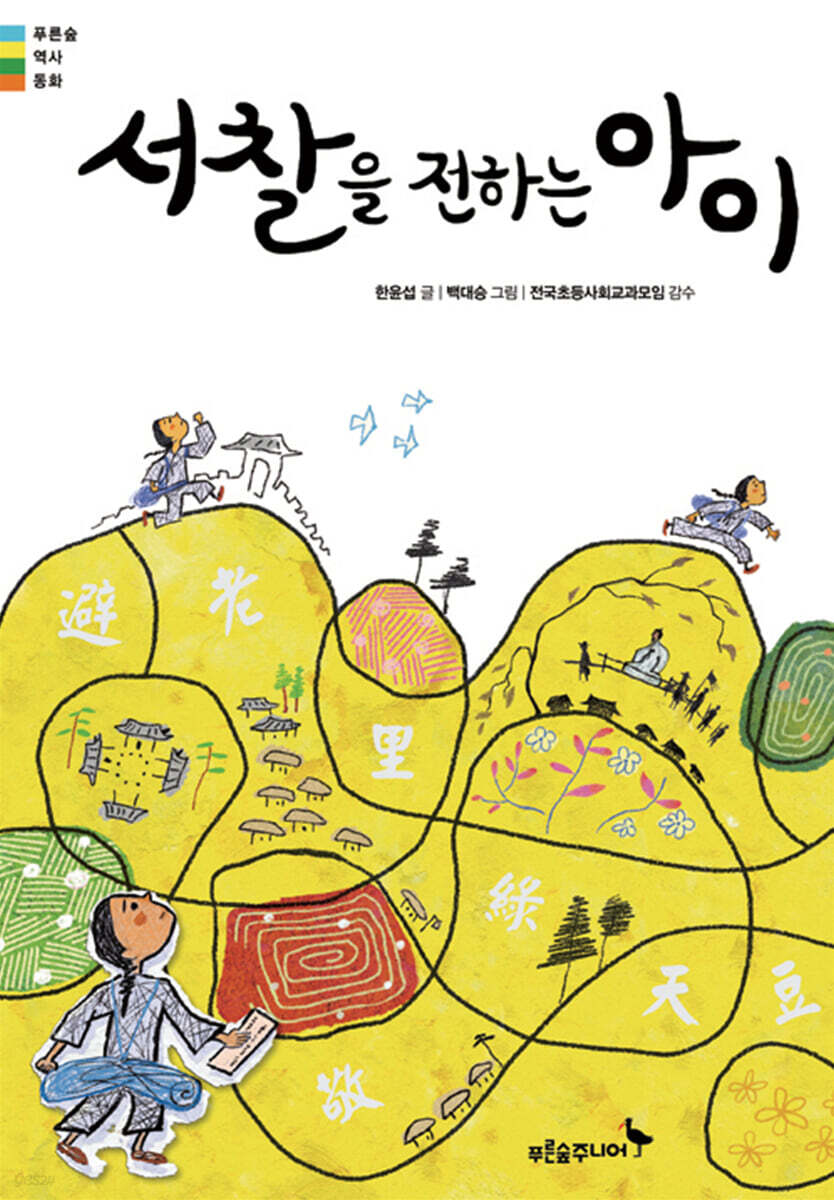
A child delivering a letter
 |
Description
Book Introduction
“General Jeon Bong-jun, a green bean, was captured by government troops and executed after Kim Gyeong-cheon’s report.”
What if Jeon Bong-jun knew that Kim Gyeong-cheon would report him?
Reviving a single line of history from a textbook with meticulous imagination!
A thirteen-year-old boy sets out alone to find the owner of the letter.
Meet the Donghak Peasant Army, who fought against an unjust world on that road.
This is the first historical fairy tale by author Han Yun-seop, who won the Munhakdongne Children's Literature Award for "Bonjour, Tour."
This is the story of a thirteen-year-old boy who sets out alone to deliver an important and secret letter in 1894, when the whole country was in an uproar over the Donghak Peasant Revolution.
This book, which traces the first memories of a thirteen-year-old peddler in a frame-like format, strongly captures the reader's attention with its solid structure, concise yet sophisticated writing style, and depictions of scenes that create a mysterious atmosphere.
The author used his rich imagination and meticulous reasoning skills to create a cinematic story based on a single historical fact: “General Jeon Bong-jun was executed after Kim Gyeong-cheon’s report.”
The story unfolds in a captivating way, with the protagonist, a child, following the path of the Donghak Peasant Army through twists and turns, and finally meeting Jeon Bong-jun, the owner of the letter, allowing us to feel the passionate hearts of that time that historical records failed to convey.
The appendix, “Reading History through Fairy Tales,” includes information, photos, and maps to help you understand the Donghak Peasant Revolution.
What if Jeon Bong-jun knew that Kim Gyeong-cheon would report him?
Reviving a single line of history from a textbook with meticulous imagination!
A thirteen-year-old boy sets out alone to find the owner of the letter.
Meet the Donghak Peasant Army, who fought against an unjust world on that road.
This is the first historical fairy tale by author Han Yun-seop, who won the Munhakdongne Children's Literature Award for "Bonjour, Tour."
This is the story of a thirteen-year-old boy who sets out alone to deliver an important and secret letter in 1894, when the whole country was in an uproar over the Donghak Peasant Revolution.
This book, which traces the first memories of a thirteen-year-old peddler in a frame-like format, strongly captures the reader's attention with its solid structure, concise yet sophisticated writing style, and depictions of scenes that create a mysterious atmosphere.
The author used his rich imagination and meticulous reasoning skills to create a cinematic story based on a single historical fact: “General Jeon Bong-jun was executed after Kim Gyeong-cheon’s report.”
The story unfolds in a captivating way, with the protagonist, a child, following the path of the Donghak Peasant Army through twists and turns, and finally meeting Jeon Bong-jun, the owner of the letter, allowing us to feel the passionate hearts of that time that historical records failed to convey.
The appendix, “Reading History through Fairy Tales,” includes information, photos, and maps to help you understand the Donghak Peasant Revolution.
- You can preview some of the book's contents.
Preview
index
Giant's belly button
Another day and another day
Set out alone
Old book seller
A traveler under a zelkova tree
Pharmacy owner
Catholic adult
A nobleman's child
The Call of Mr. Kim Jin-sa
Happiness, the first word I ever used
Grandfather Bear Boatman
Time-stopping Ugeumchi
The man I met at the inn
The scariest thing in the mountains
Finding your way in the hermitage
trembling heart
Ah! Green beans
End of Memory
Another day and another day
Set out alone
Old book seller
A traveler under a zelkova tree
Pharmacy owner
Catholic adult
A nobleman's child
The Call of Mr. Kim Jin-sa
Happiness, the first word I ever used
Grandfather Bear Boatman
Time-stopping Ugeumchi
The man I met at the inn
The scariest thing in the mountains
Finding your way in the hermitage
trembling heart
Ah! Green beans
End of Memory
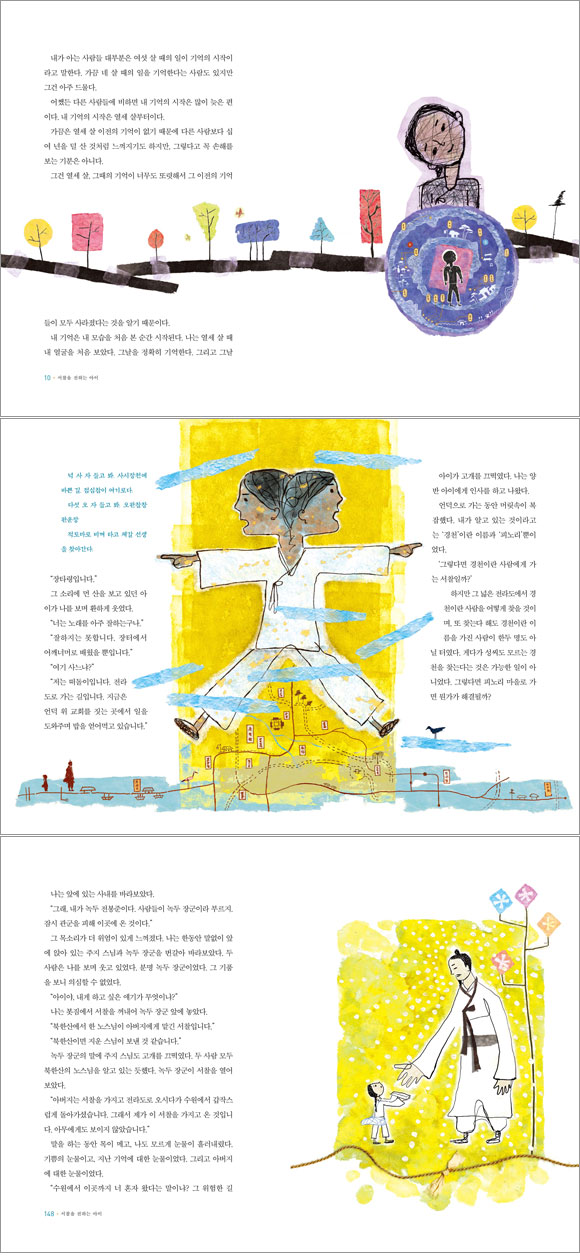
Detailed image
Publisher's Review
“Wow, there’s such an exciting story hidden in a single line of history in a textbook!”
Encounter meaningful events that shaped our history through fairy tales.
There are many children who enjoy watching historical dramas on TV but dislike textbook history.
This is because soft stories are easier to digest than hard knowledge information.
At this point, ‘historical fairy tales’ are gaining attention as a way to read history.
However, if you look closely at the books labeled "historical fairy tales," you'll find that many of them are set against unfamiliar events far removed from the historical narratives children learn in school, or are simply historical documents rewritten in narrative form. These books fail to fully satisfy readers' desire to "experience history in an accessible and engaging way."
At this point, Blue Forest Junior has published a series of twenty historical fairy tales that cover events that played a decisive role in the flow of Korean history, historical fairy tales that exude a literary flavor through a harmony of interesting material, attractive characters, and dramatic stories.
This series provides a comprehensive overview of Korean history from ancient times to modern times, but each volume is also a unique literary work.
Each volume has its own unique color with different materials, techniques, and narrative styles.
This was possible because a large number of children's literature writers who have attracted readers' attention with their unique works were able to participate.
Works by authors such as Han Yun-seop, who has been praised for “expanding the space and time of our fairy tales,” Choi Na-mi, who is evaluated as “a writer who has become a turning point in the history of children’s literature by shedding new light on the daily lives of families in our time,” Kim Nam-joong, who has shown a literary world seriously immersed in our history and social issues, as well as Lee Hyeon, Bae Yu-an, Ahn Mi-ran, and Kim Hae-won, are scheduled to be published one after another.
A peddler's boy follows in the footsteps of the Donghak Peasant Revolution.
When telling a story about the Donghak Peasant Revolution, the life of Jeon Bong-jun is usually shown, or a person who participated in the Donghak Peasant Revolution at the time is presented as the main character.
This book is set against the backdrop of the Donghak Peasant Revolution, and features a boy peddler who is far removed from the Donghak movement or the peasants as the main character.
The author's intention to shed new light on the Donghak Peasant Movement through the cracks in historical records that are publicly available is evident.
A child who follows his father, a peddler, to Jeolla Province to deliver a letter that will 'save one person and save the world.'
The world that the child and the father see is full of confusion.
The child is curious as to why the government forces arrest people who believe in Donghak, and whether it is because Donghak followers are bad people.
“Is your father a Donghak believer too?”
“Who said that?”
“I heard my father talking to the adults in the kitchen.
You always speak well of Donghak followers.
“Does your father also believe in Donghak?”
Father shook his head slowly.
That was fortunate.
-Page 21
But suddenly, the father dies, and the child is left alone in the world.
The child decides to deliver the letter on behalf of his father, but the letter contains only ten Chinese characters whose meaning he does not understand.
The child sets out to find out the meaning of the Chinese characters to find out who the recipient of the letter is.
The biggest topics of conversation at the tavern where the child took care of eating and sleeping were the Donghak Peasant Army, the king, and his subjects.
People curse the king and his subjects for calling in the Qing army to kill their own people, and recite the story of the Donghak Peasant Army causing the rebellion.
As the child listens to this story, hears the loud gunfire of the battlefield, and encounters the corpses of the Donghak Peasant Army soldiers who died miserably on the battlefield, he gradually comes to understand.
The fact that the Donghak Peasant Army fought to the death to create a happy world.
"Will a better world ever come, as the Donghak Peasant Revolution spoke of? A world without nobles or commoners, without Westerners or Japanese looking down on us?"
“Do you believe that will happen?”
“I believe you.
So I'm trying to cross the river now." - Page 111
The child dreamed of hope through the Donghak Peasant Revolution, but the tragic end of the Donghak Peasant Army that he encountered firsthand only brought despair.
However, in the memories of children who have grown up, the Donghak Peasant Revolution is not remembered only as a hopeless one.
General Nokdu was executed in the capital city the following year along with his comrades.
But as I moved from market to market, there was no place where I couldn't hear General Nokdu's song.
Even now, when I close my eyes, the image of General Nokdu, who led the Donghak Peasant Army, is vivid in my mind.
-Page 161
Author Han Yun-seop observes the Donghak Peasant Revolution through the eyes of a child.
The child's gaze may be the gaze of children today.
If young readers, like the protagonist, understood and empathized with the Donghak Peasant Army's struggle against an unjust world, the Donghak Peasant Movement that children know today would be a little different.
Couldn't words like "Jeon Bong-jun," "Donghak," and "peasant uprising," which we'd been so eager to memorize, resonate with us as passionate words that resonate deeply? Couldn't we also deeply empathize with the earnest desires of the Donghak Peasant Army, who risked their lives to fight in the hope of creating a better world?
The path to happiness created by a child
At the center of the child's path is a 'temple'.
I have set out on this journey because of the letter, and I must deliver the letter to complete this journey.
Delivering a letter is not an easy task.
You must find your destination and recipient, and navigate a perilous path through battles between the Donghak Peasant Army and the Japanese army.
But the child continues to walk his own path even in the face of things that would make him give up and turn back.
“I couldn’t find Pinori, but I found where I needed to go.
“I’m going to the princess.”
“You can’t go there right now.
Look at those soldiers over there.
These are soldiers going to the princess.
Moreover, the government troops are also preparing to fight the Donghak Peasant Army there.”
“But the place I have to go is the princess.”
“I think I found exactly where I need to go.
It is very important to know which path you should take.
“Don’t lose your way in the future.” - Page 102
One of the central events on this path is finding the meaning of Chinese characters in a letter.
The child, worried that the secret of the letter might leak out, decides to break the ten Chinese characters into twos and threes and figure out their meanings one by one.
Then, he memorizes two Chinese characters diligently and asks the meaning of them to an old bookseller he meets at an inn.
But the answer I get back is, 'Pay the price.'
After that, the same thing happened to travelers and noble children who asked about the meaning of Chinese characters.
At first, it may be frustrating to have to pay a price for knowing a few letters, but the child gradually comes to understand.
Learning is something that you have to pay a certain price to truly own.
“Child, you know three Chinese characters, so why are you paying one nyang for it? Why are you setting the price like that?”
“I set the price at this level because it shouldn’t be too expensive, and if it’s too cheap, I think people will easily forget the letters.
“Actually, I sold it for less than last time, but that’s all I have.” - pp. 65-66
As the child approaches his destination, he discovers a stronger and more resilient self.
I was scared of being left alone in the world, but seeing myself successfully navigating a path with no end in sight on my own made me feel better and my steps became lighter.
As the child reaches the end of the road, he finds himself saying the word “happy”, something he had never said before.
I looked into the puddle.
Inside was a fourteen-year-old child.
I liked that child's face.
“I am proud of you, the son of a peddler.”
I said.
The child in the water was laughing.
-Page 160
The child's journey resonates deeply with readers.
It is a message of comfort and encouragement that even in difficult situations, if you persevere and continue on your own path, happiness will eventually come.
And the process of a child who faces the contradictions of the world and finds hope instead of falling into the swamp of despair makes children think about how they should view this society and history.
Encounter meaningful events that shaped our history through fairy tales.
There are many children who enjoy watching historical dramas on TV but dislike textbook history.
This is because soft stories are easier to digest than hard knowledge information.
At this point, ‘historical fairy tales’ are gaining attention as a way to read history.
However, if you look closely at the books labeled "historical fairy tales," you'll find that many of them are set against unfamiliar events far removed from the historical narratives children learn in school, or are simply historical documents rewritten in narrative form. These books fail to fully satisfy readers' desire to "experience history in an accessible and engaging way."
At this point, Blue Forest Junior has published a series of twenty historical fairy tales that cover events that played a decisive role in the flow of Korean history, historical fairy tales that exude a literary flavor through a harmony of interesting material, attractive characters, and dramatic stories.
This series provides a comprehensive overview of Korean history from ancient times to modern times, but each volume is also a unique literary work.
Each volume has its own unique color with different materials, techniques, and narrative styles.
This was possible because a large number of children's literature writers who have attracted readers' attention with their unique works were able to participate.
Works by authors such as Han Yun-seop, who has been praised for “expanding the space and time of our fairy tales,” Choi Na-mi, who is evaluated as “a writer who has become a turning point in the history of children’s literature by shedding new light on the daily lives of families in our time,” Kim Nam-joong, who has shown a literary world seriously immersed in our history and social issues, as well as Lee Hyeon, Bae Yu-an, Ahn Mi-ran, and Kim Hae-won, are scheduled to be published one after another.
A peddler's boy follows in the footsteps of the Donghak Peasant Revolution.
When telling a story about the Donghak Peasant Revolution, the life of Jeon Bong-jun is usually shown, or a person who participated in the Donghak Peasant Revolution at the time is presented as the main character.
This book is set against the backdrop of the Donghak Peasant Revolution, and features a boy peddler who is far removed from the Donghak movement or the peasants as the main character.
The author's intention to shed new light on the Donghak Peasant Movement through the cracks in historical records that are publicly available is evident.
A child who follows his father, a peddler, to Jeolla Province to deliver a letter that will 'save one person and save the world.'
The world that the child and the father see is full of confusion.
The child is curious as to why the government forces arrest people who believe in Donghak, and whether it is because Donghak followers are bad people.
“Is your father a Donghak believer too?”
“Who said that?”
“I heard my father talking to the adults in the kitchen.
You always speak well of Donghak followers.
“Does your father also believe in Donghak?”
Father shook his head slowly.
That was fortunate.
-Page 21
But suddenly, the father dies, and the child is left alone in the world.
The child decides to deliver the letter on behalf of his father, but the letter contains only ten Chinese characters whose meaning he does not understand.
The child sets out to find out the meaning of the Chinese characters to find out who the recipient of the letter is.
The biggest topics of conversation at the tavern where the child took care of eating and sleeping were the Donghak Peasant Army, the king, and his subjects.
People curse the king and his subjects for calling in the Qing army to kill their own people, and recite the story of the Donghak Peasant Army causing the rebellion.
As the child listens to this story, hears the loud gunfire of the battlefield, and encounters the corpses of the Donghak Peasant Army soldiers who died miserably on the battlefield, he gradually comes to understand.
The fact that the Donghak Peasant Army fought to the death to create a happy world.
"Will a better world ever come, as the Donghak Peasant Revolution spoke of? A world without nobles or commoners, without Westerners or Japanese looking down on us?"
“Do you believe that will happen?”
“I believe you.
So I'm trying to cross the river now." - Page 111
The child dreamed of hope through the Donghak Peasant Revolution, but the tragic end of the Donghak Peasant Army that he encountered firsthand only brought despair.
However, in the memories of children who have grown up, the Donghak Peasant Revolution is not remembered only as a hopeless one.
General Nokdu was executed in the capital city the following year along with his comrades.
But as I moved from market to market, there was no place where I couldn't hear General Nokdu's song.
Even now, when I close my eyes, the image of General Nokdu, who led the Donghak Peasant Army, is vivid in my mind.
-Page 161
Author Han Yun-seop observes the Donghak Peasant Revolution through the eyes of a child.
The child's gaze may be the gaze of children today.
If young readers, like the protagonist, understood and empathized with the Donghak Peasant Army's struggle against an unjust world, the Donghak Peasant Movement that children know today would be a little different.
Couldn't words like "Jeon Bong-jun," "Donghak," and "peasant uprising," which we'd been so eager to memorize, resonate with us as passionate words that resonate deeply? Couldn't we also deeply empathize with the earnest desires of the Donghak Peasant Army, who risked their lives to fight in the hope of creating a better world?
The path to happiness created by a child
At the center of the child's path is a 'temple'.
I have set out on this journey because of the letter, and I must deliver the letter to complete this journey.
Delivering a letter is not an easy task.
You must find your destination and recipient, and navigate a perilous path through battles between the Donghak Peasant Army and the Japanese army.
But the child continues to walk his own path even in the face of things that would make him give up and turn back.
“I couldn’t find Pinori, but I found where I needed to go.
“I’m going to the princess.”
“You can’t go there right now.
Look at those soldiers over there.
These are soldiers going to the princess.
Moreover, the government troops are also preparing to fight the Donghak Peasant Army there.”
“But the place I have to go is the princess.”
“I think I found exactly where I need to go.
It is very important to know which path you should take.
“Don’t lose your way in the future.” - Page 102
One of the central events on this path is finding the meaning of Chinese characters in a letter.
The child, worried that the secret of the letter might leak out, decides to break the ten Chinese characters into twos and threes and figure out their meanings one by one.
Then, he memorizes two Chinese characters diligently and asks the meaning of them to an old bookseller he meets at an inn.
But the answer I get back is, 'Pay the price.'
After that, the same thing happened to travelers and noble children who asked about the meaning of Chinese characters.
At first, it may be frustrating to have to pay a price for knowing a few letters, but the child gradually comes to understand.
Learning is something that you have to pay a certain price to truly own.
“Child, you know three Chinese characters, so why are you paying one nyang for it? Why are you setting the price like that?”
“I set the price at this level because it shouldn’t be too expensive, and if it’s too cheap, I think people will easily forget the letters.
“Actually, I sold it for less than last time, but that’s all I have.” - pp. 65-66
As the child approaches his destination, he discovers a stronger and more resilient self.
I was scared of being left alone in the world, but seeing myself successfully navigating a path with no end in sight on my own made me feel better and my steps became lighter.
As the child reaches the end of the road, he finds himself saying the word “happy”, something he had never said before.
I looked into the puddle.
Inside was a fourteen-year-old child.
I liked that child's face.
“I am proud of you, the son of a peddler.”
I said.
The child in the water was laughing.
-Page 160
The child's journey resonates deeply with readers.
It is a message of comfort and encouragement that even in difficult situations, if you persevere and continue on your own path, happiness will eventually come.
And the process of a child who faces the contradictions of the world and finds hope instead of falling into the swamp of despair makes children think about how they should view this society and history.
GOODS SPECIFICS
- Date of issue: October 31, 2011
- Page count, weight, size: 176 pages | 326g | 153*220*10mm
- ISBN13: 9788971846643
- ISBN10: 897184664X
- KC Certification: Certification Type: Conformity Confirmation
You may also like
카테고리
korean


korean

![GQ KOREA Mark (Monthly): December [2025]](http://librairie.coreenne.fr/cdn/shop/files/8ef265dbbfbf186523ed75ba7319009d.jpg?v=1765340328&width=3840)


