

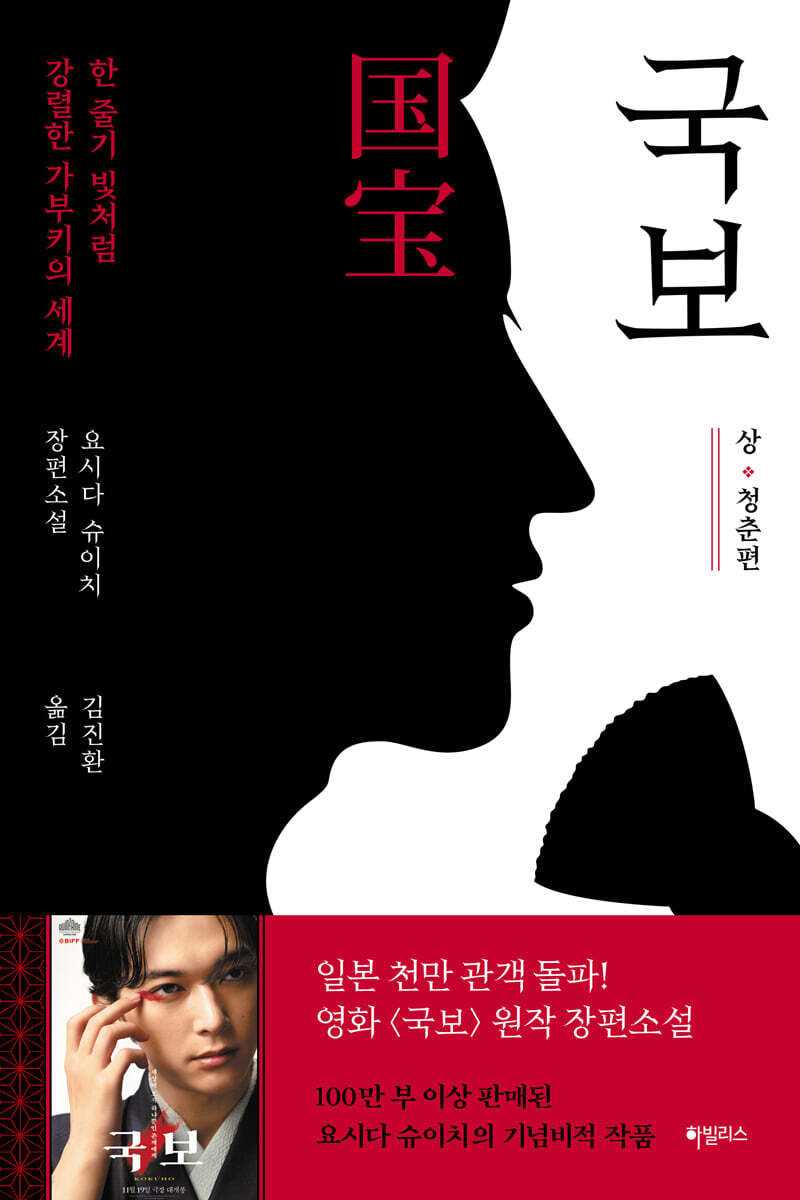
National Treasure: Sang and Cheongchun
 |
Description
Book Introduction
Winner of the 2019 Arts Captain Minister of Culture, Sports and Tourism Award and the Joongang Public Literary Award!
The original novel of the movie [National Treasure], which surpassed 10 million viewers in Japan!
It sold over 1 million copies after being published in Japan.
Shuichi Yoshida's monumental work
The film [National Treasure], released in Japan in June 2025, caused a sensation in the Japanese film industry by attracting over 10 million viewers.
This film, which deals with 'Kabuki', which has been pushed aside from the mainstream today, is based on the novel 'Kokuho' by Shuichi Yoshida, a representative figure in Japanese literature. The original novel was also loved by the nation, selling over 1 million copies after its publication.
Through the novel, the author revives the forgotten culture of Kabuki, and through the characters who dedicate themselves to creating perfect acting, dancing, and staging, he makes us think about what it means to reach the pinnacle of art.
In particular, the author shows through the novel how difficult the life of a Kabuki actor who is pushed to the margins is, and that the rosy life that everyone desires is never easy to come by, making us reflect on what it means to live life.
Let's take a look at the intense lives of the main characters and those around them, the sweat and tears they shed, and the moments of frustration and joy that could not be fully captured in a movie, through a novel.
The original novel of the movie [National Treasure], which surpassed 10 million viewers in Japan!
It sold over 1 million copies after being published in Japan.
Shuichi Yoshida's monumental work
The film [National Treasure], released in Japan in June 2025, caused a sensation in the Japanese film industry by attracting over 10 million viewers.
This film, which deals with 'Kabuki', which has been pushed aside from the mainstream today, is based on the novel 'Kokuho' by Shuichi Yoshida, a representative figure in Japanese literature. The original novel was also loved by the nation, selling over 1 million copies after its publication.
Through the novel, the author revives the forgotten culture of Kabuki, and through the characters who dedicate themselves to creating perfect acting, dancing, and staging, he makes us think about what it means to reach the pinnacle of art.
In particular, the author shows through the novel how difficult the life of a Kabuki actor who is pushed to the margins is, and that the rosy life that everyone desires is never easy to come by, making us reflect on what it means to live life.
Let's take a look at the intense lives of the main characters and those around them, the sweat and tears they shed, and the moments of frustration and joy that could not be fully captured in a movie, through a novel.
- You can preview some of the book's contents.
Preview
index
Chapter 1: The Land of the Hanamaru Fairy
Chapter 2: Kikuo's Rusty Sword
Chapter 3 Osaka Chodan
Chapter 4 Osaka 2nd Stage
Chapter 5: The Birth of a Star
Chapter 6: Escape from Sonezaki Forest
Chapter 7: Fish that Climb the World
Chapter 8: The Wind and the Madness
Chapter 9: Agarwood Pillow
Chapter 10: The Monster Cat
Chapter 2: Kikuo's Rusty Sword
Chapter 3 Osaka Chodan
Chapter 4 Osaka 2nd Stage
Chapter 5: The Birth of a Star
Chapter 6: Escape from Sonezaki Forest
Chapter 7: Fish that Climb the World
Chapter 8: The Wind and the Madness
Chapter 9: Agarwood Pillow
Chapter 10: The Monster Cat
Into the book
As the curtain suddenly opened, in stark contrast to the ominous sound of the taiko, cherry blossoms were in full bloom on the stage, covered in heavy snow.
A large cherry tree stands in the center, and cherry blossom branches in full bloom hang from the ceiling.
As they watched such a luxurious stage, sighs rose from the audience, and at that very moment, as the sound of the Taiko grew louder, the black cloth hanging on the trunk of the large tree began to loosen, and a courtesan named Sumizome appeared from within the tree.
What was revealed under the strong light was Sumizome, a courtesan wearing a dress of light gray cloth embroidered with hanging cherry blossom branches.
This is a picture of a woman with hair in the Tsubushishimada (a hairstyle popular in the late Edo period - translator's note) style, decorated with numerous hairpins for courtesans.
The audience erupted in waves of applause at the unexpected variation, and even Hanai Hanjiro, the second-generation grandson, muttered:
“Hoo.
“Is this the Sekinoto? door?”
This is a famous scene from the Kabuki dance drama, “Accumulating Love Snow Sekinoto.” At the bottom of the stage, geishas playing the role of storytellers and shamisen players are lined up, and next to a large cherry tree, a gatekeeper, Sekibei, is quietly waiting.
--- pp.23-24
As he ran into the school gate, his classmates who had already come out to the schoolyard were surprised to see Kikuo back at school after such a long time.
Kikuo ran straight into the first floor bathroom, took a dagger out of his bag, put it in his pants, and then, with an indifferent expression, mingled with the students attending the assembly.
During today's assembly, a philanthropist who recently donated a significant amount of money to build a children's library and a city council member who is promoting the project were scheduled to speak on the topic, "Why We Should Dream."
That philanthropist was none other than Kozo Miyaji, the chairman of the Miyaji faction and now the chairman of Century Construction.
Kikuo, as the procession slowly walked out onto the school grounds, clutched the dagger that had touched his stomach tightly.
--- pp.77-78
“Your father doesn’t give you a ‘ugh’ like you do.
You shouldn't force it.
Okay, keep going.”
When - just - right - then -
“You were wrong.
'When - 'da.
“I said, ‘Eud-ae -’ is not it.”
When - just -
“Wrong! Try making a sound from further inside.”
at the time -
"no.
Now, take a look at my belly.
I can see it moving.
I can't see your stomach.
This means that the ship has no strength.
ruler."
When - just - right - then -
The person who was pounding the desk in front of Shunsuke, who was sweating profusely, was Iwami Tsurutayu. Although he was already in his seventies at the time, his voice was so powerful and his skin so radiant that even Shunsuke's shining youth seemed pale in comparison to his vitality.
Gu - Magaino - , Jirofu -
“Oh, here it is again.
“It’s not ‘who-’, it’s ‘oh-’.”
Old - Magaino -
“It’s the chin.
“I told you to pull your chin in.”
Jirofu -
“Oh, there it is again! It’s ‘Jiro-o’, not ‘Jiro-fu’.
Okay, I've been chasing you since then."
I chased after you - , ah - , ah - , ah -
“No, it’s ‘come - , ah - ah -’.”
Came - , ah -
“I told you not to pull the beat! I said, ‘Come on - , ah - ah, ah - , ahhh - - ’”
It's like two fighting dogs barking at each other, and even Kikuo and Tokuji, who are watching, feel breathless.
--- pp.109-110
“How is your father?”
When Shunsuke asks with concern, Sachiko answers while sitting on the porch.
“He was crying, so pitiful.”
“Father? He cried…?”
“Yeah, that’s right.
That guy, since he first stepped on stage at the age of two, he has never once failed to perform on stage.
"He was a person who stood on stage with a real fever, a stomachache, and even a diaper, so of course he would feel wronged."
Sachiko, who had gotten up with a gasp, noticed the plates of curry the two people were holding…
“Osei, give me some curry too.”
After saying that, he goes to change his clothes, but Shunsuke follows him.
“So what do you think the stage will be like?”
“Oh, right.”
Sachiko, who had stopped, was already untying the obi strap of her kimono.
“It seems like the company is moving quickly, but it doesn’t seem like finding a replacement will be easy.
It can't be helped, because you can't bring in actors from Tokyo while making a fuss about it being the 'essence of Kansai Kabuki'.
That doesn't mean there's no actor here who can replace Hanjiro."
And Sachiko, who was about to go to her room, suddenly looks back.
“This is my feeling.”
With that premise attached… … .
“……Shun Doryeong.
“You, I think it would be good to prepare yourself mentally.”
--- pp.203-204
The song "Wisteria Girl" is being played on a cassette tape in the banquet hall of a tourist hotel in Kanazawa. The sound source is not bad, but there is quite a bit of annoying noise coming from the speakers.
Moreover, the flashy lights on the stage are cellophane lights that are not even found in suburban cabarets.
Although it is an event held at a local tourist hotel, the sight of Kikuo dancing so earnestly even in a place like this makes Tokuji, who is watching from the side of the stage, feel pity.
(…syncopation…)
In fact, it was three days ago that I received the Kanazawa business deal from Mitsutomo. Even though the time of the performance was in the evening, I requested that he arrive early to prepare, so I refused to do so, citing the need to save on hotel costs.
It's true that when he inherited the debt of the White Tiger, Kikuo himself said, "I'll do anything," but Tokuji was more upset than Kikuo because Mitsutomo made him run local events whenever his schedule was free.
A large cherry tree stands in the center, and cherry blossom branches in full bloom hang from the ceiling.
As they watched such a luxurious stage, sighs rose from the audience, and at that very moment, as the sound of the Taiko grew louder, the black cloth hanging on the trunk of the large tree began to loosen, and a courtesan named Sumizome appeared from within the tree.
What was revealed under the strong light was Sumizome, a courtesan wearing a dress of light gray cloth embroidered with hanging cherry blossom branches.
This is a picture of a woman with hair in the Tsubushishimada (a hairstyle popular in the late Edo period - translator's note) style, decorated with numerous hairpins for courtesans.
The audience erupted in waves of applause at the unexpected variation, and even Hanai Hanjiro, the second-generation grandson, muttered:
“Hoo.
“Is this the Sekinoto? door?”
This is a famous scene from the Kabuki dance drama, “Accumulating Love Snow Sekinoto.” At the bottom of the stage, geishas playing the role of storytellers and shamisen players are lined up, and next to a large cherry tree, a gatekeeper, Sekibei, is quietly waiting.
--- pp.23-24
As he ran into the school gate, his classmates who had already come out to the schoolyard were surprised to see Kikuo back at school after such a long time.
Kikuo ran straight into the first floor bathroom, took a dagger out of his bag, put it in his pants, and then, with an indifferent expression, mingled with the students attending the assembly.
During today's assembly, a philanthropist who recently donated a significant amount of money to build a children's library and a city council member who is promoting the project were scheduled to speak on the topic, "Why We Should Dream."
That philanthropist was none other than Kozo Miyaji, the chairman of the Miyaji faction and now the chairman of Century Construction.
Kikuo, as the procession slowly walked out onto the school grounds, clutched the dagger that had touched his stomach tightly.
--- pp.77-78
“Your father doesn’t give you a ‘ugh’ like you do.
You shouldn't force it.
Okay, keep going.”
When - just - right - then -
“You were wrong.
'When - 'da.
“I said, ‘Eud-ae -’ is not it.”
When - just -
“Wrong! Try making a sound from further inside.”
at the time -
"no.
Now, take a look at my belly.
I can see it moving.
I can't see your stomach.
This means that the ship has no strength.
ruler."
When - just - right - then -
The person who was pounding the desk in front of Shunsuke, who was sweating profusely, was Iwami Tsurutayu. Although he was already in his seventies at the time, his voice was so powerful and his skin so radiant that even Shunsuke's shining youth seemed pale in comparison to his vitality.
Gu - Magaino - , Jirofu -
“Oh, here it is again.
“It’s not ‘who-’, it’s ‘oh-’.”
Old - Magaino -
“It’s the chin.
“I told you to pull your chin in.”
Jirofu -
“Oh, there it is again! It’s ‘Jiro-o’, not ‘Jiro-fu’.
Okay, I've been chasing you since then."
I chased after you - , ah - , ah - , ah -
“No, it’s ‘come - , ah - ah -’.”
Came - , ah -
“I told you not to pull the beat! I said, ‘Come on - , ah - ah, ah - , ahhh - - ’”
It's like two fighting dogs barking at each other, and even Kikuo and Tokuji, who are watching, feel breathless.
--- pp.109-110
“How is your father?”
When Shunsuke asks with concern, Sachiko answers while sitting on the porch.
“He was crying, so pitiful.”
“Father? He cried…?”
“Yeah, that’s right.
That guy, since he first stepped on stage at the age of two, he has never once failed to perform on stage.
"He was a person who stood on stage with a real fever, a stomachache, and even a diaper, so of course he would feel wronged."
Sachiko, who had gotten up with a gasp, noticed the plates of curry the two people were holding…
“Osei, give me some curry too.”
After saying that, he goes to change his clothes, but Shunsuke follows him.
“So what do you think the stage will be like?”
“Oh, right.”
Sachiko, who had stopped, was already untying the obi strap of her kimono.
“It seems like the company is moving quickly, but it doesn’t seem like finding a replacement will be easy.
It can't be helped, because you can't bring in actors from Tokyo while making a fuss about it being the 'essence of Kansai Kabuki'.
That doesn't mean there's no actor here who can replace Hanjiro."
And Sachiko, who was about to go to her room, suddenly looks back.
“This is my feeling.”
With that premise attached… … .
“……Shun Doryeong.
“You, I think it would be good to prepare yourself mentally.”
--- pp.203-204
The song "Wisteria Girl" is being played on a cassette tape in the banquet hall of a tourist hotel in Kanazawa. The sound source is not bad, but there is quite a bit of annoying noise coming from the speakers.
Moreover, the flashy lights on the stage are cellophane lights that are not even found in suburban cabarets.
Although it is an event held at a local tourist hotel, the sight of Kikuo dancing so earnestly even in a place like this makes Tokuji, who is watching from the side of the stage, feel pity.
(…syncopation…)
In fact, it was three days ago that I received the Kanazawa business deal from Mitsutomo. Even though the time of the performance was in the evening, I requested that he arrive early to prepare, so I refused to do so, citing the need to save on hotel costs.
It's true that when he inherited the debt of the White Tiger, Kikuo himself said, "I'll do anything," but Tokuji was more upset than Kikuo because Mitsutomo made him run local events whenever his schedule was free.
--- pp.229-301
Publisher's Review
The world of Kabuki, as intense as a ray of light
To move towards a more beautiful world
Dancing on stage again today!
The giant of Japanese literature, Shuichi Yoshida
The essence of artistic literature!
The two-volume novel "Kokuho", which is based on Japan's traditional culture of Kabuki, is considered a masterpiece and a monumental work by Shuichi Yoshida, a representative novelist of Japanese literature.
It is recognized as an important work in the Japanese literary world, having won the "Minister of Education, Culture, Sports, Science and Technology Award" and the "Chuo Koron Literary Award," two of Japan's leading literary awards.
In the first volume of "Kokuho," the author focuses on the story of Kikuo, who was born into a Japanese yakuza family, loses his father and family, enters the Tanbaya family, a kabuki family, and grows up as a kabuki actor.
In the novel, through the life of Kikuo, the author brings out the blood, sweat, and spirit of artists who dedicate themselves to preserving traditions into the world.
Although he became an actor because he loved dancing, the reality that Kikuo faces is not so easy.
Kabuki was once a representative culture of Japan, but as society changed, it was gradually marginalized by visual media and became a 'forgotten tradition'.
Reflecting this, the number of theaters performing Kabuki plays has decreased significantly, reaching only a handful across the country.
Even in such a reality, Kikuo does not lose his awareness as a Kabuki actor and continues to pursue his passion for dance.
It is a stage that is now being forgotten, but it is waiting for the right time, waiting for the day when it will surely soar.
Although "Kokubo" is a novel based on Kabuki, it also gives us something to think about.
The author covers the Kabuki stage, dance, and music in detail, while also introducing the changes in Japanese society after World War II and the decline of Kabuki culture.
After the spread of color television, the influence of visual media, which was different from that of the past, increased, and the public's interest shifted from the Kabuki stage to movies and dramas, and accordingly, the acting and roles of 'actors' also changed.
However, these changes were a clear departure from the traditions of the kabuki stage, and as it faded from public attention, the number of theaters and venues where kabuki performances could be performed also decreased rapidly.
In the aftermath of this, not only the mission to preserve culture but also the livelihoods of all those involved are threatened.
Through the novel, the author asks what the value of 'tradition' is in the midst of changes in modern society, whether 'change' and 'tradition' are incompatible, and what role the public should play as a subject consuming culture.
Of course, we cannot easily answer these questions, but we must nonetheless find answers together.
What is clear is that the value of 'tradition' will not disappear, and it must be transformed and utilized to suit the present.
By following the life and trajectory of the traditional artist represented by "Kikuo" through "National Treasure," we can think about what kind of traditions we possess and what values we can derive from them.
To move towards a more beautiful world
Dancing on stage again today!
The giant of Japanese literature, Shuichi Yoshida
The essence of artistic literature!
The two-volume novel "Kokuho", which is based on Japan's traditional culture of Kabuki, is considered a masterpiece and a monumental work by Shuichi Yoshida, a representative novelist of Japanese literature.
It is recognized as an important work in the Japanese literary world, having won the "Minister of Education, Culture, Sports, Science and Technology Award" and the "Chuo Koron Literary Award," two of Japan's leading literary awards.
In the first volume of "Kokuho," the author focuses on the story of Kikuo, who was born into a Japanese yakuza family, loses his father and family, enters the Tanbaya family, a kabuki family, and grows up as a kabuki actor.
In the novel, through the life of Kikuo, the author brings out the blood, sweat, and spirit of artists who dedicate themselves to preserving traditions into the world.
Although he became an actor because he loved dancing, the reality that Kikuo faces is not so easy.
Kabuki was once a representative culture of Japan, but as society changed, it was gradually marginalized by visual media and became a 'forgotten tradition'.
Reflecting this, the number of theaters performing Kabuki plays has decreased significantly, reaching only a handful across the country.
Even in such a reality, Kikuo does not lose his awareness as a Kabuki actor and continues to pursue his passion for dance.
It is a stage that is now being forgotten, but it is waiting for the right time, waiting for the day when it will surely soar.
Although "Kokubo" is a novel based on Kabuki, it also gives us something to think about.
The author covers the Kabuki stage, dance, and music in detail, while also introducing the changes in Japanese society after World War II and the decline of Kabuki culture.
After the spread of color television, the influence of visual media, which was different from that of the past, increased, and the public's interest shifted from the Kabuki stage to movies and dramas, and accordingly, the acting and roles of 'actors' also changed.
However, these changes were a clear departure from the traditions of the kabuki stage, and as it faded from public attention, the number of theaters and venues where kabuki performances could be performed also decreased rapidly.
In the aftermath of this, not only the mission to preserve culture but also the livelihoods of all those involved are threatened.
Through the novel, the author asks what the value of 'tradition' is in the midst of changes in modern society, whether 'change' and 'tradition' are incompatible, and what role the public should play as a subject consuming culture.
Of course, we cannot easily answer these questions, but we must nonetheless find answers together.
What is clear is that the value of 'tradition' will not disappear, and it must be transformed and utilized to suit the present.
By following the life and trajectory of the traditional artist represented by "Kikuo" through "National Treasure," we can think about what kind of traditions we possess and what values we can derive from them.
GOODS SPECIFICS
- Date of issue: November 3, 2025
- Page count, weight, size: 368 pages | 468g | 140*210*22mm
- ISBN13: 9791142334290
- ISBN10: 1142334295
You may also like
카테고리
korean


korean

![ELLE 엘르 스페셜 에디션 A형 : 12월 [2025]](http://librairie.coreenne.fr/cdn/shop/files/b8e27a3de6c9538896439686c6b0e8fb.jpg?v=1766436872&width=3840)


