

Specification of Poverty
 |
Description
Book Introduction
“Nayeon, why do you spend so much money?” Maybe that’s where all this conversation started.
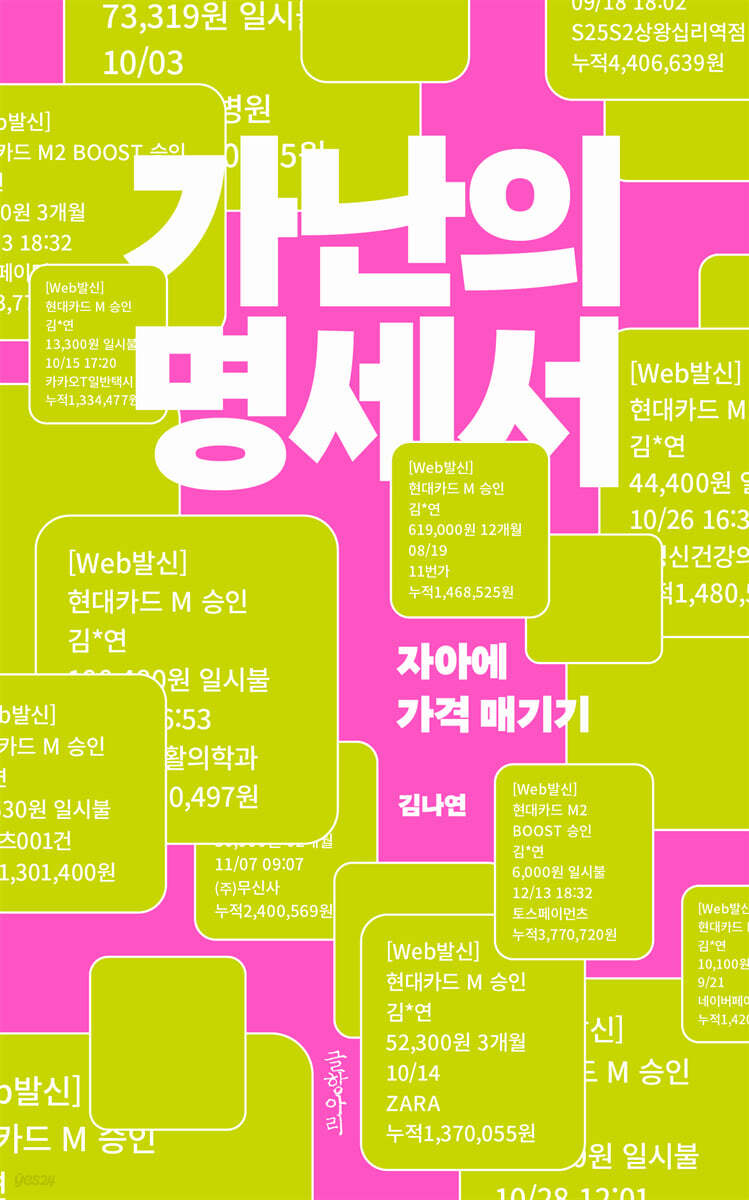
The "Statement of Poverty" tells how much money was spent, how it was spent, and what was spent.
But after writing it down, I realized that this story was not a 'list of consumption' but a 'specialization of poverty'.
'Nayeon' unfolds a narrative of poverty by revealing the details of her spending over the past 10 years, including the cost of purchasing a laptop, her mother's hospital bills, English lessons over the phone, transportation, travel, and psychiatric treatment.
It is not an objective, absolute poverty that drives people to the extremes of life.
Rather, the poverty described in this book is a subjective and relative state of 'poverty' that constantly restricts life and causes the self to shrink.
A poverty that somehow seems to have to prove that it is ‘real poverty’.
A poverty that feels like it needs to be addressed.
An incomplete, ambiguous, and temporary feeling that constantly follows me.
So, I can't be honest and I keep feeling guilty.
But as you read through this petty account of poverty, you realize that these emotions are precisely what permeate the author's own experience of poverty.
So I ask:
'What kind of people does poverty make us?'
The "Statement of Poverty" tells how much money was spent, how it was spent, and what was spent.
But after writing it down, I realized that this story was not a 'list of consumption' but a 'specialization of poverty'.
'Nayeon' unfolds a narrative of poverty by revealing the details of her spending over the past 10 years, including the cost of purchasing a laptop, her mother's hospital bills, English lessons over the phone, transportation, travel, and psychiatric treatment.
It is not an objective, absolute poverty that drives people to the extremes of life.
Rather, the poverty described in this book is a subjective and relative state of 'poverty' that constantly restricts life and causes the self to shrink.
A poverty that somehow seems to have to prove that it is ‘real poverty’.
A poverty that feels like it needs to be addressed.
An incomplete, ambiguous, and temporary feeling that constantly follows me.
So, I can't be honest and I keep feeling guilty.
But as you read through this petty account of poverty, you realize that these emotions are precisely what permeate the author's own experience of poverty.
So I ask:
'What kind of people does poverty make us?'
- You can preview some of the book's contents.
Preview
index
prolog
Part 1 October Card Statement
Work laptop 61,900 won
Mom's hospital bill: 73,319 won
English phone lessons 17,600 won
Round-trip flight to Okinawa for 34,100 won
Perfume 29,400 won
Bookcase 10,600 won
Film tool 10,100 won
Gardasil 2nd dose 63,400 won
Summer one-piece dress 19,600 won
Body lotion 10,630 won
Lunchbox 11,000 won
Part 2: Lump Sum Items: A Little Makes a Little
Psychiatry Clinic 44,400 won
Bo-eun's gift 8,000 won
Public transportation 117,700 won
Current Affairs Weekly 4,000 won
Daily necessities 10,000 won
Meal cost 312,060 won
Epilogue
Part 1 October Card Statement
Work laptop 61,900 won
Mom's hospital bill: 73,319 won
English phone lessons 17,600 won
Round-trip flight to Okinawa for 34,100 won
Perfume 29,400 won
Bookcase 10,600 won
Film tool 10,100 won
Gardasil 2nd dose 63,400 won
Summer one-piece dress 19,600 won
Body lotion 10,630 won
Lunchbox 11,000 won
Part 2: Lump Sum Items: A Little Makes a Little
Psychiatry Clinic 44,400 won
Bo-eun's gift 8,000 won
Public transportation 117,700 won
Current Affairs Weekly 4,000 won
Daily necessities 10,000 won
Meal cost 312,060 won
Epilogue
Into the book
Whenever I felt anxious, I would check the expected interest rates on various financial apps to prepare myself psychologically for life as a debtor. Then, around the time my final semester of graduate school began, I ended up applying for a small credit loan from a commercial bank.
I borrowed 4 million won out of the 5 million won limit.
The reason I didn't borrow up to the limit was because of self-esteem, dignity, and things like that.
To me, who had seen my mom, dad, and relatives raise their voices, curse, and badmouth each other over money issues since I was little, 'debt' was synonymous with ruin.
The seeds of misfortune that cause harm to people, damage relationships, and ultimately ruin lives.
Retribution and divine punishment for incompetence.
The end of an ordinary life.
--- From the "Prologue"
Later, my mother said she regretted that phone call for a long time.
The summer after my first year in the US, when my mother visited my youngest aunt's house for the first time, she saw me cowering in fear of her grandmother's reaction, and my hands were covered in pus from eczema from doing housework. She said she thought this was not right.
However, the mother, who was not in a position to bring her daughter back to Korea, had to beat her chest the whole time on the flight back home.
--- From "Phone English 17,600 won"
From that day on, I always check the smell before putting on clothes.
When I feel like the closet is starting to smell, I turn red in the face and do laundry, emptying every drawer like a burglar hiding in an empty house.
If we consider the reason for hating poverty, then postponing desires because of poverty is not a very serious matter.
Because moderating desires was once praised as an attitude of integrity and frugality.
But the very fact that poverty limits my dignity, my self-esteem, my intimacy with others, that I have to pretend that it doesn't bother me even when it suffocates me, that I was born with a narrow and shabby ego—this is what is truly despairing and unbearable.
Poverty permeates me, from what enters my mouth to what comes out of my body, to what I wear on my body.
Am I like a pickled herring in poverty?
--- From "Perfume 29,400 Won"
That was a problem that could be improved with just a few pills.
When I actually went to a psychiatrist, the treatment costs were reasonable.
To the point where I feel like the nearly 10 years of hesitation was futile.
If I had known this would happen, I would have come sooner.
Every time I thought about how I had made my condition worse by worrying about money without even knowing how much it would cost, I felt angry, sad, and miserable.
Who doesn't know that if you let an illness, whether mental or physical, grow, there will eventually come a day when even a hoe can't stop it, let alone a sickle?
But what is taken for granted to some is considered a luxury for the poor, something they can only enjoy if they have the means.
Poverty makes reality terrifying.
The fear created by poverty can sometimes lead to the justification of illness.
I borrowed 4 million won out of the 5 million won limit.
The reason I didn't borrow up to the limit was because of self-esteem, dignity, and things like that.
To me, who had seen my mom, dad, and relatives raise their voices, curse, and badmouth each other over money issues since I was little, 'debt' was synonymous with ruin.
The seeds of misfortune that cause harm to people, damage relationships, and ultimately ruin lives.
Retribution and divine punishment for incompetence.
The end of an ordinary life.
--- From the "Prologue"
Later, my mother said she regretted that phone call for a long time.
The summer after my first year in the US, when my mother visited my youngest aunt's house for the first time, she saw me cowering in fear of her grandmother's reaction, and my hands were covered in pus from eczema from doing housework. She said she thought this was not right.
However, the mother, who was not in a position to bring her daughter back to Korea, had to beat her chest the whole time on the flight back home.
--- From "Phone English 17,600 won"
From that day on, I always check the smell before putting on clothes.
When I feel like the closet is starting to smell, I turn red in the face and do laundry, emptying every drawer like a burglar hiding in an empty house.
If we consider the reason for hating poverty, then postponing desires because of poverty is not a very serious matter.
Because moderating desires was once praised as an attitude of integrity and frugality.
But the very fact that poverty limits my dignity, my self-esteem, my intimacy with others, that I have to pretend that it doesn't bother me even when it suffocates me, that I was born with a narrow and shabby ego—this is what is truly despairing and unbearable.
Poverty permeates me, from what enters my mouth to what comes out of my body, to what I wear on my body.
Am I like a pickled herring in poverty?
--- From "Perfume 29,400 Won"
That was a problem that could be improved with just a few pills.
When I actually went to a psychiatrist, the treatment costs were reasonable.
To the point where I feel like the nearly 10 years of hesitation was futile.
If I had known this would happen, I would have come sooner.
Every time I thought about how I had made my condition worse by worrying about money without even knowing how much it would cost, I felt angry, sad, and miserable.
Who doesn't know that if you let an illness, whether mental or physical, grow, there will eventually come a day when even a hoe can't stop it, let alone a sickle?
But what is taken for granted to some is considered a luxury for the poor, something they can only enjoy if they have the means.
Poverty makes reality terrifying.
The fear created by poverty can sometimes lead to the justification of illness.
--- From "Psychiatry Department 44,400 won"
Publisher's Review
“For me, poverty was a ghost.”
The self that confronts poverty,
Meanwhile, poverty has become an identity
The 'ghost' of poverty, anxious in the midst of material and existential poverty
Details of some deficiency that I have to empty my pockets to reveal
“I have always objectified poverty, objectified it, and distanced myself from it.
Because I hated poverty.
I wanted to distance myself from the object of my hatred and make it a word that had nothing to do with my life.
Even though it was a family matter, I insisted that I would not take responsibility for other people's choices and the consequences that would result from them.
He said with a straight face that this poverty was not something he decided on, so he shouldn't blame me, and he drew the line by saying that it was none of his business whether his mother was poor enough to tear her pants or not, as that was her situation.
(…) I have managed my clothes, speech, and even my values so that I do not smell of poverty and so that the shadow of poverty does not fall on me.
I wanted to bury it as a story about 'my hardships as a child' that I would only bring up briefly when I needed something to talk about.
I didn't realize that poverty wasn't a sticker that could be removed and reapplied, but something that permeated deep into the cells like a tattoo.
No, I wanted to not know.” ― Epilogue
Living poorly, as 'me'
―Party identity and identity
What does it mean to experience poverty? When poverty is treated as a social problem, it is visualized as a visible deficiency and schematized as a structural problem.
On the other hand, when it becomes someone's personal narrative, the specific daily content that is revealed, and the life patterns that are created by intertwining those of the same generation and the generations before and after, take on different aspects depending on who the poor person is.
For some, it was a threat to their livelihood, for others, it was a restriction on their lives, for others, it was a broken relationship, for others, it was a hopeless experience. The author of this book writes that it was “becoming a ghost.”
To put it simply, poverty for him is something that distorts, diminishes, and diminishes the self, and even causes it to disappear.
For the author, poverty was, above all, a problem related to ‘living as myself.’
Like any narrative by a party member, this book vividly portrays the everyday lives of youth poverty.
In a uniquely lively and chatty style.
A consumer who searches Naver and Coupang to find the lowest price for the snack in front of him, a penniless person who can't even afford a 60,000 won pair of sneakers in one go, a job seeker who writes his resume on a used laptop and works a side job, a traveler who looks up a national petition to 'ban overseas travel for basic livelihood security recipients' before leaving, a high school student who got through four semesters of graduate school on Isaac Toast while working a company, a guardian who is responsible for the medical and nursing costs of his mother who collapsed from a cerebral hemorrhage, a patient who postponed psychiatric treatment for 10 years because he was afraid of hospital bills... ... While living as such a 'poor person', 'I' constantly sense a lack in various aspects of life.
A life where we must always live calculatingly, our sense of time is fixed on the 'now', and we must constantly learn not to expect.
The author does not hesitate to express the old emotions that have accumulated inside him in this kind of life.
He is anxious, afraid, angry, sad, and sorrowful.
They fall into self-pity and then hate that pity again, and they objectify poverty and then make it their identity again.
It may be possible for him to express this confusion as it is because he is a party to poverty.
He has a 'me' he wants to become.
I want to be a 'clean person' to myself, a person who is honest and upright.
I want to be someone with “a refined eye that has been honed over a long period of time” (129), and with that eye, I want to consume in an excellent, sustainable, and ethical manner.
I want to be someone who gives to the people I love without calculating, and who is happy when I see them happy.
He says, “I am a person who only has to take responsibility for my own choices” (115), “a cultured, kind, and generous member of society” (186), “that is the kind of person I picture in my mind” (100).
But poverty constantly puts the brakes on 'becoming who I want to be'.
If we consider the reason for hating poverty, then postponing desires because of poverty is not a very serious matter.
Because moderating desires was once praised as an attitude of integrity and frugality.
But the very fact that poverty limits my dignity, my self-esteem, my intimacy with others, that I have to pretend that it doesn't bother me even when it suffocates me, that I was born with a narrow and shabby self—this is what is truly despairing and unbearable.
Page 94
I must once again be the one who chooses to act against my values because of my thin, dry wallet.
As long as I was poor, I was forced to be an unethical, politically incorrect, and environmentally destructive consumer.
That made my heart even poorer.
It made me endlessly hate myself for not being able to have beautiful clothes, a beautiful body, or a beautiful attitude, and therefore not being an object of desire for others.
Ethics, morality, beauty, and political correctness all felt like qualities that could only be achieved through capital in a capitalist society.
Page 131
As self-realization is repeatedly frustrated, 'I' learn the grammar of poverty taught by the world deep inside.
Days when you become sensitive to gazes, feel small, distrust others, and constantly doubt yourself.
Choices are always anxious and scary, and even after making them, you feel uneasy.
In this way, his existence is always put to the test, and the self that is always being tested cannot help but become rigid.
“If something doesn’t fit the ideal choice I desire, I should not even look at it, so as not to fall into the path of suffering and despair.” (127) “I should not trust others, even if they are my parents or relatives, and I should not start something I haven’t personally investigated, and the most important person in my life is no one else but myself, and I must achieve what I want myself.” (64-65) When poverty becomes an identity, poverty is no longer a problem limited to the material dimension.
Perhaps that is why the experiences of poverty that the author unfolds in concrete numbers and as stories about money are often stories about existential poverty.
Quoting the fairy tale “The Three Little Pigs,” he says:
“Did the first and second build their houses out of straw and wood because they didn’t know that bricks were the strongest and most durable material? (…) I was a pig who, if I decided that a brick house was needed, would get my hands on bricks no matter what.
Even if it means closing your eyes to your brothers' suffering and turning a deaf ear to the mother pig's pleas." (37) Even after you get a decent job, earn as much as others, become independent, buy a house, and fill that house with the furniture you've been dreaming of, 'I' continue to ask myself questions.
“How should I coexist with my materialistic nature that seeks to transfer to another society in the future?” (116) While asking this question, the author confesses his discomfort by lowering himself to the “soul of Korea” itself among colleagues who were born into wealthy families and have lived abroad for a long time. This scene seems to clearly show that the author’s vulnerability is an issue that cannot be explained by “money” alone.
No, Ernaux called this “the wounds and shame of a heart torn by social upward mobility” (Didier Eribon, Returning to Rheims, translated by Lee Sang-gil, Munhak-kwa-Jiseongsa, 2021, 273).
But without time to seriously examine the complexities of class identity in order to reconcile with the past we left behind, without time to consider how to connect with others of different backgrounds, positions, and values, this poverty is put to the test again.
Just as the author feels compelled to justify and explain his own shortcomings, he also constantly interrogates and attempts to prove the poverty that has become a part of him.
Living so comfortably, with such a warm back, is it acceptable to keep uttering the word "poverty"? Isn't it deceptive or hurtful to describe myself as poor? Is "poverty" a word that can only be recognized as genuine when it comes from someone who meets certain criteria? _Pages 220-221
Is this a question that can be answered? If so, for whom and for what purpose? If poverty isn't a "qualification test," what questions should we be asking?
My background is not me
―Drawing the line between family and the "source of struggle"
The book opens with K's story, which at first glance appears to be a typical route.
“In 1997, when everyone was having a hard time (…), K’s family of four suddenly fell into financial difficulties as the foreign exchange crisis hit.” (9) The house was put up for auction, and the economic conflict drove the relationship to ruin.
Her parents separated, and K's mother, who became a single mother, "jumped into the harsh battlefield of livelihood like a warrior." (57) K continues her college and work life with the spirit of studying day and night, and dreams of going to graduate school.
However, when K was in his 30s, his mother collapsed from a cerebral hemorrhage on the battlefield where he had been fighting fiercely.
All the money he had saved for tuition was spent on hospital bills, and K, who was now financially bankrupt, applied for a credit loan… … .
Even if you go back to your mother's or grandmother's generation, similar stories continue that seem familiar.
A family that was the backbone of the village, grew up in a world of luxury without knowing hardship, but the family's fortunes were ruined by the patriarch's womanizing, and the children were raised alone after their husbands died early.
The youngest of two sons and one daughter, with an indifferent mother and violent and selfish older brothers, a marriage chosen to escape home, the insurance business entered into to make a living, economic downturn, conflict and discord, the whirlwind of life, a broken body and mind.
Perhaps this, bearing the name of 'poverty', is a narrative of tangled relationships spanning generations.
“A cruel mother who never packed lunch for me or bought me a single sanitary pad” and her daughter.
A mother and her daughter say, “If you come to Korea, you and I will both die.”
This chronicle, where it is impossible to tell where and what is lacking and missing, begins and ends with a story about money, disguised as poverty.
“So when can I pay you back?” “Are you trying to make me feel bad for everyone?” “You should have either avoided poverty or stayed sick in the first place, one of the two,” says K, exhausted from the long hours of caregiving, endless work, persistent financial insecurity, endless emotional exhaustion, and harsh words.
“From my first-person perspective, the theme that runs through our family history is this:
“This family is a relationship bound by material and emotional debt and maintained by debt.” (54)
The escape K finds is a generational one, much like the life paths his mother and grandmother took.
Jennifer M.
In Coming Up Short (translated by Moon Hyun-ah and Park Jun-gyu, Rishioll, 2020), Silva explains today's youth's perception of adulthood.
“Millennials tend to carry more student debt, have higher poverty and unemployment rates, and lower levels of wealth and personal income than the previous two generations of the same age.
What does it mean to "grow up" in such an unstable atmosphere? (...) Surprisingly, many young people drew a line with their families and showed a harsh attitude, saying they could not forgive them.
They understood their families as the source of their problems and struggles.” (Jennifer M.
Silva, Coming Up Short, translated by Moon Hyun-ah and Park Jun-gyu, Rishioll, 2020, October-November)
Perhaps what I found truly unbearable, and what I desperately wanted to hide, was not the bank balance that didn't allow me to buy vinyl or audio right away, but my family's deteriorating state, which I could never slow down with my own abilities and efforts, and my extremely shabby background.
I thought I had hidden it behind my back as best I could, but the more I tried to deny its existence, the more I ended up affirming it.
I used to think I was separate enough from my family to think like that, but I guess I wasn't at all.
As I write this, I realize that I am a person who is more tied to my family than anyone else.
Page 116
I have always objectified poverty, objectified it, and distanced myself from it.
Because I hated poverty.
I wanted to distance myself from the object of my hatred and make it a word that had nothing to do with my life.
Even though it was a family matter, I insisted that I would not take responsibility for other people's choices and the consequences that would result from them.
He said with a straight face that it wasn't his decision to be born to a mother or to have a younger sibling, so he shouldn't hold me responsible, and he drew the line by saying that it wasn't his concern whether his mother was poor enough to tear her pants or not, as that was her situation.
Page 222
But what lies beyond drawing the line? "Not the eldest daughter who must mortgage her old age, borrowing money and time to support her ailing mother, but a free and independent person who can enjoy everything life has to offer and pursue all her dreams." What will she look like? Even though K claims to have drawn the line, she can't seem to move beyond it.
When the person he called “my only guardian” or “my one and only protector” collapsed and became disabled, K’s decision was not to leave that guardian and become a “free and independent” “orphan.”
He stands next to his guardian, saying, “I must be the shield in place of my mother,” and, conscious of the disabled person’s right to move, he keeps his eyes alert toward cars passing by.
Instead of asking where he was going after declaring independence, he asked his family about living expenses, and what he gave them was not a severance package, but housing expenses.
Even when everyday life finally feels like everyday life, he thinks.
“Can I be the only one who knows this?
“Is it okay for me to live in this convenient world without my family knowing about it?”
Would things have been different if someone had done this for him? Someone to shield him and support him in his most vulnerable moments, someone to show him compassion and patience when he felt a little unfree and dependent.
The author's words of comfort to readers in similar situations, "Don't be so alone and lonely," also sound like a self-confession that "I was so alone and lonely."
Through this book, I want to “meet you with your bare faces.
What kind of connection could he now have, saying, "I want to hear your stories?" Could that connection, circling the world, reach those closest to him, perhaps even himself?
The self that confronts poverty,
Meanwhile, poverty has become an identity
The 'ghost' of poverty, anxious in the midst of material and existential poverty
Details of some deficiency that I have to empty my pockets to reveal
“I have always objectified poverty, objectified it, and distanced myself from it.
Because I hated poverty.
I wanted to distance myself from the object of my hatred and make it a word that had nothing to do with my life.
Even though it was a family matter, I insisted that I would not take responsibility for other people's choices and the consequences that would result from them.
He said with a straight face that this poverty was not something he decided on, so he shouldn't blame me, and he drew the line by saying that it was none of his business whether his mother was poor enough to tear her pants or not, as that was her situation.
(…) I have managed my clothes, speech, and even my values so that I do not smell of poverty and so that the shadow of poverty does not fall on me.
I wanted to bury it as a story about 'my hardships as a child' that I would only bring up briefly when I needed something to talk about.
I didn't realize that poverty wasn't a sticker that could be removed and reapplied, but something that permeated deep into the cells like a tattoo.
No, I wanted to not know.” ― Epilogue
Living poorly, as 'me'
―Party identity and identity
What does it mean to experience poverty? When poverty is treated as a social problem, it is visualized as a visible deficiency and schematized as a structural problem.
On the other hand, when it becomes someone's personal narrative, the specific daily content that is revealed, and the life patterns that are created by intertwining those of the same generation and the generations before and after, take on different aspects depending on who the poor person is.
For some, it was a threat to their livelihood, for others, it was a restriction on their lives, for others, it was a broken relationship, for others, it was a hopeless experience. The author of this book writes that it was “becoming a ghost.”
To put it simply, poverty for him is something that distorts, diminishes, and diminishes the self, and even causes it to disappear.
For the author, poverty was, above all, a problem related to ‘living as myself.’
Like any narrative by a party member, this book vividly portrays the everyday lives of youth poverty.
In a uniquely lively and chatty style.
A consumer who searches Naver and Coupang to find the lowest price for the snack in front of him, a penniless person who can't even afford a 60,000 won pair of sneakers in one go, a job seeker who writes his resume on a used laptop and works a side job, a traveler who looks up a national petition to 'ban overseas travel for basic livelihood security recipients' before leaving, a high school student who got through four semesters of graduate school on Isaac Toast while working a company, a guardian who is responsible for the medical and nursing costs of his mother who collapsed from a cerebral hemorrhage, a patient who postponed psychiatric treatment for 10 years because he was afraid of hospital bills... ... While living as such a 'poor person', 'I' constantly sense a lack in various aspects of life.
A life where we must always live calculatingly, our sense of time is fixed on the 'now', and we must constantly learn not to expect.
The author does not hesitate to express the old emotions that have accumulated inside him in this kind of life.
He is anxious, afraid, angry, sad, and sorrowful.
They fall into self-pity and then hate that pity again, and they objectify poverty and then make it their identity again.
It may be possible for him to express this confusion as it is because he is a party to poverty.
He has a 'me' he wants to become.
I want to be a 'clean person' to myself, a person who is honest and upright.
I want to be someone with “a refined eye that has been honed over a long period of time” (129), and with that eye, I want to consume in an excellent, sustainable, and ethical manner.
I want to be someone who gives to the people I love without calculating, and who is happy when I see them happy.
He says, “I am a person who only has to take responsibility for my own choices” (115), “a cultured, kind, and generous member of society” (186), “that is the kind of person I picture in my mind” (100).
But poverty constantly puts the brakes on 'becoming who I want to be'.
If we consider the reason for hating poverty, then postponing desires because of poverty is not a very serious matter.
Because moderating desires was once praised as an attitude of integrity and frugality.
But the very fact that poverty limits my dignity, my self-esteem, my intimacy with others, that I have to pretend that it doesn't bother me even when it suffocates me, that I was born with a narrow and shabby self—this is what is truly despairing and unbearable.
Page 94
I must once again be the one who chooses to act against my values because of my thin, dry wallet.
As long as I was poor, I was forced to be an unethical, politically incorrect, and environmentally destructive consumer.
That made my heart even poorer.
It made me endlessly hate myself for not being able to have beautiful clothes, a beautiful body, or a beautiful attitude, and therefore not being an object of desire for others.
Ethics, morality, beauty, and political correctness all felt like qualities that could only be achieved through capital in a capitalist society.
Page 131
As self-realization is repeatedly frustrated, 'I' learn the grammar of poverty taught by the world deep inside.
Days when you become sensitive to gazes, feel small, distrust others, and constantly doubt yourself.
Choices are always anxious and scary, and even after making them, you feel uneasy.
In this way, his existence is always put to the test, and the self that is always being tested cannot help but become rigid.
“If something doesn’t fit the ideal choice I desire, I should not even look at it, so as not to fall into the path of suffering and despair.” (127) “I should not trust others, even if they are my parents or relatives, and I should not start something I haven’t personally investigated, and the most important person in my life is no one else but myself, and I must achieve what I want myself.” (64-65) When poverty becomes an identity, poverty is no longer a problem limited to the material dimension.
Perhaps that is why the experiences of poverty that the author unfolds in concrete numbers and as stories about money are often stories about existential poverty.
Quoting the fairy tale “The Three Little Pigs,” he says:
“Did the first and second build their houses out of straw and wood because they didn’t know that bricks were the strongest and most durable material? (…) I was a pig who, if I decided that a brick house was needed, would get my hands on bricks no matter what.
Even if it means closing your eyes to your brothers' suffering and turning a deaf ear to the mother pig's pleas." (37) Even after you get a decent job, earn as much as others, become independent, buy a house, and fill that house with the furniture you've been dreaming of, 'I' continue to ask myself questions.
“How should I coexist with my materialistic nature that seeks to transfer to another society in the future?” (116) While asking this question, the author confesses his discomfort by lowering himself to the “soul of Korea” itself among colleagues who were born into wealthy families and have lived abroad for a long time. This scene seems to clearly show that the author’s vulnerability is an issue that cannot be explained by “money” alone.
No, Ernaux called this “the wounds and shame of a heart torn by social upward mobility” (Didier Eribon, Returning to Rheims, translated by Lee Sang-gil, Munhak-kwa-Jiseongsa, 2021, 273).
But without time to seriously examine the complexities of class identity in order to reconcile with the past we left behind, without time to consider how to connect with others of different backgrounds, positions, and values, this poverty is put to the test again.
Just as the author feels compelled to justify and explain his own shortcomings, he also constantly interrogates and attempts to prove the poverty that has become a part of him.
Living so comfortably, with such a warm back, is it acceptable to keep uttering the word "poverty"? Isn't it deceptive or hurtful to describe myself as poor? Is "poverty" a word that can only be recognized as genuine when it comes from someone who meets certain criteria? _Pages 220-221
Is this a question that can be answered? If so, for whom and for what purpose? If poverty isn't a "qualification test," what questions should we be asking?
My background is not me
―Drawing the line between family and the "source of struggle"
The book opens with K's story, which at first glance appears to be a typical route.
“In 1997, when everyone was having a hard time (…), K’s family of four suddenly fell into financial difficulties as the foreign exchange crisis hit.” (9) The house was put up for auction, and the economic conflict drove the relationship to ruin.
Her parents separated, and K's mother, who became a single mother, "jumped into the harsh battlefield of livelihood like a warrior." (57) K continues her college and work life with the spirit of studying day and night, and dreams of going to graduate school.
However, when K was in his 30s, his mother collapsed from a cerebral hemorrhage on the battlefield where he had been fighting fiercely.
All the money he had saved for tuition was spent on hospital bills, and K, who was now financially bankrupt, applied for a credit loan… … .
Even if you go back to your mother's or grandmother's generation, similar stories continue that seem familiar.
A family that was the backbone of the village, grew up in a world of luxury without knowing hardship, but the family's fortunes were ruined by the patriarch's womanizing, and the children were raised alone after their husbands died early.
The youngest of two sons and one daughter, with an indifferent mother and violent and selfish older brothers, a marriage chosen to escape home, the insurance business entered into to make a living, economic downturn, conflict and discord, the whirlwind of life, a broken body and mind.
Perhaps this, bearing the name of 'poverty', is a narrative of tangled relationships spanning generations.
“A cruel mother who never packed lunch for me or bought me a single sanitary pad” and her daughter.
A mother and her daughter say, “If you come to Korea, you and I will both die.”
This chronicle, where it is impossible to tell where and what is lacking and missing, begins and ends with a story about money, disguised as poverty.
“So when can I pay you back?” “Are you trying to make me feel bad for everyone?” “You should have either avoided poverty or stayed sick in the first place, one of the two,” says K, exhausted from the long hours of caregiving, endless work, persistent financial insecurity, endless emotional exhaustion, and harsh words.
“From my first-person perspective, the theme that runs through our family history is this:
“This family is a relationship bound by material and emotional debt and maintained by debt.” (54)
The escape K finds is a generational one, much like the life paths his mother and grandmother took.
Jennifer M.
In Coming Up Short (translated by Moon Hyun-ah and Park Jun-gyu, Rishioll, 2020), Silva explains today's youth's perception of adulthood.
“Millennials tend to carry more student debt, have higher poverty and unemployment rates, and lower levels of wealth and personal income than the previous two generations of the same age.
What does it mean to "grow up" in such an unstable atmosphere? (...) Surprisingly, many young people drew a line with their families and showed a harsh attitude, saying they could not forgive them.
They understood their families as the source of their problems and struggles.” (Jennifer M.
Silva, Coming Up Short, translated by Moon Hyun-ah and Park Jun-gyu, Rishioll, 2020, October-November)
Perhaps what I found truly unbearable, and what I desperately wanted to hide, was not the bank balance that didn't allow me to buy vinyl or audio right away, but my family's deteriorating state, which I could never slow down with my own abilities and efforts, and my extremely shabby background.
I thought I had hidden it behind my back as best I could, but the more I tried to deny its existence, the more I ended up affirming it.
I used to think I was separate enough from my family to think like that, but I guess I wasn't at all.
As I write this, I realize that I am a person who is more tied to my family than anyone else.
Page 116
I have always objectified poverty, objectified it, and distanced myself from it.
Because I hated poverty.
I wanted to distance myself from the object of my hatred and make it a word that had nothing to do with my life.
Even though it was a family matter, I insisted that I would not take responsibility for other people's choices and the consequences that would result from them.
He said with a straight face that it wasn't his decision to be born to a mother or to have a younger sibling, so he shouldn't hold me responsible, and he drew the line by saying that it wasn't his concern whether his mother was poor enough to tear her pants or not, as that was her situation.
Page 222
But what lies beyond drawing the line? "Not the eldest daughter who must mortgage her old age, borrowing money and time to support her ailing mother, but a free and independent person who can enjoy everything life has to offer and pursue all her dreams." What will she look like? Even though K claims to have drawn the line, she can't seem to move beyond it.
When the person he called “my only guardian” or “my one and only protector” collapsed and became disabled, K’s decision was not to leave that guardian and become a “free and independent” “orphan.”
He stands next to his guardian, saying, “I must be the shield in place of my mother,” and, conscious of the disabled person’s right to move, he keeps his eyes alert toward cars passing by.
Instead of asking where he was going after declaring independence, he asked his family about living expenses, and what he gave them was not a severance package, but housing expenses.
Even when everyday life finally feels like everyday life, he thinks.
“Can I be the only one who knows this?
“Is it okay for me to live in this convenient world without my family knowing about it?”
Would things have been different if someone had done this for him? Someone to shield him and support him in his most vulnerable moments, someone to show him compassion and patience when he felt a little unfree and dependent.
The author's words of comfort to readers in similar situations, "Don't be so alone and lonely," also sound like a self-confession that "I was so alone and lonely."
Through this book, I want to “meet you with your bare faces.
What kind of connection could he now have, saying, "I want to hear your stories?" Could that connection, circling the world, reach those closest to him, perhaps even himself?
GOODS SPECIFICS
- Date of issue: October 20, 2025
- Page count, weight, size: 228 pages | 312g | 125*200*15mm
- ISBN13: 9791169094436
You may also like
카테고리
korean


korean

![GQ KOREA Mark (Monthly): December [2025]](http://librairie.coreenne.fr/cdn/shop/files/8ef265dbbfbf186523ed75ba7319009d.jpg?v=1765340328&width=3840)


