

What kind of reason
 |
Description
Book Introduction
The revised edition of Judge Park Joo-young's first book, "Reasons for Sentencing," which has been consistently cited in broadcasts and articles such as [You Quiz on the Block] and [The Story of That Day].
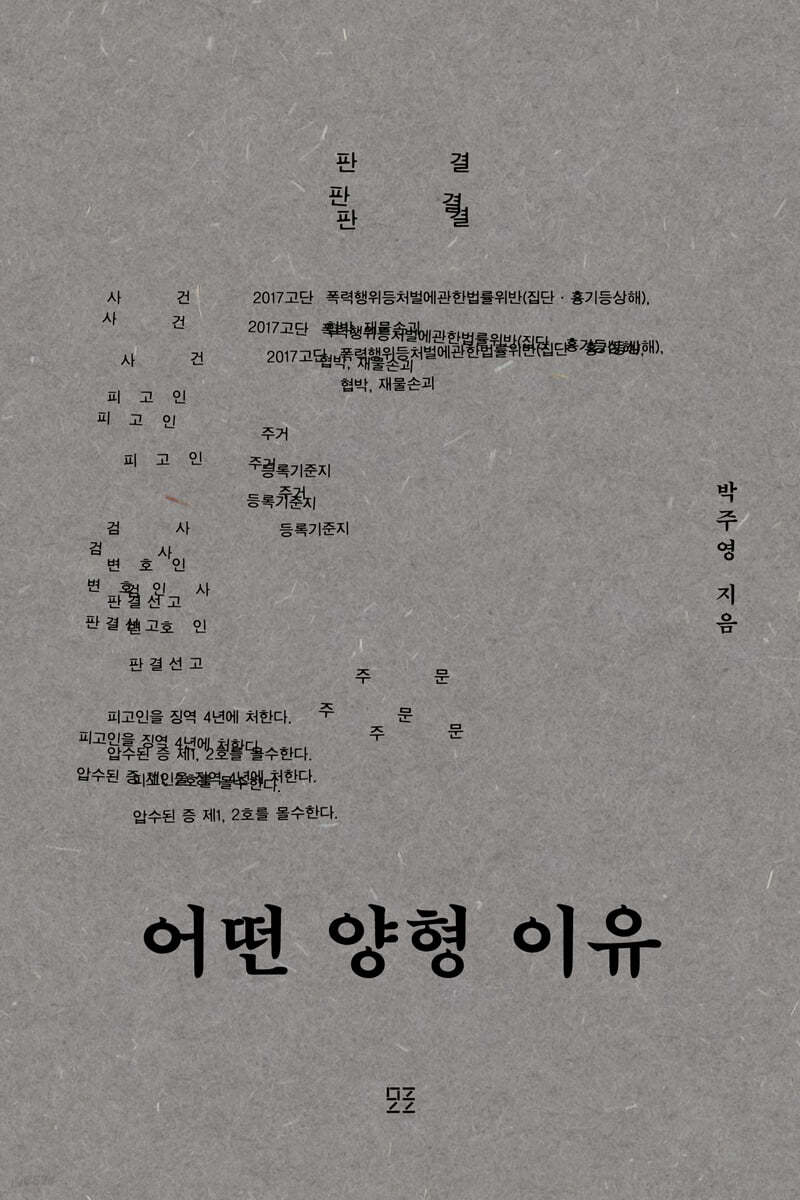
The new cover is designed to match the concept of a verdict, and reflects changes in legal terminology and statistical data since its publication in 2019.
『Reasons for Sentencing』 contains sentencing reasons from actual verdicts that moved the world, such as “There is no public space more violent than a place where violence runs rampant,” “Only other people can freely touch another person’s body,” and “There is nothing in the universe more precious than human life,” as well as Judge Park Joo-young’s warm perspective on law and society.
The new cover is designed to match the concept of a verdict, and reflects changes in legal terminology and statistical data since its publication in 2019.
『Reasons for Sentencing』 contains sentencing reasons from actual verdicts that moved the world, such as “There is no public space more violent than a place where violence runs rampant,” “Only other people can freely touch another person’s body,” and “There is nothing in the universe more precious than human life,” as well as Judge Park Joo-young’s warm perspective on law and society.
- You can preview some of the book's contents.
Preview
index
prolog
Chapter 1 I am not a dog
There is no public sphere more dangerous than one where violence runs rampant.
The only person who can freely touch another person's body is that other person.
Live whale, dead whale
No reference case
An evening with life
I am not a dog
Chapter 2: Things That Make Us Sad
An Excuse for Puss in Boots
Born to be Blue
Things that make us sad
Our honey
wet snow
frozen shoulders
Chapter 3 Justice Requested
Revolving Door Butler
Under the law school
Hallux valgus
Justice as requested
The law is like love
Epilogue
Chapter 1 I am not a dog
There is no public sphere more dangerous than one where violence runs rampant.
The only person who can freely touch another person's body is that other person.
Live whale, dead whale
No reference case
An evening with life
I am not a dog
Chapter 2: Things That Make Us Sad
An Excuse for Puss in Boots
Born to be Blue
Things that make us sad
Our honey
wet snow
frozen shoulders
Chapter 3 Justice Requested
Revolving Door Butler
Under the law school
Hallux valgus
Justice as requested
The law is like love
Epilogue
Into the book
Just as children are always at their most beautiful now, now is the time when love is most needed.
A family that only moves forward with the inertia of past love cannot last long.
Love is precious not because it is noble or sublime in itself.
Love is important because it is practical.
Love is like a vaccine or antidote that eliminates indifference, jealousy, insults, and violence.
--- pp.22~23
I must emphasize again that our society's culture of non-intervention in domestic violence must be overcome.
The proposition that the family is a private sphere and therefore public intervention should be as restrained and prudent as possible can only be established when the family maintains its minimal functions as a family.
When the elder abuses the younger, and when a family member causes only pain through violence, there is no longer a private sphere called home, a place where one can be protected. There is no public sphere more dangerous than one where violence runs rampant.
--- pp.28~29
If you want to know how far human greed and selfishness can go and what the end result will be, come to the court.
He gathers victims of fraud and creates a relief group to defraud them again, and then defrauds the wife of a person who was arrested for impersonating a prosecutor by impersonating a CIA agent from Korea.
Multi-level pyramid schemes, where people realize they've been scammed and then sequentially become perpetrators in an attempt to compensate for their losses, are a stunning display of greed and selfishness.
Some civil servants diligently save the money they receive as bribes and put it into savings.
--- p.55
As a judge, his family and regrets are more chilling than heartbreaking or pathetic.
Because my decisions often turn countless universes into tragedies.
If the defendant had been released at that time, his wife would not have committed suicide due to financial difficulties, and his children would not have been scattered. If the defendant had not been released at that time, there would not have been any additional murders…
A decision that leaves you with regrets will never let the judge off the hook.
It is a debt that cannot be repaid and a mark that cannot be erased.
--- p.78
In a country where risk is outsourced and an average of five workers die every day, in a country where even five workers die every day as long as the profits of the subcontractor increase, in a country where the punishment for a large corporation with annual sales of trillions of won that pursues only profit while tolerating the deaths of five workers every day is a mere fine of 100 million won, the most accurate words for returning home after work cannot be “off work” or “going home.”
It's a comeback.
Can a life built on the sacrifice of others truly be happy?
Risk can be outsourced.
Even death can be subcontracted.
But happiness cannot be subcontracted.
--- p.103
Why should we protect minorities? In fact, this question is flawed from the start.
Just as organisms would die without leaves and skin, and the universe would not exist without dark matter, the majority does not protect the minority.
Minorities protect them.
No, we just help each other and survive.
--- p.123
This is a well-known line from the movie Spotlight, which is based on the true story of the Boston Globe's reporting on child sexual abuse by Catholic priests in Boston.
“It takes a village to raise a child, and it takes a village to abuse a child.” This is a saying that must never be forgotten when dealing with juvenile offenders.
If all of these children must be severely punished, then we, the parents and families who abandoned, neglected, abused, and even ignored them, as well as the villagers who are part of some of these children, must also be severely punished.
A family that only moves forward with the inertia of past love cannot last long.
Love is precious not because it is noble or sublime in itself.
Love is important because it is practical.
Love is like a vaccine or antidote that eliminates indifference, jealousy, insults, and violence.
--- pp.22~23
I must emphasize again that our society's culture of non-intervention in domestic violence must be overcome.
The proposition that the family is a private sphere and therefore public intervention should be as restrained and prudent as possible can only be established when the family maintains its minimal functions as a family.
When the elder abuses the younger, and when a family member causes only pain through violence, there is no longer a private sphere called home, a place where one can be protected. There is no public sphere more dangerous than one where violence runs rampant.
--- pp.28~29
If you want to know how far human greed and selfishness can go and what the end result will be, come to the court.
He gathers victims of fraud and creates a relief group to defraud them again, and then defrauds the wife of a person who was arrested for impersonating a prosecutor by impersonating a CIA agent from Korea.
Multi-level pyramid schemes, where people realize they've been scammed and then sequentially become perpetrators in an attempt to compensate for their losses, are a stunning display of greed and selfishness.
Some civil servants diligently save the money they receive as bribes and put it into savings.
--- p.55
As a judge, his family and regrets are more chilling than heartbreaking or pathetic.
Because my decisions often turn countless universes into tragedies.
If the defendant had been released at that time, his wife would not have committed suicide due to financial difficulties, and his children would not have been scattered. If the defendant had not been released at that time, there would not have been any additional murders…
A decision that leaves you with regrets will never let the judge off the hook.
It is a debt that cannot be repaid and a mark that cannot be erased.
--- p.78
In a country where risk is outsourced and an average of five workers die every day, in a country where even five workers die every day as long as the profits of the subcontractor increase, in a country where the punishment for a large corporation with annual sales of trillions of won that pursues only profit while tolerating the deaths of five workers every day is a mere fine of 100 million won, the most accurate words for returning home after work cannot be “off work” or “going home.”
It's a comeback.
Can a life built on the sacrifice of others truly be happy?
Risk can be outsourced.
Even death can be subcontracted.
But happiness cannot be subcontracted.
--- p.103
Why should we protect minorities? In fact, this question is flawed from the start.
Just as organisms would die without leaves and skin, and the universe would not exist without dark matter, the majority does not protect the minority.
Minorities protect them.
No, we just help each other and survive.
--- p.123
This is a well-known line from the movie Spotlight, which is based on the true story of the Boston Globe's reporting on child sexual abuse by Catholic priests in Boston.
“It takes a village to raise a child, and it takes a village to abuse a child.” This is a saying that must never be forgotten when dealing with juvenile offenders.
If all of these children must be severely punished, then we, the parents and families who abandoned, neglected, abused, and even ignored them, as well as the villagers who are part of some of these children, must also be severely punished.
--- p.159
Publisher's Review
“The more peaceful and bright the world becomes, the more cruel the courts become.”
tvN's "You Quiz on the Block" Hot Topic
Judge Park Joo-young's "Reasons for Sentencing"
The reason for the sentence that made the world cry
The struggle that there are people here too
The 'Reasons for Sentencing' section at the end of the judgment describes the reasons for determining the amount of punishment.
In a harsh verdict full of “dry sentences that have been squeezed to the last drop of moisture,” it is the only place where the judge can express his thoughts without being constrained by formality.
Judge Park Joo-young, who has been conducting criminal trials for a long time, has taken the time to write down his reasons for sentencing when he has something special to say to the parties in the case or to society.
“As perpetrators of laws related to sexual crimes, the proposition that we must always keep in mind regarding sexual crimes, especially sexual self-determination, is simple and clear.
“Only the other person can freely touch another person’s body.” _ Part of the reason for sentencing in a sexual assault case
“In this era of South Korea, where people pursue a ‘life with dinner,’ it is incredibly sad that there are many workers and their families who worry about ‘a life with dinner.’” _ Part of the reason for sentencing in industrial accident cases
The verdict written by the author attracted public attention at some point.
The reasons for his writing were featured on TV programs such as “The Story of That Day, the Tail Chasing Its Own,” and were cited in many articles, and were mentioned in books by bestselling authors such as Kwon Seok-cheon, Park Woong-hyun, and Jeong Moon-jeong.
Judge Park Joo-young, who appeared on tvN's "You Quiz on the Block," said of the reason for writing such a ruling, "It is the result of my own struggle to send a message that we need to pay attention because horrific incidents continue to occur."
His struggles are changing the world for the better.
Judge as a profession
It's like watching a tragic reality show that never ends.
The courtroom is a place where countless requests and pleas constantly pour in.
Judges must provide answers to everyone who comes to court as quickly and clearly as possible.
But the records, filled with tears and pain, pile up without rest, and the deadlines are set at 10-20 minute intervals.
The judge's decisions "often turn countless universes into tragedies," but he doesn't have time to listen intently to the parties involved.
So judges live under the pressure of having to make the right decision even when they are faced with a caseload full of cases, and under the tragedy of having to punish someone.
“Even though I knew I hadn’t told them even half of the story they had prepared, I barely made it to the office around 8 o’clock, urging them to come up with a follow-up story.
Outside the window, snow continues to fall, and heavy stories weigh heavily on the minds of those leaving the courthouse again.
“I always promise to listen faithfully, but I always sigh when I see the packed deadlines.” _Page 198
《Reasons for Sentencing》 contains the other side of the judges that could not be revealed in the verdict.
People who go back and forth between blaming and defending the parties involved, even at night and on holidays, who take lutein and keep their eyes wide open to read about 4,000 A4 pages a week, who hunched their shoulders under the weight of their cut-off words, who cannot believe without evidence even outside the courtroom, and who must be on guard if someone recognizes them outside.
A judge's work and life are much more difficult, heavy, and brutal than we think.
The law is like love
Judges' attitude toward the law
Supreme Court Justice John Marshall Harlan, pointing out the injustice of segregated education, said, “Our Constitution is colorblind.”
The author says that our Constitution is also color-blind, “denying all kinds of discrimination,” and “neither male, female, heterosexual, rich, middle class, Christian, or Buddhist.”
The law is not limited to anything, such as wealth, gender, or sexual identity.
For the general public, the law is far more distant and difficult than the fist, but "the judiciary, which pursues universally valid principles, is inherently based on a deep understanding and concern for people." As an enforcer of the law, the author never forgets this fact, and in order to keep learning anew about the world and people with a mind of ignorance, he "communicates with the realities of life" to prevent the law from becoming a dead letter.
To have this kind of heart, you must have a deep love for people.
Because what unites us all is “love, not language.”
The author's verdict, which is filled with the miserable reality and human suffering, gives people inspiration and hope because it contains compassion and deep affection for humanity.
In “A Reason for Sentencing,” the author writes, “If we could explain with any certainty what the law exists for, we would have to say that the law is at least based on love and serves love.”
All that is needed for the world to become a better place and for us to be hope for one another, not despair, is love.
tvN's "You Quiz on the Block" Hot Topic
Judge Park Joo-young's "Reasons for Sentencing"
The reason for the sentence that made the world cry
The struggle that there are people here too
The 'Reasons for Sentencing' section at the end of the judgment describes the reasons for determining the amount of punishment.
In a harsh verdict full of “dry sentences that have been squeezed to the last drop of moisture,” it is the only place where the judge can express his thoughts without being constrained by formality.
Judge Park Joo-young, who has been conducting criminal trials for a long time, has taken the time to write down his reasons for sentencing when he has something special to say to the parties in the case or to society.
“As perpetrators of laws related to sexual crimes, the proposition that we must always keep in mind regarding sexual crimes, especially sexual self-determination, is simple and clear.
“Only the other person can freely touch another person’s body.” _ Part of the reason for sentencing in a sexual assault case
“In this era of South Korea, where people pursue a ‘life with dinner,’ it is incredibly sad that there are many workers and their families who worry about ‘a life with dinner.’” _ Part of the reason for sentencing in industrial accident cases
The verdict written by the author attracted public attention at some point.
The reasons for his writing were featured on TV programs such as “The Story of That Day, the Tail Chasing Its Own,” and were cited in many articles, and were mentioned in books by bestselling authors such as Kwon Seok-cheon, Park Woong-hyun, and Jeong Moon-jeong.
Judge Park Joo-young, who appeared on tvN's "You Quiz on the Block," said of the reason for writing such a ruling, "It is the result of my own struggle to send a message that we need to pay attention because horrific incidents continue to occur."
His struggles are changing the world for the better.
Judge as a profession
It's like watching a tragic reality show that never ends.
The courtroom is a place where countless requests and pleas constantly pour in.
Judges must provide answers to everyone who comes to court as quickly and clearly as possible.
But the records, filled with tears and pain, pile up without rest, and the deadlines are set at 10-20 minute intervals.
The judge's decisions "often turn countless universes into tragedies," but he doesn't have time to listen intently to the parties involved.
So judges live under the pressure of having to make the right decision even when they are faced with a caseload full of cases, and under the tragedy of having to punish someone.
“Even though I knew I hadn’t told them even half of the story they had prepared, I barely made it to the office around 8 o’clock, urging them to come up with a follow-up story.
Outside the window, snow continues to fall, and heavy stories weigh heavily on the minds of those leaving the courthouse again.
“I always promise to listen faithfully, but I always sigh when I see the packed deadlines.” _Page 198
《Reasons for Sentencing》 contains the other side of the judges that could not be revealed in the verdict.
People who go back and forth between blaming and defending the parties involved, even at night and on holidays, who take lutein and keep their eyes wide open to read about 4,000 A4 pages a week, who hunched their shoulders under the weight of their cut-off words, who cannot believe without evidence even outside the courtroom, and who must be on guard if someone recognizes them outside.
A judge's work and life are much more difficult, heavy, and brutal than we think.
The law is like love
Judges' attitude toward the law
Supreme Court Justice John Marshall Harlan, pointing out the injustice of segregated education, said, “Our Constitution is colorblind.”
The author says that our Constitution is also color-blind, “denying all kinds of discrimination,” and “neither male, female, heterosexual, rich, middle class, Christian, or Buddhist.”
The law is not limited to anything, such as wealth, gender, or sexual identity.
For the general public, the law is far more distant and difficult than the fist, but "the judiciary, which pursues universally valid principles, is inherently based on a deep understanding and concern for people." As an enforcer of the law, the author never forgets this fact, and in order to keep learning anew about the world and people with a mind of ignorance, he "communicates with the realities of life" to prevent the law from becoming a dead letter.
To have this kind of heart, you must have a deep love for people.
Because what unites us all is “love, not language.”
The author's verdict, which is filled with the miserable reality and human suffering, gives people inspiration and hope because it contains compassion and deep affection for humanity.
In “A Reason for Sentencing,” the author writes, “If we could explain with any certainty what the law exists for, we would have to say that the law is at least based on love and serves love.”
All that is needed for the world to become a better place and for us to be hope for one another, not despair, is love.
GOODS SPECIFICS
- Date of issue: January 17, 2023
- Page count, weight, size: 296 pages | 398g | 140*210*20mm
- ISBN13: 9791197559778
- ISBN10: 1197559779
You may also like
카테고리
korean


korean

![GQ KOREA Mark (Monthly): December [2025]](http://librairie.coreenne.fr/cdn/shop/files/8ef265dbbfbf186523ed75ba7319009d.jpg?v=1765340328&width=3840)


