

Earth Environment Class with a Calendar
 |
Description
Book Introduction
“A very special day when the whole world comes together to protect the Earth!”
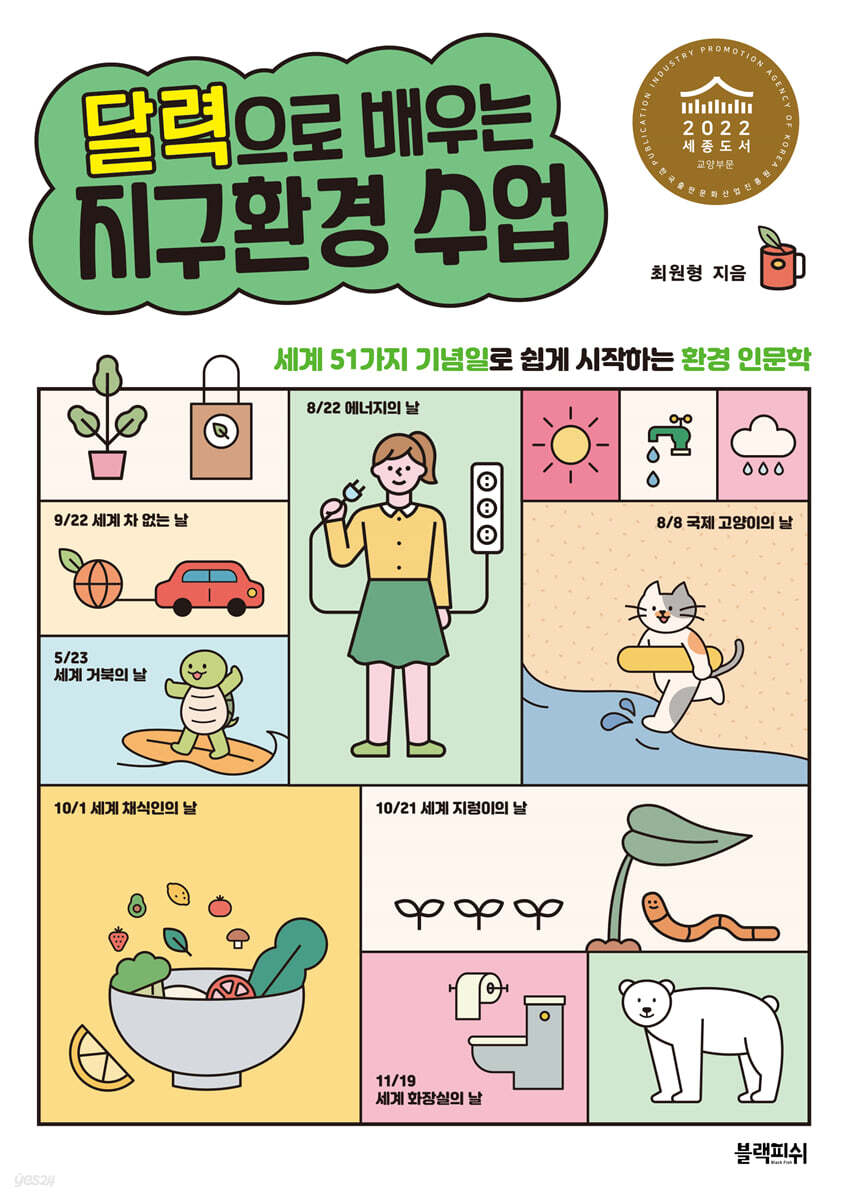
An environmental story that starts easily with 51 anniversaries on the calendar.
The calendar, which we pass by without paying attention to the numbers, contains many anniversaries.
There are days like the familiar 'Arbor Day' and 'Earth Day', as well as days that raise awareness, such as 'World Day to Combat Desertification' and 'World Ozone Layer Preservation Day', and days that encourage environmental protection practices, such as 'Paperless Day'.
How and when did each anniversary originate? Why do people around the world mark so many anniversaries on their calendars?
"Learning the Earth Environment through Calendars" is a new book by Wonhyung Choi, an expert in ecology, environment, and energy. It introduces the origins and meaning of environmental anniversaries in an easy-to-understand way, along with colorful stories that cross over humanities, history, and scientific knowledge.
From the story of Laika, a dog who was sent into space instead of humans to experiment on whether she could survive in space (Laboratory Animal Day), to the story of how rich countries are destroying forests in poorer countries to obtain wood, chocolate, coffee, and cows (Forest Day), to the story of how we ingest the weight of a credit card's worth of microplastics in a week (No Plastic Bag Day), to the story of 'companion beaches' that encourage us to adopt beaches and take responsibility for them (Coastal Cleanup Day)...
We approach the intimate relationship between our daily lives—what we eat, drink, and enjoy—and nature through 51 environmental anniversaries.
The extreme heat waves and cold waves the Earth is currently experiencing, fine dust, global pandemics like COVID-19, labor and sexual exploitation, poverty, and refugees—all of these issues cannot be addressed without considering the environment.
Accordingly, the book aims to provide a forum for discussion by raising hot topics related to the environment, such as, "Is it okay to take animal lives at will for a better life for humans?" and "Is there no way for the entire world to have equal access to clean water?"
Additionally, we have included over 100 ways to protect the environment in line with the anniversary, so that anyone can easily start taking action for the Earth.
If you want to try something small to make the planet a better place, opening this book will be the start.
An environmental story that starts easily with 51 anniversaries on the calendar.
The calendar, which we pass by without paying attention to the numbers, contains many anniversaries.
There are days like the familiar 'Arbor Day' and 'Earth Day', as well as days that raise awareness, such as 'World Day to Combat Desertification' and 'World Ozone Layer Preservation Day', and days that encourage environmental protection practices, such as 'Paperless Day'.
How and when did each anniversary originate? Why do people around the world mark so many anniversaries on their calendars?
"Learning the Earth Environment through Calendars" is a new book by Wonhyung Choi, an expert in ecology, environment, and energy. It introduces the origins and meaning of environmental anniversaries in an easy-to-understand way, along with colorful stories that cross over humanities, history, and scientific knowledge.
From the story of Laika, a dog who was sent into space instead of humans to experiment on whether she could survive in space (Laboratory Animal Day), to the story of how rich countries are destroying forests in poorer countries to obtain wood, chocolate, coffee, and cows (Forest Day), to the story of how we ingest the weight of a credit card's worth of microplastics in a week (No Plastic Bag Day), to the story of 'companion beaches' that encourage us to adopt beaches and take responsibility for them (Coastal Cleanup Day)...
We approach the intimate relationship between our daily lives—what we eat, drink, and enjoy—and nature through 51 environmental anniversaries.
The extreme heat waves and cold waves the Earth is currently experiencing, fine dust, global pandemics like COVID-19, labor and sexual exploitation, poverty, and refugees—all of these issues cannot be addressed without considering the environment.
Accordingly, the book aims to provide a forum for discussion by raising hot topics related to the environment, such as, "Is it okay to take animal lives at will for a better life for humans?" and "Is there no way for the entire world to have equal access to clean water?"
Additionally, we have included over 100 ways to protect the environment in line with the anniversary, so that anyone can easily start taking action for the Earth.
If you want to try something small to make the planet a better place, opening this book will be the start.
- You can preview some of the book's contents.
Preview
index
Opening remarks
Spring, March to May
March 3rd World Wildlife Day_ When one species goes extinct, other species disappear too.
March 11th, the day of the Fukushima accident (2011) - You may end up drinking radioactive contaminated water.
March 20th World Sparrow Day_ Sparrows and humans have a symbiotic relationship.
March 21st: International Day of Forests: Forests as Dams and Carbon Storage
March 22nd World Water Day_ Water is essential for all living things
March 23, World Meteorological Day_ Weather anomalies are becoming increasingly difficult to predict.
April 4th Paperless Day_ Using less paper is like planting a tree.
April 5th Arbor Day_ The trend is to bring forward Arbor Day due to earlier flowering periods.
April 7th World Health Day_ Health is an issue that shakes the entire social system.
April 22nd, Earth Day - A day to speak out with one voice to protect the Earth
April 24th, World Laboratory Animal Day_ Now is the time for animal welfare too.
April 25th, World Penguin Day_ Humans stealing penguins' food
April 25th World Malaria Day_ Super malaria caused by global warming?
International Permaculture Day, the first Sunday in May_ Sustainable farming in harmony with nature
World Fair Trade Day, the second Saturday of May_ Unfair trade destroys even the ecosystem.
May 20th World Bee Day_ The fate of countless fruits and vegetables rests with bees.
May 22nd International Day for Biological Diversity_ All living things connected in the web of life
May 23rd World Turtle Day_ Are humans now the turtles' biggest predator?
World Otter Day, the last Wednesday of May_ Otters mean a healthy river ecosystem.
Summer June to August
June 3rd World Bicycle Day_ The best eco-friendly and sustainable mode of transportation
June 5th World Environment Day_ The world stands together for a clean environment
June 8th World Oceans Day_ Marine life returns to humans
World Day to Combat Desertification on the 6th and 17th_ As desertification increases, yellow dust also becomes more severe.
June 20th, World Refugee Day_ As climate problems worsen, refugees also increase.
June 28th: Railway Day_ Railways, a more energy-efficient mode of transportation than buses.
July 3rd International Plastic Bag Free Day - For very short-term use, long-lasting non-biodegradable items
July 26th: International Mangrove Ecosystem Conservation Day_ From coastal ecosystem conservation to carbon absorption
July 29th: International Tiger Day - Why We Need to Conserve Asia's Top Predator
August 8th, International Cat Day_Cat Days vary from country to country
August 10th, World Lion Day_ Animals sacrificed for entertainment and amusement
August 12th, World Elephant Day_ Elephants born without tusks
August 22nd Energy Day_ To prevent the chaos that a major power outage would bring
Fall, September to November
September 6th: World Recycling Day - Reduce consumption and dispose of waste wisely.
September 16th: International Day for the Preservation of the Ozone Layer_ A global response is needed to protect the ozone layer.
International Coastal Cleanup Day, the third Saturday of September_ Now, it's time to adopt beaches, just like pets.
September 22nd World Rhino Day_ Trade in endangered animals must be banned
September 22nd World Car-Free Day_ Are electric cars always eco-friendly?
Food Waste Day (Denmark) on September 29th - The problem of food being wasted somewhere and insufficient somewhere
October 1st World Vegetarian Day_ Even if it's just an effort to reduce meat consumption
World Migratory Bird Day, the second Saturday of May and October_ Twice a year, we must protect the great migration of birds.
October 16th World Food Day_ Every human being has the right not to starve!
October 17th: International Day for the Eradication of Poverty - Climate change and environmental pollution are also causes of poverty.
October 21st World Earthworm Day_ Earthworms are 'silent farmers who till the soil'
World Cities Day, October 31st: Creating Safe, Resilient, and Sustainable Homes
November 19th, World Toilet Day_ 4.5 billion people around the world still need clean toilets
The fourth Friday of November: Buy Nothing Day_ The Anthropocene, where the weight of artificial objects exceeds the weight of natural objects
Winter December to February
December 5th World Soil Day_ Soil that nurtures infinite life
December 11th, International Mountain Day_Mountains are a treasure trove of biodiversity
February 2nd World Wetlands Day_Disappearing Wetlands
Third Sunday of February World Whale Day_ If whales disappear, the biological pump disappears too.
February 27th, International Polar Bear Day_ Polar bears are an indicator of the Arctic marine ecosystem.
References
Spring, March to May
March 3rd World Wildlife Day_ When one species goes extinct, other species disappear too.
March 11th, the day of the Fukushima accident (2011) - You may end up drinking radioactive contaminated water.
March 20th World Sparrow Day_ Sparrows and humans have a symbiotic relationship.
March 21st: International Day of Forests: Forests as Dams and Carbon Storage
March 22nd World Water Day_ Water is essential for all living things
March 23, World Meteorological Day_ Weather anomalies are becoming increasingly difficult to predict.
April 4th Paperless Day_ Using less paper is like planting a tree.
April 5th Arbor Day_ The trend is to bring forward Arbor Day due to earlier flowering periods.
April 7th World Health Day_ Health is an issue that shakes the entire social system.
April 22nd, Earth Day - A day to speak out with one voice to protect the Earth
April 24th, World Laboratory Animal Day_ Now is the time for animal welfare too.
April 25th, World Penguin Day_ Humans stealing penguins' food
April 25th World Malaria Day_ Super malaria caused by global warming?
International Permaculture Day, the first Sunday in May_ Sustainable farming in harmony with nature
World Fair Trade Day, the second Saturday of May_ Unfair trade destroys even the ecosystem.
May 20th World Bee Day_ The fate of countless fruits and vegetables rests with bees.
May 22nd International Day for Biological Diversity_ All living things connected in the web of life
May 23rd World Turtle Day_ Are humans now the turtles' biggest predator?
World Otter Day, the last Wednesday of May_ Otters mean a healthy river ecosystem.
Summer June to August
June 3rd World Bicycle Day_ The best eco-friendly and sustainable mode of transportation
June 5th World Environment Day_ The world stands together for a clean environment
June 8th World Oceans Day_ Marine life returns to humans
World Day to Combat Desertification on the 6th and 17th_ As desertification increases, yellow dust also becomes more severe.
June 20th, World Refugee Day_ As climate problems worsen, refugees also increase.
June 28th: Railway Day_ Railways, a more energy-efficient mode of transportation than buses.
July 3rd International Plastic Bag Free Day - For very short-term use, long-lasting non-biodegradable items
July 26th: International Mangrove Ecosystem Conservation Day_ From coastal ecosystem conservation to carbon absorption
July 29th: International Tiger Day - Why We Need to Conserve Asia's Top Predator
August 8th, International Cat Day_Cat Days vary from country to country
August 10th, World Lion Day_ Animals sacrificed for entertainment and amusement
August 12th, World Elephant Day_ Elephants born without tusks
August 22nd Energy Day_ To prevent the chaos that a major power outage would bring
Fall, September to November
September 6th: World Recycling Day - Reduce consumption and dispose of waste wisely.
September 16th: International Day for the Preservation of the Ozone Layer_ A global response is needed to protect the ozone layer.
International Coastal Cleanup Day, the third Saturday of September_ Now, it's time to adopt beaches, just like pets.
September 22nd World Rhino Day_ Trade in endangered animals must be banned
September 22nd World Car-Free Day_ Are electric cars always eco-friendly?
Food Waste Day (Denmark) on September 29th - The problem of food being wasted somewhere and insufficient somewhere
October 1st World Vegetarian Day_ Even if it's just an effort to reduce meat consumption
World Migratory Bird Day, the second Saturday of May and October_ Twice a year, we must protect the great migration of birds.
October 16th World Food Day_ Every human being has the right not to starve!
October 17th: International Day for the Eradication of Poverty - Climate change and environmental pollution are also causes of poverty.
October 21st World Earthworm Day_ Earthworms are 'silent farmers who till the soil'
World Cities Day, October 31st: Creating Safe, Resilient, and Sustainable Homes
November 19th, World Toilet Day_ 4.5 billion people around the world still need clean toilets
The fourth Friday of November: Buy Nothing Day_ The Anthropocene, where the weight of artificial objects exceeds the weight of natural objects
Winter December to February
December 5th World Soil Day_ Soil that nurtures infinite life
December 11th, International Mountain Day_Mountains are a treasure trove of biodiversity
February 2nd World Wetlands Day_Disappearing Wetlands
Third Sunday of February World Whale Day_ If whales disappear, the biological pump disappears too.
February 27th, International Polar Bear Day_ Polar bears are an indicator of the Arctic marine ecosystem.
References
Detailed image
.jpg)
Into the book
Come to think of it, the calendar has been talking to us constantly.
It tells us that after the small cold and the big cold pass, it will get warmer.
When the spring rain gently wets the earth, the frogs that received the spring rain letter will stretch out from their long winter sleep.
This beautiful story told by the calendar, which I thought was just a bunch of blunt numbers, was actually the rhythm of the earth and the cycle of life.
---From the "Opening Remarks"
Fishermen catch sharks and cut off their dorsal and pectoral fins to obtain shark fin.
Then they throw the shark into the sea.
Because shark meat has no commercial value compared to its fins.
The shark is alive, just missing its fins.
But you can't swim without fins.
Sharks are one of the rare fish that do not have swim bladders.
So, in order to not sink, they have to constantly move their fins, but without fins, they slowly sink to the bottom of the sea and die.
This act of extreme cruelty is committed to bring fine cuisine to the table.
Sharks, the ocean's most feared top predators, have declined by 71% in half a century.
(…)
30% of shark species are endangered or near extinction.
Once a shark becomes endangered, it is unlikely that its population will recover.
Because growth is slow and reproduction rate is low.
What would happen to the marine ecosystem if sharks, the top predators, disappeared? The number of mid-level fish that sharks prey on would increase.
As these numbers increase, the number of fish below them, that is, herbivorous fish that feed on algae such as seaweed, will decrease significantly.
As herbivorous fish decline, algae will increase.
As algae increase, they block sunlight from reaching the ocean, damaging coral colonies and reducing species diversity.
---From "World Wildlife Day, March 3"
Recycling used paper rather than cutting down trees to make new paper saves more energy than cutting down trees, as it reduces the number of processes that require water, energy, and chemicals.
It is said that if we replace just 10% of the printing paper used in our country with recycled paper, we will cut down 760 less trees every day.
It is said that this has the effect of planting 270,000 trees per year.
---From "April 4th, Paperless Day"
One of the most important lessons we've learned from the pandemic is that the world is interconnected.
Like it or not, we are all passengers on the same boat called Earth.
Who would have imagined that a virus originating in a single community in Wuhan would wreak havoc across the globe? And yet, it did.
I hope we've learned from COVID-19 that when all members of society are healthy, society becomes healthy and the world can lead a peaceful life.
We need to put in place systems that address health inequalities for the most vulnerable and marginalized groups.
There should be no discrimination in enjoying a healthy life with more attention paid to it.
On World Health Day, we must urgently strive to eliminate health inequalities and move toward a better future, ensuring that everyone has access to quality healthcare services within their communities, tailored to their needs and values.
---From "World Health Day, April 7th"
International Coastal Cleanup Day was created when Texas launched its Adopt-a-Beach program.
Just as we adopt children and pets, individuals, groups, and companies voluntarily adopt a specific beach and responsibly clean up trash, protect, and maintain the coastal landscape.
Our country also selected Jeju Island as a pilot region in 2020 and launched a beach adoption system.
The total length of our country's coastline is 14,963 km.
With a north-south length of approximately 1,100 kilometers, can you imagine how winding and complex the coastline is? This vast coastline has been managed by the government, related organizations such as the Ministry of Oceans and Fisheries, the Korea Marine Environment Management Corporation, and local governments.
Because we were sorely lacking the capacity to properly manage it, it was difficult to manage it in any way other than picking up trash on special occasions.
The idea in Texas is fresh and novel.
Adoption means becoming a family, and it is based on the premise that you will take good care of it.
Beach adoption involves voluntary, responsible, and consistent care.
Furthermore, by engaging in various activities centered around the coast, the beach can become a familiar place that becomes part of everyday culture.
The name of the Ocean Adoption System was changed to 'Companion Beach' through a contest in 2020.
Anyone who participates in marine debris collection activities can log their collections on the smartphone application Clean Swell.
---From "International Coastal Cleanup Day, the third Saturday of September"
The Danish government has designated today, 2020, as 'Food Waste Day'.
Denmark is said to be a traditional garbage country.
The amount of waste generated per capita was far higher than the EU average.
The same goes for food waste.
Denmark, which used to be like that, started reducing food waste, and it is said that this started with individual efforts.
In 2008, Selina Yule created a small group on Facebook called Stop Food Waste and started a movement to reduce food waste.
And I've posted tips on how to deal with leftovers and how to buy only the amount of food you need.
As these activities became known, we launched various campaigns in collaboration with the Danish government.
Representative examples include refrigerator clean-out day, ‘Sunday tapas’ where you cook up leftovers, and sharing groceries with neighbors before going on summer vacation.
These efforts have changed the way the Danish people think.
As food waste decreases, it attracts attention from the media and political circles.
As consumers' voices calling for food waste reduction grew louder, companies' perceptions also changed.
They began to realize that rationalizing food waste could be a source of cost savings and could even become a business.
Companies are even competing with each other to reduce waste.
In May 2017, the European Parliament set a target to reduce food waste by 30% by 2025 and by half by 2030.
Above all, eating less and not leaving any leftovers will save you money.
It would be a good idea to use some of the money saved to support those suffering from hunger.
And since we eat less, we don't need to produce as much.
It also has the effect of reducing greenhouse gases.
This action that kills three birds with one stone is the Zero Hunger Campaign of the United Nations World Food Programme (WFP).
Today marks Denmark's Food Waste Day, so I think it would be a good idea to spread the word about this and put it into practice together.
It tells us that after the small cold and the big cold pass, it will get warmer.
When the spring rain gently wets the earth, the frogs that received the spring rain letter will stretch out from their long winter sleep.
This beautiful story told by the calendar, which I thought was just a bunch of blunt numbers, was actually the rhythm of the earth and the cycle of life.
---From the "Opening Remarks"
Fishermen catch sharks and cut off their dorsal and pectoral fins to obtain shark fin.
Then they throw the shark into the sea.
Because shark meat has no commercial value compared to its fins.
The shark is alive, just missing its fins.
But you can't swim without fins.
Sharks are one of the rare fish that do not have swim bladders.
So, in order to not sink, they have to constantly move their fins, but without fins, they slowly sink to the bottom of the sea and die.
This act of extreme cruelty is committed to bring fine cuisine to the table.
Sharks, the ocean's most feared top predators, have declined by 71% in half a century.
(…)
30% of shark species are endangered or near extinction.
Once a shark becomes endangered, it is unlikely that its population will recover.
Because growth is slow and reproduction rate is low.
What would happen to the marine ecosystem if sharks, the top predators, disappeared? The number of mid-level fish that sharks prey on would increase.
As these numbers increase, the number of fish below them, that is, herbivorous fish that feed on algae such as seaweed, will decrease significantly.
As herbivorous fish decline, algae will increase.
As algae increase, they block sunlight from reaching the ocean, damaging coral colonies and reducing species diversity.
---From "World Wildlife Day, March 3"
Recycling used paper rather than cutting down trees to make new paper saves more energy than cutting down trees, as it reduces the number of processes that require water, energy, and chemicals.
It is said that if we replace just 10% of the printing paper used in our country with recycled paper, we will cut down 760 less trees every day.
It is said that this has the effect of planting 270,000 trees per year.
---From "April 4th, Paperless Day"
One of the most important lessons we've learned from the pandemic is that the world is interconnected.
Like it or not, we are all passengers on the same boat called Earth.
Who would have imagined that a virus originating in a single community in Wuhan would wreak havoc across the globe? And yet, it did.
I hope we've learned from COVID-19 that when all members of society are healthy, society becomes healthy and the world can lead a peaceful life.
We need to put in place systems that address health inequalities for the most vulnerable and marginalized groups.
There should be no discrimination in enjoying a healthy life with more attention paid to it.
On World Health Day, we must urgently strive to eliminate health inequalities and move toward a better future, ensuring that everyone has access to quality healthcare services within their communities, tailored to their needs and values.
---From "World Health Day, April 7th"
International Coastal Cleanup Day was created when Texas launched its Adopt-a-Beach program.
Just as we adopt children and pets, individuals, groups, and companies voluntarily adopt a specific beach and responsibly clean up trash, protect, and maintain the coastal landscape.
Our country also selected Jeju Island as a pilot region in 2020 and launched a beach adoption system.
The total length of our country's coastline is 14,963 km.
With a north-south length of approximately 1,100 kilometers, can you imagine how winding and complex the coastline is? This vast coastline has been managed by the government, related organizations such as the Ministry of Oceans and Fisheries, the Korea Marine Environment Management Corporation, and local governments.
Because we were sorely lacking the capacity to properly manage it, it was difficult to manage it in any way other than picking up trash on special occasions.
The idea in Texas is fresh and novel.
Adoption means becoming a family, and it is based on the premise that you will take good care of it.
Beach adoption involves voluntary, responsible, and consistent care.
Furthermore, by engaging in various activities centered around the coast, the beach can become a familiar place that becomes part of everyday culture.
The name of the Ocean Adoption System was changed to 'Companion Beach' through a contest in 2020.
Anyone who participates in marine debris collection activities can log their collections on the smartphone application Clean Swell.
---From "International Coastal Cleanup Day, the third Saturday of September"
The Danish government has designated today, 2020, as 'Food Waste Day'.
Denmark is said to be a traditional garbage country.
The amount of waste generated per capita was far higher than the EU average.
The same goes for food waste.
Denmark, which used to be like that, started reducing food waste, and it is said that this started with individual efforts.
In 2008, Selina Yule created a small group on Facebook called Stop Food Waste and started a movement to reduce food waste.
And I've posted tips on how to deal with leftovers and how to buy only the amount of food you need.
As these activities became known, we launched various campaigns in collaboration with the Danish government.
Representative examples include refrigerator clean-out day, ‘Sunday tapas’ where you cook up leftovers, and sharing groceries with neighbors before going on summer vacation.
These efforts have changed the way the Danish people think.
As food waste decreases, it attracts attention from the media and political circles.
As consumers' voices calling for food waste reduction grew louder, companies' perceptions also changed.
They began to realize that rationalizing food waste could be a source of cost savings and could even become a business.
Companies are even competing with each other to reduce waste.
In May 2017, the European Parliament set a target to reduce food waste by 30% by 2025 and by half by 2030.
Above all, eating less and not leaving any leftovers will save you money.
It would be a good idea to use some of the money saved to support those suffering from hunger.
And since we eat less, we don't need to produce as much.
It also has the effect of reducing greenhouse gases.
This action that kills three birds with one stone is the Zero Hunger Campaign of the United Nations World Food Programme (WFP).
Today marks Denmark's Food Waste Day, so I think it would be a good idea to spread the word about this and put it into practice together.
---From "Food Waste Day (Denmark) on September 29th"
Publisher's Review
Marking an anniversary on the calendar means 'let's remember' that day!
Crossing fields of history, science, politics, culture…
A colorful story of environmental humanities
“An oil rig near Santa Barbara, California, spilled 100,000 barrels of crude oil, polluting the ocean on a massive scale.
This incident, which led to the death of countless marine life, has inspired over 20 million citizens in the United States alone to speak out.
“Let’s create an ‘Earth Day’ to protect the Earth from natural destruction and environmental pollution.”
_ From the opening text
Marking an anniversary on the calendar means 'let's remember' that day.
Especially on environmental anniversaries, there is solidarity among countless people around the world who speak with one voice to protect nature.
'Laboratory Animal Day', which was created to commemorate animals sacrificed for humans, and 'Biodiversity Conservation Day', which aims to protect biodiversity by saving various creatures from extinction, are all commemorative days that each have their own precious meaning, essential for all living things, including humans, to live in harmony.
The book, "Learning About the Earth's Environment Through the Calendar," freely crosses over history, science, politics, and culture to introduce the origins and meaning of environmental anniversaries in an easy-to-understand manner. Furthermore, it conveys the message that environmental pollution is not just a story of distant lands, other people, and other plants and animals, but also our own.
Just as plants cannot survive if bees and birds disappear (Bee Day, Migratory Bird Day), and the damage from radioactive contamination is not limited to one country (Fukushima Accident Day), the web of nature is very tightly connected with invisible lines.
Let's explore the intimate relationship between our everyday lives—eating, drinking, wearing, and enjoying—and nature, how each small human action shakes up the ecosystem, and how life is organically connected, through vivid examples.
There is a big difference between knowing and not knowing.
If we could remember on "Elephant Day" that poachers brutally hack off the faces of live elephants with chainsaws to obtain as much ivory as possible, and on "Paperless Day" that 42% of all felled trees are used to make paper, would we be more likely to use ivory products or paper indiscriminately? The more we know, remember, and pay attention, the more careful and thoughtful our actions will be for the planet.
Environmental problems occur unequally?
On the survival of the weak and social justice directly related to ecology
The most meaningful calendar reading for Generation Z, the action-oriented and practice-oriented generation.
Human progress has brought convenience and abundance, but at the same time it has caused environmental pollution and maximized poverty and crisis.
But what if those who enjoy abundance and those who suffer from it don't coincide? What if my abundance becomes a threat to someone else's survival, and environmental problems are unequally distributed across countries and people? What should we do?
Sharks that are thrown into the ocean with their fins cut off for the delicacy called shark fin soup end up dying in agony at the bottom of the ocean, unable to swim or breathe (Wildlife Day). Countless endangered animals are sacrificed to the unnecessary desires and amusement of humans, the top predators in the ecosystem, without being able to express their opinions.
But it is not only animals that cannot speak out in situations of inequality and exploitation.
Women in developing countries are at risk of sexual violence and human trafficking on their way to get clean water, and girls may even give up their studies to get water (Water Day).
There are still 4.5 billion people around the world who do not have access to clean, proper toilets (Toilet Day).
The COVID-19 pandemic, which has swept the world since 2020, has also been more severe for the socially vulnerable.
People who find it difficult to survive without assistance are facing threats to their survival as they undergo self-isolation or social distancing.
In the case of call center workers and irregular workers, they had to go to work to make a living even if their health was not good.
In the process of developing and distributing vaccines, vaccine inequality has emerged between wealthy and poor countries (Health Day).
Ultimately, the issue of all humans enjoying clean water and air and being free from the threat of disease can also be seen as directly related to the environment.
So protecting the environment is no different from a matter of survival for the weak and justice.
In this book, the author emphasizes our role, reminding us of those who have no place and those who are weak and unable to speak up, with the message that protecting the environment and ecology is the same as saving their lives.
One small habit a day, adds up to save tomorrow's Earth!
Contains 111 'Today's Actions for the Earth'!
+ An eco-friendly book printed on recycled paper and eco-friendly soy ink
From increasingly severe weather events like monsoon rains lasting over 50 days, extreme heat waves, and ongoing wildfires, to areas sinking due to rising sea levels and the billions of tons of plastic covering the Earth, the climate crisis has become a hot topic, and people are trying to do even the smallest thing for a better planet.
Try being a vegetarian, keep a 'zero food waste day', and use tumblers and eco bags.
The 'Bring Your Own Container Challenge', which encourages people to reduce the use of straws and bring their own reusable containers to receive their food, is also on the rise.
But beyond these few items, many people are left unsure of where to start and what to do to address the climate crisis.
For those people, we've included environmental protection methods that can be practiced on each anniversary, ranging from very easy to those that require a little more effort.
I've compiled over 100 seemingly small ways to celebrate each anniversary, including using vegan cosmetics, cleaning air conditioner filters, switching from paper bills to email bills, and participating in ocean waste collection activities and recording them in the "Clean Swell" app.
These small habits, one a day, will accumulate to change our daily lives, shift national policies and corporate perceptions, and save tomorrow's planet.
Meanwhile, the author is an environmental expert who is accustomed to 'practicing from myself' and pursues a good consumer lifestyle that considers nature.
This book was printed using eco-friendly soy ink and recycled paper to reflect the author's intentions.
The reason for removing unnecessary ribbons is the same.
The author's wish that this book, when it is thrown away after reading it in the distant future, would quickly rot and return to nature is fully reflected in this book.
What other "actions for the Earth" can we do today? Let's start by opening this book, which raises awareness of the importance of the environment.
Crossing fields of history, science, politics, culture…
A colorful story of environmental humanities
“An oil rig near Santa Barbara, California, spilled 100,000 barrels of crude oil, polluting the ocean on a massive scale.
This incident, which led to the death of countless marine life, has inspired over 20 million citizens in the United States alone to speak out.
“Let’s create an ‘Earth Day’ to protect the Earth from natural destruction and environmental pollution.”
_ From the opening text
Marking an anniversary on the calendar means 'let's remember' that day.
Especially on environmental anniversaries, there is solidarity among countless people around the world who speak with one voice to protect nature.
'Laboratory Animal Day', which was created to commemorate animals sacrificed for humans, and 'Biodiversity Conservation Day', which aims to protect biodiversity by saving various creatures from extinction, are all commemorative days that each have their own precious meaning, essential for all living things, including humans, to live in harmony.
The book, "Learning About the Earth's Environment Through the Calendar," freely crosses over history, science, politics, and culture to introduce the origins and meaning of environmental anniversaries in an easy-to-understand manner. Furthermore, it conveys the message that environmental pollution is not just a story of distant lands, other people, and other plants and animals, but also our own.
Just as plants cannot survive if bees and birds disappear (Bee Day, Migratory Bird Day), and the damage from radioactive contamination is not limited to one country (Fukushima Accident Day), the web of nature is very tightly connected with invisible lines.
Let's explore the intimate relationship between our everyday lives—eating, drinking, wearing, and enjoying—and nature, how each small human action shakes up the ecosystem, and how life is organically connected, through vivid examples.
There is a big difference between knowing and not knowing.
If we could remember on "Elephant Day" that poachers brutally hack off the faces of live elephants with chainsaws to obtain as much ivory as possible, and on "Paperless Day" that 42% of all felled trees are used to make paper, would we be more likely to use ivory products or paper indiscriminately? The more we know, remember, and pay attention, the more careful and thoughtful our actions will be for the planet.
Environmental problems occur unequally?
On the survival of the weak and social justice directly related to ecology
The most meaningful calendar reading for Generation Z, the action-oriented and practice-oriented generation.
Human progress has brought convenience and abundance, but at the same time it has caused environmental pollution and maximized poverty and crisis.
But what if those who enjoy abundance and those who suffer from it don't coincide? What if my abundance becomes a threat to someone else's survival, and environmental problems are unequally distributed across countries and people? What should we do?
Sharks that are thrown into the ocean with their fins cut off for the delicacy called shark fin soup end up dying in agony at the bottom of the ocean, unable to swim or breathe (Wildlife Day). Countless endangered animals are sacrificed to the unnecessary desires and amusement of humans, the top predators in the ecosystem, without being able to express their opinions.
But it is not only animals that cannot speak out in situations of inequality and exploitation.
Women in developing countries are at risk of sexual violence and human trafficking on their way to get clean water, and girls may even give up their studies to get water (Water Day).
There are still 4.5 billion people around the world who do not have access to clean, proper toilets (Toilet Day).
The COVID-19 pandemic, which has swept the world since 2020, has also been more severe for the socially vulnerable.
People who find it difficult to survive without assistance are facing threats to their survival as they undergo self-isolation or social distancing.
In the case of call center workers and irregular workers, they had to go to work to make a living even if their health was not good.
In the process of developing and distributing vaccines, vaccine inequality has emerged between wealthy and poor countries (Health Day).
Ultimately, the issue of all humans enjoying clean water and air and being free from the threat of disease can also be seen as directly related to the environment.
So protecting the environment is no different from a matter of survival for the weak and justice.
In this book, the author emphasizes our role, reminding us of those who have no place and those who are weak and unable to speak up, with the message that protecting the environment and ecology is the same as saving their lives.
One small habit a day, adds up to save tomorrow's Earth!
Contains 111 'Today's Actions for the Earth'!
+ An eco-friendly book printed on recycled paper and eco-friendly soy ink
From increasingly severe weather events like monsoon rains lasting over 50 days, extreme heat waves, and ongoing wildfires, to areas sinking due to rising sea levels and the billions of tons of plastic covering the Earth, the climate crisis has become a hot topic, and people are trying to do even the smallest thing for a better planet.
Try being a vegetarian, keep a 'zero food waste day', and use tumblers and eco bags.
The 'Bring Your Own Container Challenge', which encourages people to reduce the use of straws and bring their own reusable containers to receive their food, is also on the rise.
But beyond these few items, many people are left unsure of where to start and what to do to address the climate crisis.
For those people, we've included environmental protection methods that can be practiced on each anniversary, ranging from very easy to those that require a little more effort.
I've compiled over 100 seemingly small ways to celebrate each anniversary, including using vegan cosmetics, cleaning air conditioner filters, switching from paper bills to email bills, and participating in ocean waste collection activities and recording them in the "Clean Swell" app.
These small habits, one a day, will accumulate to change our daily lives, shift national policies and corporate perceptions, and save tomorrow's planet.
Meanwhile, the author is an environmental expert who is accustomed to 'practicing from myself' and pursues a good consumer lifestyle that considers nature.
This book was printed using eco-friendly soy ink and recycled paper to reflect the author's intentions.
The reason for removing unnecessary ribbons is the same.
The author's wish that this book, when it is thrown away after reading it in the distant future, would quickly rot and return to nature is fully reflected in this book.
What other "actions for the Earth" can we do today? Let's start by opening this book, which raises awareness of the importance of the environment.
GOODS SPECIFICS
- Publication date: September 13, 2021
- Page count, weight, size: 296 pages | 448g | 148*210*20mm
- ISBN13: 9788968333347
- ISBN10: 8968333343
You may also like
카테고리
korean


korean

![GQ KOREA Mark (Monthly): December [2025]](http://librairie.coreenne.fr/cdn/shop/files/8ef265dbbfbf186523ed75ba7319009d.jpg?v=1765340328&width=3840)


