

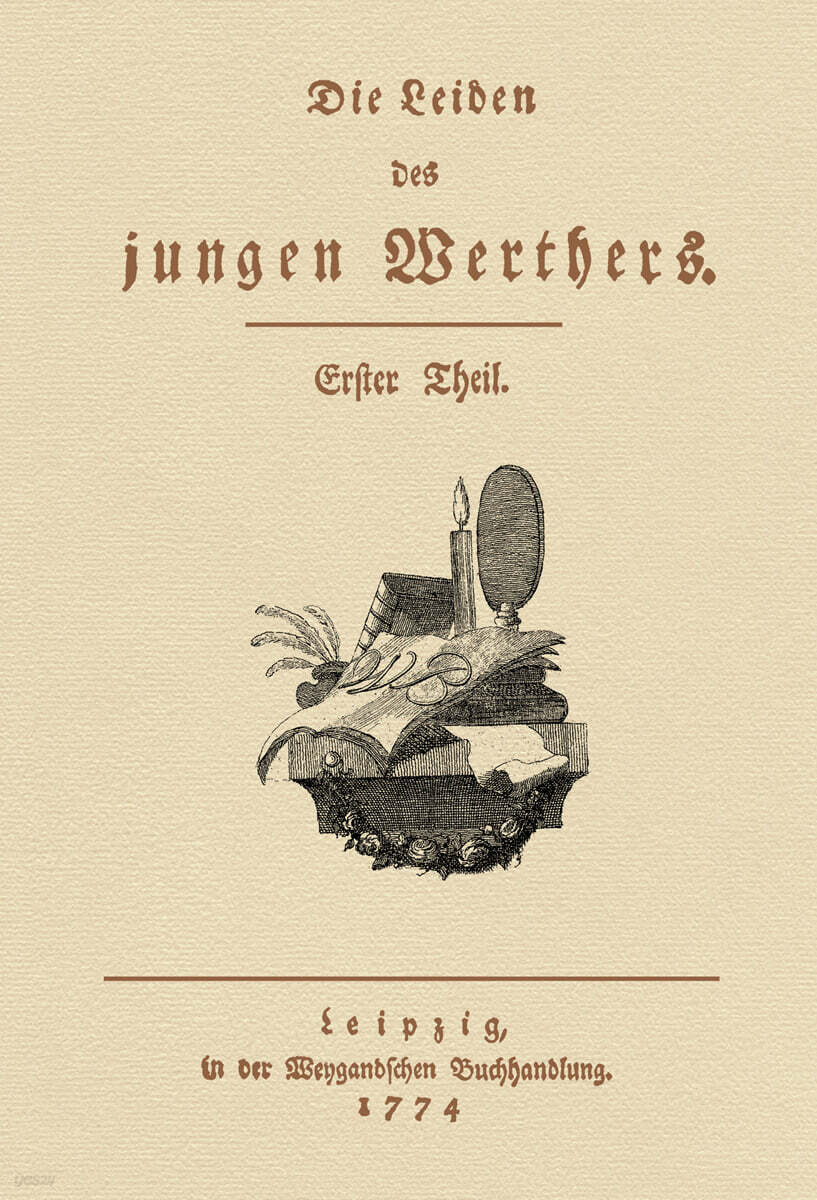
First edition of The Sorrows of Young Werther
 |
Description
Book Introduction
“Fate, why am I so happy and why am I so unhappy!
Truly, there is no one happier than I, and no one more miserable than I!”
The stormy mind of youth, its intense passion and swirling emotions
The Sorrows of Young Werther, a work expressed in its purest form
An autobiographical novel by Goethe, considered one of the world's three greatest poets along with Dante and Shakespeare.
“I have never written a single line about something I have not experienced.
But as the saying goes, “I did not write a single line exactly as I experienced it,” the protagonist Werther is Goethe himself and a portrait of our “vulnerable souls.”
This is why we sympathize with Werther, who is torn between love and morality, madness and reason, happiness and unhappiness, life and death.
The structure of the letters makes it seem as if Werther is confessing directly to the reader, making the story even more immersive.
One spring day, while Goethe was studying law and starting his legal practice in a city called Wetzlar, he saw Charlotte, the fiancée of his colleague Kestner, and fell in love at first sight.
He returned home in agony and a broken heart, but after about half a year, he heard a shocking story.
Another colleague, Jerusalem, tormented by his love for a married woman, borrowed Kestner's pistol and took his own life! About two years later, Goethe wrote The Sorrows of Young Werther.
The note from Jerusalem read, "I'm going on a trip. Could you lend me your gun?" It was an autobiographical novel that captured the fever of love he had experienced.
Young people in Europe were enthusiastic about the work of the 25-year-old writer and his outfit of 'Werther's blue tailcoat and yellow vest'.
During the period when the French Revolution was brewing (15 years before 1789), young people who had escaped the authority of the church and received enlightenment education, but were still frustrated by the reality of being blocked by 'social status (royalty-nobility-commoner)', identified with Werther, who loved more purely than anyone else, worried passionately, and ultimately broke social taboos and escaped the mold.
Truly, there is no one happier than I, and no one more miserable than I!”
The stormy mind of youth, its intense passion and swirling emotions
The Sorrows of Young Werther, a work expressed in its purest form
An autobiographical novel by Goethe, considered one of the world's three greatest poets along with Dante and Shakespeare.
“I have never written a single line about something I have not experienced.
But as the saying goes, “I did not write a single line exactly as I experienced it,” the protagonist Werther is Goethe himself and a portrait of our “vulnerable souls.”
This is why we sympathize with Werther, who is torn between love and morality, madness and reason, happiness and unhappiness, life and death.
The structure of the letters makes it seem as if Werther is confessing directly to the reader, making the story even more immersive.
One spring day, while Goethe was studying law and starting his legal practice in a city called Wetzlar, he saw Charlotte, the fiancée of his colleague Kestner, and fell in love at first sight.
He returned home in agony and a broken heart, but after about half a year, he heard a shocking story.
Another colleague, Jerusalem, tormented by his love for a married woman, borrowed Kestner's pistol and took his own life! About two years later, Goethe wrote The Sorrows of Young Werther.
The note from Jerusalem read, "I'm going on a trip. Could you lend me your gun?" It was an autobiographical novel that captured the fever of love he had experienced.
Young people in Europe were enthusiastic about the work of the 25-year-old writer and his outfit of 'Werther's blue tailcoat and yellow vest'.
During the period when the French Revolution was brewing (15 years before 1789), young people who had escaped the authority of the church and received enlightenment education, but were still frustrated by the reality of being blocked by 'social status (royalty-nobility-commoner)', identified with Werther, who loved more purely than anyone else, worried passionately, and ultimately broke social taboos and escaped the mold.
index
Part 1
Part 2
Translator's Note: An autobiographical novel by Goethe, a master of German literature, the story of young Werther, suffering from the pain of love.
Johann Wolfgang von Goethe Chronology
Part 2
Translator's Note: An autobiographical novel by Goethe, a master of German literature, the story of young Werther, suffering from the pain of love.
Johann Wolfgang von Goethe Chronology
GOODS SPECIFICS
- Date of issue: March 28, 2025
- Page count, weight, size: 256 pages | 128*188*20mm
- ISBN13: 9791194591429
- ISBN10: 1194591426
You may also like
카테고리
korean


korean

![GQ KOREA Mark (Monthly): December [2025]](http://librairie.coreenne.fr/cdn/shop/files/8ef265dbbfbf186523ed75ba7319009d.jpg?v=1765340328&width=3840)


