

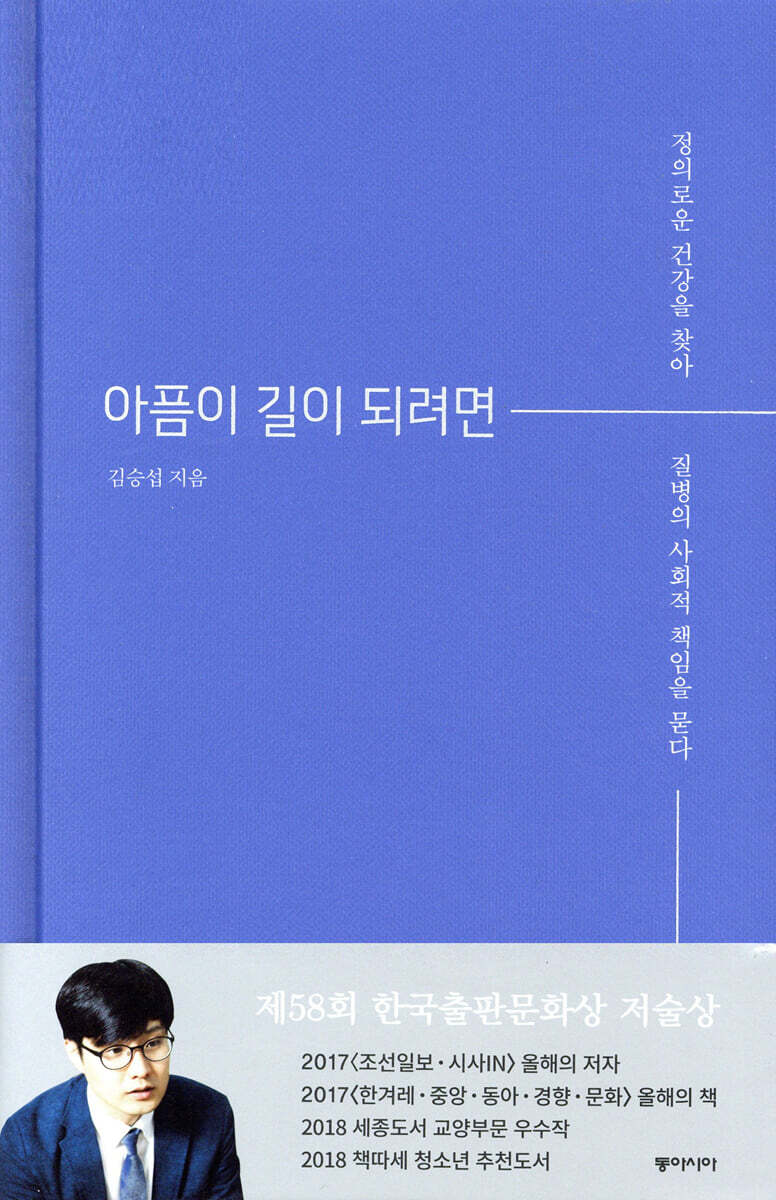
For pain to become a path
 |
Description
Book Introduction
Hate speech, job seeker discrimination, job insecurity, disaster…
How do social wounds make our bodies sick?
The Real Reason We're Sick, According to Data
"For Pain to Become a Path" contains the traces of Professor Seungseop Kim's intense struggles and research since his days as a public health doctor.
Using social epidemiology, which uses data to uncover the social and political causes of disease, he explains how social wounds such as hatred, discrimination, and job insecurity make us sick.
It also talks about how society is projected onto an individual's body.
The author states that “there can be no disease that progresses completely isolated from the social environment,” and that “diseases with social causes require social solutions.”
Even if cutting-edge medical technology advances to predict and treat diseases at the genetic level, individuals cannot become healthy without social change.
Professor Seung-Seop Kim, a social epidemiologist at Korea University's College of Health Sciences, discusses his research on how experiences of discrimination affect health.
To measure discrimination in the employment process, the study's questionnaire asked:
“Have you ever experienced discrimination when trying out a new job?” The answer options are “Yes,” “No,” and “None of the above.”
“Not applicable” is a question created for respondents who have no job search experience.
If you are already employed, you can answer 'yes' or 'no'.
However, a significant number of office workers responded that this was ‘not applicable.’
What happened? Professor Kim Seung-seop investigated the health status of those who answered "not applicable."
Then, a surprising result comes out.
For men, those who responded "none of the above" had no significant health differences from those who responded that there was no discrimination.
But for women, it was different.
The health of women who answered 'not applicable' was worse than that of those who responded that they had been discriminated against.
In another similar study, this time the questions were asked to youth from multicultural families.
“How did you respond after experiencing school violence?” Professor Kim Seung-seop noted that among the respondents, those who answered, “I just let it go without thinking much about it.”
When we investigated the health of these students, we again found stark differences between men and women.
For female students, there was no significant difference, but this time a difference was found among male students.
The survey found that male students who answered, “I just let it go without thinking much about it,” had the worst mental health.
An experience that I had dismissed as insignificant was actually causing me pain.
These studies show that when we experience discrimination or violence, and are unable to speak out, or when we try to pretend we're okay, our bodies actually hurt more.
To borrow the expression of the author, Professor Seungseop Kim, ‘it is because the body is honest.’
This book discusses how social wounds such as job insecurity and discrimination cause our bodies to hurt, and how society is reflected in the individual's body, using various research cases from social epidemiology.
How do social wounds make our bodies sick?
The Real Reason We're Sick, According to Data
"For Pain to Become a Path" contains the traces of Professor Seungseop Kim's intense struggles and research since his days as a public health doctor.
Using social epidemiology, which uses data to uncover the social and political causes of disease, he explains how social wounds such as hatred, discrimination, and job insecurity make us sick.
It also talks about how society is projected onto an individual's body.
The author states that “there can be no disease that progresses completely isolated from the social environment,” and that “diseases with social causes require social solutions.”
Even if cutting-edge medical technology advances to predict and treat diseases at the genetic level, individuals cannot become healthy without social change.
Professor Seung-Seop Kim, a social epidemiologist at Korea University's College of Health Sciences, discusses his research on how experiences of discrimination affect health.
To measure discrimination in the employment process, the study's questionnaire asked:
“Have you ever experienced discrimination when trying out a new job?” The answer options are “Yes,” “No,” and “None of the above.”
“Not applicable” is a question created for respondents who have no job search experience.
If you are already employed, you can answer 'yes' or 'no'.
However, a significant number of office workers responded that this was ‘not applicable.’
What happened? Professor Kim Seung-seop investigated the health status of those who answered "not applicable."
Then, a surprising result comes out.
For men, those who responded "none of the above" had no significant health differences from those who responded that there was no discrimination.
But for women, it was different.
The health of women who answered 'not applicable' was worse than that of those who responded that they had been discriminated against.
In another similar study, this time the questions were asked to youth from multicultural families.
“How did you respond after experiencing school violence?” Professor Kim Seung-seop noted that among the respondents, those who answered, “I just let it go without thinking much about it.”
When we investigated the health of these students, we again found stark differences between men and women.
For female students, there was no significant difference, but this time a difference was found among male students.
The survey found that male students who answered, “I just let it go without thinking much about it,” had the worst mental health.
An experience that I had dismissed as insignificant was actually causing me pain.
These studies show that when we experience discrimination or violence, and are unable to speak out, or when we try to pretend we're okay, our bodies actually hurt more.
To borrow the expression of the author, Professor Seungseop Kim, ‘it is because the body is honest.’
This book discusses how social wounds such as job insecurity and discrimination cause our bodies to hurt, and how society is reflected in the individual's body, using various research cases from social epidemiology.
- You can preview some of the book's contents.
Preview
index
Entering
1.
Unspoken wounds, a body that remembers
Where are my unspoken wounds?
Same response, different meanings to experiences of discrimination
Unequal Summer: Questioning the Role of the State
How a community can learn from the Chicago heatwave to address disaster inequality.
What would happen if abortion were banned?
-Unequal abortion laws, as seen in the case of Romania
The experiences of the fetus that remain in the body even after becoming an adult
-Social environment engraved in the body, thrifty trait hypothesis
Poverty is etched into our very being.
-A History of the Poor Body and Anatomy
Have you ever seen a spider?
-The history of social epidemiology, which traces the 'cause of the cause' of disease.
[Three Elements of Extremely Personal Scientific Rationality]
2.
Workplaces that recommend disease prevention, let's fix it together
What does the state mean to laid-off workers?
- While conducting a study on the health of laid-off Ssangyong Motors workers
Someone has to stand on their side.
The Samsung Semiconductor and IBM occupational disease lawsuits represent researchers taking on large corporations.
Dangerous workplaces are heading to poor villages.
Where did Wonjin Rayon and Jeil Chemical, the factories that created occupational diseases, go?
People who have no choice but to work even when they are sick
-The trap of job insecurity and 'laying off underperformers'
Doctors who can't go to the hospital even when they're sick
-Becoming a researcher, I question the working environment and patient safety of residents.
Those who keep us safe, they are sick
- Conducting a survey on the human rights situation of firefighters
Reading the Right Numbers for a Healthy Workplace
3.
The end and the beginning, if sadness is to become a path
Disasters must be recorded
- Conducting a survey on the students who survived the Sewol Ferry disaster
To heal social pain socially
Post-traumatic stress disorder: The dilemma of 'treatment without explanation'
[The children did their best to survive]
When the system denies existence, the body becomes sick.
-The relationship between non-recognition of same-sex marriage and the health of sexual minorities
Against unscientific hatred towards homosexuals
-Homosexuality, conversion therapy, and HIV/AIDS
If you can't stop the rain, you have to get wet together.
Defending transgender people who hesitate in front of the operating table
-Lawsuit against active-duty military service for non-surgical transgender individuals
If you leave Korea, you too will be a minority.
-Shameless racism in our society
Working as a prison doctor
- While conducting research on the health of prisoners
4.
The more connected we are, the healthier we become.
The more connected you are, the longer you live
- A History of Social Networks and Health Research
If we can protect ourselves, will we be safe?
Gun Control: How Much Responsibility Should Communities Have?
To survive together in a risk society
Humidifier Disinfectant Deaths: Sufficient Evidence for Regulation
How is your community?
Why is the heart disease mortality rate low only in Roseto?
[Let's live a life that transcends our selfishness]
main
1.
Unspoken wounds, a body that remembers
Where are my unspoken wounds?
Same response, different meanings to experiences of discrimination
Unequal Summer: Questioning the Role of the State
How a community can learn from the Chicago heatwave to address disaster inequality.
What would happen if abortion were banned?
-Unequal abortion laws, as seen in the case of Romania
The experiences of the fetus that remain in the body even after becoming an adult
-Social environment engraved in the body, thrifty trait hypothesis
Poverty is etched into our very being.
-A History of the Poor Body and Anatomy
Have you ever seen a spider?
-The history of social epidemiology, which traces the 'cause of the cause' of disease.
[Three Elements of Extremely Personal Scientific Rationality]
2.
Workplaces that recommend disease prevention, let's fix it together
What does the state mean to laid-off workers?
- While conducting a study on the health of laid-off Ssangyong Motors workers
Someone has to stand on their side.
The Samsung Semiconductor and IBM occupational disease lawsuits represent researchers taking on large corporations.
Dangerous workplaces are heading to poor villages.
Where did Wonjin Rayon and Jeil Chemical, the factories that created occupational diseases, go?
People who have no choice but to work even when they are sick
-The trap of job insecurity and 'laying off underperformers'
Doctors who can't go to the hospital even when they're sick
-Becoming a researcher, I question the working environment and patient safety of residents.
Those who keep us safe, they are sick
- Conducting a survey on the human rights situation of firefighters
Reading the Right Numbers for a Healthy Workplace
3.
The end and the beginning, if sadness is to become a path
Disasters must be recorded
- Conducting a survey on the students who survived the Sewol Ferry disaster
To heal social pain socially
Post-traumatic stress disorder: The dilemma of 'treatment without explanation'
[The children did their best to survive]
When the system denies existence, the body becomes sick.
-The relationship between non-recognition of same-sex marriage and the health of sexual minorities
Against unscientific hatred towards homosexuals
-Homosexuality, conversion therapy, and HIV/AIDS
If you can't stop the rain, you have to get wet together.
Defending transgender people who hesitate in front of the operating table
-Lawsuit against active-duty military service for non-surgical transgender individuals
If you leave Korea, you too will be a minority.
-Shameless racism in our society
Working as a prison doctor
- While conducting research on the health of prisoners
4.
The more connected we are, the healthier we become.
The more connected you are, the longer you live
- A History of Social Networks and Health Research
If we can protect ourselves, will we be safe?
Gun Control: How Much Responsibility Should Communities Have?
To survive together in a risk society
Humidifier Disinfectant Deaths: Sufficient Evidence for Regulation
How is your community?
Why is the heart disease mortality rate low only in Roseto?
[Let's live a life that transcends our selfishness]
main
Into the book
The female worker who answered "not applicable" to discrimination in the job search process and the male student who answered "I don't feel anything" to school violence were both unable to recognize or speak about their experiences as they were.
However, women workers who experienced discrimination but said it did not affect them were more likely to suffer than those who could say they had experienced discrimination.
Even male students from multicultural families who said they were fine after experiencing school violence suffered more than anyone else, including those who experienced school violence and were able to talk about it.
People who have been hurt by social violence often cannot speak out about their experiences.
Understanding that wound is both painful and confusing.
But our bodies remember even the wounds we cannot tell ourselves and sometimes do not even recognize.
Because the body is honest.
Just as the sea is imprinted on the scales of a fish, the time of the society in which one lives is imprinted on the human body.
---From "Where Are My Unspoken Wounds?"
So who is vulnerable to heat waves? (…) Another factor that increases the risk of death from heat waves is revealed.
It was social isolation.
People who live alone, people who do not leave their homes during heat waves, and people who do not participate in social activities such as going to church or volunteering died more often.
(…) But that question doesn’t answer why some people couldn’t go to air-conditioned facilities, or why some people couldn’t be active in social activities.
Because they only point out the causes at the individual level, they do not investigate or mention the social environment behind those causes.
This is an answer that can only be obtained by asking what political and economic forces make specific individuals vulnerable to heat waves, how such social structures were formed historically, and what role the community and the state played in that process.
---From "Summer of Inequality: Questioning the Role of the State"
In a time when fear of corpse theft was widespread, the wealthy could be assured of a secure time after death.
I had bought an expensive coffin that was much harder and harder to open.
(…) However, the reality that the corpses for dissection were the bodies of poor people did not change.
In 19th century Britain, more than 99 percent of the corpses used for anatomy practice in medical schools at the time came from workhouses that housed the poor.
(…) These historical facts have important implications beyond the fact that economic inequality during life persists after death.
The history of anatomy is marred by the fact that only the bodies of the poor are dissected and recorded.
Because poverty changes the human body.
---From "Poverty is engraved on our bodies"
In areas with laws protecting same-sex relationships, the proportion of people who reported being heterosexual in the 1995 survey but identified as gay or bisexual in 2009 was 30 percent higher than in areas without such laws.
With the social change that legally recognizes same-sex relationships, those who previously hid their sexual orientation began to reveal their existence.
This is a good example of how institutional discrimination, such as the refusal to recognize same-sex marriage, can affect an individual's life and self-esteem.
However, women workers who experienced discrimination but said it did not affect them were more likely to suffer than those who could say they had experienced discrimination.
Even male students from multicultural families who said they were fine after experiencing school violence suffered more than anyone else, including those who experienced school violence and were able to talk about it.
People who have been hurt by social violence often cannot speak out about their experiences.
Understanding that wound is both painful and confusing.
But our bodies remember even the wounds we cannot tell ourselves and sometimes do not even recognize.
Because the body is honest.
Just as the sea is imprinted on the scales of a fish, the time of the society in which one lives is imprinted on the human body.
---From "Where Are My Unspoken Wounds?"
So who is vulnerable to heat waves? (…) Another factor that increases the risk of death from heat waves is revealed.
It was social isolation.
People who live alone, people who do not leave their homes during heat waves, and people who do not participate in social activities such as going to church or volunteering died more often.
(…) But that question doesn’t answer why some people couldn’t go to air-conditioned facilities, or why some people couldn’t be active in social activities.
Because they only point out the causes at the individual level, they do not investigate or mention the social environment behind those causes.
This is an answer that can only be obtained by asking what political and economic forces make specific individuals vulnerable to heat waves, how such social structures were formed historically, and what role the community and the state played in that process.
---From "Summer of Inequality: Questioning the Role of the State"
In a time when fear of corpse theft was widespread, the wealthy could be assured of a secure time after death.
I had bought an expensive coffin that was much harder and harder to open.
(…) However, the reality that the corpses for dissection were the bodies of poor people did not change.
In 19th century Britain, more than 99 percent of the corpses used for anatomy practice in medical schools at the time came from workhouses that housed the poor.
(…) These historical facts have important implications beyond the fact that economic inequality during life persists after death.
The history of anatomy is marred by the fact that only the bodies of the poor are dissected and recorded.
Because poverty changes the human body.
---From "Poverty is engraved on our bodies"
In areas with laws protecting same-sex relationships, the proportion of people who reported being heterosexual in the 1995 survey but identified as gay or bisexual in 2009 was 30 percent higher than in areas without such laws.
With the social change that legally recognizes same-sex relationships, those who previously hid their sexual orientation began to reveal their existence.
This is a good example of how institutional discrimination, such as the refusal to recognize same-sex marriage, can affect an individual's life and self-esteem.
---From "When the system denies existence, the body hurts"
Publisher's Review
Hate speech, job seeker discrimination, poverty, disaster…
How Social Experiences Seep Under the Skin
“The body remembers even the wounds that cannot be spoken of!”
Smoking causes lung cancer, and continuous exposure to benzene causes leukemia.
Epidemiologists work to find the causes of these diseases.
When an infectious disease like MERS appears, data is collected and analyzed to determine where the initial outbreak occurred, what caused the disease, and how it spread.
It is natural that viruses and substances that are dangerous to the human body are pointed out as the cause of disease.
So, when we hear hateful comments from others, experience discrimination during the job search, or are laid off from our company, can these experiences also be considered causes of illness? Among epidemiologists, "social epidemiologists" trace how these social experiences permeate our bodies and lead to illness.
Professor Seung-Seop Kim, a social epidemiologist at Korea University's College of Health Sciences, discusses his research on how experiences of discrimination affect health.
A survey designed to measure discrimination in the employment process asked the following questions:
“Have you ever experienced discrimination when trying out a new job?” The answers are yes, no, or not applicable.
“Not applicable” is a question created for respondents who have no job search experience.
If you are already employed, you can answer 'yes' or 'no'.
However, a significant number of office workers responded that this was ‘not applicable.’
What happened?
Professor Seungseop Kim investigated the health status of people who answered 'not applicable' and confirmed surprising results.
For men, those who responded "none of the above" had no significant health differences from those who responded that there was no discrimination.
But for women, it was different.
Women who answered "none of the above" reported worse health than those who reported experiencing discrimination.
In another similar study, this time multicultural youth were asked the following question:
“How did you respond after experiencing school violence?” Professor Kim Seung-seop noted that among the respondents, students said, “I just let it go without thinking much about it.”
When we investigated the health status of these students, we found that in this case too, there was a stark difference between men and women.
This time, the difference was evident among the boys.
The survey found that male students who answered, “I just let it go without thinking much about it,” had the worst mental health.
An experience that I had dismissed as insignificant was actually causing me pain.
These studies show that when we experience discrimination or violence, and are unable to speak out, or when we try to pretend we're okay, our bodies actually hurt more.
To borrow the expression of the author, Professor Seungseop Kim, it is because ‘the body is honest.’
This book discusses how social wounds such as job insecurity, experiences of discrimination, and hate speech cause our bodies to hurt, and how society is reflected in the individual's body, using various research cases from social epidemiology.
The Real Reason We're Sick, According to Data
“There is no disease that is disconnected from society, and the body reflects society!”
In 2000, adult life expectancy in rural KwaZulu-Natal, South Africa, was 52.3 years.
The average adult life expectancy in South Africa was 61.4 years, a difference of nine years.
At the time, 29 percent of the population in rural KwaZulu-Natal was living with HIV, and the poor community was largely forced to forgo expensive treatment drugs.
In 2004, life expectancy in rural KwaZulu-Natal had fallen to 49 years, and South Africa's Department of Health began providing free HIV treatment through public health insurance.
And then change happens.
In just seven years, average life expectancy has increased by 12 years.
Professor Seungseop Kim introduces this study and asks a question.
So, then, isn't it true that the people in this village died not because of the virus they were individually infected with, but because of the system's failure to provide a cure that already existed in the world?
It questions the community's responsibility for individual health.
A second case can be viewed from a similar perspective.
As the Soviet Union collapsed, Eastern European countries, which were experiencing a severe economic crisis, received bailout funds from the IMF.
And during this period, life expectancy in Eastern European countries declines sharply.
In a study comparing tuberculosis mortality rates, countries that implemented IMF structural adjustment programs experienced an upward trend in tuberculosis mortality rates.
Meanwhile, only in Slovenia, which did not receive IMF bailout funds, did the tuberculosis mortality rate decline. The book explains that this was due to reduced investment in public health systems and social safety nets as a result of implementing the IMF structural adjustment program.
Professor Kim Seung-seop says, “There can be no disease that progresses completely disconnected from the social environment,” and asks, “How should we view the human body and health, and to what extent should the community be responsible for the lives of individuals?”
Even if cutting-edge medical technology advances to predict and treat diseases at the genetic level, individuals cannot become healthy without social change.
The book contains data collected and analyzed by the author through his own research, organized into various graphs and tables.
In the case of materials in existing literature, they were reprocessed and included.
It helps readers see various research cases at a glance.
Firefighters, laid-off Ssangyong Motors workers, Sewol ferry disaster survivors, homosexuals…
Field-based research reveals how we can survive and thrive together.
“Diseases with social causes require social solutions.”
1.
What Should the State Be for Laid-Off Workers?
After the 2009 Ssangyong Motor layoffs, 50.5 percent of workers who participated in the workplace occupation strike were found to suffer from post-traumatic stress disorder.
The severity of the situation becomes even more evident when we consider that the prevalence of post-traumatic stress disorder among Gulf War veterans was 22 percent.
Professor Kim Seung-seop begins researching the health of laid-off workers after witnessing the successive deaths of laid-off Ssangyong Motors workers and their families.
Focusing on the country's failing "active labor market programs," the paper questions the government why unemployment must lead to death.
In a Korean society where even private safety nets such as savings and insurance collapse after layoffs, and where public safety nets are absent, this article discusses the impact of job insecurity on individual health.
2.
From research on the health of Sewol ferry survivors to research on the health of sexual minorities.
The book contains the traces of Professor Seungseop Kim's intense struggles and research since his days as a public health doctor.
The concerns I had while meeting inmates at Cheonan Juvenile Detention Center later became the impetus for the Human Rights Commission's 'Inmate Health Research'.
During my medical school days, I was aware of the poor working environment, including sleep deprivation and violence within the hospital for interns and residents. This awareness led me to conduct the '2014 Resident Work Environment Survey' after becoming a researcher.
It raises the question, "Can patients treated by unhealthy doctors be safe?" and addresses sensitive issues such as medical malpractice.
This is also the first study of its kind in Korea on the working environment and patient safety of medical residents.
In 2016, I resided in Ansan, conducting health research on the Danwon High School students and their families who survived the Sewol Ferry disaster, and conducted in-depth interviews.
I was also present at the rally this year on the day a gay soldier was convicted under Article 92-6 of the Military Criminal Act.
The speeches at the rally, summarized in writing, are included in the book.
Recently, we have been conducting research on gay and lesbian health and transgender health called the 'Rainbow Connection Project'.
In this regard, the book also talks about the impact of legalizing same-sex marriage on the health of homosexuals.
Additionally, we oppose viewing homosexuality as a disease or something that can be cured, and present clear scientific evidence.
It also points out the context in which transgender people cannot easily undergo gender reassignment surgery in Korean society.
In addition, it shows the extent of racism, homosexuality, and AIDS hatred in our society through comparison among OECD countries.
While discussing the major issues in Korean society with rational basis, it also raises questions about the direction in which our society should move.
We introduce examples such as the case of Roseto, where a community culture of mutual support lowered the mortality rate from heart disease, and social epidemiological studies on how social networks affect life expectancy, and discuss what communities should consider to achieve health together.
Several sentences, which are well-written and reflect the author Professor Kim Seung-seop's intense thoughts and reflections, are placed alongside meaningful press photos and works by Korean artists, making the book even more enjoyable to read.
How Social Experiences Seep Under the Skin
“The body remembers even the wounds that cannot be spoken of!”
Smoking causes lung cancer, and continuous exposure to benzene causes leukemia.
Epidemiologists work to find the causes of these diseases.
When an infectious disease like MERS appears, data is collected and analyzed to determine where the initial outbreak occurred, what caused the disease, and how it spread.
It is natural that viruses and substances that are dangerous to the human body are pointed out as the cause of disease.
So, when we hear hateful comments from others, experience discrimination during the job search, or are laid off from our company, can these experiences also be considered causes of illness? Among epidemiologists, "social epidemiologists" trace how these social experiences permeate our bodies and lead to illness.
Professor Seung-Seop Kim, a social epidemiologist at Korea University's College of Health Sciences, discusses his research on how experiences of discrimination affect health.
A survey designed to measure discrimination in the employment process asked the following questions:
“Have you ever experienced discrimination when trying out a new job?” The answers are yes, no, or not applicable.
“Not applicable” is a question created for respondents who have no job search experience.
If you are already employed, you can answer 'yes' or 'no'.
However, a significant number of office workers responded that this was ‘not applicable.’
What happened?
Professor Seungseop Kim investigated the health status of people who answered 'not applicable' and confirmed surprising results.
For men, those who responded "none of the above" had no significant health differences from those who responded that there was no discrimination.
But for women, it was different.
Women who answered "none of the above" reported worse health than those who reported experiencing discrimination.
In another similar study, this time multicultural youth were asked the following question:
“How did you respond after experiencing school violence?” Professor Kim Seung-seop noted that among the respondents, students said, “I just let it go without thinking much about it.”
When we investigated the health status of these students, we found that in this case too, there was a stark difference between men and women.
This time, the difference was evident among the boys.
The survey found that male students who answered, “I just let it go without thinking much about it,” had the worst mental health.
An experience that I had dismissed as insignificant was actually causing me pain.
These studies show that when we experience discrimination or violence, and are unable to speak out, or when we try to pretend we're okay, our bodies actually hurt more.
To borrow the expression of the author, Professor Seungseop Kim, it is because ‘the body is honest.’
This book discusses how social wounds such as job insecurity, experiences of discrimination, and hate speech cause our bodies to hurt, and how society is reflected in the individual's body, using various research cases from social epidemiology.
The Real Reason We're Sick, According to Data
“There is no disease that is disconnected from society, and the body reflects society!”
In 2000, adult life expectancy in rural KwaZulu-Natal, South Africa, was 52.3 years.
The average adult life expectancy in South Africa was 61.4 years, a difference of nine years.
At the time, 29 percent of the population in rural KwaZulu-Natal was living with HIV, and the poor community was largely forced to forgo expensive treatment drugs.
In 2004, life expectancy in rural KwaZulu-Natal had fallen to 49 years, and South Africa's Department of Health began providing free HIV treatment through public health insurance.
And then change happens.
In just seven years, average life expectancy has increased by 12 years.
Professor Seungseop Kim introduces this study and asks a question.
So, then, isn't it true that the people in this village died not because of the virus they were individually infected with, but because of the system's failure to provide a cure that already existed in the world?
It questions the community's responsibility for individual health.
A second case can be viewed from a similar perspective.
As the Soviet Union collapsed, Eastern European countries, which were experiencing a severe economic crisis, received bailout funds from the IMF.
And during this period, life expectancy in Eastern European countries declines sharply.
In a study comparing tuberculosis mortality rates, countries that implemented IMF structural adjustment programs experienced an upward trend in tuberculosis mortality rates.
Meanwhile, only in Slovenia, which did not receive IMF bailout funds, did the tuberculosis mortality rate decline. The book explains that this was due to reduced investment in public health systems and social safety nets as a result of implementing the IMF structural adjustment program.
Professor Kim Seung-seop says, “There can be no disease that progresses completely disconnected from the social environment,” and asks, “How should we view the human body and health, and to what extent should the community be responsible for the lives of individuals?”
Even if cutting-edge medical technology advances to predict and treat diseases at the genetic level, individuals cannot become healthy without social change.
The book contains data collected and analyzed by the author through his own research, organized into various graphs and tables.
In the case of materials in existing literature, they were reprocessed and included.
It helps readers see various research cases at a glance.
Firefighters, laid-off Ssangyong Motors workers, Sewol ferry disaster survivors, homosexuals…
Field-based research reveals how we can survive and thrive together.
“Diseases with social causes require social solutions.”
1.
What Should the State Be for Laid-Off Workers?
After the 2009 Ssangyong Motor layoffs, 50.5 percent of workers who participated in the workplace occupation strike were found to suffer from post-traumatic stress disorder.
The severity of the situation becomes even more evident when we consider that the prevalence of post-traumatic stress disorder among Gulf War veterans was 22 percent.
Professor Kim Seung-seop begins researching the health of laid-off workers after witnessing the successive deaths of laid-off Ssangyong Motors workers and their families.
Focusing on the country's failing "active labor market programs," the paper questions the government why unemployment must lead to death.
In a Korean society where even private safety nets such as savings and insurance collapse after layoffs, and where public safety nets are absent, this article discusses the impact of job insecurity on individual health.
2.
From research on the health of Sewol ferry survivors to research on the health of sexual minorities.
The book contains the traces of Professor Seungseop Kim's intense struggles and research since his days as a public health doctor.
The concerns I had while meeting inmates at Cheonan Juvenile Detention Center later became the impetus for the Human Rights Commission's 'Inmate Health Research'.
During my medical school days, I was aware of the poor working environment, including sleep deprivation and violence within the hospital for interns and residents. This awareness led me to conduct the '2014 Resident Work Environment Survey' after becoming a researcher.
It raises the question, "Can patients treated by unhealthy doctors be safe?" and addresses sensitive issues such as medical malpractice.
This is also the first study of its kind in Korea on the working environment and patient safety of medical residents.
In 2016, I resided in Ansan, conducting health research on the Danwon High School students and their families who survived the Sewol Ferry disaster, and conducted in-depth interviews.
I was also present at the rally this year on the day a gay soldier was convicted under Article 92-6 of the Military Criminal Act.
The speeches at the rally, summarized in writing, are included in the book.
Recently, we have been conducting research on gay and lesbian health and transgender health called the 'Rainbow Connection Project'.
In this regard, the book also talks about the impact of legalizing same-sex marriage on the health of homosexuals.
Additionally, we oppose viewing homosexuality as a disease or something that can be cured, and present clear scientific evidence.
It also points out the context in which transgender people cannot easily undergo gender reassignment surgery in Korean society.
In addition, it shows the extent of racism, homosexuality, and AIDS hatred in our society through comparison among OECD countries.
While discussing the major issues in Korean society with rational basis, it also raises questions about the direction in which our society should move.
We introduce examples such as the case of Roseto, where a community culture of mutual support lowered the mortality rate from heart disease, and social epidemiological studies on how social networks affect life expectancy, and discuss what communities should consider to achieve health together.
Several sentences, which are well-written and reflect the author Professor Kim Seung-seop's intense thoughts and reflections, are placed alongside meaningful press photos and works by Korean artists, making the book even more enjoyable to read.
GOODS SPECIFICS
- Date of publication: September 13, 2017
- Format: Hardcover book binding method guide
- Page count, weight, size: 320 pages | 540g | 140*215*30mm
- ISBN13: 9788962621952
- ISBN10: 8962621959
You may also like
카테고리
korean


korean

![GQ KOREA Mark (Monthly): December [2025]](http://librairie.coreenne.fr/cdn/shop/files/8ef265dbbfbf186523ed75ba7319009d.jpg?v=1765340328&width=3840)


