

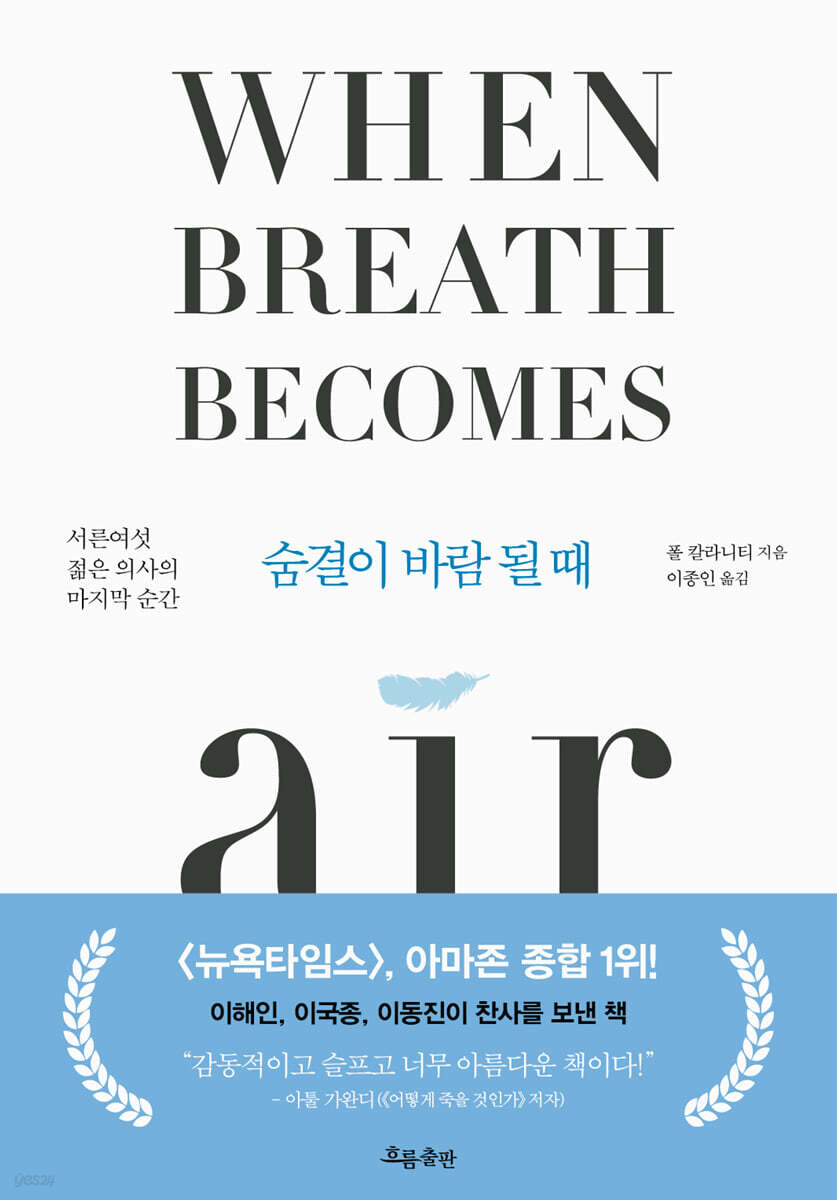
When breath becomes wind
 |
Description
Book Introduction
[New York Times] #1 for 12 consecutive weeks, #1 overall on Amazon
Exported to 38 countries worldwide, ranked as the best book in the US (first half of 2016)
Paul Kalanithi's "When Breath Becomes Air," which has moved countless Korean readers since its publication in 2016, will finally present its 100th printing in the winter of 2024.
Paul Kalanithi, a young doctor of thirty-six who fought against death while treating patients with critical brain injuries as a neurosurgeon, was diagnosed with terminal lung cancer and faced death himself.
When Breath Becomes Air, a record of the last two years he wrote, rose to number one on the Amazon and New York Times bestseller lists as soon as it was published in the United States, and remained there for 12 consecutive weeks.
Atul Gawande, author of How to Die, mourned his death, calling it "a moving, sad, and utterly beautiful book that teaches us so much about life."
This moving story of the agony and determination to choose to live instead of die, a deep reflection on life and death and their meaning, and the love and values that endure even after one's last breath, reminds readers what values are most needed in this day and age.
Exported to 38 countries worldwide, ranked as the best book in the US (first half of 2016)
Paul Kalanithi's "When Breath Becomes Air," which has moved countless Korean readers since its publication in 2016, will finally present its 100th printing in the winter of 2024.
Paul Kalanithi, a young doctor of thirty-six who fought against death while treating patients with critical brain injuries as a neurosurgeon, was diagnosed with terminal lung cancer and faced death himself.
When Breath Becomes Air, a record of the last two years he wrote, rose to number one on the Amazon and New York Times bestseller lists as soon as it was published in the United States, and remained there for 12 consecutive weeks.
Atul Gawande, author of How to Die, mourned his death, calling it "a moving, sad, and utterly beautiful book that teaches us so much about life."
This moving story of the agony and determination to choose to live instead of die, a deep reflection on life and death and their meaning, and the love and values that endure even after one's last breath, reminds readers what values are most needed in this day and age.
- You can preview some of the book's contents.
Preview
index
prolog
Part 1_ I started out very healthy
Part 2_ Don't Stop Until Death Comes
Epilogue | Lucy Kalanithi
Recommended Reading | Abraham Burghese
Acknowledgements
Translator's Note
Part 1_ I started out very healthy
Part 2_ Don't Stop Until Death Comes
Epilogue | Lucy Kalanithi
Recommended Reading | Abraham Burghese
Acknowledgements
Translator's Note
Into the book
Neurosurgeons work in the harsh furnace of identity.
All brain surgery inevitably involves manipulating the brain, which is the very essence of human beings, and when communicating with patients undergoing brain surgery, we inevitably face the question of identity.
Additionally, brain surgery is usually the most dramatic event in a patient's life and their family's lives, and as with any major life event, it has a profound impact.
At such a crucial turning point, the question is not simply whether to live or die, but which one is worth living for.
For example, what choice would you make if you or your mother were forced to lose speech in exchange for a few more months of life? What choice would you make if you had to sacrifice vision loss to completely eliminate the small possibility of a fatal brain hemorrhage? What choice would you make if you lost the use of your right hand while trying to stop a seizure? How much pain would your child have to endure before they would say they'd rather die?
---pp.95-96
The unique suffering caused by severe brain injury sometimes hurts the family more than the patient.
So it's not just doctors who don't fully grasp the meaning.
Even the family members gathered around their loved ones who lay with their heads shaved due to brain injuries do not fully understand the meaning.
They look to the past.
I think the memories they have accumulated over time, the feelings of love they feel anew, all of these are represented by the body placed before them.
But I see the future that lies ahead.
A breathing apparatus connected through a surgical hole in my neck, a clear liquid dripping drop by drop through a hole in my abdomen, a long and painful treatment process, and an incomplete recovery.
Sometimes, patients never return to the way they were before as people remember them.
---p.113
One night, Lucy, who was lying next to me, asked.
“Honey, what’s the scariest or saddest thing that’s ever happened to you?” “Leaving you.” I knew that having a baby would be a great joy for our family.
Besides, I couldn't bear the thought that after I died, Lucy would have no husband or child.
But I insisted that the final decision should be made by Lucy.
In the end, she would have to raise the baby alone, and if my illness worsened, it would be even harder for her to take care of me as well.
“Will we be able to spend more time together when we have a baby?” Lucy asked.
“Wouldn’t death be more painful if I had to be separated from my baby?” “Even so, wouldn’t a baby be a wonderful gift?” I said.
Lucy and I felt that life wasn't just about avoiding pain.
---pp.173-174
Ultimately, it was literature that gave me my vitality during this period.
The future was so uncertain that it was making me feel helpless.
The shadow of death was so thick wherever I looked that every action felt meaningless.
But I remember the moment when the worries that had been weighing me down disappeared and the sea of anxiety that seemed impassable parted.
As usual, I woke up in pain and had nothing to do after breakfast.
The moment I thought, 'I can't go on,' an answer came to mind.
That was also a line from Samuel Beckett that I learned a long time ago during my undergraduate years.
“But I’ll keep going.” I got out of bed, took a step forward, and repeated that phrase over and over again.
“I can't go on, but I'll keep going.”
I'll go on).”
---pp.179~180
When you become seriously ill, the outlines of your life become very clear.
I knew I was going to die.
But that was something I already knew.
My knowledge remained the same, but my ability to plan my life was completely ruined.
Once I know how much time I have left, the task ahead becomes clear.
If I had three months left, I would spend time with my family.
If it takes a year, I will write a book.
In 10 years, I will return to a life of treating people's illnesses.
The truth that we can only live one day at a time didn't help much either.
What on earth should I do with that day?
---p.193
“Father, would you like to hold your daughter?” the nurse asked me.
“Well, my body is so cold.” There was a chatter of teeth.
“Still, I want to hug you.” They wrapped my daughter in a blanket and handed her to me.
With one arm feeling the weight of the child and the other holding Lucy's hand, the possibilities of life seemed to unfold before us.
The cancer cells in my body may still be dying or growing again.
In the vast horizon that stretched before me, I saw not an empty wasteland, but something simpler.
It was a blank page on which I had to continue writing.
All brain surgery inevitably involves manipulating the brain, which is the very essence of human beings, and when communicating with patients undergoing brain surgery, we inevitably face the question of identity.
Additionally, brain surgery is usually the most dramatic event in a patient's life and their family's lives, and as with any major life event, it has a profound impact.
At such a crucial turning point, the question is not simply whether to live or die, but which one is worth living for.
For example, what choice would you make if you or your mother were forced to lose speech in exchange for a few more months of life? What choice would you make if you had to sacrifice vision loss to completely eliminate the small possibility of a fatal brain hemorrhage? What choice would you make if you lost the use of your right hand while trying to stop a seizure? How much pain would your child have to endure before they would say they'd rather die?
---pp.95-96
The unique suffering caused by severe brain injury sometimes hurts the family more than the patient.
So it's not just doctors who don't fully grasp the meaning.
Even the family members gathered around their loved ones who lay with their heads shaved due to brain injuries do not fully understand the meaning.
They look to the past.
I think the memories they have accumulated over time, the feelings of love they feel anew, all of these are represented by the body placed before them.
But I see the future that lies ahead.
A breathing apparatus connected through a surgical hole in my neck, a clear liquid dripping drop by drop through a hole in my abdomen, a long and painful treatment process, and an incomplete recovery.
Sometimes, patients never return to the way they were before as people remember them.
---p.113
One night, Lucy, who was lying next to me, asked.
“Honey, what’s the scariest or saddest thing that’s ever happened to you?” “Leaving you.” I knew that having a baby would be a great joy for our family.
Besides, I couldn't bear the thought that after I died, Lucy would have no husband or child.
But I insisted that the final decision should be made by Lucy.
In the end, she would have to raise the baby alone, and if my illness worsened, it would be even harder for her to take care of me as well.
“Will we be able to spend more time together when we have a baby?” Lucy asked.
“Wouldn’t death be more painful if I had to be separated from my baby?” “Even so, wouldn’t a baby be a wonderful gift?” I said.
Lucy and I felt that life wasn't just about avoiding pain.
---pp.173-174
Ultimately, it was literature that gave me my vitality during this period.
The future was so uncertain that it was making me feel helpless.
The shadow of death was so thick wherever I looked that every action felt meaningless.
But I remember the moment when the worries that had been weighing me down disappeared and the sea of anxiety that seemed impassable parted.
As usual, I woke up in pain and had nothing to do after breakfast.
The moment I thought, 'I can't go on,' an answer came to mind.
That was also a line from Samuel Beckett that I learned a long time ago during my undergraduate years.
“But I’ll keep going.” I got out of bed, took a step forward, and repeated that phrase over and over again.
“I can't go on, but I'll keep going.”
I'll go on).”
---pp.179~180
When you become seriously ill, the outlines of your life become very clear.
I knew I was going to die.
But that was something I already knew.
My knowledge remained the same, but my ability to plan my life was completely ruined.
Once I know how much time I have left, the task ahead becomes clear.
If I had three months left, I would spend time with my family.
If it takes a year, I will write a book.
In 10 years, I will return to a life of treating people's illnesses.
The truth that we can only live one day at a time didn't help much either.
What on earth should I do with that day?
---p.193
“Father, would you like to hold your daughter?” the nurse asked me.
“Well, my body is so cold.” There was a chatter of teeth.
“Still, I want to hug you.” They wrapped my daughter in a blanket and handed her to me.
With one arm feeling the weight of the child and the other holding Lucy's hand, the possibilities of life seemed to unfold before us.
The cancer cells in my body may still be dying or growing again.
In the vast horizon that stretched before me, I saw not an empty wasteland, but something simpler.
It was a blank page on which I had to continue writing.
---p.230
Publisher's Review
It brought tears and emotion to readers around the world.
The last record of a thirty-six-year-old young doctor
Thirty-six, final year of neurosurgery residency before becoming a specialist.
Just when it seemed like the life he wanted was within reach after a grueling fourteen-hour day of training, Paul Kalanithi was diagnosed with stage 4 lung cancer, and it completely changed his life.
His last two years as a doctor, treating patients with critical brain injuries and battling death, and then becoming a patient himself, are told in intelligent and eloquent language.
In January 2014, eight months after being first diagnosed with cancer in 2013, his column, "How Long Have I Got Left?", which was published in the New York Times, created a huge stir.
Here he poignantly portrays the dilemma of a terminally ill patient who has been sentenced to death but does not know exactly when.
If you are clear about how many months or years remain, the path forward will be clear.
If it's three months, I'll spend that time with my family.
If I had a year left, I would write the book I always wanted to write.
If it's 10 years, I will return to the hospital and treat patients.
My doctor just says this:
“I can’t tell you how much time is left.
“You have to find out for yourself what is most precious to you.” (From the text)
He realizes that if he can't know exactly when he will die, he has no choice but to continue living.
He returned to the operating room and, as the most senior resident, took on a tremendous workload, and his wife Lucy became pregnant through artificial insemination.
However, just before completing his residency, his cancer rapidly worsens, forcing him to give up his path as a doctor and he struggles between life and death with his pregnant wife by his side.
Finally, eight months after the birth of his daughter, Kady, he refused resuscitation and died in the arms of his loving family, in a clear mind.
After Paul Kalanithi passed away in March 2015, the epilogue to the book, which he had been working on but never finished, was written by his wife Lucy.
This book was a hot topic as soon as the publishing plan was announced in the New York publishing world in December 2014, before the manuscript was even published, and contracts were signed within a day with Random House in the US, as well as Germany, Italy, and Brazil. In January 2016, upon publication of the original book, it rose to the number one spot on the Amazon and New York Times bestseller lists in the US, and maintained the number one spot on the New York Times bestseller list for 12 consecutive weeks.
The book was licensed to 38 countries around the world, and became an immediate bestseller in the UK, Germany, Italy, and Canada, where it had already been published.
Asking about the meaning of life across literature, philosophy, and medicine
A unique essay combining experience and reflection, emotion and intellect.
Paul Kalanithi was fascinated by young adult literature.
He was fascinated by the question of what makes life meaningful, and literature provided a way to convey the meaning of life in the form of stories.
Then, he learned that the human mind is a function of the brain, so he majored in English literature and biology at Stanford University.
As he explored human beings as both physiological and spiritual beings, he eventually decided to become a doctor.
It was “an opportunity to connect with those who suffer and to continue to ponder the question of what makes human life meaningful even in the face of physical decline and death.”
Paul Kalanithi chose his field of expertise precisely because of that sense of calling.
“Neurosurgery seemed to me to be the most challenging and directly confronting of meaning, identity, and death.” The author, who chose the profession of medicine based on humanistic insights, and who has constantly pondered what he could do for patients with catastrophic brain injuries, raises questions for our society about the role medicine and science can play in human lives and what makes a good doctor.
Neurosurgeons work in the harsh furnace of identity.
All brain surgery inevitably involves manipulating the brain, which is the very essence of human beings, and when communicating with patients undergoing brain surgery, we inevitably face the question of identity.
The point is not simply whether to live or die, but which one is worth living for.
What choice would you make if you were forced to lose your voice in exchange for a few more months of life? What if you lost the use of your right hand while trying to stop a seizure? How much pain would your child have to endure before they would say they'd rather die? (Excerpt from the text)
And finally, at the age of thirty-six, the author is sentenced to death and finds himself in the position of his patients.
Just as he didn't know when he would die even before he was diagnosed with cancer, he despairs over the fact that he doesn't know when he will die after being diagnosed with stage 4 lung cancer.
If you don't know when you'll die, you have no choice but to keep living.
With a keen awareness of death, which is much closer than before.
He repeats a line from Samuel Beckett:
“I can’t go on.
Still I can't go on.
I'll go on).
Even if I am dying, I am still alive until I actually die.
“I decided to keep living instead of dying.”
Even as my body crumbled toward death, there was a firm hope that my future would not be taken away.
As he struggled to type on his keyboard, his fingertips cracking from chemotherapy, Paul Kalanithi left this final letter to his daughter:
When the time comes to explain how you lived, what you did, and what meaningful contributions you made to the world, I hope you won't forget that you filled your father's dying days with joy.
It was a joy my father had never felt in his life, and because of it, he was able to rest comfortably, contented, and without wishing for more.
At this moment, it's really a huge deal to me.
(From the text)
The last record of a thirty-six-year-old young doctor
Thirty-six, final year of neurosurgery residency before becoming a specialist.
Just when it seemed like the life he wanted was within reach after a grueling fourteen-hour day of training, Paul Kalanithi was diagnosed with stage 4 lung cancer, and it completely changed his life.
His last two years as a doctor, treating patients with critical brain injuries and battling death, and then becoming a patient himself, are told in intelligent and eloquent language.
In January 2014, eight months after being first diagnosed with cancer in 2013, his column, "How Long Have I Got Left?", which was published in the New York Times, created a huge stir.
Here he poignantly portrays the dilemma of a terminally ill patient who has been sentenced to death but does not know exactly when.
If you are clear about how many months or years remain, the path forward will be clear.
If it's three months, I'll spend that time with my family.
If I had a year left, I would write the book I always wanted to write.
If it's 10 years, I will return to the hospital and treat patients.
My doctor just says this:
“I can’t tell you how much time is left.
“You have to find out for yourself what is most precious to you.” (From the text)
He realizes that if he can't know exactly when he will die, he has no choice but to continue living.
He returned to the operating room and, as the most senior resident, took on a tremendous workload, and his wife Lucy became pregnant through artificial insemination.
However, just before completing his residency, his cancer rapidly worsens, forcing him to give up his path as a doctor and he struggles between life and death with his pregnant wife by his side.
Finally, eight months after the birth of his daughter, Kady, he refused resuscitation and died in the arms of his loving family, in a clear mind.
After Paul Kalanithi passed away in March 2015, the epilogue to the book, which he had been working on but never finished, was written by his wife Lucy.
This book was a hot topic as soon as the publishing plan was announced in the New York publishing world in December 2014, before the manuscript was even published, and contracts were signed within a day with Random House in the US, as well as Germany, Italy, and Brazil. In January 2016, upon publication of the original book, it rose to the number one spot on the Amazon and New York Times bestseller lists in the US, and maintained the number one spot on the New York Times bestseller list for 12 consecutive weeks.
The book was licensed to 38 countries around the world, and became an immediate bestseller in the UK, Germany, Italy, and Canada, where it had already been published.
Asking about the meaning of life across literature, philosophy, and medicine
A unique essay combining experience and reflection, emotion and intellect.
Paul Kalanithi was fascinated by young adult literature.
He was fascinated by the question of what makes life meaningful, and literature provided a way to convey the meaning of life in the form of stories.
Then, he learned that the human mind is a function of the brain, so he majored in English literature and biology at Stanford University.
As he explored human beings as both physiological and spiritual beings, he eventually decided to become a doctor.
It was “an opportunity to connect with those who suffer and to continue to ponder the question of what makes human life meaningful even in the face of physical decline and death.”
Paul Kalanithi chose his field of expertise precisely because of that sense of calling.
“Neurosurgery seemed to me to be the most challenging and directly confronting of meaning, identity, and death.” The author, who chose the profession of medicine based on humanistic insights, and who has constantly pondered what he could do for patients with catastrophic brain injuries, raises questions for our society about the role medicine and science can play in human lives and what makes a good doctor.
Neurosurgeons work in the harsh furnace of identity.
All brain surgery inevitably involves manipulating the brain, which is the very essence of human beings, and when communicating with patients undergoing brain surgery, we inevitably face the question of identity.
The point is not simply whether to live or die, but which one is worth living for.
What choice would you make if you were forced to lose your voice in exchange for a few more months of life? What if you lost the use of your right hand while trying to stop a seizure? How much pain would your child have to endure before they would say they'd rather die? (Excerpt from the text)
And finally, at the age of thirty-six, the author is sentenced to death and finds himself in the position of his patients.
Just as he didn't know when he would die even before he was diagnosed with cancer, he despairs over the fact that he doesn't know when he will die after being diagnosed with stage 4 lung cancer.
If you don't know when you'll die, you have no choice but to keep living.
With a keen awareness of death, which is much closer than before.
He repeats a line from Samuel Beckett:
“I can’t go on.
Still I can't go on.
I'll go on).
Even if I am dying, I am still alive until I actually die.
“I decided to keep living instead of dying.”
Even as my body crumbled toward death, there was a firm hope that my future would not be taken away.
As he struggled to type on his keyboard, his fingertips cracking from chemotherapy, Paul Kalanithi left this final letter to his daughter:
When the time comes to explain how you lived, what you did, and what meaningful contributions you made to the world, I hope you won't forget that you filled your father's dying days with joy.
It was a joy my father had never felt in his life, and because of it, he was able to rest comfortably, contented, and without wishing for more.
At this moment, it's really a huge deal to me.
(From the text)
GOODS SPECIFICS
- Date of publication: August 19, 2016
- Format: Hardcover book binding method guide
- Page count, weight, size: 284 pages | 348g | 128*188*22mm
- ISBN13: 9788965961956
- ISBN10: 8965961955
You may also like
카테고리
korean


korean

![GQ KOREA Mark (Monthly): December [2025]](http://librairie.coreenne.fr/cdn/shop/files/8ef265dbbfbf186523ed75ba7319009d.jpg?v=1765340328&width=3840)


