

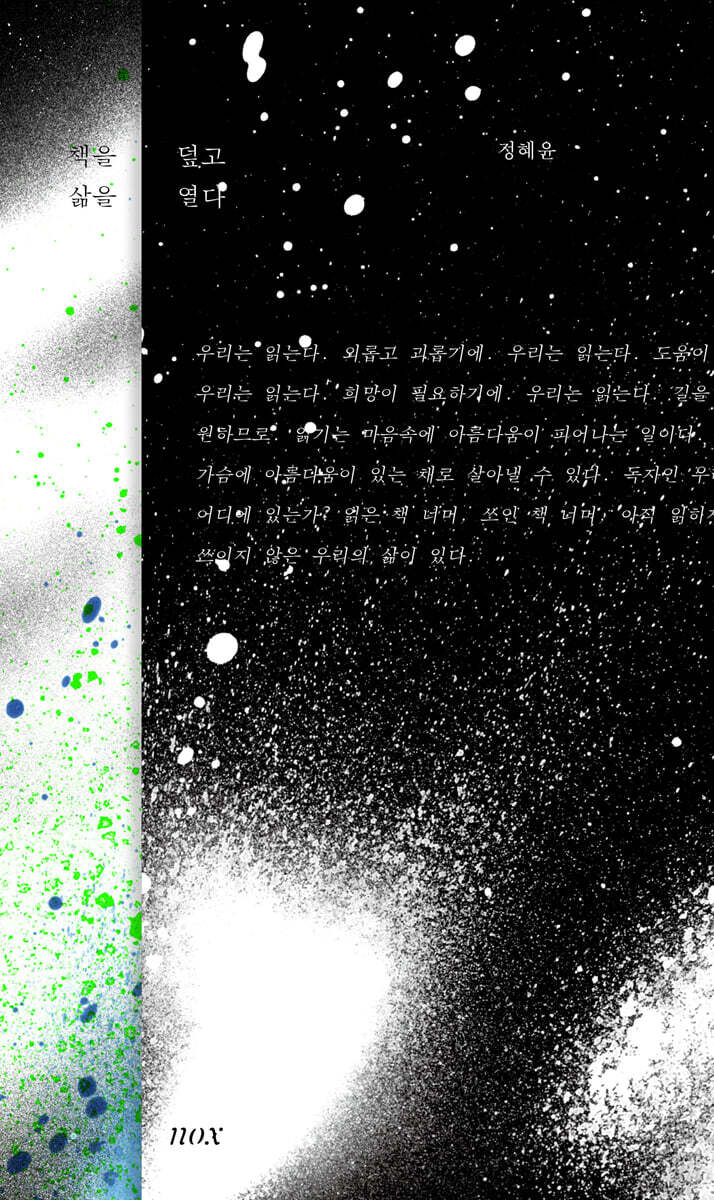
Close the book and open life
 |
Description
Book Introduction
- A word from MD
-
About the life-changing magic of readingA new work by author Jeong Hye-yoon.
Tells the story of the moment a book changed your life.
How underlined sentences and folded pages can become new perspectives in life, how books become the material of life.
In an age where information is readily available, we explore why we read.
October 17, 2025. Essay PD Lee Ju-eun
We read because we are lonely and miserable
We read because we need hope.
We read because we want to find our way.
Where is our life as readers?
Beyond the books read, beyond the books written,
There is a life of ours that has not yet been read or written.
A writer who deeply sympathizes with the fate of humans who live with tears flowing silently, hearts at a loss for words, and a large rock on their backs.
Author Jeong Hye-yoon, who ponders more deeply than anyone else the meaning of finding a glimmer of hope in all kinds of suffering, has published her new book, "Closing the Book and Opening Life."
If his previous works, "Joyful Words in a Sad World" and "The Invention of Life," imprinted upon us scenes we would never see again through the stories of people who quietly shine, "Closing the Book and Opening Life" is an essay about the moment when a book entered deep into one's heart and changed one's life forever.
It talks about how books can become the material of life, how underlined sentences, folded pages, and copied passages can open up new possibilities in life, and how you can tell your own life story by linking together sentences from other writers.
If a book is special, it is because we need it or love it, and for no other reason.
It is human passion that keeps old stories alive, and we accept the stories that humanity has reread countless times as part of our lives.
The reason the author calls this work, which sometimes seems meaningless and fleeting, “magic” is because, for him, reading is like taking a step forward and running towards another life.
This book contains moments of newly falling in love with something one had never noticed before, moments when one could not close one's heart to the world, moments when one rushed to the scene of a disaster, and among them, there is the wonder of a wider world that the author, who had become "my passion is forgetting myself" and was dragged out of "myself," discovered.
This book, created by author Jeong Hye-yoon, who has long provided us with immense comfort through her captivating writing, combines the most powerful material in her life, books, and offers an answer to the question of what kind of connection the feeble act of reading can create in this sad world.
We read because we need hope.
We read because we want to find our way.
Where is our life as readers?
Beyond the books read, beyond the books written,
There is a life of ours that has not yet been read or written.
A writer who deeply sympathizes with the fate of humans who live with tears flowing silently, hearts at a loss for words, and a large rock on their backs.
Author Jeong Hye-yoon, who ponders more deeply than anyone else the meaning of finding a glimmer of hope in all kinds of suffering, has published her new book, "Closing the Book and Opening Life."
If his previous works, "Joyful Words in a Sad World" and "The Invention of Life," imprinted upon us scenes we would never see again through the stories of people who quietly shine, "Closing the Book and Opening Life" is an essay about the moment when a book entered deep into one's heart and changed one's life forever.
It talks about how books can become the material of life, how underlined sentences, folded pages, and copied passages can open up new possibilities in life, and how you can tell your own life story by linking together sentences from other writers.
If a book is special, it is because we need it or love it, and for no other reason.
It is human passion that keeps old stories alive, and we accept the stories that humanity has reread countless times as part of our lives.
The reason the author calls this work, which sometimes seems meaningless and fleeting, “magic” is because, for him, reading is like taking a step forward and running towards another life.
This book contains moments of newly falling in love with something one had never noticed before, moments when one could not close one's heart to the world, moments when one rushed to the scene of a disaster, and among them, there is the wonder of a wider world that the author, who had become "my passion is forgetting myself" and was dragged out of "myself," discovered.
This book, created by author Jeong Hye-yoon, who has long provided us with immense comfort through her captivating writing, combines the most powerful material in her life, books, and offers an answer to the question of what kind of connection the feeble act of reading can create in this sad world.
- You can preview some of the book's contents.
Preview
index
One voice that keeps talking can stick in your mind - 7
The Ingredients of Life - 15
Journey of Transformation - 33
Sadness, Beauty, Fate - 71
How to Tell Your Life Story - 103
Together in the Darkness - 133
The Magic of Books, the Magic of Life - 169
The Ingredients of Life - 15
Journey of Transformation - 33
Sadness, Beauty, Fate - 71
How to Tell Your Life Story - 103
Together in the Darkness - 133
The Magic of Books, the Magic of Life - 169
Detailed image

Into the book
When reading a book, a thought or a sentence that is like a gift may come to mind.
A passage from a book you came across by chance, a line of poetry, a thought that suddenly came to mind, a word of love.
What is it about these things that makes them feel so precious? What is it about these fleeting things that stir our hearts? What is it about them that moves us and inspires us to do better, to overcome, to resolve? What is it about them that makes us try to transform them into life? Many thoughts race through my mind during this brief moment of respite.
If you have this mindset of 'Let the best thoughts move me,' it's like standing up with a small light.
Even after the break, thoughts that don't end, a voice that keeps talking can remain in your mind.
--- p.12
Some places become special because one person was there in a special way.
What completes the landscape is the story.
We go on trips, but our bodies also become the destinations.
Our lives are a port where countless lives flow in, but there are moments when we are a single, hazy light that we want to decipher from our travel destination.
The true landscape unfolds in our hearts.
--- pp.39-40
The mystery of life has been so powerfully ingrained in me that I now feel a sad sisterhood for the tired backs of strangers I glimpse, their hunched shoulders, their faces growing accustomed to disappointment, their closed shops, our stories that always go awry.
I have come to wish that all living things not only endure life, but also 'enjoy' it to the fullest.
That's not all I want.
I sincerely hope that you will not be discouraged and tremble in shame, that you will not hang your head and remain alone in the darkness, that you will not fall into hatred, that you will not lose your laughter and humor, that you will not suffer too much, that you will not misuse your strength, that you will not lose your dignity and life, that you will find your own abilities and joy, and that you will have the opportunity to love and be loved.
--- pp.56-57
This is a question about decline.
What if you once achieved something but now can't move forward? Can even that be a source of inspiration? To borrow Charlie Parker's words, "Music is your experience, your thoughts, your wisdom."
“If you haven’t lived with it, it will never come out of your saxophone.”
If you haven't put books to the test, if you haven't gone through your own little hell and heaven with them, if you haven't experienced them as salty, you can't go deep in life.
--- pp.76-77
If someone were to ask me, “What kind of stories do you like?” I would say I like “but beautiful” stories.
My heart responds to 'but beautiful' stories.
As a human being, you may suffer, you may be lonely, you may have sorrows that last a lifetime, you may not be understood, you may be afraid, your love may not come true, you may be insulted and shamed, things may rarely go your way… … .
But someone didn't fail.
Creating beauty.
--- p.90
I always connect the question of how to live with stories.
Knowing what stories I like means knowing what influences me.
'But Beautiful' touches the deepest part of my heart.
I call this part of the story that is touched upon the 'core of existence'.
What lies at the core of our being is what makes us who we are.
The mind makes a connection with destiny.
'But beautiful' has the power to change me.
It transforms me into a person full of love.
I love the beautiful self of a sad person.
No matter how heartbreaking something may be, beauty can still remain.
This is the most shining part of humanity.
I can't help but love you.
--- pp.90-91
In our lives, things either happen or don't happen.
What really matters is how you talk about it, how you find a way to talk about it.
When you change the way you talk, your life changes.
'Life is a way of telling everything about life', 'Life is a story about life', 'If there is no story about life, there is no life' - this is my thought, and also the thought of many writers.
As storytelling creatures, our job is to find our own stories, not to let others tell our stories for us, and to find ways to tell the best parts of ourselves.
--- p.111
In this way, my story becomes their story.
But there's something more important than just the emotion involved in reading a book, underlining it in colorful lines, folding the pages, adding notes, sticking Post-it notes, and copying them into a notebook.
What is it? Underlines, folded pages, and copied passages reveal our mental state.
The underlined sentences are the very words that each of our hearts needed.
It is the reader's own heart that admires and feels love on every page and wants not to miss anything.
The beauty of a book comes not only from the book itself, but also from the reader.
“One summer evening, I look at the river through the eyes of someone who has forgotten the worries of the world and is looking down across the riverbank.
[…] Let us go and find this man (it soon becomes clear that this man is ourselves).”
--- p.174
When someone who needs courage, someone who is afraid of the future, someone who is lost, someone who is discouraged, someone who is gripped by dark foreboding, discovers the power within a sentence and tries to sew up the wounds in their heart with that sentence as a red thread, when they make a promise to themselves with that sentence as their only friend, when they try to put that sentence into their life, the story does not end there.
To borrow John Berger's expression, "When a hungry person sees someone else eating, the story doesn't end there."
I gave this process my own name.
'Continuing the story'.
The reader becomes like the story he has connected.
The reader can find out who he wants to be, not who he was.
A passage from a book you came across by chance, a line of poetry, a thought that suddenly came to mind, a word of love.
What is it about these things that makes them feel so precious? What is it about these fleeting things that stir our hearts? What is it about them that moves us and inspires us to do better, to overcome, to resolve? What is it about them that makes us try to transform them into life? Many thoughts race through my mind during this brief moment of respite.
If you have this mindset of 'Let the best thoughts move me,' it's like standing up with a small light.
Even after the break, thoughts that don't end, a voice that keeps talking can remain in your mind.
--- p.12
Some places become special because one person was there in a special way.
What completes the landscape is the story.
We go on trips, but our bodies also become the destinations.
Our lives are a port where countless lives flow in, but there are moments when we are a single, hazy light that we want to decipher from our travel destination.
The true landscape unfolds in our hearts.
--- pp.39-40
The mystery of life has been so powerfully ingrained in me that I now feel a sad sisterhood for the tired backs of strangers I glimpse, their hunched shoulders, their faces growing accustomed to disappointment, their closed shops, our stories that always go awry.
I have come to wish that all living things not only endure life, but also 'enjoy' it to the fullest.
That's not all I want.
I sincerely hope that you will not be discouraged and tremble in shame, that you will not hang your head and remain alone in the darkness, that you will not fall into hatred, that you will not lose your laughter and humor, that you will not suffer too much, that you will not misuse your strength, that you will not lose your dignity and life, that you will find your own abilities and joy, and that you will have the opportunity to love and be loved.
--- pp.56-57
This is a question about decline.
What if you once achieved something but now can't move forward? Can even that be a source of inspiration? To borrow Charlie Parker's words, "Music is your experience, your thoughts, your wisdom."
“If you haven’t lived with it, it will never come out of your saxophone.”
If you haven't put books to the test, if you haven't gone through your own little hell and heaven with them, if you haven't experienced them as salty, you can't go deep in life.
--- pp.76-77
If someone were to ask me, “What kind of stories do you like?” I would say I like “but beautiful” stories.
My heart responds to 'but beautiful' stories.
As a human being, you may suffer, you may be lonely, you may have sorrows that last a lifetime, you may not be understood, you may be afraid, your love may not come true, you may be insulted and shamed, things may rarely go your way… … .
But someone didn't fail.
Creating beauty.
--- p.90
I always connect the question of how to live with stories.
Knowing what stories I like means knowing what influences me.
'But Beautiful' touches the deepest part of my heart.
I call this part of the story that is touched upon the 'core of existence'.
What lies at the core of our being is what makes us who we are.
The mind makes a connection with destiny.
'But beautiful' has the power to change me.
It transforms me into a person full of love.
I love the beautiful self of a sad person.
No matter how heartbreaking something may be, beauty can still remain.
This is the most shining part of humanity.
I can't help but love you.
--- pp.90-91
In our lives, things either happen or don't happen.
What really matters is how you talk about it, how you find a way to talk about it.
When you change the way you talk, your life changes.
'Life is a way of telling everything about life', 'Life is a story about life', 'If there is no story about life, there is no life' - this is my thought, and also the thought of many writers.
As storytelling creatures, our job is to find our own stories, not to let others tell our stories for us, and to find ways to tell the best parts of ourselves.
--- p.111
In this way, my story becomes their story.
But there's something more important than just the emotion involved in reading a book, underlining it in colorful lines, folding the pages, adding notes, sticking Post-it notes, and copying them into a notebook.
What is it? Underlines, folded pages, and copied passages reveal our mental state.
The underlined sentences are the very words that each of our hearts needed.
It is the reader's own heart that admires and feels love on every page and wants not to miss anything.
The beauty of a book comes not only from the book itself, but also from the reader.
“One summer evening, I look at the river through the eyes of someone who has forgotten the worries of the world and is looking down across the riverbank.
[…] Let us go and find this man (it soon becomes clear that this man is ourselves).”
--- p.174
When someone who needs courage, someone who is afraid of the future, someone who is lost, someone who is discouraged, someone who is gripped by dark foreboding, discovers the power within a sentence and tries to sew up the wounds in their heart with that sentence as a red thread, when they make a promise to themselves with that sentence as their only friend, when they try to put that sentence into their life, the story does not end there.
To borrow John Berger's expression, "When a hungry person sees someone else eating, the story doesn't end there."
I gave this process my own name.
'Continuing the story'.
The reader becomes like the story he has connected.
The reader can find out who he wants to be, not who he was.
--- pp.174-175
Publisher's Review
Reading a book written by someone who listens for a long time and writes with admiration
- Listen so you don't disappear, write so you don't forget
"Closing the Book and Opening Life" is a book about the voices that made Jeong Hye-yoon who she is today.
For decades, the author has worked as a radio producer, documenting the stories of storytellers who have held on to hope and joy even in the face of life-changing disasters.
In this book about books, the reason why the sentences of great writers such as Melville, Calvino, Dinesen, and Dyer flow together with the stories of citizens who stayed up all night in Namtaeryeong in the middle of winter, the families of the Sewol ferry victims who gathered at Muan Airport, and the navigators of deep-sea fishing boats who remember the face of a whale with tears streaming down its face is clear.
No matter how great a book is, it only gains value when it illuminates life.
For the author, the world is still a place with stories to tell, in that there are those who hold on to love even after losing it, and those who keep non-existent life alive in other ways.
The author knows well that discovering the words that bloom in the cracks of each person's life, each person's misfortune, each person's pain and sorrow is by no means a fleeting task.
Moments of Transformation
- 『Babette's Feast』, 『Moby Dick』, 『But Beautiful』, 『Horizon』… …
"Closing the Book and Opening Life" is a record of the author's moments of transformation through books and a tribute to the authors he loves.
The moment when I discovered the true meaning of freedom and art while looking into the hands of a genius chef in 'Babette's Feast'.
The moment I reread the classic book, Moby Dick, which I once read like a world travel guidebook, and was transformed into a person who knows how to be amazed.
A moment when I realized how to reframe reality when I can't move forward while reading Jeff Dyer's "But Beautiful."
The moment I read Calvino's work and learned how to move forward lightly without being crushed by the weight of reality.
The moment I decided to become “storytellers for one another,” following Barry Lopez, who wrote Horizon, to become a friend to those who have difficulty hearing.
By gathering these stories, the author's message is clear.
As storytelling animals, our mission is to “find our own stories, not let others tell them for us, and find ways to tell the best parts of ourselves.”
In this way, we can read the sentences of books, the stories of life, and find out not who we were, but who we want to be.
In this way, we become like the stories we tell, the stories we love.
Close the book and open life
- Find possibilities that didn't exist before reading
When a book exists only as a book, it is a confined world and the reader's self does not change.
Reading without change is just information.
In an age where information is readily available, what does it mean to read? The author describes reading as "a process of slow, gradual, and perhaps even eternal transformation as we embrace something unfamiliar, new, or enticing."
Therefore, in this book, the act of closing the book is an act of longing to stop being confined to words and to reach out into life and connect with others.
"No matter how meaningless life may seem, meaning can be found in connection, and the only way to change life is to connect with something.
Only the right connections can lighten the burden of life."
All books are ultimately stories about life.
And we follow the story.
Because when you change the way you talk, your life changes.
"Closing the Book and Opening Life" uses underlined sentences as friends, discovers the power within them, and talks about the changes in life that come when "you try to sew up the wounds in your heart with sentences as red thread."
- Listen so you don't disappear, write so you don't forget
"Closing the Book and Opening Life" is a book about the voices that made Jeong Hye-yoon who she is today.
For decades, the author has worked as a radio producer, documenting the stories of storytellers who have held on to hope and joy even in the face of life-changing disasters.
In this book about books, the reason why the sentences of great writers such as Melville, Calvino, Dinesen, and Dyer flow together with the stories of citizens who stayed up all night in Namtaeryeong in the middle of winter, the families of the Sewol ferry victims who gathered at Muan Airport, and the navigators of deep-sea fishing boats who remember the face of a whale with tears streaming down its face is clear.
No matter how great a book is, it only gains value when it illuminates life.
For the author, the world is still a place with stories to tell, in that there are those who hold on to love even after losing it, and those who keep non-existent life alive in other ways.
The author knows well that discovering the words that bloom in the cracks of each person's life, each person's misfortune, each person's pain and sorrow is by no means a fleeting task.
Moments of Transformation
- 『Babette's Feast』, 『Moby Dick』, 『But Beautiful』, 『Horizon』… …
"Closing the Book and Opening Life" is a record of the author's moments of transformation through books and a tribute to the authors he loves.
The moment when I discovered the true meaning of freedom and art while looking into the hands of a genius chef in 'Babette's Feast'.
The moment I reread the classic book, Moby Dick, which I once read like a world travel guidebook, and was transformed into a person who knows how to be amazed.
A moment when I realized how to reframe reality when I can't move forward while reading Jeff Dyer's "But Beautiful."
The moment I read Calvino's work and learned how to move forward lightly without being crushed by the weight of reality.
The moment I decided to become “storytellers for one another,” following Barry Lopez, who wrote Horizon, to become a friend to those who have difficulty hearing.
By gathering these stories, the author's message is clear.
As storytelling animals, our mission is to “find our own stories, not let others tell them for us, and find ways to tell the best parts of ourselves.”
In this way, we can read the sentences of books, the stories of life, and find out not who we were, but who we want to be.
In this way, we become like the stories we tell, the stories we love.
Close the book and open life
- Find possibilities that didn't exist before reading
When a book exists only as a book, it is a confined world and the reader's self does not change.
Reading without change is just information.
In an age where information is readily available, what does it mean to read? The author describes reading as "a process of slow, gradual, and perhaps even eternal transformation as we embrace something unfamiliar, new, or enticing."
Therefore, in this book, the act of closing the book is an act of longing to stop being confined to words and to reach out into life and connect with others.
"No matter how meaningless life may seem, meaning can be found in connection, and the only way to change life is to connect with something.
Only the right connections can lighten the burden of life."
All books are ultimately stories about life.
And we follow the story.
Because when you change the way you talk, your life changes.
"Closing the Book and Opening Life" uses underlined sentences as friends, discovers the power within them, and talks about the changes in life that come when "you try to sew up the wounds in your heart with sentences as red thread."
GOODS SPECIFICS
- Date of issue: October 10, 2025
- Page count, weight, size: 184 pages | 242g | 125*210*12mm
- ISBN13: 9791199405806
- ISBN10: 1199405809
You may also like
카테고리
korean


korean

![GQ KOREA Mark (Monthly): December [2025]](http://librairie.coreenne.fr/cdn/shop/files/8ef265dbbfbf186523ed75ba7319009d.jpg?v=1765340328&width=3840)


