

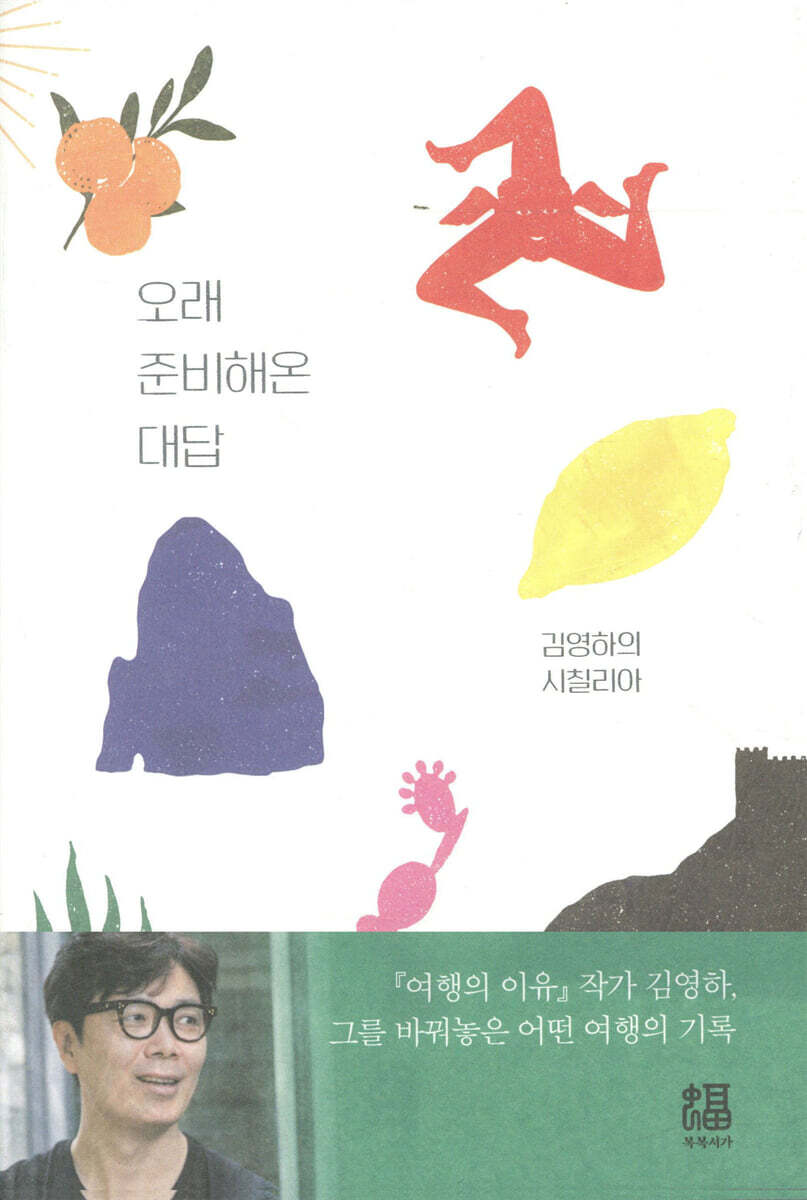
A long-prepared answer
 |
Description
Book Introduction
Kim Young-ha's full-fledged travel essay returns after a 10-year hiatus. "The Answer I've Been Preparing for a Long Time" is a book that vividly captures what novelist Kim Young-ha saw and felt while traveling in Sicily over 10 years ago. 『Remember What You Lost』, which was widely loved when it was first published in 2009, is being republished by Bokbok Publishing with a new cover and title. Through this revision, the author refined the sentences and content and included a wealth of photos taken during the trip. We added new chapters that were not included in the first edition to make reading more enjoyable. In the fall of 2007, the production team preparing to launch EBS's [World Theme Travel], which has now established itself as a long-running travel program, visited writer Kim Young-ha. When they asked the writer where he would like to travel, Kim Young-ha answered Sicily, as if it was an answer he had prepared for a long time. The author, who was teaching students at the Korea National University of Arts at the time, resigned from his professorship after visiting Sicily with them, packed up everything in Seoul, and left for Sicily again with his wife five months later. It was the beginning of a two and a half year wandering that would lead to Vancouver and New York. After many twists and turns, he finally arrives in Sicily, where he realizes why the place seemed like a 'long-prepared answer'. Warm people who approach you with affection, help you when you're having a hard time, and then disappear; a leisurely and relaxed life where no one is in a hurry; magnificent ruins and the Mediterranean Sea. There, the author recalls the past that made him a writer (“an archaeological exploration encountering the shining fragments of the past sunk in a dark bottle”) and also encounters the long-forgotten “young artist” within himself. |
- You can preview some of the book's contents.
Preview
index
Prologue To you who will one day get lost in Sicily
Where did the little artist inside me go?
First meeting
Sopresso, espresso
Lipari
Mediterranean Survival Recipes
Lipari Scooter Tour
The day I left Lipari
perfume
Medusa's Sea, Godfather's Land
Lions of Aquedolchi Beach
Castle in the Sky, Erice
The light is coming down like a harpoon
Memento Mori, Carpe Diem
temple
Society of the Dead Gods
Epilogue Remember What You Lost
Where did the little artist inside me go?
First meeting
Sopresso, espresso
Lipari
Mediterranean Survival Recipes
Lipari Scooter Tour
The day I left Lipari
perfume
Medusa's Sea, Godfather's Land
Lions of Aquedolchi Beach
Castle in the Sky, Erice
The light is coming down like a harpoon
Memento Mori, Carpe Diem
temple
Society of the Dead Gods
Epilogue Remember What You Lost
Publisher's Review
Kim Young-ha's full-fledged travel essay returns after a 10-year hiatus.
"The Answer I've Been Preparing for a Long Time" is a book that vividly captures what novelist Kim Young-ha saw and felt while traveling in Sicily over 10 years ago.
『Remember What You Lost』, which was widely loved when it was first published in 2009, is being republished by Bokbok Publishing with a new cover and title.
Through this revision, the author refined the sentences and content and included a wealth of photos taken during the trip.
We added new chapters that were not included in the first edition to make reading more enjoyable.
In the fall of 2007, the production team preparing to launch EBS's [World Theme Travel], which has now established itself as a long-running travel program, visited writer Kim Young-ha.
When they asked the writer where he would like to travel, Kim Young-ha answered Sicily, as if it was an answer he had prepared for a long time.
The author, who was teaching students at the Korea National University of Arts at the time, resigned from his professorship, packed up everything in Seoul, and left for Sicily again with his wife five months later after traveling to Sicily with them.
It was the beginning of a two and a half year wandering that would lead to Vancouver and New York.
After many twists and turns, he finally arrives in Sicily, where he realizes why the place seemed like a 'long-prepared answer'.
Warm people who approach you with affection, help you when you're having a hard time, and then disappear; a leisurely and relaxed life where no one is in a hurry; magnificent ruins and the Mediterranean Sea.
There, the author recalls the past that made him a writer (“an archaeological exploration encountering the shining fragments of the past sunk in a dark bottle”) and also encounters the long-forgotten “young artist” within himself.
I sat on the faded limestone steps of Syracuse, gazing at the distant, shimmering horizon of the Mediterranean, and recalled the radiant happiness I had experienced in the spring of my nineteenth year.
That day when we all wore the same colored t-shirts and raised our hands high while singing [Youth].
In such a case, travel becomes not a wandering to an unfamiliar place, but an archaeological exploration, a voyage into the inner self, encountering the shining fragments of the past sunk in dark bottles.
Sitting in the Greek theater of Taormina overlooking the sea, I timidly hum the song of that time.
The cheer song, which had simple lyrics repeated over and over again, so that even freshmen could easily learn it, ends like this.
You, you, you, you and I were young like the sun.
_Page 91 of the text
My last trip without a smartphone
They set off on their journey in 2008, just before smartphones became popular.
There was no Google Maps, no TripAdvisor, no Hotels.com.
They had to book hotels over public phones and find their way around using paper maps.
It was easy to get lost in the maze-like alleys of Italian cities, and the weather was so unpredictable that I often got caught in the rain.
Italian trains not only ran “when they wanted to, not according to schedule,” but were also frequently cancelled without warning.
Not knowing Italian, I mistook 'Soppresso' (cancellation) for 'Espresso' (express) and waited endlessly on the platform for a cancelled train.
Even crossing from Italy to Sicily was not an easy task.
But the author says that even during this arduous journey that did not go as planned, “I came to know with certainty and clarity, and with my own body, that Sicily is an island across the sea.”
Without smartphones, travelers rely on their senses and intuition to navigate life in unfamiliar places.
Every page of the book is filled with the tastes, scenery, textures, and smells of Sicily, experienced with the author's full senses.
At eight thirty in the morning, I go to the local bakery to buy bread.
The bakery is a minute away, and on the way to the bakery, there is a fruit shop run by brothers and sisters from the same family.
I always go out to buy bread, but when I come back, I also buy fruit.
The bread my wife and I eat doesn't cost more than 1 euro, but it's made with the famous Sicilian wheat, so it's incredibly delicious.
You can't just pass by the fruit shop where the fruits, tempered by the sun, give off a fragrant aroma.
The fruit shops here seem to pay considerable attention to the arrangement of colors.
Things like red and yellow oranges, green and purple grapes, and red strawberries are out on the road, giving off a sweet smell.
I finish my morning with some bread, coffee, and fruit, then go back to work or go for a walk.
Everything important is on Via Vittorio Emanuele.
This street has a bookstore selling mainly Italian books but also some English books and foreign newspapers, a small supermarket, a post office and bank branches, fruit and vegetable shops, cafes and restaurants, a bakery and clothing store, an optician and a church.
All of this was within a five-minute walk.
_Page 75 of the text
It is only now, long after I left Noto, that I ask.
Why are the people of Noto so serious about food?
Could it be because they are descendants of those who survived the great earthquake three hundred years ago? Why should they postpone the pleasure of enjoying sweet pistachio ice cream in a hot plaza, swept by the Saharan winds? After all, death might knock tomorrow.
_Page 247
A journey of humanistic thought along the majestic ruins
The book begins with an adventure story of an impromptu writer and his anxious wife, lost in an unfamiliar place and heading in an unexpected direction. However, as the book progresses, Kim Young-ha's characteristically captivating writing style and lively insights are added, drawing readers into a profound contemplation of human destiny and civilization.
Traveling through Sicily, the land of Archimedes, Plato, and Medusa, the author guides modern readers into the world of history, myth, and legend that permeates every corner of the island.
In Erice, which resembles a castle in the sky, the legend of Odysseus and the one-eyed monster Cyclops is told, and humanistic insights are provided that extend their story to thoughts on modern-day terrorism.
In Taormina, the theme of 'chain of revenge', which was triggered by the movie [The Godfather], is continued from the Greek tragedy [Oresteia] to Ismail Kadare and Salman Rushdie.
As the author prepares for re-publication after 10 years, he says, “The journey takes place in three stages.
It is completed once by planning and imagining the trip, once by actually traveling, and once by remembering and recording the trip.
When I published this book ten years ago, I thought all three of those journeys were over.
But as I received the proofs again, added or subtracted from the manuscript, and looked through the photos, I realized that the journey was not over yet and could begin again at any time,” he said.
Only after ten years had passed since the trip ended did the author realize that every journey begins like a 'long-prepared answer'.
Rereading the travelogue after realizing all the changes that have occurred to him over the past ten years will be a special gift not only to the author personally, but also to the many readers who love his writing style and insight.
Author's Note
Life is not long.
This is even more true when looking at books written in the past.
The feeling of writing it is still vivid, but when I look at the copyright page, it is already ten or fifteen years ago.
Those books are like messages sent from my past self to my present self.
Luckily, I'm still a writer and I make a living writing, but when I was writing this book, everything was uncertain.
In the proof copy I received from the editor, I am preparing to leave on a long journey with my wife.
We traveled to Sicily and returned home safely after two and a half years abroad, but we still didn't know it at the time.
I will go to live in Vancouver and New York, and even live in Busan for three more years after returning to Korea.
Now I know everything and can look back with a smile.
But that wasn't possible ten years ago when this book was written.
The iPhone was released in Korea the year this book was published.
So, this trip could be said to be the last trip I experienced before the smartphone era.
There was no Google Maps, no TripAdvisor, no Hotels.com.
We arrived at the location and made a reservation for a hotel for that night using a public phone.
My wife, sitting in the passenger seat of the rental car, looked at a paper map to find her way.
We often wandered off on strange paths and stopped at places that weren't on our itinerary.
It's been a decade since smartphones became a part of our lives, and now we can't lose them even if we want to.
Book everything, research it on YouTube, and read reviews from other travelers.
So sometimes I think back to those days when I traveled to unexpected places and made surprising discoveries.
Back then, there were no smartphones, and above all, I was young, and (or rather, because of that), I was fearless.
I've heard that people are still looking for this book since it went out of print a few years ago.
I am delighted to be able to republish it with a new cover and editing.
There have been big changes in my life since that trip.
I had my first experience living long-term away from this land, discovered the joy of cooking, and gained a clearer understanding of who I am.
It was a trip I decided to take with the feeling of hitting the jackpot, but once I actually set off, I found the trip itself to be great.
I want to share that feeling with new readers.
The revised edition includes a section that was omitted at the last minute from the original edition: a recipe for a local dish I clumsily tried in Sicily.
As I was editing and polishing the manuscript, my eyes lingered on a certain phrase.
A decade ago, it was something I would have simply overlooked. A scene where an EBS travel program producer came to me and asked where I wanted to travel, and I answered Sicily, as if it were a long-prepared answer.
If I think about it, many of my journeys started like that.
I have a country or city in mind and then forget about it for a while.
Then suddenly, for some reason, that place comes to mind again.
And when you come to your senses, you're already there.
Such a journey feels like the fulfillment of a predetermined destiny.
The title of the revised edition comes from this phrase.
To me, this book is like a letter from my past self, but I hope that for some readers, it could be like a promise to their future selves.
Anyone who reads this book will eventually travel to Sicily, and I guarantee you, they won't regret it.
April 2020
Kim Young-ha
"The Answer I've Been Preparing for a Long Time" is a book that vividly captures what novelist Kim Young-ha saw and felt while traveling in Sicily over 10 years ago.
『Remember What You Lost』, which was widely loved when it was first published in 2009, is being republished by Bokbok Publishing with a new cover and title.
Through this revision, the author refined the sentences and content and included a wealth of photos taken during the trip.
We added new chapters that were not included in the first edition to make reading more enjoyable.
In the fall of 2007, the production team preparing to launch EBS's [World Theme Travel], which has now established itself as a long-running travel program, visited writer Kim Young-ha.
When they asked the writer where he would like to travel, Kim Young-ha answered Sicily, as if it was an answer he had prepared for a long time.
The author, who was teaching students at the Korea National University of Arts at the time, resigned from his professorship, packed up everything in Seoul, and left for Sicily again with his wife five months later after traveling to Sicily with them.
It was the beginning of a two and a half year wandering that would lead to Vancouver and New York.
After many twists and turns, he finally arrives in Sicily, where he realizes why the place seemed like a 'long-prepared answer'.
Warm people who approach you with affection, help you when you're having a hard time, and then disappear; a leisurely and relaxed life where no one is in a hurry; magnificent ruins and the Mediterranean Sea.
There, the author recalls the past that made him a writer (“an archaeological exploration encountering the shining fragments of the past sunk in a dark bottle”) and also encounters the long-forgotten “young artist” within himself.
I sat on the faded limestone steps of Syracuse, gazing at the distant, shimmering horizon of the Mediterranean, and recalled the radiant happiness I had experienced in the spring of my nineteenth year.
That day when we all wore the same colored t-shirts and raised our hands high while singing [Youth].
In such a case, travel becomes not a wandering to an unfamiliar place, but an archaeological exploration, a voyage into the inner self, encountering the shining fragments of the past sunk in dark bottles.
Sitting in the Greek theater of Taormina overlooking the sea, I timidly hum the song of that time.
The cheer song, which had simple lyrics repeated over and over again, so that even freshmen could easily learn it, ends like this.
You, you, you, you and I were young like the sun.
_Page 91 of the text
My last trip without a smartphone
They set off on their journey in 2008, just before smartphones became popular.
There was no Google Maps, no TripAdvisor, no Hotels.com.
They had to book hotels over public phones and find their way around using paper maps.
It was easy to get lost in the maze-like alleys of Italian cities, and the weather was so unpredictable that I often got caught in the rain.
Italian trains not only ran “when they wanted to, not according to schedule,” but were also frequently cancelled without warning.
Not knowing Italian, I mistook 'Soppresso' (cancellation) for 'Espresso' (express) and waited endlessly on the platform for a cancelled train.
Even crossing from Italy to Sicily was not an easy task.
But the author says that even during this arduous journey that did not go as planned, “I came to know with certainty and clarity, and with my own body, that Sicily is an island across the sea.”
Without smartphones, travelers rely on their senses and intuition to navigate life in unfamiliar places.
Every page of the book is filled with the tastes, scenery, textures, and smells of Sicily, experienced with the author's full senses.
At eight thirty in the morning, I go to the local bakery to buy bread.
The bakery is a minute away, and on the way to the bakery, there is a fruit shop run by brothers and sisters from the same family.
I always go out to buy bread, but when I come back, I also buy fruit.
The bread my wife and I eat doesn't cost more than 1 euro, but it's made with the famous Sicilian wheat, so it's incredibly delicious.
You can't just pass by the fruit shop where the fruits, tempered by the sun, give off a fragrant aroma.
The fruit shops here seem to pay considerable attention to the arrangement of colors.
Things like red and yellow oranges, green and purple grapes, and red strawberries are out on the road, giving off a sweet smell.
I finish my morning with some bread, coffee, and fruit, then go back to work or go for a walk.
Everything important is on Via Vittorio Emanuele.
This street has a bookstore selling mainly Italian books but also some English books and foreign newspapers, a small supermarket, a post office and bank branches, fruit and vegetable shops, cafes and restaurants, a bakery and clothing store, an optician and a church.
All of this was within a five-minute walk.
_Page 75 of the text
It is only now, long after I left Noto, that I ask.
Why are the people of Noto so serious about food?
Could it be because they are descendants of those who survived the great earthquake three hundred years ago? Why should they postpone the pleasure of enjoying sweet pistachio ice cream in a hot plaza, swept by the Saharan winds? After all, death might knock tomorrow.
_Page 247
A journey of humanistic thought along the majestic ruins
The book begins with an adventure story of an impromptu writer and his anxious wife, lost in an unfamiliar place and heading in an unexpected direction. However, as the book progresses, Kim Young-ha's characteristically captivating writing style and lively insights are added, drawing readers into a profound contemplation of human destiny and civilization.
Traveling through Sicily, the land of Archimedes, Plato, and Medusa, the author guides modern readers into the world of history, myth, and legend that permeates every corner of the island.
In Erice, which resembles a castle in the sky, the legend of Odysseus and the one-eyed monster Cyclops is told, and humanistic insights are provided that extend their story to thoughts on modern-day terrorism.
In Taormina, the theme of 'chain of revenge', which was triggered by the movie [The Godfather], is continued from the Greek tragedy [Oresteia] to Ismail Kadare and Salman Rushdie.
As the author prepares for re-publication after 10 years, he says, “The journey takes place in three stages.
It is completed once by planning and imagining the trip, once by actually traveling, and once by remembering and recording the trip.
When I published this book ten years ago, I thought all three of those journeys were over.
But as I received the proofs again, added or subtracted from the manuscript, and looked through the photos, I realized that the journey was not over yet and could begin again at any time,” he said.
Only after ten years had passed since the trip ended did the author realize that every journey begins like a 'long-prepared answer'.
Rereading the travelogue after realizing all the changes that have occurred to him over the past ten years will be a special gift not only to the author personally, but also to the many readers who love his writing style and insight.
Author's Note
Life is not long.
This is even more true when looking at books written in the past.
The feeling of writing it is still vivid, but when I look at the copyright page, it is already ten or fifteen years ago.
Those books are like messages sent from my past self to my present self.
Luckily, I'm still a writer and I make a living writing, but when I was writing this book, everything was uncertain.
In the proof copy I received from the editor, I am preparing to leave on a long journey with my wife.
We traveled to Sicily and returned home safely after two and a half years abroad, but we still didn't know it at the time.
I will go to live in Vancouver and New York, and even live in Busan for three more years after returning to Korea.
Now I know everything and can look back with a smile.
But that wasn't possible ten years ago when this book was written.
The iPhone was released in Korea the year this book was published.
So, this trip could be said to be the last trip I experienced before the smartphone era.
There was no Google Maps, no TripAdvisor, no Hotels.com.
We arrived at the location and made a reservation for a hotel for that night using a public phone.
My wife, sitting in the passenger seat of the rental car, looked at a paper map to find her way.
We often wandered off on strange paths and stopped at places that weren't on our itinerary.
It's been a decade since smartphones became a part of our lives, and now we can't lose them even if we want to.
Book everything, research it on YouTube, and read reviews from other travelers.
So sometimes I think back to those days when I traveled to unexpected places and made surprising discoveries.
Back then, there were no smartphones, and above all, I was young, and (or rather, because of that), I was fearless.
I've heard that people are still looking for this book since it went out of print a few years ago.
I am delighted to be able to republish it with a new cover and editing.
There have been big changes in my life since that trip.
I had my first experience living long-term away from this land, discovered the joy of cooking, and gained a clearer understanding of who I am.
It was a trip I decided to take with the feeling of hitting the jackpot, but once I actually set off, I found the trip itself to be great.
I want to share that feeling with new readers.
The revised edition includes a section that was omitted at the last minute from the original edition: a recipe for a local dish I clumsily tried in Sicily.
As I was editing and polishing the manuscript, my eyes lingered on a certain phrase.
A decade ago, it was something I would have simply overlooked. A scene where an EBS travel program producer came to me and asked where I wanted to travel, and I answered Sicily, as if it were a long-prepared answer.
If I think about it, many of my journeys started like that.
I have a country or city in mind and then forget about it for a while.
Then suddenly, for some reason, that place comes to mind again.
And when you come to your senses, you're already there.
Such a journey feels like the fulfillment of a predetermined destiny.
The title of the revised edition comes from this phrase.
To me, this book is like a letter from my past self, but I hope that for some readers, it could be like a promise to their future selves.
Anyone who reads this book will eventually travel to Sicily, and I guarantee you, they won't regret it.
April 2020
Kim Young-ha
GOODS SPECIFICS
- Publication date: April 29, 2020
- Page count, weight, size: 300 pages | 444g | 138*203*20mm
- ISBN13: 9791197021602
- ISBN10: 1197021604
You may also like
카테고리
korean


korean

![GQ KOREA Mark (Monthly): December [2025]](http://librairie.coreenne.fr/cdn/shop/files/8ef265dbbfbf186523ed75ba7319009d.jpg?v=1765340328&width=3840)


