

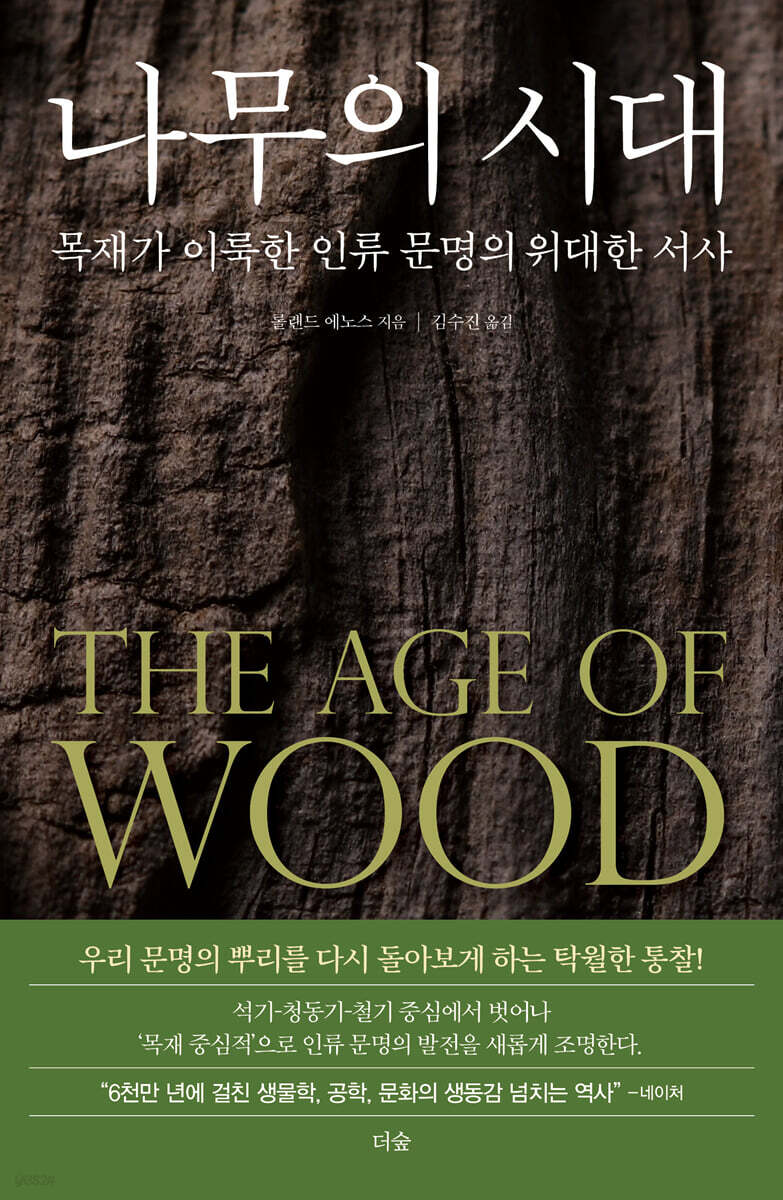
The Age of Trees
 |
Description
Book Introduction
- A word from MD
-
A History of Human Civilization Centered on Trees“The history of mankind is the history of trees.” Trees are the most common, yet most overlooked creatures.
A narrative of human civilization that is illuminated anew, focusing on this.
It restores the role trees have played in all aspects of civilization, including evolution, technology, society, architecture, and the environment, and shows the traces of trees in human history in a broad and detailed manner.
September 19, 2025. History PD Ahn Hyun-jae
A brilliant insight that makes us revisit the roots of our civilization!
Breaking away from the Stone Age, Bronze Age, and Iron Age
Shedding new light on the development of human civilization through a 'wood-centered' approach.
“A vibrant and vast history of biology, engineering, and culture spanning 60 million years” - Nature
This book on human civilization takes a step beyond the traditional narrative that divides human history into three materials: stone, bronze, and iron, and sheds new light on it from the perspective of "wood," arguably the most familiar and useful material to human civilization.
This book, which explores and analyzes the role trees have played in the evolution of mankind, the rise and fall of civilizations, and the creation of the world as it is today, received praise and attention from global media and academic journals such as the Washington Post, the New York Times, the Wall Street Journal, and Nature immediately after its publication.
Since leaving the trees and coming down to the ground, mankind has made remarkable progress.
But how did the descendants of small primates succeed in walking upright, become apex predators, and command the world? How did humanity develop civilization and give birth to a global economy?
This book shows for the first time that the key to humanity's success lies in our relationship with trees.
Beyond the simple 'history of trees,' it illuminates in a three-dimensional way how trees have guided human evolution, technology, society, architecture, and the environment, and persuasively explains how our ability to utilize the unique properties of 'trees as wood' has fundamentally shaped our bodies, minds, societies, and lives.
Breaking away from the Stone Age, Bronze Age, and Iron Age
Shedding new light on the development of human civilization through a 'wood-centered' approach.
“A vibrant and vast history of biology, engineering, and culture spanning 60 million years” - Nature
This book on human civilization takes a step beyond the traditional narrative that divides human history into three materials: stone, bronze, and iron, and sheds new light on it from the perspective of "wood," arguably the most familiar and useful material to human civilization.
This book, which explores and analyzes the role trees have played in the evolution of mankind, the rise and fall of civilizations, and the creation of the world as it is today, received praise and attention from global media and academic journals such as the Washington Post, the New York Times, the Wall Street Journal, and Nature immediately after its publication.
Since leaving the trees and coming down to the ground, mankind has made remarkable progress.
But how did the descendants of small primates succeed in walking upright, become apex predators, and command the world? How did humanity develop civilization and give birth to a global economy?
This book shows for the first time that the key to humanity's success lies in our relationship with trees.
Beyond the simple 'history of trees,' it illuminates in a three-dimensional way how trees have guided human evolution, technology, society, architecture, and the environment, and persuasively explains how our ability to utilize the unique properties of 'trees as wood' has fundamentally shaped our bodies, minds, societies, and lives.
- You can preview some of the book's contents.
Preview
index
Prologue: Another Era Missed by Stone, Bronze, and Iron: Wood
PART 1: WOOD AND HUMAN EVOLUTION
Chapter 1: The Legacy of Treetop Life
A great ape that knew how to use the mechanism of tree branches
Chimpanzees are the most adept and ingenious users of wooden tools.
The process by which human tree climbing evolved into quadrupedal locomotion
Chapter 2 Coming Down from the Tree
Early hominins who understood the superior mechanical properties of wood
How did early humans get down into the trees?
Chapter 3: Losing Hair
The fallacy of the hunting hypothesis for securing prey
The theory of ectoparasites due to group barrack life
Chapter 4 Arming Yourself with Tools
The development of wooden tools and the advancement of human intelligence
The wooden bow was the most preferred weapon of hunters.
PART 2 Building a Civilization
Chapter 5 Clearing the Forest
Ships born from new woodworking techniques
Abandon the hunting and gathering lifestyle and begin farming
Building a house using sophisticated woodworking techniques
Evidence showing the Neolithic people's forestry work
Chapter 6 Melting and Smelting
The advent of the era of combined use of gold and stone
The development of shipbuilding and trade in the Early Bronze Age
The first appearance of the wheel
Chapter 7: Building a Human Community
Great advances in wooden architecture
Why the tradition of woodworking with raw wood has been maintained
Tools for effectively handling wood, such as saws and planes
A new woodworking technique for creating curved timber
Chapter 8: Gifting Life with Luxuries
Wooden products that have become more elaborate to be loved by the rich
Musical instruments born from the superior mechanical properties of wood
Chapter 9: Supporting Human Vain Ambition
Tricks of ancient architects to build strong roofs
Colorful variations of wooden roof trusses
Wooden buildings are more resistant to cold and earthquakes than stone buildings.
Chapter 10: Limiting Our Vision
A power struggle that led to a stagnation in woodworking technology
The correlation between wood production and technological progress
Securing timber transport routes and urban growth
Efforts to resolve wood warping
PART 3 Wood in the Industrial Age
Chapter 11: Coal Replaces Firewood and Charcoal
Industrial expansion and development of applied science
A stable coal supply fuels growth in diverse manufacturing industries.
The development of iron and steel production using coal-fired furnaces and steam engines
European countries and the New World that improved the fuel efficiency of wood
Chapter 12 Wood in the 19th Century
Wrought iron used to build stronger structures
The pulley factory that became a stepping stone for the Industrial Revolution
The emergence of a revolutionary wood joining device, the nail
The paradigm shift brought about by wood pulp
Chapter 13 Wood in the Modern World
New industrial materials that replace wood
New plastic material to replace wood for small items
Wood, a new material used in aircraft manufacturing
Various uses of moisture-resistant plywood
Wood production and usage increases year after year
PART 4 Facing the Price
Chapter 14: Evaluating Our Impact
The loophole in the deforestation myth
Patterns in which humans have utilized trees and forests
drastic reduction of 'primitive forests' and 'old-growth forests'
The problem of rapid forest loss and plantation forestry
Chapter 15: Repairing Broken Relationships
Reducing knowledge of forests and trees to outdated trash
The Benefits of Urban Trees: Why We Need to Reforest the Earth
Photo gallery
Acknowledgements
Reference books
PART 1: WOOD AND HUMAN EVOLUTION
Chapter 1: The Legacy of Treetop Life
A great ape that knew how to use the mechanism of tree branches
Chimpanzees are the most adept and ingenious users of wooden tools.
The process by which human tree climbing evolved into quadrupedal locomotion
Chapter 2 Coming Down from the Tree
Early hominins who understood the superior mechanical properties of wood
How did early humans get down into the trees?
Chapter 3: Losing Hair
The fallacy of the hunting hypothesis for securing prey
The theory of ectoparasites due to group barrack life
Chapter 4 Arming Yourself with Tools
The development of wooden tools and the advancement of human intelligence
The wooden bow was the most preferred weapon of hunters.
PART 2 Building a Civilization
Chapter 5 Clearing the Forest
Ships born from new woodworking techniques
Abandon the hunting and gathering lifestyle and begin farming
Building a house using sophisticated woodworking techniques
Evidence showing the Neolithic people's forestry work
Chapter 6 Melting and Smelting
The advent of the era of combined use of gold and stone
The development of shipbuilding and trade in the Early Bronze Age
The first appearance of the wheel
Chapter 7: Building a Human Community
Great advances in wooden architecture
Why the tradition of woodworking with raw wood has been maintained
Tools for effectively handling wood, such as saws and planes
A new woodworking technique for creating curved timber
Chapter 8: Gifting Life with Luxuries
Wooden products that have become more elaborate to be loved by the rich
Musical instruments born from the superior mechanical properties of wood
Chapter 9: Supporting Human Vain Ambition
Tricks of ancient architects to build strong roofs
Colorful variations of wooden roof trusses
Wooden buildings are more resistant to cold and earthquakes than stone buildings.
Chapter 10: Limiting Our Vision
A power struggle that led to a stagnation in woodworking technology
The correlation between wood production and technological progress
Securing timber transport routes and urban growth
Efforts to resolve wood warping
PART 3 Wood in the Industrial Age
Chapter 11: Coal Replaces Firewood and Charcoal
Industrial expansion and development of applied science
A stable coal supply fuels growth in diverse manufacturing industries.
The development of iron and steel production using coal-fired furnaces and steam engines
European countries and the New World that improved the fuel efficiency of wood
Chapter 12 Wood in the 19th Century
Wrought iron used to build stronger structures
The pulley factory that became a stepping stone for the Industrial Revolution
The emergence of a revolutionary wood joining device, the nail
The paradigm shift brought about by wood pulp
Chapter 13 Wood in the Modern World
New industrial materials that replace wood
New plastic material to replace wood for small items
Wood, a new material used in aircraft manufacturing
Various uses of moisture-resistant plywood
Wood production and usage increases year after year
PART 4 Facing the Price
Chapter 14: Evaluating Our Impact
The loophole in the deforestation myth
Patterns in which humans have utilized trees and forests
drastic reduction of 'primitive forests' and 'old-growth forests'
The problem of rapid forest loss and plantation forestry
Chapter 15: Repairing Broken Relationships
Reducing knowledge of forests and trees to outdated trash
The Benefits of Urban Trees: Why We Need to Reforest the Earth
Photo gallery
Acknowledgements
Reference books
Detailed image

Into the book
Wood has clearly been a central material throughout human history.
Wood has been a key material that has supported humanity's grand evolution and journey of civilization.
From the apes roaming the forests, to the hunter-gatherers throwing spears, to the farmers swinging axes, to the carpenters putting up roofs, to the scholars reading paper books, wood has always been with us.
(…) Now is the time to shed new light on the role of wood.
This book seeks to reinterpret human evolution, prehistoric times, and historical periods based on the relationship between wood, arguably the world's most versatile material, and humanity.
In academic terms, this could be called a kind of 'lignocentric perspective'.
Looking at the world from this perspective, with wood at its center, gives us new insights into who we are, where we came from, and where we are going.
--- From the "Prologue"
Sleeping inside a hut can make you feel about 4.4 to 5.6 degrees Celsius warmer than sleeping outside.
This is enough to get a comfortable night's sleep.
The main reason for this result is that the hut blocked the indoor airflow and thus blocked the cold night sky.
Therefore, the reason why hair could disappear from the bodies of early humans was because they slept in tree huts.
As a result, we have come to rely much more heavily on practical woodworking techniques.
This technology allowed them to make fire, build ever more elaborate shelters, and later use other materials to make paper and cloth.
Paradoxically, becoming more adept at these activities may have allowed them to expand their habitats to cooler climates.
By losing hair, humans became more ingenious and reliant on intelligence to manipulate their environment, rather than adapting to it like other animals.
This allowed humans, originally weak primates, to conquer the world.
--- From "Chapter 3: Losing Hair"
Over the three thousand years since the discovery of iron smelting, ironwork has contributed to a world where wooden artifacts are found everywhere.
However, each technique was time-consuming and required a high level of mechanical skill and specialized knowledge.
As a result, a large number of skilled craftsmen emerged in the woodworking field.
This can be seen by looking at how many common surnames originated from wood-related occupations.
Not only Carpenters and Joiners, but also Wrights, Wheelwrights, Shipwrights, Wainwrights, Bodgers, Bowyers, Fletchers, Turners, Bowlers, Coopers, Sawyers, Foresters, and Colliers.
Moreover, Masons used wooden-handled tools, and Millers lived and worked in wooden watermills and windmills.
Glaziers, potters, and smiths of all kinds used charcoal to fire their kilns.
As such, the Iron Age was a time when wood dominated people's lives.
And that world continued until just 200 years ago.
--- From Chapter 7, Building a Human Community
The rich and powerful, despite their love of music, lived in a world far less dominated by wood than the poor.
It is truly paradoxical that their way of life required much greater consumption of wood.
To make pottery and glass, which required smelting and firing multiple times to complete the metalwork they used, they would have needed vast quantities of wood and charcoal made from wood.
Like the story of the grumpy dog in the manger in Aesop's fables, the rich did not want to use ordinary wood, but they used that wood to produce other expensive materials, making it impossible for the poor to use wood.
The poor would have had to shiver in the cold and not have been able to find shelter, as the rich lived surrounded by beauty and luxury.
--- From Chapter 8, “Gifting Luxuries to Life”
Forests around the world are currently facing difficult times.
Yet, there are still over 3 trillion trees on Earth, covering more than 30% of the planet.
We need to understand how we have historically affected trees in the past and how we are still affecting them today.
Then, armed with this knowledge, we must take action.
We must stop allowing multinational corporations to encroach further on our heritage.
We must prevent foresters from further damaging our remaining forest areas.
There are essential steps that must be taken when launching such a campaign.
First, we need to correct the distorted relationship between us and trees, forests, and the wood they produce.
Wood has been a key material that has supported humanity's grand evolution and journey of civilization.
From the apes roaming the forests, to the hunter-gatherers throwing spears, to the farmers swinging axes, to the carpenters putting up roofs, to the scholars reading paper books, wood has always been with us.
(…) Now is the time to shed new light on the role of wood.
This book seeks to reinterpret human evolution, prehistoric times, and historical periods based on the relationship between wood, arguably the world's most versatile material, and humanity.
In academic terms, this could be called a kind of 'lignocentric perspective'.
Looking at the world from this perspective, with wood at its center, gives us new insights into who we are, where we came from, and where we are going.
--- From the "Prologue"
Sleeping inside a hut can make you feel about 4.4 to 5.6 degrees Celsius warmer than sleeping outside.
This is enough to get a comfortable night's sleep.
The main reason for this result is that the hut blocked the indoor airflow and thus blocked the cold night sky.
Therefore, the reason why hair could disappear from the bodies of early humans was because they slept in tree huts.
As a result, we have come to rely much more heavily on practical woodworking techniques.
This technology allowed them to make fire, build ever more elaborate shelters, and later use other materials to make paper and cloth.
Paradoxically, becoming more adept at these activities may have allowed them to expand their habitats to cooler climates.
By losing hair, humans became more ingenious and reliant on intelligence to manipulate their environment, rather than adapting to it like other animals.
This allowed humans, originally weak primates, to conquer the world.
--- From "Chapter 3: Losing Hair"
Over the three thousand years since the discovery of iron smelting, ironwork has contributed to a world where wooden artifacts are found everywhere.
However, each technique was time-consuming and required a high level of mechanical skill and specialized knowledge.
As a result, a large number of skilled craftsmen emerged in the woodworking field.
This can be seen by looking at how many common surnames originated from wood-related occupations.
Not only Carpenters and Joiners, but also Wrights, Wheelwrights, Shipwrights, Wainwrights, Bodgers, Bowyers, Fletchers, Turners, Bowlers, Coopers, Sawyers, Foresters, and Colliers.
Moreover, Masons used wooden-handled tools, and Millers lived and worked in wooden watermills and windmills.
Glaziers, potters, and smiths of all kinds used charcoal to fire their kilns.
As such, the Iron Age was a time when wood dominated people's lives.
And that world continued until just 200 years ago.
--- From Chapter 7, Building a Human Community
The rich and powerful, despite their love of music, lived in a world far less dominated by wood than the poor.
It is truly paradoxical that their way of life required much greater consumption of wood.
To make pottery and glass, which required smelting and firing multiple times to complete the metalwork they used, they would have needed vast quantities of wood and charcoal made from wood.
Like the story of the grumpy dog in the manger in Aesop's fables, the rich did not want to use ordinary wood, but they used that wood to produce other expensive materials, making it impossible for the poor to use wood.
The poor would have had to shiver in the cold and not have been able to find shelter, as the rich lived surrounded by beauty and luxury.
--- From Chapter 8, “Gifting Luxuries to Life”
Forests around the world are currently facing difficult times.
Yet, there are still over 3 trillion trees on Earth, covering more than 30% of the planet.
We need to understand how we have historically affected trees in the past and how we are still affecting them today.
Then, armed with this knowledge, we must take action.
We must stop allowing multinational corporations to encroach further on our heritage.
We must prevent foresters from further damaging our remaining forest areas.
There are essential steps that must be taken when launching such a campaign.
First, we need to correct the distorted relationship between us and trees, forests, and the wood they produce.
--- From Chapter 14, “Evaluating Our Impact”
Publisher's Review
The evolution of humanity, the rise and fall of civilizations, and the creation of today's world.
A meticulous restoration of the grand story of civilization written by trees!
The author takes us on a journey spanning over 60 million years, unraveling a vast story about the history of civilization and the remarkable role trees and wood have played in our culture, technology, and environment.
Wood has clearly been a central material throughout human history, from the time we came down to the earth to live.
So what was the key that led humanity down from the trees? The author suggests that fortunately, harnessing two of wood's most useful properties played a significant role.
The first step is that early humans took advantage of the property of wood to harden as it dries.
As a result, they were able to create sticks to use for digging the ground, which gave them access to a new food source.
This means that they can dig up the underground storage organs of plants and eat them.
In the second stage, early members of the genus Homo, like us, took advantage of the flammability of dry wood.
Thanks to fire, we could protect ourselves from predators and cook our food.
Ultimately, it is our rapidly growing relationship with wood, a material derived from trees, that paradoxically helped us move beyond trees.
The grand story of the civilizations created by trees and timber around the world makes us think again about the essence of human civilization.
In Southeast Asia and West Africa, the need to roam the trees and make tools stimulated the brains of great apes.
In China and Japan, the Forbidden City, the world's largest palace that has stood for over 600 years, and the five-story pagoda of Horyu-ji Temple, built around 600 AD, have withstood frequent earthquakes, while in Europe, wood was transformed into violins and pianos and provided paper for books and newspapers.
Britain built its empire on wooden ships, and the new nations of 19th-century America relied on vast forests to build houses, railroads, cattle pens, and bridges.
The role of wood was not only positive.
The development of wooden weapons has made us apex predators, and has also led to mass extinction in the world around us.
Before we even learned how to change the environment through agriculture, we killed and destroyed large animals using wooden tools.
In Europe, the mammoth, woolly rhinoceros, and megaloceros (giant reindeer) disappeared; in Asia, the giant orangutan; in North America, the mastodon, horse, and tapir; in South America, the ground sloth and giant armadillo; and in Australia, the giant wombat (diprotodon) and giant kangaroo disappeared from the Earth.
And that's not all.
This can be seen by looking at the English victories over France in the Battles of Crécy and Agincourt, which were representative of the Hundred Years' War.
As exemplified by the longbow made of yew, which can be considered the pinnacle of wooden bows, wooden bows were truly the most effective weapon of mass destruction in the world until the 15th century.
A groundbreaking humanities book that explores nature, technology, history, and evolution!
You will experience a network of knowledge that is interconnected and expanding.
By meticulously weaving together knowledge and recent research findings from a wide range of fields, including primatology, anthropology, archaeology, history, architecture, engineering, and woodworking, the scale of the story is grand, and the knowledge and insight it fills are profound.
The narrative, centered around wood, provides a broad and detailed look at the role trees have played throughout human history, from primitive humans' tree-based lifestyle to modern industrial society.
The author unravels the scientific principles of wood from the perspectives of biology and materials science, while also illustrating, through fascinating examples, how wood has driven technological innovation and social change throughout history and culture.
This interdisciplinary convergence is not a simple list of knowledge, but a narrative intricately woven from research achievements and cutting-edge research findings from various fields.
The book's greatest strength lies in its deep knowledge and its perfect balance of scientific evidence and humanistic narrative.
The author's captivating sentences and tight structure here never compromise readability despite the extensive content.
As readers turn the pages, they experience not fragments of information, but a network of interconnected and expanding knowledge.
For modern readers accustomed to simple and fragmented knowledge, this book reminds us of the importance of convergence of ideas and diverse perspectives.
This book not only broadens your perspective on trees, but also has the power to make you reflect anew on the relationship between nature and humanity, and the future of civilization.
A masterpiece recommended to all who love history, science, and the humanities.
A meticulous restoration of the grand story of civilization written by trees!
The author takes us on a journey spanning over 60 million years, unraveling a vast story about the history of civilization and the remarkable role trees and wood have played in our culture, technology, and environment.
Wood has clearly been a central material throughout human history, from the time we came down to the earth to live.
So what was the key that led humanity down from the trees? The author suggests that fortunately, harnessing two of wood's most useful properties played a significant role.
The first step is that early humans took advantage of the property of wood to harden as it dries.
As a result, they were able to create sticks to use for digging the ground, which gave them access to a new food source.
This means that they can dig up the underground storage organs of plants and eat them.
In the second stage, early members of the genus Homo, like us, took advantage of the flammability of dry wood.
Thanks to fire, we could protect ourselves from predators and cook our food.
Ultimately, it is our rapidly growing relationship with wood, a material derived from trees, that paradoxically helped us move beyond trees.
The grand story of the civilizations created by trees and timber around the world makes us think again about the essence of human civilization.
In Southeast Asia and West Africa, the need to roam the trees and make tools stimulated the brains of great apes.
In China and Japan, the Forbidden City, the world's largest palace that has stood for over 600 years, and the five-story pagoda of Horyu-ji Temple, built around 600 AD, have withstood frequent earthquakes, while in Europe, wood was transformed into violins and pianos and provided paper for books and newspapers.
Britain built its empire on wooden ships, and the new nations of 19th-century America relied on vast forests to build houses, railroads, cattle pens, and bridges.
The role of wood was not only positive.
The development of wooden weapons has made us apex predators, and has also led to mass extinction in the world around us.
Before we even learned how to change the environment through agriculture, we killed and destroyed large animals using wooden tools.
In Europe, the mammoth, woolly rhinoceros, and megaloceros (giant reindeer) disappeared; in Asia, the giant orangutan; in North America, the mastodon, horse, and tapir; in South America, the ground sloth and giant armadillo; and in Australia, the giant wombat (diprotodon) and giant kangaroo disappeared from the Earth.
And that's not all.
This can be seen by looking at the English victories over France in the Battles of Crécy and Agincourt, which were representative of the Hundred Years' War.
As exemplified by the longbow made of yew, which can be considered the pinnacle of wooden bows, wooden bows were truly the most effective weapon of mass destruction in the world until the 15th century.
A groundbreaking humanities book that explores nature, technology, history, and evolution!
You will experience a network of knowledge that is interconnected and expanding.
By meticulously weaving together knowledge and recent research findings from a wide range of fields, including primatology, anthropology, archaeology, history, architecture, engineering, and woodworking, the scale of the story is grand, and the knowledge and insight it fills are profound.
The narrative, centered around wood, provides a broad and detailed look at the role trees have played throughout human history, from primitive humans' tree-based lifestyle to modern industrial society.
The author unravels the scientific principles of wood from the perspectives of biology and materials science, while also illustrating, through fascinating examples, how wood has driven technological innovation and social change throughout history and culture.
This interdisciplinary convergence is not a simple list of knowledge, but a narrative intricately woven from research achievements and cutting-edge research findings from various fields.
The book's greatest strength lies in its deep knowledge and its perfect balance of scientific evidence and humanistic narrative.
The author's captivating sentences and tight structure here never compromise readability despite the extensive content.
As readers turn the pages, they experience not fragments of information, but a network of interconnected and expanding knowledge.
For modern readers accustomed to simple and fragmented knowledge, this book reminds us of the importance of convergence of ideas and diverse perspectives.
This book not only broadens your perspective on trees, but also has the power to make you reflect anew on the relationship between nature and humanity, and the future of civilization.
A masterpiece recommended to all who love history, science, and the humanities.
GOODS SPECIFICS
- Date of issue: September 15, 2025
- Page count, weight, size: 444 pages | 734g | 146*222*26mm
- ISBN13: 9791194273011
- ISBN10: 1194273017
You may also like
카테고리
korean


korean

![GQ KOREA Mark (Monthly): December [2025]](http://librairie.coreenne.fr/cdn/shop/files/8ef265dbbfbf186523ed75ba7319009d.jpg?v=1765340328&width=3840)


