

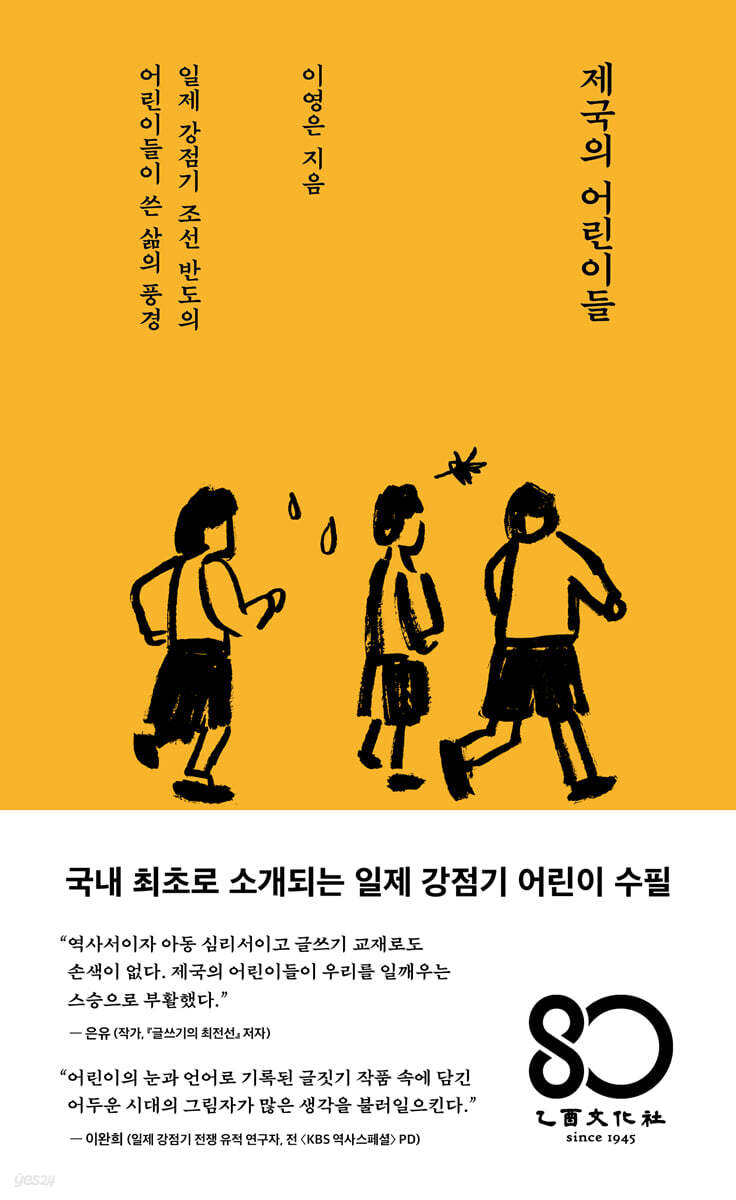
Children of the Empire
 |
Description
Book Introduction
- A word from MD
-
Shadows of the Times Seen Through Children's WritingHow did children in Joseon live during the Japanese colonial period?
Through the winning entries from the essay contest held by the Government-General of Korea in 1938, we take a look into the lives of children and the historical background of that time.
The different daily lives of Japanese children who immigrated to Joseon and native Korean children vividly reveal the landscape of the times and the dark shadows behind it.
August 13, 2025. History PD Ahn Hyun-jae
How did children living in Joseon in the 1930s live?
A child who lives with his grandmother walks from morning until sunset to ask a relative who lives far away for money for school tuition.
Another child goes sightseeing in his father's new car.
Some children raise cute cats, while others raise pigs to help with household chores.
Some children get scolded by their mothers for not cleaning their rooms, while others go to the public faucet in the middle of winter to wash rice in place of their sick mothers and older sisters who have gone to do laundry.
These various stories are the winning entries from a writing contest held by the Government-General of Korea in 1938, and were all written by children living in Korea at the time.
"Children of the Empire" introduces these writings for the first time in Korea, and delves into the historical background hidden within these simple yet sparkling writings.
What differences existed between the worlds of Japanese children who came to live in Joseon and those of native Korean children? What criteria did the Japanese Government-General of Korea use to select the children's awards it sought?
"Children of the Empire" presents the world of Japanese children who came to live in Korea during the Japanese colonial period, along with the world of native Korean children.
By observing these two naturally contrasting worlds, readers can see how children learn different worldviews based on their social origins and backgrounds.
A child who lives with his grandmother walks from morning until sunset to ask a relative who lives far away for money for school tuition.
Another child goes sightseeing in his father's new car.
Some children raise cute cats, while others raise pigs to help with household chores.
Some children get scolded by their mothers for not cleaning their rooms, while others go to the public faucet in the middle of winter to wash rice in place of their sick mothers and older sisters who have gone to do laundry.
These various stories are the winning entries from a writing contest held by the Government-General of Korea in 1938, and were all written by children living in Korea at the time.
"Children of the Empire" introduces these writings for the first time in Korea, and delves into the historical background hidden within these simple yet sparkling writings.
What differences existed between the worlds of Japanese children who came to live in Joseon and those of native Korean children? What criteria did the Japanese Government-General of Korea use to select the children's awards it sought?
"Children of the Empire" presents the world of Japanese children who came to live in Korea during the Japanese colonial period, along with the world of native Korean children.
By observing these two naturally contrasting worlds, readers can see how children learn different worldviews based on their social origins and backgrounds.
- You can preview some of the book's contents.
Preview
index
Entering
Ⅰ.
non-war
(Ⅰ) Nature
(Ⅱ) Family
(Ⅲ) Animals
(Ⅳ) Play
(Ⅴ) Daily life
(Ⅵ) School
Ⅱ.
war
In conclusion
References
Ⅰ.
non-war
(Ⅰ) Nature
(Ⅱ) Family
(Ⅲ) Animals
(Ⅳ) Play
(Ⅴ) Daily life
(Ⅵ) School
Ⅱ.
war
In conclusion
References
Detailed image
Into the book
… … A child is the seed of a fruit.
The seeds of the fruit have the power to grow on their own.
All you have to do is help those around you to unleash that power.
Forcing adult-created moral standards or social conventions on children is unreasonable and ultimately causes great harm to all of humanity.
Because the adult world is a distorted world.
Therefore, this world is in a situation where it must freely develop what the children's world has.
Could there be a more empty endeavor than trying to drag a child into the world of adults? No, it's closer to vice than empty effort...
Akita Ujaku, Waseda Literature, "Fairy Tales as Artistic Expression," 1921
--- p.22~23
The frosted bathroom window was transformed into a truly beautiful window with pure white ice crystals shaped like azalea petals.
When I lightly traced a line over it with my finger, tiny crystals, like quinine in cold medicine, got stuck in my fingernail and it hurt like being pricked by a needle.
I had no choice but to open the door slightly, just enough to reveal my eyes, centered around my nose, to look outside, and then the wind blew a flurry of powdered snow onto my face.
“Oh, it’s cold,” he said, and hurriedly closed the door.
This time, I blew my breath on the window and rubbed it with my finger, and the ice crystals naturally melted, allowing me to look outside.
The snow is piled up very heavily and is still falling continuously.
It seems like no one has been to the well in the backyard yet, and snow is piled up on the suction pump and the well.
Only the wooden barrel that someone had forgotten and left by the well was lying on its side, so the inside was black, but everywhere else was pure white.
(From "Snowy Morning" by Sumiko Kato, a sixth-grade student at Hamheung Public Elementary School in South Hamgyong Province)
--- p.52~53
Korean fathers have a much weaker (or more negative) presence.
In the eyes of children, they are either sick and need to be worried, or they are drunk and don't come home, or they went to Japan as children and are forgotten, or they hit someone while driving a bus, or they left their children with their older siblings, or they are absent, or there is no news at all.
The image of Korean fathers who have lost their authority in a patriarchal society is very similar to the image of Korea under Japanese colonial rule.
--- p.64
The animals in the writings of Japanese children living in Korea were merely friends who comforted loneliness and shared joy.
On the other hand, for Korean children, animals are one of the means of earning a living for the household, and playing with such animals is naturally linked to the productive activities that the animals perform.
So the saddest moment for children is not when their livestock dies, but when they are sold.
Because it is a separation due to livelihood, not illness or death.
--- p.93
And there is a look of compassion, a look that looks at those in pitiful circumstances.
The compassion that is particularly abundant for children often turns into a moment of recognizing their own peaceful current situation compared to others, which in turn turns into enthusiasm for their own future.
Even in the midst of anxiety, surprise, and fear, children transform their anxieties and depression into powerful passion through compassion for others.
Shame and guilt also lead to passion.
Why is it so perfect? How can such a sound and good system exist? This raises another question.
Where is the jealousy that must have existed in the hearts of these children hidden within these writings? The kind and exemplary faces depicted in the "Governor-General's Award Exemplary Writings"—those created faces (or masks)—were even more deeply ingrained in the children of the colonized Korean nation than in the children of the Japanese, the suzerain nation.
How are these face masks made and worn?
--- p.156
I had forgotten the cold while I was on duty, but when it was time to go home, I remembered the cold again.
But I couldn't not go back home, so I boldly ran outside.
The sun casts a yellow glow, casting a cold glow over the playground.
In the wide playground, a plane tree with its branches cut off stands quietly, its white skin bathed in sunlight, casting long shadows as if it were cold.
On the slide where there should normally be eighteen children playing, there is only a hat left by someone hanging there, and not a single person is visible.
I tucked the bundle under my arm and ran out of the playground in one breath.
(From "On a Cold Day" by Park Su-jin, 5th grade, Busan Mokdo Public Elementary School, Busan)
--- p.166
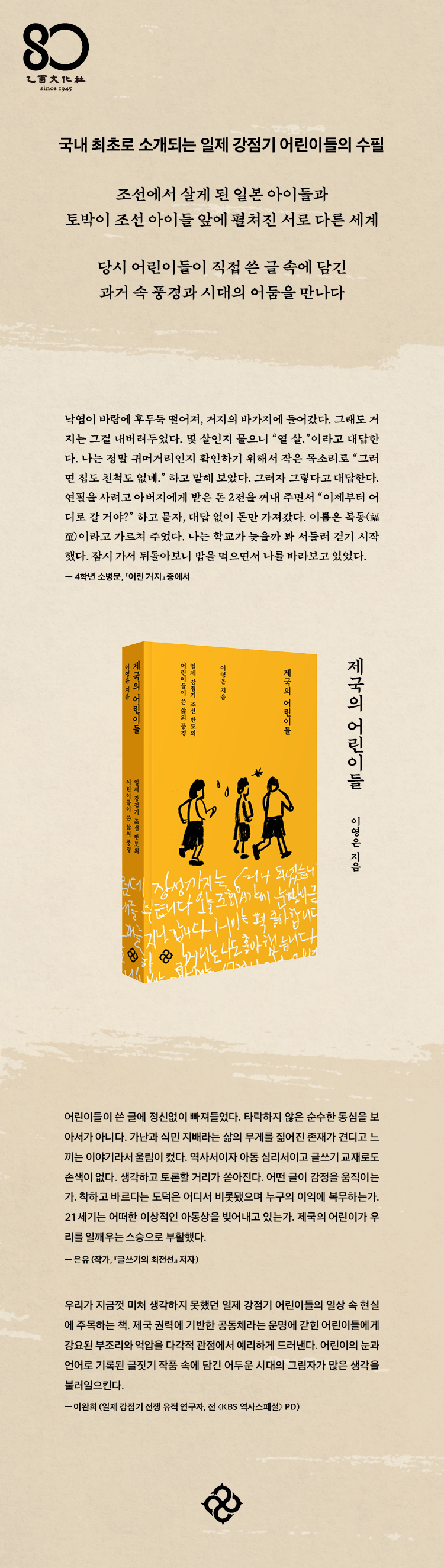
The leaves fell in the wind and fell into the beggar's basket.
But the beggar left it alone.
When asked how old he is, he answers, “Ten years old.”
To check if I was really deaf, I said in a small voice, “Then you have no home or relatives.”
Then he answers yes.
He wasn't deaf.
Even when I say, “Eat,” he only looks at my face.
I felt so bad for him that I took out two cents from my father to buy a pencil and asked him, “Where are you going from now on?” He just took the money without answering.
He taught me that his name was Bokdong.
I started walking in a hurry for fear of being late for school.
I went for a moment and looked back, and he was looking at me while eating.
When I thought, 'Did you not eat it because I was there?', I felt so sorry.
(From "The Little Beggar" by So Byeong-mun, a 4th grade student at Namwon Binlang Public Elementary School in Jeollabuk-do)
--- p.186~187
The biggest difference between the first and second elementary schools was the meals.
When Kim Chang-guk was carrying his lunchbox, Japanese children ate yellow rice at a cafeteria.
Yellow rice was something that Kim Chang-guk had never seen before: curry rice.
Instead of school meals, Koreans were given bread and fish liver oil as a snack every day, and the bread was sometimes shared with the student teachers.
(Omitted) Japanese and Korean students attending teachers' colleges usually came from less affluent family backgrounds.
In particular, Korean student teachers were so poor that they often did not bring lunch boxes at all or brought poor ones. In such cases, Kim Chang-guk and his friends took turns distributing bread to the student teachers.
The teachers initially refused, but after repeated urging, they accepted.
The children hated being away from their teacher, who was with them all day, from morning assembly to the end of class, except for snack time.
So the children's bread became the teacher's lunch.
--- p.191~192
My brother's face was terrifyingly thin.
There were no visible signs of injury, but somehow it felt like he had become a different person.
He told me war stories at night.
I was injured and went to the hospital, and they said it took 26 days.
His hands were shriveled, as if they had been burned.
One eye is a glass eye.
They say that His Majesty the Emperor gave him those eyes.
There is a black bullet mark on his chest.
They say that when they went to ○○ Hospital, they took a big car.
It is said that when he told the regimental commander along the way, “Just get down and kill me,” he got angry and said that was stupid.
When I heard that story and thought, 'How much pain and suffering must my brother have endured?', tears welled up in my eyes.
("My Brother Returned from the Military" by Tamaru Sadako, a third-year student at Gwangju Central Public Elementary School in Jeollanam-do)
The seeds of the fruit have the power to grow on their own.
All you have to do is help those around you to unleash that power.
Forcing adult-created moral standards or social conventions on children is unreasonable and ultimately causes great harm to all of humanity.
Because the adult world is a distorted world.
Therefore, this world is in a situation where it must freely develop what the children's world has.
Could there be a more empty endeavor than trying to drag a child into the world of adults? No, it's closer to vice than empty effort...
Akita Ujaku, Waseda Literature, "Fairy Tales as Artistic Expression," 1921
--- p.22~23
The frosted bathroom window was transformed into a truly beautiful window with pure white ice crystals shaped like azalea petals.
When I lightly traced a line over it with my finger, tiny crystals, like quinine in cold medicine, got stuck in my fingernail and it hurt like being pricked by a needle.
I had no choice but to open the door slightly, just enough to reveal my eyes, centered around my nose, to look outside, and then the wind blew a flurry of powdered snow onto my face.
“Oh, it’s cold,” he said, and hurriedly closed the door.
This time, I blew my breath on the window and rubbed it with my finger, and the ice crystals naturally melted, allowing me to look outside.
The snow is piled up very heavily and is still falling continuously.
It seems like no one has been to the well in the backyard yet, and snow is piled up on the suction pump and the well.
Only the wooden barrel that someone had forgotten and left by the well was lying on its side, so the inside was black, but everywhere else was pure white.
(From "Snowy Morning" by Sumiko Kato, a sixth-grade student at Hamheung Public Elementary School in South Hamgyong Province)
--- p.52~53
Korean fathers have a much weaker (or more negative) presence.
In the eyes of children, they are either sick and need to be worried, or they are drunk and don't come home, or they went to Japan as children and are forgotten, or they hit someone while driving a bus, or they left their children with their older siblings, or they are absent, or there is no news at all.
The image of Korean fathers who have lost their authority in a patriarchal society is very similar to the image of Korea under Japanese colonial rule.
--- p.64
The animals in the writings of Japanese children living in Korea were merely friends who comforted loneliness and shared joy.
On the other hand, for Korean children, animals are one of the means of earning a living for the household, and playing with such animals is naturally linked to the productive activities that the animals perform.
So the saddest moment for children is not when their livestock dies, but when they are sold.
Because it is a separation due to livelihood, not illness or death.
--- p.93
And there is a look of compassion, a look that looks at those in pitiful circumstances.
The compassion that is particularly abundant for children often turns into a moment of recognizing their own peaceful current situation compared to others, which in turn turns into enthusiasm for their own future.
Even in the midst of anxiety, surprise, and fear, children transform their anxieties and depression into powerful passion through compassion for others.
Shame and guilt also lead to passion.
Why is it so perfect? How can such a sound and good system exist? This raises another question.
Where is the jealousy that must have existed in the hearts of these children hidden within these writings? The kind and exemplary faces depicted in the "Governor-General's Award Exemplary Writings"—those created faces (or masks)—were even more deeply ingrained in the children of the colonized Korean nation than in the children of the Japanese, the suzerain nation.
How are these face masks made and worn?
--- p.156
I had forgotten the cold while I was on duty, but when it was time to go home, I remembered the cold again.
But I couldn't not go back home, so I boldly ran outside.
The sun casts a yellow glow, casting a cold glow over the playground.
In the wide playground, a plane tree with its branches cut off stands quietly, its white skin bathed in sunlight, casting long shadows as if it were cold.
On the slide where there should normally be eighteen children playing, there is only a hat left by someone hanging there, and not a single person is visible.
I tucked the bundle under my arm and ran out of the playground in one breath.
(From "On a Cold Day" by Park Su-jin, 5th grade, Busan Mokdo Public Elementary School, Busan)
--- p.166
The leaves fell in the wind and fell into the beggar's basket.
But the beggar left it alone.
When asked how old he is, he answers, “Ten years old.”
To check if I was really deaf, I said in a small voice, “Then you have no home or relatives.”
Then he answers yes.
He wasn't deaf.
Even when I say, “Eat,” he only looks at my face.
I felt so bad for him that I took out two cents from my father to buy a pencil and asked him, “Where are you going from now on?” He just took the money without answering.
He taught me that his name was Bokdong.
I started walking in a hurry for fear of being late for school.
I went for a moment and looked back, and he was looking at me while eating.
When I thought, 'Did you not eat it because I was there?', I felt so sorry.
(From "The Little Beggar" by So Byeong-mun, a 4th grade student at Namwon Binlang Public Elementary School in Jeollabuk-do)
--- p.186~187
The biggest difference between the first and second elementary schools was the meals.
When Kim Chang-guk was carrying his lunchbox, Japanese children ate yellow rice at a cafeteria.
Yellow rice was something that Kim Chang-guk had never seen before: curry rice.
Instead of school meals, Koreans were given bread and fish liver oil as a snack every day, and the bread was sometimes shared with the student teachers.
(Omitted) Japanese and Korean students attending teachers' colleges usually came from less affluent family backgrounds.
In particular, Korean student teachers were so poor that they often did not bring lunch boxes at all or brought poor ones. In such cases, Kim Chang-guk and his friends took turns distributing bread to the student teachers.
The teachers initially refused, but after repeated urging, they accepted.
The children hated being away from their teacher, who was with them all day, from morning assembly to the end of class, except for snack time.
So the children's bread became the teacher's lunch.
--- p.191~192
My brother's face was terrifyingly thin.
There were no visible signs of injury, but somehow it felt like he had become a different person.
He told me war stories at night.
I was injured and went to the hospital, and they said it took 26 days.
His hands were shriveled, as if they had been burned.
One eye is a glass eye.
They say that His Majesty the Emperor gave him those eyes.
There is a black bullet mark on his chest.
They say that when they went to ○○ Hospital, they took a big car.
It is said that when he told the regimental commander along the way, “Just get down and kill me,” he got angry and said that was stupid.
When I heard that story and thought, 'How much pain and suffering must my brother have endured?', tears welled up in my eyes.
("My Brother Returned from the Military" by Tamaru Sadako, a third-year student at Gwangju Central Public Elementary School in Jeollanam-do)
--- p.286~287
Publisher's Review
Growing up in Joseon during the Japanese colonial period
Meet the writings of children themselves
How did children living in Joseon in the 1930s live?
A child who lives with his grandmother walks from morning until sunset to ask a relative who lives far away for money for school tuition.
Another child goes sightseeing in his father's new car.
Some children raise cute cats, while others raise pigs to help with household chores.
Some children get scolded by their mothers for not cleaning their rooms, while others go to the public faucet in the middle of winter to wash rice in place of their sick mothers and older sisters who have gone to do laundry.
These various stories are the winning entries from a writing contest held by the Government-General of Korea in 1938, and were all written by children living in Korea at the time.
"Children of the Empire" introduces these writings for the first time in Korea, and delves into the historical background hidden within these simple yet sparkling writings.
What differences existed between the worlds of Japanese children who came to live in Joseon and those of native Korean children? What criteria did the Japanese Government-General of Korea use to select the children's awards it sought?
Children should be children, but
What does it mean to be 'childlike' in an imperialist society?
It is considered common sense that children should be raised as children.
But when you ask what it means to be childish, the answers vary depending on the era and person.
The boundaries between discipline and corporal punishment, and between obedience and autonomy, surrounding children's education are still among the topics that generate much debate.
The reason why there are such different perspectives on children is because children are fundamentally beings who must be incorporated into ‘this society.’
Ultimately, people end up imposing their own judgments about what 'this society' is or should be onto children.
Children are the future of humanity, but that future is largely created within the framework imagined by adults.
"Children of the Empire" reveals how the militaristic imperial colonies, one of the most extreme worlds among the adult worlds, tried to raise their children.
In particular, this book's attempt to present the world of Japanese children living in Joseon and the world of native Korean children together is an unprecedented approach.
By observing these two naturally contrasting worlds, readers can see how children learn different worldviews based on their social origins and backgrounds.
Gradually moving towards war,
But even then, it's a story about children who are like children.
Author Lee Young-eun introduces the writings of children from both worlds and adds historical commentary on the society of the time.
In particular, the author analyzes the elementary education system of the time and confirms the ambition of the Japanese Government-General of Korea, which sought to naturally incorporate young Korean children into the ranks of the Japanese Empire. He also explains why they did not leave Koreans as a mere ruled class, but instead sought to transform them into part of the Japanese Empire.
This commentary helps readers think more deeply by uncovering the social pressures hidden in the children's writings in "Children of the Empire."
Meanwhile, the structure of this book, which begins with everyday life during the Japanese colonial period and gradually moves toward war, is also designed to lead the reader's thoughts deeper and deeper.
Readers who first encounter the children's daily lives in this book will be able to look back on the lives of the children who have passed through them, while seeing the influence that imperial ambitions related to the war have had on the foundation of their daily lives.
『Children of the Empire』 systematically examines the darkness of the Japanese colonial period.
In other words, it sinks into the darkness.
Yet even in its darkest moments, the book retains a certain precious vitality.
This is because the pure and simple language of children that appears over and over again evokes unexpected admiration and emotion.
Even in a time when the times encouraged children to become part of the war machine, children lived in the world with a mysterious vitality that only they possessed.
Every time we encounter such moments, 『Children of the Empire』 transforms beyond a history book covering modern and contemporary Korean history into a book that asks important questions about how we should approach and raise children in this world today.
“Forcing adult-created moral standards or social conventions on children is unreasonable for children, and ultimately causes great harm to all of humanity.
Because the adult world is a distorted world.
Therefore, this world is in a situation where it must freely develop what the children's world has.
"What could be more empty than trying to drag a child into the world of adults? No, it's closer to vice than empty effort." - Akita Ujaku, 1921.
(From page 23 of the text)
Meet the writings of children themselves
How did children living in Joseon in the 1930s live?
A child who lives with his grandmother walks from morning until sunset to ask a relative who lives far away for money for school tuition.
Another child goes sightseeing in his father's new car.
Some children raise cute cats, while others raise pigs to help with household chores.
Some children get scolded by their mothers for not cleaning their rooms, while others go to the public faucet in the middle of winter to wash rice in place of their sick mothers and older sisters who have gone to do laundry.
These various stories are the winning entries from a writing contest held by the Government-General of Korea in 1938, and were all written by children living in Korea at the time.
"Children of the Empire" introduces these writings for the first time in Korea, and delves into the historical background hidden within these simple yet sparkling writings.
What differences existed between the worlds of Japanese children who came to live in Joseon and those of native Korean children? What criteria did the Japanese Government-General of Korea use to select the children's awards it sought?
Children should be children, but
What does it mean to be 'childlike' in an imperialist society?
It is considered common sense that children should be raised as children.
But when you ask what it means to be childish, the answers vary depending on the era and person.
The boundaries between discipline and corporal punishment, and between obedience and autonomy, surrounding children's education are still among the topics that generate much debate.
The reason why there are such different perspectives on children is because children are fundamentally beings who must be incorporated into ‘this society.’
Ultimately, people end up imposing their own judgments about what 'this society' is or should be onto children.
Children are the future of humanity, but that future is largely created within the framework imagined by adults.
"Children of the Empire" reveals how the militaristic imperial colonies, one of the most extreme worlds among the adult worlds, tried to raise their children.
In particular, this book's attempt to present the world of Japanese children living in Joseon and the world of native Korean children together is an unprecedented approach.
By observing these two naturally contrasting worlds, readers can see how children learn different worldviews based on their social origins and backgrounds.
Gradually moving towards war,
But even then, it's a story about children who are like children.
Author Lee Young-eun introduces the writings of children from both worlds and adds historical commentary on the society of the time.
In particular, the author analyzes the elementary education system of the time and confirms the ambition of the Japanese Government-General of Korea, which sought to naturally incorporate young Korean children into the ranks of the Japanese Empire. He also explains why they did not leave Koreans as a mere ruled class, but instead sought to transform them into part of the Japanese Empire.
This commentary helps readers think more deeply by uncovering the social pressures hidden in the children's writings in "Children of the Empire."
Meanwhile, the structure of this book, which begins with everyday life during the Japanese colonial period and gradually moves toward war, is also designed to lead the reader's thoughts deeper and deeper.
Readers who first encounter the children's daily lives in this book will be able to look back on the lives of the children who have passed through them, while seeing the influence that imperial ambitions related to the war have had on the foundation of their daily lives.
『Children of the Empire』 systematically examines the darkness of the Japanese colonial period.
In other words, it sinks into the darkness.
Yet even in its darkest moments, the book retains a certain precious vitality.
This is because the pure and simple language of children that appears over and over again evokes unexpected admiration and emotion.
Even in a time when the times encouraged children to become part of the war machine, children lived in the world with a mysterious vitality that only they possessed.
Every time we encounter such moments, 『Children of the Empire』 transforms beyond a history book covering modern and contemporary Korean history into a book that asks important questions about how we should approach and raise children in this world today.
“Forcing adult-created moral standards or social conventions on children is unreasonable for children, and ultimately causes great harm to all of humanity.
Because the adult world is a distorted world.
Therefore, this world is in a situation where it must freely develop what the children's world has.
"What could be more empty than trying to drag a child into the world of adults? No, it's closer to vice than empty effort." - Akita Ujaku, 1921.
(From page 23 of the text)
GOODS SPECIFICS
- Date of issue: August 15, 2025
- Page count, weight, size: 324 pages | 428g | 132*215*19mm
- ISBN13: 9788932475691
- ISBN10: 8932475695
You may also like
카테고리
korean


korean

![GQ KOREA Mark (Monthly): December [2025]](http://librairie.coreenne.fr/cdn/shop/files/8ef265dbbfbf186523ed75ba7319009d.jpg?v=1765340328&width=3840)


