

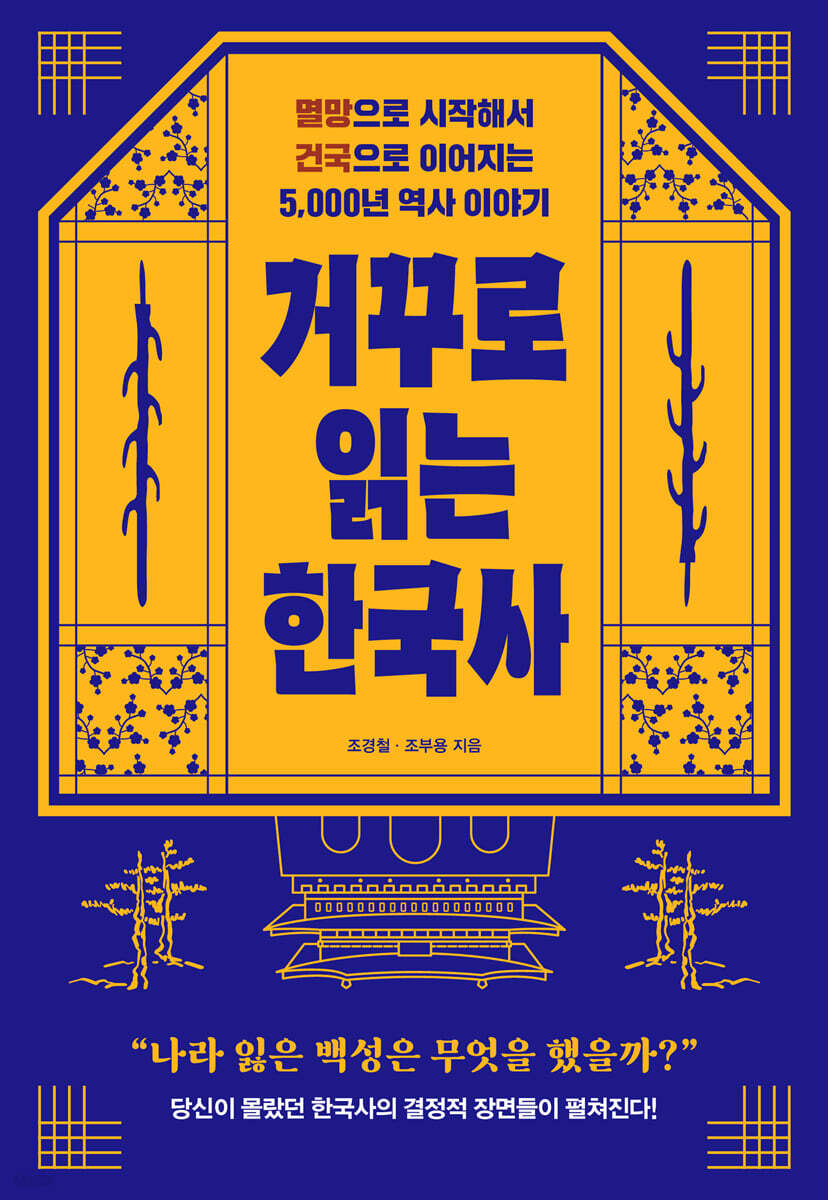
Korean history read backwards
 |
Description
Book Introduction
- A word from MD
-
Korean history from the perspective of successionFrom Gojoseon to the Republic of Korea, can the history of the Korean Peninsula be clearly divided into distinct nations? This book examines the 5,000-year history from the perspective of "succession," reconstructing it as a single, unified flow.
The decisive scenes of destruction and founding, and the historical continuity that followed, convey the main story of Korean history to the reader.
April 25, 2025. History PD Ahn Hyun-jae
“What would the people who lost their country do?”
Although textbooks and most history books don't say it,
The post-apocalyptic history you must know!
From Gojoseon to the Republic of Korea, it is a long and complex history.
A reconstructed half-millennium history into one connected story
The first Korean history textbook!
There is a separate reason why, no matter how much you study Korean history, you can't get the flow.
Most history books, including textbooks, only list the rise and fall of individual countries in order, such as the founding and fall of Gojoseon, the founding and fall of Goguryeo, etc., and do not show the 'connected history' between countries.
However, if you know that the spirit of the revival movement carried out by the people after the fall of Gojoseon was passed down and Goguryeo was established, the story will look completely different.
What we have been missing so far is this ‘history of succession’, that is, continuity.
"Reading Korean History Backwards" traces the unbroken 5,000-year history of Korea from beginning to end.
From Gojoseon to Goguryeo, Balhae, Goryeo, Joseon, the Korean Empire, and the Republic of Korea, every time a country collapsed and was reestablished, there was a spirit and event that sought to be inherited.
This book examines each of these 'links' one by one, providing a 'sense of understanding the entirety of Korean history as a single story' that cannot be found in existing chronological history books.
If you are a reader who still finds the flow of Korean history disjointed in your head, or who cannot remember it no matter how much you memorize it, let's look at Korean history anew from the perspective of succession, not discontinuity.
Although textbooks and most history books don't say it,
The post-apocalyptic history you must know!
From Gojoseon to the Republic of Korea, it is a long and complex history.
A reconstructed half-millennium history into one connected story
The first Korean history textbook!
There is a separate reason why, no matter how much you study Korean history, you can't get the flow.
Most history books, including textbooks, only list the rise and fall of individual countries in order, such as the founding and fall of Gojoseon, the founding and fall of Goguryeo, etc., and do not show the 'connected history' between countries.
However, if you know that the spirit of the revival movement carried out by the people after the fall of Gojoseon was passed down and Goguryeo was established, the story will look completely different.
What we have been missing so far is this ‘history of succession’, that is, continuity.
"Reading Korean History Backwards" traces the unbroken 5,000-year history of Korea from beginning to end.
From Gojoseon to Goguryeo, Balhae, Goryeo, Joseon, the Korean Empire, and the Republic of Korea, every time a country collapsed and was reestablished, there was a spirit and event that sought to be inherited.
This book examines each of these 'links' one by one, providing a 'sense of understanding the entirety of Korean history as a single story' that cannot be found in existing chronological history books.
If you are a reader who still finds the flow of Korean history disjointed in your head, or who cannot remember it no matter how much you memorize it, let's look at Korean history anew from the perspective of succession, not discontinuity.
- You can preview some of the book's contents.
Preview
index
One for the Recipient│Focusing on their story, which continued even after destruction
Two for the recipient│Revisiting history through my own perspective
The First Letter: The Fall of Gojoseon and the Founding of Goguryeo
Some destruction is proud
The Postman's Preface│Gojoseon, the Oldest Joseon│King Ugeo, Who Chose Death Instead of Surrender│Goguryeo, Not the Han Four Commanderies│The Beginning of Succession, the Fall of Gojoseon│A Brief Summary of The Postman's Preface
Second Letter: The Fall of Goguryeo and the Founding of Balhae
What would the people who lost their country do?
The Postman's Preface│Why the Great Power of Goguryeo Fell│30 Years of Struggle to Reclaim the Nation│Balhae Finally Founded│The Unnoticed History of Balhae│Balhae Founded by the Goguryeo Revival Movement│A Brief Summary of the Postman's Preface
Third Letter: The Fall of Balhae and the Founding of Goryeo
Goryeo, constantly reviving
The Postman's Preface│The Reason for Balhae's Fall, Still Unknown│Different Years of Balhae's Fall│The Goryeo Dynasty Before Goryeo│From Goryeo to Korea│A Brief Summary of the Postman's Preface
One thing in common among the kings who ruled the country:
P.S. Two, the inscription on the back of the Buddha
Fourth, Letter: The Fall of Goryeo and the Founding of Joseon
The choice of a small country before a large country
The Postman's Preface | An Unwanted Throne and an Unwanted Death | Why Yi Seong-gye Turned His Armies Back | Joseon, Built by the Ming Dynasty | Our History of Standing Up to Great Powers | A Brief Summary of The Postman's Preface
Postscript: How did Yi Seong-gye and Jeong Do-jeon rise to prominence?
Postscript Four: The reason why there are two tombs of King Gongyang
Fifth Letter: The Fall of Joseon and the Establishment of the Korean Empire
The first step of the Manse Movement
The Postman's Preface | The Korean Empire on a Par with China | Standing on the Brink of Destruction | An Empire in Name Only, Leaving Behind the Long Live | A Brief Summary of The Postman's Preface
P.S. Five, the three who went to the Netherlands secretly
Letter Six: The Fall of the Korean Empire and the Establishment of the Republic of Korea
Four questions that arose after looking at the museum's timeline
Postman's Note: Opening Remarks | The Museum's Continuously Revised Chronology | First Question: The Missing Three Years | Second Question: The Expression "Japanese Colonial Period" | Third Question: Where the Provisional Government of the Republic of Korea is Inscribed | Fourth Question: The Duration of the Provisional Government of the Republic of Korea | Redrawing the Korean Era Chronology | A Brief Summary of the Postman's Note
Seventh Letter: The Fall of Buyeo and the Founding of Southern Buyeo
Buyeo, which succeeded Gojoseon, and Baekje, which succeeded Buyeo
Postman's Preface | Buyeo, the Successor to Gojoseon | Goguryeo and Baekje: From Brothers to Enemies | Baekje Becomes Buyeo | A Reimagined Chronology of Prehistoric and Ancient Times | A Brief Summary of Postman's Preface
Postscript 6: Why Buyeo was divided into Northern Buyeo and Eastern Buyeo
Postscript Seven: King Muryeong's Tomb and Daetongsa Temple, containing the dreams of King Seongwang
Postscript Eight: A Letter from the Field Trip, a Great Work of Art from East Asia with a Sad Story
The Eighth Letter: The Fall of Baekje and the Founding of Later Baekje
Recalling Baekje's Creativity at the Brink of Destruction
The Postman's Preface | The Truth Hidden in "King Uija and the Three Thousand Palace Ladies" | The Misjudgment of King Uija of Haedong Jeungja | Baekje's Creativity and Originality | Baekje's Rebirth as Later Baekje | A Brief Summary of the Postman's Preface
P.S. Nine, a unique sword shape that cannot be found anywhere else in the world
The Ninth Letter: The Fall of Silla and the Founding of Goryeo
The world is divided into three before destruction
The Postman's Preface | The Futile End of 1,000 Years of History | The Kim and Park Clans' Struggle for the Throne | King Gyeongmyeong's Three-Part Plan | A Brief Summary of The Postman's Preface
The Tenth Letter, From the Three Kingdoms to the Four Kingdoms Period
History of Han
The Postman's Note: The Unification of the Three Hans, Not the Unification of the Three Kingdoms | The Goguryeo and Three Han Periods, Not the Three Kingdoms | A Brief Summary of the Postman's Note
Eleventh Letter: The Fall of Gaya and the Rise of the Kim Yu-sin Family
The twist of a ruined family
The Postman's Preface | Gaya's Fall from the Three Kingdoms Period | The Gaya People Who Rise in Silla | The Decline and Reemergence of the Kim Yu-sin Family | A Brief Summary of The Postman's Preface
Twelfth Letter, Redrawing the Museum Chronology
A shift in perspective is needed.
The Postman's Preface | A Chronology Redrawn from the Perspective of Succession | The Fall of Gojoseon and the Founding of Goguryeo | The Fall of Goguryeo and the Founding of Balhae | The Fall of Balhae and the Founding of Goryeo | The Fall of the Korean Empire and the Founding of the Provisional Government of the Republic of Korea | From the Fall of Gojoseon to the Provisional Government of the Republic of Korea and the Founding of the Republic of Korea | A Brief Summary of the Postman's Preface
Sources of photos, illustrations, and quotes
Two for the recipient│Revisiting history through my own perspective
The First Letter: The Fall of Gojoseon and the Founding of Goguryeo
Some destruction is proud
The Postman's Preface│Gojoseon, the Oldest Joseon│King Ugeo, Who Chose Death Instead of Surrender│Goguryeo, Not the Han Four Commanderies│The Beginning of Succession, the Fall of Gojoseon│A Brief Summary of The Postman's Preface
Second Letter: The Fall of Goguryeo and the Founding of Balhae
What would the people who lost their country do?
The Postman's Preface│Why the Great Power of Goguryeo Fell│30 Years of Struggle to Reclaim the Nation│Balhae Finally Founded│The Unnoticed History of Balhae│Balhae Founded by the Goguryeo Revival Movement│A Brief Summary of the Postman's Preface
Third Letter: The Fall of Balhae and the Founding of Goryeo
Goryeo, constantly reviving
The Postman's Preface│The Reason for Balhae's Fall, Still Unknown│Different Years of Balhae's Fall│The Goryeo Dynasty Before Goryeo│From Goryeo to Korea│A Brief Summary of the Postman's Preface
One thing in common among the kings who ruled the country:
P.S. Two, the inscription on the back of the Buddha
Fourth, Letter: The Fall of Goryeo and the Founding of Joseon
The choice of a small country before a large country
The Postman's Preface | An Unwanted Throne and an Unwanted Death | Why Yi Seong-gye Turned His Armies Back | Joseon, Built by the Ming Dynasty | Our History of Standing Up to Great Powers | A Brief Summary of The Postman's Preface
Postscript: How did Yi Seong-gye and Jeong Do-jeon rise to prominence?
Postscript Four: The reason why there are two tombs of King Gongyang
Fifth Letter: The Fall of Joseon and the Establishment of the Korean Empire
The first step of the Manse Movement
The Postman's Preface | The Korean Empire on a Par with China | Standing on the Brink of Destruction | An Empire in Name Only, Leaving Behind the Long Live | A Brief Summary of The Postman's Preface
P.S. Five, the three who went to the Netherlands secretly
Letter Six: The Fall of the Korean Empire and the Establishment of the Republic of Korea
Four questions that arose after looking at the museum's timeline
Postman's Note: Opening Remarks | The Museum's Continuously Revised Chronology | First Question: The Missing Three Years | Second Question: The Expression "Japanese Colonial Period" | Third Question: Where the Provisional Government of the Republic of Korea is Inscribed | Fourth Question: The Duration of the Provisional Government of the Republic of Korea | Redrawing the Korean Era Chronology | A Brief Summary of the Postman's Note
Seventh Letter: The Fall of Buyeo and the Founding of Southern Buyeo
Buyeo, which succeeded Gojoseon, and Baekje, which succeeded Buyeo
Postman's Preface | Buyeo, the Successor to Gojoseon | Goguryeo and Baekje: From Brothers to Enemies | Baekje Becomes Buyeo | A Reimagined Chronology of Prehistoric and Ancient Times | A Brief Summary of Postman's Preface
Postscript 6: Why Buyeo was divided into Northern Buyeo and Eastern Buyeo
Postscript Seven: King Muryeong's Tomb and Daetongsa Temple, containing the dreams of King Seongwang
Postscript Eight: A Letter from the Field Trip, a Great Work of Art from East Asia with a Sad Story
The Eighth Letter: The Fall of Baekje and the Founding of Later Baekje
Recalling Baekje's Creativity at the Brink of Destruction
The Postman's Preface | The Truth Hidden in "King Uija and the Three Thousand Palace Ladies" | The Misjudgment of King Uija of Haedong Jeungja | Baekje's Creativity and Originality | Baekje's Rebirth as Later Baekje | A Brief Summary of the Postman's Preface
P.S. Nine, a unique sword shape that cannot be found anywhere else in the world
The Ninth Letter: The Fall of Silla and the Founding of Goryeo
The world is divided into three before destruction
The Postman's Preface | The Futile End of 1,000 Years of History | The Kim and Park Clans' Struggle for the Throne | King Gyeongmyeong's Three-Part Plan | A Brief Summary of The Postman's Preface
The Tenth Letter, From the Three Kingdoms to the Four Kingdoms Period
History of Han
The Postman's Note: The Unification of the Three Hans, Not the Unification of the Three Kingdoms | The Goguryeo and Three Han Periods, Not the Three Kingdoms | A Brief Summary of the Postman's Note
Eleventh Letter: The Fall of Gaya and the Rise of the Kim Yu-sin Family
The twist of a ruined family
The Postman's Preface | Gaya's Fall from the Three Kingdoms Period | The Gaya People Who Rise in Silla | The Decline and Reemergence of the Kim Yu-sin Family | A Brief Summary of The Postman's Preface
Twelfth Letter, Redrawing the Museum Chronology
A shift in perspective is needed.
The Postman's Preface | A Chronology Redrawn from the Perspective of Succession | The Fall of Gojoseon and the Founding of Goguryeo | The Fall of Goguryeo and the Founding of Balhae | The Fall of Balhae and the Founding of Goryeo | The Fall of the Korean Empire and the Founding of the Provisional Government of the Republic of Korea | From the Fall of Gojoseon to the Provisional Government of the Republic of Korea and the Founding of the Republic of Korea | A Brief Summary of the Postman's Preface
Sources of photos, illustrations, and quotes
Detailed image

Into the book
The fall of Gojoseon led to the establishment of the Han Four Commanderies of the Han Dynasty of China, and after the fall of the Korean Empire, the Japanese colonial period began.
Coincidentally, there was a break between the destruction and the founding of both countries, as both were destroyed by other countries.
But if a nation is destroyed, will that be the end? No.
There were efforts by people to restore the ruined country.
After the fall of Baekje, there was a Baekje revival movement. After the fall of Goguryeo, there was a Goguryeo revival movement. After the fall of the Korean Empire, there was a Korean revival movement.
--- From "One for the Receiver"
The founding and destruction of a nation speak of the beginning and end of a nation.
The founding and fall of Goguryeo signify the history of Goguryeo, and the founding and fall of Joseon signify the history of Joseon.
But if we just change the order of the two words here and put destruction first, a 'link' is created between the preceding country and the succeeding country.
The fall of Gojoseon and the founding of Goguryeo, the fall of Goguryeo and the founding of Balhae.
So, 'destruction and founding' naturally brings to mind the destruction of a previous country and the founding of the subsequent country.
Just by reversing the order of these two words, it feels like you're hearing a connected story that conveys the flow of history.
--- From "Two to the Receiver"
This is a passage that records the incident in 670 when King Munmu of Silla appeared to appoint Anseung, a member of the Goguryeo royal family, as the king of Goguryeo.
King Munmu says that the history of Goguryeo, which began with Jumong, lasted 800 years.
Based on this record, Goguryeo's founding year is approximately the 2nd century BC.
It is different from the common view of 37 BC.
According to King Munmu, Goguryeo was founded more than 100 years earlier than we know.
--- From "The First Letter, The Fall of Gojoseon and the Founding of Goguryeo"
If you open the textbook, you will see the story of Silla's unification of the three kingdoms following the fall of Goguryeo.
However, in order to emphasize the continuity between countries, it is necessary to learn about the founding of Balhae after the fall of Goguryeo.
However, Balhae was founded in 698 after Goguryeo was destroyed in 668, so there was a 30-year gap between the destruction of Goguryeo and the founding of Balhae.
However, the year of the country's destruction is just a year, and we cannot say with certainty that the country was completely over at that time.
So, the 30 years were not just a blank period, but a time of transition from Goguryeo to Balhae.
--- From “The Second Letter, The Fall of Goguryeo and the Founding of Balhae”
In fact, Goguryeo was called "Goryeo" for most of its existence! So, what exactly was Later Goguryeo, founded by Gung Ye after Goguryeo? We learned in our textbooks that Gung Ye founded Later Goguryeo before Wang Geon founded Goryeo.
However, the name of the country founded by Gung Ye was actually Goryeo.
The name we learned about, Goguryeo, was given in the 20th century.
If you look at old history books, you will not find the name of the country called 'Later Goguryeo'.
It's all written as Gung Ye's "Later Goryeo."
--- From "The Third Letter, The Fall of Balhae and the Founding of Goryeo"
So who named the country "Joseon"? It was obviously Yi Seong-gye, the founder of the country, and Jeong Do-jeon, a founding contributor. They succeeded in founding the new nation, but they didn't name it.
Yi Seong-gye sent two names to the Ming emperor: 'Joseon' and 'Hwaryeong' in South Hamgyong Province, his hometown, and asked him to choose one.
And the Ming Dynasty chose ‘Joseon’.
--- From "The Fourth Letter, The Fall of Goryeo and the Founding of Joseon"
However, the Japanese colonial period is an expression of the Japanese perspective that ruled our country.
Wouldn't there be a better term to emphasize how we fought to reclaim our country from which we were forcibly taken?
Because the masters of history are the people of that country.
If we were to record this period in history books from the perspective of the Korean Empire, what would be a good way to describe it?
I would like to call it the 'Period of Resistance Against Japanese Colonialism' to reflect the strong will we had to reclaim our country.
--- From "The Sixth Letter, The Fall of the Korean Empire and the Establishment of the Republic of Korea"
The story of King Uija and the Three Thousand Palace Ladies contains the intention of the Japanese, who colonized Joseon, to emphasize that the cause of Baekje's downfall was King Uija's pleasures.
Similarly, the Japanese designated Poseokjeong as Historic Site No. 1, which was also intended to highlight the incident where King Gyeongae of Silla was killed while drinking alcohol at Poseokjeong.
The intention was to convey that the fall of Silla was also due to King Gyeongae's hedonism.
--- From "The Eighth Letter, The Fall of Baekje and the Founding of Later Baekje"
However, we learned that the countries of the Three Kingdoms period that we are familiar with are Goguryeo, Baekje, and Silla, and that Silla later unified the three kingdoms.
However, this content cannot be said to be accurate.
This is because Silla was unable to occupy the area north of Pyongyang, which was Goguryeo's territory.
So, it would be more accurate to say that Mahan and Byeonhan were unified.
--- From "The Tenth Letter, From the Three Kingdoms to the Four Kingdoms Period"
Since the founding of Gojoseon in 2333 BC, there have been several destructions and foundings until the Provisional Government of the Republic of Korea and the founding of the Republic of Korea.
In the meantime, it was destroyed by China and Japan and suffered humiliation on several occasions.
But at no point has our history been interrupted.
Even during the Japanese colonial period, they tried to regain their homeland by establishing provisional governments in other countries.
What was it that we had been trying to protect for so long?
Isn't it that we wanted to protect our history and ourselves?
Coincidentally, there was a break between the destruction and the founding of both countries, as both were destroyed by other countries.
But if a nation is destroyed, will that be the end? No.
There were efforts by people to restore the ruined country.
After the fall of Baekje, there was a Baekje revival movement. After the fall of Goguryeo, there was a Goguryeo revival movement. After the fall of the Korean Empire, there was a Korean revival movement.
--- From "One for the Receiver"
The founding and destruction of a nation speak of the beginning and end of a nation.
The founding and fall of Goguryeo signify the history of Goguryeo, and the founding and fall of Joseon signify the history of Joseon.
But if we just change the order of the two words here and put destruction first, a 'link' is created between the preceding country and the succeeding country.
The fall of Gojoseon and the founding of Goguryeo, the fall of Goguryeo and the founding of Balhae.
So, 'destruction and founding' naturally brings to mind the destruction of a previous country and the founding of the subsequent country.
Just by reversing the order of these two words, it feels like you're hearing a connected story that conveys the flow of history.
--- From "Two to the Receiver"
This is a passage that records the incident in 670 when King Munmu of Silla appeared to appoint Anseung, a member of the Goguryeo royal family, as the king of Goguryeo.
King Munmu says that the history of Goguryeo, which began with Jumong, lasted 800 years.
Based on this record, Goguryeo's founding year is approximately the 2nd century BC.
It is different from the common view of 37 BC.
According to King Munmu, Goguryeo was founded more than 100 years earlier than we know.
--- From "The First Letter, The Fall of Gojoseon and the Founding of Goguryeo"
If you open the textbook, you will see the story of Silla's unification of the three kingdoms following the fall of Goguryeo.
However, in order to emphasize the continuity between countries, it is necessary to learn about the founding of Balhae after the fall of Goguryeo.
However, Balhae was founded in 698 after Goguryeo was destroyed in 668, so there was a 30-year gap between the destruction of Goguryeo and the founding of Balhae.
However, the year of the country's destruction is just a year, and we cannot say with certainty that the country was completely over at that time.
So, the 30 years were not just a blank period, but a time of transition from Goguryeo to Balhae.
--- From “The Second Letter, The Fall of Goguryeo and the Founding of Balhae”
In fact, Goguryeo was called "Goryeo" for most of its existence! So, what exactly was Later Goguryeo, founded by Gung Ye after Goguryeo? We learned in our textbooks that Gung Ye founded Later Goguryeo before Wang Geon founded Goryeo.
However, the name of the country founded by Gung Ye was actually Goryeo.
The name we learned about, Goguryeo, was given in the 20th century.
If you look at old history books, you will not find the name of the country called 'Later Goguryeo'.
It's all written as Gung Ye's "Later Goryeo."
--- From "The Third Letter, The Fall of Balhae and the Founding of Goryeo"
So who named the country "Joseon"? It was obviously Yi Seong-gye, the founder of the country, and Jeong Do-jeon, a founding contributor. They succeeded in founding the new nation, but they didn't name it.
Yi Seong-gye sent two names to the Ming emperor: 'Joseon' and 'Hwaryeong' in South Hamgyong Province, his hometown, and asked him to choose one.
And the Ming Dynasty chose ‘Joseon’.
--- From "The Fourth Letter, The Fall of Goryeo and the Founding of Joseon"
However, the Japanese colonial period is an expression of the Japanese perspective that ruled our country.
Wouldn't there be a better term to emphasize how we fought to reclaim our country from which we were forcibly taken?
Because the masters of history are the people of that country.
If we were to record this period in history books from the perspective of the Korean Empire, what would be a good way to describe it?
I would like to call it the 'Period of Resistance Against Japanese Colonialism' to reflect the strong will we had to reclaim our country.
--- From "The Sixth Letter, The Fall of the Korean Empire and the Establishment of the Republic of Korea"
The story of King Uija and the Three Thousand Palace Ladies contains the intention of the Japanese, who colonized Joseon, to emphasize that the cause of Baekje's downfall was King Uija's pleasures.
Similarly, the Japanese designated Poseokjeong as Historic Site No. 1, which was also intended to highlight the incident where King Gyeongae of Silla was killed while drinking alcohol at Poseokjeong.
The intention was to convey that the fall of Silla was also due to King Gyeongae's hedonism.
--- From "The Eighth Letter, The Fall of Baekje and the Founding of Later Baekje"
However, we learned that the countries of the Three Kingdoms period that we are familiar with are Goguryeo, Baekje, and Silla, and that Silla later unified the three kingdoms.
However, this content cannot be said to be accurate.
This is because Silla was unable to occupy the area north of Pyongyang, which was Goguryeo's territory.
So, it would be more accurate to say that Mahan and Byeonhan were unified.
--- From "The Tenth Letter, From the Three Kingdoms to the Four Kingdoms Period"
Since the founding of Gojoseon in 2333 BC, there have been several destructions and foundings until the Provisional Government of the Republic of Korea and the founding of the Republic of Korea.
In the meantime, it was destroyed by China and Japan and suffered humiliation on several occasions.
But at no point has our history been interrupted.
Even during the Japanese colonial period, they tried to regain their homeland by establishing provisional governments in other countries.
What was it that we had been trying to protect for so long?
Isn't it that we wanted to protect our history and ourselves?
--- From "The Twelfth Letter, Redrawing the Museum Chronology"
Publisher's Review
Throwing a question mark at the end of history called destruction
A new perspective on Korean history that introduces stories!
"Reading Korean History Backwards" sheds new light on the "story after" the nation's fall.
“What would the people who lost their country have done?” and “What did destruction leave them?” are unfamiliar and refreshing questions that we rarely encounter in existing history books.
Until now, when we studied Korean history, we accepted the fall of a country as the end of history.
But this book adds a question mark to the period of destruction.
From the perspective of succession rather than discontinuity, it opens up a completely new perspective on Korean history by following the stories of those who survived even after the nation's disappearance, and the spirit and movement to rebuild the nation without giving up.
By asking unfamiliar questions about familiar history, you will experience a completely new, connected Korean history.
I didn't know because I didn't ask
The history of destruction and after destruction
It was as proud as the founding of the country!
If we were to pick the most spectacular moment of destruction in Korean history, it would be the first nation, Gojoseon.
The last king, King Ugeo, fought against the Han invasion for over a year, refusing to surrender until the end, and was eventually killed by internal rebels.
He was the only king in Korean history who chose death over surrender.
Although Gojoseon collapsed, its spirit was not broken.
Goguryeo, which followed, was the most powerful nation encompassing the Korean Peninsula and Manchuria, but it also could not avoid destruction.
But the Goguryeo refugees never knelt down.
The revival movement led by the royal family's An Seung and general Geommo Jam continued for a full 30 years, and even the last king, King Bojang, who had been captured, was exiled after refusing Tang's orders and attempting to rebuild the country.
Ultimately, the spirit of Goguryeo was re-established by Dae Jo-yeong under the name of 'Balhae', and its flow continued to Goryeo, the Korean Empire, and the Republic of Korea.
"Reading Korean History Backwards" fascinatingly traces the resistance that occurred at each moment of "destruction" from Gojoseon through Goguryeo, Balhae, Goryeo, Joseon, and the Korean Empire, and how the seeds of succession began to sprout.
History is not simply a list of rises and falls.
Through this book, we vividly encounter how a seemingly tragic destruction became a decisive moment that opened the door to the next era.
It feels like visiting a museum or historic site in person.
Vivid photos of relics and ruins,
And a new Korean history chronology reconstructed from the perspective of succession!
『Reading Korean History Backwards』 is rich in illustrations and photographs that help with understanding and add vividness to the story, just as it is rich in content.
As the two authors are historians and publishers of Korea's first Korean history newsletter, "My Own Korean History Letter," they have filled this book with precious photos they have personally taken and collected while traveling to museums and historic sites across the country for a long time.
Therefore, you can see many important relics and sites more vividly and precisely than in any history book, just as if you were viewing them in an actual museum or historical site.
Particularly noteworthy is the newly constructed Korean history chronology from the perspective of ‘succession.’
This chronology, which weaves together the history from Gojoseon to the Republic of Korea as a single flow, helps us understand the continuity of 5,000 years of history at a glance, transcending the traditional, disjointed narrative style.
This unique chronology, restored with the unique insight of a historian, will open readers to a whole new perspective.
Even if you don't know any history
No need to be afraid at all
A friendly guide from the postman!
Each letter begins and ends with an 'opening remark' and a 'brief summary' by the postman, adding fun and curiosity while minimizing complexity.
Even readers with limited background knowledge can fully enjoy this book, which is packed with new facts about Korean history.
Before introducing the story of the aftermath of the apocalypse, which you will never encounter anywhere else, we kindly help you follow the flow of events by revisiting the reasons and how each country fell.
This way, not only readers who are already familiar with Korean history, but also those who are not familiar with it can enjoy this book without any burden!
A new perspective on Korean history that introduces stories!
"Reading Korean History Backwards" sheds new light on the "story after" the nation's fall.
“What would the people who lost their country have done?” and “What did destruction leave them?” are unfamiliar and refreshing questions that we rarely encounter in existing history books.
Until now, when we studied Korean history, we accepted the fall of a country as the end of history.
But this book adds a question mark to the period of destruction.
From the perspective of succession rather than discontinuity, it opens up a completely new perspective on Korean history by following the stories of those who survived even after the nation's disappearance, and the spirit and movement to rebuild the nation without giving up.
By asking unfamiliar questions about familiar history, you will experience a completely new, connected Korean history.
I didn't know because I didn't ask
The history of destruction and after destruction
It was as proud as the founding of the country!
If we were to pick the most spectacular moment of destruction in Korean history, it would be the first nation, Gojoseon.
The last king, King Ugeo, fought against the Han invasion for over a year, refusing to surrender until the end, and was eventually killed by internal rebels.
He was the only king in Korean history who chose death over surrender.
Although Gojoseon collapsed, its spirit was not broken.
Goguryeo, which followed, was the most powerful nation encompassing the Korean Peninsula and Manchuria, but it also could not avoid destruction.
But the Goguryeo refugees never knelt down.
The revival movement led by the royal family's An Seung and general Geommo Jam continued for a full 30 years, and even the last king, King Bojang, who had been captured, was exiled after refusing Tang's orders and attempting to rebuild the country.
Ultimately, the spirit of Goguryeo was re-established by Dae Jo-yeong under the name of 'Balhae', and its flow continued to Goryeo, the Korean Empire, and the Republic of Korea.
"Reading Korean History Backwards" fascinatingly traces the resistance that occurred at each moment of "destruction" from Gojoseon through Goguryeo, Balhae, Goryeo, Joseon, and the Korean Empire, and how the seeds of succession began to sprout.
History is not simply a list of rises and falls.
Through this book, we vividly encounter how a seemingly tragic destruction became a decisive moment that opened the door to the next era.
It feels like visiting a museum or historic site in person.
Vivid photos of relics and ruins,
And a new Korean history chronology reconstructed from the perspective of succession!
『Reading Korean History Backwards』 is rich in illustrations and photographs that help with understanding and add vividness to the story, just as it is rich in content.
As the two authors are historians and publishers of Korea's first Korean history newsletter, "My Own Korean History Letter," they have filled this book with precious photos they have personally taken and collected while traveling to museums and historic sites across the country for a long time.
Therefore, you can see many important relics and sites more vividly and precisely than in any history book, just as if you were viewing them in an actual museum or historical site.
Particularly noteworthy is the newly constructed Korean history chronology from the perspective of ‘succession.’
This chronology, which weaves together the history from Gojoseon to the Republic of Korea as a single flow, helps us understand the continuity of 5,000 years of history at a glance, transcending the traditional, disjointed narrative style.
This unique chronology, restored with the unique insight of a historian, will open readers to a whole new perspective.
Even if you don't know any history
No need to be afraid at all
A friendly guide from the postman!
Each letter begins and ends with an 'opening remark' and a 'brief summary' by the postman, adding fun and curiosity while minimizing complexity.
Even readers with limited background knowledge can fully enjoy this book, which is packed with new facts about Korean history.
Before introducing the story of the aftermath of the apocalypse, which you will never encounter anywhere else, we kindly help you follow the flow of events by revisiting the reasons and how each country fell.
This way, not only readers who are already familiar with Korean history, but also those who are not familiar with it can enjoy this book without any burden!
GOODS SPECIFICS
- Date of issue: May 15, 2025
- Page count, weight, size: 264 pages | 444g | 145*210*20mm
- ISBN13: 9791193941317
- ISBN10: 1193941318
You may also like
카테고리
korean


korean

![GQ KOREA Mark (Monthly): December [2025]](http://librairie.coreenne.fr/cdn/shop/files/8ef265dbbfbf186523ed75ba7319009d.jpg?v=1765340328&width=3840)


