

A Brief History of Korea (200,000 copies commemorative liberation edition)
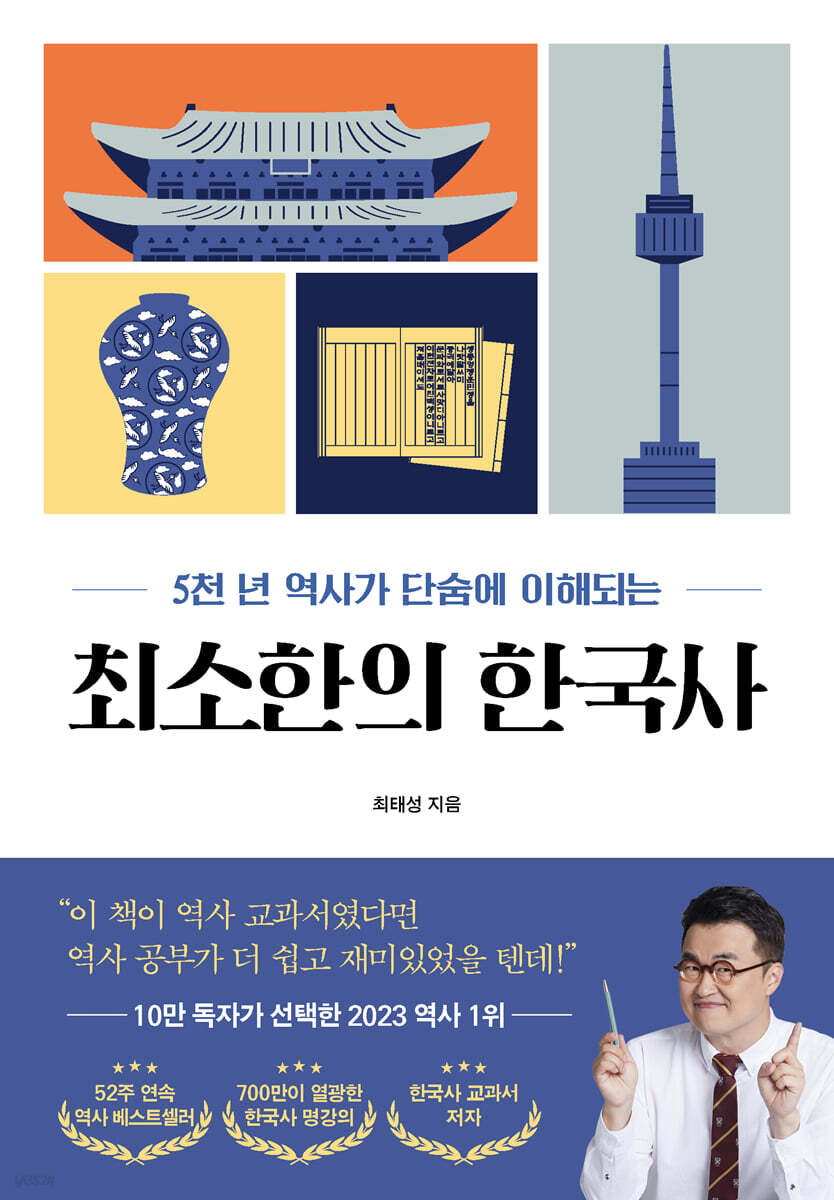 |
Description
Book Introduction
- A word from MD
-
Half a Millennium of History in One VolumeA new book by Choi Tae-seong, Korea's leading history lecturer.
A single volume contains a selection of essential information that must be known from 5,000 years of history from Gojoseon to the present day.
This book, which breaks free from memorization of people and events and draws a broad framework for understanding, invites readers lost in history into the exciting world of Korean history.
June 23, 2023. History PD Ahn Hyun-jae
#1 in history for two consecutive years in 2023 and 2024!
"Minimum Korean History," chosen by 200,000 readers, now available in the "Gwangbok Edition."
Choi Tae-seong, a representative history lecturer in Korea
A liberal arts Korean history class that explores our moving history.
"Minimum Korean History," which has instilled confidence in Korean history in countless readers, is being published as a special edition commemorating the 80th anniversary of liberation, with 200,000 copies sold.
This limited edition of the Gwangbok Edition features a cover featuring the work of artist Kim Nu-ri, who creates modern versions of folk paintings using traditional coloring and lithography.
The cover artwork depicts the Rose of Sharon, the national flower, and the tiger, the guardian deity that wards off evil spirits, against the backdrop of our beautiful mountains and rivers, expressing the joy of liberation and hope for a new era.
Author Choi Tae-seong, while publishing the Gwangbok Edition, said this about the meaning of liberation and the reason for learning its history.
“Liberation means ‘finding light again.’
On August 29, 1910, the Republic of Korea lost its sovereignty and lost its light, but on August 15, 1945, it regained its light.
Many people who lived during the 35 years of Japanese colonial rule dreamed that those who came after them would not have to live as colonial subjects.
I gave up my fortune and my life for that dream.
History reminds us that we, today, have been loved by so many people.
“On the 80th anniversary of liberation, it is now time for us to remember them.”
"Minimum Korean History," which contains the minimum knowledge required to properly understand our history, has maintained its position as a bestseller for 104 consecutive weeks since its publication in 2023 and has solidified its position as the best introductory book to Korean history, having been selected as Yes24's Book of the Year and a National Library Librarian Recommended Book.
This book is the perfect choice for anyone who wants to properly study our history on the occasion of the 80th anniversary of liberation, anyone who wants to find heart-warming inspiration in history, or anyone who is curious about the correct history amidst the endless historical debate.
Let's recharge our confidence in Korean history with the "Minimum Korean History" "Gwangbok Edition," which offers both a visual and reading experience with its sensuous cover.
"Minimum Korean History," chosen by 200,000 readers, now available in the "Gwangbok Edition."
Choi Tae-seong, a representative history lecturer in Korea
A liberal arts Korean history class that explores our moving history.
"Minimum Korean History," which has instilled confidence in Korean history in countless readers, is being published as a special edition commemorating the 80th anniversary of liberation, with 200,000 copies sold.
This limited edition of the Gwangbok Edition features a cover featuring the work of artist Kim Nu-ri, who creates modern versions of folk paintings using traditional coloring and lithography.
The cover artwork depicts the Rose of Sharon, the national flower, and the tiger, the guardian deity that wards off evil spirits, against the backdrop of our beautiful mountains and rivers, expressing the joy of liberation and hope for a new era.
Author Choi Tae-seong, while publishing the Gwangbok Edition, said this about the meaning of liberation and the reason for learning its history.
“Liberation means ‘finding light again.’
On August 29, 1910, the Republic of Korea lost its sovereignty and lost its light, but on August 15, 1945, it regained its light.
Many people who lived during the 35 years of Japanese colonial rule dreamed that those who came after them would not have to live as colonial subjects.
I gave up my fortune and my life for that dream.
History reminds us that we, today, have been loved by so many people.
“On the 80th anniversary of liberation, it is now time for us to remember them.”
"Minimum Korean History," which contains the minimum knowledge required to properly understand our history, has maintained its position as a bestseller for 104 consecutive weeks since its publication in 2023 and has solidified its position as the best introductory book to Korean history, having been selected as Yes24's Book of the Year and a National Library Librarian Recommended Book.
This book is the perfect choice for anyone who wants to properly study our history on the occasion of the 80th anniversary of liberation, anyone who wants to find heart-warming inspiration in history, or anyone who is curious about the correct history amidst the endless historical debate.
Let's recharge our confidence in Korean history with the "Minimum Korean History" "Gwangbok Edition," which offers both a visual and reading experience with its sensuous cover.
- You can preview some of the book's contents.
Preview
index
|Introduction| A first history lesson that fills you with culture and common sense.
Chapter 1: Gojoseon and the Three Kingdoms Period
Gojoseon: The Beginning of Half a Thousand Years of History
Goguryeo: A military powerhouse with iron cavalry galloping across the Manchurian plains
Baekje: A splendid but not extravagant cultural powerhouse
Silla: A diplomatic powerhouse that unified the three kingdoms with a flexible stance.
Gaya: A trading powerhouse known as the Iron Kingdom
Chapter 2: The North-South States Period
Balhae: The East Sea Kingdom that succeeded Goguryeo
Unified Silla: A Unified Korean Peninsula that Flourished a Brilliant Culture
Chapter 3: Goryeo Dynasty
The Founding of Goryeo: Opening the Middle Ages in Korean History
The Khitan and Jurchen Invasions: Brilliant Diplomatic Strategies and the Fall of the Aristocracy
The Military Era and the Mongol Invasion: A Turning Point in Goryeo History
The Yuan Intervention and King Gongmin's Reforms: Beyond Chaos and into a New Era
Chapter 4: Joseon Dynasty
The Founding of Joseon: Dreaming of a Confucian State Based on Neo-Confucianism
The Early Joseon Dynasty: Establishment of a Governing System and Cultural Development
The Rise of Sarim: The Spread of Confucianism and the Emergence of Local Scholars
The Imjin War and the Byeongja War: A Turning Point in Joseon History
Political Changes in the Late Joseon Dynasty: From Factional Strife to Restoration
The Reform Politics of King Yeongjo and King Jeongjo: The Renaissance of the Late Joseon Dynasty
The Decline of Joseon: The Politics of Factionalism and the Impoverished Livelihoods of the People
Chapter 5 Modern Times
The Opening of Joseon: Demands from Great Powers for Port Opening and Internal Chaos in Joseon
Japanese Invasion of National Sovereignty and Resistance: The Frustrated Dream of Establishing a Modern State
The Japanese colonial period in the 1910s: The March 1st Movement that ended military rule
1920s Japanese colonial period: Armed struggle against national division policies
The 1930s Japanese Colonial Period: Activities of the Provisional Government of the Republic of Korea amidst the policy of national genocide
Chapter 6 Modern Times
Liberation and Division: The Korean Peninsula Divided in Two After Liberation
Political History of the 1950s: The Establishment of the First Republic and Syngman Rhee's Government
Political History of the 1960s and 1970s: The 18-Year Park Chung-hee Government
Political History of the 1980s: The Rise of the New Military Regime and the Struggle for Democracy
Political History of the 1990s: The Development of Democracy
Source of the illustration
Chapter 1: Gojoseon and the Three Kingdoms Period
Gojoseon: The Beginning of Half a Thousand Years of History
Goguryeo: A military powerhouse with iron cavalry galloping across the Manchurian plains
Baekje: A splendid but not extravagant cultural powerhouse
Silla: A diplomatic powerhouse that unified the three kingdoms with a flexible stance.
Gaya: A trading powerhouse known as the Iron Kingdom
Chapter 2: The North-South States Period
Balhae: The East Sea Kingdom that succeeded Goguryeo
Unified Silla: A Unified Korean Peninsula that Flourished a Brilliant Culture
Chapter 3: Goryeo Dynasty
The Founding of Goryeo: Opening the Middle Ages in Korean History
The Khitan and Jurchen Invasions: Brilliant Diplomatic Strategies and the Fall of the Aristocracy
The Military Era and the Mongol Invasion: A Turning Point in Goryeo History
The Yuan Intervention and King Gongmin's Reforms: Beyond Chaos and into a New Era
Chapter 4: Joseon Dynasty
The Founding of Joseon: Dreaming of a Confucian State Based on Neo-Confucianism
The Early Joseon Dynasty: Establishment of a Governing System and Cultural Development
The Rise of Sarim: The Spread of Confucianism and the Emergence of Local Scholars
The Imjin War and the Byeongja War: A Turning Point in Joseon History
Political Changes in the Late Joseon Dynasty: From Factional Strife to Restoration
The Reform Politics of King Yeongjo and King Jeongjo: The Renaissance of the Late Joseon Dynasty
The Decline of Joseon: The Politics of Factionalism and the Impoverished Livelihoods of the People
Chapter 5 Modern Times
The Opening of Joseon: Demands from Great Powers for Port Opening and Internal Chaos in Joseon
Japanese Invasion of National Sovereignty and Resistance: The Frustrated Dream of Establishing a Modern State
The Japanese colonial period in the 1910s: The March 1st Movement that ended military rule
1920s Japanese colonial period: Armed struggle against national division policies
The 1930s Japanese Colonial Period: Activities of the Provisional Government of the Republic of Korea amidst the policy of national genocide
Chapter 6 Modern Times
Liberation and Division: The Korean Peninsula Divided in Two After Liberation
Political History of the 1950s: The Establishment of the First Republic and Syngman Rhee's Government
Political History of the 1960s and 1970s: The 18-Year Park Chung-hee Government
Political History of the 1980s: The Rise of the New Military Regime and the Struggle for Democracy
Political History of the 1990s: The Development of Democracy
Source of the illustration
Detailed image
.jpg)
Into the book
King Muryeong brought order back to the country, which was on the verge of collapse.
It held up without collapsing easily.
I think that's the power of culture.
If Goguryeo was a military powerhouse, Baekje was a cultural powerhouse.
In the Samguk Sagi, there is a saying, “Frugal does not make you shabby, luxurious does not make you luxurious.”
This is the principle applied when designing Baekje's first capital, Hanseong.
This is a phrase I really like, which translates to 'simple but not shabby, flashy but not extravagant.'
How cool is that? That's how I describe luxury.
This is what true luxury is all about.
---From "Baekje: A Splendid but Not Extravagant Cultural Powerhouse"
It's really amazing.
Who would have thought that Silla would unite the three kingdoms of the Three Kingdoms period? Yet, the smallest kingdom, Silla, achieved its dream of unification.
Wang Geon was also not a protagonist of the Later Three Kingdoms period.
He was a subordinate under Gung Ye.
In a way, it seems that an unexpected person unified the Later Three Kingdoms.
Those who are ahead should always be wary of complacency, and those who are behind should not give up and steadily pursue their own path.
Isn't the history of the Later Three Kingdoms period teaching us this lesson?
---From "Unified Silla: A Unified State of the Korean Peninsula that Flourished a Brilliant Culture"
Gwangjong did not reveal his presence for seven years after taking power.
I just read the book.
It is said that he always kept by his side 『Zhenguan Zhengyo』, a compilation of political dialogues between Emperor Taizong of Tang and his subjects, and read it.
Since the king was only reading books and not implementing any specific policies, his subjects must have thought, 'Isn't he too incompetent?'
However, the 『Jeonggwanjeongyo』 that Gwangjong read was not an ordinary book.
It was a political guidebook that allowed one to study the science of kingship, which included things like the way of a monarch and how to appoint talented people.
After seven years, Gwangjong finally pulled out his first reform card.
This is the slave inspection method.
It is a method of searching and examining slaves in detail to find those who were unjustly enslaved and free them.
Who had the largest number of slaves? It was the aristocrats.
However, if those who were illegally enslaved are returned to the status of commoners, the private property of the powerful families will decrease.
The military power that can be mobilized at will is also weakened.
This is exactly what Gwangjong was after.
---From "The Founding of Goryeo: Opening the Middle Ages of Korean History"
Jeong Do-jeon was a man who was full of the will to establish a Confucian nation.
So, the names of the four gates also include ‘Inuiyeji’, which is considered the most important in Confucianism.
The east gate was named Heunginjimun with the character 'in', the west gate was named Donuimun with the character 'ui', and the south gate was named Sungnyemun with the character 'ye'.
The only exception is the North, where the character for 'clear' (청) was used instead of 'ji' (지), as wisdom is not something to be shown outwardly.
So, the name was changed to Sukjeongmun, which means ‘comfortable’.
So where did the "God"—a concept also emphasized in Confucianism—come in? This was created after Jeong Do-jeon.
This is Bosingak, the place where the New Year's Eve bell is rung every time the year changes.
Bosin Pavilion is located in the middle of the four gates.
---From "The Founding of Joseon: Dreaming of a Confucian State Based on Neo-Confucianism"
The Gapsin Coup occurred at the opening banquet of the Korea Post Office, the first post office in Korea.
Radical reformists, including Kim Ok-gyun, set fire to the nearby banquet hall, throwing it into chaos, and then attacked Empress Myeongseong's nephew, Min Yeong-ik.
Then, he went to Changdeokgung Palace and lied that the Qing had started a rebellion, and took Gojong and Empress Myeongseong to Gyeongungung Palace.
Those who captured the king established the Reform Party government and announced a reform platform.
One of the core contents of the reform platform was the abolition of the caste system.
It's truly amazing.
Those at the very top of the class system gave up their vested interests and proposed a new world.
It's heartwarming to think that the young generation of a century ago dreamed of a better future.
It is a very valuable scene in our country's modern history.
---From "The Opening of Joseon: The Demands for Port Opening by the Great Powers and the Internal Chaos of Joseon"
The Chun Doo-hwan government had weak legitimacy because it came to power through a coup and the suppression of the May 18 Democratization Movement.
Unlike the Yushin regime, it implemented conciliatory policies such as lifting curfews and liberalizing overseas travel, but its legitimacy was shaken every spring.
Every May, citizens would protest, saying they would carry on the spirit of the May 18th Democratization Movement.
In this situation, a major incident occurred in January 1987.
This is the Park Jong-cheol torture death case.
A student named Park Jong-cheol, who participated in the protest, died during police torture.
But the police kept telling lies.
This is where the saying, “I hit the table with a thud and it died with a thud” comes from.
Students and citizens rose up again in protest against the police's absurd lies.
What they demanded was a direct presidential election system.
However, the Chun Doo-hwan government announced the April 13 Constitutional Amendment Measures on April 13, 1987.
It's about protecting the Constitution.
It meant that they would implement the 7-year single-term presidential indirect election system they had created.
It was like pouring oil on fire.
It held up without collapsing easily.
I think that's the power of culture.
If Goguryeo was a military powerhouse, Baekje was a cultural powerhouse.
In the Samguk Sagi, there is a saying, “Frugal does not make you shabby, luxurious does not make you luxurious.”
This is the principle applied when designing Baekje's first capital, Hanseong.
This is a phrase I really like, which translates to 'simple but not shabby, flashy but not extravagant.'
How cool is that? That's how I describe luxury.
This is what true luxury is all about.
---From "Baekje: A Splendid but Not Extravagant Cultural Powerhouse"
It's really amazing.
Who would have thought that Silla would unite the three kingdoms of the Three Kingdoms period? Yet, the smallest kingdom, Silla, achieved its dream of unification.
Wang Geon was also not a protagonist of the Later Three Kingdoms period.
He was a subordinate under Gung Ye.
In a way, it seems that an unexpected person unified the Later Three Kingdoms.
Those who are ahead should always be wary of complacency, and those who are behind should not give up and steadily pursue their own path.
Isn't the history of the Later Three Kingdoms period teaching us this lesson?
---From "Unified Silla: A Unified State of the Korean Peninsula that Flourished a Brilliant Culture"
Gwangjong did not reveal his presence for seven years after taking power.
I just read the book.
It is said that he always kept by his side 『Zhenguan Zhengyo』, a compilation of political dialogues between Emperor Taizong of Tang and his subjects, and read it.
Since the king was only reading books and not implementing any specific policies, his subjects must have thought, 'Isn't he too incompetent?'
However, the 『Jeonggwanjeongyo』 that Gwangjong read was not an ordinary book.
It was a political guidebook that allowed one to study the science of kingship, which included things like the way of a monarch and how to appoint talented people.
After seven years, Gwangjong finally pulled out his first reform card.
This is the slave inspection method.
It is a method of searching and examining slaves in detail to find those who were unjustly enslaved and free them.
Who had the largest number of slaves? It was the aristocrats.
However, if those who were illegally enslaved are returned to the status of commoners, the private property of the powerful families will decrease.
The military power that can be mobilized at will is also weakened.
This is exactly what Gwangjong was after.
---From "The Founding of Goryeo: Opening the Middle Ages of Korean History"
Jeong Do-jeon was a man who was full of the will to establish a Confucian nation.
So, the names of the four gates also include ‘Inuiyeji’, which is considered the most important in Confucianism.
The east gate was named Heunginjimun with the character 'in', the west gate was named Donuimun with the character 'ui', and the south gate was named Sungnyemun with the character 'ye'.
The only exception is the North, where the character for 'clear' (청) was used instead of 'ji' (지), as wisdom is not something to be shown outwardly.
So, the name was changed to Sukjeongmun, which means ‘comfortable’.
So where did the "God"—a concept also emphasized in Confucianism—come in? This was created after Jeong Do-jeon.
This is Bosingak, the place where the New Year's Eve bell is rung every time the year changes.
Bosin Pavilion is located in the middle of the four gates.
---From "The Founding of Joseon: Dreaming of a Confucian State Based on Neo-Confucianism"
The Gapsin Coup occurred at the opening banquet of the Korea Post Office, the first post office in Korea.
Radical reformists, including Kim Ok-gyun, set fire to the nearby banquet hall, throwing it into chaos, and then attacked Empress Myeongseong's nephew, Min Yeong-ik.
Then, he went to Changdeokgung Palace and lied that the Qing had started a rebellion, and took Gojong and Empress Myeongseong to Gyeongungung Palace.
Those who captured the king established the Reform Party government and announced a reform platform.
One of the core contents of the reform platform was the abolition of the caste system.
It's truly amazing.
Those at the very top of the class system gave up their vested interests and proposed a new world.
It's heartwarming to think that the young generation of a century ago dreamed of a better future.
It is a very valuable scene in our country's modern history.
---From "The Opening of Joseon: The Demands for Port Opening by the Great Powers and the Internal Chaos of Joseon"
The Chun Doo-hwan government had weak legitimacy because it came to power through a coup and the suppression of the May 18 Democratization Movement.
Unlike the Yushin regime, it implemented conciliatory policies such as lifting curfews and liberalizing overseas travel, but its legitimacy was shaken every spring.
Every May, citizens would protest, saying they would carry on the spirit of the May 18th Democratization Movement.
In this situation, a major incident occurred in January 1987.
This is the Park Jong-cheol torture death case.
A student named Park Jong-cheol, who participated in the protest, died during police torture.
But the police kept telling lies.
This is where the saying, “I hit the table with a thud and it died with a thud” comes from.
Students and citizens rose up again in protest against the police's absurd lies.
What they demanded was a direct presidential election system.
However, the Chun Doo-hwan government announced the April 13 Constitutional Amendment Measures on April 13, 1987.
It's about protecting the Constitution.
It meant that they would implement the 7-year single-term presidential indirect election system they had created.
It was like pouring oil on fire.
---From "Political History of the 1980s: The Rise of the New Military Regime and the Struggle for Democracy"
Publisher's Review
For those who are intimidated by historical stories
Big Star Teacher Choi Tae-seong's Essential Korean History: Read it once and use it for life
History, which was always relegated to the back burner during school days, is often considered an essential element of culture and common sense once one enters society.
This is why companies and public figures have been embroiled in controversy for making statements that are not historically relevant, and why everyone has had the experience of awkwardly laughing and wasting time when history came up as a topic of conversation at least once.
But contrary to one's heart, starting to study history is not so easy.
Because of the sheer volume, the event names in Chinese characters, and the complex causal relationships, it makes me hesitate to even start.
Author Choi Tae-seong, who has taught history for a long time, says he has met many people who are interested in Korean history but are frustrated because they don't know where to start.
I thought that there was a need for an introductory book on Korean history that could help them, and as a result, I published “Minimum Korean History.”
As the author says, “As a Korean history textbook author and a lecturer on Korean history, I have organized the core of Korean history that I believe will allow you to feel confident if you know just this much, no more, no less,” and this book covers the essential Korean history that all Koreans must know among the 5,000-year history of the Korean Peninsula from the founding of Gojoseon to the present day.
For those who want to understand the entire context of our history at a glance, those who want to study history as a general knowledge rather than for exam preparation, and those who repeatedly give up on Korean history books without finishing them, this book will lay the foundation for Korean history that can be used for a lifetime after reading it once.
“Even without any basic knowledge, you’ll be drawn into it like watching a drama!”
From the founding of Gojoseon to the present day,
The minimum knowledge required to understand our half-millennium history
The most important thing author Choi Tae-seong considered while writing this book was to complete an introductory book on Korean history that was easy and fun to read.
So, I extracted only the most important parts of Korean history and presented them as a drama so that each fact could be naturally connected.
Even complex historical facts that often make people give up studying history in the middle were explained with images to help them understand at a glance.
In addition, to allow readers to understand the context of Korean history, the book describes it in order from ancient times to the present day, focusing on the kings for pre-modern history from Gojoseon to Joseon, and on events for modern and contemporary history from the opening of the country to the present.
Because the characters and events were introduced using explanatory methods appropriate for each era, the flow of Korean history is clearly organized just by following the story, and events and characters that had previously been memorized become clearly understood.
We learn about history throughout our school years and encounter it through various content, but history always feels like a series of complex and difficult concepts.
Now it's time to break that prejudice.
Instead of explaining countless figures and events that can be memorized today but forgotten tomorrow, 『Minimum Korean History』 outlines the main plot of Korean history, placing a simple and clear map in the hands of readers who are constantly lost in the vast ocean of history, inviting them into the exciting world of Korean history.
Instill confidence in conversations, gain a deeper understanding of content,
A liberal arts Korean history class that cultivates insight into the world.
It is no coincidence that in our rapidly developing modern society, history is considered one of the first liberal arts necessary for this era.
If we learn about the turbulent times our country has gone through to become what it is today, we can accurately understand the present and our perspective on the world will change.
In that sense, history is not a faded old story, but the most basic knowledge for understanding the world.
It is for the same reason that this book tells stories not only about historically important people and events, but also about stories that are closely related to our daily lives.
By introducing the legacies that history has left in our daily lives, such as how the names of the Sadamun Gates in Seoul were derived, why people who run errands and don't return are called Hamheung Chasa, and why National Foundation Day is on October 3rd, it reveals the true nature of history as a form of culture and common sense.
When we possess living historical knowledge, rather than dead historical facts, we can confidently speak out in conversations, gain a deeper understanding of historical content, and gain insight into the world.
"Minimum Korean History," which catches both fun and meaningful rabbits, will be the first step toward that change.
Big Star Teacher Choi Tae-seong's Essential Korean History: Read it once and use it for life
History, which was always relegated to the back burner during school days, is often considered an essential element of culture and common sense once one enters society.
This is why companies and public figures have been embroiled in controversy for making statements that are not historically relevant, and why everyone has had the experience of awkwardly laughing and wasting time when history came up as a topic of conversation at least once.
But contrary to one's heart, starting to study history is not so easy.
Because of the sheer volume, the event names in Chinese characters, and the complex causal relationships, it makes me hesitate to even start.
Author Choi Tae-seong, who has taught history for a long time, says he has met many people who are interested in Korean history but are frustrated because they don't know where to start.
I thought that there was a need for an introductory book on Korean history that could help them, and as a result, I published “Minimum Korean History.”
As the author says, “As a Korean history textbook author and a lecturer on Korean history, I have organized the core of Korean history that I believe will allow you to feel confident if you know just this much, no more, no less,” and this book covers the essential Korean history that all Koreans must know among the 5,000-year history of the Korean Peninsula from the founding of Gojoseon to the present day.
For those who want to understand the entire context of our history at a glance, those who want to study history as a general knowledge rather than for exam preparation, and those who repeatedly give up on Korean history books without finishing them, this book will lay the foundation for Korean history that can be used for a lifetime after reading it once.
“Even without any basic knowledge, you’ll be drawn into it like watching a drama!”
From the founding of Gojoseon to the present day,
The minimum knowledge required to understand our half-millennium history
The most important thing author Choi Tae-seong considered while writing this book was to complete an introductory book on Korean history that was easy and fun to read.
So, I extracted only the most important parts of Korean history and presented them as a drama so that each fact could be naturally connected.
Even complex historical facts that often make people give up studying history in the middle were explained with images to help them understand at a glance.
In addition, to allow readers to understand the context of Korean history, the book describes it in order from ancient times to the present day, focusing on the kings for pre-modern history from Gojoseon to Joseon, and on events for modern and contemporary history from the opening of the country to the present.
Because the characters and events were introduced using explanatory methods appropriate for each era, the flow of Korean history is clearly organized just by following the story, and events and characters that had previously been memorized become clearly understood.
We learn about history throughout our school years and encounter it through various content, but history always feels like a series of complex and difficult concepts.
Now it's time to break that prejudice.
Instead of explaining countless figures and events that can be memorized today but forgotten tomorrow, 『Minimum Korean History』 outlines the main plot of Korean history, placing a simple and clear map in the hands of readers who are constantly lost in the vast ocean of history, inviting them into the exciting world of Korean history.
Instill confidence in conversations, gain a deeper understanding of content,
A liberal arts Korean history class that cultivates insight into the world.
It is no coincidence that in our rapidly developing modern society, history is considered one of the first liberal arts necessary for this era.
If we learn about the turbulent times our country has gone through to become what it is today, we can accurately understand the present and our perspective on the world will change.
In that sense, history is not a faded old story, but the most basic knowledge for understanding the world.
It is for the same reason that this book tells stories not only about historically important people and events, but also about stories that are closely related to our daily lives.
By introducing the legacies that history has left in our daily lives, such as how the names of the Sadamun Gates in Seoul were derived, why people who run errands and don't return are called Hamheung Chasa, and why National Foundation Day is on October 3rd, it reveals the true nature of history as a form of culture and common sense.
When we possess living historical knowledge, rather than dead historical facts, we can confidently speak out in conversations, gain a deeper understanding of historical content, and gain insight into the world.
"Minimum Korean History," which catches both fun and meaningful rabbits, will be the first step toward that change.
GOODS SPECIFICS
- Date of issue: June 21, 2023
- Page count, weight, size: 352 pages | 532g | 146*210*23mm
- ISBN13: 9791198243430
- ISBN10: 1198243430
You may also like
카테고리
korean


korean

![GQ KOREA Mark (Monthly): December [2025]](http://librairie.coreenne.fr/cdn/shop/files/8ef265dbbfbf186523ed75ba7319009d.jpg?v=1765340328&width=3840)


