

Who knows if it's good or bad?
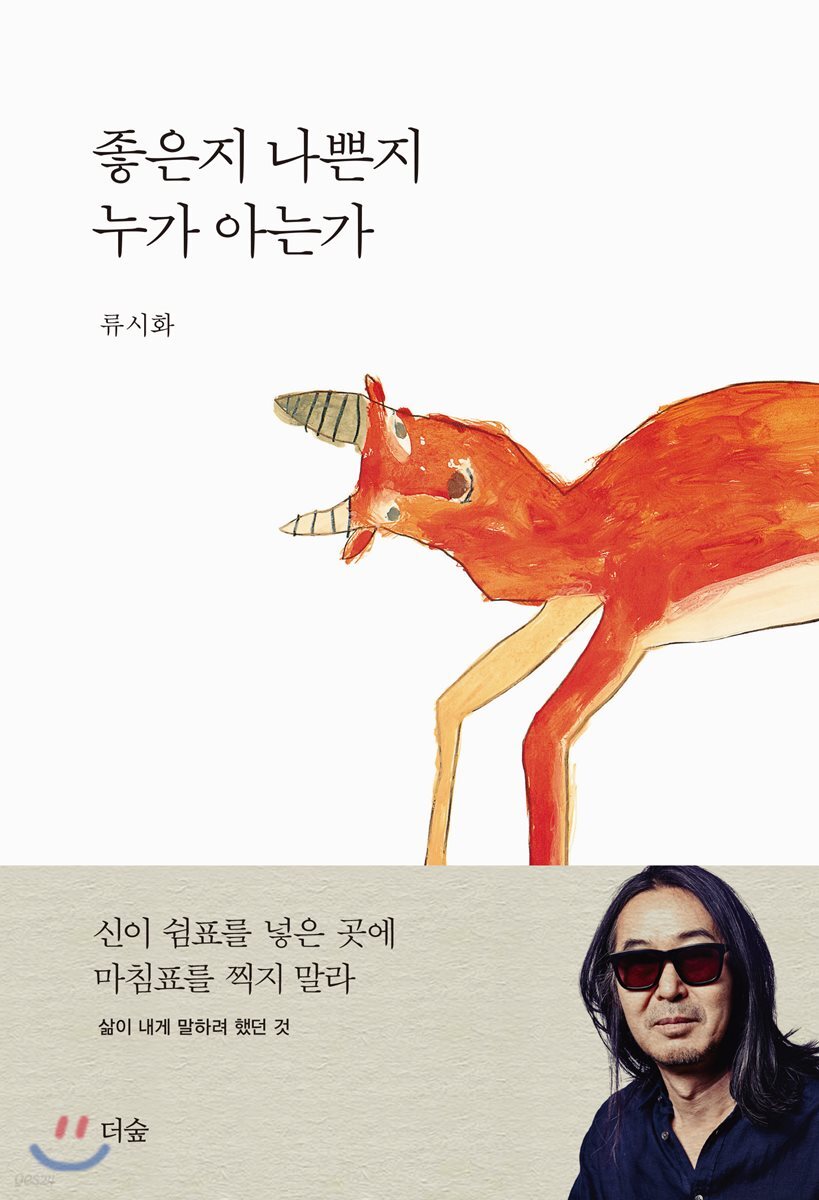 |
Description
Book Introduction
- A word from MD
-
What life was trying to tell meIf we could see the full picture of life, would we realize that this moment, which seems so dark, will one day return as a gift? The poet, in his own words, speaks of what life has tried to tell us.
A new work by poet Ryu Si-hwa, who transforms even the twists and turns of life into laughter and enlightenment.
March 5, 2019. Essay PD Kim Tae-hee
Opening an unknown book is a matter of expectation and faith in the author.
A new essay by poet Ryu Si-hwa, whose poetry, prose, travelogues, and translations consistently evoke empathy.
The theme of this book is 'What life was trying to tell me.'
In addition to the title work, “Who Knows If It’s Good or Bad,” “A Fool in the Rain,” “When Counting Blessings, Don’t Count Wounds,” “God Writes Straight Messages in Crooked Handwriting,” “An Imperfect Person Can Give a Perfect Rose,” “Life Mantra,” and “There Is No Star That Shines Without Burning Itself,” the poet’s words tell stories about life and humanity.
It also includes a true confession that one person can make to another, "I like myself the best when I'm with you," and "The Secret to Creating Magic," which you have to keep doing over and over again until the end, since you're not a genius anyway.
If we could see the full picture of life, would we realize that the roadblocks we face today will one day be a gift? "Don't put a period where God put a comma," the author says.
We ourselves are bigger than our problems.
It reveals the insight that transforms even the twists and turns of life into laughter and enlightenment.
It is often said that essays are written with the strokes of a brush, but some brushes carve deeply like iron and burn away the impurities of the mind like fire, making us reflect on the days we have lived and the days we will live.
A new essay by poet Ryu Si-hwa, whose poetry, prose, travelogues, and translations consistently evoke empathy.
The theme of this book is 'What life was trying to tell me.'
In addition to the title work, “Who Knows If It’s Good or Bad,” “A Fool in the Rain,” “When Counting Blessings, Don’t Count Wounds,” “God Writes Straight Messages in Crooked Handwriting,” “An Imperfect Person Can Give a Perfect Rose,” “Life Mantra,” and “There Is No Star That Shines Without Burning Itself,” the poet’s words tell stories about life and humanity.
It also includes a true confession that one person can make to another, "I like myself the best when I'm with you," and "The Secret to Creating Magic," which you have to keep doing over and over again until the end, since you're not a genius anyway.
If we could see the full picture of life, would we realize that the roadblocks we face today will one day be a gift? "Don't put a period where God put a comma," the author says.
We ourselves are bigger than our problems.
It reveals the insight that transforms even the twists and turns of life into laughter and enlightenment.
It is often said that essays are written with the strokes of a brush, but some brushes carve deeply like iron and burn away the impurities of the mind like fire, making us reflect on the days we have lived and the days we will live.
- You can preview some of the book's contents.
Preview
index
1
Fool who gets wet in the rain
A bird may fly and not know where it will go
Don't make a big deal out of it
Life Mantra
When counting your blessings, don't count your wounds.
God writes straight messages in crooked letters.
Being alive hurts
2
Who knows if it's good or bad?
Why only this
The secret to making magic happen
My Hindi Class
My disciple whom I cannot hate
Jung's Stone House
An imperfect person can give a perfect rose.
3
Store and sow
I like myself the most when I'm with you
Me when no one is looking
Inner Child
My part of speech
My soul, how are you?
The miracle of meeting again
4
Whatever path you take, become one with it.
Pure Korean
Don't think of monkeys
Welcome, Emotion
Lenchak
Apple Story
Death of the Black-faced Woodpecker
5
No one comes by accident
You will know when the flowers bloom
6 billion worlds
compassion fatigue
If you worry about it and then your worries disappear, you won't have any worries.
Why am I not you
It's me
6
One true sentence
parachute folder
The real me, the fake you
There is no star that shines without burning itself.
What we seek is seeking us
Epilogue_A Gift from the Sky Lake
Fool who gets wet in the rain
A bird may fly and not know where it will go
Don't make a big deal out of it
Life Mantra
When counting your blessings, don't count your wounds.
God writes straight messages in crooked letters.
Being alive hurts
2
Who knows if it's good or bad?
Why only this
The secret to making magic happen
My Hindi Class
My disciple whom I cannot hate
Jung's Stone House
An imperfect person can give a perfect rose.
3
Store and sow
I like myself the most when I'm with you
Me when no one is looking
Inner Child
My part of speech
My soul, how are you?
The miracle of meeting again
4
Whatever path you take, become one with it.
Pure Korean
Don't think of monkeys
Welcome, Emotion
Lenchak
Apple Story
Death of the Black-faced Woodpecker
5
No one comes by accident
You will know when the flowers bloom
6 billion worlds
compassion fatigue
If you worry about it and then your worries disappear, you won't have any worries.
Why am I not you
It's me
6
One true sentence
parachute folder
The real me, the fake you
There is no star that shines without burning itself.
What we seek is seeking us
Epilogue_A Gift from the Sky Lake
Detailed image

Into the book
“To be honest, the stories were so good that I was captivated.
“I couldn’t give up without listening to the end.”
Shiva suppressed his anger and said:
“Then you should leave this Mount Kailash and go down to the human world and tell those stories.
“Never think of coming back until everyone in the world knows those stories.”
So the minister was banished from his Himalayan temple and was forced to wander the world, telling humans the stories he knew.
I think that all writers, like this gentleman, bear the fate of a storyteller.
We must always tell stories that are new, interesting, enlightening and meaningful.
So, once the reader has read the first story, you have to make them want to read the next one.
We are each the authors of our own lives.
Only we can say what story our lives are writing, what meaning those stories hold, and whether they are exciting enough to read next.
Following 『Birds Don't Look Back While Flying』, I am publishing a new collection of prose.
I hope you enjoy reading it.
---From the author's preface, "The Author of My Own Life"
I asked.
"Why didn't you tell me? Knowing the environment of the Langtang region so well, why didn't you advise me on what equipment I needed?"
My friend said.
“Because it’s better for you to experience it firsthand.
And I will continue to trek in the future.
I knew I would be able to get the necessary equipment and tools along the way.
“I believe that we can somehow solve the problem.”
Life is not something to be explained, it is something to be experienced.
Experience burns away the impurities within us.
If that friend hadn't been so generous with his advice, the Langtang trek wouldn't have been so deeply engraved in my soul.
I believe those roads were waiting for me then.
To make me embrace uncertainty myself, as I try to live by relying on the advice of those with experience.
When entering unknown territory, I want to make you encounter the reality before your eyes rather than a guide.
Because life will eventually give you the answer.
---From "A bird may fly and not know where it will go"
It was the first time I had ever been hit by so much rain in such a short period of time.
The auto rickshaw, submerged up to its wheels, was running wildly through what was either a swamp or a puddle, and I felt like I was getting rained on from all sides.
It was difficult to tell whether the randomly appearing object was a cow or a person.
The old rickshaw driver, sensing my fear as I clutched the bars, spoke over his shoulder.
“Nothing special!”
"It's not a big deal, so don't worry" was the reply (in South India, where the rainy season is long, heavy rain often falls even in December).
Those words instantly changed my mind, which was fighting an internal battle with negative thoughts.
A thought suddenly crossed my mind: 'Aren't I a traveler? Where else but a subtropical country would I encounter such rain?'
---From "Don't Make a Big Deal of It"
A woman I knew before would say, “Make it delicious, make it delicious!” before eating her food.
It was quite serious, as if sprinkling a special masala (seasoning) that changed the taste, and it made the viewer smile.
He said he leaves that order even when he cooks at home.
When I asked, “Would that really make tasteless food taste good?” he said, “Yes, it is a powerful mantra!”
What is your life mantra, the magic spell you cast on yourself? Are the words and phrases filled with positivity? ---From "Life Mantra"
We ask God, we ask life.
'Why is this all you give me?' But an invisible voice answers.
"Because this is what leads you to what you want." When we fail to hear that whisper, we waste time in internal debates with the world.
It's natural for others to not understand your journey, but it's unfortunate for you to not understand your own journey.
It is said that the moment he accepted the fact that he would never have arms, wings began to grow from his bird body.
---From "Why Only This"
The first sentence Sunil taught me while bragging was this:
It's a sentence that I can't forget even though a lot of time has passed.
'Az ham bahut kushi he!'
It means 'I (or we) am very happy today!'
Because Sunil unilaterally decided to teach me only one sentence a day, and because he disappeared somewhere within a ten-kilometer radius for several days after that, I had to repeat that sentence out loud countless times.
Az ham bahut kushi he, az ham bahut kushi he.
I am very happy today.
---From "My Hindi Class"
The reason we like someone and want to be with them is not simply because we like them, but because we feel better and more ourselves when we are with them.
Another reason we often avoid and distance ourselves from someone is because we start to dislike ourselves when we are with that person.
Have you ever been so lucky? To have someone say to you, "I'm the best when I'm with you."
---From "I like myself the most when I'm with you"
Everyone has a wounded child inside them.
A child who was left alone and uncared for.
A child who actually wants to live better and make life more precious.
It must be we, not others, who bring that inner child back to life.
---From "Inner Child"
Pruning relationships takes courage.
Without owls, otters could swim across vast lakes and live free and happy lives.
Without otters, owls could easily survive as birds of prey.
An otter's life is an otter's life, and an owl's life is an owl's life.
This simple awareness is the way to break unhealthy relationships.
To do that, you need to realize whether the relationship you are in is a dalliance or true love.
The standard is this.
"Does your relationship bring pure joy? Is there mutual respect and admiration? Does self-sacrifice lead to positive outcomes and growth for both parties?" --- From "Renchak"
Every encounter has meaning, and no one appears in our lives by chance.
Some people come into my life and leave quickly, while others stay with me for a long time, but they all leave big or small marks on my heart, and before I know it, I have become a different person.
I am grateful that you came into my life.
Whether it's a meeting for a reason, a meeting for a season, or a lifelong meeting.
---From "Nobody Comes by Chance"
Most of the important things I have accomplished in life have been accomplished because of a series of signs that appeared before me.
If you believe and follow the signs without missing them, you will definitely get the answer, and in that case, the results will always be good, regardless of worldly success.
The poet Rumi says:
“What you love will attract you.
Follow it silently.
You will not lose your way.”
“I couldn’t give up without listening to the end.”
Shiva suppressed his anger and said:
“Then you should leave this Mount Kailash and go down to the human world and tell those stories.
“Never think of coming back until everyone in the world knows those stories.”
So the minister was banished from his Himalayan temple and was forced to wander the world, telling humans the stories he knew.
I think that all writers, like this gentleman, bear the fate of a storyteller.
We must always tell stories that are new, interesting, enlightening and meaningful.
So, once the reader has read the first story, you have to make them want to read the next one.
We are each the authors of our own lives.
Only we can say what story our lives are writing, what meaning those stories hold, and whether they are exciting enough to read next.
Following 『Birds Don't Look Back While Flying』, I am publishing a new collection of prose.
I hope you enjoy reading it.
---From the author's preface, "The Author of My Own Life"
I asked.
"Why didn't you tell me? Knowing the environment of the Langtang region so well, why didn't you advise me on what equipment I needed?"
My friend said.
“Because it’s better for you to experience it firsthand.
And I will continue to trek in the future.
I knew I would be able to get the necessary equipment and tools along the way.
“I believe that we can somehow solve the problem.”
Life is not something to be explained, it is something to be experienced.
Experience burns away the impurities within us.
If that friend hadn't been so generous with his advice, the Langtang trek wouldn't have been so deeply engraved in my soul.
I believe those roads were waiting for me then.
To make me embrace uncertainty myself, as I try to live by relying on the advice of those with experience.
When entering unknown territory, I want to make you encounter the reality before your eyes rather than a guide.
Because life will eventually give you the answer.
---From "A bird may fly and not know where it will go"
It was the first time I had ever been hit by so much rain in such a short period of time.
The auto rickshaw, submerged up to its wheels, was running wildly through what was either a swamp or a puddle, and I felt like I was getting rained on from all sides.
It was difficult to tell whether the randomly appearing object was a cow or a person.
The old rickshaw driver, sensing my fear as I clutched the bars, spoke over his shoulder.
“Nothing special!”
"It's not a big deal, so don't worry" was the reply (in South India, where the rainy season is long, heavy rain often falls even in December).
Those words instantly changed my mind, which was fighting an internal battle with negative thoughts.
A thought suddenly crossed my mind: 'Aren't I a traveler? Where else but a subtropical country would I encounter such rain?'
---From "Don't Make a Big Deal of It"
A woman I knew before would say, “Make it delicious, make it delicious!” before eating her food.
It was quite serious, as if sprinkling a special masala (seasoning) that changed the taste, and it made the viewer smile.
He said he leaves that order even when he cooks at home.
When I asked, “Would that really make tasteless food taste good?” he said, “Yes, it is a powerful mantra!”
What is your life mantra, the magic spell you cast on yourself? Are the words and phrases filled with positivity? ---From "Life Mantra"
We ask God, we ask life.
'Why is this all you give me?' But an invisible voice answers.
"Because this is what leads you to what you want." When we fail to hear that whisper, we waste time in internal debates with the world.
It's natural for others to not understand your journey, but it's unfortunate for you to not understand your own journey.
It is said that the moment he accepted the fact that he would never have arms, wings began to grow from his bird body.
---From "Why Only This"
The first sentence Sunil taught me while bragging was this:
It's a sentence that I can't forget even though a lot of time has passed.
'Az ham bahut kushi he!'
It means 'I (or we) am very happy today!'
Because Sunil unilaterally decided to teach me only one sentence a day, and because he disappeared somewhere within a ten-kilometer radius for several days after that, I had to repeat that sentence out loud countless times.
Az ham bahut kushi he, az ham bahut kushi he.
I am very happy today.
---From "My Hindi Class"
The reason we like someone and want to be with them is not simply because we like them, but because we feel better and more ourselves when we are with them.
Another reason we often avoid and distance ourselves from someone is because we start to dislike ourselves when we are with that person.
Have you ever been so lucky? To have someone say to you, "I'm the best when I'm with you."
---From "I like myself the most when I'm with you"
Everyone has a wounded child inside them.
A child who was left alone and uncared for.
A child who actually wants to live better and make life more precious.
It must be we, not others, who bring that inner child back to life.
---From "Inner Child"
Pruning relationships takes courage.
Without owls, otters could swim across vast lakes and live free and happy lives.
Without otters, owls could easily survive as birds of prey.
An otter's life is an otter's life, and an owl's life is an owl's life.
This simple awareness is the way to break unhealthy relationships.
To do that, you need to realize whether the relationship you are in is a dalliance or true love.
The standard is this.
"Does your relationship bring pure joy? Is there mutual respect and admiration? Does self-sacrifice lead to positive outcomes and growth for both parties?" --- From "Renchak"
Every encounter has meaning, and no one appears in our lives by chance.
Some people come into my life and leave quickly, while others stay with me for a long time, but they all leave big or small marks on my heart, and before I know it, I have become a different person.
I am grateful that you came into my life.
Whether it's a meeting for a reason, a meeting for a season, or a lifelong meeting.
---From "Nobody Comes by Chance"
Most of the important things I have accomplished in life have been accomplished because of a series of signs that appeared before me.
If you believe and follow the signs without missing them, you will definitely get the answer, and in that case, the results will always be good, regardless of worldly success.
The poet Rumi says:
“What you love will attract you.
Follow it silently.
You will not lose your way.”
---From "What We Seek Finds Us"
Publisher's Review
Written in the language of a poet,
What life was trying to tell me
"Who Knows If It's Good or Bad" contains the author's experience and realization that there is nothing bad in life.
The anecdote of being kicked out of a religious community because of people who mistook a 'poet' for a 'god'; the difference between burying and sowing that I realized while living in a rented room without a bathroom and running to the bathroom at a nearby university hospital every day; the Hindi class where I had to repeat 'I am happy today' out loud countless times; a voice that answered the question 'Why only this do you give me?' with 'Because only this will lead you to that'; the truth that God has written each person's path and that if you follow the signs, you won't get lost; the truth that you shouldn't judge a tree by its appearance in its most difficult season, but that you will know it when it blooms.
Some stories are funny, some are memorable, some have a twist, and some are so touching that they will bring you to tears.
A poet opens his heart with just one sentence.
Although Ryu Si-hwa has been actively translating meditation books and meeting spiritual masters, he is not a writer who prioritizes claims or ideologies.
It tells of chance encounters that helped him grow, of painful experiences hidden behind laughter and wit, and of many stories from the world that provided nourishment to his soul.
Sometimes it makes you burst out laughing, and at other times it makes you cry.
As I read the writings, I get the feeling that the author is more of a 'storyteller' than a 'story therapist'.
His idea is that 'life is not about learning, but about finding out.'
During his senior year of college, the author heard from a friend that there was a cheap place to rent, so he moved into a religious community on the outskirts of Gyeonggi Province.
It's an old studio apartment, but it's an independent space, and there's a path to the river, so I consider it a gift from God.
But when a long-haired stranger wanders into their sacred grounds, the community gathers and demands that he leave immediately.
When he reveals himself as a poet and pleads for mercy, people misunderstand him as a god and shout, “Get out of here, you devil!”
In the end, you get kicked out without even getting your remaining rent back.
But God did not completely abandon him.
As he was wandering the country roads with nowhere to go, he met a junior from the theater club who arranged for him to live in an unlicensed warehouse in a field by the river.
Happiness is short-lived, as the summer monsoon season arrives and when I go outside in the middle of the night, the river is surging in torrential rain.
He suddenly becomes aware of the threateningly rising river, filled with fear and trembling, with nowhere else to go.
“Am I not a poet!”
The author summarizes his realization by quoting novelist Natalie Goldberg, who said, "Writers are fools who get wet."
“When I thought of myself as a poet, not as someone who was ‘out of place’ or ‘a devil cast out of the community,’ the raindrops hitting my face, the corn leaves dancing in the rain, even the windowsill dripping with candle wax felt like blessings.
“Such poetic moments are not given to just anyone.”
“God writes straight messages in crooked letters.”
There are times when a book embraces us.
The reader feels it the moment he reads, and he believes that feeling.
How much of the writer's sincerity is contained in the writing.
In an interview, the author says:
“To me, a reader is a comrade with whom I share my writing.
When I meet someone who has read my writing, I feel a sense of camaraderie as a fellow human being.
The poet Pablo Neruda once stopped by a coal mine in Chile while traveling.
At that moment, a miner with a dark face who was working in the mine approached Neruda and hugged him tightly, shouting:
"I've known you for a long time." Having such a comrade strengthens us in this world...
Like many others, I have experienced many times when I have broken down or despaired.
“All those who raised me up at times like that, and those who showed me the way when I was lost, are my teachers.”
The author tells the story of a family who had been living with no hope, relying only on an old cow, but after the cow fell off a cliff and died, they turned their lives around and finally met the best luck of their lives.
“The moment we decide to live safely, life pushes us off a cliff.
When waves crash, it is a message that it is time to start a new life.
Any loss or loss is not in vain.
Isn't there a saying that 'God writes straight messages in crooked letters'?
"What cow do I have that I need to push off the cliff right now? What is its name? The comfort and familiarity that my life depends on, the thing that holds me back from going any further."
“Even an imperfect person can give a perfect rose.”
The moment you accept that you will never have arms
Wings began to sprout from the bird's body.
“I believe there is a difference between burying and sowing.
There are times in life when you feel like you are buried in a dark place.
There are times when you can't see any light even if you run at full speed in the darkness.
But in fact, at that time we were not buried in the layer of darkness, but were sown.
To cultivate hearing and smell, to root deep down, so that when the season comes, you can bloom and open up to life.
We may think the world is burying us, but it is we who turn it into sowing.
If you accept sowing rather than burying, misfortune is not the end of the story.
- From "Burying and Sowing"
Good writing clears the mind.
So it heals the heart.
The sentences, which are unusual for a poet's writing and refrain from using adjectives and adverbs, and the vivid descriptions that seem to paint a picture before one's eyes, 'immerse' the reader.
Each sentence is filled with wit and humor, and each heartwarming story contains a complete message, leaving a lasting impression long after the book is closed.
Sometimes, I pause to take a deep breath, look back on the days I've lived and look forward to the days ahead.
There is a trembling and resonance breathing from the bookmark, like a bird singing in the darkness.
Even though it is a book about the author's life journey, the reader can hear his own breathing.
It is true that the author's heirs are the readers.
Even in an ice age, the heart that loves life remains warm.
As you read the book, you will find yourself empathizing with the author's perspective on the world and life and being drawn into that world.
Author Ryu Si-hwa, who clearly follows her own path, never disappoints. Where does her strength come from, consistently producing excellent writing that never disappoints? The author attributes it to "strenuous effort."
“I am not a naturally talented writer or translator, so I have to put in the effort every day.
Sometimes I don't like the first sentence, or I spend the whole morning unable to finish a single paragraph.
If I had waited for inspiration to strike, I would never have been able to finish a single piece.
For me, inspiration is just continuing to write every day.
The luck of having great material just roll in always eludes me.
I can't help but think that the god of writing never visits my studio and only favors the studios of other writers.
You and I, we are not geniuses anyway.
So, you have no choice but to keep doing it over and over again until the end to create magic.”
- From "The Secret to Creating Magic"
What life was trying to tell me
"Who Knows If It's Good or Bad" contains the author's experience and realization that there is nothing bad in life.
The anecdote of being kicked out of a religious community because of people who mistook a 'poet' for a 'god'; the difference between burying and sowing that I realized while living in a rented room without a bathroom and running to the bathroom at a nearby university hospital every day; the Hindi class where I had to repeat 'I am happy today' out loud countless times; a voice that answered the question 'Why only this do you give me?' with 'Because only this will lead you to that'; the truth that God has written each person's path and that if you follow the signs, you won't get lost; the truth that you shouldn't judge a tree by its appearance in its most difficult season, but that you will know it when it blooms.
Some stories are funny, some are memorable, some have a twist, and some are so touching that they will bring you to tears.
A poet opens his heart with just one sentence.
Although Ryu Si-hwa has been actively translating meditation books and meeting spiritual masters, he is not a writer who prioritizes claims or ideologies.
It tells of chance encounters that helped him grow, of painful experiences hidden behind laughter and wit, and of many stories from the world that provided nourishment to his soul.
Sometimes it makes you burst out laughing, and at other times it makes you cry.
As I read the writings, I get the feeling that the author is more of a 'storyteller' than a 'story therapist'.
His idea is that 'life is not about learning, but about finding out.'
During his senior year of college, the author heard from a friend that there was a cheap place to rent, so he moved into a religious community on the outskirts of Gyeonggi Province.
It's an old studio apartment, but it's an independent space, and there's a path to the river, so I consider it a gift from God.
But when a long-haired stranger wanders into their sacred grounds, the community gathers and demands that he leave immediately.
When he reveals himself as a poet and pleads for mercy, people misunderstand him as a god and shout, “Get out of here, you devil!”
In the end, you get kicked out without even getting your remaining rent back.
But God did not completely abandon him.
As he was wandering the country roads with nowhere to go, he met a junior from the theater club who arranged for him to live in an unlicensed warehouse in a field by the river.
Happiness is short-lived, as the summer monsoon season arrives and when I go outside in the middle of the night, the river is surging in torrential rain.
He suddenly becomes aware of the threateningly rising river, filled with fear and trembling, with nowhere else to go.
“Am I not a poet!”
The author summarizes his realization by quoting novelist Natalie Goldberg, who said, "Writers are fools who get wet."
“When I thought of myself as a poet, not as someone who was ‘out of place’ or ‘a devil cast out of the community,’ the raindrops hitting my face, the corn leaves dancing in the rain, even the windowsill dripping with candle wax felt like blessings.
“Such poetic moments are not given to just anyone.”
“God writes straight messages in crooked letters.”
There are times when a book embraces us.
The reader feels it the moment he reads, and he believes that feeling.
How much of the writer's sincerity is contained in the writing.
In an interview, the author says:
“To me, a reader is a comrade with whom I share my writing.
When I meet someone who has read my writing, I feel a sense of camaraderie as a fellow human being.
The poet Pablo Neruda once stopped by a coal mine in Chile while traveling.
At that moment, a miner with a dark face who was working in the mine approached Neruda and hugged him tightly, shouting:
"I've known you for a long time." Having such a comrade strengthens us in this world...
Like many others, I have experienced many times when I have broken down or despaired.
“All those who raised me up at times like that, and those who showed me the way when I was lost, are my teachers.”
The author tells the story of a family who had been living with no hope, relying only on an old cow, but after the cow fell off a cliff and died, they turned their lives around and finally met the best luck of their lives.
“The moment we decide to live safely, life pushes us off a cliff.
When waves crash, it is a message that it is time to start a new life.
Any loss or loss is not in vain.
Isn't there a saying that 'God writes straight messages in crooked letters'?
"What cow do I have that I need to push off the cliff right now? What is its name? The comfort and familiarity that my life depends on, the thing that holds me back from going any further."
“Even an imperfect person can give a perfect rose.”
The moment you accept that you will never have arms
Wings began to sprout from the bird's body.
“I believe there is a difference between burying and sowing.
There are times in life when you feel like you are buried in a dark place.
There are times when you can't see any light even if you run at full speed in the darkness.
But in fact, at that time we were not buried in the layer of darkness, but were sown.
To cultivate hearing and smell, to root deep down, so that when the season comes, you can bloom and open up to life.
We may think the world is burying us, but it is we who turn it into sowing.
If you accept sowing rather than burying, misfortune is not the end of the story.
- From "Burying and Sowing"
Good writing clears the mind.
So it heals the heart.
The sentences, which are unusual for a poet's writing and refrain from using adjectives and adverbs, and the vivid descriptions that seem to paint a picture before one's eyes, 'immerse' the reader.
Each sentence is filled with wit and humor, and each heartwarming story contains a complete message, leaving a lasting impression long after the book is closed.
Sometimes, I pause to take a deep breath, look back on the days I've lived and look forward to the days ahead.
There is a trembling and resonance breathing from the bookmark, like a bird singing in the darkness.
Even though it is a book about the author's life journey, the reader can hear his own breathing.
It is true that the author's heirs are the readers.
Even in an ice age, the heart that loves life remains warm.
As you read the book, you will find yourself empathizing with the author's perspective on the world and life and being drawn into that world.
Author Ryu Si-hwa, who clearly follows her own path, never disappoints. Where does her strength come from, consistently producing excellent writing that never disappoints? The author attributes it to "strenuous effort."
“I am not a naturally talented writer or translator, so I have to put in the effort every day.
Sometimes I don't like the first sentence, or I spend the whole morning unable to finish a single paragraph.
If I had waited for inspiration to strike, I would never have been able to finish a single piece.
For me, inspiration is just continuing to write every day.
The luck of having great material just roll in always eludes me.
I can't help but think that the god of writing never visits my studio and only favors the studios of other writers.
You and I, we are not geniuses anyway.
So, you have no choice but to keep doing it over and over again until the end to create magic.”
- From "The Secret to Creating Magic"
GOODS SPECIFICS
- Date of issue: March 5, 2019
- Page count, weight, size: 256 pages | 390g | 139*204*20mm
- ISBN13: 9791186900789
- ISBN10: 1186900784
You may also like
카테고리
korean


korean

![GQ KOREA Mark (Monthly): December [2025]](http://librairie.coreenne.fr/cdn/shop/files/8ef265dbbfbf186523ed75ba7319009d.jpg?v=1765340328&width=3840)


