

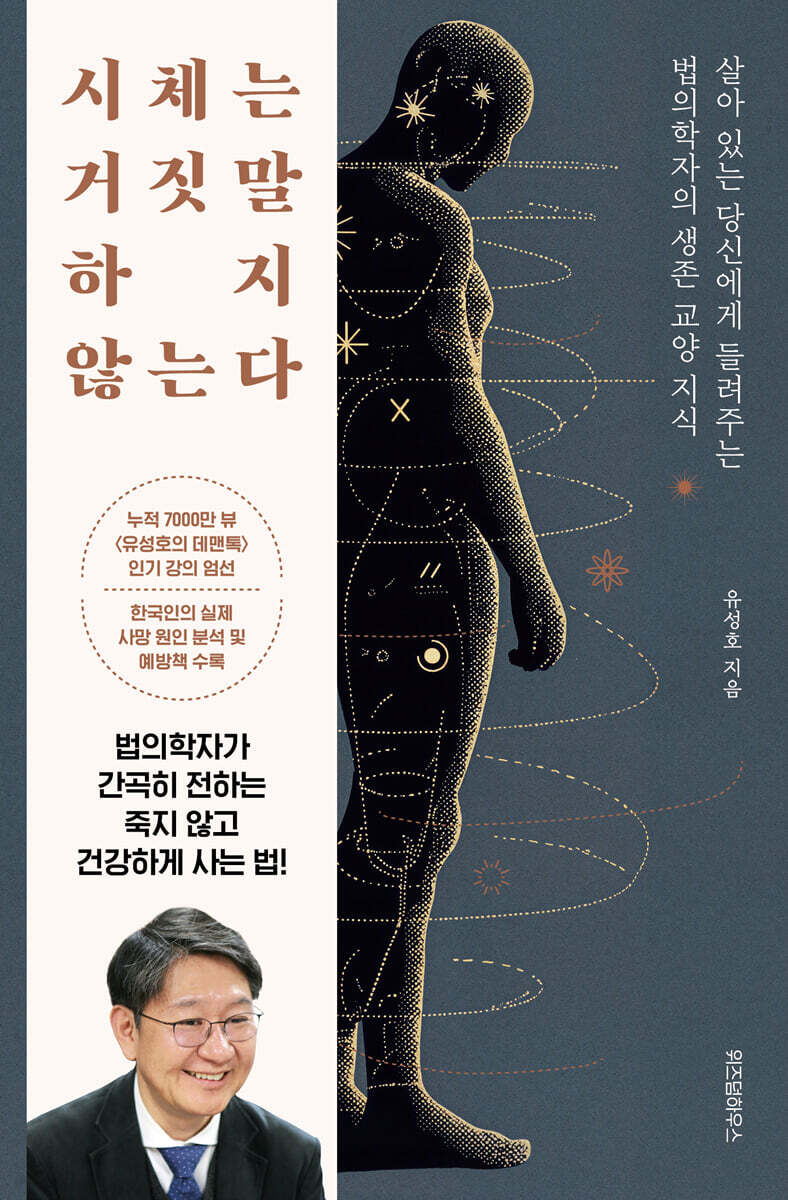
The corpse doesn't lie
 |
Description
Book Introduction
- A word from MD
-
Forensic scientist Yoo Seong-ho's path to longevityA book that explains the actual causes of death of Koreans based on countless deaths from over 3,000 autopsies performed since the first autopsy in 1999.
It tells us about the organs in our body and suggests ways to delay death from disease or accident.
October 21, 2025. Min-gyu Son, Humanities PD
Professor Yoo Seong-ho of Seoul National University College of Medicine, one of the country's top forensic scientists, still encounters corpses in the autopsy room every week.
Having performed over 3,000 autopsies since his first in 1999, he knows more precisely than anyone how people die.
This book, based on the countless deaths he has encountered over the past 27 years, identifies the real causes of death among Koreans, delves into the internal organs of our bodies, and provides expert yet easily understandable ways to delay death from disease or accident.
Through the shocking autopsy cases he actually experienced, he closely analyzes the major organs of our body and fatal diseases that determine life or death, while also providing methods to 'live healthily without dying.'
Having performed over 3,000 autopsies since his first in 1999, he knows more precisely than anyone how people die.
This book, based on the countless deaths he has encountered over the past 27 years, identifies the real causes of death among Koreans, delves into the internal organs of our bodies, and provides expert yet easily understandable ways to delay death from disease or accident.
Through the shocking autopsy cases he actually experienced, he closely analyzes the major organs of our body and fatal diseases that determine life or death, while also providing methods to 'live healthily without dying.'
- You can preview some of the book's contents.
Preview
index
prolog
A doctor facing death shares his story of how to protect precious lives.
Part 1 I'm curious about your long-term health.
1.
A case that forensic pathologists see a lot on the autopsy table - the heart.
2.
The final stage of a blocked or burst blood vessel - a blood vessel
3.
The brain, a fatal organ that can end everything in an instant
4.
From the flu to pneumonia, it quietly kills you - the lungs
5.
Crucial clues left behind by the deceased - above
6.
Danger signals from the digestive tract - small intestine
7.
The final checkpoint in the stomach - the colon
8.
Betrayal of the Silent Organ - Liver
9.
The first gateway encountered by invading bacteria - the spleen
10.
A fatal blow from the invisible - the gallbladder
11.
Why is it so late when you know? - Pancreas
12.
Blood determines the survival of the entire body
13.
DNA - a unique blueprint engraved on each body
Part 2: How to avoid dying if possible
1.
Most Koreans die from this - cancer
2.
Everything About Alcohol from a Purely Medical Perspective - Alcohol
3.
The most effective preventive measure prescribed to everyone today is smoking.
4.
Our bodies are destroyed when it is too hot or too cold - Temperature
5.
Even a single use is dangerous - steroids
6.
Diet pills: drugs that destroy both body and mind
A doctor facing death shares his story of how to protect precious lives.
Part 1 I'm curious about your long-term health.
1.
A case that forensic pathologists see a lot on the autopsy table - the heart.
2.
The final stage of a blocked or burst blood vessel - a blood vessel
3.
The brain, a fatal organ that can end everything in an instant
4.
From the flu to pneumonia, it quietly kills you - the lungs
5.
Crucial clues left behind by the deceased - above
6.
Danger signals from the digestive tract - small intestine
7.
The final checkpoint in the stomach - the colon
8.
Betrayal of the Silent Organ - Liver
9.
The first gateway encountered by invading bacteria - the spleen
10.
A fatal blow from the invisible - the gallbladder
11.
Why is it so late when you know? - Pancreas
12.
Blood determines the survival of the entire body
13.
DNA - a unique blueprint engraved on each body
Part 2: How to avoid dying if possible
1.
Most Koreans die from this - cancer
2.
Everything About Alcohol from a Purely Medical Perspective - Alcohol
3.
The most effective preventive measure prescribed to everyone today is smoking.
4.
Our bodies are destroyed when it is too hot or too cold - Temperature
5.
Even a single use is dangerous - steroids
6.
Diet pills: drugs that destroy both body and mind
Detailed image

Into the book
I am a forensic pathologist, a doctor you meet only after life has ended.
Other excellent doctors may diagnose and prescribe medicine for a living person, but I only meet that person at the end of his or her life.
And I repeat it to myself every time.
'If I had met this person in life... ...' Starting with my first autopsy in 1999, and having performed over 3,000 autopsies to date, I have come to know more precisely than anyone else how people die.
I hoped that knowledge would not remain limited to merely interpreting death.
Rather, paradoxically, it led to a profound realization about how to live.
--- From "Prologue - A Record of Preserving Precious Life, Delivered by a Doctor Facing Death"
When I opened his chest on the autopsy table and felt and felt his heart, I couldn't help but be amazed.
At this age, a heart that normally weighs about 320g is expected, but the size was so large that it felt heavy when removed.
It weighed well over 500g.
When the left coronary artery of the heart was carefully cut into small pieces about 0.3 cm apart and examined, hardened arteriosclerosis was observed blocking the entire inside of the blood vessel.
The anterior muscles of the left ventricle of the heart were white and locally red with necrosis (tissue death).
The cause of his death was acute myocardial infarction.
Many people think that they don't need to worry about heart diseases like myocardial infarction when they are young, but surprisingly, among the cases I have experienced through autopsies, myocardial infarction occurred quite often in people in their 30s.
Previously, there was a media report about an incident where a delivery man suddenly collapsed and died while on duty.
This person said that he felt chest pain while delivering the goods, but since he was so busy working, he endured it thinking that he would be okay if he rested for a while, and then collapsed in the vehicle.
An autopsy revealed that, as expected, about three-quarters of the blood vessels were blocked.
Most cases of sudden death while living a normal life are due to cardiovascular disease.
--- From "A Case That Forensic Scientists See So Often on the Autopsy Table - The Heart"
The brain is not just an organ.
It cannot be reduced to a mere 'command center' that issues orders to the body or a 'computer' that controls thoughts and emotions.
The brain is a unique universe that contains the intangible world of a person's personality, memories, desires, fears, and loves.
As a forensic scientist, I examine the brains of deceased people every day.
Life has passed away, but the trajectory of their lives remains intact in their brains.
For some, there are traces of accidents, for others, the shadow of illness, and for others, fragments created by the violence of others.
Observing the brain is not simply a matter of recording pathological changes, but rather a matter of retracing the processes that the person went through until the end.
So the brain is not just an organ.
It is the deepest story of a human being and the last language that survives death.
--- From "The Brain: A Fatal Organ Where Everything Ends in an Instant"
Pneumonia is a very common disease affecting the lungs, ranking as the third leading cause of death in our country.
Although it may initially conjure up images of a severe cough or vomiting blood, pneumonia actually progresses insidiously and causes general debilitation.
Our body's oxygen saturation should be close to 100% in the arteries, but when we get pneumonia, our oxygen saturation drops and we gradually reach the point of suffocation.
In other words, you will suffer from not being able to breathe and will eventually die of thirst.
If you perform an autopsy, the traces of pneumonia are clear and can be easily distinguished with the naked eye.
Normal lungs are like sponges, with many holes that allow air to pass through.
However, lungs with pneumonia have numerous cavities filled with white blood cells, dirty substances, pus, etc., and the bronchi are also filled with inflammation that resembles yellow nasal discharge.
If he had been X-rayed at a hospital while he was alive, his lungs would have looked cloudy, like cloudy glass.
--- From "From the flu to pneumonia, quietly drying up and killing you - the lungs"
When you touch the brain with your hand, it feels soft and smooth, like tofu for frying.
It is a fragile tissue that swells when bruised and can be easily damaged.
The brain is surrounded by three membranes and the skull, which are very dense spaces, so even if bleeding occurs around the brain, it puts pressure on the brain.
Even a small amount of bleeding, less than 200ml, can cause brain damage and death.
The same goes for the heart.
There is an electric current flowing through the heart, and if you get a bruise, it can be seen as a situation where that wire is cut off.
So, when you have an accident while driving, you often hit your chest against the steering wheel, causing a contusion to your heart and leading to death.
--- From "Determines the survival of the entire body - blood"
What are the most common autopsy cases for forensic pathologists? While autopsies are certainly used to determine the circumstances of criminal cases, including murder, the most common cause of death in Korea is none other than cancer.
In the past, there were many accidents caused by drunk driving, but now the number has decreased significantly, and because it is a country with good public safety, the number of deaths by homicide is only 0.6 per 100,000 people.
However, among the 300,000 people who die each year, 80,000 to 90,000, or one-third, die from cancer.
Moreover, statistics show that 49% of our population will develop cancer at least once before they die.
There is a high probability that we, or our family members or close friends, will experience this at some point.
--- From "Most Koreans Die From This - Cancer"
When the firefighters, contacted by the police, opened Mr. B's front door, the room was filled with alcohol bottles, and maggots were crawling on the floor, as if time had stopped.
An autopsy of the decomposed body revealed chronic alcoholic liver disease and cirrhosis.
Even taking corruption into account, the blood alcohol content was well over 0.15%.
It appeared that he was drinking alone until just before he died.
These days, such lonely deaths are not unusual and are very common in autopsies.
In particular, it is increasingly common among men in their 50s and 60s, and recently, it is also increasing among middle-aged women who drink alone, so we are seeing the decomposing bodies of middle-aged women more often.
A life destroyed by loneliness and alcohol is scarier than a body collapsing.
--- From "All About Alcohol from a Purely Medical Perspective - Alcohol"
What happens if you artificially inject steroids into your body, outside of what's naturally produced? Testosterone is supposed to be secreted by the testes, but if steroids are already injected into your body, they will stop it from being secreted.
Then, the testicles may atrophy, which can lead to erectile dysfunction, azoospermia, and decreased libido.
When women are artificially injected with testosterone, their voices deepen and their menstrual periods become irregular or stop.
Hair loss can occur in both men and women.
Once you start taking steroids, your cravings will only increase.
If this happens, not only will hormonal imbalance occur, but the overall balance, including the cardiovascular system, will also be disrupted.
Other excellent doctors may diagnose and prescribe medicine for a living person, but I only meet that person at the end of his or her life.
And I repeat it to myself every time.
'If I had met this person in life... ...' Starting with my first autopsy in 1999, and having performed over 3,000 autopsies to date, I have come to know more precisely than anyone else how people die.
I hoped that knowledge would not remain limited to merely interpreting death.
Rather, paradoxically, it led to a profound realization about how to live.
--- From "Prologue - A Record of Preserving Precious Life, Delivered by a Doctor Facing Death"
When I opened his chest on the autopsy table and felt and felt his heart, I couldn't help but be amazed.
At this age, a heart that normally weighs about 320g is expected, but the size was so large that it felt heavy when removed.
It weighed well over 500g.
When the left coronary artery of the heart was carefully cut into small pieces about 0.3 cm apart and examined, hardened arteriosclerosis was observed blocking the entire inside of the blood vessel.
The anterior muscles of the left ventricle of the heart were white and locally red with necrosis (tissue death).
The cause of his death was acute myocardial infarction.
Many people think that they don't need to worry about heart diseases like myocardial infarction when they are young, but surprisingly, among the cases I have experienced through autopsies, myocardial infarction occurred quite often in people in their 30s.
Previously, there was a media report about an incident where a delivery man suddenly collapsed and died while on duty.
This person said that he felt chest pain while delivering the goods, but since he was so busy working, he endured it thinking that he would be okay if he rested for a while, and then collapsed in the vehicle.
An autopsy revealed that, as expected, about three-quarters of the blood vessels were blocked.
Most cases of sudden death while living a normal life are due to cardiovascular disease.
--- From "A Case That Forensic Scientists See So Often on the Autopsy Table - The Heart"
The brain is not just an organ.
It cannot be reduced to a mere 'command center' that issues orders to the body or a 'computer' that controls thoughts and emotions.
The brain is a unique universe that contains the intangible world of a person's personality, memories, desires, fears, and loves.
As a forensic scientist, I examine the brains of deceased people every day.
Life has passed away, but the trajectory of their lives remains intact in their brains.
For some, there are traces of accidents, for others, the shadow of illness, and for others, fragments created by the violence of others.
Observing the brain is not simply a matter of recording pathological changes, but rather a matter of retracing the processes that the person went through until the end.
So the brain is not just an organ.
It is the deepest story of a human being and the last language that survives death.
--- From "The Brain: A Fatal Organ Where Everything Ends in an Instant"
Pneumonia is a very common disease affecting the lungs, ranking as the third leading cause of death in our country.
Although it may initially conjure up images of a severe cough or vomiting blood, pneumonia actually progresses insidiously and causes general debilitation.
Our body's oxygen saturation should be close to 100% in the arteries, but when we get pneumonia, our oxygen saturation drops and we gradually reach the point of suffocation.
In other words, you will suffer from not being able to breathe and will eventually die of thirst.
If you perform an autopsy, the traces of pneumonia are clear and can be easily distinguished with the naked eye.
Normal lungs are like sponges, with many holes that allow air to pass through.
However, lungs with pneumonia have numerous cavities filled with white blood cells, dirty substances, pus, etc., and the bronchi are also filled with inflammation that resembles yellow nasal discharge.
If he had been X-rayed at a hospital while he was alive, his lungs would have looked cloudy, like cloudy glass.
--- From "From the flu to pneumonia, quietly drying up and killing you - the lungs"
When you touch the brain with your hand, it feels soft and smooth, like tofu for frying.
It is a fragile tissue that swells when bruised and can be easily damaged.
The brain is surrounded by three membranes and the skull, which are very dense spaces, so even if bleeding occurs around the brain, it puts pressure on the brain.
Even a small amount of bleeding, less than 200ml, can cause brain damage and death.
The same goes for the heart.
There is an electric current flowing through the heart, and if you get a bruise, it can be seen as a situation where that wire is cut off.
So, when you have an accident while driving, you often hit your chest against the steering wheel, causing a contusion to your heart and leading to death.
--- From "Determines the survival of the entire body - blood"
What are the most common autopsy cases for forensic pathologists? While autopsies are certainly used to determine the circumstances of criminal cases, including murder, the most common cause of death in Korea is none other than cancer.
In the past, there were many accidents caused by drunk driving, but now the number has decreased significantly, and because it is a country with good public safety, the number of deaths by homicide is only 0.6 per 100,000 people.
However, among the 300,000 people who die each year, 80,000 to 90,000, or one-third, die from cancer.
Moreover, statistics show that 49% of our population will develop cancer at least once before they die.
There is a high probability that we, or our family members or close friends, will experience this at some point.
--- From "Most Koreans Die From This - Cancer"
When the firefighters, contacted by the police, opened Mr. B's front door, the room was filled with alcohol bottles, and maggots were crawling on the floor, as if time had stopped.
An autopsy of the decomposed body revealed chronic alcoholic liver disease and cirrhosis.
Even taking corruption into account, the blood alcohol content was well over 0.15%.
It appeared that he was drinking alone until just before he died.
These days, such lonely deaths are not unusual and are very common in autopsies.
In particular, it is increasingly common among men in their 50s and 60s, and recently, it is also increasing among middle-aged women who drink alone, so we are seeing the decomposing bodies of middle-aged women more often.
A life destroyed by loneliness and alcohol is scarier than a body collapsing.
--- From "All About Alcohol from a Purely Medical Perspective - Alcohol"
What happens if you artificially inject steroids into your body, outside of what's naturally produced? Testosterone is supposed to be secreted by the testes, but if steroids are already injected into your body, they will stop it from being secreted.
Then, the testicles may atrophy, which can lead to erectile dysfunction, azoospermia, and decreased libido.
When women are artificially injected with testosterone, their voices deepen and their menstrual periods become irregular or stop.
Hair loss can occur in both men and women.
Once you start taking steroids, your cravings will only increase.
If this happens, not only will hormonal imbalance occur, but the overall balance, including the cardiovascular system, will also be disrupted.
--- From "Is even a single use dangerous? Steroids"
Publisher's Review
“I hope we don’t meet on the autopsy table.”
Survival knowledge from a forensic scientist for those who are still alive
A heart that has stopped breathing, lungs that have turned black, a brain that has suddenly stopped functioning, a blood vessel that has quietly ruptured… These are the scenes that forensic pathologist Professor Yoo Seong-ho encounters every week on the autopsy table.
A corpse always honestly records the traces of the person's life.
"The Corpse Doesn't Lie" is a book that tells us how to delay death and live a healthy life, based on the actual causes of death of Koreans analyzed by the author through over thousands of autopsies.
Beyond simple medical knowledge, this is a survival guide written from a forensic scientist's perspective, pointing out how the habits we repeat without thinking in our daily lives can destroy our bodies and conveying what to watch out for and what choices to make.
This book is shocking and vivid, as if you were listening to Professor Yoo Seong-ho's lecture directly in his autopsy room.
The functions of major organs such as the heart, blood vessels, brain, lungs, and pancreas, as well as the processes that lead to death, are explained in detail and in a friendly manner.
He also clearly reveals the causes of death through autopsy cases he personally experienced, such as a young man in his 30s who died of acute myocardial infarction, a middle school student who suddenly passed away from a cerebral hemorrhage, and a college student who was found drowned in the shower, and raises awareness about our bodies and health.
The author kept thinking the same thing in front of the autopsy table.
‘If only I had met this person in my lifetime…’ These words contain not only regret but also an earnest warning to all of us who are alive.
To prevent thoughtless actions from turning into fatal consequences, to encourage us to listen to the voices of precious organs within us that we have overlooked, to convey the clear truth that we all die someday, but we can slow down the pace of our death.
“I will teach you how to avoid dying if possible.”
The bare minimum we can learn from thousands of deaths
This book contains a selection of lectures that became popular on the YouTube channel “Yoo Seong-ho’s Demon Talk,” which has gained explosive responses from hundreds of thousands of subscribers.
Part 1, "I'm curious about your organs," realistically demonstrates how our core organs, including the heart, blood vessels, brain, and lungs, work and what warning signs lead to death through real-life death cases.
In addition, we closely analyze dangerous diseases that can determine our life or death, such as acute myocardial infarction, cerebral hemorrhage, aortic aneurysm rupture, and various types of cancer, and suggest their causes and countermeasures.
Part 2, "I'll teach you how to avoid dying if possible," dissects factors that are easily accessible to anyone but can cause irreversible consequences to our lives, such as alcohol and cigarettes, as well as diet pills and steroids, which have become recent issues, from a forensic scientist's perspective, and clearly reveals the medical evidence and specific mechanisms that support why they are dangerous, making them more persuasive.
As the author's earnest request, "Please read this book while you are still alive," suggests, "The Corpse Doesn't Lie" delivers a powerful message that encourages us to take care of our bodies and change our attitude toward life right now.
For readers who want to learn about the principles of our body from a professional perspective and those seeking a new, never-before-seen form of educational material, this book will be an incredibly practical and beneficial experience.
Survival knowledge from a forensic scientist for those who are still alive
A heart that has stopped breathing, lungs that have turned black, a brain that has suddenly stopped functioning, a blood vessel that has quietly ruptured… These are the scenes that forensic pathologist Professor Yoo Seong-ho encounters every week on the autopsy table.
A corpse always honestly records the traces of the person's life.
"The Corpse Doesn't Lie" is a book that tells us how to delay death and live a healthy life, based on the actual causes of death of Koreans analyzed by the author through over thousands of autopsies.
Beyond simple medical knowledge, this is a survival guide written from a forensic scientist's perspective, pointing out how the habits we repeat without thinking in our daily lives can destroy our bodies and conveying what to watch out for and what choices to make.
This book is shocking and vivid, as if you were listening to Professor Yoo Seong-ho's lecture directly in his autopsy room.
The functions of major organs such as the heart, blood vessels, brain, lungs, and pancreas, as well as the processes that lead to death, are explained in detail and in a friendly manner.
He also clearly reveals the causes of death through autopsy cases he personally experienced, such as a young man in his 30s who died of acute myocardial infarction, a middle school student who suddenly passed away from a cerebral hemorrhage, and a college student who was found drowned in the shower, and raises awareness about our bodies and health.
The author kept thinking the same thing in front of the autopsy table.
‘If only I had met this person in my lifetime…’ These words contain not only regret but also an earnest warning to all of us who are alive.
To prevent thoughtless actions from turning into fatal consequences, to encourage us to listen to the voices of precious organs within us that we have overlooked, to convey the clear truth that we all die someday, but we can slow down the pace of our death.
“I will teach you how to avoid dying if possible.”
The bare minimum we can learn from thousands of deaths
This book contains a selection of lectures that became popular on the YouTube channel “Yoo Seong-ho’s Demon Talk,” which has gained explosive responses from hundreds of thousands of subscribers.
Part 1, "I'm curious about your organs," realistically demonstrates how our core organs, including the heart, blood vessels, brain, and lungs, work and what warning signs lead to death through real-life death cases.
In addition, we closely analyze dangerous diseases that can determine our life or death, such as acute myocardial infarction, cerebral hemorrhage, aortic aneurysm rupture, and various types of cancer, and suggest their causes and countermeasures.
Part 2, "I'll teach you how to avoid dying if possible," dissects factors that are easily accessible to anyone but can cause irreversible consequences to our lives, such as alcohol and cigarettes, as well as diet pills and steroids, which have become recent issues, from a forensic scientist's perspective, and clearly reveals the medical evidence and specific mechanisms that support why they are dangerous, making them more persuasive.
As the author's earnest request, "Please read this book while you are still alive," suggests, "The Corpse Doesn't Lie" delivers a powerful message that encourages us to take care of our bodies and change our attitude toward life right now.
For readers who want to learn about the principles of our body from a professional perspective and those seeking a new, never-before-seen form of educational material, this book will be an incredibly practical and beneficial experience.
GOODS SPECIFICS
- Date of issue: October 15, 2025
- Page count, weight, size: 304 pages | 480g | 138*210*19mm
- ISBN13: 9791171715305
- ISBN10: 1171715307
You may also like
카테고리
korean


korean

![GQ KOREA Mark (Monthly): December [2025]](http://librairie.coreenne.fr/cdn/shop/files/8ef265dbbfbf186523ed75ba7319009d.jpg?v=1765340328&width=3840)


