

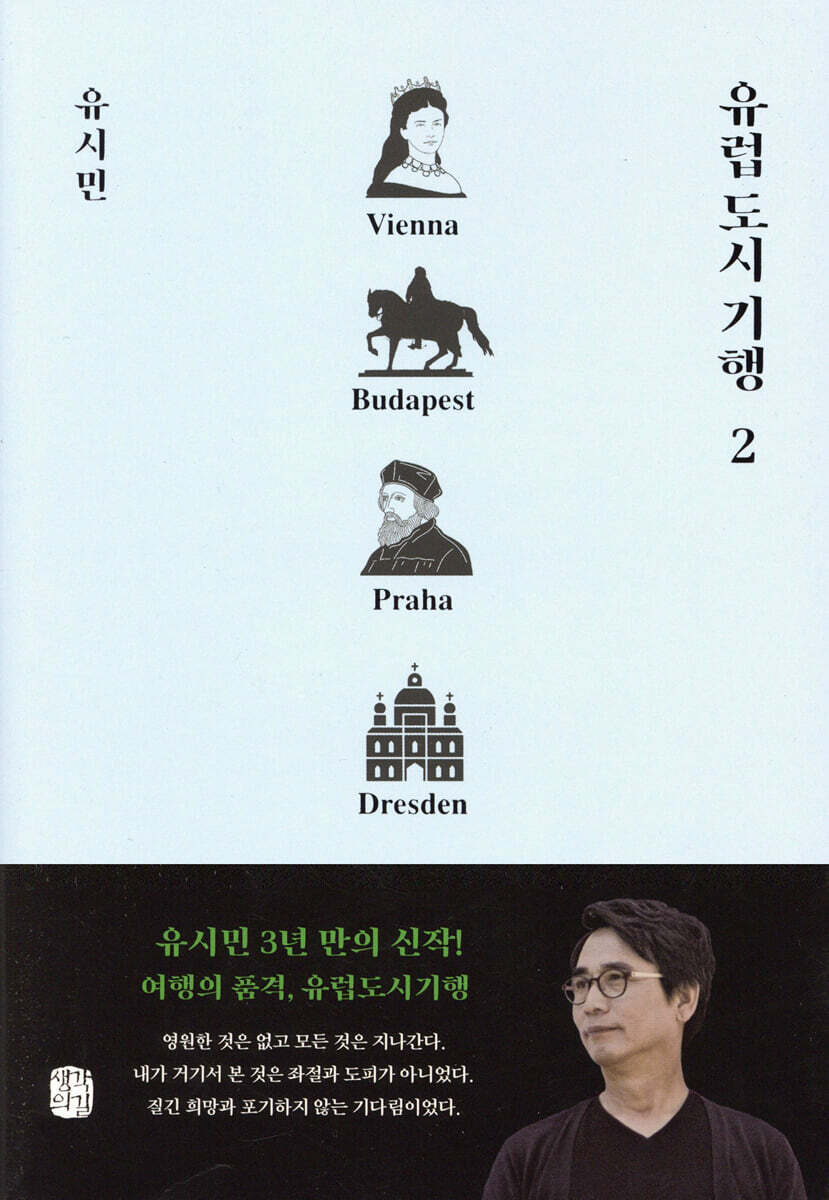
European City Tour 2
 |
Description
Book Introduction
A story told by an unfamiliar city Civilization, humanity, and my encounters, a European city tour “Nothing lasts forever, everything passes. What I saw there was not frustration and escape. “It was a tenacious hope and a wait that did not give up.” “I regarded the city’s architecture, museums, art galleries, streets, squares, and parks as ‘texts’ and focused on conveying the ‘context’ necessary to interpret them. “Because I believe that cities speak to those who understand their context, and that travelers who understand what they are saying can experience much deeper and richer emotions than those who don’t.” Yoo Si-min's new work, "European City Travelogue 2," which returns after three years, contains the stories of four cities that have overcome the turbulent times and each shine with their own unique presence: Vienna, Budapest, Prague, and Dresden. Vienna, the most splendid and perfect city Budapest, a city that believes in itself and moves forward Prague, a bohemian city where anything seems okay. Dresden, the city that achieved the miracle of resurrection This book is packed with information that you'll want someone to point out and tell you about, whether you're looking for a rich and enriching trip to a European city you've worked hard to decide on, or want to learn more about a European city you've only vaguely known about through the media. From hot spots that let you feel the city's charm, to the solid background knowledge that will keep you from being overwhelmed by any city's architecture, streets, squares, museums, and artwork, to the world-historical events and figures that shaped the city's presence, to the city's narratives and scars created by the interweaving of European and urban history like warp and woof, this book unfolds an exciting story that will allow us to fully enjoy the city. The author's intellectual insight into cities, people, and life is added here to show how the values, context, and meaningful narratives of cities resonate with our present. |
- You can preview some of the book's contents.
Preview
index
introduction
In search of stories of people who remain in the old city
1.
Bin, you're too perfect for me
Ringstrasse 'Dapjeongneo'
St. Stephen's Cathedral, a fossil of the Middle Ages
Great Wall
Pummerin, Graben, Vienna Coffee
Vienna style
The Rebirth of Vienna
A comparative experience of extremes: the Museum of Art History and the Secession
Museum of Applied Arts (MAK)
Mozart and Sissi
Schönbrunn and Belvedere
Food in Vienna, Sissi was right!
Votive Church, University of Vienna, City Hall, National Assembly Building
An unexpected discovery: Hundertwasser
A city without gaps
2.
Budapest, sad yet cheerful
The turbid waters of the Danube
Basilica of St. Stephen
Geopolitical misfortune
Pride and inferiority complex
List Memorial and House of Terror
Buda Castle District
Andrassy in the National Assembly building
Statue of Prime Minister Nagy
Shoes left on the riverbank
Zitterdeller on Gellert Hill
Memento Park
Ruin Bar in the Jewish Quarter
Goedele Palace, Sissi's summer residence
Budapest at night
3.
Prague, a place where anything seems okay
Humble Tyn Cathedral
The Birth of Prague
Jan Hus, the Righteous Man
The castle and the castle of the old city
Jewish Quarter, Josefov
Charles Bridge, Prague's hotspot
Bohemian food
Equestrian Statue of St. Wenceslas
Jan Palach in the square
Prague Castle
Kafka and Dalibor
Petrin Observation Tower
Dancing House, Cubism Museum
Vltava Jazz Boat
4.
Dresden, the miracle of resurrection
The perpetrator's wounds
Elbe Valley Road
Our Lady of Love Church
The epic of resurrection
Socialist architectural style
Medieval new town
Historic Old Town
August, the King of Vigor
Seongan New Town
Colorful Republic
Food in Dresden
A small but big city
In search of stories of people who remain in the old city
1.
Bin, you're too perfect for me
Ringstrasse 'Dapjeongneo'
St. Stephen's Cathedral, a fossil of the Middle Ages
Great Wall
Pummerin, Graben, Vienna Coffee
Vienna style
The Rebirth of Vienna
A comparative experience of extremes: the Museum of Art History and the Secession
Museum of Applied Arts (MAK)
Mozart and Sissi
Schönbrunn and Belvedere
Food in Vienna, Sissi was right!
Votive Church, University of Vienna, City Hall, National Assembly Building
An unexpected discovery: Hundertwasser
A city without gaps
2.
Budapest, sad yet cheerful
The turbid waters of the Danube
Basilica of St. Stephen
Geopolitical misfortune
Pride and inferiority complex
List Memorial and House of Terror
Buda Castle District
Andrassy in the National Assembly building
Statue of Prime Minister Nagy
Shoes left on the riverbank
Zitterdeller on Gellert Hill
Memento Park
Ruin Bar in the Jewish Quarter
Goedele Palace, Sissi's summer residence
Budapest at night
3.
Prague, a place where anything seems okay
Humble Tyn Cathedral
The Birth of Prague
Jan Hus, the Righteous Man
The castle and the castle of the old city
Jewish Quarter, Josefov
Charles Bridge, Prague's hotspot
Bohemian food
Equestrian Statue of St. Wenceslas
Jan Palach in the square
Prague Castle
Kafka and Dalibor
Petrin Observation Tower
Dancing House, Cubism Museum
Vltava Jazz Boat
4.
Dresden, the miracle of resurrection
The perpetrator's wounds
Elbe Valley Road
Our Lady of Love Church
The epic of resurrection
Socialist architectural style
Medieval new town
Historic Old Town
August, the King of Vigor
Seongan New Town
Colorful Republic
Food in Dresden
A small but big city
Detailed image

Into the book
Bean looked as great as his reputation.
Every space in the city center felt like something out of a movie.
The buildings were all large and beautiful, and the streets were wide and clean.
The boutiques were reflected in the shop windows and people's clothing.
The cafes and restaurants had ornate interiors and the food was correspondingly expensive.
Public exhibition halls and sophisticated private galleries housed in Baroque-style buildings overflowed with paintings and sculptures by masters familiar from art textbooks, while opera houses and music association concert halls hosted Europe's finest orchestras performing works by Mozart, Beethoven, and other great masters.
But somehow I felt uneasy in Vienna.
--- p.15
Most of the royal collection consists of works of art created or purchased according to the needs and tastes of the person who commissioned the work.
On the other hand, the exhibits at Jechezion were the artists' expressions of their inner aspirations and emotions, presented to the world.
Monarchy and republic, medieval nobility and emerging bourgeoisie, political and religious conventions and free artistic spirit—all these things came together and clashed in Vienna at the turn of the century.
If I had time to visit only one art museum in Vienna, I would choose the Secession without hesitation.
The works I encountered there, whether large or small, showcased the imagination, philosophy, and individuality of the artists who created them, and each evoked different emotions in my heart.
--- p.53
The Great Wall protected the medieval city of Vienna through its existence, and through its absence, it opened the way for the city to be reborn.
I have decided that the road that holds this paradox is ‘the number one landmark in my heart.’
Could there be another pair as contrasting as a wall and a road?
The walls block the inside from the outside, but the roads mix everything up.
--- p.36
Heroes' Square, the Liszt Memorial, and the House of Terror offer a glimpse into the Hungarian people's thoughts and feelings about national identity and history.
They wandered for a long time between feelings of inferiority and pride, victimhood and responsibility.
If you're Korean, you know what that feels like.
…The Magyar people also established an independent republic after enduring over 500 years of hardship in the midst of the Slavic sphere of influence.
Both peoples are good at 'conservatism'.
The reason such a nation was ruled by foreigners was because it was reluctant to innovate.
--- p.123
Those museums seemed to suggest that it was no mere coincidence that the bohemian cultural genes that led to hippies, yuppies, and bobos were born in Prague.
Because human nature is ‘vulgar,’ life cannot be filled with ‘sacred’ things alone.
However, humans are not satisfied with just pursuing their 'vulgar' desires.
“Neither life nor the world can be complete without acknowledging, accepting, and respecting both the inner and outer worlds.
“I have not put the shackles of holiness on the people who live here,” Prague’s old town told me.
Prague, then and now, is a city with a wide range of amenities.
--- p.189
Roads move and mix people, goods, information, and culture.
Because of the road, we can live rich lives, meet strangers, and broaden and deepen our understanding and empathy for other cultures.
But there was no road that only had good things happen.
There wasn't only life on the road.
Death was also present.
Humans carried weapons and germs along the way, and committed plunder and murder.
The road in the Elbe Valley was no different.
Despair and hope, savagery and joy intertwined.
Every space in the city center felt like something out of a movie.
The buildings were all large and beautiful, and the streets were wide and clean.
The boutiques were reflected in the shop windows and people's clothing.
The cafes and restaurants had ornate interiors and the food was correspondingly expensive.
Public exhibition halls and sophisticated private galleries housed in Baroque-style buildings overflowed with paintings and sculptures by masters familiar from art textbooks, while opera houses and music association concert halls hosted Europe's finest orchestras performing works by Mozart, Beethoven, and other great masters.
But somehow I felt uneasy in Vienna.
--- p.15
Most of the royal collection consists of works of art created or purchased according to the needs and tastes of the person who commissioned the work.
On the other hand, the exhibits at Jechezion were the artists' expressions of their inner aspirations and emotions, presented to the world.
Monarchy and republic, medieval nobility and emerging bourgeoisie, political and religious conventions and free artistic spirit—all these things came together and clashed in Vienna at the turn of the century.
If I had time to visit only one art museum in Vienna, I would choose the Secession without hesitation.
The works I encountered there, whether large or small, showcased the imagination, philosophy, and individuality of the artists who created them, and each evoked different emotions in my heart.
--- p.53
The Great Wall protected the medieval city of Vienna through its existence, and through its absence, it opened the way for the city to be reborn.
I have decided that the road that holds this paradox is ‘the number one landmark in my heart.’
Could there be another pair as contrasting as a wall and a road?
The walls block the inside from the outside, but the roads mix everything up.
--- p.36
Heroes' Square, the Liszt Memorial, and the House of Terror offer a glimpse into the Hungarian people's thoughts and feelings about national identity and history.
They wandered for a long time between feelings of inferiority and pride, victimhood and responsibility.
If you're Korean, you know what that feels like.
…The Magyar people also established an independent republic after enduring over 500 years of hardship in the midst of the Slavic sphere of influence.
Both peoples are good at 'conservatism'.
The reason such a nation was ruled by foreigners was because it was reluctant to innovate.
--- p.123
Those museums seemed to suggest that it was no mere coincidence that the bohemian cultural genes that led to hippies, yuppies, and bobos were born in Prague.
Because human nature is ‘vulgar,’ life cannot be filled with ‘sacred’ things alone.
However, humans are not satisfied with just pursuing their 'vulgar' desires.
“Neither life nor the world can be complete without acknowledging, accepting, and respecting both the inner and outer worlds.
“I have not put the shackles of holiness on the people who live here,” Prague’s old town told me.
Prague, then and now, is a city with a wide range of amenities.
--- p.189
Roads move and mix people, goods, information, and culture.
Because of the road, we can live rich lives, meet strangers, and broaden and deepen our understanding and empathy for other cultures.
But there was no road that only had good things happen.
There wasn't only life on the road.
Death was also present.
Humans carried weapons and germs along the way, and committed plunder and murder.
The road in the Elbe Valley was no different.
Despair and hope, savagery and joy intertwined.
--- p.254
Publisher's Review
Yoo Si-min's way of experiencing European cities
The city's past, present, and life
Not everyone in the various spaces of those cities has to feel the same way.
As with life, there is no right answer when it comes to traveling.
Everyone can do it their own way.
-p.7
Dozens of pairs of metal shoes of men, women, and children were placed on the riverbank.
The owners of those shoes were shot and thrown into the Danube River.
Even though I knew it was there, I still cried.
It was different from the terror house that was just scary.
I never knew such a small sculpture could evoke such powerful emotions.
Rainwater was clearly pooled inside the shoes, and beyond them the turbid waters of the Danube flowed wildly.
-p.142
When you face an insurmountable barrier of reality, you have two choices.
It is about escaping society or turning one's gaze inward.
The fall of Napoleon led to the return of monarchies, and European society entered a period when hope for progress disappeared.
The people of Germany and Austria, where the feudal class system and old privileges held sway, endured the times by ignoring reality and savoring the small but certain pleasures of everyday life.
Looking at the interior decorations, furniture, crafts, and paintings in the Biedermeier era exhibition hall, I tried to understand the minds of those who created them.
Nothing is eternal, everything passes.
-p.58
As darkness fell, the entire city changed its appearance in an instant.
The historic buildings of the Old Town, including the Tyn Cathedral, and the bridges over the Vltava River were illuminated at night, and cars and trams began to flash their headlights.
The lights of shops, restaurants, and cafes glowed brightly, and the streetlights also opened their eyes at once.
People came out from somewhere, filling the sunless squares and streets, and all kinds of sounds they made rose into the dark night sky.
Looking down from the bridge tower, the entire city seemed to slowly rise upwards and hang in the air.
Prague has been transformed into a giant night-time theme park.
Prague's landmark number one was neither Týn Cathedral nor Wenceslas Square.
It was Prague itself, just after the sun had set, as seen from the bridge tower.
-p.200
Everything made by humans has a story.
The largest, most beautiful, and oldest things humans have created are probably cities.
The city is steeped in vivid, dramatic, and unfamiliar stories of historical events and characters.
Especially in European cities, there are many places that have interesting histories not only in museums and palaces, but also in everyday spaces such as squares, buildings, cafes, and alleys.
The author allows us to hear the stories told by these European urban spaces, searching for the stories hidden beneath the city's surface and reflecting on the lives of the people the city holds, and encounters the glory and wounds, barbarism and tolerance, success and failure, disconnection and connection, frustration and achievement, life and death, etc., through his own perspective, until the city was born as it is today.
The urban spaces and stories contained within them, as told by the author, illuminate the present by showing the diverse faces of humanity, such as the process of human achievement and the beauty and ugliness, selfishness and altruism, despair and hope expressed along the way.
This makes us feel more three-dimensional and brings about unfamiliar thoughts and feelings that are different from the usual ones, forcing us to confront ourselves.
Perhaps this is why we travel through European cities, walking and walking along distant but unfamiliar streets.
In search of the stories of those who remain in the old city
-Vienna, Budapest, Prague, Dresden
That's probably not the only reason why empty people love poetry.
Although she became a 'power celebrity' by fate, Sisi pursued 'a life of her own.'
…I did not reject or overcome fate, but I was not trapped by it either.
While accepting my fate, I struggled and challenged myself to live a life that I felt had meaning.
-p.66
I experienced similar emotions while looking at the modern history of South Korea in Budapest.
Budapest was a sad yet cheerful city.
He exuded great confidence even though he didn't have much.
It was a city where expectations for tomorrow were greater than today's satisfaction.
I like that kind of person and that kind of city.
-p.163
Prague was beautiful.
The palace and the church, the streets and the river, the cafes and the museum, everything was so cute and pretty.
Nothing was particularly impressive, but Prague itself was.
Prague did not hide the wounds of its history, nor did it suffer because of them.
Let's leave the scars of the past behind and pursue today's joy.
To do so, we allow coexistence within the performance.
-p.239
Without knowing the tragedy of February 1945, it is impossible to understand why Dresden looks the way it does today.
…the 'Baroque city' of Dresden was then lost forever.
Although many buildings have been restored, the city cannot return to its former glory.
However, it cannot be said that today's Dresden is worse than it used to be.
Dresden has become a city unlike any other in the world.
A city that is ugly yet beautiful, sad yet peaceful, and somewhere out of place yet comfortable and sentimental.
I felt that way.
-p.249
Vienna, Budapest, Prague, and Dresden are geographically close cities, making them great cities to travel to together.
The center of your city is Vienna.
Vienna was the capital of the Habsburg Empire for a long time, and when it comes to culture and arts, Vienna has a high level of quality and wealth comparable to Paris.
Especially travelers who love music and art cannot miss Vienna.
Budapest and Prague were deeply intertwined with Vienna in every way, as they were both under the influence of the Habsburg Empire.
But the cultural atmosphere of the city is very different.
Dresden was once completely destroyed, but through the process of rebuilding, it created its own Dresden-ness.
It's a great city to stop by when going to Prague.
Vienna, the author felt, was the most perfect and splendid city, Budapest was a sad but beautiful city, Prague was a city with a wide heart where anything seemed okay, and Dresden was a city that achieved the miracle of resurrection.
The author's encounters with the city's splendid moments, the things the city wants to reveal or hide, the things that ruined the city, what makes the city a city, the city's wounds and the process of overcoming them to move forward and create the city's present, resemble our lives, sometimes comforting and sometimes remaining in a corner of our hearts.
In this way, the four cities become attractive cities that you want to visit and that will remain in your memory for a long time, thanks to the vivid stories the author has found and collected, and the author's own unique feeling added to them.
Here, through the author's intellectual curiosity and humanistic thinking, we can experience the civilizational fragrance of the four cities more richly, view the cities from a more diverse perspective, and deepen our reflections on ourselves, life, and people.
The city's past, present, and life
Not everyone in the various spaces of those cities has to feel the same way.
As with life, there is no right answer when it comes to traveling.
Everyone can do it their own way.
-p.7
Dozens of pairs of metal shoes of men, women, and children were placed on the riverbank.
The owners of those shoes were shot and thrown into the Danube River.
Even though I knew it was there, I still cried.
It was different from the terror house that was just scary.
I never knew such a small sculpture could evoke such powerful emotions.
Rainwater was clearly pooled inside the shoes, and beyond them the turbid waters of the Danube flowed wildly.
-p.142
When you face an insurmountable barrier of reality, you have two choices.
It is about escaping society or turning one's gaze inward.
The fall of Napoleon led to the return of monarchies, and European society entered a period when hope for progress disappeared.
The people of Germany and Austria, where the feudal class system and old privileges held sway, endured the times by ignoring reality and savoring the small but certain pleasures of everyday life.
Looking at the interior decorations, furniture, crafts, and paintings in the Biedermeier era exhibition hall, I tried to understand the minds of those who created them.
Nothing is eternal, everything passes.
-p.58
As darkness fell, the entire city changed its appearance in an instant.
The historic buildings of the Old Town, including the Tyn Cathedral, and the bridges over the Vltava River were illuminated at night, and cars and trams began to flash their headlights.
The lights of shops, restaurants, and cafes glowed brightly, and the streetlights also opened their eyes at once.
People came out from somewhere, filling the sunless squares and streets, and all kinds of sounds they made rose into the dark night sky.
Looking down from the bridge tower, the entire city seemed to slowly rise upwards and hang in the air.
Prague has been transformed into a giant night-time theme park.
Prague's landmark number one was neither Týn Cathedral nor Wenceslas Square.
It was Prague itself, just after the sun had set, as seen from the bridge tower.
-p.200
Everything made by humans has a story.
The largest, most beautiful, and oldest things humans have created are probably cities.
The city is steeped in vivid, dramatic, and unfamiliar stories of historical events and characters.
Especially in European cities, there are many places that have interesting histories not only in museums and palaces, but also in everyday spaces such as squares, buildings, cafes, and alleys.
The author allows us to hear the stories told by these European urban spaces, searching for the stories hidden beneath the city's surface and reflecting on the lives of the people the city holds, and encounters the glory and wounds, barbarism and tolerance, success and failure, disconnection and connection, frustration and achievement, life and death, etc., through his own perspective, until the city was born as it is today.
The urban spaces and stories contained within them, as told by the author, illuminate the present by showing the diverse faces of humanity, such as the process of human achievement and the beauty and ugliness, selfishness and altruism, despair and hope expressed along the way.
This makes us feel more three-dimensional and brings about unfamiliar thoughts and feelings that are different from the usual ones, forcing us to confront ourselves.
Perhaps this is why we travel through European cities, walking and walking along distant but unfamiliar streets.
In search of the stories of those who remain in the old city
-Vienna, Budapest, Prague, Dresden
That's probably not the only reason why empty people love poetry.
Although she became a 'power celebrity' by fate, Sisi pursued 'a life of her own.'
…I did not reject or overcome fate, but I was not trapped by it either.
While accepting my fate, I struggled and challenged myself to live a life that I felt had meaning.
-p.66
I experienced similar emotions while looking at the modern history of South Korea in Budapest.
Budapest was a sad yet cheerful city.
He exuded great confidence even though he didn't have much.
It was a city where expectations for tomorrow were greater than today's satisfaction.
I like that kind of person and that kind of city.
-p.163
Prague was beautiful.
The palace and the church, the streets and the river, the cafes and the museum, everything was so cute and pretty.
Nothing was particularly impressive, but Prague itself was.
Prague did not hide the wounds of its history, nor did it suffer because of them.
Let's leave the scars of the past behind and pursue today's joy.
To do so, we allow coexistence within the performance.
-p.239
Without knowing the tragedy of February 1945, it is impossible to understand why Dresden looks the way it does today.
…the 'Baroque city' of Dresden was then lost forever.
Although many buildings have been restored, the city cannot return to its former glory.
However, it cannot be said that today's Dresden is worse than it used to be.
Dresden has become a city unlike any other in the world.
A city that is ugly yet beautiful, sad yet peaceful, and somewhere out of place yet comfortable and sentimental.
I felt that way.
-p.249
Vienna, Budapest, Prague, and Dresden are geographically close cities, making them great cities to travel to together.
The center of your city is Vienna.
Vienna was the capital of the Habsburg Empire for a long time, and when it comes to culture and arts, Vienna has a high level of quality and wealth comparable to Paris.
Especially travelers who love music and art cannot miss Vienna.
Budapest and Prague were deeply intertwined with Vienna in every way, as they were both under the influence of the Habsburg Empire.
But the cultural atmosphere of the city is very different.
Dresden was once completely destroyed, but through the process of rebuilding, it created its own Dresden-ness.
It's a great city to stop by when going to Prague.
Vienna, the author felt, was the most perfect and splendid city, Budapest was a sad but beautiful city, Prague was a city with a wide heart where anything seemed okay, and Dresden was a city that achieved the miracle of resurrection.
The author's encounters with the city's splendid moments, the things the city wants to reveal or hide, the things that ruined the city, what makes the city a city, the city's wounds and the process of overcoming them to move forward and create the city's present, resemble our lives, sometimes comforting and sometimes remaining in a corner of our hearts.
In this way, the four cities become attractive cities that you want to visit and that will remain in your memory for a long time, thanks to the vivid stories the author has found and collected, and the author's own unique feeling added to them.
Here, through the author's intellectual curiosity and humanistic thinking, we can experience the civilizational fragrance of the four cities more richly, view the cities from a more diverse perspective, and deepen our reflections on ourselves, life, and people.
GOODS SPECIFICS
- Publication date: July 9, 2022
- Page count, weight, size: 316 pages | 512g | 145*210*20mm
- ISBN13: 9788965137702
- ISBN10: 8965137705
You may also like
카테고리
korean


korean

![GQ KOREA Mark (Monthly): December [2025]](http://librairie.coreenne.fr/cdn/shop/files/8ef265dbbfbf186523ed75ba7319009d.jpg?v=1765340328&width=3840)


