

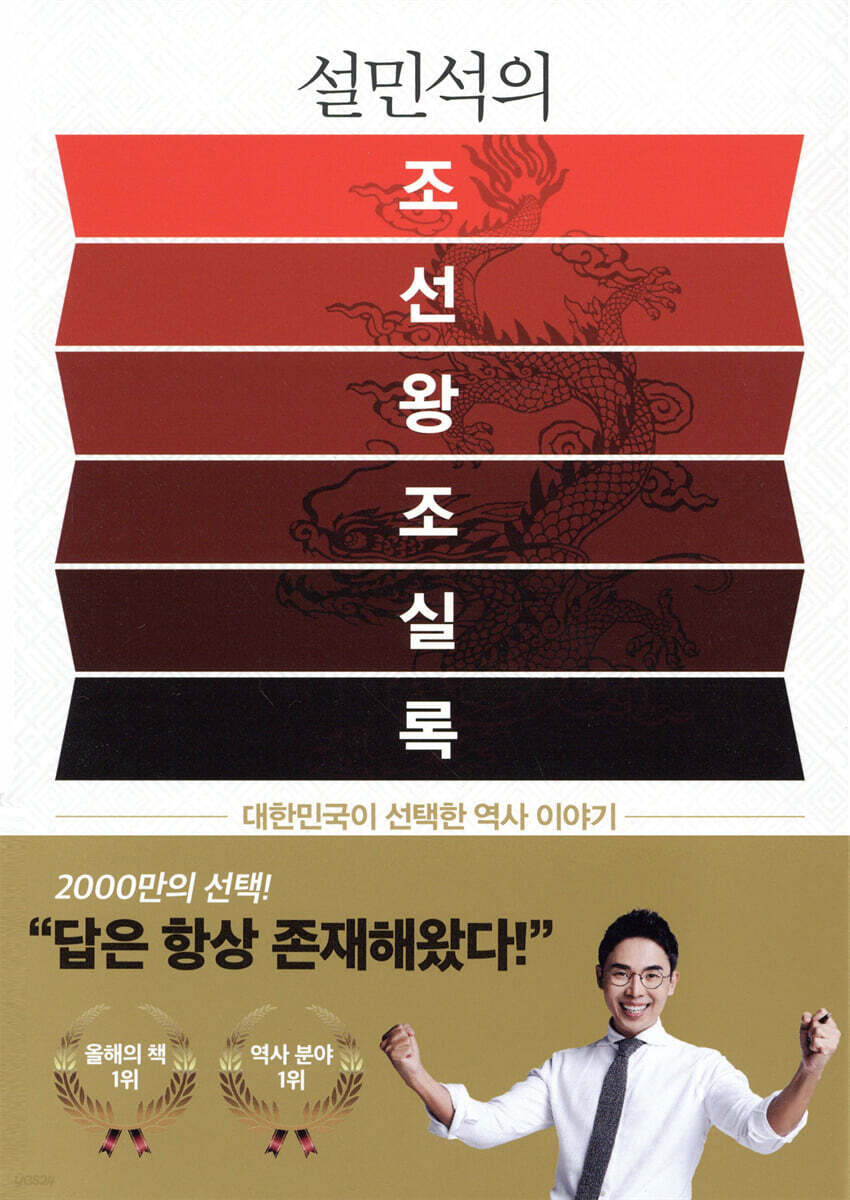
Seol Min-seok's Annals of the Joseon Dynasty
 |
Description
Book Introduction
A must-attend humanities and history lecture from a star lecturer in Korea
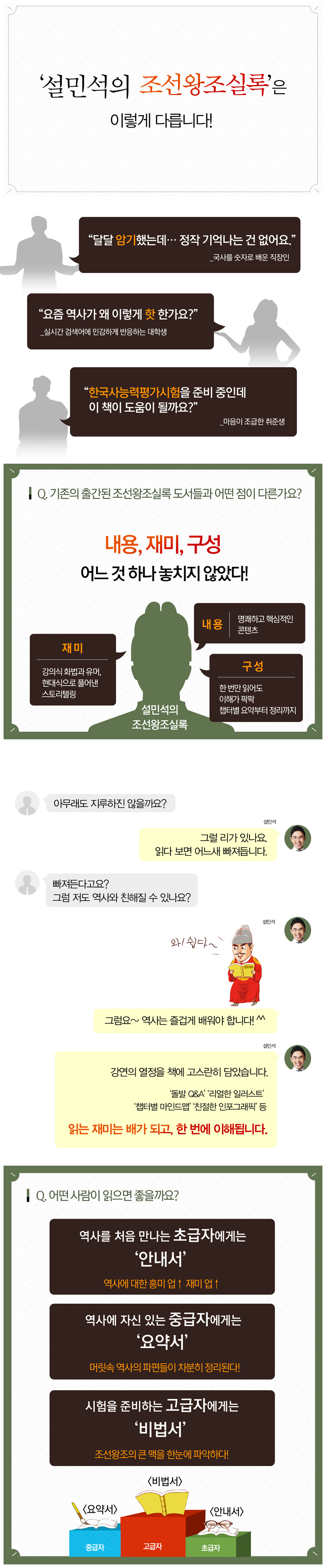
A knowledge concert featuring lectures by Seol Min-seok, featuring 27 Joseon leaders. A book that gathers together the 27 kings of Joseon and explains their key events. Seol Min-seok's characteristically captivating conciseness and witty speech were captured in the book in colloquial style. The question-and-answer session that suddenly appears in the middle makes you feel as if you are listening to a lecture right in front of you. Additionally, the voices of the kings appearing in the Annals are translated into modern language, which helps to clearly understand the policies of the time and the background of the major events. Events that were simply memorized in history class are now understood one by one, and the fragments of shallow national history knowledge that were remembered in a jumbled mess are now being calmly organized. · How does history evaluate the kings who were virtuous, tyrants, and incompetent without presence? · The story behind the fierce factional battle surrounding the throne · The reason why politics of the maternal relatives was so prevalent in the late Joseon Dynasty, etc. Furthermore, the beauty of this book lies in its bold abandonment of the tedious difficulties inherent in existing history books. The detailed portrayal of his human life as a son, husband, and father before becoming a king offers a unique entertainment that cannot be found in textbooks. |
- You can preview some of the book's contents.
Preview
index
Prologue | Easy and Fun History, with Seol Min-seok · 4
The Annals of the Joseon Dynasty: The Most Intimate Records, Unseen Even by the Kings · 13
Before the Founding of Joseon | The Road to a New World·25
【 1st King Taejo 】
Toothless tiger.
Became king at age 57, the oldest king ever to do so. 41
Jeong Do-jeon, a founding father and partner, dreams of a world centered on the prime minister.
- Why did Taejo choose his youngest son as his successor?
- Father Yi Seong-gye vs. son Yi Bang-won
【2nd King Jeongjong】
A tiger in name only.
A Weak King? No! A Master of Worldly Conduct!·63
- Why did King Jeongjong move the capital back to Gaegyeong?
- Declaring his younger brother, Lee Bang-won (Taejong), as the 'Crown Prince'
- King Jeongjong's leisurely later years, which even Lee Bang-won (Taejong) envied
【Taejong the Third】
A real tiger.
Joseon's only king who passed the civil service examination? Strengthening royal authority!·77
- The throne seized by blood, showing true kingship
- The only king who stepped down from the throne of his own free will
【4th King Sejong】
Great Tiger.
A King of the People, by the People, and for the People·101
- The hard-working genius, Sejong!
- Behind the happy people, there were servants who worked their bones off?!
- Sejong's daughter-in-law was a homosexual...
【 5th King Munjong 】
Tired tiger.
The Crown Prince, who lived for 30 years, resembled his father, King Sejong. 139
- King Munjong (文宗) should actually have been King Mujong (武宗)?!
- King Munjong, the king who was prepared, and why his death is regrettable
【 6th King Danjong 】
Young tiger.
The Lonely Boy Monarch Who Became King at Age 15·151
- The reason why King Danjong had no choice but to rely on the famous minister
- Prince Suyang aims his sword at his nephew, the young king!
【 7th King Sejo 】
A scary tiger.
King Sejo's "Strengthening of Royal Authority" Achieved Through Blood · 165
- A copycat, Han Myeong-hoe, creates a list of assassins to make Prince Suyang the king.
- Strengthening royal authority achieved by killing his brothers and nephews
- Sejo's wife and alcohol! And a love of Buddhism.
【 8th King Yeongjong 】
Short-lived tiger.
King who had a son at the age of 12·187
- A king who dreamed of strengthening royal authority like his father, King Sejo
- What disease caused King Yejong's sudden death after only one year on the throne?
【9th King Seongjong】
Model student tiger.
Joseon's greatest model king·197
- Third in line to the throne, he became king through the power of his father-in-law, Han Myeong-hoe.
- Completion of Gyeongguk Daejeon, Joseon's unique legal code
Seongjong, who was a perfect king but a mere zero as a husband!
【10th King Yeonsangun】
Crazy tiger.
Joseon's Greatest Tyrant·215
- Even after learning of the death of his mother, the deposed Queen Yun, he hid his sword of revenge.
- King Yeonsangun who shut the mouths of his subjects and closed his own ears
- The king who 'lived wildly' with a thousand gisaengs
【11th King Jungjong】
The fickle tiger.
The King Who Promoted and Abandoned Jo Gwang-jo·233
- Elementary school textbook [Elementary Learning] that even the king had to read
Jo Gwang-jo, King Jungjong's man! Abandoned by King Jungjong.
【 12th Race 】
Tiger for 9 months.
The shortest-lived king in Joseon, who reigned for less than a year (251)
- A child prodigy who read books fluently from the age of 3
- Why do people with anorexia fast?
【 13th King Myeongjong 】
Mom is a tiger.
A king with no presence, overshadowed by his mother. 263
Queen Munjeong, the queen above the king! Launching a large-scale purge.
- I can't stand it anymore, Im Kkeok-jeong's Rebellion!
【 14th King Seonjo 】
The runaway cat.
The King Who Abandoned His People and Fleeed·277
- King Seonjo, the first king of Joseon from a collateral line
- What was Joseon doing a year before the outbreak of the Imjin War?
- Three reasons why Japan had no choice but to lose the Imjin War.
【15th King Gwanghaegun】
The wronged tiger.
A war hero who loved his people · 303
- A reasonable two-timing between the Ming and Later Jin dynasties
- The end of King Gwanghaegun, who had no choice but to depose his mother and kill his younger brother
【 16th King Injo 】
Kneeling tiger.
The king who apologized to the barbarians·321
- Two wars caused by the pro-Ming dynasty
- What is the truth behind the mysterious death of Prince Sohyeon, the eldest son of King Injo?
【 17th King Hyojong 】
Wasin Consulting Tiger.
The king who tried to wash away his father's shame through the Northern Expedition (337)
- Dreaming of a northern expedition while wielding the Blue Dragon Sword
- Joseon's circumstances surrounding the capture of Dutch nationals stranded on Jeju Island
【 18th King Hyeonjong 】
Powerless tiger.
The King at the Center of Joseon's Greatest Debate, the Yesong Controversy (351)
- King Hyeonjong, embroiled in political conflict over clothing
A Romantic of the Age? A Joseon King with Only One Wife
【 19th King Sukjong 】
Golden spoon tiger.
The ultimate in long-term premiums·359
- The boy monarch King Sukjong defeats Song Si-yeol, a 9th-dan politician.
- Strengthening of royal authority achieved by King Sukjong through three royal revolts
- Jang Hui-bin, the greatest beauty of Joseon recognized in the Annals of the Joseon Dynasty
【 20th King Gyeongjong 】
Sick tiger.
The unfortunate king born as the son of Jang Hui-bin (379)
- The difficult task of protecting the throne of a powerless king
- The crab and persimmons presented by his younger brother, Prince Yeoning (King Yeongjo), and the death of King Gyeongjong
【21st King Yeongjo】
The longest-lived tiger.
Joseon's first king of low-born origins·389
- King Yeongjo said, “I did not poison my brother! You guys!”
- What policies led to the revival of Joseon by establishing the Tangpyeong Monument?
- The tragic fatherly love that led to the death of his son, Crown Prince Sado, by locking him in a rice chest.
【22nd King Jeongjo】
The perfect tiger.
A king who strived to communicate with his people·417
- The son of a traitor becomes a king who loves the people.
- King Jeongjo, a king with both intelligence, virtue, and physical strength
- Constructing Hwaseong Fortress in Suwon, remembering his father, Crown Prince Sado.
【 23rd King Sunjo 】
Incompetent tiger.
A puppet king swayed by the Su-reum-cheong-jeong (445)
- Queen Jeongsun, King Sunjo's great-grandmother, reveals political ambitions.
- The reason Jeong Yak-yong was exiled for 18 years
- The beginning of the politics of the powerful was because of Jeongjo?!
【 24th King Heonjong 】
The youngest tiger.
The young king who ascended the throne at the age of eight, 457
- A time of crisis and confusion
- A 'neighborhood watch system' where people monitor each other
【 25th King Cheoljong 】
Cinderella Tiger.
Joseon's Puppet Kings·4 63
- Making the young master of Ganghwa Island the king by changing the kinship system
- A corrupt era in which taxes were collected even from the dead.
【 26th Emperor Gojong, 1st Emperor of the Korean Empire 】
The unfortunate tiger.
King, who stood in an era of transformation and invasion, 734
- 10 years of regency by Heungseon Daewongun, father of King Gojong
- After the opening of the port, the winds of modern change blew.
- Joseon is in turmoil, and they try to change the national title and make new changes, but…
【 27th Emperor Sunjong, 2nd Emperor of the Korean Empire 】
A cat whose country was stolen.
The last king, who was sickly, 847
- The last prince of Joseon who drank poisoned tea
- The coronation ceremony of the emperor that the protagonist did not attend
Epilogue | You Who Know History See the Present Differently · 492
Appendix 1 | List of Films Set in Joseon Dynasty (495)
Appendix 2 | List of Dramas Set in Joseon Dynasty (497)
Appendix 3 | Infographics at a Glance·501
The Annals of the Joseon Dynasty: The Most Intimate Records, Unseen Even by the Kings · 13
Before the Founding of Joseon | The Road to a New World·25
【 1st King Taejo 】
Toothless tiger.
Became king at age 57, the oldest king ever to do so. 41
Jeong Do-jeon, a founding father and partner, dreams of a world centered on the prime minister.
- Why did Taejo choose his youngest son as his successor?
- Father Yi Seong-gye vs. son Yi Bang-won
【2nd King Jeongjong】
A tiger in name only.
A Weak King? No! A Master of Worldly Conduct!·63
- Why did King Jeongjong move the capital back to Gaegyeong?
- Declaring his younger brother, Lee Bang-won (Taejong), as the 'Crown Prince'
- King Jeongjong's leisurely later years, which even Lee Bang-won (Taejong) envied
【Taejong the Third】
A real tiger.
Joseon's only king who passed the civil service examination? Strengthening royal authority!·77
- The throne seized by blood, showing true kingship
- The only king who stepped down from the throne of his own free will
【4th King Sejong】
Great Tiger.
A King of the People, by the People, and for the People·101
- The hard-working genius, Sejong!
- Behind the happy people, there were servants who worked their bones off?!
- Sejong's daughter-in-law was a homosexual...
【 5th King Munjong 】
Tired tiger.
The Crown Prince, who lived for 30 years, resembled his father, King Sejong. 139
- King Munjong (文宗) should actually have been King Mujong (武宗)?!
- King Munjong, the king who was prepared, and why his death is regrettable
【 6th King Danjong 】
Young tiger.
The Lonely Boy Monarch Who Became King at Age 15·151
- The reason why King Danjong had no choice but to rely on the famous minister
- Prince Suyang aims his sword at his nephew, the young king!
【 7th King Sejo 】
A scary tiger.
King Sejo's "Strengthening of Royal Authority" Achieved Through Blood · 165
- A copycat, Han Myeong-hoe, creates a list of assassins to make Prince Suyang the king.
- Strengthening royal authority achieved by killing his brothers and nephews
- Sejo's wife and alcohol! And a love of Buddhism.
【 8th King Yeongjong 】
Short-lived tiger.
King who had a son at the age of 12·187
- A king who dreamed of strengthening royal authority like his father, King Sejo
- What disease caused King Yejong's sudden death after only one year on the throne?
【9th King Seongjong】
Model student tiger.
Joseon's greatest model king·197
- Third in line to the throne, he became king through the power of his father-in-law, Han Myeong-hoe.
- Completion of Gyeongguk Daejeon, Joseon's unique legal code
Seongjong, who was a perfect king but a mere zero as a husband!
【10th King Yeonsangun】
Crazy tiger.
Joseon's Greatest Tyrant·215
- Even after learning of the death of his mother, the deposed Queen Yun, he hid his sword of revenge.
- King Yeonsangun who shut the mouths of his subjects and closed his own ears
- The king who 'lived wildly' with a thousand gisaengs
【11th King Jungjong】
The fickle tiger.
The King Who Promoted and Abandoned Jo Gwang-jo·233
- Elementary school textbook [Elementary Learning] that even the king had to read
Jo Gwang-jo, King Jungjong's man! Abandoned by King Jungjong.
【 12th Race 】
Tiger for 9 months.
The shortest-lived king in Joseon, who reigned for less than a year (251)
- A child prodigy who read books fluently from the age of 3
- Why do people with anorexia fast?
【 13th King Myeongjong 】
Mom is a tiger.
A king with no presence, overshadowed by his mother. 263
Queen Munjeong, the queen above the king! Launching a large-scale purge.
- I can't stand it anymore, Im Kkeok-jeong's Rebellion!
【 14th King Seonjo 】
The runaway cat.
The King Who Abandoned His People and Fleeed·277
- King Seonjo, the first king of Joseon from a collateral line
- What was Joseon doing a year before the outbreak of the Imjin War?
- Three reasons why Japan had no choice but to lose the Imjin War.
【15th King Gwanghaegun】
The wronged tiger.
A war hero who loved his people · 303
- A reasonable two-timing between the Ming and Later Jin dynasties
- The end of King Gwanghaegun, who had no choice but to depose his mother and kill his younger brother
【 16th King Injo 】
Kneeling tiger.
The king who apologized to the barbarians·321
- Two wars caused by the pro-Ming dynasty
- What is the truth behind the mysterious death of Prince Sohyeon, the eldest son of King Injo?
【 17th King Hyojong 】
Wasin Consulting Tiger.
The king who tried to wash away his father's shame through the Northern Expedition (337)
- Dreaming of a northern expedition while wielding the Blue Dragon Sword
- Joseon's circumstances surrounding the capture of Dutch nationals stranded on Jeju Island
【 18th King Hyeonjong 】
Powerless tiger.
The King at the Center of Joseon's Greatest Debate, the Yesong Controversy (351)
- King Hyeonjong, embroiled in political conflict over clothing
A Romantic of the Age? A Joseon King with Only One Wife
【 19th King Sukjong 】
Golden spoon tiger.
The ultimate in long-term premiums·359
- The boy monarch King Sukjong defeats Song Si-yeol, a 9th-dan politician.
- Strengthening of royal authority achieved by King Sukjong through three royal revolts
- Jang Hui-bin, the greatest beauty of Joseon recognized in the Annals of the Joseon Dynasty
【 20th King Gyeongjong 】
Sick tiger.
The unfortunate king born as the son of Jang Hui-bin (379)
- The difficult task of protecting the throne of a powerless king
- The crab and persimmons presented by his younger brother, Prince Yeoning (King Yeongjo), and the death of King Gyeongjong
【21st King Yeongjo】
The longest-lived tiger.
Joseon's first king of low-born origins·389
- King Yeongjo said, “I did not poison my brother! You guys!”
- What policies led to the revival of Joseon by establishing the Tangpyeong Monument?
- The tragic fatherly love that led to the death of his son, Crown Prince Sado, by locking him in a rice chest.
【22nd King Jeongjo】
The perfect tiger.
A king who strived to communicate with his people·417
- The son of a traitor becomes a king who loves the people.
- King Jeongjo, a king with both intelligence, virtue, and physical strength
- Constructing Hwaseong Fortress in Suwon, remembering his father, Crown Prince Sado.
【 23rd King Sunjo 】
Incompetent tiger.
A puppet king swayed by the Su-reum-cheong-jeong (445)
- Queen Jeongsun, King Sunjo's great-grandmother, reveals political ambitions.
- The reason Jeong Yak-yong was exiled for 18 years
- The beginning of the politics of the powerful was because of Jeongjo?!
【 24th King Heonjong 】
The youngest tiger.
The young king who ascended the throne at the age of eight, 457
- A time of crisis and confusion
- A 'neighborhood watch system' where people monitor each other
【 25th King Cheoljong 】
Cinderella Tiger.
Joseon's Puppet Kings·4 63
- Making the young master of Ganghwa Island the king by changing the kinship system
- A corrupt era in which taxes were collected even from the dead.
【 26th Emperor Gojong, 1st Emperor of the Korean Empire 】
The unfortunate tiger.
King, who stood in an era of transformation and invasion, 734
- 10 years of regency by Heungseon Daewongun, father of King Gojong
- After the opening of the port, the winds of modern change blew.
- Joseon is in turmoil, and they try to change the national title and make new changes, but…
【 27th Emperor Sunjong, 2nd Emperor of the Korean Empire 】
A cat whose country was stolen.
The last king, who was sickly, 847
- The last prince of Joseon who drank poisoned tea
- The coronation ceremony of the emperor that the protagonist did not attend
Epilogue | You Who Know History See the Present Differently · 492
Appendix 1 | List of Films Set in Joseon Dynasty (495)
Appendix 2 | List of Dramas Set in Joseon Dynasty (497)
Appendix 3 | Infographics at a Glance·501
Detailed image
Into the book
I too was one of those people who found history difficult.
Especially during my school days, the history I learned at school was so-called test-oriented history, so I was busy memorizing historical facts and dates.
But after I became an adult, history took on a new meaning.
At a time when I was pondering, "How should I live from now on?", I began to look into the lives of my ancestors through history, which I had previously considered boring and dull.
And now, history gives me direction on how to live going forward.
---From the "Prologue"
Previous kings could live more or less the way they wanted.
If I wanted to drink, I could drink, and if I wanted to have fun, I had the luxury of having fun to some extent.
But this is impossible for the kings of the Joseon Dynasty.
It is because of the contest system that Jeong Do-jeon conceived.
Gyeongyeon is a place where the king and his subjects discuss academics and discuss practical politics, which is essentially a way to educate the king.
We studied in the morning, called morning lectures, during lunch time we had day lectures, and in the evening we had evening lectures.
In this way, he studied with his subjects for a total of 6 hours a day, 2 hours each time.
And after the greetings, you have to work on your personal time as well.
Because we have to listen to the managers' stories.
From the scholars down to the prime ministers up, their petitions must be received and read, but the time for reading these petitions is arranged to be just before bedtime.
Because the petition contained critical content, reading it could be seen as similar to reading malicious comments on the Internet today.
Think about it: Would you be able to sleep well if you read the string of malicious comments on your own writing? It would be a total nightmare.
In this way, it can be said that Jeong Do-jeon's strategy was to catch the kings of the Joseon Dynasty like catching rats and make them into virtuous kings.
---From "The First King Taejo"
Hwang Hee persistently requests his resignation, citing his 'old age and illness'.
But Sejong also stubbornly refused this.
In the end, Sejong's reign lasted 32 years, and Hwang Hui served as Prime Minister for 18 of those years, working hard and eating mustard while crying.
Whenever Hwang Hui was having a hard time, Sejong would comfort and soothe him by saying the following.
“Your age has not yet reached the peak of your decline, and your illness has not reached a serious level. Your energy is strong enough to govern the country. If you do become ill, you should be treated with medicine. Even if it is not a conventional show of force, how can you resign from your position due to the constraints of common practice?”
『Sejong Sillok』 Volume 56, April 20, Year 14 (1432)
To a 68-year-old man who is about to retire because his body is aching and broken down here and there, he is saying, "You are not yet weak enough to die, and your illness is not serious. If you do find a serious illness, you can just get treatment."
It's really crazy.
---From "The Fourth King Sejong"
In June of the 11th year of King Yeonsangun's reign (1505), King Yeonsangun dispatched 'Chae Hongjunsa', a local official, to seek out beautiful women and strong horses from all eight provinces of the country.
He also has a thousand parasites.
Among them, those who were outstandingly talented were called 'Unpyeong', and those who were not only talented but also beautiful were called 'Heungcheong'.
They were housed in Won-gak-sa Temple (present-day Tapgol Park), which was built by King Sejo, the great-grandfather of King Yeonsangun.
King Yeonsangun gave many rewards to many gisaengs and enjoyed playing with them in the palace.
Because of these games, the national treasury is emptied and the country is on the verge of ruin.
This is where the word 'heungcheongmangcheong' comes from.
---From "The 10th King Yeonsangun"
As the Japanese army continues to invade Hanyang, an unprecedented incident occurs in Hanyang.
The king abandoned the palace and ran away.
To preserve his own safety, King Seonjo left Hanyang and moved to Gaeseong, Pyongyang, and Uiju, gradually moving further north.
Of course, the king's safety was important in Joseon, but King Seonjo's actions were something Japan could never have imagined.
Even if the Japanese are the lords of small castles, they will never abandon their castles or run away, and will not commit seppuku or surrender when threatened with defeat in war.
The fact that the king had fled angered not only the Japanese army but also the people of Joseon.
How could a father of a nation abandon his children and flee for his own survival? The people's anger turned to Gyeongbokgung Palace.
And while burning the slave documents in Gyeongbokgung Palace, they also burned down the palace itself.
---From "The 14th Ancestor"
But the problem is that Joseon was a time when the people did not have the right to directly elect a king.
As can be seen from the fact that all the kings' surnames were Lee, Joseon could only be succeeded by 'the descendants of King Taejo Lee Seong-gye.'
In the end, from the people's perspective, if they are lucky enough to meet a king who loves the people, it is a blessing in disguise, but if they are unlucky enough to meet an incompetent king, their lives will inevitably be difficult in a world ruled by relatives.
Now we have the precious right to vote to elect a virtuous leader and true worker like Sejong as president.
So how do we make a difference? It's possible only if we all have a constant interest in and affection for society.
We can choose Sejong directly with our own hands, or we can choose Yeonsangun.
Especially during my school days, the history I learned at school was so-called test-oriented history, so I was busy memorizing historical facts and dates.
But after I became an adult, history took on a new meaning.
At a time when I was pondering, "How should I live from now on?", I began to look into the lives of my ancestors through history, which I had previously considered boring and dull.
And now, history gives me direction on how to live going forward.
---From the "Prologue"
Previous kings could live more or less the way they wanted.
If I wanted to drink, I could drink, and if I wanted to have fun, I had the luxury of having fun to some extent.
But this is impossible for the kings of the Joseon Dynasty.
It is because of the contest system that Jeong Do-jeon conceived.
Gyeongyeon is a place where the king and his subjects discuss academics and discuss practical politics, which is essentially a way to educate the king.
We studied in the morning, called morning lectures, during lunch time we had day lectures, and in the evening we had evening lectures.
In this way, he studied with his subjects for a total of 6 hours a day, 2 hours each time.
And after the greetings, you have to work on your personal time as well.
Because we have to listen to the managers' stories.
From the scholars down to the prime ministers up, their petitions must be received and read, but the time for reading these petitions is arranged to be just before bedtime.
Because the petition contained critical content, reading it could be seen as similar to reading malicious comments on the Internet today.
Think about it: Would you be able to sleep well if you read the string of malicious comments on your own writing? It would be a total nightmare.
In this way, it can be said that Jeong Do-jeon's strategy was to catch the kings of the Joseon Dynasty like catching rats and make them into virtuous kings.
---From "The First King Taejo"
Hwang Hee persistently requests his resignation, citing his 'old age and illness'.
But Sejong also stubbornly refused this.
In the end, Sejong's reign lasted 32 years, and Hwang Hui served as Prime Minister for 18 of those years, working hard and eating mustard while crying.
Whenever Hwang Hui was having a hard time, Sejong would comfort and soothe him by saying the following.
“Your age has not yet reached the peak of your decline, and your illness has not reached a serious level. Your energy is strong enough to govern the country. If you do become ill, you should be treated with medicine. Even if it is not a conventional show of force, how can you resign from your position due to the constraints of common practice?”
『Sejong Sillok』 Volume 56, April 20, Year 14 (1432)
To a 68-year-old man who is about to retire because his body is aching and broken down here and there, he is saying, "You are not yet weak enough to die, and your illness is not serious. If you do find a serious illness, you can just get treatment."
It's really crazy.
---From "The Fourth King Sejong"
In June of the 11th year of King Yeonsangun's reign (1505), King Yeonsangun dispatched 'Chae Hongjunsa', a local official, to seek out beautiful women and strong horses from all eight provinces of the country.
He also has a thousand parasites.
Among them, those who were outstandingly talented were called 'Unpyeong', and those who were not only talented but also beautiful were called 'Heungcheong'.
They were housed in Won-gak-sa Temple (present-day Tapgol Park), which was built by King Sejo, the great-grandfather of King Yeonsangun.
King Yeonsangun gave many rewards to many gisaengs and enjoyed playing with them in the palace.
Because of these games, the national treasury is emptied and the country is on the verge of ruin.
This is where the word 'heungcheongmangcheong' comes from.
---From "The 10th King Yeonsangun"
As the Japanese army continues to invade Hanyang, an unprecedented incident occurs in Hanyang.
The king abandoned the palace and ran away.
To preserve his own safety, King Seonjo left Hanyang and moved to Gaeseong, Pyongyang, and Uiju, gradually moving further north.
Of course, the king's safety was important in Joseon, but King Seonjo's actions were something Japan could never have imagined.
Even if the Japanese are the lords of small castles, they will never abandon their castles or run away, and will not commit seppuku or surrender when threatened with defeat in war.
The fact that the king had fled angered not only the Japanese army but also the people of Joseon.
How could a father of a nation abandon his children and flee for his own survival? The people's anger turned to Gyeongbokgung Palace.
And while burning the slave documents in Gyeongbokgung Palace, they also burned down the palace itself.
---From "The 14th Ancestor"
But the problem is that Joseon was a time when the people did not have the right to directly elect a king.
As can be seen from the fact that all the kings' surnames were Lee, Joseon could only be succeeded by 'the descendants of King Taejo Lee Seong-gye.'
In the end, from the people's perspective, if they are lucky enough to meet a king who loves the people, it is a blessing in disguise, but if they are unlucky enough to meet an incompetent king, their lives will inevitably be difficult in a world ruled by relatives.
Now we have the precious right to vote to elect a virtuous leader and true worker like Sejong as president.
So how do we make a difference? It's possible only if we all have a constant interest in and affection for society.
We can choose Sejong directly with our own hands, or we can choose Yeonsangun.
---From the "Epilogue"
Publisher's Review
★ Clear explanations! Core content! It couldn't be easier!
★ The #1 Humanities and History Lecture by a Star Instructor in Korea You Must Attend at Lecture Hall
★ Appeared on many shows including MBC's Infinite Challenge and O'tvN's Somehow Adult, becoming a hot topic!
“If only I could see the former king’s records just once…”
The record of truth that even kings could never open
Who said Joseon was the history of monarchs?
The most intimate records that even the most powerful king could never access.
This extensive record, consisting of 2,077 volumes, is recognized for its global value and is currently registered as a UNESCO Memory of the World.
The reason the Annals of the Joseon Dynasty, with a history spanning over 500 years, still hold significance today is because it contains the concerns of the time regarding politics, economy, culture, and all aspects of society.
In fact, the voices of the king and his subjects at that time are quoted as they are in the Annals of the Joseon Dynasty.
There are also sharp evaluations from officers.
Therefore, reading the Annals of the Joseon Dynasty is like seeing the naked truth of the Joseon Dynasty.
And that bare face somehow resembles today's Republic of Korea a lot.
27 leaders of Joseon
A knowledge concert presented through Seol Min-seok's lectures
『Seol Min-seok's Annals of the Joseon Dynasty』 is a book that gathers together the 27 kings of Joseon and explains the key events that occurred during their reign.
Seol Min-seok's characteristically captivating conciseness and witty speech were captured in the book in colloquial style.
The question-and-answer session that suddenly appears in the middle makes you feel as if you are listening to a lecture right in front of you.
Additionally, the voices of the kings appearing in the Annals are translated into modern language, which helps to clearly understand the policies of the time and the background of the major events.
Events that were simply memorized in history class are now understood one by one, and the fragments of shallow national history knowledge that were remembered in a jumbled mess are now being calmly organized.
· How does history evaluate the kings who were virtuous, tyrants, and incompetent without presence?
· The story behind the fierce factional battle surrounding the throne
· The reason why politics of the maternal relatives was so prevalent in the late Joseon Dynasty, etc.
Furthermore, the beauty of this book lies in its bold abandonment of the tedious difficulties inherent in existing history books.
The detailed portrayal of his human life as a son, husband, and father before becoming a king offers a unique entertainment that cannot be found in textbooks.
For everyone from students to adults,
A thoroughly planned popular humanities book
Perhaps the reason for the recent surge of content on history is a desire to find true answers to the "present." Even though their titles may have changed from kings to presidents, their policies and roles have had a profound impact on the lives of the people.
600 years ago, King Sejong granted a month's paternity leave to male slaves, and 420 years ago, King Seonjo abandoned his people and became self-righteous when war broke out.
The greatest joy of reading the Annals of the Joseon Dynasty lies in the ability to gain 'the insight to evaluate the role of a leader' and 'the foresight to look to the future.'
『Seol Min-seok's Annals of the Joseon Dynasty』 is perfect for readers who want to know the main story and core of Joseon history.
It is a popular humanities content that can be comfortably read and enjoyed by everyone from students to adults.
★ The #1 Humanities and History Lecture by a Star Instructor in Korea You Must Attend at Lecture Hall
★ Appeared on many shows including MBC's Infinite Challenge and O'tvN's Somehow Adult, becoming a hot topic!
“If only I could see the former king’s records just once…”
The record of truth that even kings could never open
Who said Joseon was the history of monarchs?
The most intimate records that even the most powerful king could never access.
This extensive record, consisting of 2,077 volumes, is recognized for its global value and is currently registered as a UNESCO Memory of the World.
The reason the Annals of the Joseon Dynasty, with a history spanning over 500 years, still hold significance today is because it contains the concerns of the time regarding politics, economy, culture, and all aspects of society.
In fact, the voices of the king and his subjects at that time are quoted as they are in the Annals of the Joseon Dynasty.
There are also sharp evaluations from officers.
Therefore, reading the Annals of the Joseon Dynasty is like seeing the naked truth of the Joseon Dynasty.
And that bare face somehow resembles today's Republic of Korea a lot.
27 leaders of Joseon
A knowledge concert presented through Seol Min-seok's lectures
『Seol Min-seok's Annals of the Joseon Dynasty』 is a book that gathers together the 27 kings of Joseon and explains the key events that occurred during their reign.
Seol Min-seok's characteristically captivating conciseness and witty speech were captured in the book in colloquial style.
The question-and-answer session that suddenly appears in the middle makes you feel as if you are listening to a lecture right in front of you.
Additionally, the voices of the kings appearing in the Annals are translated into modern language, which helps to clearly understand the policies of the time and the background of the major events.
Events that were simply memorized in history class are now understood one by one, and the fragments of shallow national history knowledge that were remembered in a jumbled mess are now being calmly organized.
· How does history evaluate the kings who were virtuous, tyrants, and incompetent without presence?
· The story behind the fierce factional battle surrounding the throne
· The reason why politics of the maternal relatives was so prevalent in the late Joseon Dynasty, etc.
Furthermore, the beauty of this book lies in its bold abandonment of the tedious difficulties inherent in existing history books.
The detailed portrayal of his human life as a son, husband, and father before becoming a king offers a unique entertainment that cannot be found in textbooks.
For everyone from students to adults,
A thoroughly planned popular humanities book
Perhaps the reason for the recent surge of content on history is a desire to find true answers to the "present." Even though their titles may have changed from kings to presidents, their policies and roles have had a profound impact on the lives of the people.
600 years ago, King Sejong granted a month's paternity leave to male slaves, and 420 years ago, King Seonjo abandoned his people and became self-righteous when war broke out.
The greatest joy of reading the Annals of the Joseon Dynasty lies in the ability to gain 'the insight to evaluate the role of a leader' and 'the foresight to look to the future.'
『Seol Min-seok's Annals of the Joseon Dynasty』 is perfect for readers who want to know the main story and core of Joseon history.
It is a popular humanities content that can be comfortably read and enjoyed by everyone from students to adults.
GOODS SPECIFICS
- Date of publication: July 25, 2016
- Page count, weight, size: 504 pages | 991g | 165*235*30mm
- ISBN13: 9788933870693
- ISBN10: 8933870695
You may also like
카테고리
korean


korean

![GQ KOREA Mark (Monthly): December [2025]](http://librairie.coreenne.fr/cdn/shop/files/8ef265dbbfbf186523ed75ba7319009d.jpg?v=1765340328&width=3840)


