

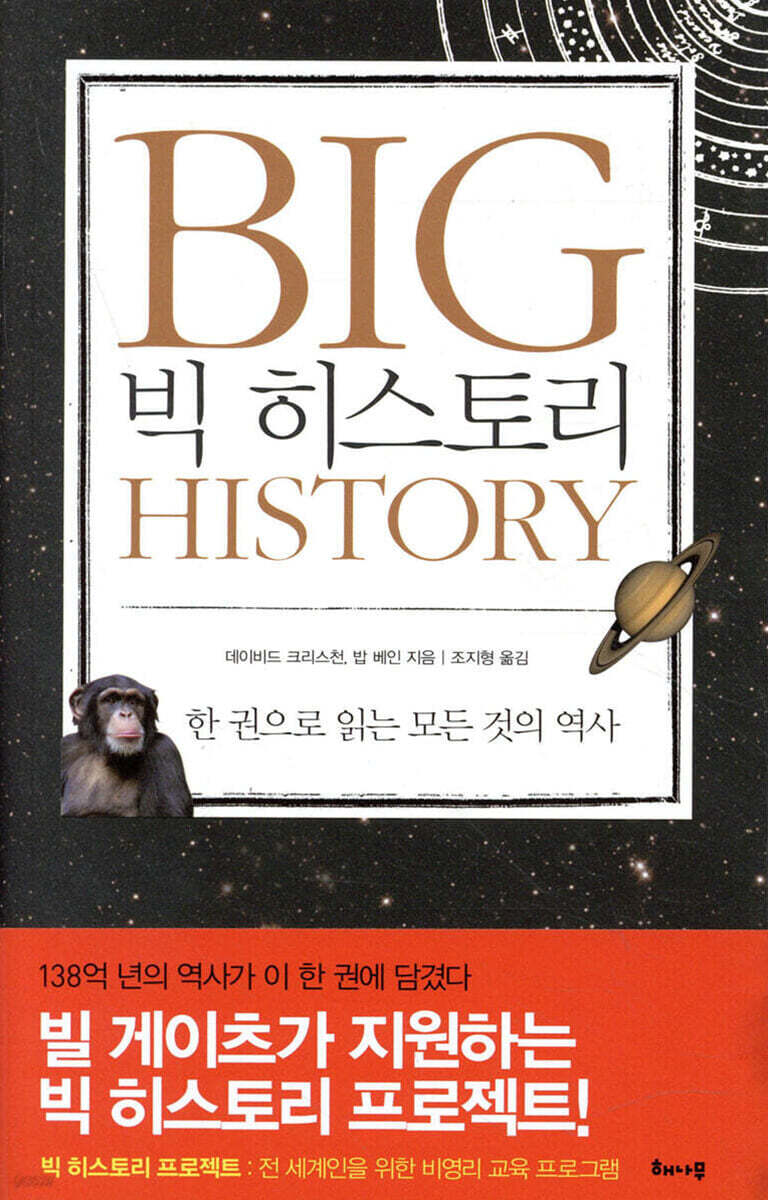
Big History BIG HISTORY
 |
Description
Book Introduction
- A word from MD
-
A convergence liberal arts project sponsored by Bill Gates!A liberal arts lecture project fully supported by Bill Gates.
This history lecture covers a full 13.7 billion years, from the origins of the universe to modern and future society, and combines science and humanities to read the history of nature and humanity as one.
The birth of a creative and comprehensive convergence education that is essential for our times!
13.7 billion years of history contained in this one volume
The Big History Project, backed by Bill Gates!
How did it all begin?
How did the universe come to function as it does today?
Why do we exist in this vast universe?
Why did humans become so powerful?
What exactly is humanity, and what is human history?
The history of the universe, Earth, and humanity in one volume.
David Christian and Bob Bain's Big History is a history book that covers everything from the origins of the universe to modern society and the future.
It crosses various academic fields, including astronomy, physics, biology, archaeology, anthropology, and history, and examines the history of nature and humanity from a cosmic perspective of 13.7 billion years.
We have translated the core lectures of the 'Big History Project' curriculum, which is being supported by Bill Gates, into Korean.
As this is a core lecture, you can see at a glance what Big History is and what it covers.
It shows the most important and significant historical events in a big picture, such as the Big Bang, the birth of the solar system, the birth of the Earth, the origin of life, the emergence of mankind, the birth of civilization, and the development of industry.
This book serves as an introduction and guide to Big History, which understands the history of nature and human history as one grand story.
The Big History Project, backed by Bill Gates!
How did it all begin?
How did the universe come to function as it does today?
Why do we exist in this vast universe?
Why did humans become so powerful?
What exactly is humanity, and what is human history?
The history of the universe, Earth, and humanity in one volume.
David Christian and Bob Bain's Big History is a history book that covers everything from the origins of the universe to modern society and the future.
It crosses various academic fields, including astronomy, physics, biology, archaeology, anthropology, and history, and examines the history of nature and humanity from a cosmic perspective of 13.7 billion years.
We have translated the core lectures of the 'Big History Project' curriculum, which is being supported by Bill Gates, into Korean.
As this is a core lecture, you can see at a glance what Big History is and what it covers.
It shows the most important and significant historical events in a big picture, such as the Big Bang, the birth of the solar system, the birth of the Earth, the origin of life, the emergence of mankind, the birth of civilization, and the development of industry.
This book serves as an introduction and guide to Big History, which understands the history of nature and human history as one grand story.
- You can preview some of the book's contents.
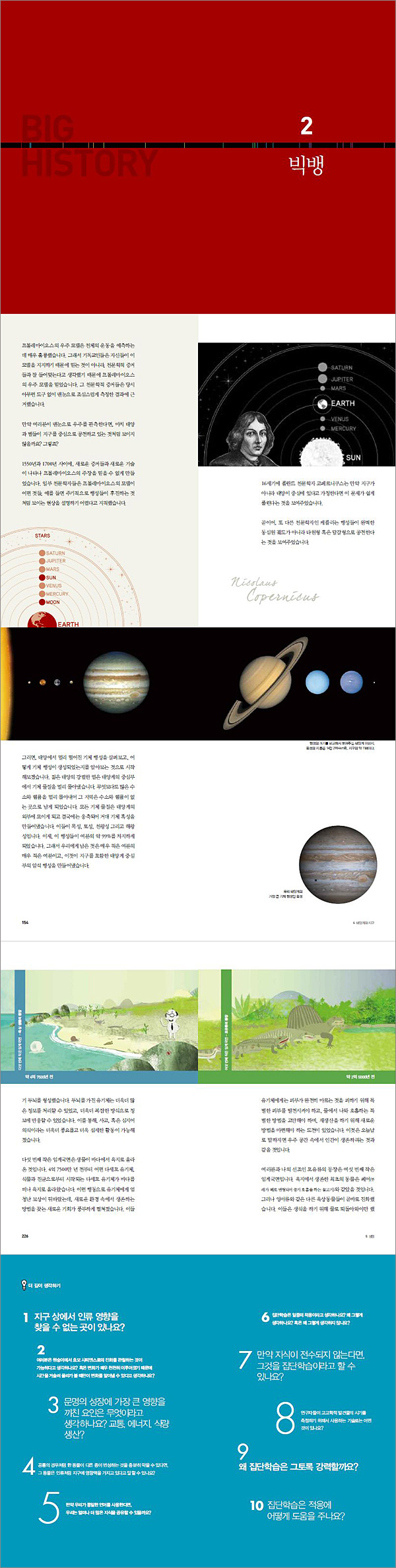
Preview
index
Preface to the Korean Edition: A Concise and Clear Big History _David Christian
Recommendation: Why I Love Big History _Bill Gates
1 What is Big History?
1-1 What is Big History?
1-2 How do we know what is true and what is not?
2 Big Bang
2-1 How has our view of the universe changed?
2-2 What emerged from the Big Bang?
3 stars and elements
3-1 How are stars formed?
3-2 What did the stars give us?
4 The Solar System and Earth
4-1 How was the Earth created?
4-2 What did the early Earth look like?
5 lives
5-1 What is life?
5-2 How did life begin and change?
5-3 How do the Earth and living things interact?
6 Early humans
6-1 How did our ancestors evolve?
6-2 What makes humans unique?
6-3 How did the first humans live?
7 Agriculture and Civilization
7-1 Why is agriculture so important?
7-2 Where and why did the first cities appear?
8 Expansion and Interconnection
8-1 How is the world connected?
9 acceleration
9-1 How did the change accelerate?
9-2 How was the modern world created?
10 Future
10-1 How will complexity increase in the future?
Translator's Note
Source of the illustration
Recommendation: Why I Love Big History _Bill Gates
1 What is Big History?
1-1 What is Big History?
1-2 How do we know what is true and what is not?
2 Big Bang
2-1 How has our view of the universe changed?
2-2 What emerged from the Big Bang?
3 stars and elements
3-1 How are stars formed?
3-2 What did the stars give us?
4 The Solar System and Earth
4-1 How was the Earth created?
4-2 What did the early Earth look like?
5 lives
5-1 What is life?
5-2 How did life begin and change?
5-3 How do the Earth and living things interact?
6 Early humans
6-1 How did our ancestors evolve?
6-2 What makes humans unique?
6-3 How did the first humans live?
7 Agriculture and Civilization
7-1 Why is agriculture so important?
7-2 Where and why did the first cities appear?
8 Expansion and Interconnection
8-1 How is the world connected?
9 acceleration
9-1 How did the change accelerate?
9-2 How was the modern world created?
10 Future
10-1 How will complexity increase in the future?
Translator's Note
Source of the illustration
Detailed image
Publisher's Review
Big History that Bill Gates fell in love with at first sight!
The Big History Project's core lectures are now available as a book!
“Big History has been with me throughout my life.
“It is my favorite field of study.”
- Bill Gates
From the Big Bang to the future,
Big History: A Fusion of Science and Humanities
An introductory book to Big History, which looks at history on the largest scale, has been published.
David Christian (professor at Macquarie University, Australia) and Bob Bain (professor at the University of Michigan, USA)'s "Big History" is a book version of the core lecture series of the Big History Project, which is supported by Bill Gates.
Since 2009, Bill Gates has been promoting the 'Big History Project' to develop a Big History curriculum, and the Big History lecture series is the most core content of this project.
It broadly presents 13.7 billion years of history, from the Big Bang to the birth of stars, the birth of the solar system and the Earth, the origin of life, the emergence of mankind, the emergence of civilization, and the development of modern society.
What is it about Big History that has captivated even Bill Gates? Big History is a convergence of science and the humanities. To understand humanity, it seeks to look beyond human history to the history of the entire universe.
So, the story begins not with the origins of humanity or civilization, but with the creation of our universe 13.7 billion years ago.
By drawing on not only history but also astronomy, physics, biology, geology, archaeology, and anthropology, it demonstrates in a remarkable way that human history is part of the larger history of the Earth, and even more so, the history of the universe.
It is the 'largest scale history' that allows us to understand where 'I' and 'we' are located in the vast universe.
Big History draws on physics, astronomy, and chemistry to explain the origin of the universe, and biology, chemistry, and anthropology to explain the origin of life.
It is completely different from the way we have approached the structure of atoms in physics, the combination of elements in chemistry, and the evolution of living things in biology.
So, Big History, like a multi-tap that can plug in multiple codes, naturally integrates scattered pieces of knowledge and allows us to understand them in a larger context.
A grand story connecting nature and human history,
Big history is living history!
The most striking feature of this book is that it traces the Big Bang, the origin of the universe, life on Earth, the evolution of humanity, the birth of civilization, and the development of modern society in chronological order, showing that increasingly complex things have emerged over the past 13.7 billion years.
The author develops the story around eight critical junctures (points or periods when new phenomena appear) that are most noteworthy in the history of the universe, based on the grand premise that new things with completely new characteristics have gradually emerged in the universe.
The first critical point is the Big Bang (13.7 billion years ago), the second is the emergence of stars (13.5 billion years ago), the third is the emergence of new elements (13.5 billion years ago), the fourth is the birth of the solar system and Earth (4.5 billion years ago), the fifth is the emergence of life on Earth (3.8 billion years ago), the sixth is the collective learning of humanity (200,000 years ago), the seventh is the beginning of agriculture (11,000 years ago), and the eighth is the Modern Revolution (250 years ago).
This book asks questions, big and small, as it passes through each critical juncture.
Why study Big History? How has our view of the universe changed? What emerged from the Big Bang? How were stars formed? What have stars given us? How did the Earth and life begin? What makes humans unique? Why is agriculture important? How is the world interconnected? How was the modern world created?
For big, bold questions, we offer our own answers based on scientific and historical knowledge revealed by numerous scholars throughout history.
If the history of the universe were likened to a giant tree, the eight critical junctures focused on in this book would correspond to the thickest branches of the tree.
If we were to cover all the countless branches that branch out from this main branch, it would be a literal 'big history.'
So, Big History is a history that is in progress and constantly being upgraded (this is probably why the Big History Project promoted by Bill Gates continues to increase in detail over time).
But to avoid getting lost on a cosmic scale, we will need to focus on the big branches.
What 『Big History』 wants to show is the thick branches, that is, the big flow.
The answers presented in this book are not perfect.
Just as the mysteries of the universe and life have not yet been fully revealed, this book leaves unanswered questions unanswered.
However, this book can serve as a sufficient guide to help us realize how much we know about the universe, what questions we can ask, and where we are headed.
What is the Big History Project?
Big History is an academic discipline that seeks to understand the history of the universe, Earth, life, and humanity as a single, coherent story through an integrated academic methodology.
Author David Christian first coined the term 'Big History' to encompass history from the Big Bang to the present, and has been giving lectures on Big History in Australia, the United States, and other countries for over 20 years.
Bill Gates, co-founder of Microsoft, was so inspired by a Big History lecture he happened to hear a few years ago that he started the Big History Project with David Christian.
The Big History pilot project began in September 2011 with the full support of Bill Gates, and the online regular curriculum content has now been completed and released to general teachers, and will soon be available to the general public.
You can download a variety of lecture videos, lecture materials, and images for free from the Big History Project website.
In Korea, the Ewha Womans University Earth History Research Institute has signed an exclusive MOU (Memorandum of Understanding) with Bill Gates' bgC3 to operate a Big History education program for the general public, college students, and middle and high school students, and is also developing educational content.
The Big History Project's core lectures are now available as a book!
“Big History has been with me throughout my life.
“It is my favorite field of study.”
- Bill Gates
From the Big Bang to the future,
Big History: A Fusion of Science and Humanities
An introductory book to Big History, which looks at history on the largest scale, has been published.
David Christian (professor at Macquarie University, Australia) and Bob Bain (professor at the University of Michigan, USA)'s "Big History" is a book version of the core lecture series of the Big History Project, which is supported by Bill Gates.
Since 2009, Bill Gates has been promoting the 'Big History Project' to develop a Big History curriculum, and the Big History lecture series is the most core content of this project.
It broadly presents 13.7 billion years of history, from the Big Bang to the birth of stars, the birth of the solar system and the Earth, the origin of life, the emergence of mankind, the emergence of civilization, and the development of modern society.
What is it about Big History that has captivated even Bill Gates? Big History is a convergence of science and the humanities. To understand humanity, it seeks to look beyond human history to the history of the entire universe.
So, the story begins not with the origins of humanity or civilization, but with the creation of our universe 13.7 billion years ago.
By drawing on not only history but also astronomy, physics, biology, geology, archaeology, and anthropology, it demonstrates in a remarkable way that human history is part of the larger history of the Earth, and even more so, the history of the universe.
It is the 'largest scale history' that allows us to understand where 'I' and 'we' are located in the vast universe.
Big History draws on physics, astronomy, and chemistry to explain the origin of the universe, and biology, chemistry, and anthropology to explain the origin of life.
It is completely different from the way we have approached the structure of atoms in physics, the combination of elements in chemistry, and the evolution of living things in biology.
So, Big History, like a multi-tap that can plug in multiple codes, naturally integrates scattered pieces of knowledge and allows us to understand them in a larger context.
A grand story connecting nature and human history,
Big history is living history!
The most striking feature of this book is that it traces the Big Bang, the origin of the universe, life on Earth, the evolution of humanity, the birth of civilization, and the development of modern society in chronological order, showing that increasingly complex things have emerged over the past 13.7 billion years.
The author develops the story around eight critical junctures (points or periods when new phenomena appear) that are most noteworthy in the history of the universe, based on the grand premise that new things with completely new characteristics have gradually emerged in the universe.
The first critical point is the Big Bang (13.7 billion years ago), the second is the emergence of stars (13.5 billion years ago), the third is the emergence of new elements (13.5 billion years ago), the fourth is the birth of the solar system and Earth (4.5 billion years ago), the fifth is the emergence of life on Earth (3.8 billion years ago), the sixth is the collective learning of humanity (200,000 years ago), the seventh is the beginning of agriculture (11,000 years ago), and the eighth is the Modern Revolution (250 years ago).
This book asks questions, big and small, as it passes through each critical juncture.
Why study Big History? How has our view of the universe changed? What emerged from the Big Bang? How were stars formed? What have stars given us? How did the Earth and life begin? What makes humans unique? Why is agriculture important? How is the world interconnected? How was the modern world created?
For big, bold questions, we offer our own answers based on scientific and historical knowledge revealed by numerous scholars throughout history.
If the history of the universe were likened to a giant tree, the eight critical junctures focused on in this book would correspond to the thickest branches of the tree.
If we were to cover all the countless branches that branch out from this main branch, it would be a literal 'big history.'
So, Big History is a history that is in progress and constantly being upgraded (this is probably why the Big History Project promoted by Bill Gates continues to increase in detail over time).
But to avoid getting lost on a cosmic scale, we will need to focus on the big branches.
What 『Big History』 wants to show is the thick branches, that is, the big flow.
The answers presented in this book are not perfect.
Just as the mysteries of the universe and life have not yet been fully revealed, this book leaves unanswered questions unanswered.
However, this book can serve as a sufficient guide to help us realize how much we know about the universe, what questions we can ask, and where we are headed.
What is the Big History Project?
Big History is an academic discipline that seeks to understand the history of the universe, Earth, life, and humanity as a single, coherent story through an integrated academic methodology.
Author David Christian first coined the term 'Big History' to encompass history from the Big Bang to the present, and has been giving lectures on Big History in Australia, the United States, and other countries for over 20 years.
Bill Gates, co-founder of Microsoft, was so inspired by a Big History lecture he happened to hear a few years ago that he started the Big History Project with David Christian.
The Big History pilot project began in September 2011 with the full support of Bill Gates, and the online regular curriculum content has now been completed and released to general teachers, and will soon be available to the general public.
You can download a variety of lecture videos, lecture materials, and images for free from the Big History Project website.
In Korea, the Ewha Womans University Earth History Research Institute has signed an exclusive MOU (Memorandum of Understanding) with Bill Gates' bgC3 to operate a Big History education program for the general public, college students, and middle and high school students, and is also developing educational content.
GOODS SPECIFICS
- Date of issue: September 10, 2013
- Page count, weight, size: 432 pages | 554g | 135*215*30mm
- ISBN13: 9788956056937
- ISBN10: 8956056935
You may also like
카테고리
korean


korean

![GQ KOREA Mark (Monthly): December [2025]](http://librairie.coreenne.fr/cdn/shop/files/8ef265dbbfbf186523ed75ba7319009d.jpg?v=1765340328&width=3840)


